
Gender Bias in ASD Diagnostic and Screening Tools: A Systematic Review and Meta-Analysis

Abstract
1. Introduction
2. Materials and Methods
2.1. Study Design
2.2. Literature Search Strategy
2.3. Eligibility Criteria
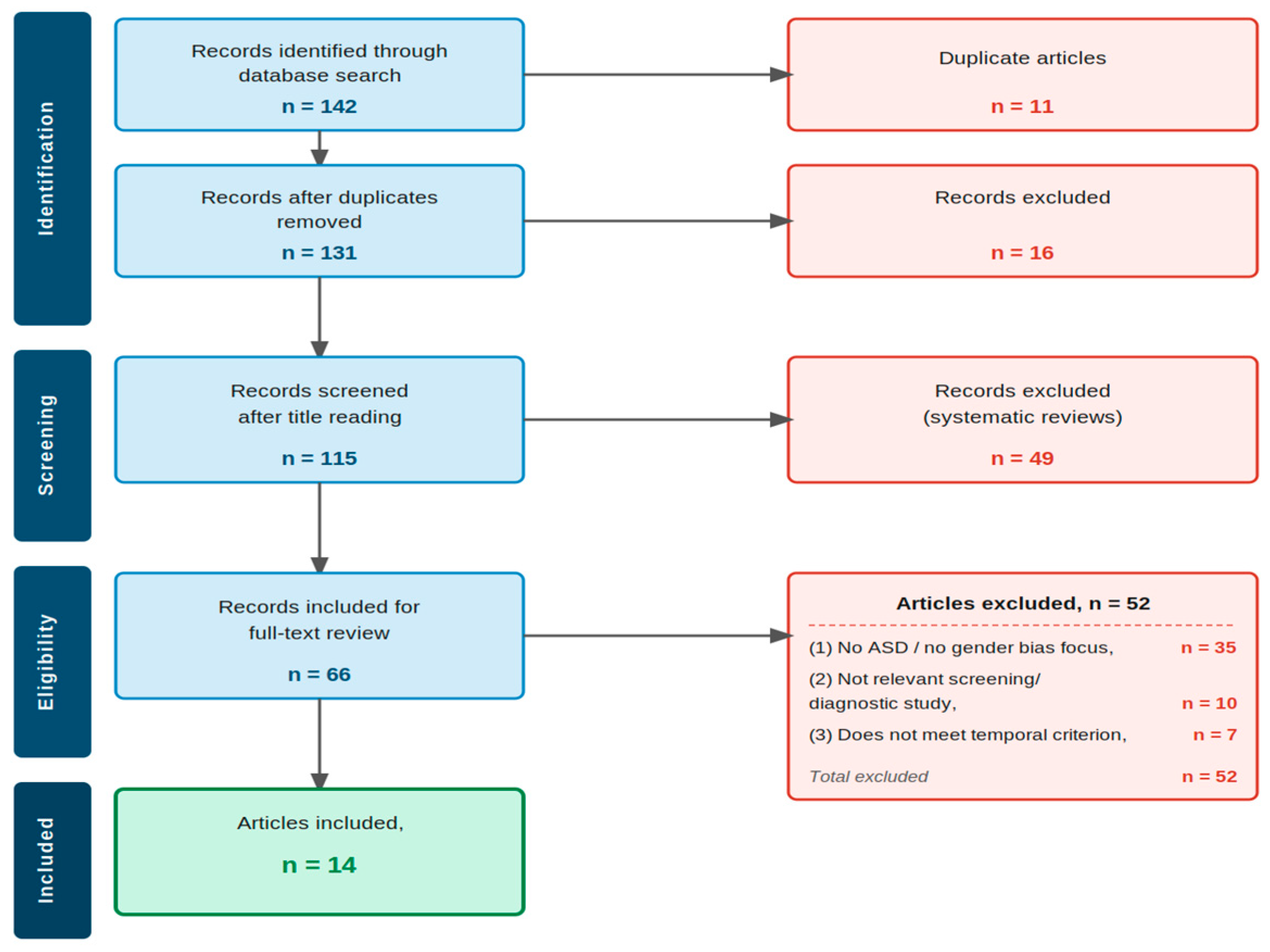
Study Selection Process
- -
- P (Population): Individuals assessed for suspected ASD or included in population-based studies using autism trait screening instruments.
- -
- E (Exposure): Sex assigned at birth and/or gender, treated as a moderator of diagnostic performance; studies explicitly analyzing differences associated with gender socialization or camouflaging were included.
- -
- C (Comparison): Contrasted group comparisons (girls vs. boys; AFAB vs. AMAB).
- -
- (Outcomes): Indicators of diagnostic functioning, including diagnosis probability, instrument performance, diagnostic thresholds, or differential diagnostic prediction.
2.4. Data Extraction
2.5. Methodological Quality Assessment
2.6. Risk of Bias Assessment
2.7. Statistical Analysis
2.8. Use of Artificial Intelligence
3. Results
3.1. Included Studies
3.2. Heterogeneity and Publication Bias
3.3. Exploratory Subgroup Analysis by Study Context
4. Discussion
4.1. Clinical Interpretation
4.2. The Role of Camouflaging
4.3. Limitations
4.4. Methodological Implications and Future Research Directions
5. Conclusions
Supplementary Materials
Author Contributions
Funding
Institutional Review Board Statement
Informed Consent Statement
Data Availability Statement
Acknowledgments
Conflicts of Interest
Abbreviations
| ADI-R | Autism Diagnostic Interview—Revised |
| ADHD | Attention-Deficit/Hyperactivity Disorder |
| ADOS/ADOS-2 | Autism Diagnostic Observation Schedule (2nd edition) |
| AFAB | Assigned Female At Birth |
| AMAB | Assigned Male At Birth |
| APA | American Psychological Association |
| ASD | Autism Spectrum Disorder |
| ASC-ASD | Anxiety Scale for Children—Autism Spectrum Disorder |
| BAP-Q | Broader Autism Phenotype Questionnaire |
| CAT-Q/CAT-Q-A | Camouflaging Autistic Traits Questionnaire (Adult version) |
| CBCL | Child Behavior Checklist |
| CFA | Confirmatory Factor Analysis |
| CI | Confidence Interval |
| CRF-QS | Critical Review Form—Quantitative Studies |
| DDDI | Developmental, Dimensional and Diagnostic Interview |
| DSM-5 | Diagnostic and Statistical Manual of Mental Disorders, 5th Edition |
| EFA | Exploratory Factor Analysis |
| ERIC | Education Resources Information Center |
| ES | Effect Size |
| I2 | I-squared statistic (index of between-study heterogeneity) |
| IQ | Intelligence Quotient |
| ITSEA | Infant–Toddler Social and Emotional Assessment |
| NPV | Negative Predictive Value |
| OR | Odds Ratio |
| PECO | Population, Exposure, Comparison, Outcomes (framework) |
| PPV | Positive Predictive Value |
| PRISMA | Preferred Reporting Items for Systematic Reviews and Meta-Analyses |
| Q-CHAT | Quantitative Checklist for Autism in Toddlers |
| RCADS | Revised Children’s Anxiety and Depression Scale |
| RRB | Restricted and Repetitive Behaviors |
| SCQ | Social Communication Questionnaire |
| SES | Socioeconomic Status |
| SPARK | Simons Foundation Powering Autism Research for Knowledge |
| SRS-2 | Social Responsiveness Scale, 2nd Edition |
| TD | Typically Developing |
| UNED | Universidad Nacional de Educación a Distancia |
| UNIE | Universidad Internacional de la Empresa |
| WASI-II | Wechsler Abbreviated Scale of Intelligence, 2nd Edition |
| WISC | Wechsler Intelligence Scale for Children |
| WPPSI | Wechsler Preschool and Primary Scale of Intelligence |
References
- Tien, I.; Pearson, A.; Sozeri, S.; Seers, K. “Only boys can be autistic”: Gender stereotypes and socialization in the diagnostic journey. Autism 2025. [Google Scholar] [CrossRef]
- Goldblum, J.E.; McFayden, T.C.; Bristol, S.; Putnam, O.C.; Wylie, A.; Harrop, C. Autism prevalence and the intersectionality of assigned sex at birth, race, and ethnicity on age of diagnosis. J. Autism Dev. Disord. 2024, 54, 3777–3791. [Google Scholar] [CrossRef] [PubMed]
- Probol, T.; Mieskes, M. A reproducible dataset of autistic speech from social media: Gender representation and linguistic features. Proc. ACL 2025. [Google Scholar] [CrossRef]
- Rea, C.J.; Lesch, K.; Hernandez, B.; Sprecher, E.; Hauptman, M.; Epee-Bounya, A.; Wilson, K.; Shah, S.N. Child and family characteristics associated with age of autism spectrum disorder diagnosis in a primary care population. J. Dev. Behav. Pediatr. 2025, 46, e450–e455. [Google Scholar] [CrossRef] [PubMed]
- Friedman, A.; Paltoglou, A.; Sorte, R. A qualitative exploration of the experiences of self-diagnosed autistic women and gender-diverse individuals who are not pursuing an autism diagnosis. Autism Adulthood 2024, 2, 27546330241307828. [Google Scholar] [CrossRef]
- Kentrou, V.; de Veld, D.M.J.; Mataw, K.J.K.; Begeer, S. Delayed autism spectrum disorder recognition in children and adolescents previously diagnosed with ADHD. Autism 2019, 23, 1065–1072. [Google Scholar] [CrossRef] [PubMed]
- Kniola, A.; Ludwig, N.N.; Singh, V.; Bradley, C.; Carpenter, L.; Dillon, E.F.; Kanne, S.; Kim, S.H.; Parish-Morris, J.; Snyder, L.G.; et al. Delayed milestones and demographic factors relate to autism screening accuracy in verbally fluent autistic girls. J. Autism Dev. Disord. 2024, 56, 547–559. [Google Scholar] [CrossRef] [PubMed]
- Levante, A.; Martis, C.; Duma, L.; Lecciso, F. Autism traits, emotional regulation, and competence in toddlers: Sex differences in early development. Infant Behav. Dev. 2025, 117, 202679. [Google Scholar] [CrossRef]
- McKinney, A.; O’Brien, S.; Maybin, J.A.; Chan, S.W.Y.; Richer, S.; Rhodes, S. Camouflaging in neurodivergent and neurotypical girls at the transition to adolescence and its relationship to mental health: A participatory methods research study. J. Child Adolesc. Couns. 2024, 4, e12294. [Google Scholar] [CrossRef] [PubMed]
- Page, M.J.; McKenzie, J.E.; Bossuyt, P.M.; Boutron, I.; Hoffmann, T.C.; Mulrow, C.D.; Shamseer, L.; Tetzlaff, J.M.; Akl, E.A.; Brennan, S.E.; et al. The PRISMA 2020 statement: An updated guideline for reporting systematic reviews. BMJ 2021, 372, n71. [Google Scholar] [CrossRef] [PubMed]
- Petticrew, M.; Roberts, H. Systematic Reviews in the Social Sciences: A Practical Guide; Blackwell Publishing: Oxford, UK, 2006. [Google Scholar] [CrossRef]
- Elsabbagh, M.; Divan, G.; Koh, Y.J.; Kim, Y.S.; Kauchali, S.; Marcín, C.; Montiel-Nava, C.; Patel, V.; Paula, C.S.; Wang, C.; et al. Global prevalence of autism and other pervasive developmental disorders. Autism Res. 2012, 5, 160–179. [Google Scholar] [CrossRef] [PubMed]
- Law, M.; Stewart, D.; Pollock, M.; Letts, L.; Bosch, J.; Westmorland, M. Guidelines for Critical Review Form: Quantitative Studies; McMaster University Occupational Therapy Evidence-Based Practice Research Group: Hamilton, ON, Canada, 1998. [Google Scholar]
- Brian, J.; Bryson, S.E.; Smith, I.M.; Roberts, W.; Roncadin, C.; Szatmari, P.; Zwaigenbaum, L. Stability and change in autism spectrum disorder diagnosis from age 3 to middle childhood in a high-risk sibling cohort. Autism 2016, 20, 888–892. [Google Scholar] [CrossRef] [PubMed]
- Cage, E.; Troxell-Whitman, Z. Understanding the relationships between autistic identity, disclosure, and camouflaging. Autism Adulthood 2020, 2, 334–338. [Google Scholar] [CrossRef] [PubMed]
- Duvekot, J.; van der Ende, J.; Verhulst, F.C.; Slappendel, G.; van Daalen, E.; Maras, A.; Greaves-Lord, K. Factors influencing the probability of a diagnosis of autism spectrum disorder in girls versus boys. Autism 2017, 21, 646–658. [Google Scholar] [CrossRef] [PubMed]
- Hegemann, L.; Askeland, R.B.; Valand, S.B.; Øyen, A.S.; Schjølberg, S.; Bal, V.H.; Bishop, S.L.; Stoltenberg, C.; von Soest, T.; Hannigan, L.J.; et al. Measuring autism-associated traits in the general population: Factor structure and measurement invariance across sex and diagnosis status of the Social Communication Questionnaire. Autism 2024, 28, 2105–2119. [Google Scholar] [CrossRef] [PubMed]
- Morris, J.; Campbell, M. Investigating the Disparities in Autism Spectrum Disorder Diagnoses. Poster presented at the Research and Schol-arship Conference (RASC), Western Carolina University, Cullowhee, NC, USA. 2025. Available online: https://affiliate.wcu.edu/rasc24/wp-content/uploads/sites/404/2024/03/Trey.Morris.RASC_.Poster.pdf (accessed on 1 October 2025).
- Parish-Morris, J.; Pallathra, A.A.; Ferguson, E.; Maddox, B.B.; Brodkin, E.S.; Schultz, R.T. Adaptation to different communicative contexts: An eye tracking study of autistic adults. J. Neurodev. Disord. 2019, 11, 5. [Google Scholar] [CrossRef] [PubMed]
- Román-Urrestarazu, A.; van Kessel, R.; Matthews, F.; Allison, C.; Brayne, C.; Baron-Cohen, S. Autism prevalence in Chile: A national Bayesian analysis of health and education records. Autism Res. 2024, 17, 345–357. [Google Scholar] [CrossRef] [PubMed]
- Rutherford, M.; Burns, M.; Gray, D.; Bremner, L.; Clegg, S.; Russell, L.; Smith, C.; O’Hare, A. Improving efficiency and quality of the children’s ASD diagnostic pathway: Lessons learned from practice. J. Autism Dev. Disord. 2018, 48, 1579–1595. [Google Scholar] [CrossRef] [PubMed]
- Rutherford, M.; McKenzie, K.; Johnson, T.; Catchpole, C.; O’Hare, A.; McClure, I.; Forsyth, K.; McCartney, D.; Murray, A. Gender ratio, age of diagnosis, and assessment duration in autism spectrum disorder. Autism 2016, 20, 628–634. [Google Scholar] [CrossRef] [PubMed]
- Smith, J.V.; McQuaid, G.A.; Wallace, G.L.; Neuhaus, E.; Lopez, A.; Ratto, A.B.; Jack, A.; Khuu, A.; Webb, S.J.; Verbalis, A.; et al. Time is of the essence: Age at autism diagnosis, sex assigned at birth, and psychopathology. Autism 2024, 28, 2909–2922. [Google Scholar] [CrossRef] [PubMed]
- Zahorodny, W.; Shenouda, J.; Sidwell, K.; Verile, M.G.; Cruz Alvarez, C.; Fusco, A.; Mars, A.; Waale, M.; Gleeson, T.; Burack, G.; et al. Prevalence and characteristics of adolescents with autism spectrum disorder in the New York–New Jersey metropolitan area. J. Autism Dev. Disord. 2023, 55, 2043–2049. [Google Scholar] [CrossRef] [PubMed]
- Cochran, W.G. The Combination of Estimates from Different Experiments. Biometrics 1954, 10, 101–129. [Google Scholar] [CrossRef] [PubMed]
- Salomon, C.; Heinz, K.; Aronson-Ramos, J.; Wall, D.P. An analysis of the real world performance of an artificial intelligence based autism diagnostic. Sci. Rep. 2025, 15, 29503. [Google Scholar] [CrossRef] [PubMed]
- Surgent, O.; Andrews, D.S.; Lee, J.K.; Boyle, J.; Dakopolos, A.; Miller, M.; Ozonoff, S.; Rogers, S.J.; Solomon, M.; Amaral, D.G.; et al. Sex differences in the striatal contributions to longitudinal fine motor development in autistic children. Biol. Psychiatry 2025, 97, 1150–1162. [Google Scholar] [CrossRef] [PubMed]
- Peterson, T.; Dodson, J.; Sherwin, R.; Strale, F., Jr. Comparative effects of applied behavior analysis on male and female individuals with autism spectrum disorder. Cureus 2024, 16, e59802. [Google Scholar] [CrossRef] [PubMed]
- Čolić, M.; Dababnah, S.; Garbarino, N.; Betz, G. Parental experiences raising children with autism spectrum disorder in Eastern Europe: A scoping review. Int. J. Dev. Disabil. 2019, 68, 1–13. [Google Scholar] [CrossRef] [PubMed]
- Hull, L.; Mandy, W.; Lai, M.C.; Baron-Cohen, S.; Allison, C.; Smith, P.; Petrides, K.V. Development and validation of the Camouflaging Autistic Traits Questionnaire (CAT-Q). J. Autism Dev. Disord. 2019, 49, 819–833. [Google Scholar] [PubMed]



| Population (P) | Exposure (E) | Comparison (C) | Outcomes (O) |
|---|---|---|---|
| autism OR autistic OR “autism spectrum disorder” OR ASD OR neurodivergent | diagnos* OR “age at diagnosis” OR “diagnostic delay” OR “diagnostic pathway” OR identification OR detection OR screening OR assessment OR “camouflaging” OR masking OR compensation OR assimilation OR “sex differences” OR sex OR gender OR female OR women OR girls OR AFAB OR AMAB OR nonbinary OR transgender OR “gender diverse” | male OR female OR boys OR girls OR AFAB OR AMAB | prevalence OR epidemiology OR “age of diagnosis” OR “time to diagnosis” OR “waiting time” OR sensitivity OR specificity OR accuracy OR PPV OR NPV OR psychometric* OR “factor structure” OR invariance OR “measurement invariance” OR validity OR reliability OR “lived experience” OR qualitative OR interview* OR “thematic analysis” OR phenomenolog* |
| Study | Design | CRF-QS | Quality | Bias Risk | Rationale |
|---|---|---|---|---|---|
| Brian et al. [14] | Prospective longitudinal | 17 | Very good | Low | Blinded diagnosis, longitudinal follow-up, validated measures |
| Cage & Troxell-Whitman [15] | Cross-sectional observational (online survey) with mediation analysis | 12 | Moderate-high | Moderate | Disclosure measured via a single item, limiting construct depth. Methodological transparency, rigorous analysis, and conceptual relevance justify inclusion as a key theoretical support study for understanding mechanisms of diagnostic bias. |
| Duvekot et al. [16] | Multicenter observational | 16 | Very good | Low | Clear sex-based comparisons, standardized instruments |
| Hegemann et al. [17] | Population-based psychometric | 18 | Excellent | Low | Large N, EFA/CFA, factorial invariance tests |
| Kniola et al. [7] | Cross-sectional observational | 16 | Very good | Low | Large SPARK cohort, clear predictive analyses |
| Levante et al. [8] | Cross-sectional | 14 | Good | Uncertain | Parent self-reports, no diagnostic confirmation |
| McKinney et al. [9] | Cross-sectional observational | 15 | Good | Uncertain | Self-reported camouflaging, moderate sample |
| Morris & Campbell [18] | Population-based | 16 | Very good | Low | National survey, analyses by SES and gender |
| Parish-Morris [19] | Cross-sectional | 15 | Good | Uncertain | Reliance on traditional ADOS |
| Roman-Urrestarazu et al. [20] | Population-based | 18 | Excellent | Low | National registries, robust methodology |
| Rutherford et al. [21] | Quasi-experimental pre–post | 16 | Very good | Low | Objective indicators, structural improvement |
| Rutherford et al. [22] | Retrospective | 15 | Good | Uncertain | Real service data, referral bias |
| Smith et al. [23] | Observational with mediation | 16 | Very good | Low | Well-specified models, partial replication |
| Zahorodny et al. [24] | Population-based surveillance | 16 | Very good | Low | Multiple registries, active surveillance |
| Dimension | Description |
|---|---|
| Database search | APA PsycINFO, Dialnet, PsicoDoc, and ERIC |
| Date restrictions | 2015–2025 |
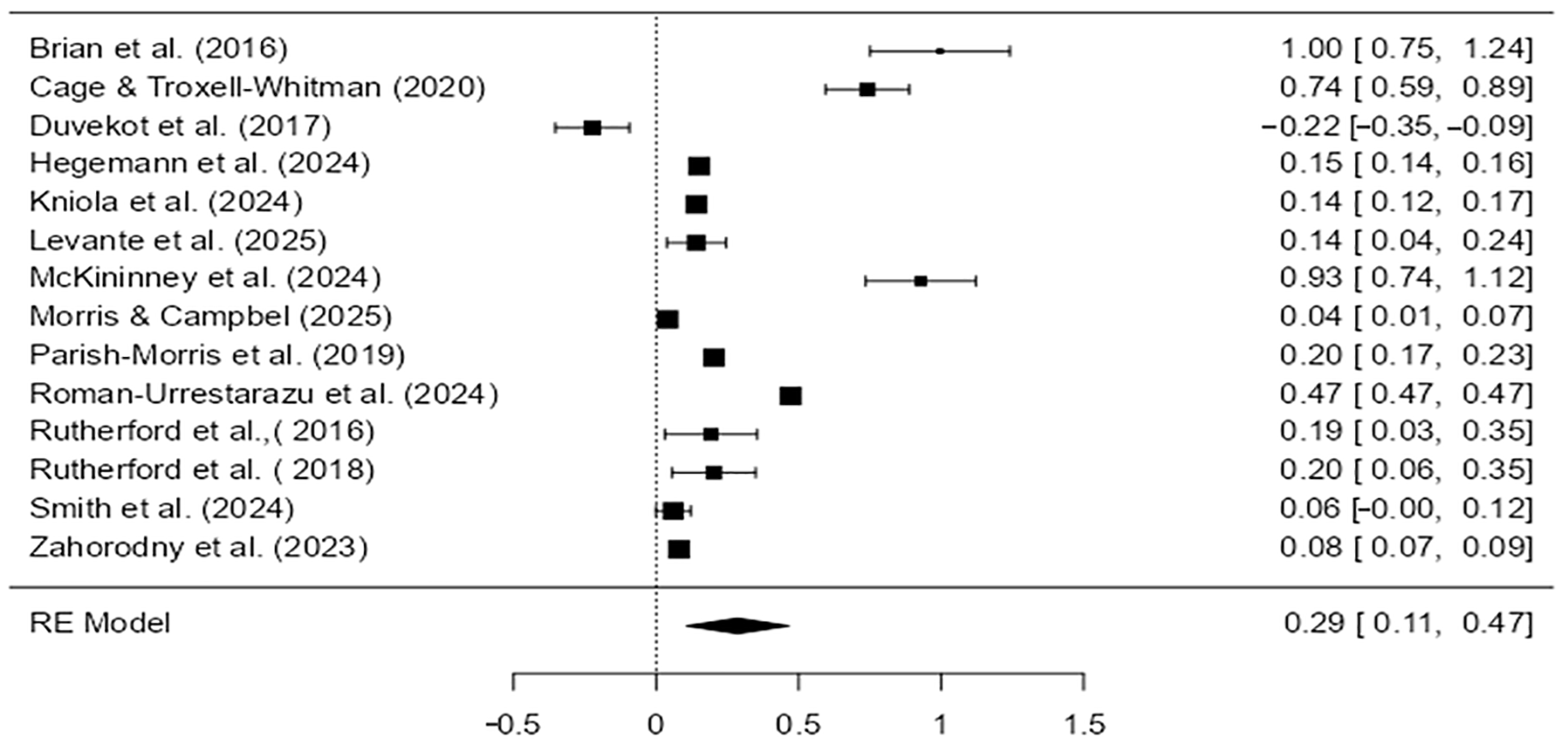
| Tau2 estimate | τ2 = 0.11, indicating heterogeneity across studies |
| Cochran’s Q test | Q (p < 0.0001), heterogeneity confirmed |
| I2 statistic | I2 = 99.94%; variance explained by between-study heterogeneity |
| Outliers | No outlying studies identified |
| Prediction interval | Range: −0.40 to 0.97 |
| Funnel plot asymmetry | Regression test (p = 0.01): possible publication bias; rank correlation non-significant |
| Author (Year) | Country/Context | Design | Sample (Total/by Sex) | Mean Age/Range | Diagnostic/Screening Instruments | Relevant Statistics |
|---|---|---|---|---|---|---|
| Brian et al. [14] | Canada/High-risk family clinical cohort | Blinded prospective longitudinal | N = 67 (sex not reported by subgroup) | Follow-up to M ≈ 9.5 years | Blinded clinical assessment; standardized measures of autistic symptomatology, language, and cognition | Diagnostic stability analyses; kappa coefficient. Diagnostic stability 89.6%; κ = 0.76; ≈9% late diagnoses |
| Cage & Troxell-Whitman [15] | UK/Autistic adult community | Cross-sectional observational (online survey) | N = 180 (52% women; 42% men; 5% gender-diverse) | Adults | Camouflaging measures; autistic identity; disclosure | Significant mediation: identity → disclosure → ↓ camouflaging; competitive mediation |
| Duvekot et al. [16] | Netherlands/Specialized clinical referral | Multicenter observational with logistic regression | N = 231 (ASD: 106 boys, 24 girls; non-ASD: 61 boys, 40 girls) | 2.5–10 years | DDDI (short form); ADOS; CBCL; WISC/WPPSI/Bayley | Logistic regression with sex interaction terms. RRB × sex OR = 0.41; emotional problems × sex OR = 2.44 |
| Hegemann et al. [17] | Norway/Population cohort (MoBa) | Population-based psychometric study (EFA, CFA, factorial invariance) | EFA: 21,775; CFA: 21,674; Autism n = 636 | 8 years | SCQ (current version); national registries | Exploratory and confirmatory factor analysis; invariance tests. General sex invariance; qualitative differences in factor structure |
| Kniola et al. [7] | USA/SPARK national cohort | Cross-sectional observational with predictive models | N = 5946 autistic girls and women | Childhood–adulthood (verbal language) | SCQ; CBCL; parental developmental data | Multivariate logistic regression. Higher probability of positive screening with motor delays; implicit detection bias |
| Levante et al. [8] | Italy/Early general population | Cross-sectional with parent questionnaires | N = 361 (sex breakdown not detailed by subgroup) | 18–36 months | Q-CHAT; ITSEA | Correlations and sex-based comparative analyses. Sex differences in autistic traits, externalizing behavior, and competence |
| McKinney et al. [9] | UK/Participatory school-based approach | Transdiagnostic cross-sectional observational | N = 119 girls (70 neurodivergent; 49 neurotypical) | M ≈ 12 years | CAT-Q-A; RCADS; ASC-ASD; SRS-2; Conners-3 | Hierarchical regression; comparative analyses. Camouflaging predicts anxiety/depression; significant β independent of neurodevelopmental profile |
| Morris & Campbell [18] | USA/National population survey | Survey-based observational | N = 224,401 (4.3% males; 1.2% females diagnosed) | 3–17 years | National Survey of Children’s Health | Proportion comparisons; logistic regression. Sex differences in diagnostic rate and age (Δ ≈ 0.7 years) |
| Parish-Morris [19] | USA (Children’s Hospital of Philadelphia/University of Pennsylvania) | Experimental comparative study with eye-tracking (mixed design: between-groups ASD vs. TD; within-subjects by condition: rich vs. sparse social context) | N = 55 (ASD = 28; TD = 27). Sex: ASD (25 boys, 3 girls); TD (23 boys, 4 girls) | ASD: M = 27.04 years (21–49); TD: M = 28.19 years (20–48) | DSM-5 clinical diagnosis + ADOS-2; WASI-II (IQ); BAP-Q | Group × Condition interaction on face gaze: β = −6.63, p = 0.01. Main effect group: ASD < TD in face gaze (β = −10.09, p = 0.03). Main effect condition: greater face gaze in communicative context (β = 12.81, p < 0.001). Hand/object interaction: ASD gazed more at hands in social context (β = 11.47, p = 0.01). Global attention greater in rich social condition (p = 0.0001) |
| Roman-Urrestarazu et al. [20] | Chile/National education-health system | Observational with Bayesian analysis | ≈3,000,000 children aged 6–18 years | School age | Health registries | Pre–post comparison: boy-to-girl ratio shifted from 5.6:1 to 2.7:1 |
| Rutherford et al. [21] | UK/Clinical services | Quasi-experimental pre–post | Consecutive clinical samples | Childhood | Clinical record review | Sex-based comparisons across pre- and post-reform cohorts |
| Rutherford et al. [22] | UK/Clinical records | Retrospective observational | N = 150 | Childhood–adulthood | Clinical record review | Significantly later diagnosis in girls |
| Smith et al. [23] | USA/Clinical and research setting | Observational with mediation | Clinical n = 1035 (22.9% AFAB); Research n = 128 | Adolescence–adulthood | Age at diagnosis; anxiety/depression scales | Regression-based mediation models. AFAB → later diagnosis → ↑ anxiety/depression |
| Zahorodny et al. [24] | USA/Population surveillance | Longitudinal epidemiological | ≈59,500 children | Childhood | Educational and health registries | Prevalence comparisons. Boy-to-girl ratio ≈ 5:1 |
| Study Context | k | Fisher’s z | 95% CI | p | τ2 | I2 (%) | Q |
|---|---|---|---|---|---|---|---|
| Clinical | 5 | 0.237 | −0.150 to 0.624 | 0.231 | 0.188 | 94.98 | 79.68 |
| Population-based | 6 | 0.172 | 0.046 to 0.297 | 0.007 | 0.024 | 99.95 | 10,760.29 |
| Between-group difference | — | 0.057 | −0.301 to 0.414 | 0.757 | — | — | — |
Disclaimer/Publisher’s Note: The statements, opinions and data contained in all publications are solely those of the individual author(s) and contributor(s) and not of MDPI and/or the editor(s). MDPI and/or the editor(s) disclaim responsibility for any injury to people or property resulting from any ideas, methods, instructions or products referred to in the content. |
© 2026 by the authors. Licensee MDPI, Basel, Switzerland. This article is an open access article distributed under the terms and conditions of the Creative Commons Attribution (CC BY) license.
Share and Cite
Muiño Tato, A.; Marquès-Donoso, A.; Sánchez-Huete, J.C. Gender Bias in ASD Diagnostic and Screening Tools: A Systematic Review and Meta-Analysis. Psychiatry Int. 2026, 7, 145. https://doi.org/10.3390/psychiatryint7040145
Muiño Tato A, Marquès-Donoso A, Sánchez-Huete JC. Gender Bias in ASD Diagnostic and Screening Tools: A Systematic Review and Meta-Analysis. Psychiatry International. 2026; 7(4):145. https://doi.org/10.3390/psychiatryint7040145
Chicago/Turabian StyleMuiño Tato, Ana, Albert Marquès-Donoso, and Juan Carlos Sánchez-Huete. 2026. "Gender Bias in ASD Diagnostic and Screening Tools: A Systematic Review and Meta-Analysis" Psychiatry International 7, no. 4: 145. https://doi.org/10.3390/psychiatryint7040145
APA StyleMuiño Tato, A., Marquès-Donoso, A., & Sánchez-Huete, J. C. (2026). Gender Bias in ASD Diagnostic and Screening Tools: A Systematic Review and Meta-Analysis. Psychiatry International, 7(4), 145. https://doi.org/10.3390/psychiatryint7040145