Article

Dynamics of the Use of Addiction Treatment Services in Poland Before and During the COVID-19 Pandemic: An Analysis of National Health Fund Data from 2018 to 2023


1
Department of Public Health, Faculty of Public Health in Bytom, Medical University of Silesia in Katowice, 41-902 Bytom, Poland
2
Department of Rehabilitation, Faculty of Health Sciences in Katowice, Medical University of Silesia in Katowice, 40-751 Katowice, Poland
3
Department of Sports Tourism, Faculty of Physical Culture Sciences, Poznan University of Physical Education, 61-871 Poznan, Poland
*
Author to whom correspondence should be addressed.
Psychiatry Int. 2026, 7(4), 144; https://doi.org/10.3390/psychiatryint7040144
Submission received: 13 April 2026 / Revised: 29 May 2026 / Accepted: 25 June 2026 / Published: 1 July 2026

Abstract

Alcohol and psychoactive substance use disorders are major public health challenges in Poland. The COVID-19 pandemic affected both mental health and the organization of addiction treatment services. This study assessed changes in the utilization of publicly funded addiction treatment services in Poland before, during, and after the pandemic, with attention to regional differences. National Health Fund data from 2018 to 2023 were analyzed for alcohol use disorder treatment and treatment of other substance use disorders. Indicators included the number of patients, services provided, and total financial value of services. ANOVA, linear regression, and Pearson correlation analyses were performed. In 2020, the number of patients and services declined, particularly for non-alcohol substance treatment, followed by gradual recovery in 2021–2023. Significant regional differences were observed (p < 0.001), while differences between years were not significant. The financial value of services increased significantly over time, and strong positive correlations were found between patients, services, and costs. The pandemic temporarily reduced access to addiction treatment services in Poland. Although service utilization recovered over time, regional inequalities and increasing treatment costs persisted, highlighting the need to improve accessibility and resilience of addiction care systems.

1. Introduction

In recent years, addiction has constituted a major public health challenge both in Poland and globally. Addictions include the misuse of psychoactive substances (such as alcohol and illicit drugs) as well as behavioral addictions. Epidemiological studies in Poland indicate that approximately 583,000 individuals are affected by alcohol dependence, while an additional ~59,000 are dependent on drugs [1,2]. Similar findings were reported in the MHAD (Mental Health Disorders and Availability of Psychiatric Care) project from 2018, confirming the high prevalence of alcohol- and drug-related problems in the population. Addiction is also a concern among school-aged youth: according to the 2019 ESPAD (European School Survey Project on Alcohol and Other Drugs) study, 47% of 16-year-olds reported alcohol consumption within the previous month, and 22% declared drug use [3]. Moreover, addictive substances are often used as a means of coping with stress and psychological distress. Consequently, the increasing prevalence of mood and anxiety disorders in the population may lead to a growing demand for addiction treatment services [4].
The COVID-19 pandemic, which began in the spring of 2020, had an unprecedented impact on population mental health. Numerous publications reported a marked increase in the prevalence of depressive and anxiety disorders worldwide during the pandemic [3,5,6,7]. These changes were accompanied by sanitary restrictions (lockdowns and limitations on social contact), which disrupted daily functioning and induced a sense of loss of control in many individuals. This phenomenon contributed to increased substance use, as studies demonstrated that a substantial proportion of the population intensified their use of psychoactive substances as a coping mechanism in response to pandemic-related stress. For example, as many as 53% of adults in the United States reported that the COVID-19 crisis negatively affected their mental well-being and led to increased alcohol consumption and gambling [8]. Systematic reviews have confirmed increased use of opioids and cannabis in various populations, while alcohol and tobacco consumption either increased or remained at high levels. Individuals with pre-existing substance use disorders were particularly vulnerable to relapse and escalation of addiction due to pandemic-related stressors [9]. In Poland, studies conducted among university students showed that 12.6% of respondents reported increased psychoactive substance use as a result of the pandemic, while the majority did not observe significant changes in their habits, indicating a heterogeneous impact of the pandemic across social groups [10].
The pandemic also necessitated a reorganization of the healthcare system. From March 2020 onward, the National Health Fund in Poland permitted the provision of psychiatric consultations and addiction treatment services in the form of teleconsultations [11]. Electronic prescriptions were widely implemented, and certain formal barriers were removed (e.g., the requirement for referral to a psychologist). These changes enabled continuity of care under challenging conditions; however, at the same time, a portion of in-person services was restricted. Early reports on the impact of the COVID-19 pandemic on healthcare in Poland documented a decline in the number of patients receiving psychiatric care and addiction treatment in 2020 compared with the previous year. Despite a population-level increase in mental health disorders, access to addiction treatment services was constrained by logistical limitations and patient concerns [3,11].
The aim of this study is to assess the impact of the COVID-19 pandemic on the utilization of publicly funded addiction treatment services in Poland. Given the numerous epidemiological and organizational changes that occurred during the pandemic, we sought to analyze whether—and in what way—the number of addiction treatment services provided changed between 2018 and 2023. The hypothesis was that the COVID-19 pandemic significantly affected the utilization of publicly funded addiction treatment services in Poland, resulting in changes in the number of services provided between 2018 and 2023.

2. Materials and Methods

2.1. Data Source and Study Design

The analysis was based on aggregated administrative data obtained from the National Health Fund (Narodowy Fundusz Zdrowia, NFZ), the sole public payer responsible for financing healthcare services in Poland. The dataset included records of publicly funded psychiatric care and addiction treatment services delivered between 2018 and 2023. The study period covered the pre-pandemic years, the period of the COVID-19 pandemic, and the post-pandemic recovery phase, allowing for the assessment of temporal changes in service utilization associated with the pandemic and healthcare system reorganization.

2.2. Data Preparations and Variable

The data were stratified according to the administrative division of Poland into 16 voivodeships and by treatment category. Two categories of addiction treatment services were analyzed separately: (1) treatment of alcohol use disorders and (2) treatment of dependence on psychoactive substances other than alcohol. For each treatment category, year, and voivodeship, three aggregated indicators were available: the number of patients receiving services, the number of services provided, and the total financial value of reimbursed services expressed in Polish zloty (PLN). These indicators were selected to reflect different dimensions of addiction treatment system utilization, including patient access, service intensity, and healthcare expenditure.
The analyzed data consisted exclusively of aggregated and anonymized administrative records. No individual-level patient information, personal identifiers, or sensitive personal data were available to the researchers. The dataset was obtained from NFZ administrative reporting systems and used in accordance with regulations governing secondary analyses of anonymized public healthcare data.
Prior to statistical analysis, the dataset underwent verification and preparation procedures. The verification process included checking the completeness of observations across all years and voivodeships, assessment of consistency between variables, and identification of potential duplicate or missing records. The term “standardization” used in the preparation process referred to harmonization and restructuring of the dataset rather than statistical normalization of indicators. Specifically, the original dataset was transformed from a wide-format structure into a long-format structure to facilitate aggregation, statistical modeling, and visualization. After transformation, each observation corresponded to a single combination of year, voivodeship, treatment category, and analyzed variable.

2.3. Statistical Analysis

Descriptive statistics were calculated for all analyzed indicators, including annual totals and regional distributions. Analyses were conducted separately for each treatment category (alcohol-related treatment and treatment of dependence on other psychoactive substances) and separately for each of the three indicators (number of patients, number of services, and financial value of services). This approach enabled independent evaluation of temporal and regional variability within distinct areas of addiction treatment services.
To assess differences in service utilization between years, one-way analysis of variance (ANOVA) was applied with year treated as the grouping variable. This analysis was intended to evaluate whether statistically significant temporal variability occurred during the study period, particularly in relation to the COVID-19 pandemic and subsequent recovery phase. In parallel, separate ANOVA models were conducted using voivodeship as the grouping variable in order to evaluate regional variation in addiction treatment utilization across Poland. For each model, F-statistics and corresponding p-values were calculated. Statistical significance was defined as p < 0.05.
Whenever ANOVA results indicated statistically significant differences, post hoc pairwise comparisons were performed using Tukey’s Honestly Significant Difference (HSD) test. This procedure enabled identification of specific pairs of years or voivodeships that differed significantly from one another while controlling for multiple comparisons. Post hoc analyses were primarily used to determine which regions demonstrated the highest and lowest levels of service utilization and whether particular years differed significantly from the pandemic period.
To evaluate long-term temporal trends, linear regression analyses were performed separately for each analyzed variable and treatment category. In these models, calendar year was treated as the independent variable, while the analyzed indicators served as dependent variables. Regression slope coefficients were calculated to estimate the direction and magnitude of annual changes over time. In addition, coefficients of determination (R2) were used to assess the proportion of variance explained by the temporal trend, and p-values were calculated to determine statistical significance of the regression models.
Pearson correlation coefficients were additionally computed to assess relationships between the analyzed variables, including associations between the number of patients, number of services provided, and total financial value of services. Correlation analyses were conducted separately for alcohol-related treatment and treatment of other psychoactive substance use disorders. Correlation strength was interpreted according to standard conventions, with coefficients closer to 1.0 indicating stronger positive linear associations.
All statistical analyses and graphical visualizations were performed using Statistica 13.0 software (TIBCO Software Inc., Palo Alto, CA, USA). Results were presented in tables and figures illustrating annual trends and regional variability. Because the study used aggregated and anonymized administrative data without individual patient identifiers, ethical approval and informed consent were not required under Polish regulations governing secondary analyses of administrative healthcare datasets. The aggregated datasets used in the present study are available from the corresponding author upon reasonable request and in accordance with NFZ data access regulations.

3. Results

The following analyses are based on data on addiction treatment services (for alcohol and other substances) in Poland for the years 2018–2023. The number of patients, the number of services provided, and the financial value of services (PLN) are presented for each treatment category and voivodeship.
The highest numbers of patients were recorded in the Mazowieckie voivodeship (e.g., over 20,000 in 2018–2019), while the lowest numbers were observed in the Świętokrzyskie voivodeship, with only several hundred patients annually.

3.1. Alcohol Addiction Treatment

Similarly to the number of patients, the number of alcohol addiction treatment services provided was highest in the Mazowieckie voivodeship and substantially lower in less populous regions. In many voivodeships, a general increase in the number of services was observed up to 2022 (Table 1).
The financial value of alcohol addiction treatment services shows similar inter-regional differences, with the highest budgets (on the order of several million PLN) recorded in the Mazowieckie and Śląskie voivodeships. In most regions, the total value of services increased between 2018 and 2023. Smaller voivodeships (e.g., Opolskie) reported substantially lower expenditures, amounting to tens or hundreds of thousands of PLN (Table 2).
ANOVA showed no statistically significant differences between years in the number of patients or services provided (p > 0.05), whereas differences between voivodeships were highly significant (p < 0.001). Given the pronounced regional effect, multiple comparisons using Tukey’s post hoc test were performed, indicating significantly higher mean values in the Śląskie and Mazowieckie voivodeships compared with less serviced regions (e.g., Świętokrzyskie), which points to an uneven distribution of services. Linear regression confirmed a statistically significant upward trend only for the financial value of services (R2 = 0.865, p ≈ 0.007); models for the number of patients and the number of services showed low R2 values and non-significant p-values (p > 0.05), indicating no clear temporal trend. Pearson correlation coefficients between the indicators were very high; for example, the correlation between the number of patients and the financial value of services was r ≈ 0.958 (p ≪ 0.001), between the number of services and their value r ≈ 0.953 (p ≪ 0.001), and between the number of patients and the number of services r ≈ 0.984 (p ≪ 0.001). These results indicate strong positive associations, whereby voivodeships with a higher number of patients also delivered proportionally more services and incurred higher expenditures (p ≪ 0.001 for all comparisons). Interpreting the coefficients, an R2 of approximately 0.92 for the regression of the number of patients on the number of services indicates that about 92% of the variance in patient numbers is explained by the number of services provided (Table 3).

3.2. Addiction Treatment for Psychoactive Substances (Other than Alcohol)

For addiction treatment of psychoactive substances other than alcohol, larger voivodeships—such as Mazowieckie and Śląskie—also dominate, with several thousand patients per year.
In terms of the number of services, treatment for substances follows a similar pattern: larger voivodeships provide a greater number of services. Significant declines are also visible in 2020 (the first wave of the pandemic), followed by an increase in 2021–2022. On average, the highest number of services was recorded in 2018–2019, then a decline in 2020, and a gradual increase afterward (Table 4).
The financial value of addiction treatment services for substances was highest in voivodeships such as Mazowieckie and Śląskie. In 2019, the value reflected a high level of services (therapeutic activity) in these regions, whereas in 2020 a significant decline is visible (fewer services provided). From 2021 onward, the values gradually recovered, although the levels from 2018 to 2019 were not fully reached (Table 5).
For addiction therapy for other substances, similarly to the previous category: there were no significant differences between years in the number of patients and services (p > 0.05), whereas differences between voivodeships were highly significant (p < 0.001 for all). Regression analysis showed significant annual trends in the number of services (R2 = 0.834, p ≈ 0.011) and the value of services (R2 = 0.884, p ≈ 0.005), confirming the increasing utilization and costs of therapy (R2 indicates that 83–88% of the variance is explained by the year). Pearson correlations were also high: number of patients vs. value r ≈ 0.904 (p ≪ 0.001), number of services vs. value r ≈ 0.941 (p ≪ 0.001), number of patients vs. services r ≈ 0.959 (p ≪ 0.001). In practice, the more patients in a voivodeship, the higher the expenditure on their treatment (p ≪ 0.001 for all comparisons) (Table 6).
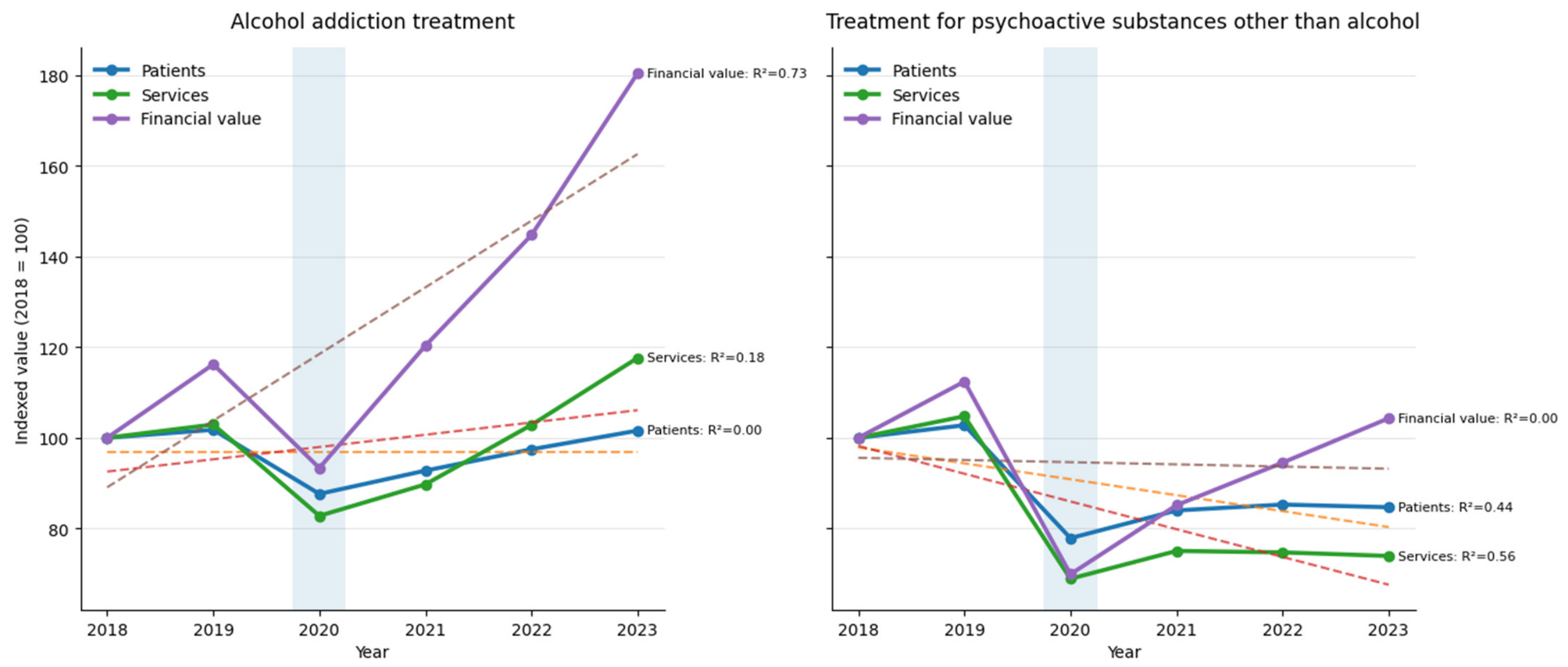
Solid lines show annual national totals indexed to 2018 = 100; dashed lines represent linear trend estimates. The shaded band marks 2020, when treatment provision declined during the first pandemic year. The figure shows that the financial value of alcohol addiction treatment increased most strongly, whereas treatment for psychoactive substances other than alcohol showed a pandemic-related decline followed by partial recovery (Figure 1). In summary, the analyses confirmed that in 2018–2023 there was a general increase in the financial value of addiction treatment services, strongly correlated with the number of patients and services, with significant regional differences. ANOVA showed significant variation between voivodeships for all indicators analyzed (p < 0.001). Linear trend analyses confirmed rising costs for both types of therapy (high R2 and p < 0.01), although the number of patients increased more modestly. Overall, the dynamics and regional disparities highlight the need for further analysis of health policy and funding for addiction treatment, consistent with NFZ observations of a systematic increase in the value of psychiatric services.

4. Discussion

The study revealed significant changes in the utilization of addiction therapy in Poland during the COVID-19 pandemic. The results indicate a substantial decrease in the number of new patients starting addiction treatment during the pandemic compared to the previous year. This phenomenon aligns with observations from other authors. Malczewski [12] showed that in Poland, the number of first-time patients addicted to drugs decreased by approximately 20% in 2020 compared to 2019. Moreover, monthly analysis revealed a sharp drop in new admissions in March–April 2020 (over 50% fewer patients than before the pandemic), followed by a gradual rebound in the summer. A similar sharp decline in admissions at the onset of the pandemic was reported in European studies. The European Drug Report 2021 (EMCDDA) notes that in six EU countries, the number of people starting addiction therapy dropped dramatically between February and March 2020 and remained low for the rest of the year. The report suggests that this was partly due to the rapid adaptation of services, including telemedicine, which reduced the perceived need for in-person therapy while allowing care to continue remotely.
Our results confirm this general trend: in the early months of the pandemic, access to traditional addiction services was limited, resulting in fewer completed treatments. Consistent with the observed declines, Poland introduced the possibility of providing outpatient psychiatric and addiction counseling remotely (teleconsultations) in March 2020 [9]. Consequently, some therapy could continue outside the register of conventional inpatient services, which also affected NFZ data. A longer-term perspective is illustrated by our data: after the initial collapse in Q2 2020, service indicators stabilized in the following months, suggesting a partial return of patients to the system. At the same time, it is worth noting that the increased demand for psychological and addiction services was expected, as the pandemic was accompanied by rising depressive and anxiety symptoms in the population [3]. However, barriers to direct contact and the risk of infection led many patients to postpone starting therapy.
The results above should be interpreted in the context of the PaLS study [10]. This study indicated that only about 13% of Polish students reported increased use of psychoactive substances as a result of the pandemic [10], while 70% observed no change, and 17% reported decreased use. This shows that the pandemic affected different groups differently, which may explain our observations of a relatively small overall increase in addiction cases despite worsening mental health indicators. In other words, although pandemic-related stress encouraged substance use, the actual translation of this into therapy demand may have been limited by restricted access to services.
In the USA and New Zealand, after the introduction of social distancing measures, many addicted patients switched to hybrid or fully remote therapy, partially mitigating the drop in in-person service delivery [13,14]. Similarly, in Poland, health authorities recommended remote psychological support (e.g., 24 h hotlines), which, however, does not always reflect in NFZ records. On one hand, telemedicine allowed some patient needs to be met (previously difficult), but on the other hand, not all forms of support (e.g., group programs) could be easily conducted online. EMCDDA noted that although extensive use of teleconsultations may have reduced perceived demand for therapy, it allowed continuity of care to be maintained [8]. Our study observes a similar phenomenon: a portion of patients shifted to general psychiatric care or sought private assistance (not recorded by NFZ), which may explain the observed discrepancies between actual need and reported service numbers.
Comparing our results with other publications, it should be noted that our analysis both confirms and complements previous findings. Kiejna and colleagues conducted a national NFZ data analysis, showing, among other things, higher mortality among people with mental disorders during the pandemic [15].
In summary, our analyses indicate that the COVID-19 pandemic caused significant disruptions in the delivery of addiction therapy in Poland. The combination of increased demand (worsening mental health) and access barriers (lockdowns, need for telemedicine registration) led to a scenario in which the number of provided services and initiated therapies initially dropped, only later approaching previous levels (reflecting the relative 70% stability in the PaLS Study [10]). These trends align with EMCDDA observations and national reports. New forms of care delivery played a key role: in Poland, efforts were made to ensure that addiction services could continue remotely [6], likely mitigating the negative effects of the temporary “closure” of clinics and centers. Ultimately, this study confirms that the pandemic created a significant disparity in access to addiction therapy, and future efforts should focus both on facilitating therapy continuation during crises and on strengthening addiction prevention under pandemic conditions.
The study has several important strengths that enhance its credibility and scientific value. First, it is based on robust NFZ administrative data covering the entire country, providing an objective and comprehensive picture of addiction therapy utilization in Poland. Second, analyzing six consecutive years captures both pre-pandemic, pandemic, and post-pandemic periods, allowing assessment of changes over time. Third, a multidimensional approach was applied, considering the number of patients, services, and financial value, alongside statistical and regional analyses, enabling the identification of significant trends, relationships, and differences between voivodeships.
At the same time, the study has some limitations. NFZ data do not include private therapy, activities of non-governmental organizations, or some online services, which may underestimate the actual level of addiction treatment in Poland. Additionally, the administrative nature of the data does not allow assessment of therapeutic outcomes, severity of addiction, or relapses, and does not account for social and economic factors influencing addiction dynamics. The pandemic also altered health service reporting, especially teleconsultations, which may have partially distorted the full picture of services. It should also be emphasized that the analysis concerns therapy utilization, not the actual prevalence of addiction in the population, limiting causal and epidemiological inferences.

5. Conclusions

The COVID-19 pandemic significantly disrupted access to addiction therapy in Poland, causing a decline in the number of patients and services provided in 2020, particularly in therapies for addictions to substances other than alcohol. Despite the initial collapse, the system gradually regained capacity, and since 2021, there has been an increase in the number of services as well as a significant upward trend in the financial value of therapy, indicating rising expenditures and intensified care. Analyses revealed strong regional disparities in therapy utilization, with the highest activity in large voivodeships (Mazowieckie, Śląskie) and the lowest in smaller, less populous regions. The number of patients increased more slowly than the value of services, suggesting higher per-patient costs and insufficient coverage of actual demand. Teleconsultations and organizational changes mitigated access limitations but did not fully compensate for the losses in inpatient therapy. Overall, the results indicate that the pandemic led to a temporary restriction in the availability of addiction treatment, followed by a return to the growth trend and further strain on the system, alongside persistent territorial disparities.

Author Contributions

Conceptualization, M.G. (Mateusz Grajek), J.K. and M.R.; methodology, M.G. (Mateusz Grajek); software, M.G. (Mateusz Grajek) and T.J.; validation, M.G. (Mateusz Grajek), P.J., J.K., M.G. (Mariusz Geremek) and B.N.; formal analysis, M.G. (Mateusz Grajek); investigation, M.G. (Mateusz Grajek); resources, M.G. (Mateusz Grajek); data curation, M.G. (Mateusz Grajek), P.J., J.K., M.G. (Mariusz Geremek) and B.N.; writing—original draft preparation, M.G. (Mateusz Grajek); writing—review and editing, M.G. (Mateusz Grajek), P.J., J.K., M.G. (Mariusz Geremek), M.R., T.J. and B.N.; visualization, M.R.; supervision, M.G. (Mateusz Grajek), J.K. and M.R.; project administration, M.G. (Mateusz Grajek) All authors have read and agreed to the published version of the manuscript.

Funding

This research received no external funding.

Institutional Review Board Statement

Ethical review and approval were waived for this study due to it is a secondary analysis administrative healthcare datasets obtained from the authorised National Health Fund (Narodowy Fundusz Zdrowia, NFZ).

Informed Consent Statement

Informed consent was waived because this study is a secondary analysis administrative healthcare datasets obtained from the authorised National Health Fund (Narodowy Fundusz Zdrowia, NFZ), The analyzed data consisted exclusively of aggregated and anonymized administrative records. No individual-level patient information, personal identifiers, or sensitive personal data were available to the researchers.

Data Availability Statement

The aggregated datasets used in the present study are available from the corresponding author upon reasonable request and in accordance with NFZ data access regulations.

Conflicts of Interest

The authors declare no conflicts of interest.

References

  1. Santangelo, O.E.; Provenzano, S.; Firenze, A. Risk Factors for Addictive Behaviors: A General Overview. Int. J. Environ. Res. Public Health 2022, 19, 6583. [Google Scholar] [CrossRef] [PubMed]
  2. Karim, R.; Chaudhri, P. Behavioral addictions: An overview. J. Psychoact. Drugs 2012, 44, 5–17. [Google Scholar] [CrossRef] [PubMed]
  3. Gondek, T.M.; Adamowski, T.; Janus, J.; Cichoń, E.; Paciorek, S.; Zięba, M.; Bukowska, A.; Todzia-Kornaś, A.; Kiejna, A. Mortality in people with mental disorders in Poland during the COVID-19 pandemic: A nationwide, register-based cohort study. Curr. Opin. Psychiatry 2025, 38, 3–34. [Google Scholar] [CrossRef] [PubMed]
  4. Strategie, J.S.T. Problemy Uzależnień w Polsce—Co Mówią Nam Ostatnie Dane? 20 March 2024. Available online: https://www.strategiejst.pl/2024/03/20/problemy-uzaleznien-w-polsce-co-mowia-nam-ostatnie-dane/ (accessed on 1 December 2025).
  5. COVID-19 Mental Disorders Collaborators. Global prevalence and burden of depressive and anxiety disorders in 204 countries and territories in 2020 due to the COVID-19 pandemic. Lancet 2021, 398, 1700–1712. [Google Scholar] [CrossRef] [PubMed]
  6. Filindassi, V.; Pedrini, C.; Sabadini, C.; Duradoni, M.; Guazzini, A. Impact of COVID-19 First Wave on Psychological and Psychosocial Dimensions: A Systematic Review. COVID 2022, 2, 273–340. [Google Scholar] [CrossRef]
  7. Clemente-Suárez, V.J.; Martínez-González, M.B.; Benitez-Agudelo, J.C.; Navarro-Jiménez, E.; Beltran-Velasco, A.I.; Ruisoto, P.; Diaz Arroyo, E.; Laborde-Cárdenas, C.C.; Tornero-Aguilera, J.F. The Impact of the COVID-19 Pandemic on Mental Disorders. A Critical Review. Int. J. Environ. Res. Public Health 2021, 18, 10041. [Google Scholar] [CrossRef] [PubMed]
  8. Górowska, M.P.; Obarska, K.; Szymczak, K.; Gola, M.; Chodkiewicz, J. COVID-19, sense of control, and the rise of addictive behaviors: A study in Poland. Postep. Psychiatr. Neurol. 2025, 34, 253–263. [Google Scholar] [CrossRef] [PubMed]
  9. Volkow, N.D. Collision of the COVID-19 and addiction epidemics. Ann. Intern. Med. 2020, 173, 61–62. [Google Scholar] [CrossRef] [PubMed]
  10. Jodczyk, A.M.; Kasiak, P.S.; Adamczyk, N.; Gębarowska, J.; Sikora, Z.; Gruba, G.; Mamcarz, A.; Śliż, D. PaLS Study: Tobacco, alcohol and drugs usage among Polish university students in the context of stress caused by the COVID-19 pandemic. Int. J. Environ. Res. Public Health 2022, 19, 1261. [Google Scholar] [CrossRef] [PubMed]
  11. European Monitoring Centre for Drugs and Drug Addiction (EMCDDA). European Drug Report 2021: Trends and Developments; Publications Office of the EU: Luxembourg, 2021. [Google Scholar]
  12. Malczewski, A. Przeciwdziałanie uzależnieniom a pandemia COVID-19 w 2020 roku. Serwis Inf. Uzależ. 2021, 1, 10–14. [Google Scholar]
  13. Rodda, S.N.; Park, J.J.; Wilkinson-Meyers, L.; King, D.L. The impact of COVID-19 on addiction treatment in New Zealand. Addict. Behav. 2022, 127, 107230. [Google Scholar] [CrossRef] [PubMed]
  14. Columb, D.; Hussain, R.; O’Gara, C. Addiction psychiatry and COVID-19: Impact on patients and service provision. Ir. J. Psychol. Med. 2020, 37, 164–168. [Google Scholar] [CrossRef] [PubMed]
  15. Kiejna, A.; Janus, J.; Cichoń, E.; Paciorek, S.; Zięba, M.; Gondek, T.M. Mortality in people with mental disorders in Poland: A nationwide, register-based cohort study. Eur. Psychiatry 2022, 66, e2. [Google Scholar] [CrossRef] [PubMed]
Figure 1. National trends in addiction treatment indicators in Poland, 2018–2023.
Psychiatryint 07 00144 g001
Table 1. Number of patients receiving alcohol addiction treatment in 2018–2023.
Voivodeship201820192020202120222023
Dolnośląskie840483117272753174567795
Kujawsko-Pomorskie566552984653492751655405
Lubelskie835481336736736076947660
Lubuskie493448504343454246074832
Mazowieckie20,24920,83018,03918,73419,90220,965
Małopolskie231830722882304533603499
Opolskie237924012190253325362618
Podkarpackie644465705980637162235948
Podlaskie326932762846315636183862
Pomorskie9261945079449028993910,143
Warmińsko-mazurskie681771336188637466106887
Wielkopolskie11,44612,22510,63110,64111,09312,077
Zachodniopomorskie843786637330761078117935
Łódzkie397640152953307032633363
Śląskie24,51224,42220,71122,31123,94725,464
Świętokrzyskie396463456434416427
Table 2. Number of alcohol addiction treatment services in 2018–2023.
Voivodeship201820192020202120222023
Dolnośląskie53,21453,49446,82448,13048,55152,323
Kujawsko-Pomorskie35,60434,10129,16032,22734,57237,478
Lubelskie58,26257,66847,43452,53455,78257,325
Lubuskie30,73030,39526,65928,151287,7631,442
Mazowieckie274,113272,305217,879236,788265,615314,825
Małopolskie59,80070,95463,19264,86880,19490,358
Opolskie37,23740,22535,77743,63145,75452,071
Podkarpackie91,47595,14079,60586,05387,33893,489
Podlaskie33,61939,151344,6638,25743,93947,418
Pomorskie102,825109,66790,49997,572117,591140,807
Warmińsko-mazurskie59,25760,02750,71051,94354,21457,018
Wielkopolskie168,084168,982127,160140,464166,247205,715
Zachodniopomorskie73,00775,97463,26265,68778,01389,809
Łódzkie54,52764,13039,45243,57860,62173,657
Śląskie220,798231,256178,549195,130235,749262,308
Świętokrzyskie74,69165,70550,78455,53365,03472,929
Table 3. Financial value of alcohol addiction treatment services in 2018–2023 (PLN).
Voivodeship201820192020202120222023
Dolnośląskie1,526,5781,354,9361,171,5621,228,4781,201,8551,501,044
Kujawsko-Pomorskie289,517318,365212,889233,623253,295323,673
Lubelskie1,097,5781,434,2071,044,1441,395,5981,668,0482,152,008
Lubuskie617,962647,230571,767588,254656,136757,173
Mazowieckie1,919,4892,417,4191,934,7652,434,7362,953,4863,539,671
Małopolskie781,2981,057,2041,013,2891,005,9911,245,8251,567,017
Opolskie82,86691,21375,635136,601140,412234,052
Podkarpackie810,118814,387708,171820,083852,1361,083,686
Podlaskie506,471602,669467,245830,2651,014,4561,204,221
Pomorskie1,240,2981,288,047953,5681,487,0431,825,9282,272,327
Warmińsko-mazurskie424,491416,255349,425473,439516,518696,380
Wielkopolskie1,580,5191,899,1881,508,5251,960,4932,534,9723,352,218
Zachodniopomorskie351,185373,040325,555378,113527,852699,058
Łódzkie436,217604,811460,661784,5341,147,7191,432,491
Śląskie1,480,9181,747,6171,303,0681,895,7372,283,4402,715,574
Świętokrzyskie369,904641,905515,159612,130743,398863,456
Table 4. Number of patients receiving addiction treatment for psychoactive substances (other than alcohol) in 2018–2023.
Voivodeship201820192020202120222023
Dolnośląskie262826382281255427302934
Kujawsko-Pomorskie597644514506483506
Lubelskie214121411634168116581528
Lubuskie138913871189124311711187
Mazowieckie751978285447591861256129
Małopolskie130113691166113211511168
Opolskie183153185158173173
Podkarpackie868854758856869885
Podlaskie8781035736835818832
Pomorskie8249458159591046833
Warmińsko-mazurskie1193813641784722658
Wielkopolskie223524652109229523502331
Zachodniopomorskie897958813821798750
Łódzkie10251025556670605616
Śląskie280328031857194718821900
Świętokrzyskie666843433434566555
Table 5. Number of addiction treatment services for psychoactive substances (other than alcohol) in 2018–2023.
Voivodeship201820192020202120222023
Dolnośląskie16,116.516,116.514,218.015,659.015,682.016,371.0
Kujawsko-Pomorskie4685.53846.53614.03579.53459.03548.5
Lubelskie17,779.017,779.014,571.014,939.014,469.015,323.0
Lubuskie8481.58965.07148.57438.07033.07081.0
Mazowieckie127,008.0136,427.577,204.085,343.584,658.081,276.0
Małopolskie9888.012,217.08662.09022.08861.59079.5
Opolskie1009.51026.0922.01181.01150.01206.0
Podkarpackie9830.09514.07752.09730.010,132.09893.0
Podlaskie5994.06285.54523.05290.05324.55468.0
Pomorskie10,450.011,145.07840.09658.510,760.08323.0
Warmińsko-mazurskie7385.05101.53505.53668.03135.02889.0
Wielkopolskie22,082.523,579.519,840.020,152.020,106.021,701.0
Zachodniopomorskie4705.54616.53211.03313.03211.03127.0
Łódzkie6410.06410.02768.03268.02754.02900.0
Śląskie19,920.519,920.510,506.011,147.011,005.011,380.5
Świętokrzyskie4616.06570.04075.03953.04716.54707.5
Table 6. Financial value of addiction treatment services for psychoactive substances (other than alcohol) in 2018–2023 (PLN).
Voivodeship201820192020202120222023
Dolnośląskie1,354,9361,354,9361,133,1601,267,2491,257,1491,506,465
Kujawsko-Pomorskie289,517318,365212,889233,623253,295323,673
Lubelskie1,533,3711,434,2081,219,7701,335,2581,342,3041,368,054
Lubuskie617,962647,230562,405588,254588,475658,788
Mazowieckie13,300,51614,995,2867,777,3248,733,6969,177,2299,320,352
Małopolskie781,2981,057,202684,853713,574746,731812,490
Opolskie82,86691,21474,486149,070153,230255,705
Podkarpackie810,118814,387699,346825,784859,7431,083,688
Podlaskie506,470602,668454,842830,9111,014,4561,204,217
Pomorskie1,240,2981,288,050898,9331,556,9961,919,8811,975,562
Warmińsko-mazurskie424,491416,255347,453470,548516,292694,125
Wielkopolskie1,580,5161,899,1941,446,2231,718,4051,987,7512,310,400
Zachodniopomorskie351,185373,040341,923407,442562,017705,161
Łódzkie436,216604,811412,618782,3751,237,2921,507,570
Śląskie1,480,9181,747,617911,2971,293,3771,553,1831,814,157
Świętokrzyskie369,904641,905405,201511,615613,634706,986
Disclaimer/Publisher’s Note: The statements, opinions and data contained in all publications are solely those of the individual author(s) and contributor(s) and not of MDPI and/or the editor(s). MDPI and/or the editor(s) disclaim responsibility for any injury to people or property resulting from any ideas, methods, instructions or products referred to in the content.