Article

Containment Failure, Diagnostic Masculinity, and the Diffusion of Looksmaxxing: The Case of Clavicular


by
Dag Øivind Madsen
Department of Business, Marketing and Law, USN School of Business, University of South-Eastern Norway, 3511 Hønefoss, Norway
Journal. Media 2026, 7(3), 158; https://doi.org/10.3390/journalmedia7030158
Submission received: 11 April 2026 / Revised: 5 July 2026 / Accepted: 9 July 2026 / Published: 1 August 2026

Abstract

This article uses Clavicular, a controversial livestreamer who became a prominent public face of looksmaxxing in early 2026, as a trace-supported case study of fringe diffusion under platform conditions. Using public media traces, platform snapshots, and public visibility indicators, it examines how a niche masculine self-optimization culture becomes broadly legible. The article introduces diagnostic masculinity—a platformed style of masculine authority built on naming, ranking, and promising correction of bodily lack—as a working concept to explain why looksmaxxing resonates with boys and men beyond platform affordances alone. Drawing on scholarship on digital masculinity, platformization, and meme circulation, it argues that Clavicular’s rise depended on the alignment of coded vernacular, high-volume livestreaming, clipping infrastructure, controversy, monetization, and mainstream media translation. The article proposes a five-stage model of containment failure—vernacular incubation, infrastructural assembly, controversy acceleration, mainstream translation, and parodic consolidation—through which fringe masculine self-optimization becomes culturally portable without becoming fully normalized. The case shows how platform systems do not merely amplify fringe masculinities but package them into forms that can circulate across media environments that would otherwise remain separate.

1. Introduction

By the spring of 2026, the vocabulary of looksmaxxing—facial ratios, “ascension,” “mogging,” “hardmaxxing”—had moved from obscure forums and lookism boards into GQ, the New Yorker, late-night comedy, and mainstream platform commentary. The SNL “Weekend Update” sketch in March 2026, featuring a parody influencer named “Chad Maxxington,” needed only a minimal setup to make the type recognizable (Saturday Night Live, 2026). A May 2026 Daily Show segment, “Gen Z Is ‘Maxxing’ Everything & Lewis Black Is Maxxed Out,” similarly treated “-maxxing” as a comic object (The Daily Show, 2026). These examples do not show that looksmaxxing had been accepted or normalized. They show something narrower but still important: the language and persona type had become legible enough to be used as mainstream comic material.
Looksmaxxing is the systematic attempt to maximize physical attractiveness, ranging from skincare and posture to surgical intervention and practices as extreme as bone-smashing. Earlier public commentary had already framed it as an extreme cosmetic and TikTok-mediated self-improvement trend, helping establish it as a recognizable object of concern (Farrell, 2024; Rosdahl, 2024). Academic work has moved past treating it as a grooming fad; recent studies frame it as a self-optimization milieu structured by harsh appearance ranking, pseudoscientific claims, and escalating forms of masculine bodily discipline (Halpin et al., 2025; Konig et al., 2025; Muntaner Vives et al., 2026; Pacquelet et al., 2024; Solea & Sugiura, 2025; Sousbois, 2025). This article is less concerned with documenting that the phenomenon exists than with explaining how it became broadly recognizable.
Clavicular is a useful vehicle for that question. He emerged in early 2026 as one of the most publicly visible and contested figures associated with looksmaxxing, rooted in forum culture, built around long-form IRL livestreaming, and dense in the vocabulary that became associated with the wider circulation of looksmaxxing (Cantor, 2026; Clarke, 2026; Hunt, 2026; Klee, 2026; Okundaye, 2026; Press-Reynolds, 2026; Tucci, 2026). By March 2026, major outlets (e.g., Guardian, GQ, New Yorker, Atlantic, Vogue) were not only covering him but using him to explain looksmaxxing to readers who had never heard the word. That shift, from subject to explanatory symptom, is what makes the case analytically useful. The question is not how one streamer became famous; it is how a niche masculine subculture becomes thinkable, discussable, and reusable in mainstream settings.
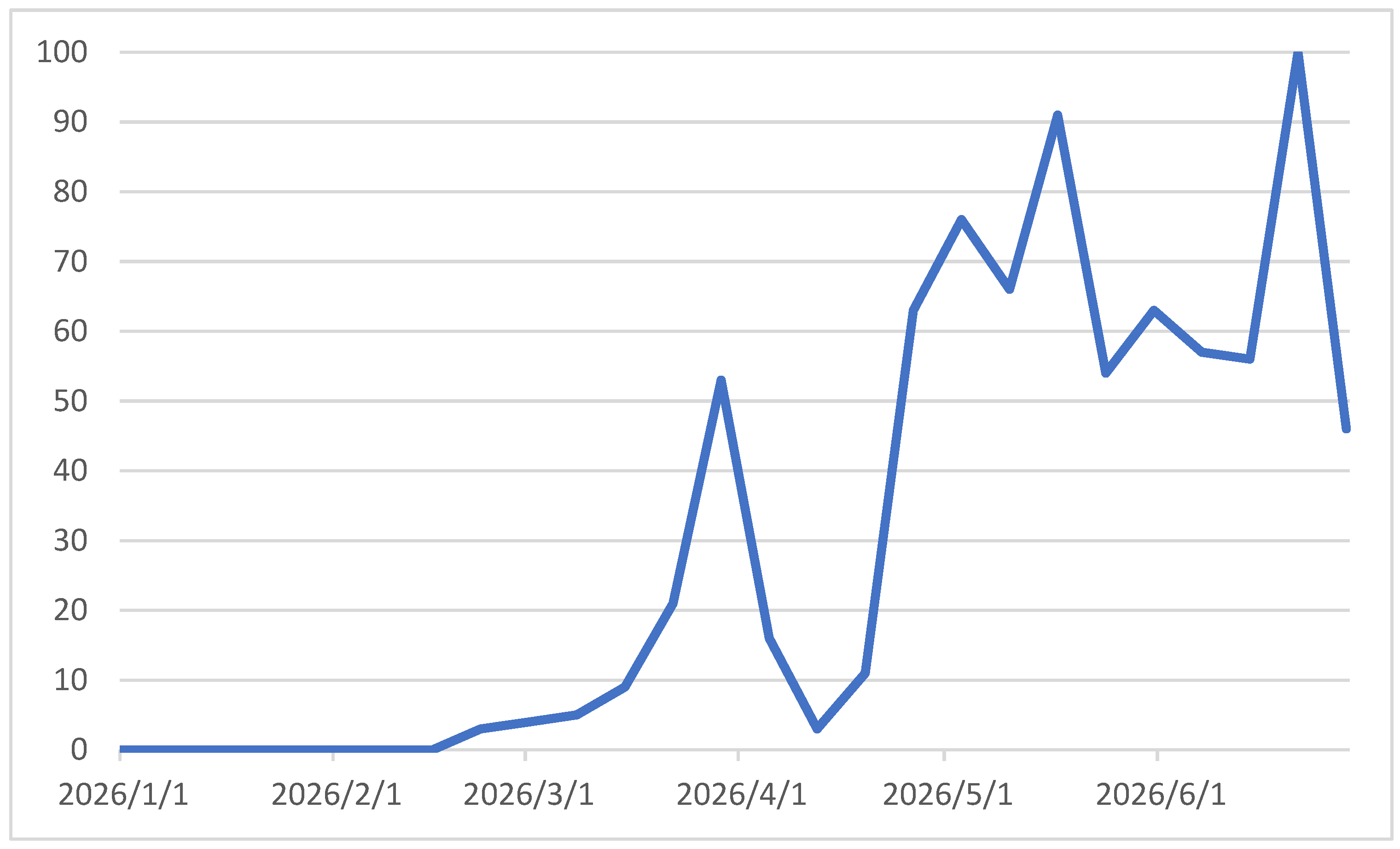
Google Trends data provides a rough picture of the attention rhythm involved and can be used cautiously as an indicator of changing public search interest over time (Silva & Madsen, 2022). Figure 1 shows searches for “Clavicular” running close to zero at the start of 2026, rising in late February and March, dropping back, and then spiking more sharply in late April and early May, before declining again during the extended observation window. The pattern matters not as a precise measure of influence—Google Trends captures when people searched, not why—but as a useful indicator of attention rhythm. It suggests that Clavicular’s public visibility did not develop through a single viral breakthrough or a smooth climb. Instead, it appeared in uneven pulses alongside moments of controversy, media explanation, legal reporting, interview circulation, and post-mainstream developments.
This article proposes a five-stage model of containment failure—vernacular incubation, infrastructural assembly, controversy acceleration, mainstream translation, and parodic consolidation—to account for how a niche masculine self-optimization culture moves from forum marginality to public legibility. Related public commentary has also described manosphere diffusion through the idiom of “breaking containment,” underscoring the wider visibility of this framing in 2026 (Warzel, 2026). The present article uses containment failure in a more specific analytical sense: the process by which a coded subculture becomes routable, translatable, and reusable across media settings.
It also introduces diagnostic masculinity as a working concept for understanding why looksmaxxing resonates in ways not reducible to any particular platform’s architecture. The case makes visible something that platform-centric accounts tend to understate: diffusion is not simply a function of algorithmic amplification. It depends on the interaction of vernacular portability, clipping infrastructure, monetization, controversy, and journalistic translation, and on a culture that speaks directly to masculine insecurity in ways that feel both brutal and actionable.

2. Looksmaxxing, “-maxxing,” and Diagnostic Masculinity

Recent scholarship has made clear that looksmaxxing is not a grooming fad. Halpin et al. (2025), drawing on qualitative analysis of a large looksmaxxing forum, argue that such communities damage participants’ health, encourage significant bodily alteration, and impose what they call masculine demoralization. Konig et al. (2025) describe the culture as occupying an unstable zone between self-enhancement and self-harm. Pacquelet et al. (2024) examine bone-smashing, the practice of striking facial bones in the belief that deliberate fracture reshapes facial structure, as a vivid instance of how optimization logic can encourage destructive and pseudoscientific practice. Sousbois (2025) traces how lookism spaces organize male bodies into aesthetic rankings, surgical fantasies, and hierarchies anchored by the idealized figure of the “Chad.” Taken together, this work establishes looksmaxxing as less a beauty practice than a value system: bodies are ranked, deficiency is moralized, and improvement is framed as both necessary and potentially limitless.
These dynamics connect to longstanding work in masculinity and body image research. Connell and Messerschmidt (2005) show how hegemonic masculinity is organized through ideals that are socially produced, hierarchically arranged, and unequally achievable. Kimmel (2017) traces how perceived status loss can generate grievance-based masculine identity formations. Body-image research has documented the role of mediated appearance ideals in shaping male dissatisfaction, self-surveillance, and bodily comparison, particularly around muscularity and physical dominance (Cash, 2004; Harriger et al., 2023; McCreary & Sasse, 2000; Tiggemann, 2011). Looksmaxxing extends this logic from the general to the granular. The object of masculine body work is no longer just fitness or build but facial harmony, canthal tilt, jawline definition, bone structure, and perceived sexual-market rank. The body becomes a site of competitive accounting.
Looksmaxxing is also, crucially, a vernacular, and that matters for how it spreads. Its terms (e.g., “ascend,” “mog,” “hardmaxx,” “sub5,” “PSL”) do more than describe. They rank, compress, and memeify social relations, turning feelings about status, rejection, and inadequacy into portable, quotable units that move easily across clips, captions, and commentary threads. Appendix A defines selected terms for reference. Solea and Sugiura (2025) argue that such language packages incel-adjacent ideas into apparently softer forms as it moves into wider digital spaces; Aleksic (2025) and Prażmo (2024) treat the portability of digital subcultural vocabulary as central to its scalability. A discourse that can be captioned, mocked, recombined, and reposted travels further than one that stays inside specialist forums.
The expansion of “-maxxing” as a derivational suffix makes this point in concrete linguistic terms. Prażmo (2024) tracks the suffix from its manosphere origins, where it names the drive to maximize a valued trait through deliberate intervention, toward a broader online register that now includes “sleepmaxxing,” “smellmaxxing,” and, most strikingly, the Pentagon’s reported use of “lethalitymaxxing” (Cantor, 2026). The suffix now operates as a generalizable optimization template: identify a domain, push it toward its limit, treat the self as a modifiable variable (Klee, 2026; Pitcher, 2024). This has a specific implication for diffusion. Once optimization is a recognizable, even comic, grammar, the move from skincare or grooming toward steroid use or pseudoscientific facial intervention can present itself as a matter of degree rather than a change in kind. Vernacular diffusion is not incidental to harmful practice; it is one of the conditions that normalizes escalation.
These accounts explain how looksmaxxing travels but do not fully explain why it resonates. Platform affordances account for circulation; they do not account for the culture’s appeal to boys and men who may encounter it with no prior familiarity with incel ideology or lookism forums. To address that question, this article proposes the concept of diagnostic masculinity.
Diagnostic masculinity, as used here, describes a platformed style of masculine authority built on naming, ranking, and promising correction of bodily lack. The distinction from conventional influencer modes matters. The aspirational influencer projects a desirable life, body, routine, or social world, and invites the audience to imagine achieving it. The diagnostic influencer does something structurally different: he identifies what is wrong, where the viewer ranks in a hierarchy, and what corrective interventions appear available.
The concept is offered as a working analytical category rather than a settled typology of male influence. Its purpose is to name a style of platformed masculine authority in which credibility is built through diagnosis: identifying lack, ranking it, and offering correction. This helps distinguish looksmaxxing content from more familiar aspirational influencer genres, while still connecting it to wider economies of self-branding, body work, and masculine comparison. In looksmaxxing terms, this diagnosis is delivered through facial ratings, PSL scores, “sub5” labels, and distinctions between soft and hard interventions, all organized around the promise of “ascension.” The body is not simply a project for improvement; it becomes a problem to be audited, ranked, and, in principle, repaired.
The concept builds on existing work on manosphere masculinities without claiming to supersede it. Ging (2019) shows how digital masculinist cultures organize men into ranked types—alphas, betas, incels—through pseudoscientific and evolutionary framing. Looksmaxxing translates that ranking logic into visible morphology: status is located not only in money, confidence, or sexual history but also in jawlines and canthal tilt, traits that can, in principle, be measured and modified. The appeal of diagnostic masculinity is partly the appeal of precision. Diffuse feelings of rejection, loneliness, or social failure are converted into a readable system: failure can be located, measured, and in principle corrected. The system is harsh, intensifying shame, comparison, and bodily surveillance. But it is also, in its own terms, legible. That combination of clarity, blame, and the promise of repair is part of its grip.
The concept also helps explain how the culture circulates through entertainment rather than doctrine. Research on manosphere aesthetics finds that misogynistic worldviews often travel through images, posture, affect, and stylized display rather than through explicit argument alone (Ging et al., 2025; Lott, 2026). Looksmaxxing spreads similarly: through poses, facial-performance tropes, and slang rather than through manifestos. The same gesture can be received as sincere self-help, ironic commentary, public spectacle, or cautionary tale, depending on the audience and platform context. That semantic flexibility is part of the circulation system. It allows the same content to function simultaneously as a regimen for insiders, a joke for outsiders, and an object of commentary for journalists, without requiring any one reading to stabilize the others.
The platform context shapes but does not determine these dynamics. Scholars have shown that cultural production is increasingly structured by infrastructure that rewards modularity and favors portable formats (Nieborg et al., 2022; Poell et al., 2022; Van Dijck et al., 2018). Bucher and Helmond (2018) redirect attention from platforms as neutral containers to the affordances through which action becomes possible and constrained; Gillespie (2018) shows that platform visibility is shaped by institutional governance decisions, not simply algorithmic neutrality. Influencer scholarship likewise shows that visibility is built through continuous circulation, format adaptation, and self-branding rather than personality alone (Abidin, 2018; Marwick, 2015). What distinguishes the Clavicular case is the fit between the persona and the affordance environment: the content is built to be clipped, captioned, redistributed, monetized, and translated for audiences with no knowledge of its origins.

3. Case Design, Materials, and Analytic Procedure

This article treats Clavicular as a trace-supported conceptual case study (Flyvbjerg, 2006; Siggelkow, 2007). The aim is not biographical reconstruction or the verification of every contested claim associated with the figure. The more analytically tractable object is the mediated persona assembled across livestreams, clips, platform profiles, journalistic profiles, commentary, monetization pages, parody, and legal reporting. This analytical move has a methodological implication: uncertainty about specific claims—earnings figures, follower authenticity, or the precise facts of contested incidents—is not a problem that must be fully resolved before analysis can proceed. Partial unverifiability is part of how such personas rise, not simply a defect in the available evidence. What matters analytically is how claims circulate, attract attention, and contribute to the construction of a recognizable public figure. Extreme claims are therefore treated as narrative assets within an attention economy rather than as facts requiring adjudication.
The case was selected because it condenses, within a short and traceable time window, several dynamics often studied in isolation: platformed masculinity, bodily self-optimization, clip-based redistribution, monetization infrastructure, controversy, and mainstream cultural translation. By early 2026, major outlets were not merely profiling Clavicular but using him as explanatory shorthand for a larger phenomenon. That shift, from person to symptom, is what makes the case analytically revealing.
The corpus was assembled purposively rather than exhaustively. It included mainstream media and commentary texts, public platform/profile traces, routing and monetization pages, selected interview and parody artifacts, public visibility indicators, and Google Trends data. The analysis did not attempt a full content analysis of all Clavicular videos or clips, since the available clip inventory was rolling, partly age-gated, and unstable. Instead, video and clip material was used selectively to document the existence and function of clipping infrastructure, public recirculation, and the translation of controversy. In this sense, the article analyzes a mediated trajectory rather than a bounded video corpus.
The platform traces included Kick, Instagram, X/Twitter mirror activity, TikTok-reported or short-form visibility, Linktree, Skool, Discord, and the Clavicular System site. Where public visibility indicators were consulted, they were treated as time-bound approximations rather than audited measurements. The empirical aim was not to measure total reach, but to identify how different public traces substantiated the mechanisms of containment failure. The analysis covers December 2025 to early July 2026, with emphasis on the period of maximum public visibility.
The trace log does not claim to be a complete archive of all Clavicular-related content. It is instead a transparency device that allows readers to see how the case interpretation was developed from public traces. Because the article avoids reproducing screenshots for ethical and copyright reasons, Table 1 summarizes the main source categories and their analytic function. Appendix B provides a more detailed public trace log, including source-level examples, observed features, analytical use, and verification status. Appendix B also includes additional public traces that informed the interpretation but are not all discussed in detail in the main text. Retrieval dates are provided in the reference list where applicable. Where exact access dates could not be reconstructed, the manuscript avoids precise numerical claims in the main text and treats the relevant traces as approximate indicators of platform ecology rather than as stable measurements.
Google Trends serves as a supplementary visibility indicator rather than a measure of audience size or influence. Its value here is not precision but rhythm: the episodic pattern is consistent with controversy-driven diffusion rather than steady organic growth, and it helps situate the case’s major moments of attention in relation to one another.
The analysis followed an abductive procedure. The literature on looksmaxxing, digital masculinity, platformization, and meme circulation provided sensitizing concepts. Public traces were then reviewed for recurring patterns: how language traveled, how platforms routed audiences, how clipping transformed long-form content, how incidents became news, and how journalistic framing shifted. Initial conceptual frames were refined as the public traces revealed distinctions and connections not fully anticipated by prior theory, including the importance of clipping infrastructure, monetized “ascension,” and the episodic pattern of public search interest. These patterns were consolidated into the mechanisms presented in Section 4 and organized into the five-stage model in Section 5.
Platform metrics are treated throughout as time-bound snapshots rather than stable measurements. Follower counts, clip availability, and public visibility indicators can shift quickly, and public access is sometimes restricted by platform throttling, login requirements, or content removal. Figures are included only where they help document the approximate scale or direction of visibility, and they are interpreted as evidence of platform ecology rather than as audited data. The article does not measure audience effects, follower motivations, or ideological adoption, nor does it verify extreme bodily or earnings claims.
Because the article analyzes a controversial public persona and volatile online materials, it avoids reproducing potentially harmful screenshots, explicit thumbnails, or user comments from ordinary viewers. This also reduces copyright, privacy, and ethical complications. Public-facing platform traces are therefore described textually and summarized in tables, at the level needed to substantiate the argument. The analysis focuses on the mediated persona and circulation infrastructure rather than on private individuals or rank-and-file audience members.

4. Clavicular as a Cross-Platform Attention System: Mechanisms of Containment Failure

A viral-event model does not fit this case. Clavicular did not spike once and then sustain attention through accumulated followers. The episodic Google Trends pattern, the distribution of media coverage across several months, and the layered structure of his public infrastructure all point toward something more organized: a system in which livestreaming, clipping, monetization, controversy, and journalistic translation combined to produce repeated opportunities for wider attention. This section walks through the main components of that system, identifying the mechanisms through which a niche looksmaxxing persona became publicly legible.

4.1. Coded Vernacular and Memetic Portability

The first condition for fringe diffusion is a vocabulary that can travel. Looksmaxxing is unusually well supplied. Terms like “ascend,” “mog,” “hardmaxx,” “sub5,” and “PSL” do not merely describe practices; they compress hierarchies into slogans, turn appearance into stylized performance, and pack a worldview into a few syllables. That combination (precision, portability, and a slight edge of menace) gives the vocabulary unusual memetic traction. The same terminology sustains subcultural cohesion among insiders and simultaneously circulates as novel shorthand among outsiders (Aleksic, 2025; Jenkins et al., 2013; Klee, 2026). One need not believe in PSL scores to quote them ironically, or to mock someone who does.
By the time journalists at the Guardian, GQ, Vox, and Atlantic were writing explainers about Clavicular, they were deploying looksmaxxing vocabulary in contexts that required no prior familiarity from their readers. The explainer did the decoding. But the density and portability of the vocabulary made translation productive: there was a system of terms worth explaining, and the explanation itself became shareable. The Pentagon’s reported use of “lethalitymaxxing” captures the endpoint of this process; a suffix originally at home in incel-adjacent forums now operating inside a military briefing, stripped of its subcultural origins but still carrying the optimization logic (Cantor, 2026).
The “-maxxing” suffix deserves particular attention. It now functions as a productive derivational pattern (Prażmo, 2024): a snap-on template for optimization talk that can be applied to almost any domain. Its cultural camouflage is worth naming explicitly. Once optimization is a recognizable, even playful, grammar, the move from grooming to steroid use to pseudoscientific facial intervention can appear to be a question of how much, not a question of whether. The suffix normalizes escalation by making it feel like a continuation rather than a departure.

4.2. Platform Routing

Clavicular’s public infrastructure during the observed period was not organized around a single account. The trace log shows a cross-platform infrastructure organized around Kick as a livestreaming hub, Instagram as a visual identity layer, X/Twitter mirror circulation, TikTok and other short-form redistribution, Linktree routing, Skool-based paid community access, Discord/community infrastructure, and a coaching/event infrastructure connected to “ascension” (Appendix B). Because follower counts and platform metrics change quickly, the article treats them as time-bound indicators of scale rather than audited measures of reach.
Each platform did different work. Kick provided duration, immediacy, and risk—the conditions for eventful raw material. Instagram stabilized visual branding across the volatility of live content. Short-form distribution channels moved clips to audiences who would never watch a full stream. Linktree organized movement from free access to paid community and coaching.
The platform stack matters because it changes what disruption means. A persona organized around one platform is vulnerable to that platform’s governance decisions. A stack can maintain visibility despite platform-specific restrictions or removals: when content disappears from one node, other nodes continue circulating it. The stack also allows different audience segments to encounter the same persona at different depths, from a 10 s TikTok clip to a paid coaching community accessible through Skool for $39, $59, and $99 per month. Routing is not incidental to the persona; it is a structural component of how the persona generates and retains attention.
Platform routing should also be understood as a governance issue, not only a distribution issue. Platform visibility is shaped by moderation rules, monetization incentives, discovery systems, and the ease with which content can be mirrored or reuploaded. In this case, the relevant point is not that one platform “caused” diffusion, but that different platforms offered different combinations of risk, reach, monetization, and portability. Livestreaming environments created eventful raw material; short-form platforms and clip accounts made that material portable; link hubs and paid communities converted attention into organized pathways; and mainstream media translated the resulting persona for wider publics. This means that containment failure depends on platform logics in the plural, not on a single algorithmic mechanism (Bucher & Helmond, 2018; Gillespie, 2018; Nieborg et al., 2022; Poell et al., 2022; Van Dijck et al., 2018).
The case also illustrates why platform routing must be understood through governance. YouTube’s later removal of additional channels tied to Clavicular was reported as enforcement of its rules against creating new channels after a prior termination, rather than as a new content violation (Brenes & Mandell, 2026). This kind of platform enforcement does not simply end visibility; it can redirect it. A cross-platform persona can absorb disruption on one node by continuing to circulate through livestreaming platforms, short-form clips, routing pages, paid communities, and media coverage. Platform governance is therefore not external to containment failure. It shapes the routes through which visibility is interrupted, displaced, and reassembled.
Platform scholars have established cross-platform routing as a standard feature of contemporary creator strategy. What is analytically notable here is the alignment between the stack’s architecture and the content’s nature. Looksmaxxing is simultaneously live spectacle, instructional content, conversational community, and diagnostic pedagogy. The platform stack maps onto the following functions: spectacle on Kick, community on Discord, instruction and paid correction on Skool, and distribution on short-form platforms. That match between affordance and content function is part of what makes the system coherent.

4.3. Streaming Intensity

Public visibility traces consulted during the observed period suggested unusually high streaming output, but these indicators are treated as approximate rather than audited platform measurements. The analytic point is not the exact number of hours streamed or viewers reached, but the high-output logic that livestreaming makes possible. A high-output streamer generates a continuous supply of raw material. Most moments do not matter; the logic is probabilistic. Long hours of live, improvised content increase the chance that something funny, inflammatory, quotable, visually striking, or legally newsworthy will occur. They also increase the supply available for clipping.
This reframes what visibility means for long-form creators. Livestreaming is not simply the live delivery of content, but a performance environment built around duration, interaction, affective labor, and repeated opportunities for audience engagement (Hamilton et al., 2014; Woodcock & Johnson, 2019). The question is not whether any single stream is compelling enough to attract a large live audience, but whether the cumulative output generates enough eventful moments to sustain a downstream clipping economy. Streaming intensity is, in this sense, a condition of reproducibility rather than a direct driver of attention.

4.4. Clip Labor

Clipping converts long streams into portable media objects. Most people who encountered Clavicular during the observed period almost certainly did not do so by watching full streams; they encountered seconds or minutes of footage, detached from context, circulating as captions, reaction clips, or short compilations. Public traces indicated a Kick clips page and routing toward Discord/community infrastructure, while press reporting documented broader paid and organized clipping economies. That organization matters. Clipping in cases like this is not simply the natural afterlife of live content; it is a managed redistribution system (Moses, 2026; Sato, 2026; Whateley, 2026).
The Clavicular case also became visible within wider reporting on the emerging clip economy. Sato (2026) describes clipping as a system in which accounts extract short moments from long-form livestreams, podcasts, and other media and redistribute them across short-form platforms. In Clavicular’s case, The Verge reported figures posted by Clavicular claiming that more than 1600 clippers had produced nearly 70,000 videos between March and April, accumulating more than 2 billion views (Sato, 2026). These figures are not treated here as audited measurements. They are more useful as traces of how the persona publicly represented the scale of clipping and as evidence that clipping had become part of the case’s visibility infrastructure. Vox’s Today, Explained similarly used Clavicular to discuss the wider short-form clipping economy, describing him as a figure whose online presence is organized around clips rather than full livestreams (Hewitt & Rameswaram, 2026).
Clipping also shapes meaning, not just distribution. A clip can intensify, simplify, reframe, or mock a performance. The same ten seconds of a livestream, captioned differently, can circulate as evidence of ideology, spectacle, self-parody, or a cautionary tale. The clip is not a neutral excerpt; it is a re-edited argument about what the stream is. For outsiders, the clips that circulate most widely define what the subculture seems to be about, which makes clipping infrastructure central not only to how far the persona travels but to how it is understood.
The relationship between clipping and controversy warrants explicit clarity. Controversy produces fresh clippable material: a confrontational incident, a run-in with law enforcement, or an interview walkout can each generate a new moment that clippers can extract and redistribute. The clip, in turn, makes the controversy portable and available for journalistic pickup. Clipping does not merely relay controversy; it converts volatility into a distributable unit (Jenkins et al., 2013; Milner, 2016; Shifman, 2014). The original stream, the extracted clip, and the captioned meme can tell different stories, and all three can circulate simultaneously.

4.5. Monetized Ascension

Public routing and monetization traces make this conversion structure more concrete. The Skool page for “The Clavicular System,” accessed on 3 July 2026, listed the community as private and priced at $39/month (The Clavicular System, 2026b). A related plans page listed Standard, Premium, and VIP tiers at $39, $59, and $99 per month, respectively (The Clavicular System, 2026c). A separate Clavicular System page for “The Ascension Summit Miami,” also accessed on 3 July 2026, listed a 28 June 2026 in-person event in Miami, with tickets described as forthcoming and the venue still being finalized (The Clavicular System, 2026a). These traces support the interpretation of “ascension” not only as a subcultural term but as a monetized pathway linking public spectacle, paid community, coaching, and event infrastructure. Overall, these details suggest a structure familiar from broader creator-economy analysis (Abidin, 2018; Hund, 2023): free spectacle at the public-facing level, paid community and instruction accessible further in.
What is analytically significant is the fit between the commercial structure and the ideological content. The promise of “Ascension” is not only symbolic; it becomes a purchasable pathway through paid community, instructional material, and forms of corrective guidance. The structure of diagnostic masculinity maps almost precisely onto a subscription coaching model: you are deficient, correction is possible, hierarchy can be climbed, and the path to correction can be bought. Insecurity becomes a recurring market. The viewer is invited to move from consuming clips to joining, from watching to paying, with the transition framed as a step in the ascension process itself.

4.6. Controversy Acceleration

Public traces associated Clavicular with a series of incidents during the observed period: livestreamed confrontations, reports of platform disruption, legal reporting around battery charges, a firearm-related charge connected to an Everglades livestream, hospitalization after a livestreamed medical episode, and an interview walkout. The facts of several incidents remain contested, and the article does not attempt to adjudicate them. The analytic point concerns what controversy does to the diffusion process, not the truth of every specific event. For example, People reported that Peters was charged with a misdemeanor for allegedly discharging a firearm at the Francis Taylor Everglades Wildlife Management Area on 26 March 2026, citing court documents obtained by the magazine (Chinman et al., 2026). Such reports matter here because they create narratable public events that can be clipped, summarized, and translated for audiences with no prior knowledge of looksmaxxing.
Controversies produce narratable moments: incidents that can be described briefly and compellingly to audiences with no prior knowledge of the subculture. A viewer unfamiliar with looksmaxxing can still understand scandal, disruption, or spectacle. That is the diffusion function of controversy. It makes the persona legible to people who do not share the vernacular. This mechanism is consistent with research showing that social feedback can amplify the expression and circulation of moral outrage in online networks (Brady et al., 2021). It also aligns with work on algorithmic amplification, which suggests that platform ranking systems can increase the visibility of divisive, affectively charged, or engagement-generating content when such content produces measurable interaction (Huszár et al., 2022; Milli et al., 2025; Rathje & Van Bavel, 2025). Once a controversially clipped moment reaches a journalist or podcaster, it provides an occasion for explanation. The explanation brings the vocabulary, and the vocabulary then reaches contexts it could not otherwise have accessed on its own.
This is why the relationship between controversy and diffusion is not simply that scandal generates attention. Scandal generates attention and creates an occasion for translation. The critical profile, the trend piece, and the legal report each decode the subculture for a new audience while adding to the volume of content in circulation. Controversy acts less as an interruption than as an accelerant.

4.7. Mainstream Translation

By early 2026, Clavicular was being used as a symbol rather than merely as a subject. The Guardian asked why incel slang had crossed into mainstream speech (Cantor, 2026). Vogue placed him within a broader account of hypermasculinity at fashion week (Clarke, 2026). The Atlantic writers used him to examine male insecurity and the appeal of ranked worldviews (Bogost, 2026; Gottsegen, 2026). The Piers Morgan interview and a 60 Minutes Australia segment put him in front of audiences with no platform background in the relevant sense (60 Minutes Australia, 2026; Dunn, 2026; Piers Morgan Uncensored, 2026).
Translation is an ambivalent mechanism. A critical profile of looksmaxxing decodes its vocabulary for readers who would otherwise never have encountered it, while simultaneously warning against the phenomenon and making it more broadly legible. This is not an argument against journalism about harmful phenomena; documentation matters. But it is a reason to treat mainstream coverage as constitutive of mainstreaming rather than simply responsive to it. The critical article participates in the diffusion system it describes. What escapes is not just content but a whole package of vocabulary, recognizability, and routable controversy that the explainer itself helps assemble.

4.8. Parody and Reuse

The SNL “Chad Maxxington” sketch is the clearest marker of what parody does in this process. The sketch needed little explanation of looksmaxxing’s origins or arguments; the visual and verbal shorthand was enough for the joke to land. That kind of recognition does not require sympathy, comprehension, or approval. It requires only that the form be familiar enough to serve as a reference.
The Daily Show offers a related example of mainstream comic translation. In a segment titled “Gen Z Is ‘Maxxing’ Everything & Lewis Black Is Maxxed Out,” Clavicular is mentioned directly as part of a wider comic treatment of “-maxxing” culture (The Daily Show, 2026). This matters because the segment does not treat Clavicular as an obscure figure requiring extended explanation. Rather, he appears as part of a broader recognizable field of optimization slang, Gen Z platform culture, and masculine self-improvement absurdity. Like the SNL parody, the segment suggests that looksmaxxing has become available as mainstream comic material. The point is not that mainstream audiences have adopted the underlying worldview. It is that the language, persona type, and cultural associations have become legible enough to be joked about in mass entertainment.
Once a niche persona type can be parodied on mass-entertainment television without contextual setup, containment has already failed. The subculture has become culturally indexical, available as a shared reference point for audiences who have never participated in its native environments. Parody is not merely commentary on diffusion; it is evidence that diffusion has already occurred.
Table 2 summarizes the mechanisms discussed above. The table should not be read as a separate empirical test, but as a synthesis of the case traces and the literatures used to interpret them. The “case indicators” column shows how each mechanism appears in the Clavicular case, while the “theoretical anchor” column identifies the bodies of research that support the mechanism.

5. A Five-Stage Model of Containment Failure

5.1. From Mechanisms to Temporal Dynamics

Section 4 identified the mechanisms through which the Clavicular case became publicly legible. This section makes a different move: it examines how those mechanisms interact over time. The five-stage model is therefore not a second list of mechanisms, but a temporal account of how a fringe persona moves from subcultural legibility to broader cultural portability. The stages are ideal-typical rather than deterministic, and later cases may skip, compress, or reorder parts of the sequence. The model’s value lies in identifying transition points and feedback effects that are not visible in a mechanism-by-mechanism account.
The stages should therefore be read as a process model rather than as a chronology of discrete events. Vernacular incubation provides the vocabulary and hierarchy that make the persona meaningful to insiders. Infrastructural assembly makes that persona routable across platforms and monetization channels. Controversy acceleration creates narratable incidents that are legible to outsiders. Mainstream translation converts those incidents and terms into public explanation. Parodic consolidation then signals that the persona type has become available as shorthand. Each stage changes the conditions under which the next stage can occur, while later stages can also feed back into earlier ones by sending new audiences toward clips, platform profiles, and paid communities.

5.2. Stage 1: Vernacular Incubation

The first stage involves vernacular incubation. A persona takes shape inside a coded subcultural environment where its language, hierarchy, and values are already meaningful to insiders. In looksmaxxing spaces, this means facial ratios, attractiveness scales, ascension narratives, and moralized distinctions between the aesthetically privileged and deficient. At this stage, the culture is relatively self-referential: visible online, but not broadly legible. The community provides both vocabulary and worldview, training participants to read bodies as ranked surfaces and to interpret social failure as bodily deficit. The transition to infrastructural assembly occurs when this insider vocabulary attaches to a persona, format, or account infrastructure capable of moving across platforms.

5.3. Stage 2: Infrastructural Assembly

The second stage involves infrastructural assembly. The persona becomes scalable through a routable platform stack. Livestreaming provides duration, improvisation, and the production of eventful raw material. Short-form platforms provide portability. Clip accounts and mirrors multiply exposure. Link hubs organize traffic. Paid communities and coaching channels convert attention into revenue. At this stage, the persona is no longer confined to one site or audience; it becomes modular and distributable across multiple environments simultaneously. The transition to controversy acceleration occurs when the routable persona begins producing incidents that are legible to outsiders, even when the subcultural language itself remains unfamiliar.

5.4. Stage 3: Controversy Acceleration

The third stage is controversy acceleration, in which a series of narratable incidents draws in viewers who are not native to the subculture. The function of controversy at this stage is less ideological than circulatory: it produces events that outsiders can understand without knowing anything about looksmaxxing, while generating fresh clippable material and new occasions for mainstream pickup. The persona no longer grows only by offering a worldview; it grows by generating moments. The transition to mainstream translation occurs when these incidents create occasions for explanation by journalists, podcasters, and commentators.

5.5. Stage 4: Mainstream Translation

The fourth stage is mainstream translation. Here, journalists, critics, podcasters, and explainers decode the slang and frame the figure as symptomatic of something larger. Translation renders the subculture available to people who would never have entered its native environments; it converts scattered signals into a legible narrative and makes the persona easier to cite, criticize, parody, and repurpose. The critical profile and the trend piece both participate in mainstreaming, regardless of their evaluative stance. The transition to parodic consolidation occurs when the explained persona type becomes recognizable enough to function as shorthand, joke, or symbol.

5.6. Stage 5: Parodic Consolidation

The fifth stage involves parodic consolidation. Once a niche persona type becomes available for mainstream parody, the subculture has become culturally indexical. The SNL “Chad Maxxington” sketch required little explanation; the type had to be familiar enough to carry a joke to a broad audience. By this point, containment has already failed. What is left is not a fringe vernacular but a cultural reference. At this stage, later circulation no longer depends on full understanding of the original subculture. The shorthand can travel on its own.
Table 3 condenses the model with observable indicators.

6. Discussion

The case has three broader implications. First, it shows that containment failure is best understood as a media process rather than as a simple effect of algorithmic amplification. Second, it develops diagnostic masculinity as a demand-side concept for explaining why looksmaxxing resonates with boys and men, not only how it circulates. Third, it suggests that mainstreaming is not a stable endpoint, but a point from which multiple post-mainstream trajectories can unfold. The discussion addresses these implications in turn.

6.1. Containment Failure as a Media Process

The case resists an easy shorthand that much public commentary reaches for: “the algorithm.” Algorithms are an important part of this story, but they do not by themselves explain how looksmaxxing moved from incel-adjacent forums to mainstream parody and cultural commentary within a few months. What drives the trajectory is the interaction of vernacular portability, platform routing, clipping infrastructure, controversy, and journalistic translation, each reformatting the cultural object for a new context and audience (Jenkins et al., 2013; Milner, 2016; Shifman, 2014). A subcultural term becomes a clip caption; a clip becomes a commentary object; commentary becomes a mainstream explanation; explanation becomes parody. The Google Trends pattern captures this in a suggestive way: not a gradual climb but a series of attention pulses, each appearing alongside new moments of controversy, commentary, or public explanation.
This supports a medium-specific account of diffusion. Different platforms and media institutions do different things. Kick provides duration and risk; short-form platforms provide portability; Linktree, Skool, and Discord provide routing, community, and conversion; mainstream journalism provides decoding; parody provides indexicality. These are not interchangeable functions. Fringe content becomes culturally portable when different media environments pull it into forms suited to each one. This logic cannot be reduced to any single platform’s recommendation system (Bucher & Helmond, 2018; Gillespie, 2018; Nieborg et al., 2022).
The ambivalence of mainstream translation is central to this process. Much of the journalism about Clavicular is critical, and often rightly so (Rothfeld, 2026). But critique can still extend reach by decoding vocabulary, naming figures, and providing a framework for recognition (Cantor, 2026; Klee, 2026; Rothfeld, 2026). This is not an argument against documenting harmful phenomena. It is a reason to treat mainstream coverage as part of the diffusion system rather than as standing outside it. Translation brings vocabulary into contexts it could not otherwise have reached, regardless of the translator’s evaluative stance.

6.2. The Concept of Diagnostic Masculinity

Diagnostic masculinity offers an account of the demand side of this process: why looksmaxxing resonates, not only how it circulates. Looksmaxxing speaks to a specific kind of masculine distress: rejection, loneliness, humiliation, lack of attention, or perceived social failure, reinterpreted as bodily deficit and made actionable through a menu of possible corrections (Ging, 2019; Halpin et al., 2025; Kimmel, 2017; Solea & Sugiura, 2025; Sousbois, 2025). Its appeal lies partly in its promise of precision. It tells users that failure can be identified, ranked, and addressed. That structure is punishing, because it intensifies shame and bodily surveillance, but it is also reassuring in its own terms because it converts diffuse pain into a legible project.
Diagnostic masculinity therefore adds to existing accounts of manosphere masculinity by foregrounding the authority of diagnosis. Much manosphere research emphasizes grievance, hierarchy, misogyny, and status anxiety (Ging, 2019; Kimmel, 2017; Lott, 2026). Looksmaxxing includes these elements, but gives them a specific operational form: it tells users that social failure can be located in the body, that bodily lack can be ranked, and that ranked lack can be corrected through specific interventions. The concept helps explain why the culture can appeal even to boys and men who encounter it first as self-improvement, humor, or platform spectacle rather than as explicit ideology.
The concept also helps explain the fit between looksmaxxing and monetized platform infrastructure. A diagnostic system lends itself to coaching, paid communities, rankings, routines, and forms of guided correction (Abidin, 2018; Hund, 2023; Khamis et al., 2017). The commercial promise of “ascension” depends on the prior diagnostic claim that the user has a measurable deficit and that movement up the hierarchy is possible. In this sense, diagnostic masculinity connects affect, hierarchy, and monetization: insecurity becomes legible, legibility becomes actionable, and actionability becomes marketable.
The case also links looksmaxxing to a broader culture of self-optimization. Although looksmaxxing is extreme in its punitive ranking and pseudoscientific bodily interventions, it also belongs to a wider cultural field in which the self is treated as a project to be disciplined, optimized, measured, and displayed (Beers & Klepper, 2023; Carstensen & Pirholt, 2025). This wider optimization culture helps explain why “-maxxing” language can travel so easily: it exaggerates a logic that is already familiar in fitness, productivity, lifestyle, and self-help cultures.

6.3. Post-Mainstreaming Trajectories

Recent developments around Clavicular complicate any picture of mainstreaming as a stable endpoint. Arrest, legal charges, platform disruption, hospitalization, interview circulation, and failed or contested event infrastructure unfolded after peak visibility (Brenes & Mandell, 2026; Chinman, 2026a, 2026b; Chinman et al., 2026; Scott, 2026; The Times, 2026; Vanderhoof, 2026a; Yang, 2026). Mainstreaming did not stabilize the persona; it intensified volatility. Legal and reputational fallout can generate renewed circulation in the same way earlier controversies did, producing new occasions for clipping, commentary, and public explanation. Notoriety and sanction can operate in parallel rather than in sequence.
Several post-mainstream trajectories are analytically worth naming. Decline through saturation occurs when novelty erodes after a figure has been widely clipped, explained, and parodied. Commercial absorption occurs when the figure migrates into adjacent cultural fields such as fashion, podcasting, events, or the broader male self-optimization market (Cordero, 2026; Guilbault & Milnes, 2026; The Times, 2026). Mutation occurs when the original figure fades while the format survives through copycats, softened variants, or hybrid creators who borrow the slang and visual codes without reproducing the full worldview. Subcultural retreat occurs when critical exposure, sanction, or platform governance pushes the most committed participants back into more insulated niches. These trajectories are not mutually exclusive; multiple paths can unfold from the same moment of mainstreaming.
Commercial absorption is already visible in the case’s movement into fashion. Vogue Business reported that Peters walked the runway for Californian brand 424 during Paris Fashion Week Men’s SS27, under a section headed “Looksmaxxing hits France” (Guilbault & Milnes, 2026). This does not mean that looksmaxxing became normalized in fashion. Rather, it shows how a fringe persona can be temporarily absorbed into adjacent cultural industries as provocation, symbol, or attention device.
A related question concerns which elements survive translation and which are stripped away. The highly portable elements in this case appear to be the “-maxxing” suffix, the ranked worldview, and the visual performance of optimized masculinity (Aleksic, 2025; Prażmo, 2024; Solea & Sugiura, 2025). Less portable are the denser ideological commitments, the deeper lookism discourse, and the harsher subcultural assumptions that gave the vocabulary its original edge. A culture that becomes mainstream material may therefore be a simplified and partially defanged version of the original. The question is what that simplified version normalizes, even in the absence of full ideological adoption.

7. Conclusions

Clavicular matters analytically not because he is original, admirable, or uniquely coherent, but because his rise makes a broader process visible. A niche masculine self-optimization subculture moved from forum marginality to public legibility within a few months, and the conditions that made that possible—coded vernacular, modular platform infrastructure, high-volume livestreaming, clip-based redistribution, monetization, controversy, and media translation—are traceable. By the time mass parody arrived, containment had already failed.
This article has proposed a five-stage model of that transition, identified the mechanisms through which fringe masculinity becomes culturally portable, and introduced diagnostic masculinity as a working concept for understanding the demand side of diffusion—why looksmaxxing resonates with boys and men, not just how it circulates. The model is grounded in a set of public traces, including media explainers, platform routing pages, public visibility indicators, clipping infrastructure, monetization pages, parody artifacts, and Google Trends data. Together, these traces show how the persona became visible across media environments rather than only within a single platform or subculture.
Taken together, these contributions suggest that platformed fringe diffusion is neither random nor simply algorithmic. It follows specific patterns, operates through traceable mechanisms, and depends on the interaction of vernacular portability, infrastructure, controversy, and translation.
The case also makes clear that platform diffusion does not require normalization. Fringe ideas do not have to become respectable to become influential. They only need to become recognizable, reusable, and easy to circulate. What follows after mainstreaming—decline, mutation, absorption, retreat, or proliferation—depends on subsequent interactions among platform governance, media attention, commercial uptake, and subcultural adaptation. That variability is not a weakness of the model; it is part of what the model is designed to explain.

Funding

This research received no external funding.

Institutional Review Board Statement

Not applicable.

Informed Consent Statement

Not applicable.

Data Availability Statement

This article is based on publicly available media materials, public platform traces, public visibility indicators, and author-compiled notes used for interpretive analysis. No private, proprietary, or human-subject dataset was created. Public sources are cited in the reference list where available; platform metrics and visibility indicators are treated as time-bound public snapshots because they may change or become inaccessible.

Acknowledgments

The author used ChatGPT-5.5 and Grammarly Pro during the drafting and revision process for language editing, structural suggestions and refinement, and assistance in revising and rewriting passages. All substantive claims, interpretations, source selection, analytical decisions, and final wording were reviewed, edited, and approved by the author. The author takes full responsibility for the content, accuracy, and argumentation of the manuscript.

Conflicts of Interest

The author declares no conflicts of interest.

Appendix A

Table A1. Selected Looksmaxxing and “-maxxing” Terms.
TermBrief Definition
LooksmaxxingEfforts to maximize physical attractiveness; can range from grooming and fitness to more extreme or risky bodily interventions.
“-maxxing”A productive suffix used online to mean maximizing or optimizing a trait, activity, or domain of life.
AscensionUpward movement in attractiveness or status through deliberate self-improvement.
Mog/moggingTo visually or socially outclass someone, especially in terms of attractiveness, physique, or presence.
ChadAn idealized figure of the highly attractive, dominant, socially successful man.
SoftmaxxingMore conventional appearance improvements such as skincare, grooming, posture, style, or exercise.
HardmaxxingMore invasive, intense, or risky forms of self-optimization.
Bone-smashingA dangerous and pseudoscientific practice based on the belief that striking facial bones can improve facial structure.
Clipper/clippingA person or account that cuts short, portable clips from longer livestreams or videos for redistribution.
PSL scaleShort for “physical sexual attractiveness” scale; a ranking logic used in some lookism and incel-adjacent spaces.
Sub5A derogatory label for someone judged to fall below a certain attractiveness threshold.
Platform routingThe movement of attention, clips, and audiences across multiple platforms rather than one single site.
Mainstream translationThe process by which journalists, commentators, or influencers explain subcultural language and practices to broader publics.
Parodic consolidationThe point at which a once niche persona type becomes recognizable enough for mainstream parody or satire.
Note: Definitions are simplified for readability and do not endorse the assumptions embedded in the terms.

Appendix B. Public Trace Log and Time-Bound Platform Indicators

Appendix B summarizes public traces used in the analysis. It is not an exhaustive archive of all Clavicular-related content. Retrieval dates are provided in the reference list where applicable. Platform pages, follower counts, membership pages, routing pages, and public visibility indicators are volatile and may change or become inaccessible. They are therefore used as time-bound indicators rather than audited measurements.
Table A2. Overview of Public Traces Used in the Analysis.
Trace CategorySource/CitationWhat Was ObservedAnalytical UseVerification Status
Mainstream media profileThe Guardian profile of Clavicular (Hunt, 2026)Clavicular presented as a visible looksmaxxing figure linked to manosphere/self-improvement discourseMainstream translation; case selectionPublic article
Mainstream media profileGQ profile/New York coverage (Press-Reynolds, 2026)Clavicular framed through public performance, appearance culture, and wider platform visibilityMainstream translation; public legibilityPublic article
Mainstream media commentaryGuardian, Wired, Atlantic, Vogue coverage (Cantor, 2026; Clarke, 2026; Gottsegen, 2026; Klee, 2026)Looksmaxxing and/or Clavicular treated as symptomatic of wider masculinity, media, and platform trendsMainstream translation; cultural legibilityPublic articles
Earlier public trend coverageBBC and The Conversation coverage (Farrell, 2024; Rosdahl, 2024)Looksmaxxing framed as an extreme cosmetic and TikTok-mediated self-improvement trend before the Clavicular peakBackground visibility; public concernPublic articles
Linguistic/vernacular traceGuardian and Wired coverage of “-maxxing” and incel-coded slang (Cantor, 2026; Klee, 2026)“-maxxing” and incel-coded vocabulary shown moving into wider public languageCoded vernacular; memetic portabilityPublic articles
Platform profile traceKick profile/channel page (clavicular, 2026)Livestreaming hub and public clip infrastructure visiblePlatform routing; streaming intensity; clippingPublic platform page; volatile
Platform profile traceInstagram profile (clavicular0, 2026)Visual identity layer and public follower indicators visible at time of accessPlatform routing; visual brandingPublic platform page; volatile
Platform/profile mirror traceX/Twitter mirror or related account (@Clavicular0, 2026)Cross-platform circulation and mirror visibilityPlatform routing; redundancyPublic platform page; volatile
Routing pageLinktree or equivalent routing page (Linktree, 2026)Links routing audiences toward livestreaming, coaching, Skool, Discord, and other endpointsPlatform routing; monetization funnelPublic page; volatile
Paid communitySkool: The Clavicular System (The Clavicular System, 2026b)Private paid community; public listing showed membership price and member count at time of accessMonetized ascension; diagnostic masculinity; routingPublic platform page; volatile
Subscription tiersSkool plans page for The Clavicular System (The Clavicular System, 2026c)Standard, Premium, and VIP plans listed at $39, $59, and $99 per monthMonetized ascension; tiered correction pathwayPublic platform page; volatile
Event/routing pageThe Clavicular System: Ascension Summit Miami (The Clavicular System, 2026a)Event page listed a 28 June 2026 Miami summit; tickets described as forthcoming and venue details unresolvedMonetized ascension; event infrastructurePublic webpage; volatile
Clipping economyThe Verge, “The clippening” (Sato, 2026)Clavicular presented as a major beneficiary of clipping; reported figures posted by Peters claimed 1600+ clippers, nearly 70,000 videos, and 2B+ viewsClip labor; redistribution; empirical trace transparencyPublic article; figures not independently audited
Clipping economy commentaryVox/Today, Explained coverage of clipping (Hewitt & Rameswaram, 2026)Clavicular used as an example of online existence organized around clips rather than full livestreamsClip labor; platform circulationPublic article/podcast page
Platform governancePeople report on YouTube channel removals (Brenes & Mandell, 2026)YouTube removed additional channels tied to Clavicular after prior termination; enforcement framed as circumventionPlatform governance; routing and platform disruptionPublic article
Legal/scandal reportingPeople report on alligator/firearm charge (Chinman et al., 2026)Peters charged with misdemeanor for allegedly discharging a firearm in public at Francis Taylor Everglades Wildlife Management AreaControversy acceleration; post-mainstream volatilityPublic article; court-document based
Legal/scandal reportingGuardian/Independent/People legal coverage (Chinman, 2026a, 2026b; Scott, 2026; Yang, 2026)Arrest, legal charges, alligator-related reporting, and related controversyControversy acceleration; legal visibilityPublic articles
Health crisis/livestream volatilityVanity Fair hospitalization report (Vanderhoof, 2026a)Peters reportedly lost consciousness during a livestream; episode circulated through online snippets and speculationStreaming risk; controversy; clip circulationPublic article
Body experimentation discourseVanity Fair looksmaxxing/“pentastack” article (Vanderhoof, 2026b)Looksmaxxing linked to substances, peptides, and body experimentationDiagnostic masculinity; health risk; self-optimizationPublic article
Parody artifactSaturday Night Live sketch (Saturday Night Live, 2026)Looksmaxxing persona rendered as mainstream parody through “Chad Maxxington”Parodic consolidationPublic video
Comedy artifactThe Daily Show segment (The Daily Show, 2026)“-maxxing” treated as mainstream comic object; Clavicular mentioned directlyParody/reuse; public recognizabilityPublic video
Interview artifactsPiers Morgan/60 Minutes Australia (60 Minutes Australia, 2026; Piers Morgan Uncensored, 2026)Clavicular entered mainstream interview circuitMainstream translation; post-platform visibilityPublic video/listing; volatile
Fashion-cultural absorptionVogue Business Paris Fashion Week article (Guilbault & Milnes, 2026)Clavicular walked for 424 at Paris Fashion Week Men’s SS27; coverage framed the moment under “Looksmaxxing hits France”Commercial absorption; cultural consolidationPublic article
Event failure/monetization controversyThe Times report on Ascension Summit (The Times, 2026)Journalist reported paying $300 to attend an Ascension Summit in Miami that did not take place as expectedMonetized ascension; post-mainstream volatilityPublic article
Audience/gender-policing controversyThem coverage of Paris livestream rumor (Rodriguez, 2026)Viral audience speculation around a Paris livestream clip; used only as a trace of post-mainstream scrutinyPost-mainstream volatility; appearance-based scrutinyPublic article
Search dataGoogle Trends (See Figure 1)Search interest for “Clavicular” showed a near-zero baseline, a March increase, a larger late-April/early-May spike, and subsequent declineAttention rhythm; episodic visibilityPublic search-interest tool; normalized data; retrieved 4 July 2026
Beauty/business commentaryBusiness of Fashion coverage (Cordero, 2026)Looksmaxxing framed as an emerging beauty/self-optimization market involving creators and commercial opportunitiesCommercial absorption; male self-optimization marketPublic article

References

  1. 60 Minutes Australia. (2026). Looksmaxxer Clavicular walks out of interview after he was asked about Andrew Tate. YouTube. Available online: https://www.youtube.com/watch?v=CXKCoFz3WRs (accessed on 3 July 2026).
  2. Abidin, C. (2018). Internet celebrity: Understanding fame online. Emerald Publishing Limited. [Google Scholar] [CrossRef] [Scilit]
  3. Aleksic, A. (2025). Algospeak: How social media is transforming the future of language. Knopf. [Google Scholar]
  4. Beers, D., & Klepper, M. (2023). Self-optimization and self-help: Mediating subject formations in twentieth-century mass cultures. Subjectivity, 30(3), 267–272. [Google Scholar] [CrossRef] [Scilit]
  5. Bogost, I. (2026). People are thinking about looksmaxxing all wrong. The Atlantic. Available online: https://www.theatlantic.com/ideas/2026/03/maxxing-tiktok-internet-clavicular/686616 (accessed on 31 March 2026).
  6. Brady, W. J., McLoughlin, K., Doan, T. N., & Crockett, M. J. (2021). How social learning amplifies moral outrage expression in online social networks. Science Advances, 7(33), eabe5641. [Google Scholar] [CrossRef] [Scilit] [PubMed]
  7. Brenes, A., & Mandell, S. (2026). ‘Looksmaxxing’ influencer Clavicular’s YouTube channels removed, 6 months after his original channel was ‘terminated’ (exclusive). People. Available online: https://people.com/looksmaxxing-influencer-clavicular-youtube-channels-removed-6-months-after-his-original-channel-was-terminated-exclusive-11957681 (accessed on 3 July 2026).
  8. Bucher, T., & Helmond, A. (2018). The affordances of social media platforms. In J. Burgess, T. Poell, & A. E. Marwick (Eds.), The SAGE handbook of social media (Vol. 1, pp. 233–253). Sage. [Google Scholar] [CrossRef] [Scilit]
  9. Cantor, M. (2026). The Pentagon says it’s ‘lethalitymaxxing’. Why has ‘incel’ slang crossed into the mainstream? The Guardian. Available online: https://www.theguardian.com/science/2026/mar/01/incel-slang-mainstream-government-media (accessed on 28 March 2026).
  10. Carstensen, T., & Pirholt, M. (2025). Self-optimization in Modernist Culture (Vol. 9). Brill. [Google Scholar]
  11. Cash, T. F. (2004). Body image: Past, present, and future. Body Image, 1(1), 1–5. [Google Scholar] [CrossRef] [Scilit] [PubMed]
  12. Chinman, L. (2026a). Controversial influencer Clavicular arrested on battery charges. People. Available online: https://people.com/influencer-clavicular-arrested-on-battery-charges-11935705 (accessed on 21 May 2026).
  13. Chinman, L. (2026b). Controversial influencer Clavicular walks out of interview after question about his associations with Andrew Tate. People. Available online: https://people.com/controversial-influencer-clavicular-end-interview-after-question-about-andrew-tate-11948728 (accessed on 13 April 2026).
  14. Chinman, L., Ross, A., & Mandell, S. (2026). Clavicular charged with misdemeanor after allegedly firing gun at dead alligator on livestream. People. Available online: https://people.com/clavicular-charged-with-misdemeanor-after-firing-gun-at-dead-alligator-on-livestream-11968327 (accessed on 3 July 2026).
  15. Clarke, A. O. (2026). From tech bros to Looksmaxxers: Why did hypermasculinity rule at fashion week? Vogue. Available online: https://www.vogue.com/article/from-tech-bros-to-looksmaxxers-why-did-hypermasculinity-rule-at-fashion-week (accessed on 30 March 2026).
  16. clavicular. (2026). Kick. Available online: https://kick.com/Clavicular (accessed on 4 July 2026).
  17. clavicular0. (2026). Instagram. Available online: https://www.instagram.com/clavicular0 (accessed on 4 July 2026).
  18. @Clavicular0. (2026). X. Available online: https://x.com/clavicular0 (accessed on 4 July 2026).
  19. Connell, R. W., & Messerschmidt, J. W. (2005). Hegemonic masculinity: Rethinking the concept. Gender & Society, 19(6), 829–859. [Google Scholar] [CrossRef] [Scilit]
  20. Cordero, R. (2026). The business of looksmaxxing. Business of Fashion. Available online: https://www.businessoffashion.com/articles/beauty/the-business-of-looksmaxxing-clavicular-shami-oscar-patel/ (accessed on 9 April 2026).
  21. Dunn, J. (2026). ‘Looksmaxxing’ influencer Clavicular walks out of ‘60 minutes’ interview after being asked if he’s an incel: ‘The worst sequence of questions’. Variety. Available online: https://variety.com/2026/tv/news/looksmaxxing-clavicular-walks-out-60-minutes-interview-1236720779/ (accessed on 13 April 2026).
  22. Farrell, R. (2024). Inside looksmaxxing, the extreme cosmetic social media trend. BBC. Available online: https://www.bbc.com/culture/article/20240326-inside-looksmaxxing-the-extreme-cosmetic-social-media-trend (accessed on 30 March 2026).
  23. Flyvbjerg, B. (2006). Five Misunderstandings about case-study research. Qualitative Inquiry, 12(2), 219–245. [Google Scholar] [CrossRef] [Scilit]
  24. Gillespie, T. (2018). Custodians of the internet: Platforms, content moderation, and the hidden decisions that shape social media. Yale University Press. [Google Scholar] [CrossRef] [Scilit]
  25. Ging, D. (2019). Alphas, betas, and incels: Theorizing the masculinities of the manosphere. Men and Masculinities, 22(4), 638–657. [Google Scholar] [CrossRef] [Scilit]
  26. Ging, D., Baele, S., Brace, L., Long, S., & Murphy, S. (2025). Aesthetics of misogyny and the repulsive gaze: Worldview, affect, and ideology in incel imagery. New Media & Society, 14614448251348251. [Google Scholar] [CrossRef] [Scilit]
  27. Gottsegen, W. (2026). What was Clavicular? The Atlantic. Available online: https://www.theatlantic.com/technology/2026/03/clavicular-looksmaxxing-manosphere/686545/ (accessed on 31 March 2026).
  28. Guilbault, L., & Milnes, H. (2026). Key takeaways from Paris Fashion Week Men’s SS27. Vogue Business. Available online: https://www.vogue.com/article/key-takeaways-from-paris-fashion-week-mens-ss27 (accessed on 3 July 2026).
  29. Halpin, M., Gosse, M., Yeo, K., Handlovsky, I., & Maguire, F. (2025). When help is harm: Health, lookism and self-improvement in the manosphere. Sociology of Health & Illness, 47(3), e70015. [Google Scholar] [CrossRef] [Scilit] [PubMed]
  30. Hamilton, W. A., Garretson, O., & Kerne, A. (2014, April 26–May 1). Streaming on twitch: Fostering participatory communities of play within live mixed media. SIGCHI Conference on Human Factors in Computing Systems, Toronto, ON, Canada. [Google Scholar] [CrossRef] [Scilit]
  31. Harriger, J. A., Thompson, J. K., & Tiggemann, M. (2023). TikTok, TikTok, the time is now: Future directions in social media and body image. Body Image, 44, 222–226. [Google Scholar] [CrossRef] [Scilit] [PubMed]
  32. Hewitt, D., & Rameswaram, S. (2026). How clips ate the internet. Vox. Available online: https://www.vox.com/podcasts/489213/clips-short-form-video-social-media-clavicular (accessed on 3 July 2026).
  33. Hund, E. (2023). The influencer industry: The quest for authenticity on social media. Princeton University Press. [Google Scholar]
  34. Hunt, E. (2026). The disturbing rise of Clavicular: How a looksmaxxer turned his ‘horror story’ into fame. The Guardian. Available online: https://www.theguardian.com/society/2026/feb/18/foid-looksmaxxer-manosphere-influencer-braden-peters-aka-clavicular (accessed on 28 March 2026).
  35. Huszár, F., Ktena, S. I., O’Brien, C., Belli, L., Schlaikjer, A., & Hardt, M. (2022). Algorithmic amplification of politics on Twitter. Proceedings of the National Academy of Sciences of the United States of America, 119(1), e2025334119. [Google Scholar] [CrossRef] [Scilit] [PubMed]
  36. Jenkins, H., Ford, S., & Green, J. (2013). Spreadable media: Creating value and meaning in a networked culture. New York University Press. [Google Scholar]
  37. Khamis, S., Ang, L., & Welling, R. (2017). Self-branding, ‘micro-celebrity’ and the rise of social media influencers. Celebrity Studies, 8(2), 191–208. [Google Scholar] [CrossRef] [Scilit]
  38. Kimmel, M. (2017). Angry white men: American masculinity at the end of an era (2nd ed.). PublicAffairs. [Google Scholar]
  39. Klee, M. (2026). Everyone speaks incel now. Wired. Available online: https://www.wired.com/story/everyone-speaks-incel-now (accessed on 28 March 2026).
  40. Konig, D. J., Sidhu, A. S., & Corpuz, G. S. (2025). Looksmaxxing: Straddling the inflection between self-enhancement and self-harm. Facial Plastic Surgery & Aesthetic Medicine, 26893614251409793. [Google Scholar] [CrossRef] [Scilit] [PubMed]
  41. Linktree. (2026). Clavicular: The face of Looksmax. Available online: https://linktr.ee/clavicular0 (accessed on 9 April 2026).
  42. Lott, K. (2026). Techno music and luxury yachts: The misogynesque audiovisual affective codes of TikTok manfluencers. Social Media + Society, 12(1), 20563051261430708. [Google Scholar] [CrossRef] [Scilit]
  43. Marwick, A. E. (2015). You may know me from YouTube: (Micro-)celebrity in social media. In A companion to celebrity (pp. 333–350). Wiley. [Google Scholar] [CrossRef] [Scilit]
  44. McCreary, D. R., & Sasse, D. K. (2000). An exploration of the drive for muscularity in adolescent boys and girls. Journal of American College Health, 48(6), 297–304. [Google Scholar] [CrossRef] [Scilit] [PubMed]
  45. Milli, S., Carroll, M., Wang, Y., Pandey, S., Zhao, S., & Dragan, A. D. (2025). Engagement, user satisfaction, and the amplification of divisive content on social media. PNAS Nexus, 4(3), pgaf062. [Google Scholar] [CrossRef] [Scilit] [PubMed]
  46. Milner, R. M. (2016). The world made meme: Public conversations and participatory media. MIT Press. [Google Scholar]
  47. Moses, L. (2026). How Kick became a landing spot for Clavicular and other streamers big brands won’t touch. Business Insider. Available online: https://www.businessinsider.com/money-moderation-streamers-clavicular-flock-to-kick-2026-3 (accessed on 4 April 2026).
  48. Muntaner Vives, A., Ostrerova, M., & Kenig, N. (2026). Looksmaxxing: An emerging facial aesthetic culture. Indian Journal of Otolaryngology and Head & Neck Surgery, 78(4), 2594–2599. [Google Scholar] [CrossRef] [Scilit]
  49. Nieborg, D. B., Poell, T., & van Dijck, J. (2022). Platforms and platformization. In T. Flew, J. Holt, & J. Thomas (Eds.), The SAGE handbook of the digital media economy (pp. 29–49). Sage Publications. [Google Scholar] [CrossRef] [Scilit]
  50. Okundaye, J. (2026). Behind the rise of Clavicular and ‘looksmaxxing’ there are insecure young men who feel they don’t measure up. The Guardian. Available online: https://www.theguardian.com/society/commentisfree/2026/mar/24/clavicular-insecure-young-men-looksmaxxing (accessed on 28 March 2026).
  51. Pacquelet, E., Bon, L., Essid, L., & Guillier, D. (2024). The bone smashing and the excesses of social networking trends. Journal of Stomatology, Oral and Maxillofacial Surgery, 125(5), 101814. [Google Scholar] [CrossRef] [Scilit] [PubMed]
  52. Piers Morgan Uncensored. (2026). ‘I’m NOT apologizing!’ Clavicular FULL interview with Piers Morgan. YouTube. Available online: https://www.youtube.com/watch?v=xQvhqt2r2l8 (accessed on 3 July 2026).
  53. Pitcher, L. (2024). The year of maxxing: Has our obsession with self-optimisation hit its peak? Dazed. Available online: https://www.dazeddigital.com/beauty/article/65341/1/the-year-of-maxxing-how-self-optimisation-obsession-came-to-a-peak-in-2024 (accessed on 28 March 2026).
  54. Poell, T., Nieborg, D. B., & Duffy, B. E. (2022). Platforms and cultural production. Polity Press. [Google Scholar]
  55. Prażmo, E. (2024). Affixmaxxing or the emergence of new derivational affixes in online discourse: A construction morphology approach. Topics in Linguistics, 25(1), 70–82. [Google Scholar] [CrossRef] [Scilit]
  56. Press-Reynolds, K. (2026). Inside Clavicular’s thirsty tour of New York City. GQ. Available online: https://www.gq.com/story/inside-claviculars-thirsty-tour-of-new-york-city (accessed on 28 March 2026).
  57. Rathje, S., & Van Bavel, J. J. (2025). The psychology of virality. Trends in Cognitive Sciences, 29(10), 914–927. [Google Scholar] [CrossRef] [Scilit] [PubMed]
  58. Rodriguez, M. (2026). Clavicular’s audience is extremely paranoid he may have kissed a trans woman on stream. Them. Available online: https://www.them.us/story/clavicular-trans-model-stream-interaction (accessed on 3 July 2026).
  59. Rosdahl, J. (2024). ‘Looksmaxxing’ is the disturbing TikTok trend turning young men into incels. The Conversation. Available online: https://theconversation.com/looksmaxxing-is-the-disturbing-tiktok-trend-turning-young-men-into-incels-221724 (accessed on 20 March 2026).
  60. Rothfeld, B. (2026). The captivating derangement of the looksmaxxing movement. The New Yorker. Available online: https://www.newyorker.com/culture/critics-notebook/the-captivating-derangement-of-the-looksmaxxing-movement (accessed on 1 April 2026).
  61. Sato, M. (2026). The clippening. The Verge. Available online: https://www.theverge.com/report/920005/social-media-clipping-podcasts-clavicular-marketing-mrbeast (accessed on 13 May 2026).
  62. Saturday Night Live. (2026). Weekend update: Chad Maxxington on the art of looksmaxxing. YouTube. Available online: https://www.youtube.com/watch?v=4XMPLdiXB1k (accessed on 1 April 2026).
  63. Scott, O. (2026). ‘Looksmaxxing’ influencer Clavicular arrested in Florida as officials confirm they’re ‘looking into’ viral alligator shooting video. The Independent. Available online: https://www.the-independent.com/news/world/americas/crime/clavicular-arrested-alligator-florida-shooting-video-b2946979.html (accessed on 4 April 2026).
  64. Shifman, L. (2014). Memes in digital culture. MIT Press. [Google Scholar]
  65. Siggelkow, N. (2007). Persuasion with case studies. Academy of Management Journal, 50(1), 20–24. [Google Scholar] [CrossRef] [Scilit]
  66. Silva, E., & Madsen, D. Ø. (2022). Google trends. In D. Buhalis (Ed.), Encyclopedia of tourism management and marketing. Edward Elgar. [Google Scholar]
  67. Solea, A. I., & Sugiura, L. (2025). Digital subcultural diffusion theory: Rebranding the incel ideology through Looksmaxxing, Sub5s and the PSL scale. Crime, Media, Culture, 17416590251387245. [Google Scholar] [CrossRef] [Scilit]
  68. Sousbois, O. F. (2025). Incels, looksmaxxing, and the surgical design of the ‘Chad’-vertised body. Body & Society, 31(4), 33–62. [Google Scholar] [CrossRef] [Scilit]
  69. The Clavicular System. (2026a). The ascension summit Miami. Available online: https://theclavicularsystem.com/ (accessed on 3 July 2026).
  70. The Clavicular System. (2026b). The Clavicular system. Skool. Available online: https://www.skool.com/looksmax/about (accessed on 3 July 2026).
  71. The Clavicular System. (2026c). The Clavicular system: Plans. Skool. Available online: https://www.skool.com/looksmax/plans (accessed on 3 July 2026).
  72. The Daily Show. (2026). Gen Z is “Maxxing” everything & Lewis Black is maxxed out|The Daily Show. Comedy Central. Available online: https://www.youtube.com/watch?v=sb--BiQogQ8 (accessed on 23 May 2026).
  73. The Times. (2026). I paid $300 to meet Clavicular. Have I been scammaxxed? The Times. Available online: https://www.thetimes.com/us/news-today/article/clavicular-looksmaxxing-event-canceled-smv-face-wnxsq6vw8 (accessed on 3 July 2026).
  74. Tiggemann, M. (2011). Sociocultural perspectives on human appearance and body image. In T. F. Cash, & L. Smolak (Eds.), Body image: A handbook of science, practice, and prevention (pp. 12–19). The Guilford Press. [Google Scholar]
  75. Tucci, J. (2026). Who is Clavicular, a ‘looksmaxxer’ streamer once expelled from a CT university? Yahoo Entertainment. Available online: https://www.yahoo.com/entertainment/celebrity/articles/clavicular-looksmaxxer-streamer-once-expelled-210656127.html (accessed on 28 March 2026).
  76. Vanderhoof, E. (2026a). Clavicular’s family is “very concerned” after his hospitalization, according to a source. Vanity Fair. Available online: https://www.vanityfair.com/culture/story/claviculars-family-is-very-concerned-after-his-hospitalization (accessed on 18 April 2026).
  77. Vanderhoof, E. (2026b). Peptides, supplements, and the pentastack: The unholy guide to looksmaxxing. Vanity Fair. Available online: https://www.vanityfair.com/news/story/the-unholy-guide-to-looksmaxxing (accessed on 3 July 2026).
  78. Van Dijck, J., Poell, T., & De Waal, M. (2018). The platform society: Public values in a connective world. Oxford University Press. [Google Scholar] [CrossRef] [Scilit]
  79. Warzel, C. (2026, February 6). Galaxy brain. In The manosphere breaks containment. The Atlantic. Available online: https://www.theatlantic.com/podcasts/2026/02/the-manosphere-breaks-containment/685907/ (accessed on 1 April 2026).
  80. Whateley, D. (2026). ‘Elite clippers’ are earning big paychecks by helping podcasters and livestreamers stay in your social feed. Business Insider. Available online: https://www.businessinsider.com/clipping-creators-arrived-discord-money-earning-big-2026-3 (accessed on 13 May 2026).
  81. Woodcock, J., & Johnson, M. R. (2019). The affective labor and performance of live streaming on Twitch.tv. Television & New Media, 20(8), 813–823. [Google Scholar] [CrossRef] [Scilit]
  82. Yang, M. (2026). Social media influencer Clavicular arrested in Florida on battery charges. The Guardian. Available online: https://www.theguardian.com/us-news/2026/mar/27/clavicular-arrested-florida-battery-charges (accessed on 31 March 2026).
Figure 1. Google Trends interest over time for “Clavicular,” worldwide, 2026. Source: Google Trends, retrieved 4 July 2026. Values are normalized search interest scores (100 = peak within the selected period). The pattern shows near-zero interest at the start of 2026, a March increase, a larger late-April/early-May spike, and subsequent decline within the observed period.
Journalmedia 07 00158 g001
Table 1. Case materials and analytic use.
Material TypeExamplesAnalytic Use
Mainstream media coverageGuardian, GQ, Vox, New Yorker, Atlantic, Vogue, BBC, The Conversation, People, The IndependentTracks mainstream translation, cultural legibility, controversy framing, and journalistic decoding of subcultural language
Platform profiles and public account tracesKick, Instagram, X mirror, TikTok/short-form visibilityProvides time-bound indicators of cross-platform visibility and scale
Platform-routing tracesLinktree, coaching site, Skool, Discord invite pagesShows how audiences are routed from public visibility toward community, coaching, monetization, and clipping infrastructure
Public visibility indicatorsPublic platform counters, public profile indicators, and Google TrendsProvides approximate indicators of visibility, scale, and streaming intensity; treated as time-bound and non-audited.
Clipping infrastructureKick clips page, Discord/community routing, clipping coverageSupports analysis of clip labor, fragment circulation, and the conversion of long livestreams into portable media objects
Parody and interview artifactsSaturday Night Live, The Daily Show, Piers Morgan, 60 Minutes Australia, podcast listingsIndicates mainstream recognizability, parodic consolidation, and entry into public interview circuits
Search dataGoogle TrendsProvides a rough proxy for the timing and episodic character of public attention
Legal and scandal reportingGuardian, People, The Independent, and related reportsShows post-mainstream volatility, sanction, reputational fallout, and renewed circulation
Table 2. Mechanisms of containment failure.
MechanismWhat It ExplainsCase IndicatorsTheoretical Anchor
Coded vernacularHow looksmaxxing becomes quotable, portable, and memeticCirculation of “mogging,” “ascension,” “sub5,” “PSL,” “jestermaxxing,” and “-maxxing” in explainers, clips, and commentaryConstruction morphology, algospeak, memetic language, and digital subcultural diffusion (Aleksic, 2025; Prażmo, 2024; Shifman, 2014; Solea & Sugiura, 2025)
Platform routingHow visibility moves across multiple servicesLinktree routes to Kick, Instagram, TikTok/X/YouTube, coaching, Skool, Discord, and clipping infrastructurePlatformization, affordances, platform governance, and cross-platform visibility (Bucher & Helmond, 2018; Gillespie, 2018; Nieborg et al., 2022; Poell et al., 2022; Van Dijck et al., 2018)
Streaming intensityHow raw material for circulation is continuously producedHigh-volume livestreaming and public visibility traces indicating intensive live output during the observed periodLivestreaming as affective labor, continuous performance, and participatory media production (Abidin, 2018; Hamilton et al., 2014; Hund, 2023; Woodcock & Johnson, 2019)
Clip laborHow long streams become short, shareable fragmentsKick clips page, Discord/community routing, and press reporting on paid clipping economiesSpreadable media, meme circulation, participatory redistribution, and clipping economies (Jenkins et al., 2013; Milner, 2016; Sato, 2026; Shifman, 2014; Whateley, 2026)
Monetized ascensionHow attention becomes paid community and coaching infrastructureSkool community, coaching site, paid subscription tiers, and “Ascension” pedagogyInfluencer monetization, creator-economy conversion, self-branding, and self-optimization (Abidin, 2018; Beers & Klepper, 2023; Hund, 2023; Khamis et al., 2017; Marwick, 2015)
Controversy accelerationHow volatile events become narratable and redistributableMiami Beach incident, arrests/charges, alligator-related reporting, interview walkoutVirality, scandal, attention economies, and the circulation of affectively charged content (Jenkins et al., 2013; Milner, 2016; Rathje & Van Bavel, 2025; Shifman, 2014)
Mainstream translationHow outsiders learn to read the subcultureGQ, Guardian, Vox, New Yorker, Atlantic, Vogue, Piers Morgan, 60 Minutes AustraliaJournalism as mediation, cultural translation, and mainstream decoding of fringe vernaculars (Cantor, 2026; Clarke, 2026; Gottsegen, 2026; Hunt, 2026; Press-Reynolds, 2026; Rothfeld, 2026)
Parody and reuseHow the persona type becomes recognizable shorthandSNL “Chad Maxxington,” The Daily Show “maxxing” segment mentioning Clavicular, memes, commentary, fashion-cultural referencesMeme culture, parody, public recognizability, and cultural shorthand (Milner, 2016; Saturday Night Live, 2026; Shifman, 2014; The Daily Show, 2026)
Table 3. Five-stage model of containment failure.
StageCore ProcessMain ActorsDominant Media FormObservable Indicators
1. Vernacular incubationA coded subcultural language and hierarchy develop among insidersForum users, lookism participants, early adoptersForums, threads, niche discussion spacesInsider terms, rating scales, “Ascension” talk, lookism categories
2. Infrastructural assemblyA persona becomes routable across platforms and monetization channelsStreamer, platform operators, clippers, paid-community organizersLivestreams, link hubs, profiles, clips, paid communitiesCross-platform accounts, Linktree, Skool, Discord, coaching pages
3. Controversy accelerationHigh-intensity incidents create narratable moments that attract outsider attentionStreamer, bystanders, critics, reaction accounts, clippersViral clips, reaction posts, scandal coverageLivestream incidents, platform disruption, legal/scandal reporting
4. Mainstream translationJournalists and commentators decode slang and explain the phenomenonReporters, podcasters, cultural critics, explainer mediaProfiles, explainers, podcasts, interviewsGQ, Guardian, Vox, New Yorker, Atlantic, Vogue, Piers Morgan, 60 Minutes
5. Parodic consolidationThe persona type becomes recognizable enough for parody and cultural shorthandComedians, meme makers, mainstream entertainment media, secondary audiencesSketches, memes, satire, fashion/culture commentarySNL parody, The Daily Show segment, meme circulation, mainstream shorthand
Disclaimer/Publisher’s Note: The statements, opinions and data contained in all publications are solely those of the individual author(s) and contributor(s) and not of MDPI and/or the editor(s). MDPI and/or the editor(s) disclaim responsibility for any injury to people or property resulting from any ideas, methods, instructions or products referred to in the content.