
Credibility, Authenticity and Communication Strategies of Multiple Sclerosis E-Patients on Social Media


Abstract
1. Introduction
2. Theoretical Framework
2.1. Communication and Health: Social Networks as a Space for Information and Connection
2.2. Credibility and Authenticity as Key Values of the E-Patient Influencer
3. Methodology
4. Results
4.1. Purpose of the Publications
4.2. Patterns in Content Creation
4.3. Credibility and Authenticity of Those SMIs on MS, and Correlation Between Both Indicators
4.4. Impact of Credibility and Authenticity on Profile Success
4.5. Impact of Each Variable on the Main Indicators
5. Discussion and Conclusions
Author Contributions
Funding
Institutional Review Board Statement
Informed Consent Statement
Data Availability Statement
Acknowledgments
Conflicts of Interest
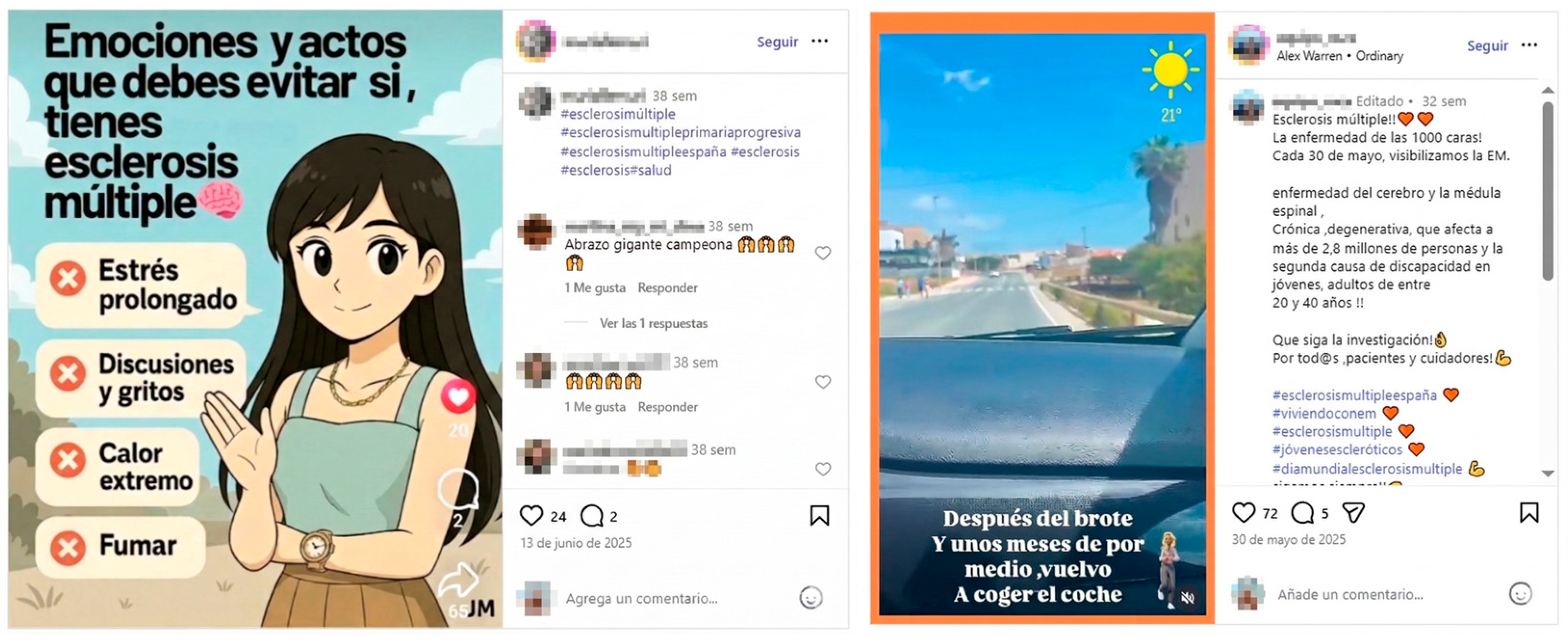
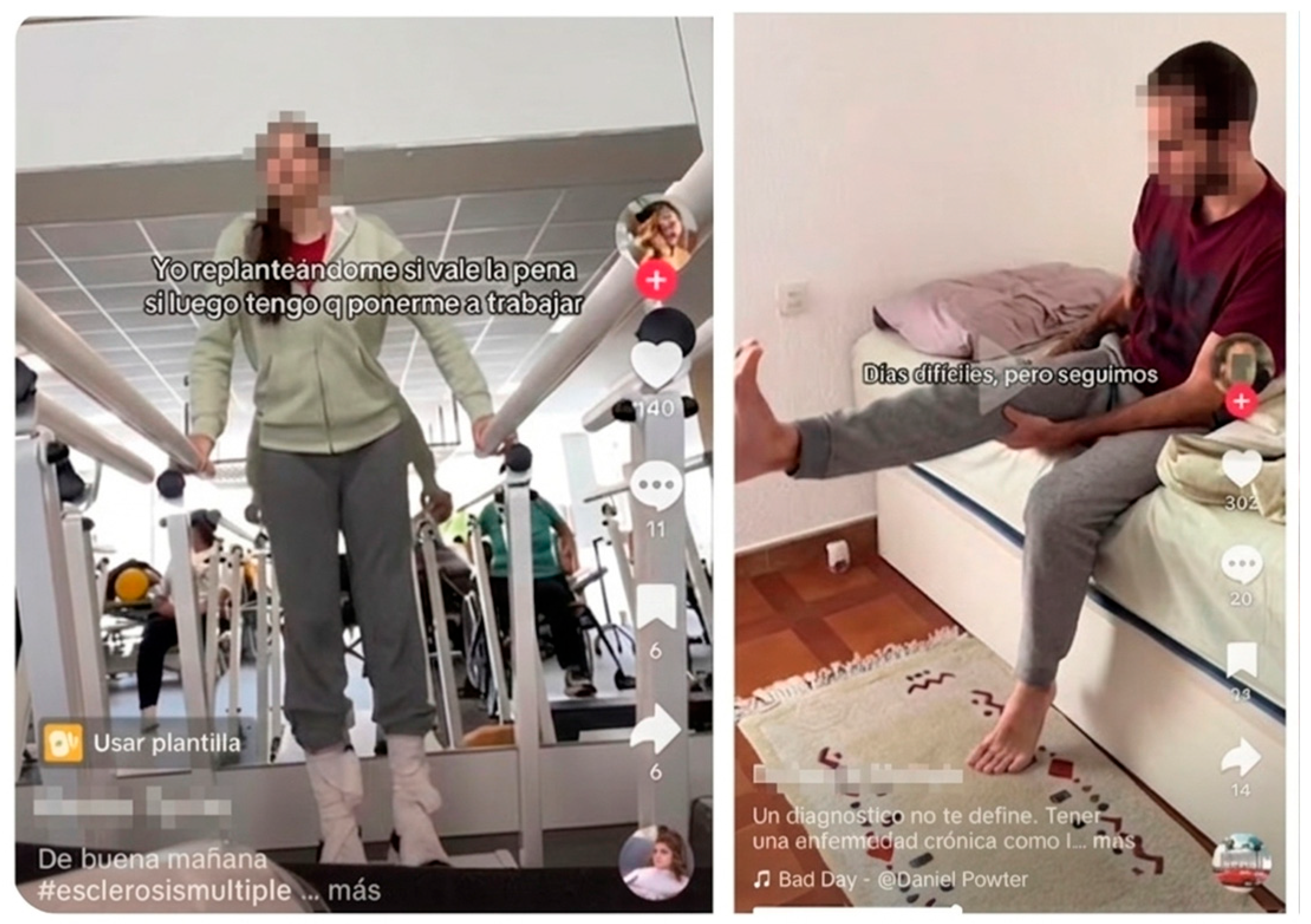
| 1 | Emotions and actions you should avoid if you have MS: prolonged stress, arguments and shouting, extreme heat, smoking (left). After the flare-up and over a few months, I’m getting back in the car (right). |
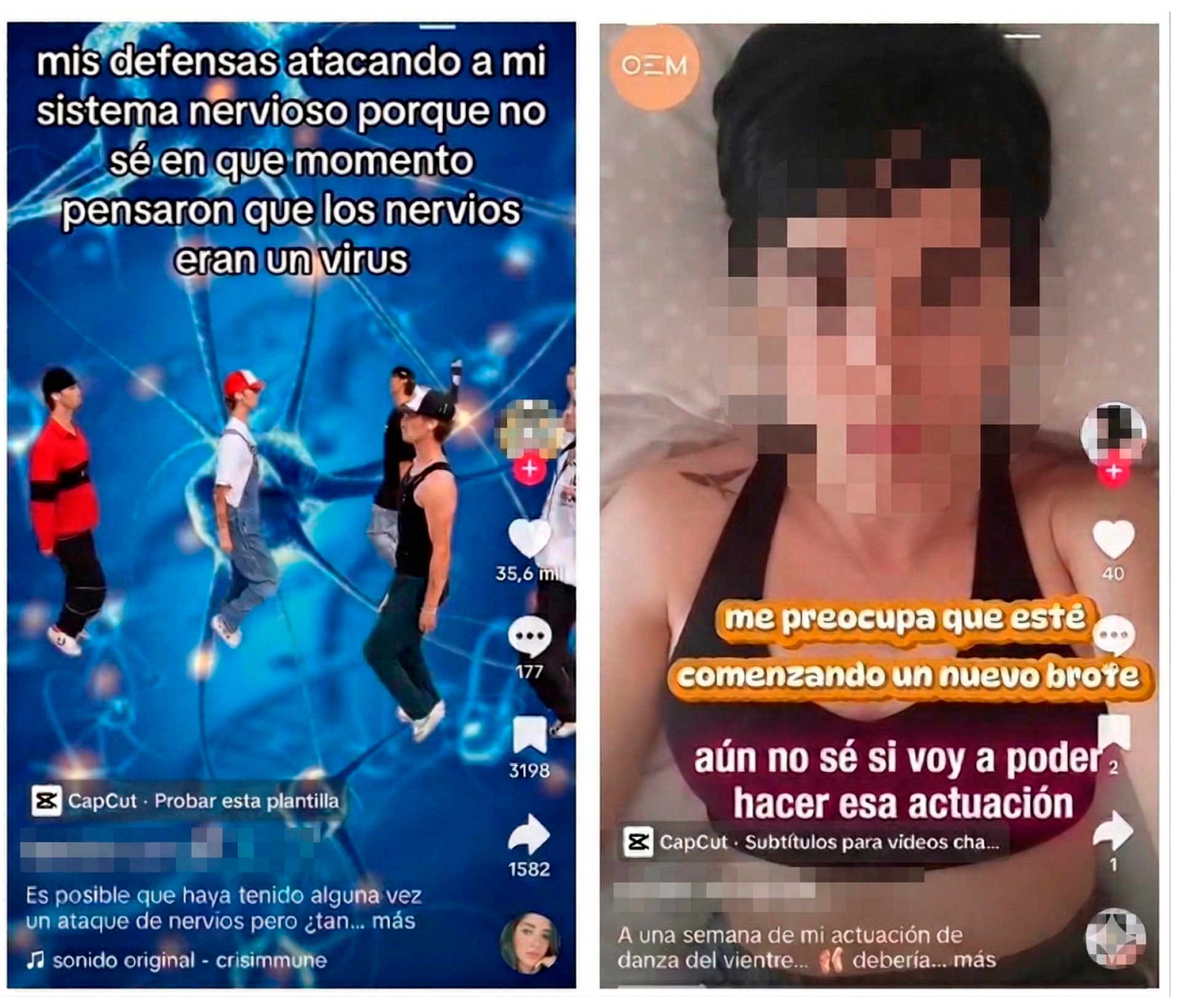
| 2 | Here my immune system attacking my nervous system because I don’t know when and how it dared to think that nerves themselves were a virus (left). I’m worried that a new flare-up is about to start. Still I don’t know whether I’ll be able to do that performance (right). |
| 3 | Here reconsidering whether it’s worth the effort, if later I have to get back to work (left). Tough days, but we keep going (right). |
References
- Barbosa, B., & Añaña, E. S. (2023). The influence of Instagrammers’ recommendations on healthy food purchase intention: The role of consumer involvement. Cuadernos de Gestión, 23(1), 75–86. [Google Scholar] [CrossRef]
- CIS, Centro de Investigaciones Sociológicas. (2025). Barómetro de marzo 2025. (report n° 3502). Available online: https://www.cis.es/documents/d/guest/es3502vpMT_a (accessed on 15 September 2025).
- Cohen, J. (1988). Statistical power analysis for the behavioral sciences. Lawrence Earlbaum. [Google Scholar] [CrossRef]
- De Araujo, S., Dhaigude, A. S., Kamath, G. B., Pai, R. R., Nayak, S., & Ganesh, S. (2025). Influencer credibility and consumer behavior: The mediating role of self-brand congruity and moderating role of involvement. Cogent Business & Management, 12(1), 2541040. [Google Scholar] [CrossRef]
- Djafarova, E., & Rushworth, C. (2017). Exploring the credibility of online celebrities’ Instagram profiles in influencing the purchase decisions of young female users. Computers in Human Behavior, 68, 1–7. [Google Scholar] [CrossRef]
- Duffek, B., Eisingerich, A. B., Merlo, O., & Lee, G. (2025). Authenticity in influencer marketing: How can influencers and brands work together to build and maintain influencer authenticity? Journal of Marketing, 89(5), 21–46. [Google Scholar] [CrossRef]
- EME, Esclerosis Múltiple España. (n.d.). Qué es la esclerosis múltiple. Available online: https://esclerosismultiple.com/esclerosis-multiple/que-es-la-esclerosis-multiple/ (accessed on 15 September 2025).
- Goyanes, M., & Piñeiro-Naval, V. (2024). Análisis de contenido en SPSS y KALPHA: Procedimiento para un análisis cuantitativo fiable con la kappa de cohen y el alpha de krippendorff. Estudios Sobre el Mensaje Periodístico, 30(1), 125–142. [Google Scholar] [CrossRef]
- Gupta, S., Dash, S. B., & Mahajan, R. (2022). The role of social influencers for effective public health communication. Online Information Review, 46(5), 974–992. [Google Scholar] [CrossRef]
- Han, J., & Balabanis, G. (2024). Meta-analysis of social media influencer impact: Key antecedents and theoretical foundations. Psychology & Marketing, 41, 394–426. [Google Scholar] [CrossRef]
- Hayes, A. F., & Krippendorff, K. (2007). Answering the call for a standard reliability measure for coding data. Communication Methods and Measures, 1(1), 77–89. [Google Scholar] [CrossRef]
- Hendry, N. A., Hartung, C., & Welch, R. (2021). Health education, social media, and tensions of authenticity in the ‘influencer pedagogy’ of health influencer Ashy Bines. Learning, Media and Technology, 47(4), 427–439. [Google Scholar] [CrossRef]
- Ibáñez-Hernández, A., & Carretón-Ballester, C. (2025). Epilepsy visibility on Instagram: The role of influencers as health content creators. index.Comunicación, 15(2), 83–108. [Google Scholar] [CrossRef]
- Jiang, F., Liu, Y., Hu, J., & Chen, X. (2022). Understanding health empowerment from the perspective of information processing: Questionnaire study. Journal of Medical Internet Research, 24(1), e27178. [Google Scholar] [CrossRef]
- Johnson, B. T., Scott-Sheldon, L. A. J., Snyder, L. B., Noar, S. M., & Huedo-Medina, T. B. (2008). Contemporary approaches to meta-analysis in communication research. In A. F. Hayes, M. D. Slater, & L. D. Snyder (Eds.), The SAGE sourcebook of advanced data analysis methods for communication research (pp. 311–347). Sage. [Google Scholar] [CrossRef]
- Krippendorff, K. (2011). Agreement and information in the reliability of coding. Communication Methods and Measures, 5(2), 93–112. [Google Scholar] [CrossRef]
- Langbecker, A., & Catalán, D. (2023). Social media and COVID-19 vaccination: Analysis of user behaviour in Spain. Perspectivas de la Comunicación, 16(2), 1–25. [Google Scholar] [CrossRef]
- Lee, J. A., & Eastin, M. S. (2021). Perceived authenticity of social media influencers: Scale development and validation. Journal of Research in Interactive Marketing, 15(4), 822–841. [Google Scholar] [CrossRef]
- Lee, Y. H., Yuan, C. W., & Wohn, D. Y. (2021). How video streamers’ mental health disclosures affect viewers’ risk perceptions. Health Communication, 36(14), 1931–1941. [Google Scholar] [CrossRef]
- Lind, J., & Wickström, A. (2023). Representations of mental health and mental health problems in content published by female social media influencers. International Journal of Cultural Studies, 27(2), 217–233. [Google Scholar] [CrossRef]
- Mansilla-Moreno, M., Parejo-Cuéllar, M., & de-Casas-Moreno, P. (2024). Instagram, the tool of e-patients with multiple sclerosis. index.Comunicación, 14(1), 207–227. [Google Scholar] [CrossRef]
- Martínez-Sanz, R., & Durántez-Stolle, P. (2024). Social learning on TikTok: The community as a literacy axis on blood donation. Comunicar, 79, 47–58. [Google Scholar] [CrossRef]
- Martín-García, A., Buitrago, Á., & Martínez-Sanz, R. (2024). My day by day life with an ostomy: The patient influencer on Instagram. Contratexto, 41, 68–88. [Google Scholar] [CrossRef]
- Menéndez-Signorini, J. A., Frigola-Reig, J., & Marca-Francés, G. (2025). Combatir la desinformación en salud: Las sociedades científico-médicas en la red. Evolución en el uso de sus canales de YouTube como herramienta de relaciones públicas. Palabra Clave, 28(s1), e28s16. [Google Scholar] [CrossRef]
- Mulcahy, R., Barnes, R., de Villiers Scheepers, R., Kay, S., & List, E. (2025). Going viral: Sharing of misinformation by social media influencers. Australasian Marketing Journal, 33(3), 296–309. [Google Scholar] [CrossRef]
- Nygård, T., & Lindfors, P. (2025). Promoting youth well-being: A qualitative study of Finnish YouTubers’ mental health content. Health Promotion International, 40(3), daaf074. [Google Scholar] [CrossRef] [PubMed]
- Ohanian, R. (1990). Construction and validation of a scale to measure celebrity endorsers’ perceived expertise, trustworthiness, and attractiveness. Journal of Advertising, 19(3), 39–52. [Google Scholar] [CrossRef]
- Piñeiro-Naval, V. (2020). The content analysis methodology. Uses and applications in communication research on Spanish-speaking countries. Communication & Society, 33(3), 1–15. [Google Scholar] [CrossRef]
- Reuters Institute. (2025). Digital news report 2025. Available online: https://reutersinstitute.politics.ox.ac.uk/sites/default/files/2025-06/Digital_News-Report_2025.pdf (accessed on 11 October 2025).
- Sánchez-Castillo, S., Armayones-Ruiz, M., & Meléndez-Labrador, S. (2025). Health information in the digital sphere. index.Comunicación, 15(2), 13–32. [Google Scholar] [CrossRef]
- Wartella, E., Rideout, V., Montague, H., Beaudoin-Ryan, L., & Lauricella, A. (2016). Teens, health and technology: A national survey. Media and Communication, 4(3), 13–23. [Google Scholar] [CrossRef]
- Wasike, B. (2023). The influencer sent me! Examining how social media influencers affect social media engagement, social self-efficacy, knowledge acquisition, and social interaction. Telematics and Informatics Reports, 10, 100056. [Google Scholar] [CrossRef]
- Wearesocial. (2025a). Digital 2026. Global overview report. Available online: https://wearesocial.com/ca-en/blog/2025/10/digital-2026/ (accessed on 13 November 2025).
- Wearesocial. (2025b). Digital 2026 Spain. Available online: https://wearesocial.com/es/blog/2025/10/digital-2026/ (accessed on 13 November 2025).
- Willis, E., & Friedel, K. (2026). Using Pender’s health promotion model to understand patient influencers’ promotion of chronic disease self-management. Journal of Health Psychology, 31(1), 115–130. [Google Scholar] [CrossRef]
- Zhu, L. (2025). Conceptualizing and measuring strategic authenticity? A reflective-formative second-order model. Journal of Business Research, 200, 115582. [Google Scholar] [CrossRef]
- Zhu, L., & Wang, Y. (2024). Acting real: A cross-cultural investigation of influencer strategic authenticity. International Journal of Advertising, 44(1), 164–183. [Google Scholar] [CrossRef]



| TikTok | |||
|---|---|---|---|
| ID-1. 136K followers | ID-6. 4733 followers | ID-11. 437K followers | ID-16. 6748 followers |
| ID-2. 9951 followers | ID-7. 4328 followers | ID-12. 296K followers | ID-17. 5833 followers |
| ID-3. 6701 followers | ID-8. 4168 followers | ID-13. 9816 followers | ID-18. 5136 followers |
| ID-4. 6189 followers | ID-9. 1988 followers | ID-14. 7472 followers | ID-19. 1054 followers |
| ID-5. 5949 followers | ID-10. 1970 followers | ID-15. 7008 followers | ID-20. 1010 followers |
| Identification data of |
| Profiles: Profile name; Social network; Number of followers; Type of influencer |
| Posts: Identifying number for the post; Encoder code; Profile name; Link to access the post; Social network; Number of likes; Number of comments |
| Credibility |
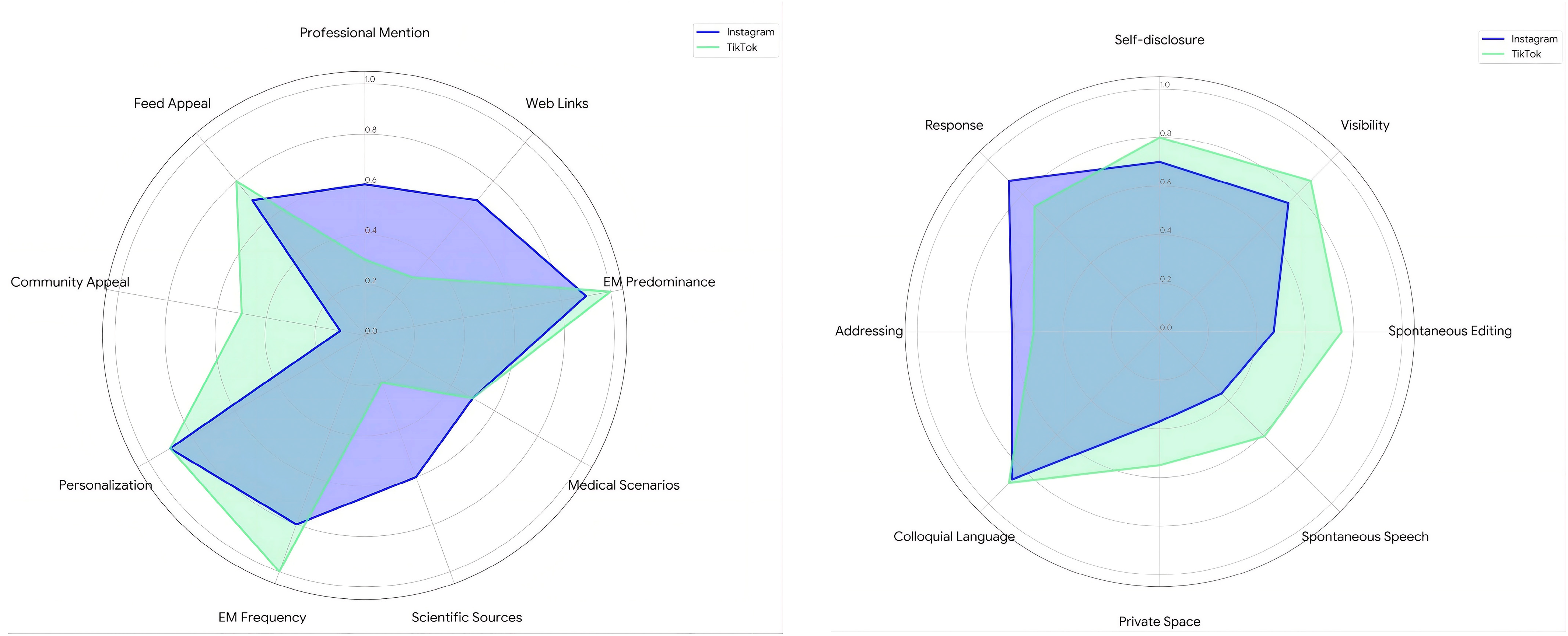
| Expertise: Professional; Links to access other sites; Predominance of MS |
| Trustworthiness: Medical environment; Quality sources; Frequency of publication |
| Attractiveness: Recognisable profile; Active community; Timeline |
| Source: Own elaboration from Barbosa and Añaña (2023), De Araujo et al. (2025), Han and Balabanis (2024) and Ohanian (1990) |
| Authenticity |
| Transparency: Self-disclosure; Visibility |
| Spontaneity: Spontaneity at editing; Spontaneity at talk |
| Everyday life: Private environment; Colloquial language |
| Connection: Addressing; Response |
| Source: Own elaboration from Duffek et al. (2025), J. A. Lee and Eastin (2021), Zhu and Wang (2024) and Zhu (2025) |
| Communicative strategies |
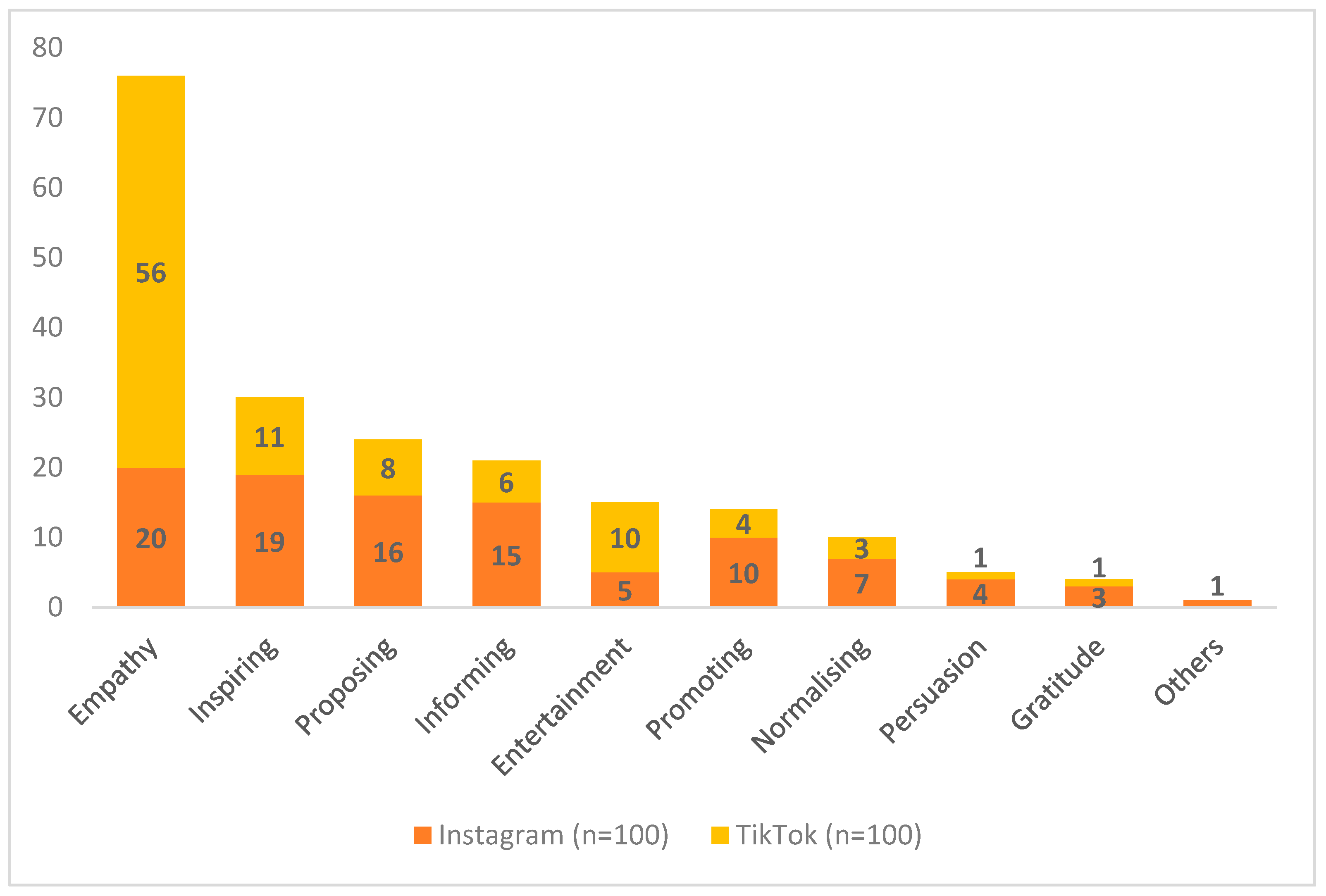
| Orientation: Informing or divulging; Empathy; Persuasion; Normalising; Entertainment; Gratitude; Promoting; Proposing; Inspiring; Others |
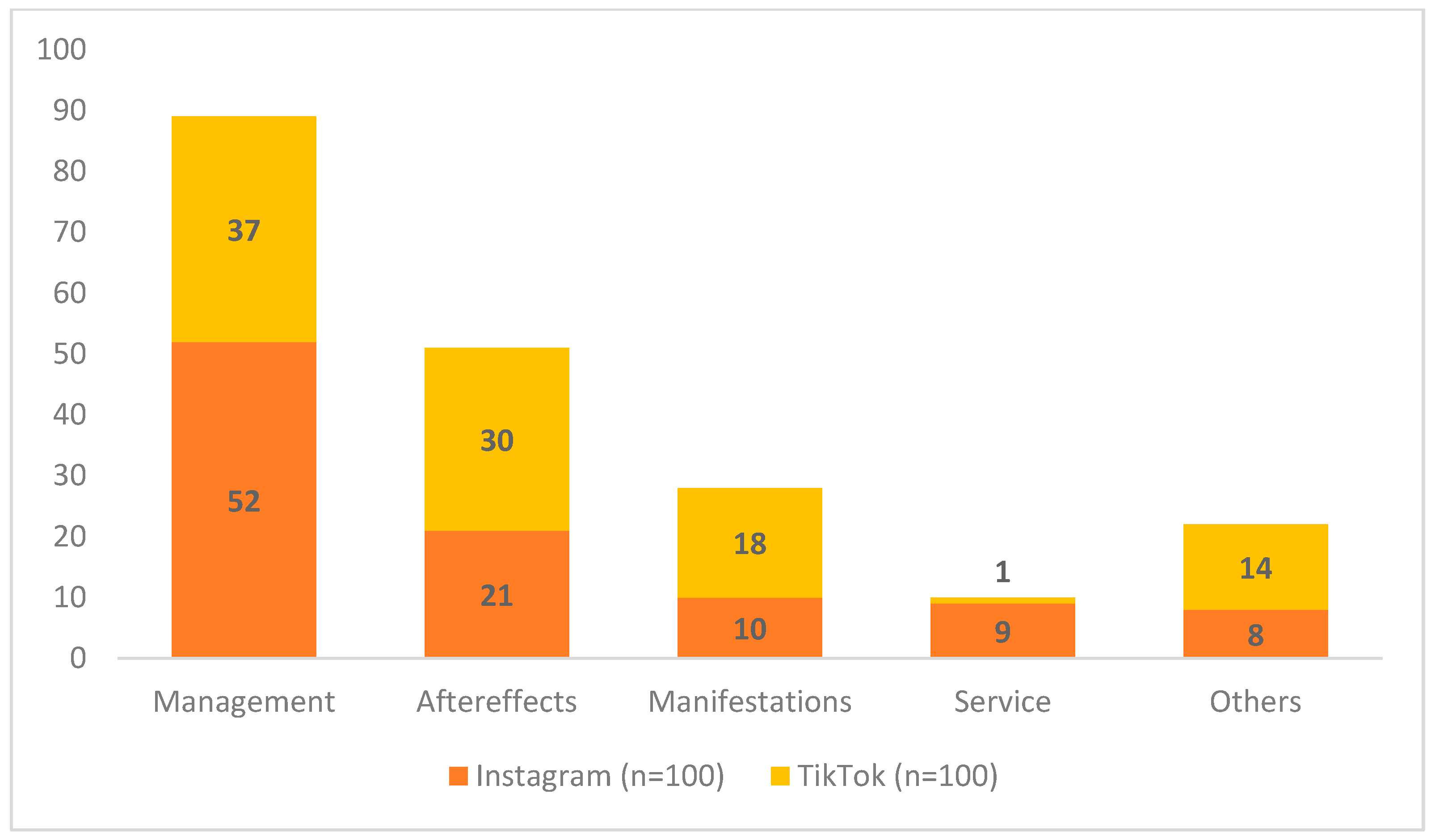
| Theme: MS manifestations; Aftereffects; Service offered; Disease management; Others |
| Priority: Presence |
| Bias: Positive; Negative; Neutral |
| Format: Image(s); Video |
| Intellectual ownership: Own elaboration; Shared elaboration |
| Source: Own elaboration from Ibáñez-Hernández and Carretón-Ballester (2025), Mansilla-Moreno et al. (2024) and Martín-García et al. (2024) |
| Id_Profile | 1 | 2 | 3 | 4 | 5 | 6 | 7 | 8 | 9 | 10 | Instagram Profiles |
|---|---|---|---|---|---|---|---|---|---|---|---|
| Credibility | 5 | 6 | 9 | 8 | 4 | 5 | 7 | 7 | 3 | 4 | 5.8 |
| Authenticity | 5.8 | 6.2 | 6.1 | 4.9 | 6.1 | 3.7 | 5.8 | 4.9 | 1.9 | 4.6 | 5 |
| Id_Profile | 11 | 12 | 13 | 14 | 15 | 16 | 17 | 18 | 19 | 20 | TikTok Profiles |
| Credibility | 4 | 5 | 4 | 6 | 5 | 7 | 6 | 5 | 8 | 5 | 5.5 |
| Authenticity | 5.1 | 6.1 | 4.8 | 5.7 | 7 | 6.7 | 4.7 | 6 | 5.1 | 6 | 5.72 |
| Support Parameters | M | SD | Credibility | Authenticity |
|---|---|---|---|---|
| Followers | 8965 | 10,015 | −0.251 *** | 0.114 |
| Likes | 852 | 3110 | −0.002 | −0.021 |
| Comments | 44.5 | 84.23 | 0.129 + | 0.225 ** |
| Total interactions 1 | 896.5 | 3157 | 0.001 | −0.015 |
Disclaimer/Publisher’s Note: The statements, opinions and data contained in all publications are solely those of the individual author(s) and contributor(s) and not of MDPI and/or the editor(s). MDPI and/or the editor(s) disclaim responsibility for any injury to people or property resulting from any ideas, methods, instructions or products referred to in the content. |
© 2026 by the authors. Licensee MDPI, Basel, Switzerland. This article is an open access article distributed under the terms and conditions of the Creative Commons Attribution (CC BY) license.
Share and Cite
Martínez-Sanz, R.; Durántez-Stolle, P.; Piñeiro-Naval, V. Credibility, Authenticity and Communication Strategies of Multiple Sclerosis E-Patients on Social Media. Journal. Media 2026, 7, 70. https://doi.org/10.3390/journalmedia7010070
Martínez-Sanz R, Durántez-Stolle P, Piñeiro-Naval V. Credibility, Authenticity and Communication Strategies of Multiple Sclerosis E-Patients on Social Media. Journalism and Media. 2026; 7(1):70. https://doi.org/10.3390/journalmedia7010070
Chicago/Turabian StyleMartínez-Sanz, Raquel, Patricia Durántez-Stolle, and Valeriano Piñeiro-Naval. 2026. "Credibility, Authenticity and Communication Strategies of Multiple Sclerosis E-Patients on Social Media" Journalism and Media 7, no. 1: 70. https://doi.org/10.3390/journalmedia7010070
APA StyleMartínez-Sanz, R., Durántez-Stolle, P., & Piñeiro-Naval, V. (2026). Credibility, Authenticity and Communication Strategies of Multiple Sclerosis E-Patients on Social Media. Journalism and Media, 7(1), 70. https://doi.org/10.3390/journalmedia7010070