Article

Context Is Everything: Podcasting as an Opportunity for Journalistic In-Depth Analysis

Institute for Communication Science, University of Bamberg, 96047 Bamberg, Germany
*
Author to whom correspondence should be addressed.
Journal. Media 2026, 7(1), 32; https://doi.org/10.3390/journalmedia7010032
Submission received: 28 November 2025 / Revised: 30 January 2026 / Accepted: 6 February 2026 / Published: 11 February 2026

Abstract

This article examines how political journalism can distinguish itself in a fast-paced information environment by providing in-depth contextualization and thereby contribute to the functioning of democratic societies in a digitalized world. Focusing on the ‘Causa Brosius-Gersdorf’—a highly polarized controversy surrounding judicial appointments to Germany’s Federal Constitutional Court in July 2025—we ask the following questions: to what extent can German-language podcasts offer in-depth analysis, and which types of contextualization can be observed across different podcast formats? The study is based on a qualitative content analysis of 39 episodes from 15 popular podcasts drawn from the German Spotify Top 200. Drawing on a theoretically grounded analytical framework comprising the categories ‘topics’, ‘dimensions of context’, and ‘relational levels’, we identify distinct types of contextualization. We analyze the distribution of these types using distant reading and interpret salient patterns through close reading. Our results show that the podcasts analyzed offer an in-depth contextualization of the issue, with a focus on political and societal evaluation. In doing so, they provide their audiences with orientation and therefore enable them to form their own well-founded opinions. Since we conducted our analysis at the level of individual statements rather than at the level of the news items themselves, our study advances research on quality in journalism, highlights the role of podcasts in digital transformation, and addresses the democratic value of contextualizing political communication.

1. Introduction

In a digitalized world, we are exposed to information overload: political information is disseminated, searched for, and shared in a fast-paced information environment. Audiences encounter such information in digital spaces often in real time, yet largely without context, in the form of constantly updated headlines, images, and video snippets (Meier, 2018, p. 198). The risk associated with this speed is that the context of events—that is, the corresponding backgrounds, causes, and consequences—is neglected. This is also due to the increasing number of new communicators, such as politicians, parties, companies, and private individuals without an institutional background, who operate their own ‘owned media’ channels within a ‘hybrid media system’ (Chadwick, 2013; Bennett & Pfetsch, 2018, p. 250). They can produce ‘content’ without being bound by the professional norms of journalism (Schneiders & Stark, 2025, p. 3). This ‘digital transformation’ may endanger media quality and, by extension, democracy itself, which depends on a well-informed public (Stark et al., 2021, p. 430). This raises the question of how high-quality journalism can stand out from this information overload and thereby continue to contribute to the functioning of democratic societies in a digitalized world (Kaczmarczyk, 2025, p. 12; Min, 2022).
As a consequence of digitalization, the mere provision of information is no longer a distinctive feature of journalism (Esser & Neuberger, 2019). If journalism is to avoid losing its audience in the midst of a fast-paced information environment, it must sharpen its profile: its specific function of providing orientation through contextualization needs to be made visible. In an increasingly complex world marked by multiple crises, in-depth analysis and contextualization are more important than ever and therefore constitute key indicators of journalistic quality (Stark et al., 2021, p. 430; Bachmann et al., 2022, p. 17). Journalism must thus become ‘journalism beyond pure information’. Audiences reward such contextualization, as evidenced by formats such as the German weekly newspaper Die Zeit, which remains successful despite the overall decline in print journalism (Meier et al., 2024, p. 11).
Apart from such ‘flagship’ outlets, journalism faces a range of challenges resulting from economic and technological transformations (Meier et al., 2024, p. 15; Whittle, 2024, p. 178). Despite the expansion of digital offerings, journalism in Germany is under increasing pressure (Von Garmissen et al., 2025, p. 5). In contrast, there is the ongoing ‘podcast boom’: the steadily growing popularity of podcasts over the past years. This development represents both a technological and substantive shift in the media landscape: innovative actors can succeed even with niche topics (Katzenberger et al., 2025). Narrative elements and storytelling are emerging as new journalistic genres (Lindgren, 2016; Schlütz, 2020; Planer & Godulla, 2022; Michael, 2022; Krause & Uhrig, 2022).
At times, it is questioned whether this new medium can, in addition to providing entertainment, also fulfill informational, critical, and watchdog functions and thus meet the expectations of journalistic quality. It is striking, however, that in the podcast sphere, long and in-depth formats in which political issues are discussed in detail and with substantial background are highly popular, as evidenced by the success of podcasts such as ‘Politik mit Anne Will’ or ‘Lage der Nation’, which regularly appear at the top of the charts on German-language podcast platforms. This points to a countermovement to the fast-paced information environment: a renewed focus on the contextualization of information, through which journalism provides social orientation and contributes to opinion formation—a core journalistic function (Dernbach et al., 2022, p. 334). Instead of prioritizing short-term immediacy and rapid topic shifts, the emphasis shifts toward in-depth analysis, background information, and the observation of long-term developments (Whittle, 2024, p. 171). This ‘slow pace’ may become a defining feature of journalism in the future. Rather than confining itself to the mere reporting of facts and the description of problems, interpretive journalism focuses on providing a broader contextualization of events and asking the question ‘Why?’ (Meier, 2018, p. 196), while solution-oriented future perspectives that address the question ‘What comes next?’ are the trademark of the more recent strand of constructive journalism (Meier et al., 2024, p. 11). Can journalism, then, distinguish itself within the fast-paced information environment through in-depth analysis and the contextualization of complex political issues? And can this be achieved in podcasts? These are the fundamental questions that guide the present study on the future of journalism.
We address these fundamental questions by examining a specific complex political issue that preoccupied the German public debate in July 2025: the ‘Causa Brosius-Gersdorf’. What began as a political dispute over the appointment of law professor Frauke Brosius-Gersdorf as a judge on the Federal Constitutional Court, Germany’s highest court, quickly evolved in public debate into broader questions of whether this might trigger a government crisis, whether political culture wars similar to those in the United States were emerging in Germany, and whether compromise, as a democratic mechanism, was being eroded. The issue developed rapidly, required substantial political and legal background knowledge, and, due to the emotionalized nature of the debate, offered ample opportunity for superficial-opinion formation. A debate that was both highly charged and compressed into just a few weeks thus constitutes an ideal case for studying how complex political issues are contextualized in podcasts. This results in the following two research questions:
  • RQ1: To what extent do German-language podcasts offer an in-depth analysis of the ‘Causa Brosius-Gersdorf’ issue?
  • RQ2: What different types of contextualization can we observe in different podcast formats?
We address these research questions by conducting a qualitative content analysis (Hemmler et al., 2022) of popular German podcasts from July 2025 that reported on the issue. In a multi-stage procedure, 15 podcasts and 39 episodes were selected from the ‘Spotify Top 200’ and then transcribed. Using a coding scheme developed both deductively and inductively—comprising categories for ‘topics’, ‘dimensions of context’, and ‘relational levels’—the transcripts were subjected to a three-step manual content analysis. The podcasts were coded at the level of individual statements, which were classified according to their semantic content and meaning. We define an individual statement as an argument or position with consistent reference points and topics, made by a single speaker and extending over one or more sentences or clauses. On this basis, we then carried out a type-building procedure, which enabled us to identify different ‘types of contextualization’. We examined the distribution of these types across the podcasts through ‘distant reading’ at several levels of analysis. The resulting patterns serve as indicators of relevance for the qualitative interpretation: striking types of contextualization were subjected to ‘close reading’, and the corresponding passages were interpreted in consideration of our research questions (Birkner, 2022, p. 12; Komossa et al., 2024, p. 824).
Our study thus contributes to three highly topical debates in political journalism, namely, (1) the importance of contextualization in a fast-paced information environment; (2) the role of podcasts in digital transformation; and (3) the advancement of research on journalistic quality, as this study is among the few that measure quality in journalism at the level of individual statements rather than at the level of the news items themselves, thereby offering useful methodological points of reference for future research on quality in journalism.
Before presenting the analytical framework that we developed for this study to examine journalistic contextualization, along with the findings derived from it, we situate our work within existing research on quality in journalism. To this end, we begin with the following fundamental question: What functions can be attributed to political journalism in a democracy?

2. Theoretical Framework

2.1. Democratic Function of Political Journalism

Democracies depend on the equal participation of their citizens. A prerequisite for political participation is the ability to form opinions freely, enabling citizens to develop their own positions on societally relevant issues and political decisions. Free opinion formation, on the other hand, requires access to information concerning events of public significance. In liberal democracies, mass media constitute the societal institutions responsible for generating the public discourse necessary for this process. Their reporting must be both critical and dialogue-oriented in order to illuminate as many perspectives as possible on relevant actors, events, and decisions. Political journalism therefore observes, reports on, comments upon, and critiques events, conditions, and actions that occur within the societal subsystem of politics. This typically concerns actors within the political–administrative system but also encompasses political activities carried out by civil-society actors (Prinzing & Blum, 2021, p. 21). On this basis, people are then able to form well-founded opinions on political matters. The role of journalism in a democratic society is thus fulfilled through three core functions, referred to as the ‘triad of functions’—the information function, the watchdog function, and the opinion-forming function—which together enable citizens to participate in and be integrated into political processes and ultimately society itself (Schulz, 2011, p. 155).
With regard to the reporting practices of political journalism, two fundamentally different perspectives can be distinguished. The first assumes that the information function is best fulfilled when journalism adheres to objectivity. In this perspective, journalism should act as an impartial mediator and represent observable reality as neutrally as possible in order to facilitate free opinion formation (Meier, 2018, p. 196). Since the 1960s, however, this notion of ‘objective journalism’ has been criticized from a constructivist perspective, as the idea of a single ‘truth’ is considered unrealistic (Westerståhl, 1983, p. 407). After all, the very act of selecting which issues are relevant for being reported already constitutes a form of journalistic evaluation and is therefore not ‘objective’. The conception of journalism as a neutral intermediary is thus regarded as excessively passive and carries the risk of reproducing official statements by political actors and institutions without sufficient critical scrutiny (Evers et al., 2021, p. 443; Meier, 2018, p. 195).
The second perspective therefore attributes an active role to political journalism: “Those who engage in political journalism become active in a political sense as they analyze, take a stance, alarm, scandalize, or engage in the political process like a seismograph” (Prinzing & Blum, 2021, p. 21; translation by the authors). This perspective encompasses, for example, investigative journalism, which assumes an active critique and control role and thereby primarily fulfils the watchdog function of journalism (Meier, 2018, p. 195). Constructive journalism, which not only describes problems but also identifies potential solutions, also falls within this view (Evers et al., 2021, p. 449).
An active role is likewise ascribed to interpretative journalism. Rather than focusing solely on reporting discrete events, it situates them within broader contexts and explains to audiences the background knowledge necessary for understanding these events (Meier, 2018, p. 196). Putting it simply, interpretative journalism addresses the ‘W-questions’: it not only asks ‘who’ did ‘what’ ‘when’, but also ‘why’. Events are examined within their chronological contexts, social contexts are explicated, for example by employing prevailing norms as interpretive frameworks. Finally, the resources and rules of other societal subsystems are considered, as motives, interests, and objectives from political, economic, or legal contexts are contrasted (Heijnk, 2021, p. 477). By asking ‘what now?’ interpretative and constructive reporting activates the audiences and supports processes of opinion formation (Evers et al., 2021, p. 449).
It is within this perspective that we locate the concept of ‘contextualization’. The capacity to provide interpretive context is a particular strength of political journalism in the digital media age, where communication by political actors often takes the form of clientelist messaging (Prinzing, 2021a, p. 532). As information increasingly reaches audiences directly from political actors—especially via social media—allowing these actors to omit or obscure their own errors, journalistic interpretation and critique become all the more essential. In this sense, journalistic contextualization can also serve as a democratically significant safeguard against populist simplification (Prinzing, 2021b, p. 713). In news journalism, oriented primarily towards immediacy, however, there is often simply insufficient time for such contextual work. This observation has also been discussed under the concept of ‘slow journalism’ (Le Masurier, 2015; Greenberg, 2007). While journalism that allows journalists ‘to take their time’ is nothing new and exists in forms such as investigative reporting, literary journalism, and magazines with slow editing routines and long publication schedules (Le Masurier, 2015, p. 142), the need to counter the fast-paced information environment through in-depth research, explanation, and contextualization has become increasingly urgent.
‘Contextualization’ also encompasses the normative evaluation and commentary on political performances, such as those staged in political TV talk shows (Schicha, 2021, p. 267). Although these are, in their basic structure, dialogue-oriented—and may therefore appeal to audience segments not reached by traditional news journalism—they tend to drift towards ‘politainment’. This is due to their strong emphasis on the visual, their function as a stage for self-presentation, and the prioritization of controversy, which frequently overshadows more deliberative forms of discourse (Geiß, 2021, p. 505). Podcasts reduce the conversation to the auditory level and typically involve only a small number of interlocutors therefore a deeper form of dialogic contextualization becomes possible, not least because of the absence of visual stimuli (Perdomo & Lindgren, 2025, p. 36). The aspiration to provide ‘in-depth background information and extensive political debates’ is found primarily among so-called quality media, such as newspapers like The New York Times or the German Die Zeit.
The question of journalistic quality, derived from the functions of journalism in democratic societies, is discussed in German-language scholarship under the labels ‘quality in journalism’ (Arnold, 2009), ‘media quality’ (Serong, 2015), or ‘news quality’ (Voigt, 2016). In the international literature, by contrast, terms such as ‘media performance’ (McQuail, 1992) or ‘journalistic excellence’ (Scheuer, 2008) have been used. This conceptual ambiguity has hindered the development of a coherent international research agenda for journalistic quality. For this reason, following one of the first English-language encyclopedia entries on the topic, this article employs the term ‘quality in journalism’, which is well established in German-language scholarship (Meier, 2019) and is explained in detail in the following section.

2.2. Quality in Journalism

Quality in journalism is a multidimensional construct that can be defined in terms of democratic theory, economic considerations, or journalistic role conceptions. When quality is understood as a relational construct, references are often made to the ‘magic polygon’ (Ruß-Mohl, 1992, p. 86). In this model, objectivity, complexity reduction, timeliness, originality, and transparency are conceptualized as cornerstones of quality assessment. However, these criteria overlap, partly contradict one another, and are contingent upon the constraints of the respective medium. For example, a strong emphasis on immediacy and concise brevity, advantageous in radio, comes at the expense of in-depth background reporting (Geuß, 2018, p. 54). In contrast, podcasts are subject to few format restrictions and therefore considered a suitable medium for in-depth insights and detailed analyses (Whittle, 2024, p. 171).
In many studies, the above mentioned ‘triad of functions’ of journalism is employed as a normative reference point for assessing journalistic quality (Meier, 2019, p. 2; Fög, 2024, p. 30; Fawzi & Mothes, 2020, p. 336; Stark et al., 2021, p. 431). Following Westerståhl (1983), McQuail (1992) was the first to take the democratic values of freedom, equality, and social order as the starting point for the conceptualization of quality in journalism. From these, he derived quality criteria such as independence, diversity, and objectivity (McQuail, 1992, p. 78). Objectivity has two dimensions, which lead to different quality criteria: external objectivity asks, ‘What is correct?’, and aims at factual and transparent accuracy. Internal objectivity, by contrast, asks, ‘What is important?’, and is ensured through relevance and balance (Westerståhl, 1983, p. 405). A central precondition for internal objectivity is diversity, which can be regarded as the key to freedom of speech and thus as the most important criterion supporting democracy (Udris et al., 2023, p. 63). Accordingly, diversity is treated as a meta-norm in most studies that argue from a normative, democracy-theoretical perspective (Geuß, 2018, p. 49; Schneiders & Stark, 2025, p. 431). Following this argument, we locate ‘contextualization’ within internal objectivity.
However, the question of when there is ‘sufficient’ diversity for journalism to fulfil its attributed function requires interpretation on a case-by-case basis. In this context, Maurer et al. (2024b) identify, in their study on diversity in German public service broadcasting, three key problems of diversity measurement:
  • What constitutes ‘sufficient’ diversity? Is it enough merely to mention controversial opinions, or should they be balanced in a 50:50 ratio? Magin et al. (2025, p. 8) warn against ‘false balance’, which arises when statements of varying relevance are treated as equivalent due to formalized requirements. Diversity without evaluative consideration could lead to an imbalance in thematic relevance (Schneiders & Stark, 2025, p. 5). For this reason, media content should not be compared with external ideal standards; instead, comparisons should be made over time, between media genres, and within media genres (Vogel et al., 2014; Meier, 2019, p. 6).
  • What are the boundaries of diversity? Pluralism does not mean ‘anything goes’ in the sense of hostile antagonism, but rather that the media must provide a productive space for the evaluative consideration of conflicting perspectives (Sax, 2022, p. 1658). In the context of migration reporting, for instance, far-right statements that contradict the principles of deliberative democracy are regarded as illegitimate and not as contributing to balanced diversity (Magin et al., 2025, p. 5).
  • At what level should diversity be present? Diversity can be ensured across the media system (Magin et al., 2025, p. 8). However, this becomes problematic when people use only a small number of media outlets (Magin et al., 2025, p. 20). Diversity can also be achieved within a single media outlet (Fög, 2024, p. 130). In this case, diversity does not have to be realized within a single journalistic piece. Rather, there may be good reasons to place different emphases at different points in time and across various journalistic contributions of the same outlet without this necessarily being criticized as ‘bias’.
Building on this, we argue that diversity manifests itself in various forms of contextualization that are used within individual journalistic pieces. Contextualization serves as a connecting principle that deepens the factual accuracy of reporting by providing background information and enhances comprehensibility and accessibility through complementary subjective evaluations. This leads us to the question of how contextualization and journalistic quality have been examined to date.
Research on quality in journalism has thus far often been driven by media criticism. It is linked to two types of transformation: first, the development of new media is routinely accompanied by concerns about negative effects (Meier, 2019, p. 1). Second, societal crises and controversial issues are important starting points for research on quality in journalism.
As far as the first point is concerned, digitalization has given rise to new communication platforms such as blogs, social network sites, and podcasts, on which new journalistic formats are being developed (e.g., cross-media reporting and storytelling) (Haarkötter, 2018, p. 52). On the other hand, the digitalization of communication has led to a state of information overload, resulting in increasingly rapid—and at times even hectic—information processing in journalism. As both a critique of this development and a counter-model, the concept of ‘slow journalism’ has been discussed for several years (Greenberg, 2007; Le Masurier, 2015) and has been linked to the development of new media and concerns about quality in journalism (Min, 2022, p. 30). By now, slow journalism encompasses a range of aspects and normative demands, such as reporting only once a story has fully developed; emphasizing investigative journalism without reliance on public relations material; prioritizing fewer but higher-quality news; and giving something back to the community by treating audiences as partners (Neveu, 2016; Peñafiel-Saiz et al., 2022; Mehendale & Jaggi, 2023). While the concept of ‘slow journalism’ primarily addresses the production conditions of journalism, the more active consideration of audiences also constitutes a central component of the approach. The role of the audience is changing through the possibilities of interactivity: the traditional mass media audience can turn into a ‘community’ that provides immediate feedback (‘crowd criticism’) (Fengler, 2012). As a result, interactivity has become one key quality criteria for digital media (Geuß, 2022, p. 288). Digital media, including podcasts, is often less institutionalized than radio and television, for example. This has led to concerns that these actors may have little or no journalistic professionalism at all (Schneiders & Stark, 2025, p. 3; Stark et al., 2021, p. 430). Furthermore, in the flood of information generated by digital communication, quality in journalism must not only be produced but also be made visible. For this reason, findability and visibility are being discussed as new criterions for quality in journalism (Schneiders & Stark, 2025, p. 15). A survey of Polish media experts found that technological innovations such as artificial intelligence are perceived as the greatest threat, as they enable the rapid dissemination of fake news. Increasing sensationalism in journalism and a growing emphasis on entertainment were also identified as risks to quality in journalism (Kaczmarczyk, 2025, p. 20). Only a few media experts expressed the optimistic expectation that technological innovations such as multimedia might enhance the diversity and plurality of content (Kaczmarczyk, 2025, p. 17). A study on online media in Germany, by contrast, showed that news articles incorporating quotes from social media did not exhibit a greater diversity of perspectives. This is because journalists also rely on familiar sources in digital media, with the result that the same actors as always remain at the center of coverage (Oschatz et al., 2024, p. 1651).
The second important starting point for research on quality in journalism lies in societal crises and controversial issues. For example, studies examining the quality of reporting on migration often take as their starting point the accusation that the media covered the issue in a one-sided manner (Maurer et al., 2019; Maurer et al., 2022; Maurer et al., 2023b; Magin et al., 2025). The same starting point underpins studies on coverage of the COVID-19 pandemic (Maurer et al., 2021; Reinemann et al., 2024) and the war in Ukraine (Maurer et al., 2023a; Maurer et al., 2024a). The pandemic in particular, as a novel event, required reporting that provided extensive background information in order to explain the crisis. In their study of German media coverage of the pandemic, Maurer et al. (2021, p. 20) conceptualize ‘contextualization’ as ‘analytical quality’. They operationalize this concept through comparisons (historical comparisons, cross-national comparisons, or comparisons with other crises) and consequences (medical, social, and economic contexts). Half of the items examined contained some form of contextualization in the shape of a statistical comparison of new infections and death rates. However, these were almost exclusively chronological or cross-national comparisons, while the consequences of the pandemic were hardly addressed or systematically assessed in the analyzed journalistic pieces (Maurer et al., 2021, p. 53).
Another line of research, which can only be briefly mentioned here, focuses on audiences’ expectations of journalistic quality. Key factors in quality evaluations include the image of the media brand (Voigt, 2016), levels of media trust (Wladarsch, 2020), and populist attitudes (Fawzi & Mothes, 2020). Arnold (2009) was the first to survey newspaper readers about their motives for using newspapers and their quality expectations. His findings indicate that readers were aware of a lack of contextualization (Arnold, 2009, p. 307).
Following the normative, democracy-theoretical perspective that conceptualizes diversity as a meta-norm of quality in journalism, Bachmann et al. (2022) present the first study to examine the congruence between quality criteria derived from democratic theory and audience evaluations. Drawing on Habermas’s ideal of deliberative democracy, they identify, among other aspects, the explanation and contextualization of events as key functions of journalism (Bachmann et al., 2022, p. 14). Their representative survey shows that the deliberative ideal is strongly anchored in conceptions of journalistic quality in Switzerland. The correlation is particularly high for judgments of relevance and least—although still high—regarding contextualization (Bachmann et al., 2022, p. 31). The study is rooted in the ‘Jahrbuch Qualität der Medien’ (Yearbook Quality in Media) (Fög, 2024), an extensive quality-monitoring project conducted by the University of Zurich. This internationally unique project has examined the Swiss media market since 2010. The fact that Switzerland is a frontrunner in research on quality in journalism is linked to the importance of high journalistic standards and a well-informed citizenry in a direct democracy (Fög, 2024, p. 7). The longitudinal study examines various media types (subscription and tabloid newspapers, public and commercial television, public radio, online newspapers, and ‘online pure’ news portals), but has so far not included podcasts (Fög, 2024, p. 124).
Quality is measured using four categories with several criteria: Relevance is coded at the level of the individual item and is considered high when political or economic hard news rather than soft news is reported and when institutions rather than individuals are featured (Fög, 2024, p. 126). At the level of the media outlet as a whole, diversity is measured by comparing the distribution of topics with a calculated ideal distribution, according to which personalized soft news should occur less frequently than news about political and economic institutions (Fög, 2024, p. 131). At the item level, source transparency and original journalistic contribution are used as indicators of professionalism (Fög, 2024, p. 127). Finally, the dimension of contextualization assesses whether an item provides relevant background information: especially in today’s fast-paced information environment, reporting that situates events within longer-term developments is regarded as a key quality criterion (Fög, 2024, p. 126). Journalism also provides valuable interpretation when actors’ strategies and interests become comprehensible and open to critique. Opinion-oriented formats likewise offer opportunities to make different viewpoints understandable and thus support processes of opinion formation (Fög, 2024, p. 127)—this can also be applied to podcasts.
The Swiss study has inspired a cross-national project (‘Media Performance and Democracy’) that examines quality in journalism in Germany, Austria, and Switzerland (Stark et al., 2021; Udris et al., 2023). This project likewise adopts a democracy-theoretical perspective, analyzes the classical media types (excluding podcasts), and analyzes at the level of individual items. In Germany, professionalism and contextualization are the dimensions that most clearly distinguish high-quality from low-quality outlets. In Germany, the weekly newspaper Die Zeit ranks first in terms of contextualization performance. Because of its characteristic long reads, it is considered particularly well suited to this quality dimension (Stark et al., 2021, p. 438). The compact ‘Tagesschau’, a prominent public broadcast television newscast, despite its short format, still falls in the lower mid-range, whereas its online counterpart even reaches rank 5 out of 19. In Germany and Switzerland, ‘online pure’ outlets perform worst (Stark et al., 2021, p. 444). This cannot be attributed to format constraints alone, which makes concerns about a loss of quality in this category plausible. A publication from the same project likewise concludes that, for online media, it is not format boundaries but editorial strategies and the organizational structures of media companies that determine content quality (Udris et al., 2023, p. 73). This corresponds with the finding that the online counterparts of newspapers perform slightly better in terms of contextualization than their print editions. Accompanying online offerings can therefore provide more in-depth contextualization alongside compact television and radio formats (Stark et al., 2021, p. 439), which was less the case in Switzerland (Fög, 2024, p. 85). Thus, sweeping concerns about an overall decline in quality online can be partially debunked—except in the case of social media channels, which are consistently rated lowest due to their high degree of personalization (Stark et al., 2021, p. 443).
Given their longitudinal research design, it is understandable that neither the ‘Jahrbuch Qualität der Medien’ nor the cross-national project ‘Media Performance and Democracy’ explicitly examines a relatively new medium such as podcasts but instead focus on established media types. We therefore conclude by taking a closer look at the current state of podcast research on quality in journalism.
Kläs and Birkner (2020) identify a research gap regarding podcasts and quality in journalism. To address this gap, they examine the popular podcast genre ‘true crime’ using Ruß-Mohl’s ‘magic polygon,’ which they extend by adding the criterion of subjectivity (Kläs & Birkner, 2020, p. 7). They argue that true-crime podcasts constitute a form of narrative journalism and that subjective opinions are deliberately employed as a counterpoint to the classical notion of objectivity. Their analysis shows that these podcasts report events in a factual, evidence-based manner, typically followed immediately by subjective, commentary-like interpretations. As a result, the boundaries between formats such as interviews, news, and opinions become blurred (Kläs & Birkner, 2020, p. 10). The role of subjectivity, which appears in podcasts as a complement to objectivity, is a relevant insight that is also supported by other studies. Since subjectivity stands in tension with the norm of objectivity, the importance of transparency has moved to the forefront of podcast research (Perdomo & Rodrigues-Rouleau, 2022, p. 15; Sánchez De La Nieta Hernández et al., 2024, p. 122). What is disclosed can be evaluated, so self-transparency, the disclosure of sources and conflicts of interest, and information about investigative procedures constitute important quality criteria (Geuß, 2022, p. 295). Subjective commentary—provided it is transparent—can fulfil a journalistic orientation function, as complex ethical questions can be discussed in an accessible way through a personalized hosting style in podcasts (Geuß, 2022, p. 301). The narrative perspective typical of podcasts offers structure and orientation, as Kalch and Schlütz (2022) demonstrate for podcasts on environmental and sustainability issues. By adopting a particular perspective, hosts organize events and embed them within broader contexts. This enhances the perceived authenticity of the communication (Kalch & Schlütz, 2022, p. 420). In doing so, hosts live up to their stated aim of providing audiences with guidance, orientation, and support (Katzenberger et al., 2022, p. 36).
Frühbrodt and Auerbacher (2021, p. 106) compare German podcasts on political issues using a set of quality criteria: diversity, relevance and timeliness, entertainment value (with the subcategories narration, emotion, and personalization), credibility (with the subcategories transparency and neutrality), and accessibility (with the subcategories comprehensibility and context and critique). The findings related to the last category are central to our study. They show that news podcasts prioritize accessibility over entertainment. However, their high scores are largely attributable to comprehensibility and only to a much lesser extent to context and critique. This is particularly noteworthy given that ‘largely monothematic podcasts’ (Frühbrodt & Auerbacher, 2021, p. 117) should in principle provide sufficient space for in-depth contextualization. In this respect, political podcasts are not living up to their full potential. At the time of the study, however, the podcasts produced by German media organizations were still in an experimental phase, in which they were used primarily as cross-media marketing tools (Frühbrodt & Auerbacher, 2021, p. 122). It is possible that they have since become more fully ‘professionalized’ in journalistic terms. Since podcasts are by no means ‘largely monothematic’, we interpret the findings of our study in relation to both mono- and polythematic episodes.
The review of the state of research yields four central insights: (1) in quality monitoring, podcasts have not yet been established as a distinct medium, revealing a clear research gap; (2) contextualization is a dimension through which quality journalism can distinguish itself, particularly in the context of complex current crises; (3) audio(-visual) long-form formats and online offerings sometimes provide excellent, and sometimes only limited, journalistic contextualization; and (4) comparisons across media types are useful for assessing differences in quality potential, while comparisons within a single medium make it possible to examine differences in the editorial strategies of podcast brands. On this basis, we conclude that examining the contextualization provided in podcasts on a complex political issue is highly relevant. To address this research gap, we first introduce the case we analyzed—the ‘Causa Brosius-Gersdorf’—and then describe the analytical framework we developed for this purpose.

2.3. The Complex Case of the ‘Causa Brosius-Gersdorf’

As we have shown, quality in journalism is a multifaceted concept: what is considered functional and desirable depends on genre, medium, and target audience (McQuail, 1992, p. 11; Stark et al., 2021, p. 430; Bachmann et al., 2022, p. 11). Case studies are better suited to capturing this complexity than purely quantitative approaches (McQuail, 1992, p. 97). Accordingly, our study focuses on the debate surrounding the failed appointment of three judges to the German Federal Constitutional Court in July 2025, which was frequently referred to in public discourse as the ‘Causa Brosius-Gersdorf’ (‘CBG’). The controversy led to conflict within the governing coalition of the CDU/CSU and SPD and triggered a broader debate about the mobilization strategies of right-wing political actors around controversial societal issues such as abortion. Numerous podcasts subsequently addressed the political processes that led to the failed appointments, the reaction of the media, and the question of whether the debate represented a kind of ‘culture war.’
The controversy originated with the replacement of three positions on the Second Senate of the Federal Constitutional Court. Among others, the Social Democratic Party (SPD) nominated Frauke Brosius-Gersdorf, a professor of public law with a focus on constitutional and social law at the University of Potsdam. The media debate began on June 30th with a report in the Frankfurter Allgemeine Zeitung (FAZ) suggesting that Brosius-Gersdorf’s election could lead to a liberalization of abortion law in Germany (Klenner, 2025). On July 1st, the right-libertarian news platform Apollo News reported on the issue (Roland, 2025), followed by high-reach conservative outlets such as NIUS, BILD, Neue Zürcher Zeitung (NZZ), and WELT. Political actors such as Alice Weidel, chair of the far-right party Alternative für Deutschland (AfD), picked up the issue on X (Sälhoff, 2025). AfD member of parliament Beatrix von Storch declared the vote a matter of conscience and publicly criticized CDU chancellor Friedrich Merz in the Bundestag for supporting the candidate (Deutschlandfunk, 2025a). The petition platform CitizenGo called on supporters to send mass emails to CDU members of parliament in order to prevent Brosius-Gersdorf’s election (CitizenGo, 2025).
These actors linked the usually low-profile process of judicial appointment to broader societal controversies: disinformation regarding Brosius-Gersdorf’s positions on human dignity and abortion law, mandatory vaccination during the COVID-19 pandemic, and a potential ban of the AfD was disseminated by Christian anti-abortion activists and far-right activists (Hillebrand et al., 2025), portraying her as a ‘radical left-wing activist’ allegedly unfit to serve on the Federal Constitutional Court (Deutschlandfunk, 2025b). In addition, on July 10th, it was reported that the ‘plagiarism hunter’ Manfred Weber was examining Brosius-Gersdorf’s doctoral dissertation for irregularities (Frigelj & Steffes-Lay, 2025).
The parliament was scheduled to vote on the nominees on July 11th. To reach the required two-thirds majority, the governing parties would have needed not only the support of the opposition party Bündnis 90/Die Grünen but also additional votes from either Die Linke or the AfD (Tagesschau, 2025). In the days leading up to the vote, however, dissenting voices within the CDU/CSU parliamentary group became increasingly vocal in their opposition to Brosius-Gersdorf. It became uncertain whether the parliamentary party leader, Jens Spahn, would be able to secure the necessary unity. Under the pressure of the heated public debate, the vote was removed from the agenda (Reimer, 2025). Since this occurred on the final day before the parliamentary summer recess, the question of the judicial appointments remained unresolved.
The public debate continued: Societal actors such as church representatives voiced both criticism and support (ZDFheute, 2025). On July 15th, Brosius-Gersdorf responded in an open letter and in the political talk show ‘Markus Lanz’, contesting the false claims made about her and her legal reasoning (ZDF, 2025). At the end of July, the governing coalition of the CDU/CSU and SPD was still divided over how to proceed (Der Spiegel, 2025a). In early August, Brosius-Gersdorf ultimately withdrew her candidacy in order to prevent a government crisis and to avoid damaging the reputation of the Federal Constitutional Court (Der Spiegel, 2025b). The core public debate over the ‘Causa Brosius-Gersdorf’ was thus clearly limited to the period of July 2025.
This case illustrates how political journalism provides orientation through contextualization: the complex dynamics of the parliamentary election process, its implications for the cohesion of the governing coalition, the mechanisms of public mobilization, and the factual basis of the legal positions all require explanation. Only with adequate knowledge of these backgrounds and contexts can audiences form well-founded opinions and make sense of the highly emotionalized debate. From this, we derive the following two research questions:
  • RQ1: To what extent do German-language podcasts offer an in-depth analysis of the issue ‘Causa Brosius-Gersdorf’?
  • RQ2: What different types of contextualization can we observe in different podcast formats?
To address these two research questions, we analyze quality within the episodes at the level of individual statements and compare the podcasts with regard to their format characteristics and the types of contextualization that define them. In the following, we present the analytical framework we developed for this case study, based on the theoretical foundations and the state of research on quality in journalism presented above.

2.4. Analytical Framework

The ‘Jahrbuch Qualität der Medien’ mentioned above examines, under the dimension of ‘topic orientation’, whether events are situated within chronological and thematic contexts, and, under the dimension of ‘interpretive performance,’ whether the interests, strategies, and positions of actors involved are analyzed. Bachmann et al. (2022) and Stark et al. (2021) employ the same analytical framework, with the latter noting that it is useful to draw on framing theory as a point of reference (Stark et al., 2021, p. 433). In this perspective, contextualization then consists of four components: context, evaluation, causes and consequences. Frühbrodt and Auerbacher (2021, p. 111) operationalize their category of accessibility in a similar way: accessible reporting conveys complex events in an understandable manner, provides overarching contexts and offers potential solutions to societal problems. It presents the motives of political actors in a comprehensible way and subjects them to critique with regard to the consequences of events (Frühbrodt & Auerbacher, 2021, p. 111). Magin et al. (2023, p. 677) refer to these criteria as ‘discursivity’ in the Habermasian sense. Drawing on the various studies of quality in journalism, we derive the following analytical framework, which is divided into two main categories—‘dimension of context’ and ‘relational level’—each comprising five subcategories. The explanation of these categories is likewise oriented toward the journalistic ‘W-questions’ (Heijnk, 2021, p. 477).
The main category, ‘dimension of context’, consists of the following subcategories:
  • ‘Background information’ includes statements that answer the question ‘What is established?’. These statements take the form of factual, basic assertions (e.g., the general procedure of the judicial appointment process independent of the specific case), and describe political processes, conditions, and initial situations that provide the necessary prior knowledge for understanding the ‘CBG’. This category also comprises information that podcast hosts or guests report as ‘behind-the-scenes’ insights and present as factual.
  • ‘Actors’ motives’ focuses on individuals and collective actors and answers the question ‘Who does what, and why?’. The statements in this category illuminate the interests of the actors involved in the ‘CBG’, explain their strategies, and thereby reveal conflicts between them (e.g., competing goals within the government or the interests of church actors). This category explicitly does not refer to anonymous ‘processes’, but to specific persons and groups, thus rendering their actions open to critique. Coded here are both motives articulated directly by actors interviewed in the podcast episode and motives attributed to them by the hosts or other speakers in the podcast.
  • ‘Causes’ captures statements through which the podcasts address the question ‘Why did this happen?’. These statements explain which events and processes are causally related to the central development (e.g., the failure of the judicial appointment or the media campaign against Frauke Brosius-Gersdorf). In this category, errors are identified, and responsibility is assigned.
  • ‘Consequences’ refers to statements that tell the audience ‘What follows from this?’. This category includes statements that describe anticipated (rather than already occurring) outcomes, offer predictions, or formulate prospects regarding where the ‘CBG’ might lead (e.g., how the vote could be rescheduled, whether the Court’s reputation might be damaged, whether the government might fail, or how the AfD should be dealt with). In doing so, podcasts move beyond purely fact-based reporting and adopt a more constructive, interpretive form of journalism. By opening up a range of possibilities, they enable debate and encourage audiences to think further about the issue.
  • ‘Evaluation’ corresponds to the subjective component and addresses the question ‘What do we make of this?’. In this category, we code statements in which podcast hosts or guests move beyond an objective description of the facts and articulate their personal views. They assess the relevance of facts, causes, and consequences, and provide personal judgments or rationales that can offer audiences guidance for forming their own opinions (e.g., whether the event is indeed an indication of a government crisis, or whether there is reason to be concerned about the state of public debate in the country).
As the examples illustrate, the ‘dimensions of context’ relate to different levels of the ‘CBG’. We include this aspect in our analysis with the second main category, ‘relational level’. This dimension specifies what a given statement about ‘background information’, ‘actors’ motives’, ‘causes’, ‘consequences’, or ‘evaluation’ refers to. We distinguish between political, societal, factual-regulatory, chronological, and economic contexts:
  • Political contexts refer to ‘polities’ in the narrower sense (actors in parliament, parties, and parliamentary groups).
  • Societal contexts refer to social norms, media discourses, and publicly debated positions (i.e., ‘policies’ in a broad sense, such as attitudes toward abortion).
  • Factual-regulatory contexts refer to conditions in the legal sphere and within the political system as far as formalized procedures are concerned (i.e., ‘politics’ processes such as the procedure in the electoral committee).
  • Chronological contexts were coded when explicit reference was made to the past or the future.
  • Economic contexts comprise statements in which financial aspects are at the center of attention.
We assume that the two main categories, each with their five subcategories, capture fundamental principles of journalistic contextualization and can therefore be applied beyond this specific case. To establish the link to the ‘CBG’ case study, we introduce a third category: ‘topics’. The topic-codes were inductively developed during a close reading of the material. Topics and events that appeared repeatedly in the podcasts were noted as potential topic-code. In several coding meetings, these codes were compared, refined, split, and regrouped until a valid instrument with 29 topic-codes had been established. These answer the question ‘What happened when and where?’ and can be grouped into five major topics:
  • ‘Stability of the governing coalition’ includes statements concerning the two governing parties and their relations with one another as well as with the opposition parties. This also includes the discussion about a possible leadership crisis in the governing party CDU.
  • ‘FBG’ includes statements that are directly related to the candidate Frauke Brosius-Gersdorf herself, e.g., her positions on abortion.
  • ‘Crisis of democracy’ covers statements about the campaign-like defamation of the candidate and the question of whether the culture of public debate is shifting toward a culture war.
  • ‘Media events’ includes, among other things, references to Frauke Brosius-Gersdorf’s appearance on the talk show Lanz on 15 July and to chancellor Merz’s summer interview on July 20th.
  • ‘Federal Constitutional Court’ includes statements about the nomination process and the role of the Federal Constitutional Court within the German political system.
The very fact that certain topic-codes were developed and others were not already provides an indication of which aspects of the issue were addressed in the analyzed podcasts and which were not. Before presenting the results of our analysis in more detail, we first outline our selection of material and methodological approach.

3. Materials and Methods

Although podcasts can by now be considered an established medium, they remain in a state of dynamic development. Various providers—from established media organizations to independent podcasters—publish a wide range of formats: these include short episodes released on a daily basis that cover current news and resemble traditional newscasts, as well as multi-hour conversations on niche topics that appear only irregularly. In order to account for this diversity, we do not restrict our analysis to specific podcast genres or providers but instead use popularity as our starting point. For the analysis of the ‘CBG’ case, we therefore collected data on the German ‘Spotify Top 200 Podcasts’. Spotify is the most widely used audio streaming platform among the main podcast audience in Germany (the population aged 14–49) (Müller, 2025a, 2025b). We therefore assume that the most popular podcasts on Spotify are also among the most popular podcasts in Germany in general.
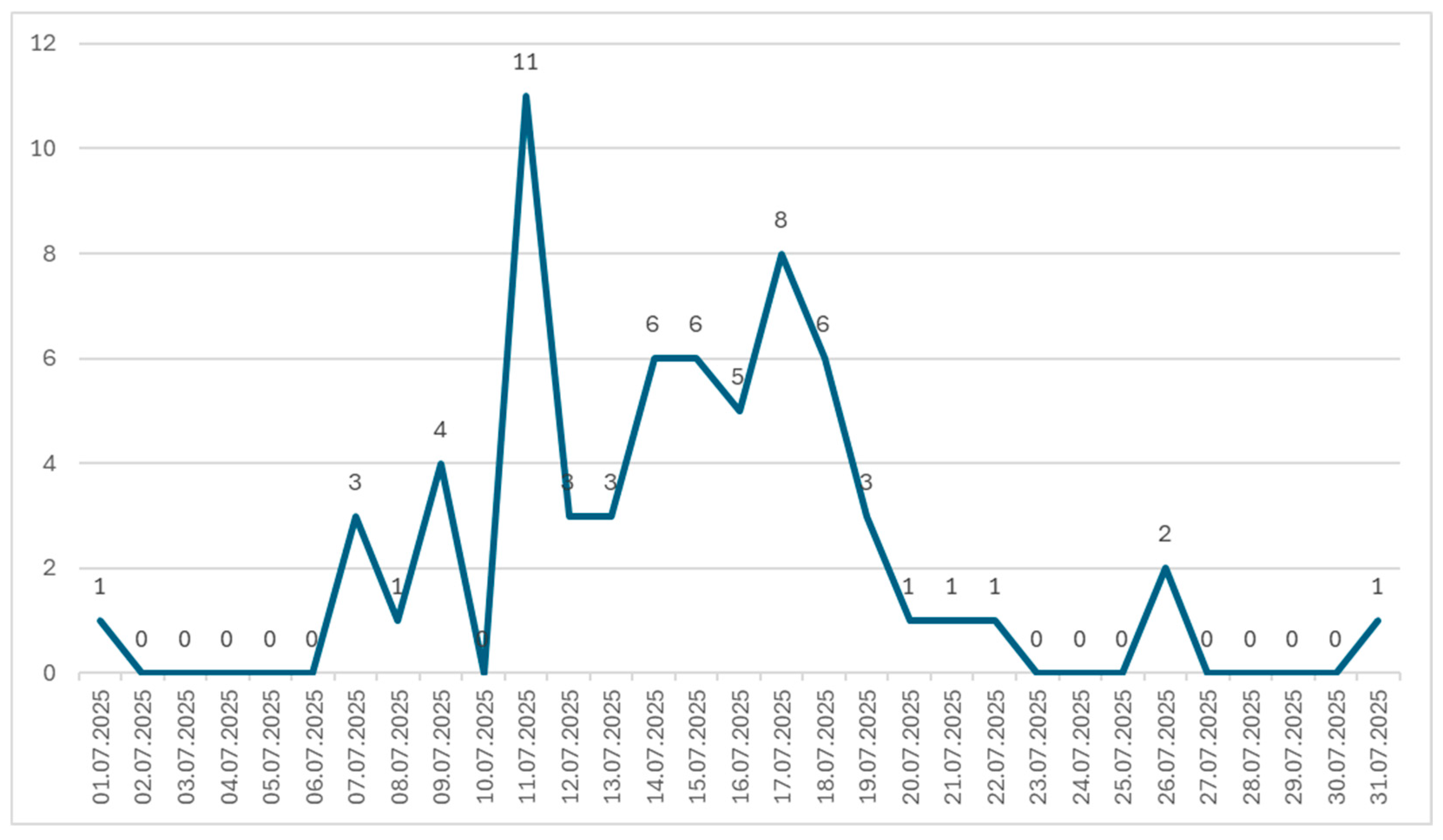
The next selection criterion was whether the episode title or description explicitly referred to Frauke Brosius-Gersdorf, the Federal Constitutional Court, or the vote in the Parliament. Podcasts in which no clear thematic link could be identified were then excluded. In this way, 66 relevant episodes were identified. Their distribution over the study period is shown in Figure 1. It is already apparent that four key events drove podcast engagement with the ‘CBG’: the general debate in the Parliament (July 9th), during which AfD member of parliament Beatrix von Storch confronted the chancellor; the removal of the vote on the candidates from the parliaments agenda (July 11th); Brosius-Gersdorf’s appearance on the television talk show ‘Markus Lanz’ (July 15th); and the chancellor’s summer press conference (July 17th).
For the 66 selected episodes, we also recorded their duration. Approximately one third of the episodes were around 40 min or longer. These 23 long-form episodes were directly selected for the content analysis. The remaining thematically relevant episodes were only about 10 to 30 min in length and followed the style of traditional newscasts, covering several current political issues within a single episode. These shorter formats were then examined to determine whether the ‘CBG’ was featured as a clearly identifiable main topic in the episode. Some podcasts, which usually offer short formats covering multiple topics, published longer episodes focusing specifically on the ‘CBG’ (e.g., ‘Auf den Punkt’ on July 19th). It was noticeable on several occasions that the issue was discussed in update episodes, leading to podcasts publishing two episodes on the same day (e.g., ‘Politico’ on July 7th and 11th, ‘Was jetzt?’ on July 11th). We interpret this as an indication of the high relevance of the issue. On this basis, 16 additional episodes were selected, resulting in a final sample of 39 episodes.
Because podcasts are sometimes broadly characterized as ‘largely monothematic’ (Frühbrodt & Auerbacher, 2021), we introduced an additional aspect for differentiating our findings by comparing mono- and polythematic podcast episodes. We assume that, in particular, long-form monothematic formats are capable of providing in-depth contextualization. However, it cannot be ruled out that shorter formats also show contextualization (Stark et al., 2021, p. 439), especially when they are monothematic, such as update episodes.
The 39 episodes analyzed originate from 15 different podcasts and amount to a total of 1450 min. Based on the recorded variables (date, duration, and topical format), episodes sharing the same characteristics were grouped together. This allows for an analysis of developments over the course of July and for a comparison of mono- versus polythematic long- versus short-form formats. The podcasts analyzed are as follows:
  • 0630—der News-Podcast: short-form polythematic on July 11th, 14th, and 16th
  • Politik mit Anne Will: long-form monothematic on July 15th, long-form polythematic on July 19th
  • Apokalypse & Filterkaffee: long-form monothematic on July 12th and 26th, long-form polythematic on July 1st, 17th, 18th, and 21st
  • Auf den Punkt: short-form polythematic on July 13th and 19th
  • Augstein & Blome: long-form polythematic on July 17th
  • Der Tag: long-form polythematic on July 11th and 16th
  • FAZ Podcast für Deutschland: long-form polythematic on July 11th, short-form polythematic on July 14th and 18th
  • FAZ Frühdenker—Die Nachrichten am Morgen: short-form polythematic on July 11th
  • Lanz & Precht: long-form monothematic on July 17th
  • The Pioneer Briefing—Nachrichten aus Politik und Wirtschaft: short-form polythematic on July 14th
  • Politico Berlin Playbook: long-form polythematic on July 11th, short-form polythematic on July 7th (Update), 9th, and 15th, short-form monothematic on July 11th (Update)
  • Das Politikteil: long-form monothematic on July 17th and 31st
  • Ronzheimer: long-form monothematic on July 9th, 11th, 13th, and 15th, long-form polythematic on July 14th
  • Table Today—mit Michael Bröcker und Helene Bubrowski: long-form polythematic on July 12th
  • Was jetzt?: short-form polythematic on July 11th, 11th (Update), and 15th, long-form polythematic on July 26th
The analytical framework was then applied in a multi-stage procedure. In the first step, the transcripts were read and corrected by simultaneously listening to the podcast episodes. In the second step, the inductive topic codes were assigned and refined. In the third step, the ‘relational levels’ were coded, and in the fourth and final step, the ‘dimensions of context’ were coded. A subset of episodes was coded by both coders, and the results were compared; discrepancies were discussed until a joint decision was reached. This corresponds to the principle of discursive validation commonly used in qualitative research (Hemmler et al., 2022, p. 207). Coding decisions made individually by each coder were likewise discussed in weekly coding meetings, so that here, too, the final results were based on shared decisions.
A central principle of the analysis was the multiple coding of a statement. The coding unit was not the sentence or paragraph, but the substantive statement, as an argument or position may extend across several sentences or clauses. Relevant statements in the podcasts were coded with exactly one subcategory from the ‘dimensions of context’ and one from the ‘relational levels’. The intersection of these codes yields the ‘types of contextualization’ that are central to the analysis. Therefore, for example, the cause of an event (the failure of the vote) can be located at the political level (a lack of leadership on the part of the chancellor) or at the societal level (a media campaign against the candidate). The resulting consequences may likewise be situated at the societal level (a changing culture of public debate), at the political level (a collapse of the government), or at the factual-regulatory level (a reform of the judicial appointment procedure). The principle of multiple coding and type formation also applies to the inductive codes: statements may contain any number of ‘topics’. The intersection of these codes makes the perspective of the discussion visible. For instance, the theme of a ‘culture war’ may be discussed in relation to abortion or mandatory vaccination, linked to comparisons with the United States of America, or used to address the domestic political situation (e.g., the problem of securing a sometimes necessary two-thirds majority in parliament). To our knowledge, neither the analysis of journalistic quality at the level of individual statements nor the development of types through multiple coding has been carried out to date in research on podcasts or on quality in journalism.
Depending on the combination of codes, detailed thematic fields and types emerge that render the podcasts’ contextualizing performance substantively tangible. A ‘distant reading’ of these code patterns allows us to draw conclusions about changes over time and differences between podcasts. Starting from the most frequent types, we then identify characteristic passages that we analyze in greater depth through ‘close reading’ in light of our research questions.

4. Results

4.1. Topics and Context

As mentioned earlier, we identified 29 different events and topics, referred to in the podcasts in relation to the ‘Causa Brosius-Gersdorf’ (‘CBG’). We then combined them into 5 different major topics: ‘stability of the governing coalition’, ‘FBG’, ‘media events’, ‘Federal Constitutional Court’, and ‘crisis of democracy’. Overall, the most mentioned major topic (467 mentions) was ‘stability of the governing coalition,’ which includes statements regarding the two governing parties and their relationship among themselves and with the opposition parties. Often the narrative here was focused on the possible instability of the governing coalition because Frauke Brosius-Gersdorf was the candidate of the SPD and representatives of the governing party CDU/CSU became increasingly critical of her candidacy while it was getting more unclear if the parliamentary party leader Jens Spahn and chancellor Merz could get their party members to vote for the agreed deal. Hence, it was not only described as a dispute between the parliamentary party groups but also as a sign of weak leadership on the part of the party leadership.
With 295 mentions, ‘FBG’ (topics directly related to the candidate Frauke Brosius-Gersdorf herself) was the second most mentioned major topic. Here, we combined all topics and events that focused on the candidate herself. This included, first and foremost, her position on the issue of abortion, which was the main target of her opponents, leading to a right-wing media-campaign, but also her appearance on the well-known German television talk show ‘Markus Lanz’ on July 15th. Other ‘media events’ (163 mentions) in the context of ‘CBG’ like the traditional summer interviews with high-ranking politicians, e.g., chancellor Merz and Alice Weidel from the far-right opposition party AfD, or the reporting on political events like the general budget debate in the parliament that referred to ‘CBG’ ranked on third place closely followed by the topic ‘Federal Constitutional Court’ (157 mentions). This topic summarizes information on the election process for the Federal Constitutional Court and its role in the political system in Germany in general. The last but even more interesting major topic is ‘crisis of democracy’ (141 mentions). This topic within the discussion of ‘CBG’ in the analyzed podcasts shows a first glimpse of a broader contextualization of the issue. Here, connections were drawn between the issue ‘CBG’ and more fundamental political and societal problems: the loss of compromise as a basic element of democracy, the coarsening of social discourse often described in the podcasts as a culture war, and, last but not least, the politicization of appointments to the highest court, drawing parallels with the latest appointments to the Supreme Court in the U.S.
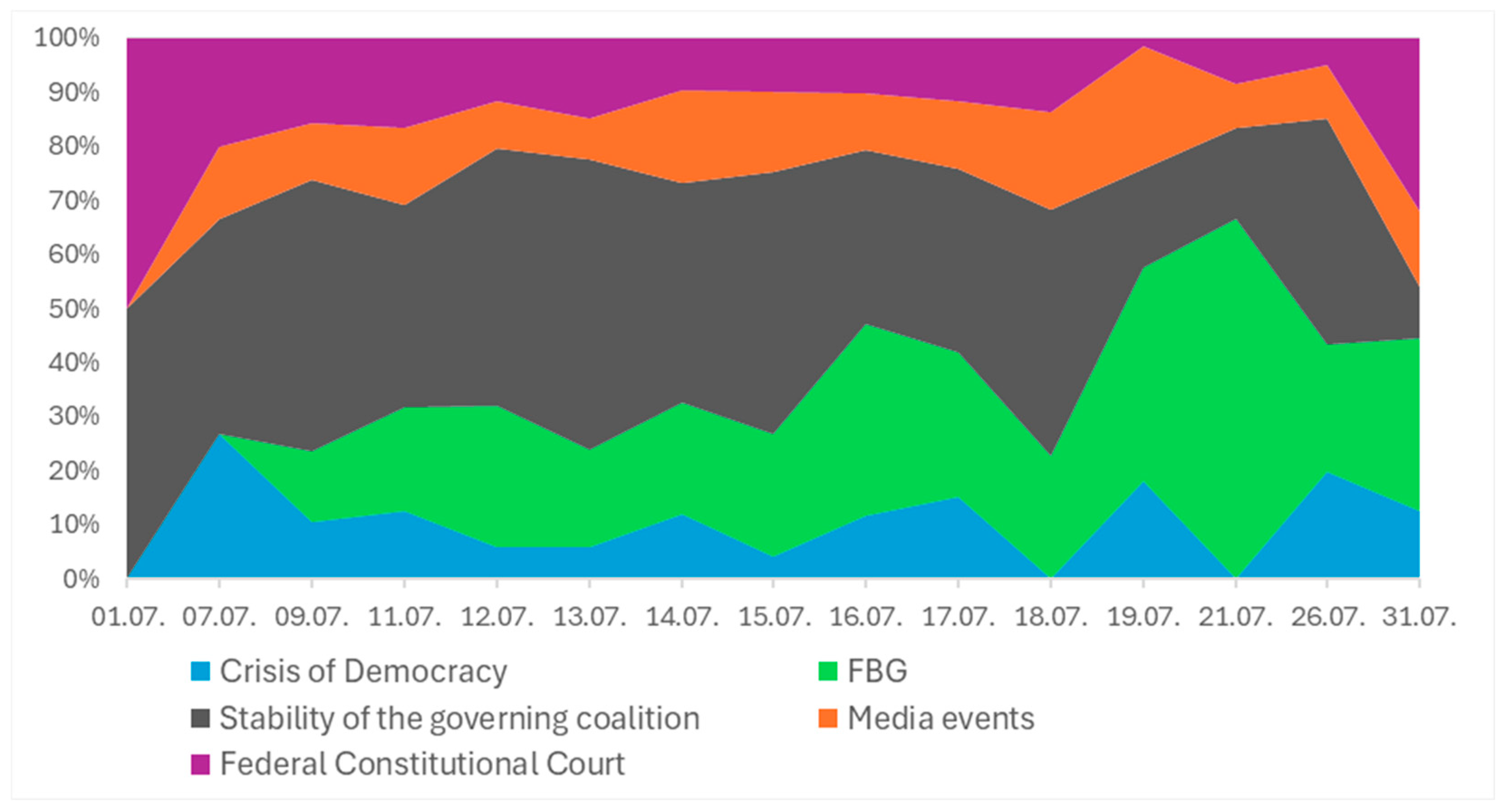
Looking at the chronological development of the five main topics identified during the study period as shown in Figure 2, some interesting insights emerge: Initially, in the first few days, the two topics of ‘stability of the governing coalition’ and ‘Federal Constitutional Court’ were equally at the center of the discussion. While the topic ‘stability of the governing coalition’ remained strongly represented throughout most of the timeframe and only took up less space towards the end, the topic of ‘Federal Constitutional Court’ remained in the background for most of the time and only received attention again in the last episodes analyzed. Regarding the topic of ‘FBG’ there is an interesting observation to be made: although the candidate herself was of little interest in the first week of July, she became increasingly important and ultimately the dominant topic in the final phase (July 19th until July 26th). This happened over a week after the election had been called off and Brosius-Gersdorf had appeared in the TV talk show ‘Markus Lanz’. Although the topics ‘media event’ and ‘crisis of democracy’ only play a minor role, they were nevertheless present throughout the entire study period. Regarding the topic ‘crisis of democracy’, however, it should be noted that it was the subject of intense discussion at the first phase (July 7th until July 9th)—in the week of parliamentary sessions during which the left and right wing parties put pressure on the CDU/CSU and it became apparent that the election might fail—and was only then more or less replaced by the topic ‘FBG’.
While the topic ‘crisis of democracy’ has already shown a connection to a broader contextualization of the issue ‘CBG’ in the analyzed podcasts, it is now time to take a look at the two core dimensions of the analysis: the development of the different ‘dimensions of context’ and their ‘relational level’ throughout the analyzed timeframe.
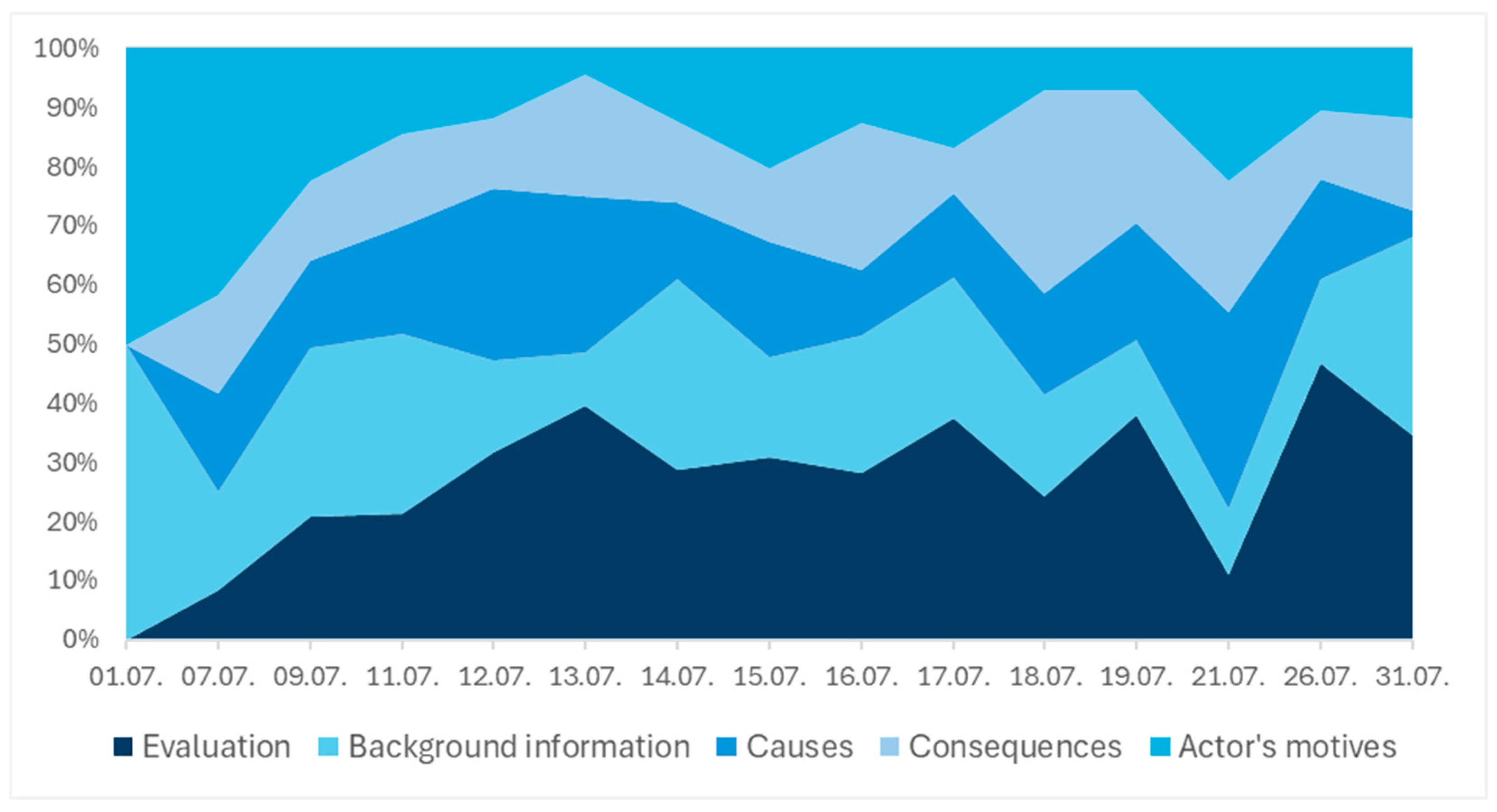
As previously stated, we define contextualization as one of the core functions of journalism, which consists of the two subdimensions ‘dimension of context’ and ‘relational level’. Before looking into the relationship between the two, we first analyze their development separately. As Figure 3 shows, the first podcast episodes focused primarily on giving facts and background information and on the actor’s motives, both remaining the top dimensions of context for the first phase until July 9th. After the election was canceled on July 11th, the podcasts focused on the evaluation of the issue. While some argued this could be a sign of a major government crisis between the coalition parties, other podcasts viewed it as ‘just’ an unprecedented case of weak leadership by chancellor Merz. In combination with the evaluation of the issue, the podcasts examined the causes of the failed election in parliament. One important explanation is that the issue of abortion touches on the ‘identity’ of the conservative CDU party and caused some delegates to withdraw their support for the candidate. Chancellor Merz and the parliamentary group leader Jens Spahn recognized this too late, which is why their weak leadership was seen as the main cause of the problem.
After the election was cancelled, Parliament’s summer recess began immediately, meaning that no further developments regarding the actor’s motives were to be expected. Apparently, the podcasts had provided the necessary background information, allowing them to turn their attention to the future: the consequences of the failed appointment got more attention in the second half of July, especially from July 17th until July 19th. Overall, the two most coded dimensions of contexts are ‘Evaluation’ (418 mentions) and ‘Background information’ (311 mentions), followed by ‘Causes’ (225 mentions), ‘Consequences’ (195 mentions) and ‘Actor’s motives’ (194 mentions).
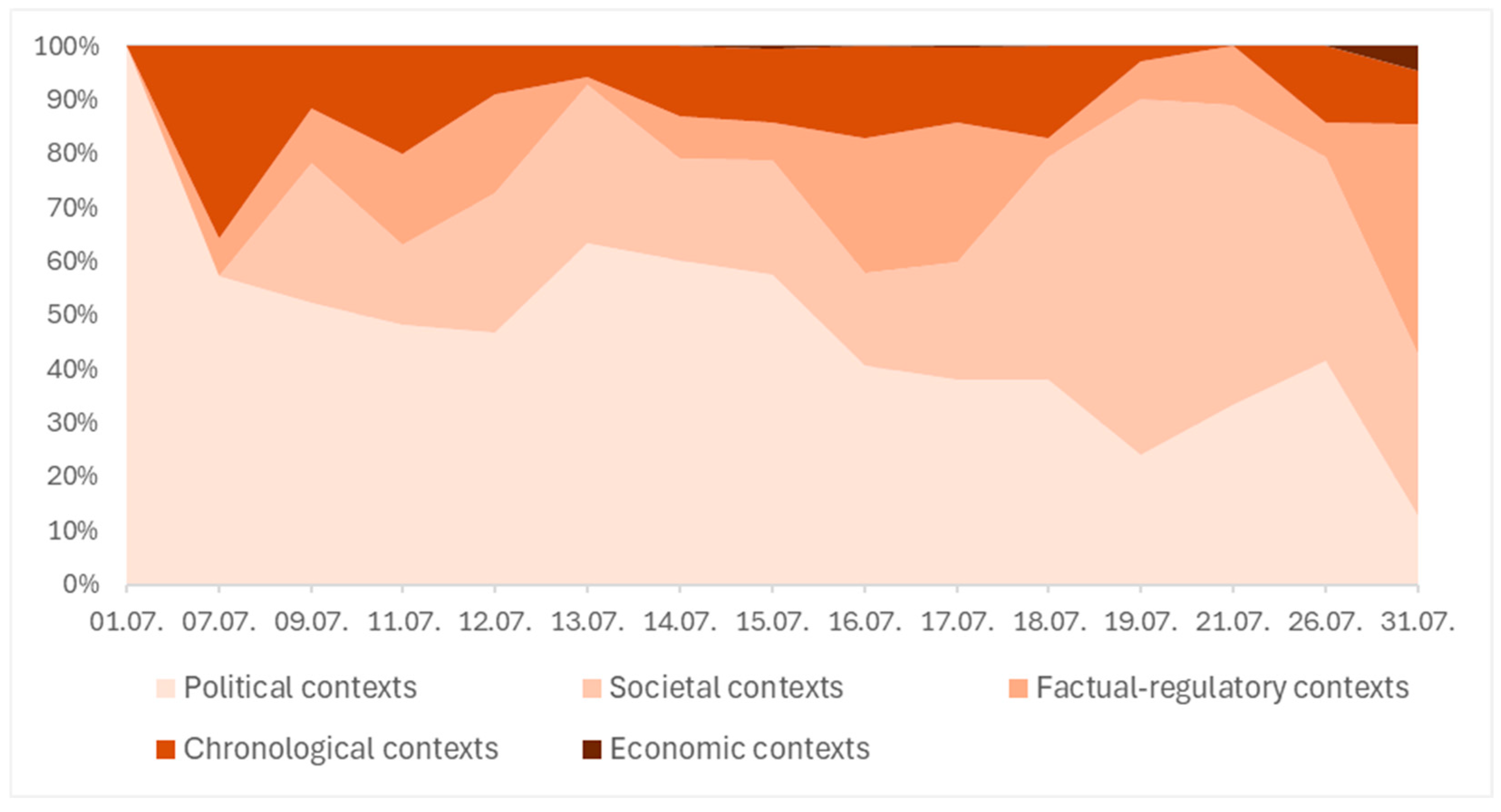
Looking, at the relational level, at which different dimensions of context could be referred to by the podcasters, we distinguish between political, societal, factual-regulatory, chronological, and economic contexts. As Figure 4 shows, political contexts were unsurprisingly by far the most relational level that was referred to (601 mentions overall making up to approximately half of all relational levels). Interestingly, however, this relational level decreased significantly over time and was replaced by the relation to the societal context, which is the second most used relational level (340 mentions overall).
Although the events were placed in chronological context in order to explain the dynamics of the sudden change in mood among CDU delegates and the high pressure that prevailed in the last few days before the parliamentary summer recess, chronological contexts (183 mentions overall) were referred to far less frequently than the two mentioned before; however, this was done quite consistently throughout the timeframe. On the other hand, relations to the factual-regulatory context (221 mentions overall) were primarily drawn following the appearance by Brosius-Gersdorf in the talk show ‘Markus Lanz’. The main reason for this was that the primary aim of the interview was to give her the opportunity to explain her positions as a legal scholar. In the interview, she described to the audience how the events had unfolded, for example how the formal procedure of the nomination process works and that the judges of the Federal Constitutional Court occupy a neutral role and collaborate through discussion and reasoned debate. She concluded that the accusations of her being a ‘political activist’ were unfounded, as all of her work is based on scholarly reasoning. Finally, it is no surprise that the economic context was related to a barely noteworthy extent (only 7 mentions overall).

4.2. Types of Contextualization

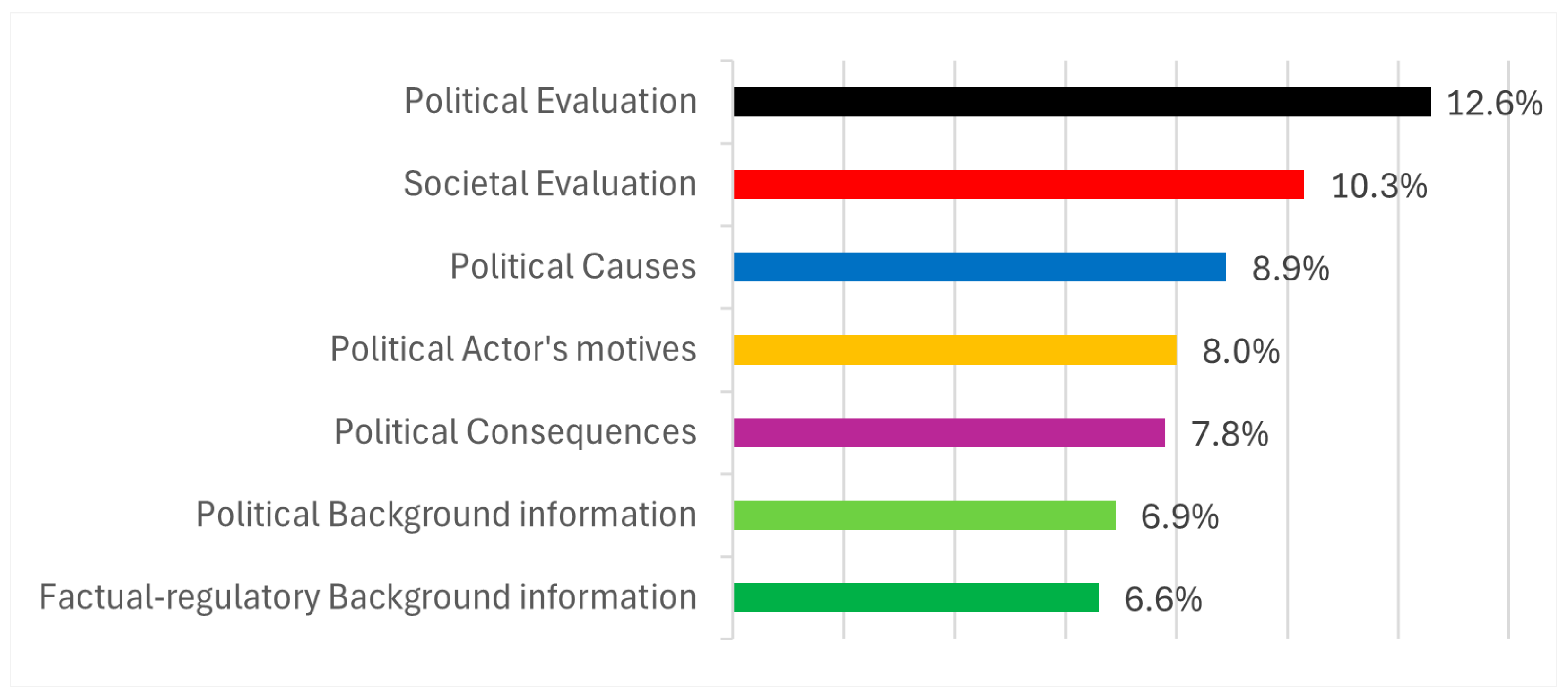
Based on the initial descriptive approach to the results we will now focus on a more analytical approach for looking into the contextualization of the issue ‘CBG’ in the top podcasts in Germany. To do this, we will take a first step by looking into the combinations of the two subdimensions ‘dimensions of context’ and ‘relational level’. As every type of context has an area it refers to, this leads us to different types of contextualization of the issue ‘CBG’ in the analyzed podcasts. A total of 23 different combinations of the two sub-dimensions can be identified, with the seven most common combinations accounting for just under two-thirds (61%) of all combinations. Figure 5 shows these most common types of contextualization.
Bearing in mind the results for the subdimension ‘relational level’ it comes with no surprise that political contextualization is predominant. However, it is noteworthy that all five types of contexts are not only combined with the political context and that these are part of the most common combinations, but that they are also relatively evenly distributed among themselves, with the exception of political evaluation being the top combination overall. What is surprising, however, is that the evaluation related to the societal level comes in a strong second. Even more so as this relation did appear in the main topic ‘crisis of democracy’ but played only a minor role regarding the main topics overall. Finally, we have to recognize that giving political and factual-regulatory background information are also relevant elements in the contextualization of the issue CBG. However, the comparison shows that these two types, which are directly related to the traditional informational function of journalism, are only secondary to the other types of contextualization. This can be interpreted to mean that the opinion-forming function of journalism is particularly prevalent in the podcasts analyzed.
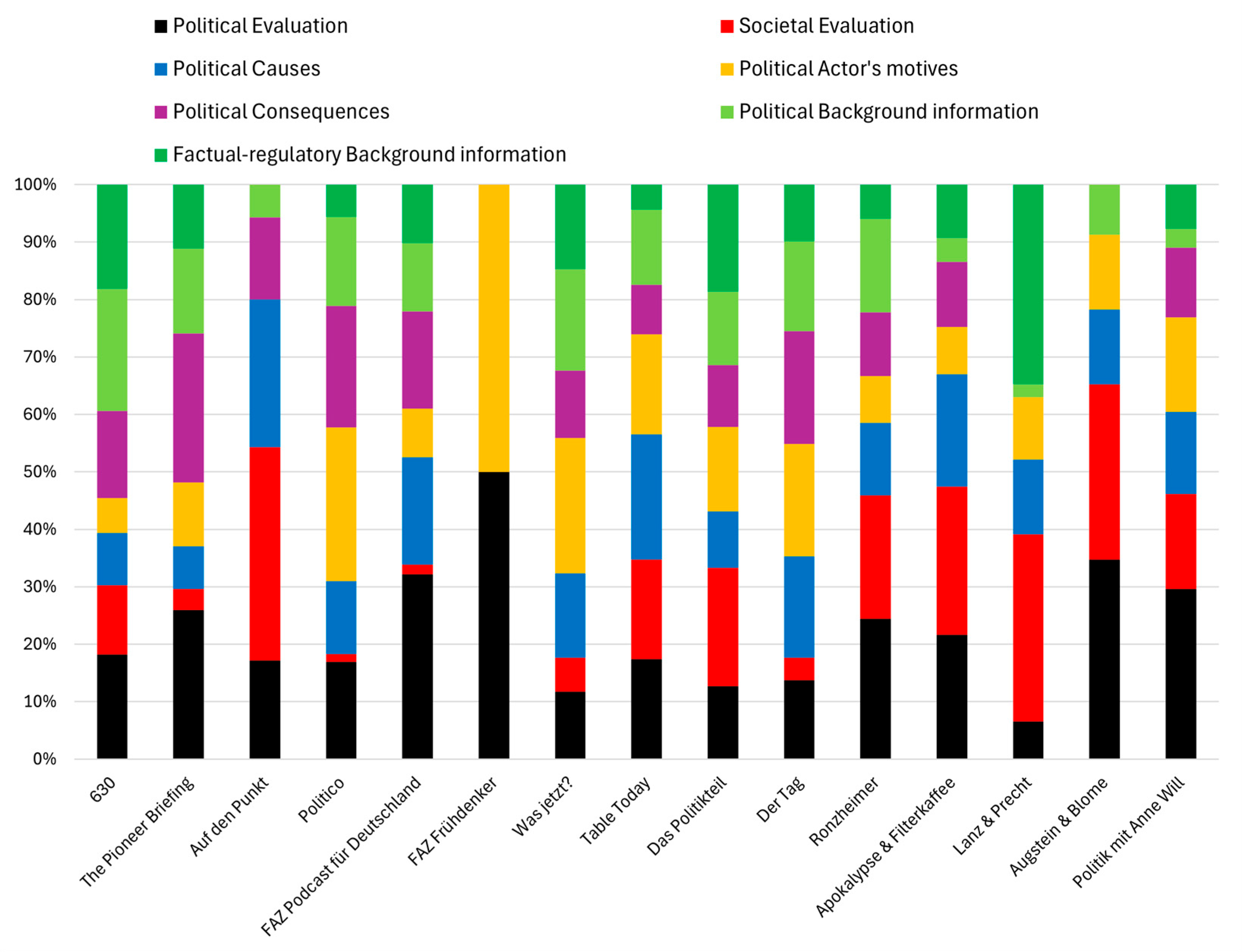
So far, however, we have only taken an overall look at the podcasts analyzed. The next analytical step is therefore to look at the individual podcasts themselves to determine which types of contextualization can be identified in which podcasts. To analyze the level of individual podcasts, we take the seven most common types of contextualization identified previously as a baseline and examine their occurrence within each individual podcast. As Figure 6 shows, several trends can be identified among different podcasts.
First of all, it comes with no surprise that political evaluation appears prominently in all podcasts. However, it is significantly more prominent in some than in others. For example, political evaluation accounts for almost a third of the podcasts ‘FAZ Podcast für Deutschland’, ‘Augstein & Blome’ and ‘Politik mit Anne Will’. It is important to note that the ‘FAZ Frühdenker’ podcast addressed the topic very briefly. Consequently, the relevant percentages should not be overinterpreted.
The following example shows how the host Anne Will assessed the issue, taking into account the actions of a leading member of the controversial far-right opposition party AfD:
“I think that captures the whole spectrum. It is complex, it is complicated. It calls for nuance, but also for stepping back from yourself. (…) Beatrix von Storch acts in a completely different way. If you keep all of this in mind and then listen to what she did on Wednesday during the so-called government questioning: Friedrich Merz subjected himself to questions from the members of parliament, and now we will hear what Ms von Storch does, who is clearly trying to set a trap for Friedrich Merz.”
(Politik mit Anne Will, 15 July 2025)
At the other end of the spectrum, political evaluation accounts for just over 10% in the podcasts ‘Was jetzt?’ and ‘Der Tag’, and in ‘Lanz & Precht’, the share is even less than 10%. Instead, the latter is significantly focused on the societal evaluation of the issue. Against the backdrop of the public debate focusing on the candidate Frauke Brosius-Gersdorf, Markus Lanz, one of the hosts of ‘Lanz & Precht’, clearly related the issue to society as a whole, as the following example illustrates:
“Lanz: When I read this, I think: wow—we really do have some brilliant minds in this country. And then I start wondering: what if we’re not treating them the way we should? These are valuable members of our society, no matter whether you agree with every one of their positions or not. This is excellence we have here, something we can build on and actually make something out of.
Precht: Who did you mean by ‘we’ when you say how we deal with this?
Lanz: We as a society. It’s a question that ultimately concerns all of us”
(Lanz & Precht, 17 July 2025).
The Host of the more news-like Podcast ‘Auf den Punkt’ even made a connection to the current situation in the U.S.:
“It’s a bit reminiscent of the culture wars in the U.S.—this constant ‘us against those who are against us.’ Is this debate a sign that we might soon be heading toward American-style conditions here as well?”
(Auf den Punkt, 19 July 2025).
Anne Will, the host of the podcast ‘Politik mit Anne Will’, also made a connection to developments in the U.S., in addition to developments in Poland and Hungary, clearly referring to the politicization of the supreme courts and therefore giving a political evaluation of the issue:
“Because Frauke Brosius-Gersdorf also said several times in her interview with Markus Lanz that there’s a real danger of the Federal Constitutional Court—and the judges working there—becoming improperly politicized. In other words, that these positions would only go to people who are politically convenient. Just like Donald Trump has done in the U.S., like PiS did in Poland, and like Viktor Orbán is doing in Hungary”
(Politik mit Anne Will, 19 July 2025).
Besides political and societal evaluation, some podcasts also pointed out the causes and consequences of the issue as well as the political actor’s motives. The latter becomes clear, for example, in the podcast ‘Was Jetzt?’, when the motives of some CDU/CSU Members of Parliament for rejecting the candidacy of Frauke Brosius-Gersdorf were explained with her supposed political orientation:
“There are strong reservations within the CDU/CSU about one of the nominees. They say she’s too left-wing—‘ultra-left,’ that was a word that came up a lot within the coalition”
(Was Jetzt? 11 July 2025).
And furthermore, with her position on the issue of abortion:
“And of course you can say: well, if you’re a Christian Democrat, some of the positions Frauke Brosius-Gersdorf has taken are pretty hard to swallow—no question about that”
(Was Jetzt? Update, 11 July 2025).
While the podcasts we analyzed mostly attributed the actor’s motives on rejecting the candidacy to the fundamental political convictions of some CDU/CSU Members of Parliament, the weak leadership of parliamentary party leader Jens Spahn and even chancellor Merz was often identified as the specific political cause as was pointed out in the podcast ‘Apokalypse & Filterkaffee’:
“Bröcker: A coalition crisis, a failure of leadership and management—but it’s not a state crisis. (…) That’s all way too exaggerated for me. But it is a real coalition crisis, and the way this coalition has handled an issue that, for decades, the CDU/CSU and the SPD have always settled early, quietly, and without drama shows that something is seriously off. (…)
Schaible: The chancellor stood in the Bundestag this week and said very openly, ‘We are going to elect her.’ I think that’s fine. And then his own parliamentary group says: ‘No, we’re not doing that.’”
(Apokalypse & Filterkaffee, 12 July 2025).
Based on this conflict within the CDU/CSU, the podcast ‘Der Tag’ discussed the political consequences:
“I think that’s what’s going to happen now: the SPD will, in fact, be in a position to hold out its hand and say, ‘Okay, we’ll put forward a new nominee for the Federal Constitutional Court—but there has to be a visible price paid for that.’”
(Der Tag, 16 July 2025).
In the meantime, another candidate has been elected to the Federal Constitutional Court in September 2025, but it is not yet known whether a ‘price’ was paid for this and, if so, what that ‘price’ was. However, these examples show how the different types of contextualization are carried out individually in the podcasts analyzed, providing more context on the issue and thus enabling the audience to form an informed opinion on the issue. While 6 out of the 15 podcasts focused especially on political and societal evaluation (‘Auf den Punkt’, ‘Ronzheimer’, ‘Apokalypse & Filterkaffee’, ‘Lanz & Precht’, ‘Augstein & Blome’ and ‘Politik mit Anne Will’) the audience of ‘Politico’ and ‘Was Jetzt?’ had the chance to learn a little bit more about the actor’s motives. The political causes were addressed predominantly in ‘Auf den Punkt’, ‘Table Today’ and ‘Apokalypse & Filterkaffee’, whereas the subsequent political consequences were discussed in particular in ‘Pioneer Briefing’, ‘Politico’ and ‘Der Tag’.
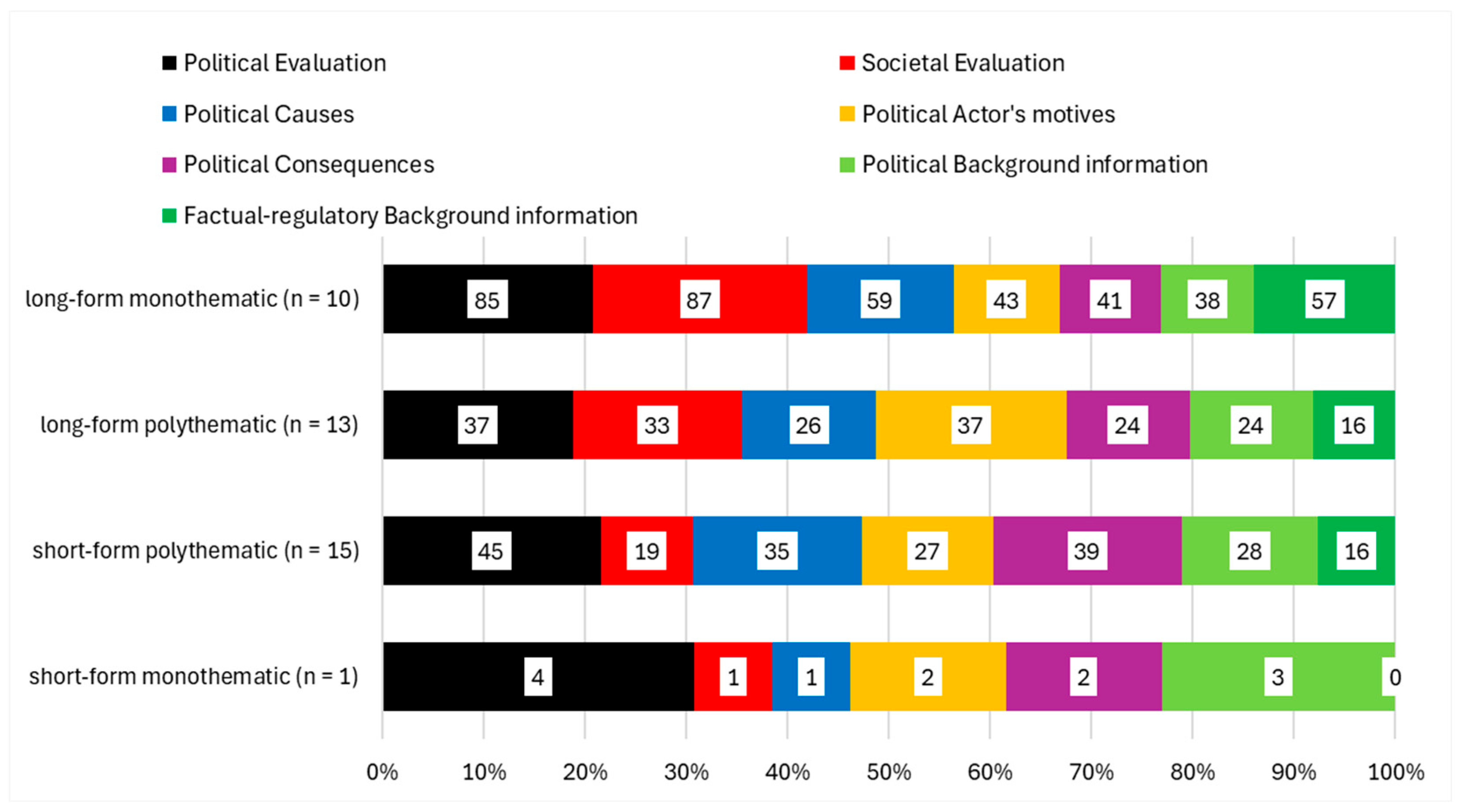
Finally, the question remains as to how the different types of contextualization manifest themselves in different podcast formats. The podcasts we analyzed showed that it is not only long-form monothematic formats that characterize the medium. By looking at the podcasts based on two characteristics—‘duration’ of an episode (long vs. short forms) and ‘thematic diversity’ (monothematic meaning only one topic is primarily discussed in the episode and polythematic meaning that more than one issue is being discussed in the episode), in the section on methods and materials, we have listed the classification of the individual episodes of the podcasts—we can define four different types of podcast formats. As Figure 7 shows, only one of the 39 analyzed episodes falls into the short-form monothematic category, whereas the other three types show a largely similar distribution.
Given the length of each episode (at least 40 min) and its focus on a single topic (the ‘Causa Brosius-Gersdorf’), it is not surprising that the long-form monothematic episodes not only offered more context but also provided more factual-regulatory background knowledge in addition to political and societal and political evaluation.
Regarding the polythematic formats, it is striking that, in addition to their political and societal evaluation, they each provided different additional focuses: long form polythematic episodes focused somewhat more on actor’s motives, while the short form polythematic episodes tended to focus more on causes and consequences. The latter are not only the most common type in the research material but also prove to be the most balanced across all five types of contextualization, apart from the comparatively low level of societal evaluation. This may be attributable to the fact that these formats resemble a traditional journalistic news format: several topics are covered within a short period of time (around 15 min), with an emphasis on balanced journalistic reporting. Nevertheless, even these forms of journalistic reporting in podcasts offered more than the mere transmission of information. Here, too—as in long-form monothematic and polythematic episodes—the contextualization of information was clearly apparent.

5. Discussion

The results presented above show clearly that the podcasts we analyzed not only passed on information but also contextualized it in different ways. Regarding RQ2, we can therefore conclude that political and societal evaluation were the main types of contextualization we found in the podcasts. This is in line with recent podcast research (Kläs & Birkner, 2020). Regarding the temporal development of those two types, an interesting pattern emerges: whereas political contexts dominated the contextualization at the beginning of the observation period, it was the societal level that became central in the final phase (19th until 26th July). Over the course of the study period, the discourse thus shifted from a predominantly political to a broader societal perspective. This is also reflected in the fact that the topic ‘stability of the governing coalition’ declined markedly during this phase, while references to the topics ‘FBG’ and ‘crisis of democracy’ together accounted for more than half of all contextual references in the final phase of the observation period. The debates in the analyzed podcasts shifted from an emphasis on the perceived leadership failure of the CDU/CSU to a focus on how the right-wing media campaign was handled in public discourse and, more broadly, on the state of public debate, increasingly framed as a culture war over the issue. Although political and societal evaluations were the predominant types of contextualization overall, the other types were by no means irrelevant. Particularly with respect to the political level, the contextualization of events in terms of actor’s motives for action, causes and consequences was clearly discernible.
A closer look at the individual podcasts reveals that they placed varying emphases. While some clearly prioritized political and societal evaluation, others offered their audiences more contextualization in terms of actor’s motives, causes and consequences. These different priorities were also evident with regard to the different podcast formats. Unsurprisingly, it is the long-form monothematic podcasts that provided the most extensive contextualization, offering in particular a more elaborate evaluative dimension concerning the political and societal contexts. Most of the podcasts in this category are characterized by a dialogue—either between the hosts themselves or between a host and a guest. Only one podcast deviates from this pattern (‘Apokalypse & Filterkaffee Presseklub’ on 12th and 26th July), in which the host discusses a topic with multiple guests.
Many short-form polythematic podcasts also engage with the ‘CBG’ topic, which is not surprising given their close resemblance to traditional journalistic news formats. What is noteworthy, however, is that across all types of contextualization, they show the most balanced distribution between the most common types of contextualization and therefore providing a brief yet broad contextualization of the issue. Our study thus complements existing research that mentions quality differences between various media formats (Stark et al., 2021, p. 439) and expands on previous research in which podcasts per se were considered ‘largely monothematic’ (Frühbrodt & Auerbacher, 2021).
We can therefore answer RQ1 as follows: the contextualization of the issue ‘Causa Brosius-Gersdorf’ in German-language podcasts is consistently conducted in considerable depth, as evidenced, among other things, by the presence of all previously developed types of contextualization. In doing so, the podcasts provide listeners with orientation, particularly through political and societal contextualization of the issue.
As with any study, there are some limitations to be considered. Every qualitative content analysis is characterized by a substantial degree of interpretive work on the part of the researchers. Although we developed a reliable analytical framework based on the literature presented and further refined its application through multiple rounds of discussion in which the researchers examined contentious cases, the coding process ultimately remains an interpretative act. This can only be rendered intersubjectively traceable through full transparency regarding the analytical procedure, which we have sought to provide in the preceding sections. In addition to this fundamental methodological constraint, the study’s focus on a single case—the ‘Causa Brosius-Gersdorf’—must be noted as a further limitation. Consequently, the conclusions drawn can only be applied to this specific case. However, we consider the analytical framework we have developed—and thus the operationalization of the concept of contextualization—to be sufficiently fundamental to be applied to other cases in which journalistic quality is assessed.
Nonetheless the podcasts examined in this study provide their audience with more than the mere transmission of information on a politically relevant and widely debated issue. Through contextualization, they particularly fulfil the role of contributing to opinion formation by presenting different perspectives on the topic and offering different evaluations that enable listeners to form their own opinion by accepting or rejecting the arguments provided (Fög, 2024, p. 127; Meier, 2018, p. 196). In doing so, the podcasts clearly exceed journalism’s traditional information function and offer something that counters the flood of information in a digitalized communication environment: context. Our study shows that this can be achieved not only in long-form monothematic formats. However, whether in the form of long monothematic or short polythematic formats, podcasts can thus constitute an important element in the future of journalism.

6. Conclusions

In contrast to the situation in the United States of America, the appointment of judges to the German Federal Constitutional Court has, until now, attracted little public attention; on the contrary, it has been a largely unnoticed affair. The situation was markedly different in July 2025: the ordinarily unremarkable political act of electing judges to the Federal Constitutional Court rapidly developed into a highly contested public issue. Within a matter of days, new information, topics and questions entered the public discourse: Had the CDU/CSU leadership failed? What exactly are the candidate’s positions on abortion? How do we cope with media campaigns put forth by extremist groups that attempt to undermine public debate through disinformation? And how does the appointment process for the Federal Constitutional Court actually work?
The high immediacy and complexity of the issue pose a considerable challenge for journalism: information must be contextualized. Yet in an environment characterized by a rapidly accelerating flow of information driven by social media and digital communication, interpretative journalism is essential in order to contribute to the formation of public opinion. At the same time, podcasts have established themselves as a medium that is not subject to the fast-paced attention dynamics of social media and can therefore offer an appropriate platform for journalism to provide contextual interpretation for their audiences. Based on these two perspectives, we developed the following two research questions: to what extent do German-language podcasts offer an in-depth analysis of the issue ‘Causa Brosius-Gersdorf’ (RQ1), and what different types of contextualization can we observe in different podcast formats (RQ2)?
Based on a qualitative content analysis of 39 episodes from 15 podcasts selected through a multi-step selection process based on the Spotify TOP 200 podcasts in July 2025, we can give a clear answer: The podcasts analyzed in this study consistently offer an in-depth contextualization of the issue by using all identified types of contextualization with a focus on political and societal evaluation. In doing so, they provide their audiences with orientation, thereby enabling them to form their own well-founded opinions.
Within the scope of our study, these findings can only be applied to the specific case examined. However, our broad theoretical foundation enabled us to develop an analytical instrument that can make measurements at the level of individual statements. To our knowledge, prior studies evaluate journalistic quality only at the level of the news items themselves rather than at the level of individual statements. We therefore hope not only to advance research on quality in journalism but also to contribute to the question of how journalism can position itself within the fast-paced information environment shaped by social media. Here, too, our answer for the future of journalism is clear: context is everything!

Author Contributions

Conceptualization, A.G. and M.W.; methodology, A.G. and M.W.; software, A.G. and M.W.; validation, A.G. and M.W.; formal analysis, A.G.; investigation, M.W.; resources, M.W.; data curation, A.G. and M.W.; writing—original draft preparation, A.G. and M.W.; writing—review and editing, A.G. and M.W.; visualization, A.G.; supervision, A.G. and M.W.; project administration, A.G. and M.W. All authors have read and agreed to the published version of the manuscript.

Funding

This research received no external funding.

Institutional Review Board Statement

Not applicable.

Informed Consent Statement

Not applicable.

Data Availability Statement

The data presented in this study is publicly available on Spotify Germany.

Conflicts of Interest

The authors declare no conflicts of interest.

Abbreviations

The following abbreviations are used in this manuscript:
CBG‘Causa Brosius-Gersdorf’, as the controversial debate was called in public discourse
FBGFrauke Brosius-Gersdorf, a professor of law and candidate for the German Federal Constitutional Court
CDU/CSUChristian Democratic Union and Christian Social Union, two conservative sister-parties forming a parliamentary group, part of a governing coalition
SPDSocial Democratic Party of Germany, part of a governing coalition
AfDAlternative for Germany, a far-right opposition party
NZZNeue Zürcher Zeitung, a Swiss Newspaper
FAZFrankfurter Allgemeine Zeitung, a German newspaper
ZDFZweites Deutsches Fernsehen, a German public service television broadcaster
U.S.United States of America

References

  1. Arnold, K. (2009). Qualitätsjournalismus. Die Zeitung und ihr Publikum. UVK. [Google Scholar]
  2. Bachmann, P., Eisenegger, M., & Ingenhoff, D. (2022). Defining and measuring news media quality: Comparing the content perspective and the audience perspective. The International Journal of Press/Politics, 27(1), 9–37. [Google Scholar] [CrossRef]
  3. Bennett, W. L., & Pfetsch, B. (2018). Rethinking political communication in a time of disrupted public spheres. Journal of Communication, 68(2), 243–253. [Google Scholar] [CrossRef]
  4. Birkner, T. (2022). „Das Wort hat die Frau Bundeskanzlerin”—Ist die Medialisierung der Politik in Regierungserklärungen messbar? Chancen und Grenzen der automatisierten Inhaltsanalyse von politischer Kommunikation am Beispiel von Regierungserklärungen deutscher Bundeskanzler*innen von 1949 bis 2021. Medien & Zeit, 37(4), 6–25. [Google Scholar]
  5. Chadwick, A. (2013). The hybrid media system: Politics and power. Oxford University Press. [Google Scholar]
  6. CitizenGo. (2025, August 7). Keine radikale Lebensfeindin ins Bundesverfassungsgericht: Stimmen Sie gegen Frauke Brosius-Gersdorf! CitizenGO. Available online: https://www.citizengo.org/de/lf/15853-keine-radikale-lebensfeindin-ins-bundesverfassungsgericht--stimmen-sie-gegen-frauke-brosius-gersdorf (accessed on 26 November 2025).
  7. Dernbach, B., Schützeneder, J., & Graßl, M. (2022). Kreativ, fordernd, vielfältig einsetzbar: Podcasts als Kompetenz-Training der Journalismusausbildung. In V. Katzenberger, J. Keil, & M. Wild (Eds.), Podcasts (pp. 333–355). Springer Fachmedien. [Google Scholar] [CrossRef]
  8. Der Spiegel. (2025a, July 24). Frauke Brosius-Gersdorf: CSU kann sich neues Personal für Richterwahl vorstellen. Der Spiegel. Available online: https://www.spiegel.de/politik/deutschland/streit-ueber-frauke-brosius-gersdorf-csu-kann-sich-neues-personal-fuer-richterwahl-vorstellen-a-047fd3e7-9891-42a0-bb16-4df605342b61 (accessed on 26 November 2025).
  9. Der Spiegel. (2025b, August 7). Frauke Brosius-Gersdorf verzichtet im Richterstreit auf erneute Kandidatur. Der Spiegel. Available online: https://www.spiegel.de/politik/deutschland/frauke-brosius-gersdorf-verzichtet-im-richterstreit-auf-erneute-kandidatur-a-a4edf647-f332-4f4d-913c-a941746e1589 (accessed on 26 November 2025).
  10. Deutschlandfunk. (2025a, July 9). Regierungsbefragung—Merz hält Wahl von Juristin Brosius-Gersdorf zur Richterin am Bundesverfassungsgericht für vertretbar. Deutschlandfunk Die Nachrichten. Available online: https://www.deutschlandfunk.de/merz-haelt-wahl-von-juristin-brosius-gersdorf-zur-richterin-am-bundesverfassungsgericht-fuer-vertret-102.html (accessed on 26 November 2025).
  11. Deutschlandfunk. (2025b, July 15). Stimmungsmache von rechts—Kampagne gegen Juristin Frauke Brosius-Gersdorf. Deutschlandfunk. Available online: https://www.deutschlandfunk.de/frauke-brosius-gersdorf-rechte-kampagne-analyse-100.html (accessed on 26 November 2025).
  12. Esser, F., & Neuberger, C. (2019). Realizing the democratic functions of journalism in the digital age: New alliances and a return to old values. Journalism, 20(1), 194–197. [Google Scholar] [CrossRef]
  13. Evers, T., Greck, R., & Altmeppen, K.-D. (2021). Konzepte des politischen Journalismus. In M. Prinzing, & R. Blum (Eds.), Handbuch Politischer Journalismus (pp. 439–471). Halem. [Google Scholar]
  14. Fawzi, N., & Mothes, C. (2020). Perceptions of media performance: Expectation-evaluation discrepancies and their relationship with media-related and populist attitudes. Media and Communication, 8(3), 335–347. [Google Scholar] [CrossRef]
  15. Fengler, S. (2012). From media self-regulation to “crowd-criticism”: Media accountability in the digital age. Central European Journal of Communication, 5(9), 175–189. [Google Scholar]
  16. Fög (Ed.). (2024). Jahrbuch Qualität der Medien 2024. Schwabe Verlag. [Google Scholar] [CrossRef]
  17. Frigelj, K., & Steffes-Lay, F. (2025, July 11). Umstrittene SPD-Kandidatin: Vorwürfe gegen Brosius-Gersdorf—Plagiatsjäger sieht “drei Möglichkeiten”, wer wo abgeschrieben hat. Die Welt. Available online: https://www.welt.de/politik/deutschland/article256387904/umstrittene-spd-kandidatin-vorwuerfe-gegen-brosius-gersdorf-plagiatsjaeger-sieht-drei-moeglichkeiten-wer-wo-abgeschrieben-hat.html (accessed on 26 November 2025).
  18. Frühbrodt, L., & Auerbacher, R. (2021). Den richtigen ton treffen. Otto-Brenner-Stiftung. [Google Scholar]
  19. Geiß, S. (2021). Formen des politischen Journalismus. 6. Politische Talkshow. In M. Prinzing, & R. Blum (Eds.), Handbuch politischer journalismus (pp. 503–509). Halem. [Google Scholar]
  20. Geuß, A. (2018). Qualität im Journalismus: Eine Synopse zum aktuellen Forschungsstand. University of Bamberg Press. [Google Scholar]
  21. Geuß, A. (2022). Medienqualität durch Medienkritik: Qualitätskriterien in und für Podcasts am Fallbeispiel des Übermedien-Podcasts Holger ruft an. In V. Katzenberger, J. Keil, & M. Wild (Eds.), Podcasts (pp. 277–306). Springer Fachmedien. [Google Scholar] [CrossRef]
  22. Greenberg, S. (2007, February 25). Slow journalism. Prospect Magazine. Available online: https://www.prospectmagazine.co.uk/opinions/57661/slow-journalism (accessed on 22 January 2026).
  23. Haarkötter, H. (2018). Verweile doch, du bist so schön: Qualitäten und Dysqualitäten im Journalismus. In H. Haarkötter, & J.-U. Nieland (Eds.), Nachrichten und Aufklärung (pp. 39–65). Springer Fachmedien Wiesbaden. [Google Scholar] [CrossRef]
  24. Heijnk, S. (2021). Formen des politischen Journalismus. 1. Grundlegende Analyse. In M. Prinzing, & R. Blum (Eds.), Handbuch Politischer Journalismus (pp. 472–490). Halem. [Google Scholar]
  25. Hemmler, V. L., Kenney, A. W., Langley, S. D., Callahan, C. M., Gubbins, E. J., & Holder, S. (2022). Beyond a coefficient: An interactive process for achieving inter-rater consistency in qualitative coding. Qualitative Research, 22(2), 194–219. [Google Scholar] [CrossRef]
  26. Hillebrand, F., Lergenmüller, L. S., & Weiland, S. (2025, July 15). Frauke Brosius-Gersdorf: Diese Akteure stehen hinter der Netzkampagne gegen sie. Der Spiegel. Available online: https://www.spiegel.de/politik/deutschland/frauke-brosius-gersdorf-diese-akteure-stehen-hinter-der-netzkampagne-gegen-sie-a-3f98e55a-98b8-4cb0-b382-0d29d8642331 (accessed on 26 November 2025).
  27. Kaczmarczyk, D. (2025). New media and news quality. Contemporary challenges and problems of journalism. Social Communication Ethics, 1(1), 9–24. [Google Scholar] [CrossRef]
  28. Kalch, A., & Schlütz, D. (2022). Nachhaltigkeit auf die Ohren?! Klima- und Umweltschutz-Podcasts und ihre Wirkung. In V. Katzenberger, J. Keil, & M. Wild (Eds.), Podcasts (pp. 417–442). Springer Fachmedien. [Google Scholar] [CrossRef]
  29. Katzenberger, V., Keil, J., & Wild, M. (2022). Hinter dem Mikrofon: Podcaster*innen im deutschsprachigen raum. In V. Katzenberger, J. Keil, & M. Wild (Eds.), Podcasts (pp. 23–50). Springer Fachmedien. [Google Scholar] [CrossRef]
  30. Katzenberger, V., Keil, J., & Wild, M. (2025). The podcast revolution? Exploring journalistic pioneers beyond legacy media. Journalism and Media, 6(1), 20. [Google Scholar] [CrossRef]
  31. Kläs, A., & Birkner, T. (2020). Listen! Let me tell you a story: True Crime-Berichterstattung in podcasts. Kommunikation@gesellschaft, 21(2), 1–16. [Google Scholar] [CrossRef]
  32. Klenner, S. (2025, June 30). Verfassungsrichterwahl: Union und SPD benennen drei Kandidaten für Karlsruhe. FAZ.NET. Available online: https://www.faz.net/einspruch/verfassungsrichterwahl-union-und-spd-benennen-drei-kandidaten-fuer-karlsruhe-110567805.html (accessed on 26 November 2025).
  33. Komossa, F., Kong, I., & Purves, R. S. (2024). What’s in the news? A multiscalar text analysis approach to exploring news media discourses for managing protected areas in Switzerland. Landscape Research, 49(6), 823–850. [Google Scholar] [CrossRef]
  34. Krause, T., & Uhrig, K. (2022). Journalismus zum Bingen: Potenziale und Funktionen serieller Podcasts für das digitale Storytelling. In V. Katzenberger, J. Keil, & M. Wild (Eds.), Podcasts (pp. 445–460). Springer Fachmedien Wiesbaden. [Google Scholar] [CrossRef]
  35. Le Masurier, M. (2015). What is slow journalism? Journalism Practice, 9(2), 138–152. [Google Scholar] [CrossRef]
  36. Lindgren, M. (2016). Personal narrative journalism and podcasting. Radio Journal: International Studies in Broadcast & Audio Media, 14(1), 23–41. [Google Scholar] [CrossRef]
  37. Magin, M., Kösters, R., Jandura, O., Weiß, R., Stark, B., Udris, L., Klein, M., & Riedl, A. A. (2025). Viewpoint diversity, balance, deliberativeness: Assessing the media performance of migration coverage multi-dimensionally based on deliberative democratic theories. Mass Communication and Society, 28(5), 926–950. [Google Scholar] [CrossRef]
  38. Magin, M., Stark, B., Jandura, O., Udris, L., Riedl, A., Klein, M., Eisenegger, M., Kösters, R., & Hofstetter Furrer, B. (2023). Seeing the whole picture. Towards a multi-perspective approach to news content diversity based on liberal and deliberative models of democracy. Journalism Studies, 24(5), 669–696. [Google Scholar] [CrossRef]
  39. Maurer, M., Haßler, J., & Jost, P. (2023a). Die Qualität der Medienberichterstattung über Russlands Krieg gegen die Ukraine. Ukraine-Analysen, 289, 4–11. [Google Scholar] [CrossRef]
  40. Maurer, M., Haßler, J., Kruschinski, S., & Jost, P. (2022). Looking over the channel: The balance of media coverage about the “refugee crisis” in Germany and the UK. Communications, 47(2), 219–240. [Google Scholar] [CrossRef]
  41. Maurer, M., Jost, P., & Haßler, J. (2024a). Grenzen der Perspektivenvielfalt—Wie deutsche Nachrichtenmedien über den Ukraine-Krieg berichtet haben. In M. Löffelholz, K. Schleicher, & C. F. Trippe (Eds.), Krieg der Narrative (pp. 149–164). De Gruyter. [Google Scholar] [CrossRef]
  42. Maurer, M., Jost, P., Haßler, J., & Kruschinski, S. (2019). Auf den Spuren der Lügenpresse: Zur Richtigkeit und Ausgewogenheit der Medienberichterstattung in der “Flüchtlingskrise”. Publizistik, 64(1), 15–35. [Google Scholar] [CrossRef]
  43. Maurer, M., Jost, P., Kruschinski, S., & Haßler, J. (2023b). Inkonsistent einseitig: Die Medienberichterstattung über Geflüchtete 2015–2020. Publizistik, 68(1), 13–35. [Google Scholar] [CrossRef]
  44. Maurer, M., Kruschinski, S., & Jost, P. (2024b). Fehlt da was? Perspektivenvielfalt in den öffentlich-rechtlichen Nachrichtenformaten. Institut für Publizistik (IfP), Johannes-Gutenberg-Universität Mainz. Available online: https://www.researchgate.net/publication/377721606_Fehlt_da_was_Perspektivenvielfalt_in_den_offentlich-rechtlichen_Nachrichtenformaten (accessed on 5 February 2026).
  45. Maurer, M., Reinemann, C., & Kruschinski, S. (2021). Einseitig, unkritisch, regierungsnah? Eine empirische Studie zur Qualität der journalistischen Berichterstattung über die Corona-Pandemie. Institut für Publizistik (IfP), Johannes-Gutenberg-Universität Mainz. [Google Scholar] [CrossRef]
  46. McQuail, D. (1992). Media performance. Mass communication and the public interest. Sage. [Google Scholar]
  47. Mehendale, S. G., & Jaggi, R. K. (2023). Remedying the fractured domain through slow journalism: A case of journalistic podcasting in India. Media International Australia, 187(1), 57–72. [Google Scholar] [CrossRef]
  48. Meier, K. (2018). Journalistik. UVK. [Google Scholar]
  49. Meier, K. (2019). Quality in journalism. In The international encyclopedia of journalism studies (pp. 1–8). Wiley. [Google Scholar] [CrossRef]
  50. Meier, K., Graßl, M., Klinghardt, K., Körner, M., & Schützeneder, J. (2024). Die Zukunft des Journalismus: Zehn Szenarien für das nächste Jahrzehnt. Springer Fachmedien Wiesbaden. [Google Scholar] [CrossRef]
  51. Michael, H. (2022). Podcasts als erzählmedium. Grundmuster des erzählens und die intermedialität von journalistischem storytelling in podcasts. In V. Katzenberger, J. Keil, & M. Wild (Eds.), Podcasts (pp. 251–275). Springer Fachmedien Wiesbaden. [Google Scholar] [CrossRef]
  52. Min, S. J. (2022). Rethinking the new technology of journalism. How slowing down will save the news. Penn State University Press. [Google Scholar]
  53. Müller, T. (2025a). Spotify und Youtube dominieren weiter den Markt der Audioplattformen. Ergebnisse der ARD/ZDF-Medienstudie 2025. Media Perspektiven, 33, 1–9. [Google Scholar]
  54. Müller, T. (2025b). Zuwachs bei Podcastnutzung nach Jahren der Stagnation. Ergebnisse der ARD/ZDF-Medienstudie 2025. Media Perspektiven, 30, 1–11. [Google Scholar]
  55. Neveu, E. (2016). On not going too fast with slow journalism. Journalism Practice, 10(4), 448–460. [Google Scholar] [CrossRef]
  56. Oschatz, C., Gil-Lopez, T., Paltra, D., Stier, S., & Schultz, T. (2024). Social media posts as source for political news coverage inside and outside election campaigns: Examining effects on deliberative news media quality. Journalism, 25(8), 1638–1656. [Google Scholar] [CrossRef]
  57. Peñafiel-Saiz, C., Manias-Muñoz, M., & Manias-Muñoz, I. (2022). Profile of digital slow journalism audiences in Argentina, Colombia, and Mexico. El Profesional de la información, 31(3), 1–18. [Google Scholar] [CrossRef]
  58. Perdomo, G., & Lindgren, M. (2025). Elements of podcast journalism, an emerging framework. In M. Perrotta (Ed.), Podcast in the future of journalism. Exploring forms and formats of audio storytelling in digital news media (pp. 27–44). RomaTre-Press. [Google Scholar]
  59. Perdomo, G., & Rodrigues-Rouleau, P. (2022). Transparency as metajournalistic performance: The New York Times’ Caliphate podcast and new ways to claim journalistic authority. Journalism, 23(11), 2311–2327. [Google Scholar] [CrossRef]
  60. Planer, R., & Godulla, A. (2022). Storytelling in Podcasts deutscher Medienhäuser: Echte Interaktion, geplante Spontanität. In V. Katzenberger, J. Keil, & M. Wild (Eds.), Podcasts (pp. 101–118). Springer Fachmedien. [Google Scholar] [CrossRef]
  61. Prinzing, M. (2021a). Ethik, rechte und pflichten des politischen Journalismus. In M. Prinzing, & R. Blum (Eds.), Handbuch Politischer Journalismus (pp. 524–562). Halem. [Google Scholar]
  62. Prinzing, M. (2021b). Politischer Journalismus in ausgewählten Ländern. 1. Deutschland. In M. Prinzing, & R. Blum (Eds.), Handbuch Politischer Journalismus (pp. 707–723). Halem. [Google Scholar]
  63. Prinzing, M., & Blum, R. (2021). Einleitung. In M. Prinzing, & R. Blum (Eds.), Handbuch Politischer Journalismus (pp. 19–29). Halem. [Google Scholar]
  64. Reimer, S. C. (2025, July 11). Deutscher Bundestag—Abgesetzt: Wahl von zwei Richterstellen am Bundesverfassungsgericht. Deutscher Bundestag. Available online: https://www.bundestag.de/dokumente/textarchiv/2025/kw28-de-richterwahl-top11-12-1098480 (accessed on 26 November 2025).
  65. Reinemann, C., Maurer, M., Kruschinski, S., & Jost, P. (2024). The quality of COVID-19 coverage: Investigating relevance and viewpoint diversity in german mainstream and alternative media. Journalism Studies, 25(6), 1–22. [Google Scholar] [CrossRef]
  66. Roland, M. (2025, July 1). BVerfG-kandidatin: Impflicht, Grundgesetz, Gendern, AfD-Verbot. Apollo News. Available online: https://apollo-news.net/impfpflicht-grundgesetz-gendern-afd-verbieten-dafuer-steht-die-kandidatin-fuer-das-verfassungsgericht/ (accessed on 26 November 2025).
  67. Ruß-Mohl, S. (1992). Am eigenen Schopfe…Qualitätssicherung im Journalismus—Grundfragen, Ansätze, Näherungsversuche. Publizistik, 37(1), 83–96. [Google Scholar] [CrossRef]
  68. Sax, M. (2022). Algorithmic news diversity and democratic theory: Adding agonism to the mix. Digital Journalism, 10(10), 1650–1670. [Google Scholar] [CrossRef]
  69. Sälhoff, P. (2025, August 5). Die Causa Brosius-Gersdorf. Polisphere. Available online: https://polisphere.eu/aktuelles/die-causa-brosius-gersdorf (accessed on 26 November 2025).
  70. Sánchez De La Nieta Hernández, M. A., Trelles-Villanueva, A., & Lozano Garcia, V. (2024). Transparency via podcasting: A journalistic strategy in search of authority. Cuadernos Info, 57, 117–136. [Google Scholar] [CrossRef]
  71. Scheuer, J. (2008). The big picture: Why democracies need journalistic excellence. Routledge. [Google Scholar]
  72. Schicha, C. (2021). Agenda des politischen Journalismus. 4. Inszenierungen. In M. Prinzing, & R. Blum (Eds.), Handbuch politischer journalismus (pp. 264–268). Halem. [Google Scholar]
  73. Schlütz, D. (2020). Auditive “deep dives”: Podcasts als narrativer journalismus. Kommunikation@gesellschaft, 21(2). [Google Scholar] [CrossRef]
  74. Schneiders, P., & Stark, B. (2025). Ensuring news quality in platformized news ecosystems: Shortcomings and recommendations for an epistemic governance. Media and Communication, 13, 10042. [Google Scholar] [CrossRef]
  75. Schulz, W. (2011). Politische Kommunikation: Theoretische Ansätze und Ergebnisse empirischer Forschung. VS Verlag für Sozialwissenschaften. [Google Scholar]
  76. Serong, J. (2015). Medienqualität und Publikum: Zur Entwicklung einer integrativen Qualitätsforschung. Herbert von Halem Verlag. [Google Scholar]
  77. Stark, B., Riedl, A., Eisenegger, M., Schneider, J., Udris, L., & Jandura, O. (2021). Qualität des politischen Nachrichtenangebots in Deutschland. Empirische Kernbefunde aus dem ländervergleichenden Projekt “Media Performance and Democracy”. Media Perspektiven, 9, 430–449. [Google Scholar]
  78. Tagesschau. (2025, July 8). Verfassungsrichter gesucht: Wahlausschuss empfiehlt Kandidaten. Tagesschau.de. Available online: https://www.tagesschau.de/inland/bundesverfassungsgericht-richter-100.html (accessed on 26 November 2025).
  79. Udris, L., Stark, B., Magin, M., Jandura, O., Riedl, A., Klein, M., Furrer, B. H., & Guix, R. P. (2023). Vielfalt in den Nachrichten. Ein Vergleich digitaler und analoger Angebote von öffentlich-rechtlichen Medien und Tageszeitungen in Deutschland, Österreich und der Schweiz. Medien & Kommunikationswissenschaft, 71(1–2), 61–84. [Google Scholar] [CrossRef]
  80. Vogel, I. C., Stengel, K., & Rahnke, M. (2014). Qualität der Fernsehberichterstattung über internationale Krisen und Konflikte. Ein Vergleich zwischen öffentlich-rechtlichen und privaten Nachrichtenanbietern. Medien & Kommunikationswissenschaft, 62(1), 42–63. [Google Scholar] [CrossRef]
  81. Voigt, J. (2016). Nachrichtenqualität aus Sicht der Mediennutzer. Springer Fachmedien Wiesbaden. [Google Scholar] [CrossRef]
  82. Von Garmissen, A., Lauerer, C., Hanitzsch, T., & Loosen, W. (2025). Journalismus in Deutschland 2023. Befunde zur Situation und Selbsteinschätzung einer Profession unter Druck. Medien & Kommunikationswissenschaft, 73(1), 3–34. [Google Scholar] [CrossRef]
  83. Westerståhl, J. (1983). Objective news reporting: General premises. Communication Research, 10(3), 403–424. [Google Scholar] [CrossRef]
  84. Whittle, C. (2024). Why America is downloading the news: A study on daily news podcasts and why U.S. audiences listen. Electronic News, 18(3), 169–182. [Google Scholar] [CrossRef]
  85. Wladarsch, J. (2020). Metakommunikation und die Qualität des Journalismus: Einfluss von Metakommunikation auf Qualitätserwartungen und -bewertungen bei Nachrichtennutzern im Internet. Nomos Verlagsgesellschaft mbH & Co. KG. [Google Scholar] [CrossRef]
  86. ZDF. (2025, July 15). Markus lanz vom 15. Juli 2025. ZDF Mediathek. Available online: https://www.zdf.de/video/talk/markus-lanz-114/markus-lanz-vom-15-juli-2025-100 (accessed on 26 November 2025).
  87. ZDFheute. (2025, July 17). Causa Brosius-Gersdorf: Bätzing warnt vor “Kulturkampf”. ZDFheute. Available online: https://www.zdfheute.de/politik/brosius-gersdorf-kirchen-vertreter-goessl-100.html (accessed on 26 November 2025).
Figure 1. Podcast episodes addressing the ‘Causa Brosius-Gersdorf’, selected from the German Spotify Top 200 (n = 66).
Journalmedia 07 00032 g001
Figure 2. Main topics concerning the ‘Causa Brosius-Gersdorf’ discussed in the podcasts (n = 39).
Journalmedia 07 00032 g002
Figure 3. Dimensions of context identified in the podcasts (n = 39).
Journalmedia 07 00032 g003
Figure 4. Relational levels identified in the podcasts (n = 39).
Journalmedia 07 00032 g004
Figure 5. Most common types of contextualization in the podcasts (code-combination accounting for 61 percent of codings).
Journalmedia 07 00032 g005
Figure 6. Occurrence of the most common types of contextualization per individual podcast.
Journalmedia 07 00032 g006
Figure 7. Occurrence of the most common types of contextualization per podcast format (number of codings mentioned in boxes).
Journalmedia 07 00032 g007
Disclaimer/Publisher’s Note: The statements, opinions and data contained in all publications are solely those of the individual author(s) and contributor(s) and not of MDPI and/or the editor(s). MDPI and/or the editor(s) disclaim responsibility for any injury to people or property resulting from any ideas, methods, instructions or products referred to in the content.