Article

Impacts of Climate Change on the Hydrology of a Highly Disturbed Tropical River Basin

by
Claudiana Mesquita de Alvarenga
1,
Lívia Alves Alvarenga
1,*,
Pâmela Aparecida Melo
2,
Javier Tomasella
3,
Pâmela Rafanele França Pinto
1,
Carlos Rogério de Mello
1 and
Jorge M. G. P. Isidoro
4
1
Departamento de Recursos Hídricos, Universidade Federal de Lavras, Lavras 37203-202, Brazil
2
Centro Nacional de Monitoramento e Alertas de Desastres Naturais (Cemaden), Estrada Dr. Altino Bondesan 500, São José dos Campos 12247-016, Brazil
3
Centro de Ciência do Sistema Terrestre, Instituto Nacional de Pesquisas Espaciais (INPE), Cachoeira Paulista 12630-970, Brazil
4
Departamento de Engenharia Civil, Instituto Superior de Engenharia, Universidade do Algarve, CIMA—Centro de Investigação Marinha e Ambiental/ARNET—Rede de Investigação Aquática, 8005-139 Faro, Portugal
*
Author to whom correspondence should be addressed.
Earth 2026, 7(2), 52; https://doi.org/10.3390/earth7020052
Submission received: 28 January 2026 / Revised: 6 March 2026 / Accepted: 11 March 2026 / Published: 18 March 2026
(This article belongs to the Topic Water Management in the Age of Climate Change)

Abstract

Climate change significantly affects hydrological responses, yet studies addressing future water availability in the Paraopeba River Basin (PRB), an important tributary of the São Francisco River Basin in Brazil, remain limited, particularly under CMIP6 scenarios and using distributed hydrological modeling approaches. In this context, this study evaluated the hydrological responses of the PRB, under climate change using the MHD-INPE. Future projections were based on an ensemble of seven climate models from the NEX-GDDP-CMIP6 collection, considering a baseline period (1992–2014), three future periods 17(2040–2060, 2061–2080 and 2081–2100) and two socioeconomic scenarios (SSP245 and SSP585). The model satisfactorily reproduced observed streamflow during the baseline period. Under the SSP585 scenario, the projections indicate stronger alterations in water availability, with a potential intensification of flood and drought events, as reflected by reductions in minimum streamflows (Q90) and increases in maximum streamflows (Q10), particularly in sub-basins 4 and 5, where Q90 reductions approach 30% and Q10 increases reach 11.7%. Additionally, a decrease in Q7,10 values was observed, which enabled the analysis of the Conflict Index (Icg), indicating that water withdrawals currently granted may exceed the limits established by existing legislation in future scenarios (Igc > 1).

1. Introduction

The Sixth Assessment Report of the Intergovernmental Panel on Climate Change (IPCC) indicates that global surface temperature is approaching and in some recent records exceeding the 1.5 °C threshold, highlighting the acceleration of climate change and its intensification in recent decades [1,2,3]. These climatic changes disrupt the hydrological cycle, increasing the frequency and intensity of extreme events such as droughts, heat waves, and extreme precipitation [4,5,6]. Such changes directly affect water availability, posing risks to ecosystems, infrastructure, and water-dependent economic sectors.
Hydrological imbalances intensify competition among multiple water uses, amplifying social, environmental, and economic vulnerabilities [7,8,9]. In this context, the Paraopeba River Basin (PRB), an important tributary of the São Francisco River, plays a strategic role in regional water security. The basin supplies approximately 53% of the population of the Metropolitan Region of Belo Horizonte and supports industrial, mining, hydroelectric, and urban demands [10,11,12,13,14]. The severe water scarcity observed between 2013 and 2015 exposed the basin’s vulnerability to hydroclimatic extremes and reinforced the need for robust long-term projections of water availability. Beyond climate stress, the PRB is also a highly disturbed basin, where intensive land use, mining activity, and multiple abstractions can modify runoff generation and baseflow maintenance, increasing sensitivity to both drought and flood hazards [10,11,12,13,14].
To evaluate hydrological responses under future climate conditions, Global Climate Models (GCMs), combined with hydrological models, have become essential tools for the mathematical representation of atmospheric processes across different time scales under future climate conditions [6,15,16]. Among the various existing GCMs, the models of the sixth phase of the Coupled Model Intercomparison Project (CMIP6) are particularly noteworthy. Compared to previous generations of CMIPs, CMIP6 demonstrates improvements in the simulation of temperature extremes at the global scale, in addition to a better representation of precipitation declines. In contrast to CMIP5, which only provides scenarios based on radiative forcings, the sixth phase incorporates the Shared Socioeconomic Pathways (SSPs), consisting of five narratives that link socioeconomic, demographic, technological, political, and institutional trends [17,18]. These narratives include the SSP245 and SSP585 scenarios, which represent intermediate and pessimistic pathways, respectively.
Among the various modeling tools in hydrology for assessing climate change, the Distributed Hydrological Model of the National Institute for Space Research (MHD-INPE) demonstrated ability to represent rainfall–runoff processes and enables the integration of atmospheric model outputs in studies of global environmental change [17]. The MHD-INPE has been used satisfactorily in studies on the impacts of climate change [13,16,17]. Ref. [16] evaluated the effects of climate change with MHD-INPE in the Ribeirão Jaguara Watershed using three global climate models (HadGEM2-ES, Eta-MIROC5, and Eta-CanESM2) and two scenarios, RCP4.5 and RCP8.5. Similarly, ref. [17] analyzed the uncertainties in long-term runoff estimates, considering future RCP 4.5 and 8.5 scenarios, using MIROC5, HadGEM2-ES, CANESM2, and BESM climate models in Budyko and the MHD-INPE model.
Previous studies provide important foundations but also reveal methodological gaps that motivate the present work. Ref. [18] showed that changes in vegetation cover and land-use configuration can substantially alter components of the water balance, supporting the use of distributed modeling for identifying spatially heterogeneous vulnerabilities within the PRB. However, that approach was primarily designed for land-use scenarios and historical-period behavior and did not quantify climate change-driven shifts in legally relevant low-flow metrics or future multi-model uncertainty. Similarly, at the São Francisco Basin scale, ref. [19] integrated CMIP6 projections with consumptive demand trajectories and reservoir system modeling. Although these results highlight basin-wide vulnerability and the value of integrating climate with management variables, such analyses are typically conducted at macro-basin resolution, limiting their ability to identify sub-basin hotspots and to evaluate allocation metrics used in local permitting practice.
Studies in Brazilian basins have commonly linked GCM projections and hydrological models to evaluate future water availability and demand. These studies provide important demonstrations of hydrological models applicability, but they also reflect common limitations, including the predominance of RCPs forcing. Thus, the novelty of this study lies in the systematic integration of high-resolution NEX-GDDP-CMIP6 projections with a distributed hydrological model (MHD-INPE) to evaluate climate change impacts on water availability in a highly disturbed tropical basin at sub-basin scale. In addition, this study adopts a sub-basin approach, enabling a more detailed identification of critical areas while explicitly accounting for the uneven spatial distribution of the population across the basin. In this context, assessing changes in mean streamflow alone is insufficient, as water management systems are primarily stressed during extreme conditions. The advancement of this research lies in assessing hydrological indicators directly related to water management and legislation (Q7,10, Q90, and Q10), thereby translating climate projections into operational implications for water security.
Therefore, this research advances the state of knowledge by employing a larger ensemble of CMIP6 models from the NEX-GDDP collection and by incorporating the SSP245 and SSP585 scenarios. It is guided by the following research question: How will projected climate changes under SSP245 and SSP585 scenarios affect water availability in the Paraopeba River Basin across different future time slices?
In this context, the purpose of this study was to evaluate the impact of climate change on water availability in the Paraopeba River Basin using the MHD-INPE model. For this purpose, seven climate models from the NEX-GGDP-CMIP6 collection and two SSP scenarios (SSP245 and SSP585) were selected. The climate models were evaluated for three time-slices: near future, mid-future, and end of the century. The results contribute not only to advancing hydrological modeling applications under CMIP6 but also to supporting adaptive planning strategies aimed at preventing future water supply crises in one of Brazil’s most socioeconomically relevant basins. Beyond its regional relevance, the integrated CMIP6–MHD-INPE framework proposed here is transferable to other basins, contributing to global efforts aligned with Sustainable Development Goals 6 (Clean Water and Sanitation) and 13 (Climate Action) by supporting sustainable water allocation and climate adaptation planning.

2. Materials and Methods

2.1. Study Area Description

The Paraopeba River basin (Figure 1), one of the main tributaries of the São Francisco River, rises in the municipality of Cristiano Otoni and runs approximately 510 km to its mouth at the Três Marias reservoir in Felixlândia. The basin covers 48 municipalities across an area of 12,500 km2.
One of the most important sources of water supply is the Paraopeba system, composed of three reservoirs: Rio Manso, Serra Azul, and Vargem das Flores, which is responsible for supplying the Belo Horizonte metropolitan region, which corresponds to approximately 3.5 million people [6,13,14,20,21]. The basin has a variety of economic activities, such as industrial centers (steel, textile, food, automotive, petrochemical, etc.), mining, hydroelectric plants, and large urban centers of economic and cultural relevance [10,11,12] and is divided into three sub-basins: Upper Paraopeba, Middle Paraopeba, and Lower Paraopeba. Mining activities, which are extensive in the basin, can change natural drainage patterns, affecting both water quality and flow regimes. Agricultural expansion intensifies water withdrawals for irrigation and, due to land use changes, contributes to reduced baseflow during dry periods. Hydropower generation depends directly on streamflow regulation, influencing reservoir operations and downstream discharge patterns. The combined pressures of these users amplify the basin’s vulnerability to climate changes, reinforcing the need for integrated hydrological assessments that explicitly account for the cumulative impacts of economic activities on water availability and security on a sub basin level.
Agricultural activities predominate in the Upper and Middle Paraopeba, with production mainly supplying the metropolitan region of Belo Horizonte [21,22]. Mining activities are more concentrated in the Middle Paraopeba, followed by the Lower and Upper Paraopeba, with emphasis on the production of fine aggregates for civil construction, ornamental stones, and iron ore [10,22].
Electricity production in the PRB occurs through the Retiro Baixo hydroelectric plants, with a production capacity of 82.00 MW. There is also a thermoelectric plant in Igarapé [23].
The average annual rainfall in the PRB is 1700 mm in the headwaters and 1150 mm in the region near the mouth. According to the Köppen climate classification, the basin has three climate types: Cwb, Cwa, and Aw [11,24]. The Cwb type is predominant, covering about 62.50% of the municipalities, followed by Cwa and Aw with 35.42% and 2.08%, respectively.

2.2. Distributed Hydrological Model of the National Institute for Space Research (MHD-INPE)

The hydrological simulations for future scenarios were performed using the Distributed Hydrological Model of the National Institute for Space Research (MHD-INPE). This model is a regular grid distributed model [25], which seamlessly integrates land use and land cover changes and climate scenarios, making it suitable for the application of this study.
The runoff generation and flow separation processes in the MHD-INPE are modeled by integrating concepts of probabilistic distribution of storage capacity, as used in the Xinanjiang model [26], along with the principles adopted in TopModel [26]. The methodologies establish a correlation between the hydrological response of the basin and the self-organization patterns observed on a large scale.
The input data required for the calibration and validation stages of the hydrological model include spatial topographic information, rainfall and river flow data, soil class, land use and cover, and meteorological data [13,25].
For the Paraopeba River Basin, the cells were discretized at approximately 5 km. The warm-up period covered 1986 to 1987, and calibration and validation were conducted for the periods 1996 to 2018 and from 1988 to 1995, respectively, using daily discharges. For the Retiro Baixo Montante, the warm-up, calibration, and validation periods correspond to 2011 to 2012, 2015 to 2018, and 2013 to 2014, respectively. Considering the statistics indices average values for the five sub-basins, calibration results showed NSE (Nash–Sutcliffe Efficiency), LNSE (Logarithmic Nash–Sutcliffe Efficiency), KGE (Kling–Gupta Efficiency), R2 (Coefficient of Determination), and PBIAS (Percent Bias) of 0.81, 0.85, 0.84, 0.82, and −6.50%, respectively. During validation, the corresponding values were 0.76, 0.75, 0.72, 0.82, and 9.35%. These results indicate satisfactory overall model performance. The calibration was performed based on the parameters suggested by [13] with daily data. Additional details are provided in the referenced study.
To simulate future scenarios, it is necessary to have precipitation and meteorological data, which consists of five variables: air temperature, dew point temperature, wind speed, solar radiation, and atmospheric pressure [26].
Climate change projections and future scenarios were obtained from the NEX-GDDP-CMIP6 (NASA Earth Exchange Global Daily Downscaled Projections) dataset, released in 2022, which provides outputs from 35 global models from CMIP6 [27]. This database already presents bias correction, based on the Bias-Correction Spatial Disaggregation (BCSD) method, and allows for higher-resolution analyses that account for the effects of local topography on climate processes [28]. The NEX-GDDP-CMIP6 database provides historical daily data for the period 1950–2014, as well as future projections based on the Shared Socioeconomic Pathways (SSPs) for the period 2015–2100, with a spatial resolution of 0.25° × 0.25° and referenced to the WGS 84 datum [28,29]. It is important to highlight that this grid was subsequently interpolated to the basin grid.
In this study, seven of the 35 available climate models from the NEX-GDDP-CMIP6 collection were selected based on the evaluation performed by [6], which assessed the performance of CMIP6 climate models in the Paraopeba River Basin. The assessment conducted by [6] consisted of an analysis of the performance of 17 models derived from the NEX-GDDP-CMIP6 collection, focusing on simulated precipitation due to the additional uncertainty associated with precipitation projections in Global Circulation Models. The seven best-performing climate models were then selected. Model performance was evaluated against observed precipitation data from the BR-DWGD grid using statistical metrics, which enabled the calculation of the Pielke index. The baseline climate was characterized using data from 1992 to 2014. Future projections were evaluated for the periods 2040–2060 (near future), 2061–2080 (mid-future), and 2081–2100 (end of the century). For analysis, the scenarios selected were SSP245 (trend scenario) and SSP585 (pessimistic scenario).
The SSP245 and SSP585 scenarios were selected due to their contrasting trajectories, which allow changes to be assessed considering different levels of radiative forces and socioeconomic development patterns. The SSP245 scenario corresponds to average emissions (intermediate scenario), representing the “middle of the road, in which no significant improvements are observed in relation to historical patterns [6,28,30]. In comparison, the SP585 scenario represents a society that is highly driven and impacted using fossil fuels, which have a greater impact on climate change [31,32]. The schematic representation of the data and projections used in this study is shown in Figure 2.

2.3. Assessment of the Impacts of Climate Changes

Under baseline scenario, the Q10 and Q90 streamflow percentiles, which is the streamflow exceeded by 10% and 90% of the time, respectively, were evaluated during the validation of simulated streamflow. Q10 reflects high streamflow conditions and may be related to flood potential, while Q90 represents streamflow conditions and is associated with drought risk and directly related to ecological flows, consumptive water uses, and hydropower. Changes in these indicators provide information on the intensification of hydrological extremes and the vulnerability of the basin in future climate scenarios.
In addition, for the future projections, Q7,10 was also evaluated for the PRB, which, according to IGAM Ordinance No. 48, dated 4 October 2019, Minas Gerais, constitutes the reference low-flow metric adopted in the state of Minas Gerais and represents a highly restrictive hydrological condition.
According to data provided by IGAM for the Paraopeba River Basin, in 2023 there were currently 555 surface water abstraction permits, of which 82% correspond to consumptive uses and 18% to non-consumptive uses. The main authorized water uses include irrigation, human consumption, public water supply, livestock watering, industrial use, mining, and other minor uses.
To calculate Q7,10 values for observed and simulated streamflow data, a probabilistic fit to the Gumbel distribution was carried out, considering annual mean minimum streamflow over seven consecutive days and accounting for three time-slices (2040–2060, 2061–2080, and 2081–2100), which represent the near future, mid-future and end-of-century periods, respectively. The goodness-of-fit of the series was assessed using the Kolmogorov–Smirnov test, adopting a significance level of 0.05.
The conflict index Icg (Equation (1), proposed by [33] was also evaluated). This index evaluated whether the streamflows water permits upstream of the control section exceed the limits set by the legislation If the (Icg > 1) or are within legal limits (0 ≤ Icg ≤ 1). The Icg is calculated based on two variables: authorized water uses and Q7,10 streamflows. For this calculation, the currently authorized water uses in the five sub-basins, as presented by [13], and Q7,10 in future scenarios were considered.
I c g = Q o u t 0.30 × Q 7,10
where:
  • Q o u t   granted water withdrawals, (m3/s),
  • Q 7,10 , streamflow rate (m3/s) established by IGAM Ordinance No. 48, of 4 October 2019 [32].
It is important to highlight that the use of 30% of the reference streamflow (Q7,10) is justified since, in the state of Minas Gerais, where the study basin is located, the authorized water concession for use corresponds to 30% of Q7,10.
For the streamflows simulated by the MHD-INPE under future projections, statistical descriptors were also applied, including MWH (hydrological response to high-flow conditions, considering streamflows with a probability of exceedance lower than 5%), MWL (hydrological response to low-flow conditions, considering flows with a probability of exceedance greater than 95%), QSM (which represents the average variability of flow coefficients), and SEASON (which describes flow seasonality). These descriptors are presented in Equations (2)–(4).
M W H = h = 1 H Q h H
M W L = l = 1 L Q l   L
Q S M = Q 0.8 Q 0.2 Q _
S E A S O N = Q r a i n y _ Q d r y _   Q _
where:
  • Q h , flow rate (m3/s) with a probability of exceedance <5%;
  • Q l , flow rate (m3/s) with a probability of exceedance >95%;
  • H and L , data in the respective interval;
  • Q 0.8 , flow rate (m3/s) for the 0.8 quantile;
  • Q 0.2 , flow rate (m3/s) for the 0.2 quantile;
  • Q _ , average flow rate for the entire period;
  • Q r a i n y _ , average between the flow rate for the rainy periods;
  • Q d r y _ , average between the flow rate for the dry periods.

3. Results

Simulated Streamflow in the Baseline Scenario

The observed and simulated streamflows from the ensemble of models (ACCESS-ESM1-5, TaiESM1, CMCC-ESM2, MPI-ESM1-2-LR-1, NorESM2-MM, MRI-ESM2-0, and CanESM5) are presented in the streamflow duration curve (Figure 3), for the baseline scenario (1992–2014).
In general, the results show a good fit between the observed and simulated daily streamflows, indicating that the ensemble of climate models satisfactorily represents the hydrological behavior of each sub-basin. However, as expected, the greatest difficulties in the simulations are for minimum and maximum streamflows. It is observed that the greatest tendency to overestimate Q10 and Q90 is evident in sub-basins 1 and 2 (Table 1). This overestimation can be attributed to the cascade of uncertainties associated with hydrological processes. It is important to highlight that sub-basins 1 and 2 have small drainage areas and are in headwater regions, which increases their sensitivity to spatial and temporal variability in precipitation. Therefore, in addition to the uncertainties inherent to the atmospheric processes represented by climate models on a coarser spatial scale, there are also limitations related to the physical representation of these sub-basins, which may not adequately capture climate variability at the local scale.
It is important to highlight that, according to [17], discharge extremes must be evaluated with caution when assessing future scenarios. Climate models still exhibit uncertainties inherent to climate processes, due to the dynamic nature of the atmosphere [17,34]. Additionally, ref. [35] emphasizes that uncertainties in the coupling of climate projections and hydrological models may be associated with the complexity of natural systems, the simplification of hydrological processes, and model parameterization, among other factors. Ref. [13] also reports difficulties in accurately adjusting extreme streamflows, which may be related to the extrapolations required in MHD-INPE simulations. These difficulties occur due to precipitation network data, which is generally sparse at headwaters where altitude ranges are higher, affecting the spatial distribution of rainfall mainly from extreme events; and extrapolation of the rating curve especially for high flows.
Given that the ensemble of models demonstrated a good fit between the permanence curve of observed daily streamflows and simulated streamflows (Table 1 and Figure 3), the behavior of streamflows in future scenarios in each sub-basin was subsequently evaluated. Overall, the flow permanence curves reveal significant changes, mainly at the extremes, in the SSP245 and SSP585 scenarios in the sub-basins considered in this study (Figure 4).
When analyzing the three time slices, the results indicate that the most pronounced changes in water availability are associated with the SSP585 scenario, particularly toward the end of the century (2081–2100). The most significant hydrological variability was observed in sub-basins 4 and 5 (Figure 4g–j). In sub-basin 4 an increase in maximum streamflows (Q10) is projected, particularly under the SSP585 scenario, with increases of 10.3% and 11.7%, relative to the near-future period and the end of the century, respectively. Reductions in Q90 were also identified, becoming more pronounced toward the end of the century, with declines exceeding 20% in both scenarios. In sub-basin 5, Q90 reductions reach nearly 30% by the end of the century under the SSP585 scenario.
In addition to the analysis, Table 2 shows the results of Q7,10 for the future scenarios in each sub-basin. Except for sub-basin 1 (during the mid-future and end of the century) and sub-basin 5 (during the mid-future), reductions in Q7,10 were observed in the remaining sub-basins under the SSP585 scenario when compared to SSP245.
The Conflict Index (Icg) is presented in Figure 5. As shown in this figure, except for sub-basin 1, the results for future scenarios indicate that the granted water withdrawals tend to exceed the maximum limits of Q7,10. It is worth noting that the risk of water-use conflicts becomes more pronounced in sub-basins 4 and 5, with the most critical impacts projected for the end of the century. Under current basin conditions, difficulties in maintaining the granted streamflows have already been identified, as reported by [13]. Therefore, under future climate scenarios, an intensification of water-use conflicts is expected, potentially compromising basin water security and the sustainability of existing water uses.
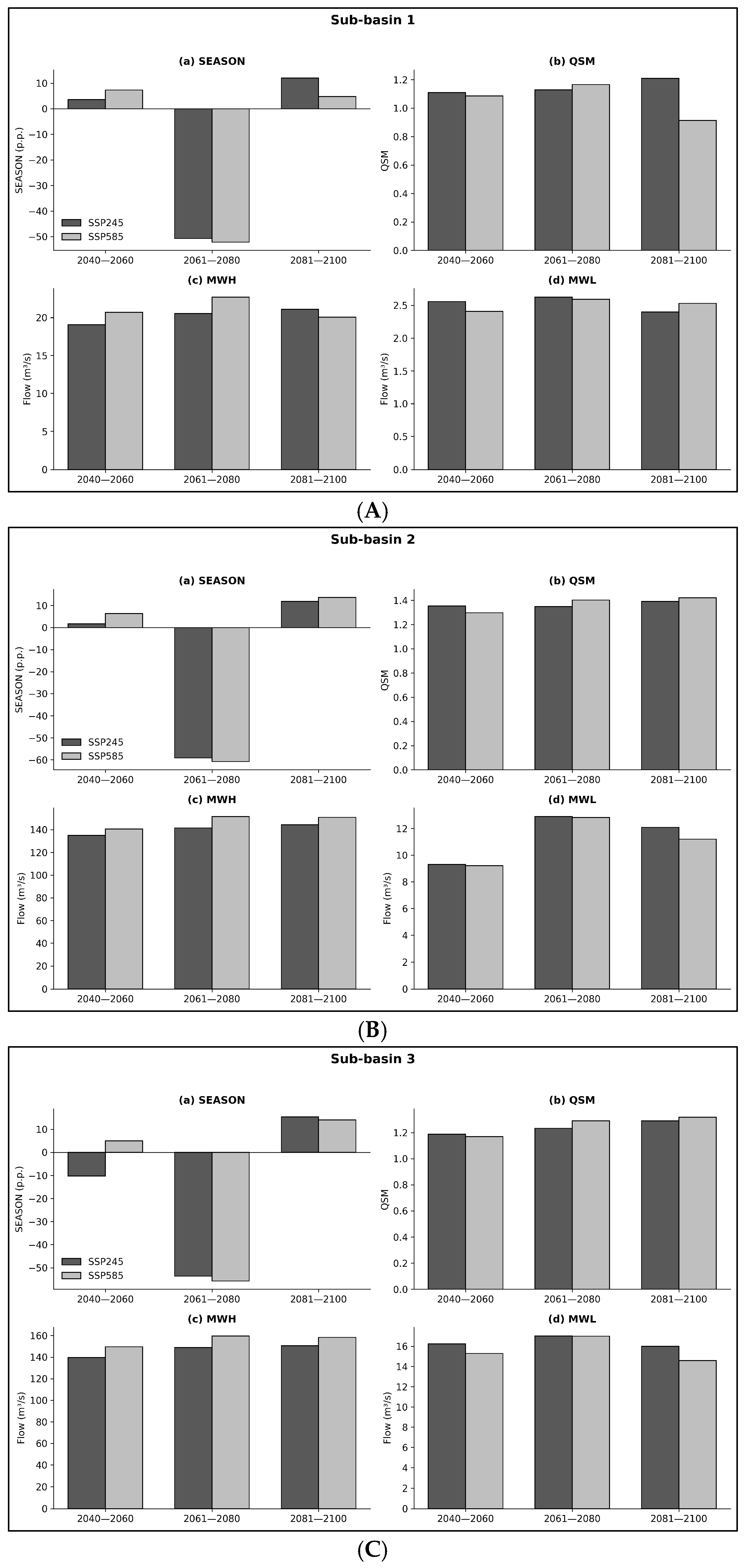
Figure 6 presents the statistical descriptors (QSM, SEASON, MWH and MWL) of the streamflow duration curve in each sub-basin. Regarding seasonality (SEASON), which shows the effects of differences in streamflow in the dry and rainy seasons, there is a reduction in all scenarios evaluated, especially in the mid-future. This decrease indicates an intensification of streamflow seasonality, characterized by a stronger temporal concentration of flows within specific periods of the year.
The QSM represents the average segment of the streamflow duration curve [36] and reflects intraseasonal variability. The projected variation of the QSM initially shows a slight increase in the first time windows, possibly associated with the intensification of significant rainfall events or the increase in seasonal recharge; however, at the end of the century, especially under the SSP585 scenario, a significant reduction is observed in sub-basins 1 and 2, suggesting that the increase in temperature and the consequent increase in evapotranspiration outweigh any gains in precipitation.
The MWH (Figure 6C) and MWL (Figure 6D) indicators represent, respectively, the average flood and drought streamflows. In most sub-basins, there is an increase in the average maximum streamflows, which may indicate an increase in the occurrence of large flood events. On the other hand, the MWL indicates a decrease in the average minimum streamflows, which may compromise the maintenance of base runoff, affecting the recharge of aquifers, especially towards the end of the century.
Given that the ensemble of models demonstrated an adequate agreement between the flow duration curve of observed daily streamflows and simulated streamflows (Table 1 and Figure 3), the behavior of streamflows in future scenarios in each sub-basin was subsequently evaluated. Overall, streamflow duration curves reveal significant changes, mainly at the extremes, in the SSP245 and SSP585 scenarios in the sub-basins considered in this study (Figure 4).

4. Discussion

The projected increase in Q10 combined with the reduction in Q90 and Q7,10 indicates a trend toward amplification of hydrological extremes. This pattern suggests an increase in maximum streamflow and a reduction in minimum streamflow. This behavior suggests changes in the seasonal distribution of precipitation, leading to more intense flooding events and more severe droughts. This interpretation is consistent with the findings of [17], who assessed the impacts of climate change on mining regions in the state of Minas Gerais. According to their study, climate extremes are expected to intensify, particularly under the high-emission scenario [1,6].
The reduction in SEASON and MWL, together with the increase in MWH, reflects a redistribution of streamflow associated with changes in precipitation patterns and atmospheric demand. Under projected climate conditions, rainfall tends to occur in fewer but more intense events, increasing surface runoff as precipitation intensity more frequently exceeds soil infiltration capacity, thereby amplifying peak flows (MWH and Q10). Simultaneously, longer dry periods combined with higher temperatures enhance evapotranspiration and reduce groundwater recharge, leading to diminished baseflow contributions and lower MWL and Q90 values. Similar mechanisms have been discussed by [4,12], who emphasize that increased atmospheric demand and rainfall variability play a central role in altering runoff regimes under climate change.
The stronger responses observed in sub-basins 4 and 5 may be associated with their hydrological and geomorphological characteristics, as well as higher water demand pressures. Land uses in these sub-basins tend to reduce infiltration capacity and increase surface runoff, amplifying peak flows during intense rainfall events while simultaneously reducing groundwater recharge and baseflow contributions during dry periods [10,12].
Estimation of Q7,10 was based on a stationary Gumbel distribution fitted to annual minimum streamflow. The results are interpreted within the framework of conditional stationarity for each time-slice. In other words, although long-term climate change may induce nonstationary behavior over the entire projection horizon [17,35], the changes within each selected period are considered sufficiently gradual that the statistical properties of annual minimum flows can be approximated as stationary. This approach is commonly applied in multi-decadal periods and assumes a condition of pseudo-stationarity within each slice in climate conditions
It should also be recognized that the assessment of future water use conflicts was conducted, assuming unchanged overtime water permits, based on current conditions. This assumption represents a limitation of the study. Additionally, the climate projections were derived from the NEX-GDDP-CMIP6 dataset using the Bias-Correction Spatial Disaggregation (BCSD) method. Although BCSD improves the statistical agreement between modeled and observed historical climate, it assumes that bias structures remain constant over time and may not fully capture changes in the frequency and intensity of extreme events [27,29]. Moreover, the interpolation of the 0.25° × 0.25° climate grids to the basin discretization can introduce spatial smoothing effects, particularly in regions with complex topography, potentially affecting the simulated hydrological response.

5. Conclusions

The results demonstrate that projected climate changes under the SSP scenarios are likely to substantially modify the hydrological regime of the Paraopeba River Basin. The ensemble of CMIP6 models coupled with the MHD-INPE model consistently indicates reductions in minimum streamflow and increases in maximum streamflow, particularly under the high-emission SSP585 scenario toward the end of the century. The most pronounced impacts were identified in sub-basins 4 and 5, where Q90 reductions approach 30% and Q10 increases reach up to 11.7%, evidencing a clear intensification of hydrological extremes.
This shift in the flow regime suggests a growing frequency of intense flood events combined with increased susceptibility to prolonged drought periods. The projected reductions in Q7,10 (the reference low streamflow metric adopted for water allocation in Minas Gerais), reinforce concerns regarding the sustainability of currently granted water withdrawals. The elevated values of the Conflict Index (Icg), especially in sub-basins 4 and 5, indicate that water use conflicts may intensify under future climate conditions potentially compromising regional water security.
Beyond extreme flows, the study reveals structural changes in the basin’s hydrological dynamics. Reductions in seasonality (SEASON), decreases in low-flow indicators (MWL), and increases in high-flow indicators (MWH) collectively point to a more irregular and temporally concentrated flow regime. These alterations are likely associated with more concentrated precipitation events and increased evapotranspiration rates under warmer conditions. Such modifications affect not only the magnitude of water availability but also the reliability and predictability of the hydrological system, which are critical for the planning and operation of water supply systems, irrigation schemes, industrial uses, and hydropower generation, posing additional challenges to water managers.
From a water management perspective, the findings underscore the urgent need to incorporate climate change projections into water resources planning and regulatory frameworks in the Paraopeba River Basin. The projected changes call for adaptive and risk-informed management strategies, including periodic reassessment of water allocation criteria, revision of water use permits based on hydrological risk indicators, strengthening of hydrometeorological monitoring networks, integration between water resources management and land-use planning, and the promotion of ecosystem restoration and conservation measures to enhance basin resilience.
Considering the limitations of this study, it can be concluded that the projections are subject to uncertainties related to climate model structure, scenario spread among SSPs, and assumptions within the hydrological modeling framework. Although these factors influence the magnitude of projected impacts, the overall trend toward intensified hydrological extremes and increased allocation stress remains consistent across models and scenarios.

Author Contributions

Conceptualization, C.M.d.A. and L.A.A.; methodology, C.M.d.A., L.A.A., P.A.M., J.T. and P.R.F.P.; validation, C.M.d.A. and L.A.A.; formal analysis, C.M.d.A., L.A.A., P.A.M., C.R.d.M., J.M.G.P.I. and J.T.; investigation, C.M.d.A. and L.A.A.; writing—original draft preparation C.M.d.A., L.A.A., P.A.M., J.T., J.M.G.P.I. and P.R.F.P.; writing—review and editing, C.M.d.A., L.A.A., P.A.M., J.T., C.R.d.M., J.M.G.P.I. and P.R.F.P. All authors have read and agreed to the published version of the manuscript.

Funding

This work was supported by the Fundação de Amparo à Pesquisa do Estado de Minas Gerais (FAPEMIG) [Grant number APQ-00709-21], Conselho Nacional de Desenvolvimento Científico e Tecnológico (CNPq) [Grant number 305295/2021-7] and Conselho Nacional de Desenvolvimento Científico e Tecnológico (CNPq) [Grant number 305711/2024-5]. Author Jorge M. G. P. Isidoro was funded by the Portuguese Foundation for Science and Technology (FCT) through projects UIDB/00350/2025 (https://doi.org/10.54499/UIDB/00350/2020) granted to Marine and Environmental Sciences Centre (CIMA), University of Algarve (Portugal), and the LA/P/0069/2020 (https://doi.org/10.54499/LA/P/0069/2020) granted to the Associate Laboratory Aquatic Research Network (ARNET).

Data Availability Statement

The original contributions presented in this study are included in the article. Further inquiries can be directed to the corresponding author.

Conflicts of Interest

The authors declare no conflicts of interest.

Abbreviations

The following abbreviations are used in this manuscript:
CMIP6Coupled Model Intercomparison Project Phase 6
GCMGlobal Climate Models
SSPsShared Socioeconomic Pathways

References

  1. Climate Change 2022: Impacts, Adaptation and Vulnerability|Climate Change 2022: Impacts, Adaptation and Vulnerability. Available online: https://www.ipcc.ch/report/ar6/wg2/ (accessed on 27 December 2025).
  2. Copernicus: 2024 Is the First Year to Exceed 1.5 °C above Pre-Industrial Level|Copernicus. Available online: https://climate.copernicus.eu/copernicus-2024-first-year-exceed-15degc-above-pre-industrial-level (accessed on 27 December 2025).
  3. Bevacqua, E.; Schleussner, C.F.; Zscheischler, J. A Year above 1.5 °C Signals That Earth Is Most Probably within the 20-Year Period That Will Reach the Paris Agreement Limit. Nat. Clim. Change 2025, 15, 262–265. [Google Scholar] [CrossRef]
  4. Melo, P.A.; Alvarenga, L.A.; Tomasella, J.; de Mello, C.R.; Martins, M.A.; Coelho, G. Analysis of Hydrological Impacts Caused by Climatic and Anthropogenic Changes in Upper Grande River Basin, Brazil. Environ. Earth Sci. 2022, 81, 504. [Google Scholar] [CrossRef]
  5. Medeiros, F.J.; Oliveira, C.P.; Avila-Diaz, A. Evaluation of extreme precipitation climate indices and their projected changes for Brazil: From CMIP3 to CMIP6. Weather Clim. Extrem. 2022, 38, 100511. [Google Scholar] [CrossRef]
  6. de Alvarenga, C.M.; Alvarenga, L.A.; Melo, P.A.; Tomasella, J.; Pinto, P.R.F.; de Mello, C.R. Meteorological Droughts in the Paraopeba River Basin: Current Scenarios and Future Projections. Land 2025, 14, 2093. [Google Scholar] [CrossRef]
  7. Lee, H.; Calvin, K.; Dasgupta, D.; Krinner, G.; Mukherji, A.; Thorne, P.; Trisos, C.; Romero, J.; Aldunce, P.; Ruane, A.C. Summary for Policymakers. In Climate Change 2023: Synthesis Report; Intergovernmental Panel on Climate Change: Geneva, Switzerland, 2023; Volume 186. [Google Scholar]
  8. Ribeiro, L.D.C.; Paiva, R.C.D.D.; Collischonn, W.; Fagundes, H.D.O.; Kolling Neto, A.; Miranda, P.T.; Rossi, J.B.; Fernandez, G.M.R.; Araujo, A.A.; Souza, S.A.D. AVANÇOS NA COMPREENSÃO DE MUDANÇAS CLIMÁTICAS E VAZÕES EXTREMAS NO BRASIL. In Encontro Nacional de Desastres; ABRHidro: Porto Alegre, Brazil, 2023. [Google Scholar]
  9. Siqueira, P.P.; Oliveira, P.T.S.; Bressiani, D.; Meira Neto, A.A.; Rodrigues, D.B.B. Effects of Climate and Land Cover Changes on Water Availability in a Brazilian Cerrado Basin. J. Hydrol. Reg. Stud. 2021, 37, 100931. [Google Scholar] [CrossRef]
  10. Barros da Silva, B.M.; Da Silva, D.D.; Moreira, M.C. Índices Para a Gestão e Planejamento de Recursos Hídricos Na Bacia Do Rio Paraopeba, Estado de Minas Gerais. Rev. Ambiente Água 2015, 10, 685–697. [Google Scholar] [CrossRef][Green Version]
  11. Fonseca Durães, M.; Rogério De Mello, C. AVALIAÇÃO DO ESTRESSE HIDROLÓGICO NA BACIA DO RIO PARAOPEBA-MG. In XX Simpósio Brasileiro de Recursos Hídricos; ABRHidro: Porto Alegre, Brazil, 2013. [Google Scholar]
  12. Soares, A.L.C.; Oliveira, S.C.; Gomes, L.N.L. Influência Das Atividades Antrópicas e Do Rompimento Da Barragem I, Da Mina Córrego Do Feijão, Na Qualidade Da Água Da Bacia Hidrográfica Do Rio Paraopeba. Rev. Min. Recur. Hídricos 2022, 3, e022004. [Google Scholar] [CrossRef]
  13. Pinto, P.R.F. Segurança Hídrica Na Bacia Hidrográfica Do Rio Paraopeba; FAO: Rome, Italy, 2024; Volume 89. [Google Scholar]
  14. Honorato, P.A.d.R.; Elmiro, M.A.T.; Nero, M.A.; Temba, P.d.C.; Jardim, H.L. A Contribuição Do Modelo FPEIR/TOPSIS No Diagnóstico Ambiental Da Segurança Hídrica de Áreas Atingidas Pela Barragem B1, Brumadinho, MG. Soc. Nat. 2025, 37, e74110. [Google Scholar] [CrossRef]
  15. Alvarenga, L.A.; Carvalho, V.S.O.; de Oliveira, V.A.; de Mello, C.R.; Colombo, A.; Tomasella, J.; Melo, P.A. Hydrological Simulation with SWAT and VIC Models in the Verde River Watershed, Minas Gerais. Rev. Ambiente Água 2020, 15, e2492. [Google Scholar] [CrossRef]
  16. Zákhia, E.M.S.; Alvarenga, L.A.; Tomasella, J.; Martins, M.A.; Santos, A.C.N.; Melo, P.A. Impactos Das Mudanças Climáticas Em Uma Bacia Hidrográfica No Sul Do Estado de Minas Gerais. Rev. Bras. Meteorol. 2021, 36, 667–681. [Google Scholar] [CrossRef]
  17. Melo, P.A.; Alvarenga, L.A.; Tomasella, J.; Santos, A.C.N. Uncertainty Analysis on Long-Term Runoff Projection from the Budyko Framework and a Conceptual Hydrological Model. J. Water Clim. Change 2024, 15, 3850–3866. [Google Scholar] [CrossRef]
  18. Costa, R.C.A.; Santos, R.M.B.; Fernandes, L.F.S.; Carvalho de Melo, M.; Valera, C.A.; do Valle Junior, R.F.; de Melo Silva, M.M.A.P.; Pacheco, F.A.L.; Pissarra, T.C.T. Hydrologic Response to Land Use and Land Cover Change Scenarios: An Example from the Paraopeba River Basin Based on the SWAT Model. Water 2023, 15, 1451. [Google Scholar] [CrossRef]
  19. da Silva, M.V.M.; Silveira, C.d.S.; Costa, J.M.F.d.; Martins, E.S.P.R.; Vasconcelos Júnior, F.d.C. Projection of Climate Change and Consumptive Demands Projections Impacts on Hydropower Generation in the São Francisco River Basin, Brazil. Water 2021, 13, 332. [Google Scholar] [CrossRef]
  20. PARAOPEBA—Sistema de Acompanhamento de Reservatórios. Available online: https://www.ana.gov.br/sar/outros-sistemas-hidricos/paraopeba (accessed on 3 January 2026).
  21. De Vilhena, C.; Sabino, S.; Francisco De Abreu, J.; Lobato, W.; Sabino, G.S.; Aparecida, E.; Knup, N. Análise de Alguns Aspectos Da Qualidade Da Água Da Bacia Do Rio Paraopeba Utilizando Estatística Multivariada. Rev. Biol. Ciências Terra 2008, 8, 6–18. [Google Scholar]
  22. Gonzaga de Oliveira Júnior, M.; Lacerda Maia, J.; Monteiro da Costa, A.; Paulo Oliveira Silva, J.; Junior, O. Disponibilidade Hídrica, Escassez e Cobrança de Recursos Hídricos Na Bacia Hidrográfica Do Rio Paraopeba, MG. Rev. Ibero-Am. Ciências Ambient. 2022, 13, 262–278. [Google Scholar] [CrossRef]
  23. Pereira, A.H. Impacto de Usinas Hidrelétricas e Rompimento de Barragem de Rejeitos Na Estrutura Genética Populacional de Peixes: Um Estudo Com Prochilodus Costatus No Rio Paraopeba. Ph.D. Thesis, Universidade Federal de Minas Gerais, Belo Horizonte, Brazil, 2021. [Google Scholar]
  24. Alvares, C.A.; Stape, J.L.; Sentelhas, P.C.; De Moraes Gonçalves, J.L.; Sparovek, G. Köppen’s Climate Classification Map for Brazil. Meteorol. Z. 2013, 22, 711–728. [Google Scholar] [CrossRef]
  25. Rodriguez, D.A.; Tomasella, J. On the Ability of Large-Scale Hydrological Models to Simulate Land Use and Land Cover Change Impacts in Amazonian Basins. Hydrol. Sci. J. 2016, 61, 1831–1846. [Google Scholar] [CrossRef]
  26. Negrão, A.C.; Camargo, C.P.; Rodriguez, D.A.; Giornes, E.d.O.; Pinto, G.L.N.; Tomasella, J.; de Siqueira Júnior, J.L.; Lopes, L.G.; do Prado, M.C.R. Modelo Hidrológico Distribuído MHD-INPE: Manual de Implementação; Instituto Nacional de Pesquisas Espaciais (INPE): São José dos Campos, Brazil, 2016; Available online: http://mtc-m21b.sid.inpe.br/col/sid.inpe.br/mtc-m21b/2016/03.24.14.43/doc/publicacao (accessed on 3 January 2026).
  27. Zou, W.; Cao, S.; Tan, W. Evaluating NEX-GDDP-CMIP6 Performance in Complex Terrain for Forecasting Key Freezing Rain Factors. Theor. Appl. Climatol. 2024, 155, 9289–9304. [Google Scholar] [CrossRef]
  28. de Paula Moura, M.; de Alvarenga, C.M.; Fontanella, J.P.C.; Pedroso, M.J.; da Costa, M.V.G.; de Oliveira, W.B.; Barros, V.R.; Neto, A.R. AVALIAÇÃO DO IMPACTO DAS MUDANÇAS CLIMÁTICAS EM REGIÕES DE MINERAÇÃO NO ESTADO DE MINAS GERAIS. In XXV Simpósio Brasileiro de Recursos Hídricos; ABRHidro: Porto Alegre, Brazil, 2023. [Google Scholar]
  29. Jiang, F.; Wen, S.; Gao, M.; Zhu, A. Assessment of NEX-GDDP-CMIP6 Downscale Data in Simulating Extreme Precipitation over the Huai River Basin. Atmosphere 2023, 14, 1497. [Google Scholar] [CrossRef]
  30. O’Neill, B.C.; Kriegler, E.; Ebi, K.L.; Kemp-Benedict, E.; Riahi, K.; Rothman, D.S.; van Ruijven, B.J.; van Vuuren, D.P.; Birkmann, J.; Kok, K.; et al. The Roads Ahead: Narratives for Shared Socioeconomic Pathways Describing World Futures in the 21st Century. Glob. Environ. Change 2017, 42, 169–180. [Google Scholar] [CrossRef]
  31. Petrielli, G.P. Avaliação Georreferenciada Dos Impactos Das Mudanças Climáticas Na Produção de Cana-de-Açúcar No Brasil. Ph.D. Thesis, Universidade Estadual de Campinas, Campinas, Brazil, 2024. [Google Scholar] [CrossRef]
  32. Instituto Mineiro de Gestão das Águas (IGAM). Portaria IGAM No 48, de 04 de Outubro de 2019; IGAM: Belo Horizonte, Brazil, 2019. [Google Scholar]
  33. de Farias, V.E.M.; Rodrigues, A.B.; Monteiro, P.B.C.L.; Araujo, D.C.d.S.; Montenegro, S.M.G.L.; Cabral, J.J.d.S.P. PERSPECTIVAS CLIMÁTICAS FUTURAS COM BASE NOS MODELOS DO CMIP6 PARA MUNICÍPIOS DA REGIÃO METROPOLITANA DO RECIFE (PE), BRASIL. Caminhos Geogr. 2024, 25, 58–79. [Google Scholar] [CrossRef]
  34. Moreira, M.; Silva, D.; Pruski, F.; Lara, M. Índices Para Identificação de Conflitos Pelo Uso Da Água:Proposição Metodológica e Estudo de Caso. Rev. Bras. Recur. Hídricos 2012, 17, 7–15. [Google Scholar] [CrossRef]
  35. Feng, D.; Beighley, E. Identifying Uncertainties in Hydrologic Fluxes and Seasonality from Hydrologic Model Components for Climate Change Impact Assessments. Hydrol. Earth Syst. Sci. 2020, 24, 2253–2267. [Google Scholar] [CrossRef]
  36. Ley, R.; Casper, M.C.; Hellebrand, H.; Merz, R. Catchment Classification by Runoff Behaviour with Self-Organizing Maps (SOM). Hydrol. Earth Syst. Sci. 2011, 15, 2947–2962. [Google Scholar] [CrossRef]
Figure 1. Location of the Paraopeba River Basin. (a) Location in South America; (b) Location in the state of Minas Gerais; (c) Detail of the Paraopeba River Basin, with the location of hydrometric stations and respective sub-basins.
Earth 07 00052 g001
Figure 2. Schematic representation of the data input and meteorological variables used in the MHD-INPE.
Earth 07 00052 g002
Figure 3. Streamflow duration curve of simulated flows considering the streamflow observed and simulated in each sub-basin. (a) Sub-basin 1. (b) Sub-basin 2. (c) Sub-basin 3. (d) Sub-basin 4. (e) Sub-basin 5.
Earth 07 00052 g003
Figure 4. Streamflow duration curve of simulated flows considering the SSP245 and SSP585 scenarios. (a) Sub-basin 1 under SSP245 scenario. (b) Sub-basin 1 under SSP585 scenario. (c) Sub-basin 2 under SSP245 scenario. (d) Sub-basin 2 under SSP585 scenario. (e) Sub-basin 3 under SSP245 scenario. (f) Sub-basin 3 under SSP585 scenario. (g) Sub-basin 4 under SSP245 scenario. (h) Sub-basin 4 under SSP585 scenario. (i) Sub-basin 5 under SSP245 scenario. (j) Sub-basin 5 under SSP585 scenario.
Earth 07 00052 g004aEarth 07 00052 g004b
Figure 5. The conflict Index (Icg) for future scenarios in each sub-basin. (a) Icg under SSP245 scenario. (b) Icg under SSP585 scenario.
Earth 07 00052 g005
Figure 6. Statistical descriptors (SEASON, SQM, MWH and MWL) of the streamflow duration curve in each sub-basin. (A) SEASON, SQM, MWH and MWL—Sub-basin 1. (B) SEASON, SQM, MWH and MWL—Sub-basin 2. (C) SEASON, SQM, MWH and MWL—Sub-basin 3. (D) SEASON, SQM, MWH and MWL—Sub-basin 4. (E) SEASON, SQM, MWH and MWL—Sub-basin 5.
Earth 07 00052 g006aEarth 07 00052 g006b
Table 1. Q10, Q50 and Q90 and relative differences in simulated and observed streamflows in sub-basins 1 to 5. Overestimates and underestimates of simulated streamflow in %.
Sub-BasinQ10 (m3/s)Q50Q90
Sim.Obs.Dif. %Sim.Obs.Dif. %Sim.Obs.Dif. %
115.7413.4217%6.024.8524%3.082.2537%
2111.2091.3422%37.9729.1930%15.3813.4215%
3118.05117.111%44.2839.2413%20.2019.265%
4165.50165.460%54.2251.944%23.2324.65−6%
5212.26217.40−2%79.2069.3614%34.1429.4716%
Table 2. Q7,10 for the future scenarios in each sub-basin.
Sub-BasinQ7,10 (m3/s)
SSP245SSP585
2040–2060
12.282.09
28.908.46
314.2312.73
417.8613.74
520.8519.00
2061–2080
12.352.35
211.4211.46
315.2115.13
416.9916.45
521.1624.48
2081–2100
12.182.21
210.729.70
314.2412.66
413.3711.56
518.0717.02
Disclaimer/Publisher’s Note: The statements, opinions and data contained in all publications are solely those of the individual author(s) and contributor(s) and not of MDPI and/or the editor(s). MDPI and/or the editor(s) disclaim responsibility for any injury to people or property resulting from any ideas, methods, instructions or products referred to in the content.