

A Systematic Review of River Discharge Measurement Methods: Evolution and Modern Applications in Water Management and Environmental Protection
 , , , , and
Abstract
1. Introduction
2. Materials and Methods
2.1. Search Strategy

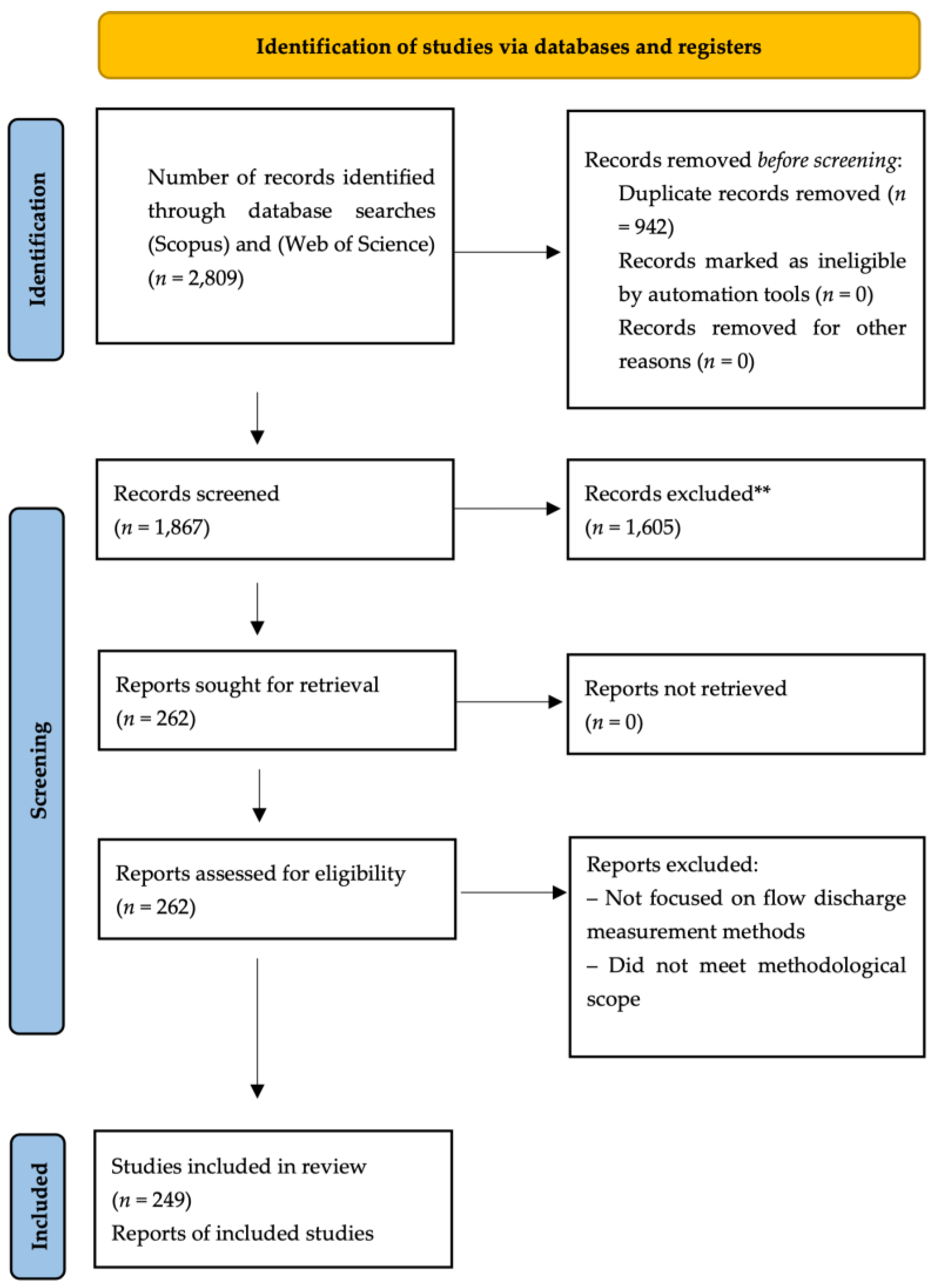
2.2. Selection Criteria and Study Screening
2.2.1. First-Stage Screening
- Peer-reviewed journal articles indexed in Web of Science or Scopus.
- Empirical or experimentally validated studies.
- Explicit focus on river discharge measurement or estimation methods, including conventional hydrometric and computational approaches.
2.2.2. Second-Stage Screening
- Use of image-derived or spatially explicit remote sensing inputs (e.g., close-range optical imagery, UAV imagery, satellite optical or SAR data).
- Implementation of machine learning or deep learning architectures (e.g., CNN, LSTM, ANN, SVR, transformer-based models).
- Direct estimation of river discharge as the primary target variable (Q), rather than intermediate hydrological variables (e.g., water level, velocity-only outputs, or flood extent).
- Empirical validation against reference discharge measurements (e.g., gauge stations, ADCP, or equivalent hydrometric benchmarks).
2.3. Analysis and Synthesis of Information
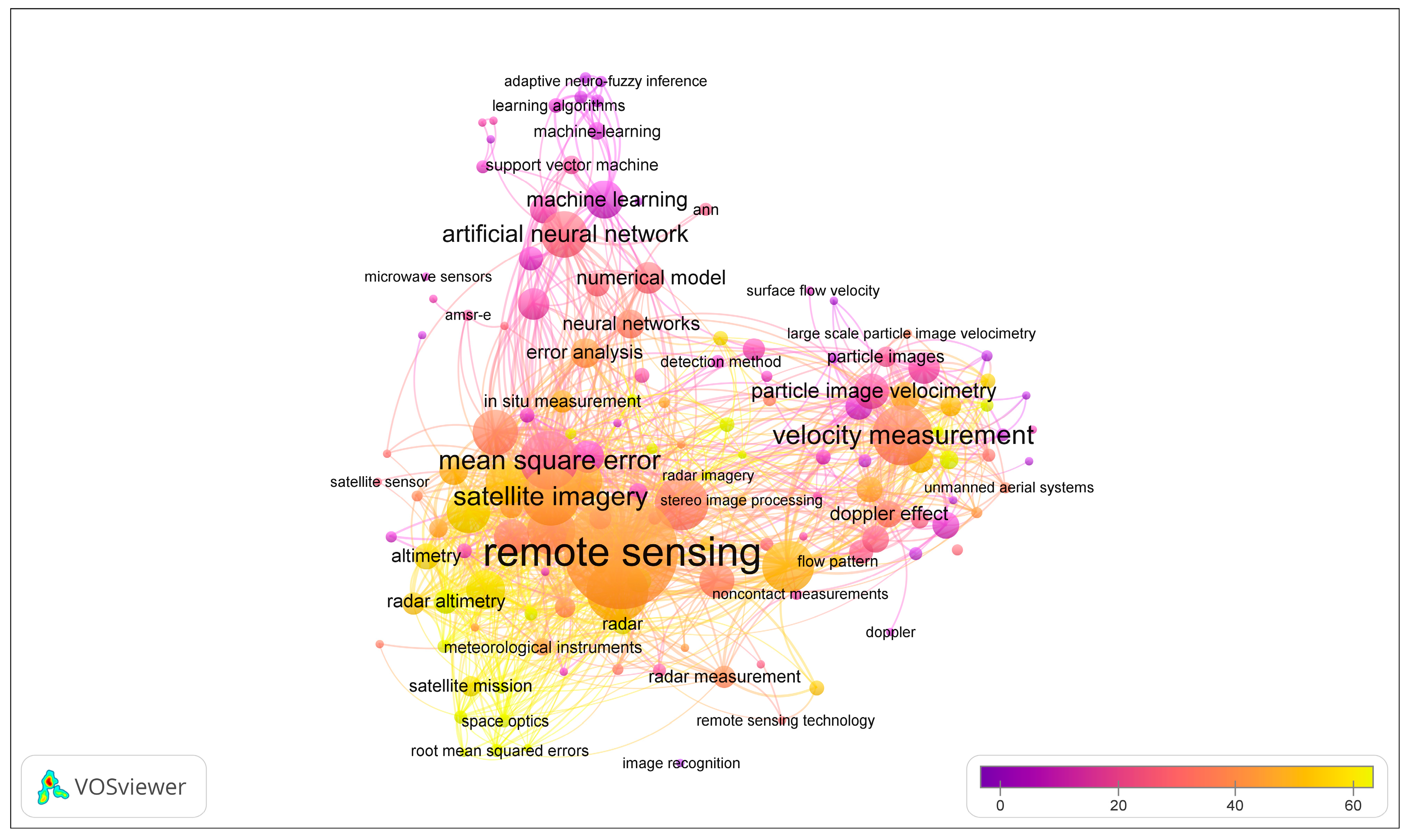
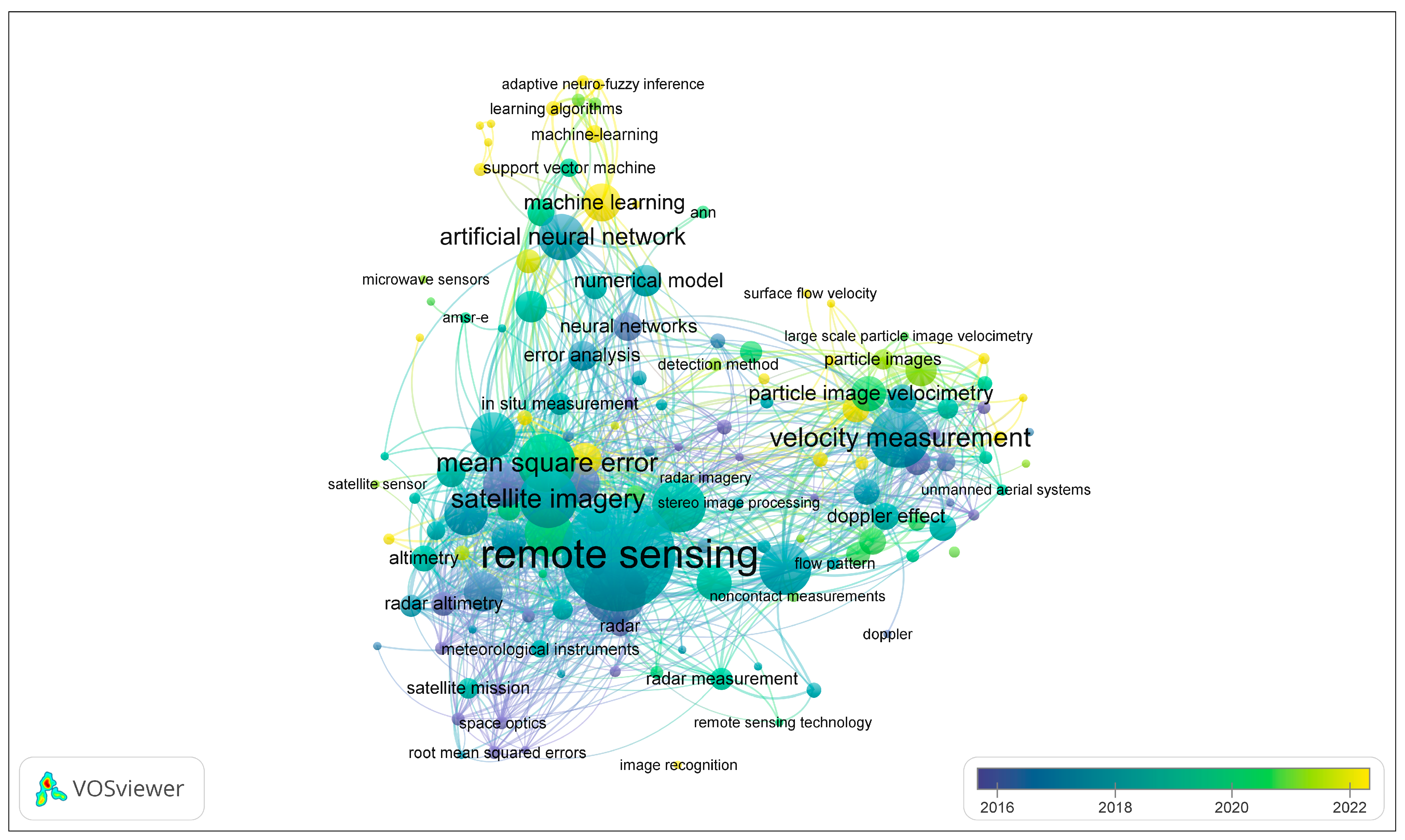
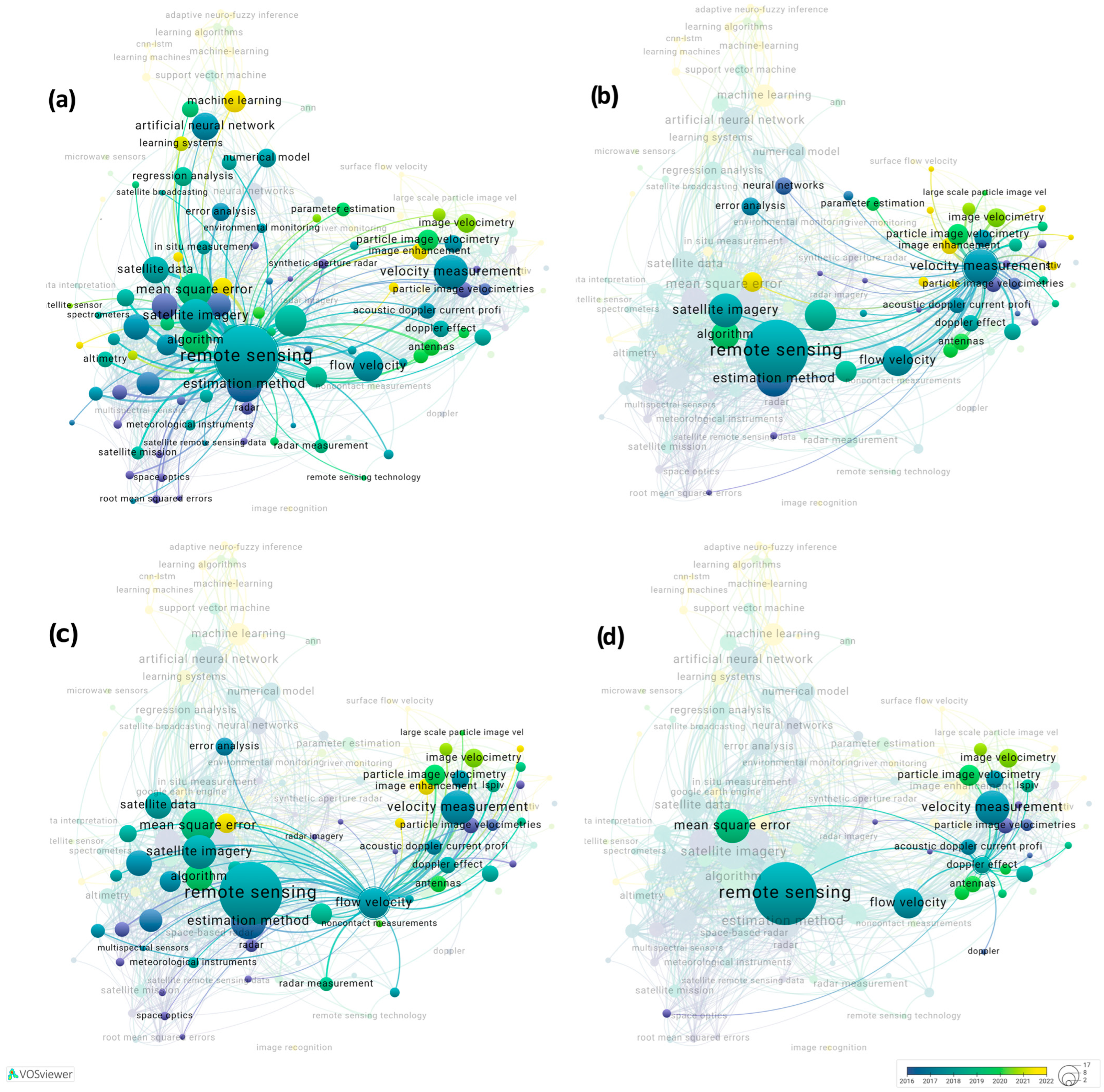
2.4. Visualization of Results and Methodological Mapping
3. Results and Discussion
3.1. Historical and Thematic Evolution of River Discharge Estimation Methods: First Substage
3.2. Second Substage: Image-Based Artificial Intelligence Approaches in River Discharge Estimation
3.3. Comparative Analysis of Conventional and AI-Based Methods for River Discharge Estimation
3.4. Justification of the Final Corpus of Image-Based AI Studies
3.5. Technical Profiling of Stage 2 Image-Based AI Studies
3.6. Limitations, and Future Directions
4. Conclusions
Supplementary Materials
Author Contributions
Funding
Data Availability Statement
Acknowledgments
Conflicts of Interest
References
- Lozano Hernández, B.L.; Marín Celestino, A.E.; Martínez Cruz, D.A.; Ramos Leal, J.A.; Hernández Pérez, E.; García Pazos, J.; Almanza Tovar, O.G. A Systematic Review of the Current State of Numerical Groundwater Modeling in American Countries: Challenges and Future Research. Hydrology 2024, 11, 179. [Google Scholar] [CrossRef]
- Barraza, R.L.; Herrera, M.T.A.; Celestino, A.E.M.; Jáquez, A.D.B.; Cruz, D.A.M. Evaluation of the Extreme Precipitation and Runoff Flow Characteristics in a Semiarid Sub-Basin Based on Three Satellite Precipitation Products. Hydrology 2025, 12, 89. [Google Scholar] [CrossRef]
- Bărbulescu, A.; Zhen, L. Forecasting the River Water Discharge by Artificial Intelligence Methods. Water 2024, 16, 1248. [Google Scholar] [CrossRef]
- Biazar, S.M.; Golmohammadi, G.; Nedhunuri, R.R.; Shaghaghi, S.; Mohammadi, K. Artificial Intelligence in Hydrology: Advancements in Soil, Water Resource Management, and Sustainable Development. Sustainability 2025, 17, 2250. [Google Scholar] [CrossRef]
- Ansari, S.; Rennie, C.D.; Jamieson, E.C.; Seidou, O.; Clark, S.P. RivQNet: Deep Learning Based River Discharge Estimation Using Close-Range Water Surface Imagery. Water Resour. Res. 2023, 59, e2021WR031841. [Google Scholar] [CrossRef]
- Hao, Z.; Xiang, N.; Cai, X.; Zhong, M.; Jin, J.; Du, Y.; Ling, F. Remote Sensing of River Discharge From Medium-Resolution Satellite Imagery Based on Deep Learning. Water Resour. Res. 2024, 60, e2023WR036880. [Google Scholar] [CrossRef]
- Costa, J.E.; Cheng, R.T.; Haeni, F.P.; Melcher, N.; Spicer, K.R.; Hayes, E.; Plant, W.; Hayes, K.; Teague, C.; Barrick, D. Use of radars to monitor stream discharge by noncontact methods. Water Resour. Res. 2006, 42, W07422. [Google Scholar] [CrossRef]
- Herschy, R.W. Streamflow Measurement, 3rd ed.; Routledge: London, UK, 2009. [Google Scholar]
- Uc Castillo, J.L.; Marín Celestino, A.E.; Martínez Cruz, D.A.; Tuxpan Vargas, J.; Ramos Leal, J.A.; Morán Ramírez, J. A systematic review of Machine Learning and Deep Learning approaches in Mexico: Challenges and opportunities. Front. Artif. Intell. 2025, 7, 1479855. [Google Scholar] [CrossRef]
- Uc-Castillo, J.L.; Marín-Celestino, A.E.; Martínez-Cruz, D.A.; Tuxpan-Vargas, J.; Ramos-Leal, J.A. A systematic review and meta-analysis of groundwater level forecasting with machine learning techniques: Current status and future directions. Environ. Model. Softw. 2023, 168, 105788. [Google Scholar] [CrossRef]
- Duan, S.; Ullrich, P.; Shu, L. Using Convolutional Neural Networks for Streamflow Projection in California. Front. Water. Sec. Water Hydrocomplex. 2020, 2, 28. [Google Scholar] [CrossRef]
- Kim, D.Y.; Song, C.M. Developing a Discharge Estimation Model for Ungauged Watershed Using CNN and Hydrological Image. Water 2020, 12, 3534. [Google Scholar] [CrossRef]
- Vanden Boomen, R.L.; Yu, Z.; Liao, Q. Application of Deep Learning for Imaging-Based Stream Gaging. Water Resour. Res. 2021, 57, e2021WR029980. [Google Scholar] [CrossRef]
- Zhang, Y.; Gu, Z.; Thé, J.V.G.; Yang, S.X.; Gharabaghi, B. The Discharge Forecasting of Multiple Monitoring Station for Humber River by Hybrid LSTM Models. Water 2022, 14, 1794. [Google Scholar] [CrossRef]
- Pham Van, C.; Nguyen–Van, G. Three different models to evaluate water discharge: An application to a river section at Vinh Tuy location in the Lo river basin, Vietnam. J. Hydro-Environ. Res. 2022, 40, 38–50. [Google Scholar] [CrossRef]
- Ilhan, A. Forecasting of river water flow rate with machine learning. Neural Comput. Appl. 2022, 34, 20341–20363. [Google Scholar] [CrossRef]
- Muhebwa, A.; Gleason, C.J.; Feng, D.; Taneja, J. Improving Discharge Predictions in Ungauged Basins: Harnessing the Power of Disaggregated Data Modeling and Machine Learning. Water Resour. Res. 2024, 60, e2024WR037122. [Google Scholar] [CrossRef]
- Zhang, J.; Xu, K.; Watanabe, M.; Yang, Y.; Chen, X. Estimation of river discharge from non-trapezoidal open channel using Quickbird-2 satellite imagery. Hydrol. Sci. J. 2004, 49, 247–260. [Google Scholar] [CrossRef][Green Version]
- Alongi, F.; Pumo, D.; Nasello, C.; Nizza, S.; Ciraolo, G.; Noto, L.V. An automatic ANN-based procedure for detecting optimal image sequences supporting LS-PIV applications for rivers monitoring. J. Hydrol. 2023, 626, 130233. [Google Scholar] [CrossRef]
- Lou, H.; Wang, P.; Yang, S.; Hao, F.; Ren, X.; Wang, Y.; Shi, L.; Wang, J.; Gong, T. Combining and comparing an unmanned aerial vehicle and multiple remote sensing satellites to calculate long-term river discharge in an ungauged water source region on the Tibetan plateau. Remote Sens. 2020, 12, 2155. [Google Scholar] [CrossRef]
- Ilhan, A. Forecasting of volumetric flow rate of Ergene river using machine learning. Eng. Appl. Artif. Intell. 2023, 121, 105983. [Google Scholar] [CrossRef]
- Blanco, A.D.J.; Alarcón, M.T.H.; Marín, A.E.C.; Ramírez, E.N.; Martínez, D.A.C. Extension of LoRa Coverage and Integration of an Unsupervised Anomaly Detection Algorithm in an IoT Water Quality Monitoring System. Water 2023, 15, 1351. [Google Scholar] [CrossRef]
- Liu, W.; Zou, P.; Jiang, D.; Quan, X.; Dai, H. Computing River Discharge Using Water Surface Elevation Based on Deep Learning Networks. Water 2023, 15, 3759. [Google Scholar] [CrossRef]
- Page, M.J.; McKenzie, J.E.; Bossuyt, P.M.; Boutron, I.; Hoffmann, T.C.; Mulrow, C.D.; Shamseer, L.; Tetzlaff, J.M.; Akl, E.A.; Brennan, S.E.; et al. The PRISMA 2020 statement: An updated guideline for reporting systematic reviews. BMJ 2021, 372, n71. [Google Scholar] [CrossRef]
- Goswami, G.; Darang, J.; Prasad, R.K.; Mandal, S. Evaluating water availability and flow characteristics for Dikrong river in Arunachal Pradesh using Acoustic Doppler Current Profiler. Sustain. Water Resour. Manag. 2024, 10, 103. [Google Scholar] [CrossRef]
- Wang, X.; Sun, W.; Lu, F.; Zuo, R. Combining satellite optical and radar image data for streamflow estimation using a machine learning method. Remote Sens. 2023, 15, 5184. [Google Scholar] [CrossRef]
- Tarpanelli, A.; Santi, E.; Tourian, M.J.; Filippucci, P.; Amarnath, G.; Brocca, L. Daily river discharge estimates by merging satellite optical sensors and radar altimetry through artificial neural network. IEEE Trans. Geosci. Remote Sens. 2019, 57, 6536–6549. [Google Scholar] [CrossRef]
- Zaji, A.H.; Bonakdari, H.; Gharabaghi, B. Applying upstream satellite signals and a 2-D error minimization algorithm to advance early warning and management of flood water levels and river discharge. IEEE Trans. Geosci. Remote Sens. 2019, 57, 1028–1042. [Google Scholar] [CrossRef]
- Dobriyal, P.; Badola, R.; Tuboi, C.; Hussain, S.A. A review of methods for monitoring streamflow for sustainable water resource management. Appl. Water Sci. 2017, 7, 2617–2628. [Google Scholar] [CrossRef]
- Gorelick, N.; Hancher, M.; Dixon, M.; Ilyushchenko, S.; Thau, D.; Moore, R. Google Earth Engine: Planetary-scale geospatial analysis for everyone. Remote Sens. Environ. 2017, 202, 18–27. [Google Scholar] [CrossRef]
- Lou, H.; Zhang, Y.; Yang, S.; Wang, X.; Pan, Z.; Luo, Y. A New Method for Long-Term River Discharge Estimation of Small-and Medium-Scale Rivers by Using Multisource Remote Sensing and RSHS: Application and Validation. Remote Sens. 2022, 14, 1798. [Google Scholar] [CrossRef]
- Wang, Y.; Zhang, X.; Liu, J.; Chen, L. Adaptive river flow measurement method based on multi-source data fusion and machine learning. Water Sci. Technol. 2024, 89, 1028–1043. [Google Scholar] [CrossRef]
- Zhen, L.; Bărbulescu, A. Comparative Analysis of Convolutional Neural Network-Long Short-Term Memory, Sparrow Search Algorithm-Backpropagation Neural Network, and Particle Swarm Optimization-Extreme Learning Machine Models for the Water Discharge of the Buzău River, Romania. Water 2024, 16, 289. [Google Scholar] [CrossRef]
- Zlatanović, N.; Gavrić, S. Comparison of an Automated and Manual Method for Calculating Storm Runoff Response in Ungauged Catchments in Serbia. J. Hydrol. Hydromech. 2013, 61, 195–201. [Google Scholar] [CrossRef][Green Version]



| Database | Search String |
|---|---|
| Scopus | TITLE-ABS-KEY ((“Mechanical Water Meter” OR “Reed-Type Water Meter” OR “Photoelectric Read-Only Water Meter” OR “Weir method” OR “slot method” OR “volume method” OR “bouy method” OR “Electromagnetic flow meter” OR “ultrasonic flow meter” OR “turbine flow meter” OR “vortex flow meters” OR “velocimetry” OR “Artificial Intelligence” OR “AI” OR “Machine Learning” OR “Neural Networks” OR “ANN” OR “Remote Sensing” OR “IoT” OR “Internet of Things” OR “Big Data” OR “CNN” OR “smart sensors” OR “real-time monitoring” OR “sensor networks” OR “Traditional methods” OR “Traditional Measurement Methods” OR “manual methods” OR “hydrometric methods” OR “empirical methods”) AND (“water flow measurement” OR “water flow monitoring methods” OR “river water flow” OR “water flow monitoring” OR “water flow monitoring systems” OR “river discharge” OR “water level monitoring” OR “water flow testing technologies” OR “canal water flow” OR “canal discharge” OR “water flow in canals” OR “canal flow measurement” OR “Water measurement instruments” OR “water flow rate”)) AND DOCTYPE (ar) AND PUBYEAR > 2003 AND PUBYEAR < 2025 AND (LIMIT-TO (LANGUAGE, “English”)) |
| Web of Science | TS = ((“Mechanical Water Meter” OR “Reed-Type Water Meter” OR “Photoelectric Read-Only Water Meter” OR “Weir method” OR “slot method” OR “volume method” OR “bouy method” OR “Electromagnetic flow meter” OR “ultrasonic flow meter” OR “turbine flow meter” OR “vortex flow meters” OR “velocimetry” OR “Artificial Intelligence” OR “AI” OR “Machine Learning” OR “Neural Networks” OR “ANN” OR “Remote Sensing” OR “IoT” OR “Internet of Things” OR “Big Data” OR “CNN” OR “smart sensors” OR “real-time monitoring” OR “sensor networks” OR “Traditional methods” OR “Traditional Measurement Methods” OR “manual methods” OR “hydrometric methods” OR “empirical methods”)) AND TS = (“water flow measurement” OR “water flow monitoring methods” OR “river water flow” OR “water flow monitoring” OR “water flow monitoring systems” OR “river discharge” OR “water level monitoring” OR “water flow testing technologies” OR “canal water flow” OR “canal discharge” OR “water flow in canals” OR “canal flow measurement” OR “Water measurement instruments” OR “water flow rate”) AND DT = (Article) AND PY = (2004–2024) AND LA = (English) |
| Category | Extracted Variables | Description/Criteria |
|---|---|---|
| Methodological characteristics | Type of approach | Classification of the method as traditional, machine learning, deep learning, or hybrid |
| Model/algorithm | Specific architecture or algorithm used (e.g., CNN, LSTM, CNN–LSTM, transformer-based models) | |
| Modeling strategy | Direct discharge estimation, velocity-to-discharge conversion, hybrid or physics-informed approach | |
| Data characteristics | Data source | Type of input data (e.g., close-range imagery, UAV video, satellite imagery, in situ measurements) |
| Spatial scale | Reach-scale, watershed-scale, or regional-scale application | |
| Temporal resolution | Event-based, daily, or continuous monitoring | |
| Data volume and labeling | Reported size of training datasets and dependence on labeled data | |
| Validation configuration and reported indicators | Performance metrics | Metrics reported by authors (e.g., NSE, RMSE, R2, KGE) |
| Validation strategy | Cross-validation, independent test sites, or comparison with conventional methods | |
| Operational applicability and limitations | Computational demand | Qualitative assessment of computational cost (low, medium, high) |
| Model interpretability | Degree to which model outputs and internal behavior can be explained | |
| Transferability | Applicability to ungauged, data-scarce, or remote regions | |
| Operational feasibility | Potential for real-time monitoring or integration into water management systems | |
| Reported limitations | Key limitations identified by the authors |
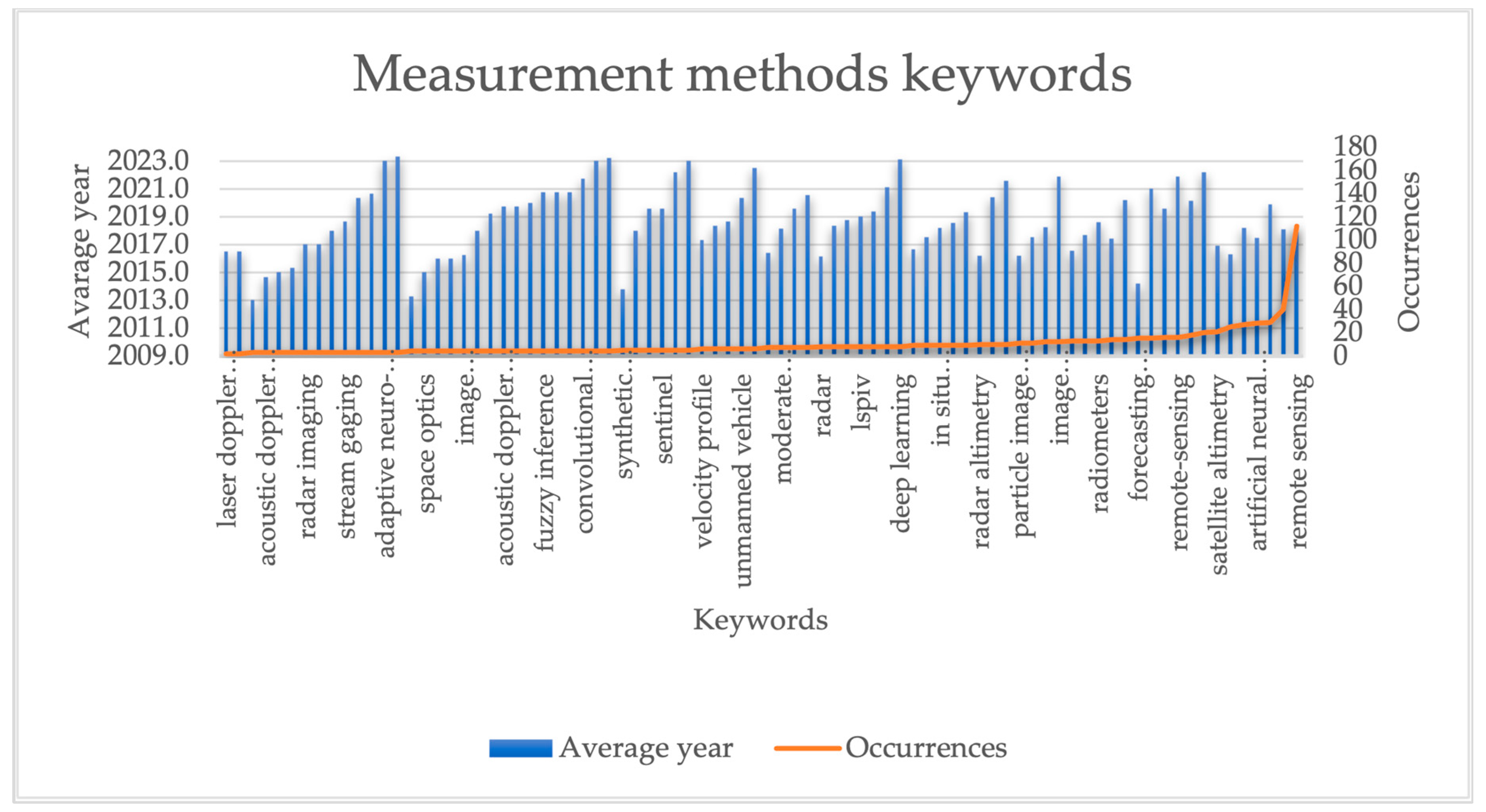
| Measurement Approach | Representative Keywords | Occurrences 2013–2016 | Occurrences 2017–2020 | Occurrences 2021–2024 |
|---|---|---|---|---|
| Intrusive surface water methods | Stream gaging, Current meter, Acoustic Doppler Current Profiler (ADCP), Doppler velocity, In situ instrumentation | 14 | 69 | 14 |
| Non-intrusive surface water methods (remote sensing-based) | Remote sensing, Satellite imagery, Radar altimetry, SAR, UAV, Optical imagery | 48 | 172 | 94 |
| Non-intrusive surface water methods (computational/AI-enhanced) | Machine learning, Artificial neural network, CNN, LSTM, Deep learning | 32 | 118 | 92 |
| Image-based velocimetry techniques | Particle Image Velocimetry (PIV), Large-Scale PIV (LSPIV), STIV, Optical flow | 52 | 185 | 62 |
| Method Category | Representative Example | Data Source | Reported Validation Indicators | Advantages | Limitations | Operational Applicability | Key References |
|---|---|---|---|---|---|---|---|
| Traditional Manual Methods | Float method, current meter | Direct field observation, surface velocity | Low–Medium accuracy; high uncertainty during extreme flows | Low cost, simple implementation | Subjective, operator-dependent, unsafe in high flows | Small local rivers | [7,8] |
| Instrumental In Situ Methods | ADCP, electromagnetic sensors | In-stream velocity profiling and bathymetric measurements | High discharge measurement precision; 3D velocity profiling; transect-based discharge computation | High-resolution velocity structure; reliable cross-sectional discharge quantification | Requires field deployment, vessel access, trained operators; cost-intensive | Gauged river sections; accessible monitoring sites | [25] |
| Close-Range Imaging + Deep Learning | RivQNet (DL velocimetry) | RGB imagery/video (shore-based or UAV) | NSE ≈ 0.89–0.95; RMSE dependent on flow regime | Non-intrusive, reduces subjective processing, suitable for dynamic rivers | Requires labeled training data and stable image acquisition | Site-specific monitoring, flood-prone rivers | [5] |
| Webcam-Based Deep Learning Gaging | Imaging-based stream gaging | Fixed optical cameras + stage reference | Comparable performance to traditional gauging in tested sites | Continuous remote monitoring, low field risk | Sensitive to lighting, site calibration needed | Gauged rivers with camera installation | [13] |
| Satellite Optical Imagery + ML/DL | Landsat-based discharge estimation | Multispectral satellite imagery | R2 > 0.90 in medium-width rivers | Regional scalability, archive-based reconstruction | Limited resolution for narrow rivers; cloud interference | Medium to large rivers; ungauged basins | [6] |
| Optical + SAR Fusion with ML | Optical–radar data integration | Satellite optical + SAR-derived indices | Reduced mean relative error (≈0.18 in testing datasets) | Improved robustness under cloud cover | Requires multisensor harmonization | Regional monitoring | [26] |
| Satellite Optical + Radar Altimetry + ANN | ANN-based discharge merging | Optical imagery + radar altimetry | Daily discharge estimation with strong agreement to gauges | Daily scale monitoring; integrates multiple signals | Dependent on altimetry overpass frequency | Large rivers; global applications | [27] |
| Satellite Signal + AI Early Warning | Upstream satellite signals + AI | Satellite-derived surface indicators | Improved flood-stage and discharge prediction | Supports early warning systems | Performance varies under low signal-to-noise conditions | Flood-prone regions | [28] |
| Exclusion Category | Operational Definition | n | Primary Criterion Not Met |
|---|---|---|---|
| Remote sensing-based discharge estimation without ML/DL | Studies estimating discharge from imagery using empirical or physics-based approaches without AI/ML integration | 110 | No ML/DL implementation |
| Conventional discharge measurement approaches (non-image-based) | Instrument-based or rating curve-based discharge methods without image input or AI/ML modeling | 61 | No imagery input; no ML/DL |
| AI/ML discharge models using time-series only | ML/DL models estimating discharge from hydrometeorological or historical discharge data without image/video input | 36 | No imagery input |
| Image-based velocimetry without AI integration | LSPIV, STIV, PIV, or optical flow methods without ML/DL architectures | 23 | No ML/DL implementation |
| Studies not directly estimating river discharge (non-Q targets) | Remote sensing and/or AI/ML studies focusing on water level, flood extent, sediment, or velocity-only outputs rather than discharge | 12 | Discharge not target variable |
| Total excluded from Stage 2 | 242 |
| Study | Image Source | Spatial Scale | AI Architecture | Validation Method | Reported Performance | Flow Sensitivity |
|---|---|---|---|---|---|---|
| [13] | Close-range RGB imagery | Medium-width rivers | CNN | Gauge station comparison | NSE ≈ 0.90–0.94 | Reduced accuracy at low flow |
| [5] | Close-range surface imagery | Controlled river sections | Transformer-based DL | In situ discharge gauges | NSE > 0.94 | Stable across moderate flows |
| [6] | Medium-resolution satellite imagery | Large rivers | Deep CNN | Gauge records | R2 > 0.94 | Decrease under low surface contrast |
| [26] | Sentinel-1 SAR + Landsat 8 + MODIS | Large basin (Yalong River) | SVR | 5-fold CV + gauge data | MRE = 0.18; MAE = 18.4 m3/s; NSE ≈ 0.83 | Lower performance during low flow |
| [27] | Optical satellite + radar altimetry | Large rivers | ANN | Gauge + satellite altimetry | R2 ≈ 0.83–0.92 | Sensitive to seasonal variability |
| [28] | Satellite brightness temperature | Large rivers | ANN/RBF | Gauge station validation | R2 ≈ 0.85–0.93 | Reduced performance in extreme low flow |
| [32] | Multi-sensor satellite imagery | Large-scale rivers | ML-based discharge modeling | Gauge comparison | R2 > 0.90 | Sensitivity under extreme hydrologic regimes |
Disclaimer/Publisher’s Note: The statements, opinions and data contained in all publications are solely those of the individual author(s) and contributor(s) and not of MDPI and/or the editor(s). MDPI and/or the editor(s) disclaim responsibility for any injury to people or property resulting from any ideas, methods, instructions or products referred to in the content. |
© 2026 by the authors. Licensee MDPI, Basel, Switzerland. This article is an open access article distributed under the terms and conditions of the Creative Commons Attribution (CC BY) license.
Share and Cite
González-Vergara, O.A.; Alarcón-Herrera, M.T.; Marín-Celestino, A.E.; Blanco-Jáquez, A.D.; García-Pazos, J.; Villarreal-Rodríguez, S.; Salazar, Y.; Martínez-Cruz, D.A. A Systematic Review of River Discharge Measurement Methods: Evolution and Modern Applications in Water Management and Environmental Protection. Earth 2026, 7, 41. https://doi.org/10.3390/earth7020041
González-Vergara OA, Alarcón-Herrera MT, Marín-Celestino AE, Blanco-Jáquez AD, García-Pazos J, Villarreal-Rodríguez S, Salazar Y, Martínez-Cruz DA. A Systematic Review of River Discharge Measurement Methods: Evolution and Modern Applications in Water Management and Environmental Protection. Earth. 2026; 7(2):41. https://doi.org/10.3390/earth7020041
Chicago/Turabian StyleGonzález-Vergara, Oscar Abel, María Teresa Alarcón-Herrera, Ana Elizabeth Marín-Celestino, Armando Daniel Blanco-Jáquez, Joel García-Pazos, Samuel Villarreal-Rodríguez, Yolocuauhtli Salazar, and Diego Armando Martínez-Cruz. 2026. "A Systematic Review of River Discharge Measurement Methods: Evolution and Modern Applications in Water Management and Environmental Protection" Earth 7, no. 2: 41. https://doi.org/10.3390/earth7020041
APA StyleGonzález-Vergara, O. A., Alarcón-Herrera, M. T., Marín-Celestino, A. E., Blanco-Jáquez, A. D., García-Pazos, J., Villarreal-Rodríguez, S., Salazar, Y., & Martínez-Cruz, D. A. (2026). A Systematic Review of River Discharge Measurement Methods: Evolution and Modern Applications in Water Management and Environmental Protection. Earth, 7(2), 41. https://doi.org/10.3390/earth7020041