Review

A Review of Automatic Voltage Regulation Methods for Synchronous Generator Control

1
Department of Electrical Power Engineering, Durban University of Technology, Durban 4001, South Africa
2
Department of Electrical & Electronic Engineering Technology, University of Johannesburg, Auckland Park, Johannesburg 2094, South Africa
3
GCET, CVM University, Vallabh Vidyanagar 388120, India
4
Department of Electrical Engineering, School of Energy Technology, Pandit Deendayal Energy University, Gandhinagar 382007, India
5
Department of Human Anatomy and Physiology, Faculty of Health Sciences, University of Johannesburg, Auckland Park, Johannesburg 2094, South Africa
6
Department of Electrical Engineering, Malaviya National Institute of Technology, Jaipur 302017, India
*
Author to whom correspondence should be addressed.
Electricity 2026, 7(1), 18; https://doi.org/10.3390/electricity7010018

Submission received: 6 June 2025 / Revised: 29 September 2025 / Accepted: 28 October 2025 / Published: 1 March 2026

Abstract

Traditional thermal power systems are merging with distributed generation and renewable energy sources, resulting in complex interconnected power system networks. This results in operational burdens and complexities in thermal power plants that they were not designed to handle. The role of Automatic Voltage Regulation (AVR) is crucial in maintaining the stability and dependability of these complicated power systems. This research provides a comprehensive review of the AVR control strategies within the last five years, considering operational complexities, changing topologies, and evolving challenges, in contemporary power systems. This review first explores the contemporary control strategies used in voltage regulation. Second, it provides an in-depth evaluation of the traditional Proportional Integral Derivative controllers with various improvements, adaptions, and modifications, followed by an examination of supplementary controllers in the AVR framework. Lastly, this paper reviews various optimisation strategies published in the last five years. This paper enriches our understanding of traditional and advanced control strategies in AVR, providing a comprehensive evaluation of their effectiveness and constraints, and aims to provide a valuable resource for researchers in this field.

1. Introduction

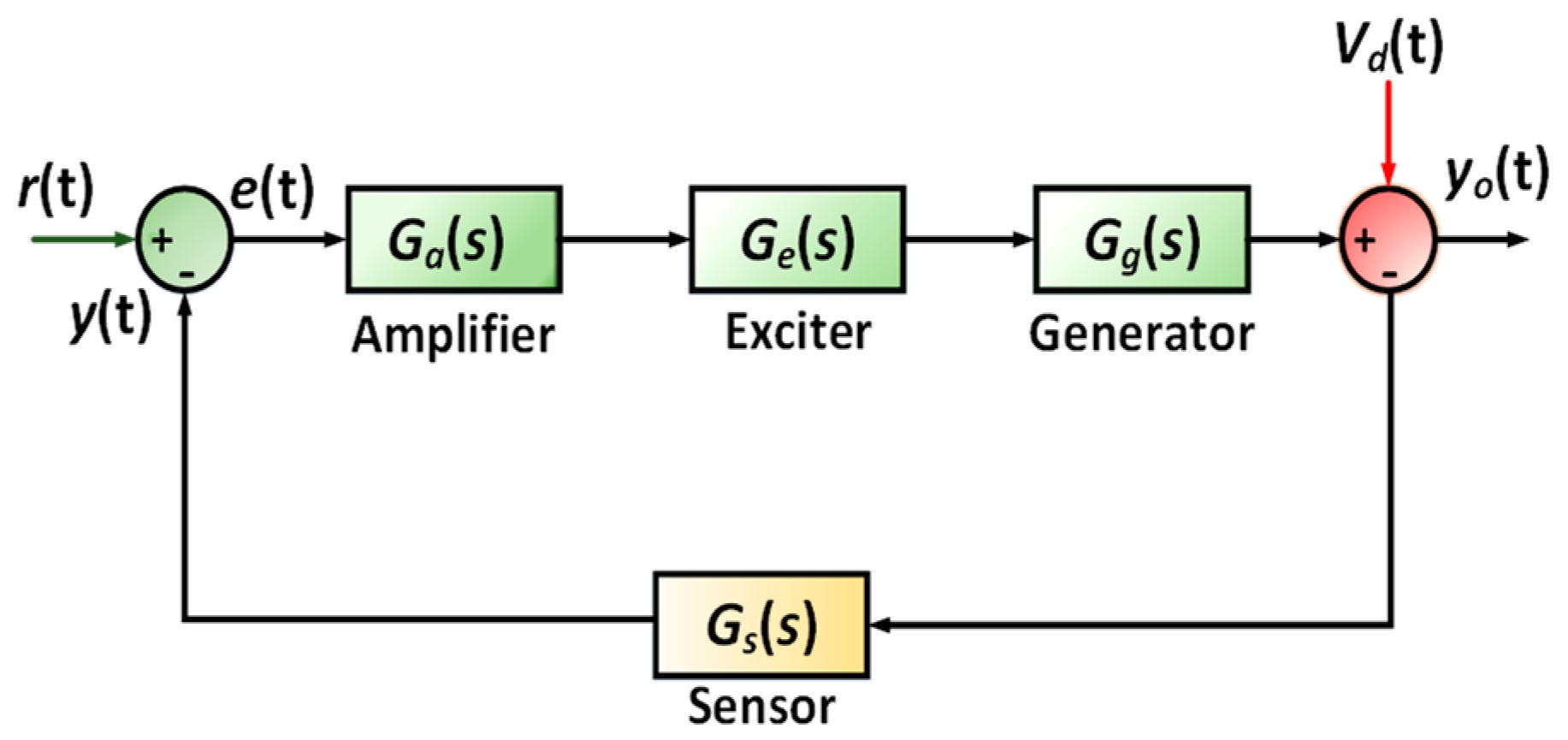
Electrical power systems form the backbone of modern society, providing energy to rural and modern areas. Modern power systems continuously evolve due to constant increases in load demand, dynamic load patterns, the integration of unpredictable renewable energy sources, the expansion of smart grids, and system parameter uncertainties [1,2,3,4], and hence create the need for advanced control strategies to address these challenges effectively. AVR control systems maintain desired voltage levels at the generator’s terminals by regulating the generator’s field excitation to control the output voltage within acceptable limits under varying operating conditions and disturbances [5,6,7,8,9]. The essential components of AVR systems are shown in Figure 1. Numerous controllers and control strategies have been employed in the AVR framework to improve the performance of the AVR control structure. These include contemporary control strategies, traditional PID-based controllers, and auxiliary control and optimisation techniques.
This paper provides a comprehensive review of the progression of AVR control strategies within the last five years, considering operational complexities, changing topologies, and evolving challenges in contemporary power system networks. The review begins with scrutinising contemporary AVR controllers, which have been widely used and studied. Each has distinct characteristics, advantages, and disadvantages. The review in this research work focuses on traditional PID-based controllers, along with the improvements seen when using several modifications and adaptations. In addition, this review also focusses on considering the auxiliary control strategies that incorporate state and disturbance observers into AVR systems. Lastly, optimisation algorithms are discussed to fine-tune the AVR parameters necessary to achieve optimal voltage regulation. In view of above discussion, this article has the following aims:
  • This review started with a scrutiny of contemporary AVR controllers. These controllers have been widely used and studied over the last five years. Each have distinct characteristics, advantages, and disadvantages.
  • This review then focuses on traditional Proportional-Integral-Derivative (PID) controllers, along with the improvements achieved when using several modifications and adaptations.
  • This research next investigates supplementary control strategies that incorporate state observers and disturbance observers into the AVR system.
  • Lastly, optimisation algorithms are reviewed for fine-tuning AVR parameters in order to achieve optimal voltage regulation of the power system.

2. Contemporary Controllers

Fuzzy Logic Controllers (FLCs) have been widely employed in AVR applications due to their ability to model complex nonlinear relationships and to handle imprecise and uncertain information. Barakat provides a comprehensive overview of FLCs in power systems [10]. The authors in [11] asserted that a critical benefit of FLCs is their excellent interpretability because experts establish the rules and classes. However, research is needed to address the subjective nature of this approach. Instead, work has focused on integrating RERs, with no emphasis on the specific obstacles of using FLCs in AVR applications. In [12], the authors used a fuzzy logic controller (FLC) to prevent voltage fluctuations in the DC bus of a power system integrated with renewable energy sources. The FLC dynamically adjusted the control parameters based on real-time system behaviour, helping to smooth out voltage oscillations caused by the intermittency of solar and wind inputs. This rule-based control scheme improved voltage regulation performance without requiring an accurate mathematical model of the system. While this innovative approach could improve the performance of AVR applications, the research focused on energy storage and the design of FLCs, and does not address the challenges of using FLCs in AVR applications. An FLC is used in [13] to mitigate harmonic distortion and voltage sag in a RE-integrated microgrid, but the research does not address the robustness of the proposed method under various operating conditions, such as grid disturbances or sudden load changes.
Lawal et al. employed an Adaptive Neuro-Fuzzy Inference System (ANFIS) to control the AVR system [14]. Their study evaluated system performance across three configurations: without a controller, with a conventional PID controller, and with the proposed ANFIS-based controller. The results demonstrated that the ANFIS controller significantly enhanced voltage regulation, showing faster settling times and reduced overshoot. However, the study did not sufficiently address the computational complexity involved in deploying learning-based optimisation within the control structure. Furthermore, the paper lacked detailed discussion on how the ANFIS parameters were selected or tuned, which limits the reproducibility and practical application of the proposed method. In [15], FLC was used, which relies on wide-area signals from Wide Area Measurement Systems (WAMS) as input signals and incorporates a sliding surface approach in the control framework to enhance its performance during different operating conditions. While this approach makes the system insensitive to parameter variations and reduces the number of fuzzy rule bases in the FLC, the research does not address the potential impact of communication delays or data loss on the performance of the proposed controller, which are common issues in real-world power systems that use WAMS. A fuzzy model is introduced in [16] that consisted of only two rules, with all other nonlinearities considered as uncertainties. The fuzzy model was defined with only two rules to simplify computation, namely, “IF error is Positive THEN output is Decrease” and “IF error is Negative THEN output is Increase.” This basic structure enables faster decision-making in low-complexity AVR scenarios. While the proposed rules reduction approach seems promising, this study is conducted on a single-machine infinite bus and may be difficult to scale and apply to real-world complex systems. The investigation in [17] demonstrates the effectiveness of a closed-loop fuzzy control strategy that integrates Boolean logic with Real-Time Recurrent Learning (RTRL). This approach enhances adaptability by allowing for the system to update its parameters dynamically during operation. The use of Boolean relations simplifies rule definition in the fuzzy inference process, while RTRL facilitates online learning for nonlinear system behaviour. However, despite these conceptual benefits, RTRL introduces significant computational overhead. Its reliance on real-time backpropagation through time makes it memory-intensive and computationally demanding, which limits its scalability and practicality for large-scale or high-speed AVR applications. The research in [18,19,20,21,22] demonstrates the ability of FLCs to improve the dynamic performance of the AVR control structure. However, the comparative analyses in these investigations were only conducted with the FLC, without the FLC and PI or PID controllers. Comparisons with advanced AVR strategies would be helpful to determine the efficacy of the proposed FLC strategies.
While there have been significant advancements in tuning fuzzy controllers for improved performance in AVR applications, and they do provide a flexible framework for dealing with uncertainties, the linguistic rules and membership functions in FLCs often require expert knowledge, making the design process subjective and exhaustive, which poses difficulties in responding to sudden load changes and system variations. Further, the interpretability of fuzzy rules can limit the adaptability of FLCs in addressing dynamic variations in AVR applications, and these controllers do not adapt to changes in the system or its environment after they are designed.
Neural Network-Based Controllers (NN-BC) use artificial neural networks to model and control complex nonlinear systems [23]. Their strength lies in their adaptability and learning capabilities, which may be helpful in dynamic AVR control systems. However, while these controllers are very efficient in capturing complex relationships, they are often considered “black-box” models. In [24], the authors focused on using the Neural Lyapunov barrier functions for safe nonlinear control. This work contributed significantly to enhancing the safety and reliability of NN-BC. The research in [25] introduced an innovative design approach for predictive current controllers using neural networks. The neural network-based predictive current controller introduced adaptive weight updates based on voltage error trends, replacing static control laws with dynamic learning. While this opens new avenues for improving AVR systems’ performance, the research did not investigate the interpretability and data-dependency challenges of NN-BC. The work in [26,27] explored the tuning of PID and Fractional Order PID (FOPID) controllers using neural network-based learning mechanisms to enhance the dynamic performance of AVR systems. These methods aimed to automate the selection of controller parameters (e.g., proportional, integral, derivative gains, and fractional orders λ and δ in FOPID) by training neural networks to approximate optimal tuning rules based on input–output response characteristics. Although these approaches showed improved performance in terms of reduced overshoot and faster settling times, the studies did not provide a detailed analysis of the added implementation complexity. Specifically, the integration of neural networks introduces challenges such as the need for large training datasets, increased computational load due to online or recursive training updates, and risks of local minima or overfitting. Furthermore, the hardware feasibility of real-time deployment, particularly in resource-constrained AVR environments, was not addressed. In [28], the authors provided a study on the application of machine learning in voltage regulation in distribution networks, but no comparative analyses were made with the proposed method and other contemporary control strategies. These comparisons would have provided useful insight into the effectiveness of the proposed works.
Addressing the challenges posed by the stochastic nature of RERs and load consumption, Ayyagari et al. developed an ANN-based voltage regulation controller for distribution networks with high integration of DERs [29]. The ANN structure mapped voltage deviations and DER outputs to corrective control signals, improving response under varying conditions. In [30], an ANN controller was implemented for a standalone synchronous generator, where the model was trained to map error signals between reference and terminal voltages to excitation control actions, demonstrating improved voltage tracking. In [31], the ANN was used to determine the relationship between the AVR setpoint and the generator’s terminal voltage. Although the study was conducted on a real 120 MVA generator in a hydroelectric power plant, only step disturbances were investigated without consideration for various operating conditions and parameter uncertainties. An Emotional Deep Learning NN-BC is presented in [32] for AVR applications. The architecture combines traditional neural network training with an “emotional learning” mechanism inspired by neurobiological models of the human brain, where emotional values are assigned to training samples based on error severity and reinforcement feedback. However, the practical implications of the emotional component on control performance, such as faster convergence, better generalisation, or improved disturbance rejection, were not clearly quantified. Aribowo et al. introduced a cascade-forward backpropagation NN-BC [33] and a focused time delay NN-BC [34] in the AVR framework. While these works showed promise in AVR applications, both studies compared the proposed methods with other NN-BC models only, which makes it difficult to gauge the effectiveness of the proposed methods compared to other advanced control strategies. The authors in [35] analysed a recurrent convolutional NN-BC on the New England 39-bus system. While the authors mentioned that the proposed method captures spatial and temporal features from a time series of selected physical variables, it is unclear how these variables are selected and whether this selection process could introduce bias into the control framework. In [36], reinforcement learning (RL) is integrated into a Neural Network-Based Controller (NN-BC) for voltage regulation in distribution networks with distributed energy storage systems. The framework uses RL to adaptively adjust the control policy based on system feedback, allowing for the controller to learn optimal voltage regulation strategies in response to varying load profiles and intermittent renewable energy injections. While the paper demonstrates promising results in managing voltage deviations, it provides limited information about the state-action formulation, reward function structure, and the specific RL algorithm used. Without these details, it is difficult to assess the controller’s learning efficiency, convergence behaviour, and suitability for real-time deployment. The research by [29,30,31,32,33,34,35,36] does not address the scalability, computational complexities, or practical feasibility of implementing NN-BC controllers in large-scale power systems. NN-BC heavily depends on the quality and quantity of the training data, which can be a tedious process. The controller performs poorly if the training data does not represent the operating conditions. Further, the training can be computationally extensive and time-consuming, especially for large complex networks. The interpretability problem in NN-BC remains a critical concern in AVR because understanding the decision-making process is essential for reliable voltage regulation. The lack of interpretability of these controllers hinders our understanding of the control decisions and makes it challenging to validate the network’s behaviour in complex dynamic power systems.
Model Predictive Control (MPC) methods are increasingly being researched for AVR applications due to their ability to manage constraints and uncertainties. A detailed analysis of MPC, highlighting its predictive nature and applications, is provided in [37,38], which frames the MPC challenge as a constrained quadratic programming (QP) optimisation problem that must be solved at each sampling interval. This formulation, although effective, demands significant processing power, which restricts real-time application under fluctuating loads. These examples reflect emerging designs where controller intelligence is embedded directly into the AVR structure to enhance response and adaptability. Further, the authors emphasised that the accuracy of system modelling is crucial for the performance of an MPC, and pointed out that any uncertainties or inaccuracies in the power system model will adversely affect the control performance. In [38], machine learning was used to accelerate the real-time MPC action, but this method further adds to the complexity of the control structure.
Chetty et al. demonstrated the MPC’s robustness in the presence of nonlinear Generation Rate Constraints (GRC) and system parameter variations in a conventional power system integrated with wind energy generation [39]. The proposed MPC strategy formulates an optimisation problem that predicts future voltage deviations over a finite time horizon and computes optimal control actions by minimising a cost function subject to system constraints. The study models GRCs explicitly as input constraints within the control horizon, and incorporates varying operating conditions such as generator time constants and load changes. Simulation results showed that the MPC maintained system stability and outperformed conventional PI controllers in terms of overshoot and settling time. In [40], the authors showed the superior performance of the MPC in thermal power systems. However, the investigations in [39,40] did not compare the proposed MPC methods with other advanced control techniques, which would be useful to determine the efficacy of the proposed strategies. A data-driven approach to improving the accuracy of system models in the MPC framework without requiring explicit knowledge of the underlying system model is presented in [41]. While the study demonstrated the effectiveness of the proposed method using extensive simulations of various power systems, it did not address the computational complexity or practical feasibility of the proposed method. It also overlooked challenges such as data quality, model uncertainty, and parameter optimisation in large-scale or distributed systems. The authors in [42] employed the Hermite–Biehler theorem to establish frequency-domain stability criteria for the AVR system. By deriving necessary and sufficient conditions based on the location of system poles in the complex plane, they ensured that the closed-loop system remained stable under varying parameter conditions. Furthermore, they introduced a novel demerit objective function that penalised excessive rise time, settling time, and maximum voltage overshoot. This objective function was incorporated into the controller tuning process to simultaneously improve transient performance and ensure stability margins. Although this approach effectively minimised undesirable dynamic responses, the study did not address how this frequency-domain-based methodology performs under significant nonlinearities or parameter uncertainty, which are common in real-world AVR environments. In [43], several energy storage devices were combined with the MPC, and the authors provided a comparative analysis of the proposed strategy with other controllers. However, the study was conducted on a linear system model, limiting its applicability in practical power systems consisting of nonlinearities. In [44], the authors proposed an integrated dynamic voltage control strategy combining local and secondary voltage control using simplified dynamic models. The method utilises simplified dynamic models to reduce computational complexity and applies a predictive control approach involving state estimation, rolling optimisation, and real-time feedback correction. This allows for anticipatory voltage regulation decisions, maintaining voltage stability across the network, despite fluctuating loads or generation. However, the study confines its scope to a regional distribution network predominantly populated with small-scale distributed generation units. As such, it does not assess the scalability or applicability of the proposed control strategy in meshed transmission systems or mixed-scale hybrid grids that incorporate both utility-scale and small-scale generation sources.
This limits its applicability in large power system networks. In [45,46,47], the MPC was used in power systems incorporating RERs, assuming that the system models were accurate. However, this may not always be the case in real-life power systems, and the research did not discuss how potential model inaccuracies could adversely impact the effectiveness of the MPC. Despite several advancements, MPC still faces challenges in real-time implementation in the AVR control framework. The need for accurate system modelling and the potential for delays in control actions limit its effectiveness in addressing rapid voltage variations in the system, thus limiting its practical application. Adaptive Control Strategies (ACS) are designed to adjust the control parameters based on the changing characteristics of the system [48]. The flexibility offered by ACS allows for better handling of varying system dynamics—a significant advantage in AVR control, where conditions can change rapidly. These methods typically rely on online identification mechanisms—such as recursive least squares or gradient-based estimators—to track system dynamics and update controller gains accordingly. In AVR systems, ACS implementations often take the form of Model Reference Adaptive Control (MRAC) or Self-Tuning Regulators (STR), where the controller continuously aligns the plant output with a predefined reference model. However, it is noted in [48] that ACS face challenges regarding stability and robustness. The adaptation mechanisms in these controllers are sensitive to noise and disturbances, which can lead to oscillations or instability if not finely tuned [49]. Moreover, adaptive controllers struggle when the system undergoes abrupt and drastic variations, as the adaptation process cannot effectively deal with these rapid variations. In [50], the authors comprehensively analysed the system’s performance under various conditions with different power system models. This study demonstrated that the direct adaptive concept could provide robust performance and effectively maintain the dynamic stability of the power system against fluctuations.
The research by [51,52] explored ACS with abrupt changes. It presents novel approaches to adaptive control using a single adaptive law, simplifying the controller and enhancing the AVR-controlled system’s efficiency and stability. Ref. [53] presented an approach to power system planning that considers operational uncertainty—a crucial aspect of power system planning, especially given the increasing integration of variable RERs into the grid. The research by [51,52,53] assumed that the proposed models can accurately capture system dynamics. However, this may not always be possible or straightforward for real-life power systems. In [54], the authors used a rule-based adaptive control strategy in islanded power systems, where discrete sets of pre-defined rules were dynamically triggered based on real-time system measurements, such as frequency deviation and voltage fluctuations. This enabled the AVR system to respond promptly to disturbances by altering control parameters such as excitation voltage or reactive power compensation modes. The adaptive nature of this strategy could allow for more effective and timely responses to disturbances and system variations; however, rule-based systems, while often simpler than other AI techniques, can also act as a “black box,” making it difficult to understand the decision-making process and the predictions thereof. This lack of transparency is a significant drawback in dynamic power system control, and was not addressed in the study. To enhance the stability and response of the ACA, the authors in [55] explored various optimisation algorithms (OAs) for tuning the controller parameters. Mesbah et al. presented a dynamic RCA for current sharing and voltage regulation [56], but no comparative analysis or sensitivity analysis was provided to gauge the effectiveness and resilience of the control strategy. While ACS offer flexibility, their sensitivity to disturbances and potential for oscillations may introduce instability in AVR control systems.
Robust Control Approaches (RCA) control strategies are designed to ensure stability and performance in the face of uncertainties and variations in system parameters [57]. These strategies typically formulate the AVR problem within the H-infinity or μ-synthesis framework, where the controller is designed to minimise the worst-case gain from disturbance inputs to regulated outputs. By explicitly incorporating system uncertainties—such as variations in generator reactance, excitation gain, and time constants—into the controller synthesis, the RCA ensures guaranteed stability margins and bounded transient responses across a range of operating conditions. This makes robust control a strong candidate for practical AVR applications in environments with fluctuating grid parameters and uncertain renewable penetration levels. An overview of robust control theory, which deals with uncertainties in complex systems, is provided in [58]. However, the inherent conservatism in these designs can lead to suboptimal performance because robust controllers prioritise stability over control performance when faced with uncertainties [58]. This conservatism can result in controllers that are less responsive to dynamic changes and may not fully exploit the system’s capabilities. In [58], various strategies were examined to enhance the performance of RCAs, addressing the trade-off between stability and control efficiency. Since the study in [58], considerable progress has been made in handling uncertainties in robust control, emphasising the need for adaptive robustness. In [59], the proposed RCA was an improved PI controller with a sigmoid function, which helped reduce external disturbances and uncertainties. While including the sigmoid function enhanced the robustness of the AVR system due to its high nonlinear gain characteristic, the analysis only compared the performance of the improved PI controller with an optimised PI controller. A comparison with other contemporary controllers or advanced control strategies would be useful to evaluate the proposed strategy’s performance better.
To enhance the responsiveness of the AVR framework, a fuzzy PID filter was used in the RCA for real-time self-tuning of the controller parameters [60]. The fuzzy logic system dynamically adjusted the proportional, integral, and derivative gains based on error magnitude and its rate of change, allowing for the controller to adapt to varying operating conditions and disturbances. While the research highlighted the advantages of the proposed RCA, a more detailed analysis of the controller’s behaviour under extreme conditions or disturbances is required to determine its robustness and effectiveness. In [61], the proposed robust control design approach simultaneously considered output disturbances, sensor noises, and system uncertainties for the linear transfer functions of the AVR system. The non-conservative modelling of six structured parameters and simulation results indicated that the proposed RCA performed better than the other optimised and fuzzy controllers in a wide range of uncertainties. The controller’s effectiveness was validated on a single machine connected to a 230 kV network and a four-machine two-area test system, and this study contributes valuable insights into robust control strategies for AVR systems. Soliman and Ali used Polyak’s corollary in the RCA to derive a set of principal polynomials that capture the uncertainties in the model parameters, which were then used in the design of the AVR controller to ensure that it can maintain robust stability and performance [62]. However, the authors assumed ideal system conditions, which implied that system parameters do not change over time, and the system model relied on linear transfer functions. In many real-world systems, parameters can change due to various factors such as ageing, wear and tear, or environmental conditions, and the controllers designed using this method do not adapt to changes in the system. In [63,64], the authors proposed simple nonlinear RCA controllers involving decentralised strategies for multiple Synchronous Generators (SGs) that do not require knowledge of network configurations. The approach avoided the need for communication links or optimisation techniques. However, the controllers’ robustness under varying load conditions and disturbances needs further investigation.
Bhusnur presented a Coefficient Diagram Method (CDM) for an RCA and concluded that the proposed strategy performed better than a conventional PID controller [65]. However, comparisons of performance metrics, including settling times, overshoot/undershoot, and steady-state errors, between the two controllers are not provided in the investigations. Further, the CDM is complex to understand and implement and requires specialised expertise. Also, the CDM can manage certain uncertainties only, but it does not perform well in the presence of large or unexpected disturbances and nonlinearities and is sensitive to parameter variations in the system. The authors in [66] presented an RCA that combined several approaches into a single robust control strategy for concurrently controlling frequency and voltage in a SG with structured uncertainties. The proposed RCA performed well in a wide range of parameter deviations. A DOB was included in the RCA framework in [67], and the authors claimed that the proposed control framework was robust, but they did not provide a thorough analysis of its robustness under various conditions, such as significant disturbances or parameter uncertainties. The analyses in [65,66,67] only compared the proposed RCA controllers with a conventional PID controller; it would be beneficial to compare the proposed methods with other contemporary controllers and advanced control strategies to better assess their performance. Although the review demonstrates that the RCA can manage uncertainties and achieve desired performances, they are mathematically complex and computationally intensive, making them difficult to implement in real-time applications. Also, with RCA, there is a trade-off between robustness and performance because increasing the robustness of the controller to handle a broader range of uncertainties leads to conservative performance, which is not desirable in AVR control strategies.
The discussed contemporary control approaches bring distinct characteristics and advantages, each contributing to the evolving AVR landscape. While their ability to provide enhanced voltage regulation is demonstrated, introducing complex control strategies in the AVR control framework can lead to practical challenges which limit their application in real-world power systems. Therefore, traditional PID-based control strategies remain popular among control engineers and researchers.

3. Proportional-Integral-Derivative Based (PID) Controllers

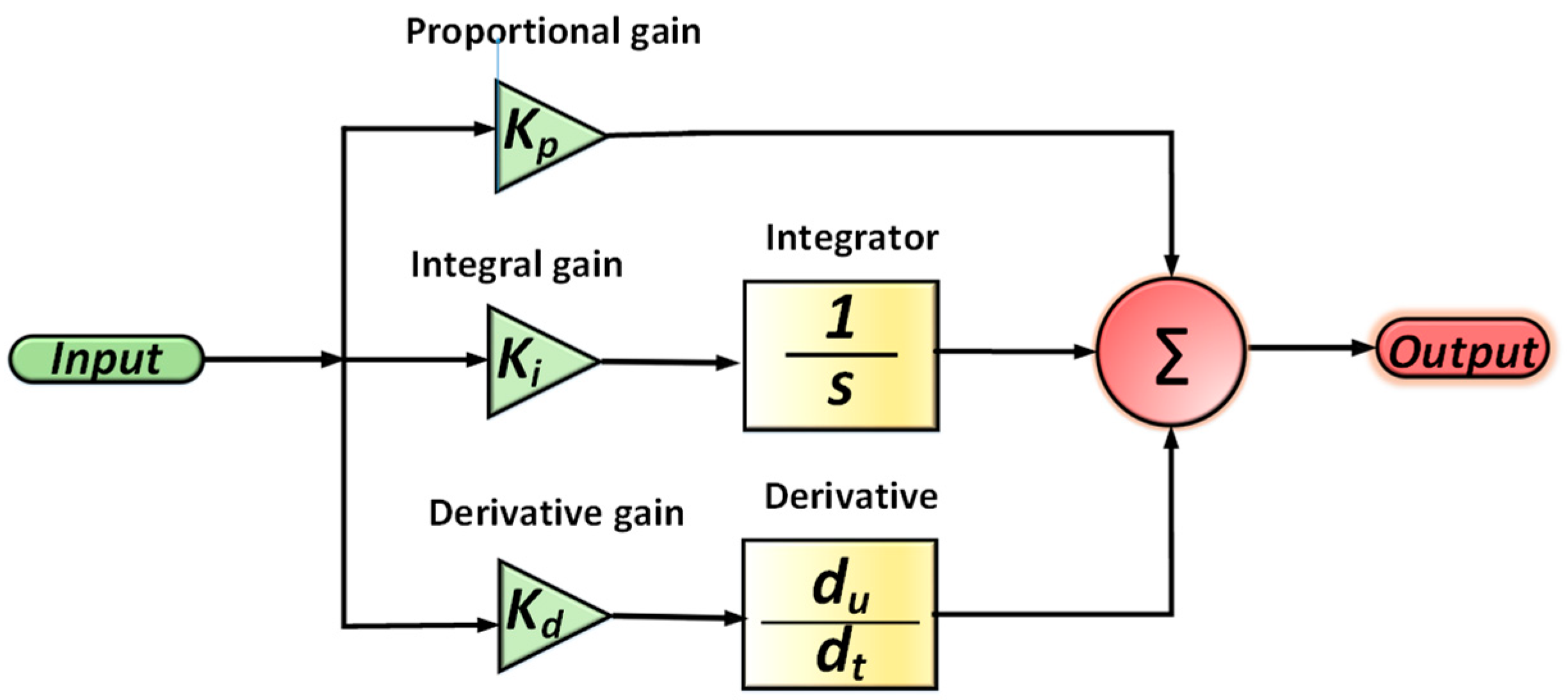
Traditional PID controllers are the most used controllers in AVR systems [68] due to their simple control structure, as shown in Figure 2. Their fast and accurate voltage regulation and effectiveness in dealing with various operating conditions are well-established in the literature [68].
However, there are reservations about the limitations of PID controllers when dealing with significant parameter uncertainties, highly nonlinear conditions, and major disturbances. While PID controllers are excellent in managing minor disturbances, they may produce oscillations and instability when faced with larger disruptions [69,70]. Several studies have investigated the limitations of PID controllers, providing proposals to mitigate these limitations. Agrawal et al. conducted a study on PID controller tuning for improved AVR performance [71]. In [72], the authors introduced a novel objective function tailored to enhance PID controller performance by explicitly minimising a weighted combination of integral performance indices, including the Integral of Time-weighted Squared Error (ITSE) and Integral of Squared Error (ISE). This objective function was designed to strike a balance between fast transient response and minimal overshoot, thereby improving the dynamic performance and robustness of the AVR system under various loading conditions. In [73,74], authors have shown the design of PID controller to achieve the required voltage and frequency of the system. However, the results were not compared with other advanced AVR control strategies.
Advanced tuning methods and optimisation techniques have been suggested to address these limitations. Rais et al. investigated various optimisation techniques to enhance the performance of PID controllers [75]. These methods aimed to identify the ideal set of controller parameters that minimise a specific objective function, typically related to the system’s error. However, the advanced tuning techniques bring the computational complexities and hence limit the real-time implementation and feasibility for practical applications.
PID-Acceleration (PIDA) controllers are an extension of traditional PID controllers, which incorporate an acceleration mechanism into the control structure [76]. The acceleration component accounts for the acceleration of the error and continuously modify the parameters of PIDA, hence making it more flexible to varying operating conditions and disturbances [76]. The adaptability of the PIDA structure in managing dynamic and uncertain power system conditions is emphasised in [77,78]. The investigation by [79] showed the effectiveness of the PIDA controller by using a two-point frequency response matching technique, which equates the desired set-point closed-loop reference model with the closed-loop transfer function of the system model. However, the investigations were based on a simplified linear system model, which restricts its application in real-world power systems. Using a graphical characteristic method [80], a non-interactive form with algebraic tuning equations [81], and relay-feedback tuning [82], the researchers aimed to develop explicit tuning methods for PIDA controllers, which negated the need for optimisation techniques and reduce the computational complexities of the AVR control framework. The study by [83] showed that using a PIDA controller helped improve both load frequency and voltage regulation in power systems. By introducing a derivative of acceleration term, the PIDA controller provided faster damping of oscillations and enhanced sensitivity to dynamic changes in system frequency and terminal voltage. Simulation results indicated superior performance compared to conventional PID controllers in terms of reduced settling time, minimal overshoot, and improved robustness under load fluctuations. Chetty et al. [84] demonstrated that an optimised PIDA controller performed well in an AVR system. Their analysis covered how the controller responded to changes over time, how sensitive it was to different conditions, and how stable it remained under disturbances. The implementation of PIDA controllers requires a good understanding of the system dynamics and careful selection of the controller parameters. The acceleration component within the PIDA structure can introduce complexity and sensitivity to parametric variations, potentially leading to instability under certain conditions. However, achieving the optimal set of adaptive parameters can be complex, requiring careful consideration of system dynamics and operating conditions. More research is needed to find the right balance between improving adaptability and managing the tuning challenges that come with PIDA controllers. This will help ensure they work reliably and effectively in AVR systems. Fractional Order PID (FOPID) controllers have gained significant attention in the AVR framework. The fractional-order nature of these controllers allows for more flexible adjustments to system dynamics, showing their advantages over traditional PID controllers [85]. The effectiveness of FOPID controllers is presented in [86], emphasising their potential to improve transient response and robustness in voltage regulation. The fractional differential–integral structure enables superior flexibility in tuning, allowing for finer control over system dynamics and improved robustness to parametric uncertainties. The study emphasised improved transient performance, specifically faster rise times, reduced overshoot, and better disturbance rejection, compared to conventional PID controllers. However, the research did not address the difficulties and extra computational demands of tuning fractional order parameters. This can introduce tuning complexities and potentially limit the practical implementation of intricate FOPID control strategies. It also raises questions about the ease of parameterisation and the potential trade-offs between enhanced adaptability and the computational burden introduced by the fractional order approach. An optimised FOPID controller with a fractional filter demonstrated its superiority when compared to an ideally tuned FOPID controller for the AVR system [87]. The optimisation approach refined both the proportional–integral–derivative gains and the fractional orders (λ and δ), enabling improved flexibility in shaping the closed-loop response. The enhanced structure provided better damping of oscillations, reduced voltage overshoot, and improved steady-state accuracy. To alleviate the difficulties of tuning the fractional order components of the FOPID controller, the authors in [88] presented an OA combined with a Local Escaping Operator (LEO). The LEO can improve the convergence speed and the ability to avoid local optima of OAs in the AVR framework. The authors in [86,87,88] only compared the proposed optimised FOPID controllers to other optimised FOPID controllers; comparative studies with PID or PIDA controllers and other advanced control strategies would be useful to better assess the proposed methods. In [89], the authors included a fractional filter in the FOPID control structure with an off-line parameter tuning. The analysis in [90] demonstrated improved stability performance of the FOPID by fine-tuning the five control parameters—proportional, integral, derivative gains, and the fractional orders λ and δ—to better adapt to the dynamic behaviour of the AVR system. The controller exhibited enhanced phase and gain margins, resulting in increased robustness against system parameter variations and external disturbances. The use of frequency-domain performance indices allowed for the design to achieve superior damping characteristics, ensuring faster settling time and reduced overshoot. In [91], a low-order approximation of the FOPID controller was presented to reduce the complexity typically associated with fractional calculus in practical implementation. By approximating the non-integer order elements with rational transfer functions, the controller retained the key advantages of the original FOPID structure—namely, its ability to provide phase and gain tuning flexibility—while significantly simplifying the computational burden. The analysis showed that the reduced-order model achieved nearly equivalent closed-loop performance in terms of transient response, overshoot suppression, and steady-state error minimization. However, these investigations in [89,90,91] only compared the FOPID controllers with a PID controller. Comparisons with other controllers, such as the PIDA, would be beneficial. Ref. [92] presented a multi-term FOPID controller, which can be complex to implement in real-world power systems. While the authors in [93] showed that the FOPID controller outperforms the integer order PID (IOPID) controller due to its nonlinear character and the underlying ISO-damping feature of fractional-order operators, they did not consider real-world power systems that have diverse dynamics, nonlinearities, and uncertainties.
Shukla et al. introduced a novel cascade PID linked with a FOPID controller with integer-order and fractional-order components [94]. Although their research contributes to AVR control by examining the benefits of combining integer-order and fractional-order control components, the structure and design principles of the controller are unclear. A FOPID controller combined with a PI controller was presented in [95]. In [96], the research aimed to enhance the AVR framework by using a cascade of controllers for both frequency and voltage regulation in an interconnected single-area and two-area hybrid power system by employing a combination of a fractional-order PI controller and a FOPID controller. In [97], a multiple FOPID configuration achieved the highest control performance in the AVR system in comparison to a traditional PID controller and a standard FOPID controller. However, authors have assumed ideal conditions for the research and neglected real-world parameter uncertainties. Although FOPID controllers offer superior performance in handling complex and dynamic power system conditions, the challenge lies in tuning the fractional order parameters in comparison to straightforward tuning processes of PID and PIDA controllers.
The research by [98] presented PID-based Model Reference Fractional Adaptive Controllers (PMRFACs) as a robust strategy in the power system control framework, where the fractional order and adaptive techniques are combined to improve the adaptability and performance of AVR systems. The proposed PMRFACs in [98,99,100,101] demonstrated superior performance with fast responses and low rising and settling times. However, there were no discussions on the tuning complexities and increased computational burdens associated with the fractional order and adaptive components. Further research is required to investigate the challenges associated with the practical implementation of PMRFACs and explore efficient tuning methods to bridge the gap between their enhanced adaptability and the complexities introduced by the reference model fractional adaptive approach.
Second-order Derivative PID (PIDD) controllers have gained attention as an effective control strategy for improving AVR system performance by using second-order derivative and integral principles. In [102,103], Chatterjee et al. showed that the proposed PIDD controller offered significantly better robustness and control compared to traditional methods. The authors in [104,105] presented “real” PIDD controllers with detailed comparative analyses, but there are no details or explanations on what precisely constitutes a “real” PIDD controller compared to a regular PIDD controller. Abood introduced a PIDD-double plus controller in [106], with little explanation and analysis of the benefits of the proposed controller compared to a standard PIDD controller or the PID and PIDA controllers. In [107], the “Bode’s ideal reference model” is introduced in the PIDD AVR control framework. However, the rationale behind using Bode’s model for the controller design is not discussed, and there was no explanation of how adhering to Bode’s model enhances the AVR system’s performance. The research in [108] used a PID-Derivative plus second order-derivative with detailed transient analysis of the proposed controller, which includes statistical tests, convergence behaviour, transient and frequency responses, root locus analysis, disturbance rejection, and a robustness assessment. However, the challenge lies due to tuning difficulties and additional complexities associated with the second-order component.
Fractional Order PIDD (FOPIDD) controllers were introduced in the AVR control framework in [109,110]. The investigations presented detailed comparative analyses of the proposed methods, demonstrating their effectiveness in the AVR control framework. However, the research did not analyse the robustness of the proposed controllers under parameter variations, disturbances, or uncertainties. While the authors in [111] demonstrated the enhanced performance of a FOPIDD controller with a double derivative, a comparative analysis with traditional PID and PIDA controllers would be helpful to justify the rationale of using a computationally intensive and complex controller compared to the simple PID or PIDA controllers. While FOPID controllers and the adaptations thereof provide enhanced voltage regulation, further research is required to investigate the practical implementation challenges of these controllers and the balance between the added complexity and computational difficulties with control performance.
Most PID-based controllers reviewed have a single Degree-of-Freedom (DOF), which refers to the number of independent parameters that can be adjusted or controlled within the control structure. However, such controllers may not compensate for the total effect of various irregularities, parametric uncertainties, load fluctuations, disturbances, and nonlinearities. Araki first proposed the two DOF-PID (2DOF-PID) controller for industrial use with a detailed analysis with a short list of optimal parameters [112]. The 2DOF controller adds an additional degree of freedom to the control structure, which allows for the control parameters to be tuned more precisely, thereby improving the performance and reliability of the controller. The research in [113] examined the effects on the dynamics of the closed-loop control with the added parameters within the 2DOF control structure with detailed theory and operation. Although the research does not explicitly deal with AVR control systems, it is useful in understanding how the 2DOF configuration contributes to the overall control framework. In complex power systems, 2DOF controllers provide additional flexibility in the control framework and have become widely used in AVR systems.
In [114], the authors presented a 2DOF Tilt-Integral-Derivative (TID) controller with a fractional derivative (2DOF-TID) and demonstrated favourable results in terms of transient responses for voltage and frequency regulation. However, the research did not discuss the practical aspects and implementation of the tuning parameters of the 2DOF-TIDμ controller. In [115,116,117], the authors used PI controllers in their 2DOF control structures without any substantial explanations for their choice of using the PI controllers instead of the PID controllers. Further, there were no comparisons or analyses between the proposed PI controllers and PID controllers or any other controller to assess the efficacy of the proposed 2DOF-PI controllers. Comparative studies in [118] demonstrated that the proposed 2DOF-FOPI controller outperforms the standard PI controller in robustness, achieving reduced settling times and overshoots. However, the comparative analysis was only conducted with a standard PI controller; comparisons with the PID and PIDA controllers would help us to ascertain the efficacy of the proposed strategy. The authors in [119] introduced a 2DOF-PID designed for wind-integrated power systems. Wind integration introduces nonlinearities into the power system due to pitch control, wind turbine dynamics, and grid interactions, but the research did not address these issues. A novel integral-based weighted-goal fitness-function approach was presented in [120], but the study did not adequately address the sensitivity of the proposed controller to variations in system parameters, disturbances, or noise. Sensitivity analyses are crucial for assessing the robustness of any control scheme. The study in [121] proposed a 2DOF-PI+PD controller for a multi-area interconnected power system and included detailed comparisons with a standard PID controller. The challenges related to tuning PID-based controllers using the 2DOF structure were further explored in [122,123,124], where OAs were used to improve the control performance.
However, the sensitivity of the controllers’ performance to variations in system parameters such as load changes, disturbances, and model uncertainties was not thoroughly investigated.
By adding a third DOF, the 3DOF-PID-based controllers go a step further and allow for the simultaneous adjustments of proportional, integral, and acceleration gains, which enables the controller to respond to complex power system dynamics with greater flexibility and precision [125]. The investigations in [126,127] demonstrated that the 3DOF-PID controllers performed better than the PID and 2DOF-PID controllers. In [128,129,130], 3DOF-FOPID configurations were used in the AVR control framework. However, the research did not address the additional complexities, computational burden, and practical applicability of these proposals. In [129], the authors indicate that increasing the DOF does not guarantee control performance improvement.
The review of PID-based controllers highlights their effectiveness and limitations in AVR control systems. In addition, limitations identified in earlier studies may be alleviated by incorporating advanced control strategies. Also, a theoretical advancements and modifications of these controllers do not necessarily result in the practical implementation of these control strategies. Therefore, further research is necessary on the practical implementation of complex PID structures for power systems.

4. Auxiliary Control

State Observers (SOs) are mathematical tools used to estimate the parts of a system that cannot be measured directly using the information that is available [131]. In the context of AVR systems, SOs help to monitor and manage how the power system behaves in real-time. By estimating the states that are not measured, they improve how well the system can be observed and controlled. This makes it possible to apply more advanced control techniques that depend on knowing the full internal behaviour of the system [132]. The two commonly known SOs are the Luenberger Observer [133] and the Extended Kalman Filter (EKF) [134]. The Luenberger-based observers are linear observers that estimate the unmeasured system states using the systems’ dynamics and output measurements. The advantage of the Luenberger Observers is their simplicity and ease of implementation, making them suitable for real-time applications in power systems. However, using Luenberger observers in practice is mainly limited to systems that behave in a linear way. When applied to nonlinear systems, their performance tends to drop, making them less suitable for complex AVR environments [132].
To address nonlinear system dynamics, Extended Kalman Filter (EKF)-based observers are often used. These are more advanced observers that improve on the basic Kalman Filter by including linear estimates of nonlinear behaviour [134,135]. In AVR applications where power systems usually display nonlinear dynamics, EKFs are useful because they can provide accurate estimates of internal system states by combining measured outputs with a model of the system. This ability to handle nonlinearities is a clear strength. However, EKFs are also known for being computationally demanding, and their accuracy can suffer if the system model is not precise [135]. A study in [136] applied this concept to improve voltage control in islanded microgrids with renewable energy sources, introducing a new method suited to such environments.
The proposed method combined the extended state Kalman–Bucy filter with a fast terminal sliding mode control to enhance system resilience and performance. While detailed performance evaluations and scalability tests verified the applicability of the proposed method, the robustness of the control method was only tested for different levels of noise measurements. A detailed robustness and sensitivity analysis to variations in system parameters, such as load changes, disturbances, and model uncertainties, are required to fully gauge the effectiveness and practical applicability of the proposed method. Extended SOs (ESOs) were used in the control framework in hybrid power systems [137,138], which included electric vehicle uncertainties that add to the complexity of the control problem. While the authors provided detailed transient analysis in both investigations, they mentioned electric vehicle uncertainties, but did not discuss the specific impact they have on the AVR control structure and system stability. A deeper analysis of these uncertainties and comparisons with other advanced control strategies are required to fully determine the efficacy of the proposed methods.
Gandhi et al. explored different types of ESOs within AVR systems, including a hybrid ESO [139], a multiple ESO [140], and a dual ESO approach [141]. These studies aimed to solve the problem of dealing with mismatched disturbances and uncertainties in nonlinear power systems. Each method used feedback control along with advanced ESO techniques to estimate and cancel out disturbances. The results from simulation tests showed that all three strategies worked well in managing system uncertainties. Although they shared similar goals, the methods varied in focus. The study by [139] targeted systems without an integral-chain structure, with an emphasis on handling mismatched disturbances. The work in [140] was specifically designed for AVR in synchronous generators, while [141] expanded the concept to a wider range of nonlinear systems using a dual ESO setup with feedback linearisation. These differences show how flexible and adaptable ESO-based methods can be for different types of systems and disturbance conditions.
Another approach gaining attention is the Disturbance Observer-Based (DOB) control strategy, which is proving to be useful for AVR systems. DOBs are designed to deal directly with disturbances in power systems, which can seriously affect AVR performance. Unlike regular state observers that estimate system states, DOBs focus on identifying and responding to external disruptions. This allows for the controller to take corrective action in real-time, helping to maintain system stability [142]. The authors in [142] reviewed DOB techniques and highlighted their ability to handle multiple types of disturbances in nonlinear systems. In [143], a DOB was used in an AVR setup to manage the unpredictable nature of wind speed in hybrid power systems combining wind and conventional sources. However, this study did not clearly explain how the DOB was built, implemented, or tested, leaving some gaps regarding our understanding of how well it worked.
A comprehensive explanation of how the observer estimates system states and handles wind velocity disturbances would be beneficial. To mitigate unknown disturbances and nonlinear dynamics, a DOB was included in the control framework in [144] to provide voltage and frequency regulation in microgrids. However, the research did not provide any comparative transient analysis or robustness investigations to evaluate the efficacy of the proposed method. A DOB control strategy was presented in [145] with OPAL-RT and laboratory-scale experimental testing. The results demonstrated the merits of DOB control strategies in complex power systems. A feedback linearisation control approach based on a Self-Learning DOB was introduced in [146] to address mismatched uncertainties in control systems with nonlinear uncertainties. While the research did not explicitly deal with AVR control systems, it did provide valuable insight. It proposed a novel strategy to handle nonlinear mismatched disturbances, which may be adapted to the AVR control framework. This research demonstrated the effectiveness of observer-based control strategies and the dynamic research area, which warrants further investigation.

5. Optimisation Strategies

Kumar et al. discussed optimisation algorithms (OAs) for solving complex problems in various areas [147]. They provided helpful insights into the understanding of the optimisation process, and defined optimisation as the process of finding the best solution among a set of feasible alternatives. Heuristic optimisers are versatile and adaptable, making them ideal for systems with uncertain parameters [148]. Their simplicity and computational speed make them suitable for applications that require real-time control. Metaheuristic optimisation methods are known for efficiently identifying the solutions close to optimal across a broad spectrum of problem areas. These methods are especially useful in complex power systems where the behaviour is nonlinear or system parameters are not well known [149]. Using optimisation algorithms (OAs) in the AVR control setup marks an important step forward in improving voltage control. As today’s power systems continue to grow more complex, using different types of generators and constantly changing loads, there is a growing need for control strategies that are both flexible and efficient. Recent investigations and comparative analyses have explored various OAs used in AVR control systems [115,116]. These techniques effectively enhance AVR controllers by leveraging the power of optimisation, ensuring stable and reliable voltage levels. However, they introduce greater complexities and computational burdens into the control framework and require further investigation.
In [147], the authors identified Particle Swarm Optimisation (PSO) and various swarm-based algorithms as the most popular OA used in control systems. A review of PSO was presented in [150], and a comprehensive analysis was provided in [151]. Various swarm techniques were discussed in [152], highlighting their challenges and opportunities. Sivanandhan et al. provided a comprehensive review of several optimisation techniques [153,154]. The authors in [75,87] provided comparative studies of various optimisation techniques for PID-based controllers. These algorithms provide flexible and adaptable ways to fine-tune control systems. They allow for researchers to carefully explore different control settings and help make sure the controller works well under a range of operating conditions. In some cases, standard optimisation algorithms were modified [9,68,70,72], or different algorithms were combined [95,107,108], to improve the performance of the AVR control framework. However, these adaptations, modifications, and combinations increase the complexity and computational burden of the AVR control structure. The increased processing demands of complex OAs can lead to slower system responses and reduced efficiency. In [155], the authors proposed a standardised approach to evaluating the performance of OAs in AVR controller designs using a consistent function evaluation metric. The study presented a comprehensive and comparative analysis of twenty OAs’ performance consisting of ten established algorithms and ten recently proposed algorithms. The performance results of the twenty algorithms were thoroughly discussed, considering various analysis techniques such as convergence curves, transient response performances, and the Wilcoxon and Friedman statistical tests.
The selection of an efficient optimisation technique is crucial for AVR control systems. There is no single OA that is superior to another optimiser in every aspect (i.e., “NO FREE LUNCH THEOREM”); there are trade-offs in obtaining optimal control solutions [156]. For example, a genetic algorithm might obtain a more accurate result, but it usually takes longer to run and can be harder to apply in real systems. In contrast, a gradient descent algorithm is quicker, but might miss the best possible solution. So, it is important to find a good balance between the benefits of using optimisation and the challenges it brings, like added complexity, longer processing times, or increased costs. Many studies focus on showing the strengths of their chosen optimisation methods, but they often do not discuss the weaknesses or limitations. Table 1, Table 2, Table 3, Table 4 and Table 5 provide a comprehensive list of established OAs employed multiple times in AVR control strategies within the last five years and briefly state their limitations/disadvantages. However, due to the vastness of the research area, this list may not be exhaustive.
The limitations outlined in Table 1, Table 2, Table 3, Table 4 and Table 5 highlight various challenges associated with each of these established OAs. These limitations reflect common challenges in OAs, such as balancing exploration and exploitation, sensitivity to parameter settings, computational complexity, and the risk of premature convergence. The recent algorithms applied in the AVR control framework such as the African Vulture Optimisation [8], Spotted Hyena Optimiser [70], Chaotic Yellow Saddle Goatfish [86], Krill Herd [90], Chicken Swarm Optimisation [95], Wildebeest Herd Optimisation [95], Artificial Rabbits Optimiser [111], Mountain Gazelle Optimisation [128], Golden Jackal Optimisation [155], Jellyfish Search Optimiser [155], Bald Eagle Search [155], Wild Horse Optimiser [155], Gorilla Troops [163], Tree Seed Algorithm [164], Aquila Optimiser [165], Honey Badger Algorithm [166], Zebra Optimisation Algorithm [167], Transit Search Optimisation Algorithm [168], Coyote Optimisation Algorithm [169], and Chaotic Black Widow Algorithm [170] provide a variety of new OAs addressing AVR optimisation challenges, each bringing unique approaches and considerations. They also highlight the ongoing research and innovation in the field of OAs applied to AVR control systems, as well as the need for further research.

6. IEEE Standard AVR Models and Structures

The IEEE Standard 421.5-2016 [171], Recommended Practice for Excitation System Models for Power System Stability Studies, provides detailed block-based dynamic models of the excitation systems and AVRs that are extensively used in industry for power system stability studies. These models include DC excitation systems (e.g., DC1A), AC systems (e.g., AC1A, AC5A), static excitation systems (ST1A, ST2A), and brushless excitation systems (EXAC1), each with their own defined AVR structure. For instance, the DC1A model represents a DC exciter with a controlled field current, including a voltage regulator, exciter field limiter, and feedback compensators. The AC1A model reflects an alternator–rectifier exciter system and incorporates a high-gain AVR with rate and gain limiters to avoid overexcitation or saturation. Static models like ST1A include fast-response AVRs used in large thermal units and are characterised by an inner current regulator loop nested within a voltage regulator, improving stability under dynamic conditions. These models also contain elements such as lead-lag compensators, voltage limiters, and power system stabilisers (PSS) to mitigate oscillations and ensure robust voltage control. Their parameters are typically derived from field test data and manufacturer specifications, making them highly representative of real generator behaviour. The inclusion and simulation of these IEEE-recommended AVR structures are essential for accurately modelling the dynamic response of large synchronous generators, particularly in interconnected systems with significant renewable energy penetration. They are implemented in commercial simulation tools such as PSS®E, DIgSILENT PowerFactory, and MATLAB/Simulink. Engineers and system planners use these models for dynamic simulations of power systems, including studies involving faults, voltage dips, generator loss, and network oscillations. The IEEE standard provides the equations, transfer functions, and parameters required to model the actual AVR behaviour, as observed in practical power station environments. These include the voltage error calculation, proportional-integral control loops, lead-lag compensators, saturation and gain limits, and time constants that mimic the response delays of hardware systems.

7. Conclusions

This research provides a comprehensive review of recent advancements in AVR control strategies, considering the challenges and complexities of modern power systems. This review discusses contemporary control approaches, such as fuzzy logic control, neural network control, predictive control, adaptive control, and robust control. It highlights their strengths, limitations, and practical challenges in implementing these controllers in real-world complex power systems. This review also provides a critical assessment of PID controllers in AVR systems. It examines various PID-based controllers, modifications, and adaptations, demonstrating their versatility, limitations, and applicability in various AVR control scenarios. Further, auxiliary control strategies, incorporating state and disturbance observers, are discussed in regard to their enhancement of AVR control systems’ performance. Finally, a comprehensive list of the various optimisers used within the past five years is provided. This review underscores the dynamic nature of the research area and the need for further investigations.
This review also addresses the practical applications of these control strategies in various power system settings, offering a real-world perspective. It evaluates their effectiveness, constraints, and challenges in actual implementation. The literature indicates that AVR control strategies have evolved significantly, addressing AVR challenges in modern power systems. Advanced control strategies and innovative optimisation techniques can rectify or enhance previous control constraints. This review also highlights the need for more practical applicability of many investigations. Many studies focus on theoretical developments without taking cognisant of the real-world applicability of the proposed methods. Complex and computationally extensive theoretical advances in AVR control systems rarely transcend into practical implementation. Most coal-fired power plants were designed and built decades ago and now require dynamic, advanced AVR control strategies to handle the operational challenges they currently experience. Even though a lot of progress has been made in AVR research, most power utilities, like Eskom, have not yet adopted many of these advanced control methods. This is mostly because of issues like old infrastructure, a cautious approach to change, and doubts about how well new techniques will work in real conditions. To close the gap between what is being researched and what is being used in the field, there needs to be better teamwork between researchers and utility companies. This could include small-scale test projects and long-term trials to show that these methods can work reliably in practice. Hence, there is a need for further research and development in AVR control systems.

Author Contributions

Conceptualization: N.D.C., G.S. and R.G.; methodology: N.D.C., G.S. and R.G.; validation: N.D.C., G.S. and R.G.; formal analysis A.V.S., P.N.B. and R.K.; investigation: N.D.C., G.S. and R.G.; data curation: N.D.C., G.S. and R.G.; writing—original draft preparation: N.D.C., G.S. and R.G.; writing—review and editing: A.V.S., P.N.B. and R.K.; supervision: G.S. and R.G. All authors have read and agreed to the published version of the manuscript.

Funding

This research received no external funding.

Data Availability Statement

No new data were created or analysed in this study. Data sharing is not applicable to this article.

Conflicts of Interest

The authors declare no conflicts of interest.

References

  1. Akrami, A.; Doostizadeh, M.; Aminifar, F. Power system flexibility: An overview of emergence to evolution. J. Mod. Power Syst. Clean. Energy 2019, 7, 987–1007. [Google Scholar] [CrossRef]
  2. Granado, P.C.; Rajasekharan, J.; Pandiyan, S.V.; Tomasgard, A.; Kara, G.; Farahmand, H.; Jaehnert, S. Flexibility Characterization, Aggregation, and Market Design Trends with a High Share of Renewables: A Review. Curr. Sustain. Renew. Energy Rep. 2023, 10, 12–21. [Google Scholar] [CrossRef]
  3. IEA. Status of Power System Transformation 2019; IEA: Paris, France, 2019. [Google Scholar]
  4. Ram Babu, N.; Bhagat, S.K.; Saikia, L.C.; Chiranjeevi, T.; Devarapalli, R.; García Márquez, F.P. A Comprehensive Review of Recent Strategies on Automatic Generation Control/Load Frequency Control in Power Systems. Arch. Comput. Methods Eng. 2023, 30, 543–572. [Google Scholar] [CrossRef]
  5. Xie, Q.; Hua, Y.; Xu, L. Review on voltage regulation techniques via flexible resources in power distribution systems. In Proceedings of the 2021 International Conference on Power System Technology (POWERCON), Haikou, China, 8–9 December 2021; pp. 850–855. [Google Scholar] [CrossRef]
  6. Shaheen, A.M.; Elattar, E.E.; Nagem, N.A.; Nasef, A.F. Allocation of PV Systems with Volt/Var Control Based on Automatic Voltage Regulators in Active Distribution Networks. Sustainability 2023, 15, 15634. [Google Scholar] [CrossRef]
  7. Ali, T.; Malik, S.A.; Daraz, A.; Adeel, M.; Aslam, S.; Herodotou, H. Load Frequency Control and Automatic Voltage Regulation in Four-Area Interconnected Power Systems Using a Gradient-Based Optimizer. Energies 2023, 16, 2086. [Google Scholar] [CrossRef]
  8. Micev, M.; Ćalasan, M.; Radulović, M. Optimal tuning of the novel voltage regulation controller considering the real model of the automatic voltage regulation system. Heliyon 2023, 9, e18707. [Google Scholar] [CrossRef]
  9. Burnaz, S.A.N.; Ayas, M.Ş. Effects of Objective Function in PID Controller Design for an AVR System. Int. J. Appl. Math. Electron. Comput. 2020, 8, 245–255. [Google Scholar] [CrossRef]
  10. Barakat, M. Optimal design of fuzzy-PID controller for automatic generation control of multi-source interconnected power system. Neural Comput. Appl. 2022, 34, 18859–18880. [Google Scholar] [CrossRef]
  11. Talaat, M.; Elkholy, M.H.; Alblawi, A.; Said, T. Artificial intelligence applications for microgrids integration and management of hybrid renewable energy sources. Artif. Intell. Rev. 2023, 56, 10557–10611. [Google Scholar] [CrossRef]
  12. Ali, M.; Hossain, M.I.; Shafiullah, M. Fuzzy Logic for Energy Management in Hybrid Energy Storage Systems Integrated DC Microgrid. In Proceedings of the 2022 International Conference on Power Energy Systems and Applications (ICoPESA), Singapore, 25–27 February 2022; pp. 424–429. [Google Scholar] [CrossRef]
  13. Dhara, D.; Shrivastav, A.K.; Sadhu, P.K. Power quality enhancement of microgrid using fuzzy logic controlled inverter and SFCL. Microsyst. Technol. 2024, 38, 123–136. [Google Scholar] [CrossRef]
  14. Lawal, M.J.; Hussein, S.U.; Saka, B.; Abubakar, S.U.; Attah, I.S. Intelligent fuzzy-based automatic voltage regulator with hybrid optimization learning method. Sci. Afr. 2023, 19, e01573. [Google Scholar] [CrossRef]
  15. Sreedivya, K.M.; Jeyanthy, P.A.; Devaraj, D. Improved Design of Interval Type-2 Fuzzy based Wide Area Power System Stabilizer for Inter-area Oscillation Damping. Microprocess. Microsyst. 2021, 83, 103957. [Google Scholar] [CrossRef]
  16. Alshammari, B.; Salah, R.B.; Kahouli, O.; Kolsi, L. Design of Fuzzy TS-PDC Controller for Electrical Power System via Rules Reduction Approach. Symmetry 2020, 12, 2068. [Google Scholar] [CrossRef]
  17. Espitia, H.; Machón, I.; López, H. Optimization of a Fuzzy Automatic Voltage Controller Using Real-Time Recurrent Learning. Processes 2021, 9, 947. [Google Scholar] [CrossRef]
  18. Shouran, M.; Alenezi, M. Automatic voltage regulator betterment based on a new fuzzy FOPI+FOPD tuned by TLBO. Fractal Fract. 2025, 9, 21. [Google Scholar] [CrossRef]
  19. Mazibuko, N.; Akindejil, K.T.; Sharma, G. Implementation of a FUZZY logic controller (FLC) for improvement of an Automated Voltage Regulators (AVR) dynamic performance. In Proceedings of the 2022 IEEE PES/IAS PowerAfrica, Kigali, Rwanda, 22–26 August 2022; pp. 1–5. [Google Scholar] [CrossRef]
  20. Badr, A.O.; Mansour, S.; Sameh, M.A.; Attia, M.A. Seamless Transition and Fault-Ride-Through by Using a Fuzzy EO PID Controller in AVR System. Energies 2022, 15, 8475. [Google Scholar] [CrossRef]
  21. Ravi, T.; Kumar, K.S.; Dhanamjayulu, C.; Khan, B.; Rajalakshmi, K. Analysis and mitigation of PQ disturbances in grid connected system using fuzzy logic based IUPQC. Sci. Rep. 2023, 13, 22425. [Google Scholar] [CrossRef]
  22. Ali, A.; Biru, G.; Bantyirga, B. Design the Potential Application of Fuzzy Logic-Based AGC and AVR for Multi-Area Interconnected Power Systems: A Case Study on Ethiopia. Int. J. Eng. Trends Technol. 2023, 71, 84–97. [Google Scholar] [CrossRef]
  23. Pike, X.; Cheer, J. Dynamic neural network switching for active control of nonlinear systems. J. Acoust. Soc. Am. 2025, 158, 154–163. [Google Scholar] [CrossRef]
  24. Dawson, C.; Qin, Z.; Gao, S.; Fan, C. Safe Nonlinear Control Using Robust Neural Lyapunov-Barrier Functions. In Proceedings of the 5th Conference on Robot Learning, London, UK, 8–11 November 2021. [Google Scholar] [CrossRef]
  25. Yarikkaya, S.; Vardar, K. Neural Network Based Predictive Current Controllers for Three Phase Inverter. IEEE Access 2023, 11, 27155–27167. [Google Scholar] [CrossRef]
  26. Chadar, G.; Mohaney, S.K.; Lakra, P. Improvement In Voltage Profile of Synchronous Generator Using PID Controller And Artificial Neural Network In Automatic Voltage Regulator. In Proceedings of the Proc. 2022 IEEE 11th Int. Conf. Commun. Syst. Network Technol. (CSNT), Indore, India; 2022; pp. 89–94. [Google Scholar] [CrossRef]
  27. Bhullar, A.K.; Kaur, R.; Sondhi, S. Design of FOPID Controller for Optimizing AVR System using Neural Network Algorithm. In Proceedings of the 2022 IEEE 11th International Conference on Communication Systems and Network Technologies (CSNT), New Delhi, India, 23–24 April 2020; pp. 1–7. [Google Scholar] [CrossRef]
  28. Musiqi, D.; Kastrati, V.; Bosisio, A.; Berizzi, A. Deep Neural Network-Based Autonomous Voltage Control for Power Distribution Networks with DGs and EVs. Appl. Sci. 2023, 13, 12690. [Google Scholar] [CrossRef]
  29. Ayyagari, K.S.; Gonzalez, R.; Jin, Y.; Alamaniotis, M.; Ahmed, S.; Gatsis, N. Artificial Neural Network-Based Adaptive Voltage Regulation in Distribution Systems using Data-Driven Stochastic Optimization. In Proceedings of the 2019 IEEE Energy Conversion Congress and Exposition (ECCE), Baltimore, MD, USA, 29 September–3 October 2019; pp. 5840–5847. [Google Scholar] [CrossRef]
  30. Bal, G.; Kaplan, O.; Yalcin, S.S. Artificial Neural Network Based Automatic Voltage Regulator for a Stand-Alone Synchronous Generator. In Proceedings of the 2019 8th International Conference on Renewable Energy Research and Applications (ICRERA), Brasov, Romania, 3–6 November 2019; pp. 1032–1037. [Google Scholar] [CrossRef]
  31. Micev, M.; Ćalasan, M.; Stipanović, D.; Radulović, M. Modeling the relation between the AVR setpoint and the terminal voltage of the generator using artificial neural networks. Eng. Appl. Artif. Intell. 2023, 120, 105852. [Google Scholar] [CrossRef]
  32. Yin, L.; Zhang, C.; Wang, Y.; Gao, F.; Yu, J.; Cheng, L. Emotional Deep Learning Programming Controller for Automatic Voltage Control of Power Systems. IEEE Access 2021, 9, 31880–31891. [Google Scholar] [CrossRef]
  33. Aribowo, W.; Suprianto, B.; Buditjahjanto, I.G.A.; Widyartono, M.; Rohman, M. An Improved Neural Network Based on Parasitism—Predation Algorithm for an Automatic Voltage Regulator. ECTI Trans. Electr. Eng. Electron. Commun. 2021, 19, 136–144. [Google Scholar] [CrossRef]
  34. Aribowo, W. Slime Mould Algorithm Training Neural Network in Automatic Voltage Regulator. Trends Sci. 2022, 19, 2145. [Google Scholar] [CrossRef]
  35. Tapia, E.A.; Colomé, D.G.; Rueda Torres, J.L. Recurrent Convolutional Neural Network-Based Assessment of Power System Transient Stability and Short-Term Voltage Stability. Energies 2022, 15, 9240. [Google Scholar] [CrossRef]
  36. Xiang, Y.; Lu, Y.; Liu, J. Deep reinforcement learning based topology-aware voltage regulation of distribution networks with distributed energy storage. Appl. Energy 2023, 332, 120510. [Google Scholar] [CrossRef]
  37. Schwenzer, M.; Ay, M.; Bergs, T.; Abel, D. Review on model predictive control: An engineering perspective. Int. J. Adv. Manuf. Technol. 2021, 117, 1327–1349. [Google Scholar] [CrossRef]
  38. Hossain, R.R.; Kumar, R. Machine learning accelerated real-time model predictive control for power systems. IEEE/CAA J. Autom. Sin. 2023, 10, 916–930. [Google Scholar] [CrossRef]
  39. Chetty, D.; Sharma, G.; Davidson, I. Active Power Regulation of the Power System considering DFIG based Wind Power in coordination with TCPS-SMES. Inter. Energy J. 2019, 19, 189–198. [Google Scholar]
  40. Mohammadikia, R.; Nikoofard, A.; Tavakoli-Kakhki, M. Application of MPC for an Automatic Voltage Regulator and Load Frequency Control of Interconnected Power System. In Proceedings of the 2020 28th Iranian Conference on Electrical Engineering (ICEE), Tabriz, Iran, 4–6 August 2020; pp. 1–5. [Google Scholar] [CrossRef]
  41. Han, W.; Stanković, A.M. Model-Predictive Control Design for Power System Oscillation Damping via Excitation—A Data-Driven Approach. IEEE Trans. Power Syst. 2023, 38, 1176–1188. [Google Scholar] [CrossRef]
  42. Elsisi, M.; Tran, M.-Q.; Hasanien, H.M.; Turky, R.A.; Albalawi, F.; Ghoneim, S.S.M. Robust Model Predictive Control Paradigm for Automatic Voltage Regulators against Uncertainty Based on Optimization Algorithms. Mathematics 2021, 9, 2885. [Google Scholar] [CrossRef]
  43. Kumar, V.; Sharma, V.; Naresh, R. HHO-based Model Predictive Controller for Combined Voltage and Frequency Control Problem Including SMES. IETE J. Res. 2023, 69, 2926–2940. [Google Scholar] [CrossRef]
  44. Li, Y.; Wang, Y.; Ye, H.; Xie, W.; Hua, B.; Lu, C. An integrated dynamic voltage control strategy in active distribution network based on improved model predictive control. IET Gener. Transm. Distrib. 2023, 17, 993–1006. [Google Scholar] [CrossRef]
  45. Kumar, V.; Sharma, V. Automatic Voltage Regulator with Particle Swarm Optimized Model Predictive Control Strategy. In Proceedings of the 2020 First IEEE International Conference on Measurement, Instrumentation, Control and Automation (ICMICA), Kurukshetra, India, 24–26 June 2020; pp. 1–5. [Google Scholar] [CrossRef]
  46. Hiskens, I.A.; Vrakopoulou, M. Model Predictive Control for Power Networks. In Encyclopedia of Syst. and Control; Baillieul, J., Samad, T., Eds.; Springer: London, UK, 2020. [Google Scholar] [CrossRef]
  47. Hasan, N.; Alsaidan, I.; Sajid, M.; Khatoon, S.; Farooq, S. Hybrid MPC-Based Automatic Generation Control for Dominant Wind Energy Penetrated Multisource Power System. Model. Simul. Eng. 2022, 2022, 5526827. [Google Scholar] [CrossRef]
  48. Fang, C.; Tang, Y.; Ye, R.; Lin, Z.; Zhu, Z.; Wen, B.; Ye, C. Adaptive Control Strategy of Energy Storage System Participating in Primary Frequency Regulation. Processes 2020, 8, 687. [Google Scholar] [CrossRef]
  49. Babu, P.N.; Guerrero, J.M.; Siano, P.; Peesapati, R.; Panda, G. An Improved Adaptive Control Strategy in Grid-Tied PV System With Active Power Filter for Power Quality Enhancement. IEEE Syst. J. 2021, 15, 2859–2870. [Google Scholar] [CrossRef]
  50. Abubakr, H.; Vasquez, J.C.; Mohamed, T.H.; Guerrero, J.M. The concept of direct adaptive control for improving voltage and frequency regulation loops in several power system applications. Int. J. Electr. Power Energy Syst. 2022, 140, 108068. [Google Scholar] [CrossRef]
  51. Xue, L.; Liu, Z.-G. A New Robust Adaptive Control Method for Complex Nontriangular Nonlinear Systems. Complexity 2023, 2023, 6628901. [Google Scholar] [CrossRef]
  52. Trinh, H.A.; Nguyen, D.G.; Phan, V.D.; Duong, T.Q.; Truong, H.V.; Choi, S.J.; Ahn, K.K. Robust Adaptive Control Strategy for a Bidirectional DC-DC Converter Based on Extremum Seeking and Sliding Mode Control. Sensors 2023, 23, 457. [Google Scholar] [CrossRef]
  53. Verástegui, F.; Lorca, Á.; Olivares, D.E.; Negrete-Pincetic, M.; Gazmuri, P. An Adaptive Robust Optimization Model for Power Systems Planning With Operational Uncertainty. IEEE Trans. Power Syst. 2019, 34, 4606–4616. [Google Scholar] [CrossRef]
  54. Gouveia, J.; Moreira, C.L.; Lopes, J.A.P. Rule-based adaptive control strategy for grid-forming inverters in islanded power systems for improving frequency stability. Electr. Power Syst. Res. 2021, 197, 107339. [Google Scholar] [CrossRef]
  55. Batmani, Y.; Golpîra, H. Automatic voltage regulator design using a modified adaptive optimal approach. Int. J. Elect. Power Energy Syst. 2019, 104, 349–357. [Google Scholar] [CrossRef]
  56. Mesbah, M.A.; Sayed, K.; Ahmed, A.; Aref, M.; El-Barbary, Z.; Almuflih, A.S.; Mossa, M. Adaptive Control Approach for Accurate Current Sharing and Voltage Regulation in DC Microgrid Applications. Energies 2024, 17, 284. [Google Scholar] [CrossRef]
  57. Annamraju, A.; Nandiraju, S. Robust frequency control in a renewable penetrated power system: An adaptive fractional order-fuzzy approach. Prot. Control Mod. Power Syst. 2019, 4, 16. [Google Scholar] [CrossRef]
  58. Pal, B.; Chaudhuri, B. Robust Control in Power Systems; Power Electronics and Power Systems; Springer: New York, NY, USA, 2005; ISBN 978-0-387-25949-9. [Google Scholar]
  59. Mahmood, S.A.; Humod, A.T.; Issa, A.H.; Ameen, N.M. Robust AVR based on augmented PI controller for synchronous generator. AIP Conf. Proc. 2021, 2804, 030005. [Google Scholar] [CrossRef]
  60. Eltag, K.; Zhang, B. Design Robust Self-tuning FPIDF Controller for AVR System. Int. J. Control Autom. Syst. 2021, 19, 910–920. [Google Scholar] [CrossRef]
  61. Modabbernia, M.; Alizadeh, B.; Sahab, A.; Moghaddam, M.M. Robust control of automatic voltage regulator (AVR) with real structured parametric uncertainties based on H∞ and μ-analysis. ISA Trans. 2020, 100, 46–62. [Google Scholar] [CrossRef]
  62. Soliman, M.; Ali, M.N. Parameterization of robust multi-objective PID-based automatic voltage regulators: Generalized Hurwitz approach. Int. J. Electr. Power Energy Syst. 2021, 133, 107216. [Google Scholar] [CrossRef]
  63. Verrelli, C.M.; Marino, R.; Tomei, P.; Damm, G. Nonlinear Robust Coordinated PSS-AVR Control for a Synchronous Generator connected to an Infinite Bus. IEEE Trans. Autom. Control 2022, 67, 1414–1422. [Google Scholar] [CrossRef]
  64. Khan, A.; Khan, M.M.; Li, Y.; Chuanwen, J.; Shahid, M.U.; Khan, I. A robust control scheme for voltage and reactive power regulation in islanded AC microgrids. Electric Power Syst. Res. 2022, 210, 108179. [Google Scholar] [CrossRef]
  65. Bhusnur, S. An Optimal Robust Controller Design for Automatic Voltage Regulator System Using Coefficient Diagram Method. J. Inst. Eng. India Ser. B 2020, 101, 443–450. [Google Scholar] [CrossRef]
  66. Modabbernia, M.; Alizadeh, B.; Sahab, A.; Moghaddam, M.M. A Novel Robust Strategy for the Concurrent Control of Frequency and Voltage in the Synchronous Generator With Real Structured Uncertainties. Electr. Power Compon. Syst. 2022, 50, 1029–1050. [Google Scholar] [CrossRef]
  67. Mandali, A.; Dong, L.; Morinec, A. Robust Controller Design for Automatic Voltage Regulation. In Proceedings of the 2020 American Control Conference (ACC), Denver, CO, USA, 1–3 July 2020. [Google Scholar] [CrossRef]
  68. Zhang, J.; Zhang, T.; Zhang, G.; Kong, M. Parameter optimization of PID controller based on an enhanced whale optimization algorithm for AVR system. Oper. Res. Int. J. 2023, 23, 44. [Google Scholar] [CrossRef]
  69. Jegatheesh, A.; Thiyagarajan, V.; Selvan, N.B.M.; Raj, M.D. Voltage regulation and stability enhancement in AVR system based on SOA-FOPID controller. J. Electr. Eng. Technol. 2023, 19, 31–44. [Google Scholar] [CrossRef]
  70. Zhou, G.; Li, J.; Tang, Z.; Luo, Q.; Zhou, Y. An Improved Spotted Hyena Optimizer for PID Parameters in an AVR System. Math. Biosci. Eng. 2020, 17, 3767–3783. [Google Scholar] [CrossRef]
  71. Agrawal, Y.; Shaw, B.; Kaushaley, S. PID controller tuning in an AVR system: A comparative study. AIP Conf. Proc. 2023, 2764, 060024. [Google Scholar] [CrossRef]
  72. Hekimoğlu, B. Determination of AVR System PID Controller Parameters Using Improved Variants of Reptile Search Algorithm and a Novel Objective Function. Energy Eng. 2023, 120, 1515–1540. [Google Scholar] [CrossRef]
  73. Ansari, M.F.; Iqbal, A.; Nezami, M.M. Design of PID-Tuned Controller for Automatic Voltage Regulator for Frequency Stability in Thermal Power Plant. In Renewable Power for Sustainable Growth; Malik, H., Mishra, S., Sood, Y.R., Iqbal, A., Ustun, T.S., Eds.; Springer: Singapore, 2024; Volume 1086, pp. 347–354. [Google Scholar] [CrossRef]
  74. Pallavi, L.P.S.S.; Kumar, V.B.; Kumar, Y.V.P.; Pradeep, D.J.; Reddy, P. Design of Automatic Voltage Regulator Loop Using Classical PID Control Methods. In Control Applications in Modern Power Systems; Kumar, J., Tripathy, M., Jena, P., Eds.; Springer: Singapore, 2023; Volume 974, pp. 177–199. [Google Scholar] [CrossRef]
  75. Rais, M.C.; Dekhandji, F.Z.; Recioui, A.; Rechid, M.S.; Djedi, L. Comparative Study of Optimization Techniques Based PID Tuning for Automatic Voltage Regulator System. Eng. Proc. 2022, 14, 21. [Google Scholar] [CrossRef]
  76. Ferrari, M.; Visioli, A. A software tool to understand the design of PIDA controllers. IFAC-Pap. 2022, 55, 249–254. [Google Scholar] [CrossRef]
  77. Milanesi, M.; Mirandola, E.; Visioli, A. A comparison between PID and PIDA controllers. In Proceedings of the IEEE 27th International Conference on Emerging Technologies and Factory Automation (ETFA), Stuttgart, Germany, 6–9 September 2022; pp. 1–6. [Google Scholar] [CrossRef]
  78. Mosaad, A.M.; Attia, M.A.; Abdelaziz, A.Y. Whale optimization algorithm to tune PID and PIDA controllers on AVR system. Ain Shams Eng. J. 2019, 10, 755–767. [Google Scholar] [CrossRef]
  79. Kumar, A.; Anwar, M.N. A PID and PIDA Controller Design for an AVR System using Frequency Response Matching. Int. J. Innov. Technol. Explor. Eng. 2019, 8, 1675–1681. [Google Scholar] [CrossRef]
  80. Kumar, M.; Hote, Y.V. Graphic RCRA-PIDA tuning based on maximum sensitivity for automatic generation control of thermal and hydro power systems. IET Gener. Transm. Distrib. 2020, 14, 6427–6439. [Google Scholar] [CrossRef]
  81. Heo, J.P.; Lim, S.; Im, C.G.; Ryu, K.H.; Sung, S.W. New non-interactive form of the proportional-integral-derivative-acceleration (PIDA) controller and its explicit tuning rule. Korean J. Chem. Eng. 2023, 40, 1277–1283. [Google Scholar] [CrossRef]
  82. Visioli, A.; Sánchez-Moreno, J. A relay-feedback automatic tuning methodology of PIDA controllers for high-order processes. Int. J. Control 2024, 97, 51–58. [Google Scholar] [CrossRef]
  83. Fayek, H.H.; Rusu, E. Novel Combined Load Frequency Control and Automatic Voltage Regulation of a 100% Sustainable Energy Interconnected Microgrids. Sustainability 2022, 14, 9428. [Google Scholar] [CrossRef]
  84. Chetty, N.D.; Sharma, G.; Gandhi, R.; Çelik, E. A Novel Salp Swarm Optimization Oriented 3-DOF-PIDA Controller Design for Automatic Voltage Regulator System. IEEE Access 2024, 12, 20181–20196. [Google Scholar] [CrossRef]
  85. Mok, R.; Ahmad, M.A. Fast and optimal tuning of fractional order PID controller for AVR system based on memorizable-smoothed functional algorithm. Int. J. Eng. Sci. Technol. 2022, 35, 101264. [Google Scholar] [CrossRef]
  86. Micev, M.; Ćalasan, M.; Oliva, D. Fractional Order PID Controller Design for an AVR System Using Chaotic Yellow Saddle Goatfish Algorithm. Mathematics 2020, 8, 1182. [Google Scholar] [CrossRef]
  87. Athira, S.; Aneesh, V. FOPID Controller Tuning: A Comparative Study of Optimization Techniques for an Automatic Voltage Regulator. AIP Conf. Proc. 2023, 2904, 060002. [Google Scholar] [CrossRef]
  88. Altbawi, S.; Mokhtar, A.; Jumani, T.; Khan, I.; Hamadneh, N.; Khan, A. Optimal Design of Fractional Order PID Controller based Automatic Voltage Regulator System Using Gradient-Based Optimization Algorithm. J. King Saud. Univ.—Eng. Sci. 2024, 36, 32–44. [Google Scholar] [CrossRef]
  89. Ayas, M.S.; Sahin, E. FOPID controller with fractional filter for an automatic voltage regulator. Comput. Electr. Eng. 2021, 90, 106895. [Google Scholar] [CrossRef]
  90. Mohamed, R.; Boudy, B.; Gabbar, H.A. Fractional PID Controller Tuning Using Krill Herd for Renewable Power Systems Control. In Proceedings of the 2021 IEEE 9th International Conference on Smart Energy Grid Engineering (SEGE), Oshawa, ON, Canada, 11–13 August 2021; pp. 153–157. [Google Scholar] [CrossRef]
  91. Idir, A.; Canale, L.; Bensafia, Y.; Khettab, K. Design and Robust Performance Analysis of Low-Order Approximation of Fractional PID Controller Based on an IABC Algorithm for an Automatic Voltage Regulator System. Energies 2022, 15, 8973. [Google Scholar] [CrossRef]
  92. Paliwal, N.; Srivastava, L.; Pandit, M. Rao algorithm based optimal Multi-term FOPID controller for automatic voltage regulator system. Optim. Control Appl. Meth 2022, 43, 1707–1734. [Google Scholar] [CrossRef]
  93. Idir, A.; Akroum, H.; Tadjer, S.A.; Canale, L. A Comparative Study of Integer Order PID, Fractionalized Order PID, and Fractional order PID Controllers on a Class of Stable System. In Proceedings of the 2023 IEEE International Conference on Environment and Electrical Engineering and 2023 IEEE Industrial and Commercial Power Systems Europe (EEEIC/I&CPS Europe), Madrid, Spain, 6–9 June 2023; pp. 1–6. [Google Scholar] [CrossRef]
  94. Shukla, H.; Raju, M. Combined frequency and voltage regulation in a multi-area system using an equilibrium optimizer-based non-integer controller with penetration of electric vehicles. Int. J. Ambient. Energy 2023, 44, 1522–1548. [Google Scholar] [CrossRef]
  95. Yadav, S.K.; Yadav, K.B. A hybrid metaheuristic assisted collateral fractional-order controller for three-phase solar PV, BESS, and wind-integrated UPQC. Soft Comput. 2024, 28, 7181–7200. [Google Scholar] [CrossRef]
  96. Kumar, S.; Kumar, A. Voltage and frequency regulation in a hybrid power system operated by an ALO optimized non-linear cascaded controller. Energy Syst. 2024. [Google Scholar] [CrossRef]
  97. Yin, L.; Cao, X.; Chen, L. High-dimensional Multiple Fractional Order Controller for Automatic Generation Control and Automatic Voltage Regulation. Int. J. Control Autom. Syst. 2022, 20, 3979–3995. [Google Scholar] [CrossRef]
  98. Shamseldin, M.; Sallam, M.; Bassiuny, A.M.; Abdel Ghany, A.M. A Novel Self-Tuning Fractional Order PID Control Based on Optimal Model Reference Adaptive System. Int. J. Power Electron. Drive Syst. 2019, 10, 230–241. [Google Scholar] [CrossRef]
  99. Omar, O.A.M.; Marei, M.I.; Attia, M.A. Comparative Study of AVR Control Systems Considering a Novel Optimized PID-Based Model Reference Fractional Adaptive Controller. Energies 2023, 16, 830. [Google Scholar] [CrossRef]
  100. Li, X.; Wang, Y.; Li, N.; Han, M.; Tang, Y.; Liu, F. Optimal fractional order PID controller design for automatic voltage regulator system based on reference model using particle swarm optimization. Int. J. Mach. Learn. Cyber. 2017, 8, 1595–1605. [Google Scholar] [CrossRef]
  101. Ghany, M.A.A.; Shamseldin, M.A.; Bassiuny, A.M.; Abdel Ghany, A.M. Model reference self-tuning fractional order PID control based on for a power system stabilizer. Int. J. Power Electron. Drive Syst. 2020, 11, 1333–1343. [Google Scholar] [CrossRef]
  102. Chatterjee, S.; Dalel, M.A.; Palavalasa, M. Design of PID plus second order derivative controller for automatic voltage regulator using whale optimization algorithm. In Proceedings of the 2019 3rd International Conference on Recent Developments in Control, Automation & Power Engineering (RDCAPE), Noida, India, 10–11 October 2019; pp. 574–579. [Google Scholar] [CrossRef]
  103. Chatterjee, S.; Kamboj, V.K.; Jangid, B. PID Plus Second Order Derivative Controller for Automatic Voltage Regulator Using Linear Quadratic Regulator. In AI Techniques for Reliability Prediction for Electronic Components; IGI Global: Hershey, PA, USA, 2020; pp. 1–26. [Google Scholar] [CrossRef]
  104. Micev, M.; Ćalasan, M.; Radulović, M. Optimal design of real PID plus second-order derivative controller for AVR system. In Proceedings of the 2021 25th International Conference on Information Technology (IT), Zabljak, Montenegro, 16–20 February 2021; pp. 1–4. [Google Scholar] [CrossRef]
  105. Izci, D.; Ekinci, S. An improved RUN optimizer based real PID plus second-order derivative controller design as a novel method to enhance transient response and robustness of an automatic voltage regulator. e-Prime-Adv. Electr. Eng. Electr. Energy 2022, 2, 100071. [Google Scholar] [CrossRef]
  106. Abood, L.H. Optimal modified PID controller for automatic voltage regulation system. AIP Conf. Proc. 2022, 2415, 030007. [Google Scholar] [CrossRef]
  107. Izci, D.; Ekinci, S.; Mirjalili, S. Optimal PID plus second-order derivative controller design for AVR system using a modified Runge Kutta optimizer and Bode’s ideal reference model. Int. J. Dynam. Control 2023, 11, 1247–1264. [Google Scholar] [CrossRef]
  108. Izci, D.; Ekinci, S.; Zeynelgil, H.L. Controlling an automatic voltage regulator using a novel Harris hawks and simulated annealing optimization technique. Adv. Control. Appl. Eng. Ind. Syst. 2024, 6, e121. [Google Scholar] [CrossRef]
  109. Can, Ö.; Andiç, C.; Ekinci, S.; Izci, D. Enhancing transient response performance of automatic voltage regulator system by using a novel control design strategy. Electr. Eng. 2023, 105, 1993–2005. [Google Scholar] [CrossRef]
  110. Tabak, A. A novel fractional order PID plus derivative (PIλDµDµ2) controller for AVR system using equilibrium optimizer. COMPEL—Int. J. Comput. Math. Electr. Electron. Eng. 2021, 40, 722–743. [Google Scholar] [CrossRef]
  111. Izci, D.; Rizk-Allah, R.M.; Snášel, V.; Ekinci, S.; Hashim, F.A.; Abualigah, L. A novel control scheme for automatic voltage regulator using novel modified artificial rabbits optimizer. e-Prime—Adv. Electr. Eng. Electron. Energy 2023, 6, 100325. [Google Scholar] [CrossRef]
  112. Araki, M. Two-degree-of-freedom control system: Part I. Syst. Control 1985, 29, 649–656. [Google Scholar]
  113. Guras, R.; Strambersky, R.; Mahdal, M. The PID and 2DOF control of the integral system—Influence of the 2DOF parameters. Meas. Control 2022, 55, 94–101. [Google Scholar] [CrossRef]
  114. Moschos, I.; Parisses, C. A 2DOF-TIDμ Controller for Combined Frequency and Voltage Regulation of Two Area Biorenewable Microgrids with RES and ESS. In Proceedings of the 2022 2nd International Conference on Energy Transition in the Mediterranean Area (SyNERGY MED), Thessaloniki, Greece, 17–19 October 2022; pp. 1–6. [Google Scholar] [CrossRef]
  115. Eke, I.; Saka, M.; Gozde, H.; Arya, Y.; Taplamacioglu, M.C. Heuristic optimization based dynamic weighted state feedback approach for 2DOF PI-controller in automatic voltage regulator. Eng. Sci. Technol. Int. J. 2021, 24, 899–910. [Google Scholar] [CrossRef]
  116. Gozde, H. Robust 2DOF state-feedback PI-controller based on meta-heuristic optimization for automatic voltage regulation system. ISA Trans. 2020, 98, 26–36. [Google Scholar] [CrossRef]
  117. Padiachy, J.; Mehta, U.; Azid, S.; Prasad, S.; Kumar, R. Two degree of freedom fractional PI scheme for automatic voltage regulation. Eng. Sci. Technol. Int. J. 2022, 30, 101046. [Google Scholar] [CrossRef]
  118. Ahmadnia, M.; Hajipour, A.; Firouz, F. Investigation of 2DOF FOPI controller for synchronous generator voltage stability. Int. J. Nonlinear Anal. Appl. 2023, 14, 323–331. [Google Scholar] [CrossRef]
  119. Karanam, A.N.; Shaw, B. A new two-degree of freedom combined PID controller for automatic generation control of a wind integrated interconnected power system. Prot. Control. Mod. Power Syst. 2022, 7, 20. [Google Scholar] [CrossRef]
  120. Abdel-hamed, A.M.; Abdelaziz, A.Y.; El-Shahat, A. Design of a 2DOF-PID Control Scheme for Frequency/Power Regulation in a Two-Area Power System Using Dragonfly Algorithm with Integral-Based Weighted Goal Objective. Energies 2023, 16, 486. [Google Scholar] [CrossRef]
  121. Ali, T.; Malik, S.A.; Hameed, I.A.; Daraz, A.; Mujlid, H.; Azar, A.T. Load Frequency Control and Automatic Voltage Regulation in a Multi-Area Interconnected Power System Using Nature-Inspired Computation-Based Control Methodology. Sustainability 2022, 14, 12162. [Google Scholar] [CrossRef]
  122. Pathak, P.K.; Jain, M.; Yadav, A.K. Metaheuristic-Assisted Advanced Control Approach for Time Delayed Unstable Automatic Voltage Regulator. Electr. Power Compon. Syst. 2023, 52, 173–188. [Google Scholar] [CrossRef]
  123. Ozbey, N.; Yeroglu, C.; Alagoz, B.B.; Herencsar, N.; Kartci, A.; Sotner, R. 2DOF Multi-objective Optimal Tuning of Disturbance Reject Fractional Order PIDA Controllers according to Improved Consensus Oriented Random Search Method. J. Adv. Res. 2020, 25, 159–170. [Google Scholar] [CrossRef]
  124. Bošković, M.Č.; Šekara, T.B.; Rapaić, M.R. An Optimal Design of 2DoF FOPID/PID Controller using Non-symmetrical Optimum Principle for an AVR System with Time Delay. In Proceedings of the 2022 21st International Symposium INFOTEH, East Sarajevo, Bosnia and Herzegovina, 16–18 March 2022; pp. 1–6. [Google Scholar] [CrossRef]
  125. Kalyan, N.S.; Goud, B.S.; Reddy, R.; Bajaj, M.; Rao, G.S. SMES and TCSC Coordinated Strategy for Multi-area Multi-source System with Water Cycle Algorithm Based 3DOF-PID Controller. Smart Sci. 2022, 11, 1–15. [Google Scholar] [CrossRef]
  126. Jena, N.K.; Sahoo, S.; Sahu, B.K.; Patel, N.C.; Mohanty, K.B. Optimal design of a three degrees of freedom based controller for AGC of a power system with renewable energy sources. In Proceedings of the 2020 International Conference on Computational Intelligence for Smart Power System and Sustainable Energy (CISPSSE), Keonjhar, India, 29–31 July 2020; pp. 1–6. [Google Scholar] [CrossRef]
  127. Panda, P.; Nanda, A.K. Design and analysis of 3-DOF PID controller for load frequency control of multi-area interconnected power systems. In Proceedings of the International Conference on Recent Innovations in Electrical, Electronics & Communication Engineering (ICRIEECE), Bhubaneswar, India, 27–28 July 2018; pp. 2983–2987. [Google Scholar] [CrossRef]
  128. Santra, S.; De, M. Mountain gazelle optimisation based 3DOF-FOPID-virtual inertia controller for frequency control of low inertia microgrid. IET Energy Syst. Integr. 2023, 5, 405–417. [Google Scholar] [CrossRef]
  129. Bashishtha, T.K.; Singh, V.P.; Yadav, U.K.; Sahu, U.K. Fractional-order PID controllers and applications: A comprehensive survey. Annu. Rev. Control 2025, 60, 101013. [Google Scholar] [CrossRef]
  130. Xie, S.; Zeng, Y.; Qian, J.; Yang, F.; Li, Y. CPSOGSA Optimization Algorithm Driven Cascaded 3DOF-FOPID-FOPI Controller for Load Frequency Control of DFIG-Containing Interconnected Power System. Energies 2023, 16, 1364. [Google Scholar] [CrossRef]
  131. Boulghasoul, Z.; Kandoussi, Z.; Elbacha, A.; Tajer, A. Fuzzy Improvement on Luenberger Observer Based Induction Motor Parameters Estimation for High Performances Sensorless Drive. J. Electr. Eng. Technol. 2020, 15, 2179–2197. [Google Scholar] [CrossRef]
  132. Kalman, R.E. A New Approach to Linear Filtering and Prediction Problems. J. Basic. Eng. 1960, 82, 35–45. [Google Scholar] [CrossRef]
  133. Luo, Y.; Yang, K.; Zheng, Y. Luenberger Observer-Based Model Predictive Control for Six-Phase PMSM Motor With Localization Error Compensation. IEEE Trans. Ind. Electron. 2023, 70, 10800–10810. [Google Scholar] [CrossRef]
  134. Daum, F.E. Extended Kalman Filters. In Encyclopedia of Systems and Control; Baillieul, J., Samad, T., Eds.; Springer: Cham, Switzerland, 2021; pp. 751–753. [Google Scholar] [CrossRef]
  135. Mira-Gebauer, N.; Rahmann, C.; Álvarez-Malebrán, R.; Vittal, V. Review of Wide-Area Controllers for Supporting Power System Stability. IEEE Access 2023, 11, 8073–8095. [Google Scholar] [CrossRef]
  136. Ge, P.; Zhu, Y.; Green, T.C.; Teng, F. Resilient Secondary Voltage Control of Islanded Microgrids: An ESKBF-Based Distributed Fast Terminal Sliding Mode Control Approach. IEEE Trans. Power Syst. 2021, 36, 1059–1070. [Google Scholar] [CrossRef]
  137. Safiullah, S.; Rahman, A.; Lone, S.A. State-observer based IDD controller for concurrent frequency-voltage control of a hybrid power system with electric vehicle uncertainties. Int. Trans. Electr. Energ. Syst. 2023, 31, e13083. [Google Scholar] [CrossRef]
  138. Safiullah, S.; Rahman, A.; Lone, S.A. A 2nd order Active Disturbance Rejection Controller for coordinated frequency-voltage control of deregulated hybrid power system with optimal electric-vehicle integration. Electr. Power Syst. Res. 2022, 210, 108129. [Google Scholar] [CrossRef]
  139. Gandhi, R.V.; Adhyaru, D.M. Hybrid Extended State Observer Based Control for Systems with Matched and Mismatched Disturbances. ISA Trans. 2020, 106, 61–73. [Google Scholar] [CrossRef]
  140. Gandhi, R.V.; Masikana, S.B.; Sharma, G.; Çelik, E. Design and Robustness Analysis of Multiple Extended State Observer Based Controller (MESOBC) for AVR of the Power System. Int. Trans. Electr. Energy Syst. 2023, 2023, 1869840. [Google Scholar] [CrossRef]
  141. Gandhi, R.V.; Adhyaru, D.; Sharma, G.; Bokoro, P.N. Dual-Extended State Observer-Based Feedback Linearizing Control for a Nonlinear System with Mismatched Disturbances and Uncertainties. Energies 2023, 16, 3142. [Google Scholar] [CrossRef]
  142. Sariyildiz, E.; Oboe, R.; Ohnishi, K. Disturbance Observer-based Robust Control and Its Applications: 35th Anniversary Overview. IEEE Trans. Ind. Electron. 2020, 67, 2042–2053. [Google Scholar] [CrossRef]
  143. Guha, P.D.; Purwar, S. Optimized cascade fractional-order 3DOF-controller for frequency regulation of a hybrid power system using marine predators algorithm. Int. J. Numer. Model. Electron. Netw. Devices Fields 2023, 36, e3025. [Google Scholar] [CrossRef]
  144. Shunwei, H.; He, L.; Zhao, H.; Liu, H.; Liu, X.; Qiu, J. Distributed Secondary Control of Microgrids with Unknown Disturbances and Non-linear Dynamics. Front. Energy Res. 2023, 10, 1113110. [Google Scholar] [CrossRef]
  145. Grover, H.; Verma, A.; Bhatti, T.S. A Fast and Robust DOBC-Based Frequency and Voltage Regulation Scheme for Future Power Systems with High Renewable Penetration. Energy Convers. Econ. 2023, 4, 287–302. [Google Scholar] [CrossRef]
  146. Kayacan, E.; Fossen, T.I. Feedback Linearization Control for Systems with Mismatched Uncertainties via Disturbance Observers. Asian J. Control 2019, 21, 1064–1076. [Google Scholar] [CrossRef]
  147. Kumar, V.; Naresh, R.; Sharma, V.; Kumar, V. State-of-the-Art Optimization and Metaheuristic Algorithms. In Handbook of Intelligent Computing and Optimization for Sustainable Development; Manshahia, M.S., Kharchenko, V., Munapo, E., Thomas, J.J., Vasant, P., Eds.; John Wiley & Sons: Hoboken, NJ, USA, 2022. [Google Scholar] [CrossRef]
  148. Daoud, M.S.; Shehab, M.; Al-Mimi, H.M.; Abualigah, L.; Zitar, R.A.; Shambour, M.K. Gradient-Based Optimizer (GBO): A Review, Theory, Variants, and Applications. Arch. Comput. Methods Eng. 2023, 30, 2431–2449. [Google Scholar] [CrossRef] [PubMed]
  149. Oladipo, S.; Sun, Y.; Wang, Z. Optimization of PID and FOPID controllers with new generation metaheuristic algorithms for controlling AVR system: Concise Survey. In Proceedings of the 12th International Conference on Computational Intelligence and Communication Networks (CICN), Bhimtal, India, 25–26 September 2020; pp. 280–286. [Google Scholar] [CrossRef]
  150. Gad, A.G. Particle Swarm Optimization Algorithm and Its Applications: A Systematic Review. Arch. Comput. Methods Eng. 2022, 29, 2531–2561. [Google Scholar] [CrossRef]
  151. Tiwari, S.; Kumar, A. Advances and Bibliographic Analysis of Particle Swarm Optimization Applications in Electrical Power System: Concepts and Variants. Evol. Intell. 2023, 16, 23–47. [Google Scholar] [CrossRef]
  152. Dhawan, S.; Gupta, R.; Rana, A.; Sharma, S. Various Swarm Optimization Algorithms: Review, Challenges, and Opportunities. In Soft Computing for Intelligent Systems; Marriwala, N., Tripathi, C.C., Jain, S., Mathapathi, S., Eds.; Springer: Singapore, 2021. [Google Scholar] [CrossRef]
  153. Sivanandhan, A.; Aneesh, V. A Review of Optimisation Algorithms Used in Proportional Integral Controllers (PID) for Automatic Voltage Regulators. ECS Trans. 2022, 107, 5927–5934. [Google Scholar] [CrossRef]
  154. Sivanandhan, A.; Thriveni, G. Optimal Design of Controller for Automatic Voltage Regulator Performance Enhancement: A Survey. Electr. Eng. 2024, 106, 3705–3720. [Google Scholar] [CrossRef]
  155. Çavdar, B.; Şahin, E.; Sesli, E. On the assessment of meta-heuristic algorithms for automatic voltage regulator system controller design: A standardization process. Electr. Eng. 2024, 106, 5801–5839. [Google Scholar] [CrossRef]
  156. Wolpert, D.H.; Macready, W.G. No Free Lunch Theorems for Optimization. IEEE Trans. Evol. Comput. 1997, 1, 67–82. [Google Scholar] [CrossRef]
  157. Goud, B.S.; Reddy, R.; Bajaj, M.; Tulsky, V.N.; Kamel, S. Fruit Fly Integration of Plugin Electric Vehicles Optimization Technique Based Regulator for LFC of Conventional Power System with the Integration of Plugin Electric Vehicles. In Proceedings of the 5th International Youth Conference on Radio Electronics, Electrical and Power Engineering (REEPE), Moscow, Russia, 16–18 March 2023. [Google Scholar] [CrossRef]
  158. Geetha, S.S.; Ramabalan, S. Improved Kidney-inspired Algorithm Approach for Tuning of PID Controller in AVR System. IEEE Access 2019, 7, 125198–125206. [Google Scholar] [CrossRef]
  159. Micev, M.; Ćalasan, M.; Ali, Z.M.; Hasanien, H.M.; Abdel Aleem, S.H.E. Optimal design of automatic voltage regulation controller using hybrid simulated annealing—Manta ray foraging optimization algorithm. Ain Shams Eng. J. 2021, 12, 641–657. [Google Scholar] [CrossRef]
  160. Sahani, A.K.; Raj, U.; Shankar, R.; Mandal, R.K. Firefly Optimization Based Control Strategies for Combined Load Frequency Control and Automatic Voltage Regulation for Two-Area Interconnected Power System. Int. J. Electr. Eng. Inform. 2019, 11, 747. [Google Scholar] [CrossRef]
  161. Agwa, A.; Elsayed, S.; Ahmed, M. Design of Optimal Controllers for Automatic Voltage Regulation Using Archimedes Optimizer. Intell. Autom. Soft Comput. 2022, 31, 799–815. [Google Scholar] [CrossRef]
  162. Bhookya, J.; Jatoth, R.K. Optimal FOPID/PID controller parameters tuning for the AVR system based on sine–cosine-algorithm. Evol. Intel. 2019, 12, 725–733. [Google Scholar] [CrossRef]
  163. Alghamdi, S.; Sindi, H.F.; Rawa, M.; Alhussainy, A.A.; Calasan, M.; Micev, M.; Ali, Z.M.; Abdel Aleem, S.H. Optimal PID Controllers for AVR Systems Using Hybrid Simulated Annealing and Gorilla Troops Optimization. Fractal Fract. 2022, 6, 682. [Google Scholar] [CrossRef]
  164. Köse, E. Optimal Control of AVR System With Tree Seed Algorithm-Based PID Controller. IEEE Access 2020, 8, 89457–89467. [Google Scholar] [CrossRef]
  165. Ekinci, S.; Izci, D.; Eker, E.; Abualigah, L. An Effective Control Design Approach Based on Novel Enhanced Aquila Optimizer for Automatic Voltage Regulator. Artif. Intell. Rev. 2023, 56, 1731–1762. [Google Scholar] [CrossRef]
  166. Can, Ö.; Ekinci, S.; Izci, D. Honey Badger Algorithm for Adjustment of FOPID Controller Adopted in An Automatic Voltage Regulator System. In Proceedings of the 2022 Global Energy Conference (GEC), Batman, Turkey, 26–29 October 2022. [Google Scholar] [CrossRef]
  167. Pazhanimuthu, C.; Saravanan, G.; Suresh, K.P.; Senthil Kumar, R. Performance Analysis of Voltage Profile Improvement in AVR System Using Zebra Optimization Algorithms Based on PID Controller. e-Prime—Adv. Electr. Eng. Electron. Energy 2023, 6, 100380. [Google Scholar] [CrossRef]
  168. Amin, M.S.; Attia, M.A.; Khamees, A.K.; Mekhamer, S.F.; Kotb, H.; AboRas, K.M.; Yousef, A. Development of AVR controller performance using exponential distribution and transit search optimization techniques. Front. Energy Res. 2024, 12, 1356978. [Google Scholar] [CrossRef]
  169. Moschos, I.; Parisses, C. A Novel Optimal PIλDND2N2 Controller Using Coyote Optimization Algorithm for an AVR System. Eng. Sci. Technol. Int. J. 2022, 26, 100991. [Google Scholar] [CrossRef]
  170. Munagala, V.K.; Jatoth, R.K. Improved Fractional PIλDμ Controller for AVR System Using Chaotic Black Widow Algorithm. Comput. Electr. Eng. 2022, 97, 107600. [Google Scholar] [CrossRef]
  171. IEEE Std 421.5™-2016 (Revision ofIEEE Std 421.5-2005); IEEE Recommended Practice for Excitation System Models for Power System Stability Studies. IEEE: New York, NY, USA, 2016; pp. 1–207. [CrossRef]
Figure 1. Block diagram of an AVR control structure.
Electricity 07 00018 g001
Figure 2. Generalised structure of a PID controller, showing the separate tuning paths for setpoint weighting, disturbance rejection, and feedback control, as applied in the AVR designs in [22,31,32].
Electricity 07 00018 g002
Table 1. Classical optimisation algorithms employed in AVR control strategies.
OptimiserLimitations
Gradient-Based Optimiser [7]It often becomes stuck in local minima and is ineffective for highly non-convex optimisation problems. It necessitates computing gradients, which can be challenging for complex systems where gradients may be unavailable.
Hill Climbing Optimisation [75]It only makes incremental improvements and does not incorporate mechanisms to escape from suboptimal peaks.
Local Unimodal Sampling [75]Assumes that the optimised function is unimodal. This makes it unsuitable for multimodal functions, where multiple local optima exist, and it easily converges to a local optimum without finding the global optimum.
Simulated Annealing Optimisation [108]The OA’s reliance on random sampling and gradual cooling schedules can result in long convergence times, making it less practical for problems requiring quick solutions or when computational resources are limited.
Table 2. Swarm and collective behaviour optimisation algorithms employed in AVR control strategies.
OptimiserLimitations
Ant Colony Optimisation [9]It requires significant computational resources and time to converge to an optimal solution, particularly for large problem spaces.
Crow Search Algorithm [9]It lacks diversity within its population, limiting effective solution space exploration.
Particle Swarm Optimisation [45]It tends to become trapped in local optima, especially in multimodal optimisation problems, because the particles converge too quickly on a suboptimal solution. This reduces the diversity in the swarm and hinders the ability to explore other potentially better regions of the search space.
Artificial Bee Colony [55]It may have slow convergence speeds in complex optimisation problems, as it relies heavily on random exploration, which may not be efficient.
Squirrel Search Algorithm [122]A simplistic approach to balancing exploration and exploitation can lead to suboptimal performance.
Table 3. Evolutionary and learning-based optimisation algorithms employed in AVR control strategies.
OptimiserLimitations
Neural Network Algorithm [27]It requires numerous iterations, training data and computational resources and is sensitive to initial parameter values and network structure.
Genetic Algorithm [55]Its performance is susceptible to crossover and mutation rates, requiring extensive tuning, and can be computationally expensive.
Harmony Search [55]Sensitive to parameter settings, such as harmony memory size and pitch adjustment rate, requiring extensive tuning for dynamic power systems.
Teaching-Learning Based Optimisation [60]Highly dependent on parameter settings and problem characteristics, requiring extensive tuning.
Rao Optimisation [92]Ineffective in maintaining a balance between exploration and exploitation, potentially leading to premature convergence in complex optimisation problems, particularly with nonlinearities and uncertainties.
Table 4. Biological and ecological optimisation algorithms employed in AVR control strategies.
OptimiserLimitations
Parasitism—Predation Algorithm [33]Suffers from premature convergence or stagnation if parameters are not correctly tuned or the initial population lacks diversity.
Slime Mould Algorithm [34]This OA is highly computationally complex and requires significant computational resources and time as the problem size increases.
Reptile Search Algorithm [72]The necessity for careful parameter tuning can make this OA less user-friendly and more challenging to apply.
BAT Algorithm [75]The performance of the BAT algorithm heavily depends on properly tuning its parameters, such as pulse rate and loudness. Inappropriate parameter settings can degrade its performance.
Whale Optimisation [78]It is highly sensitive to the selection of control parameters, such as the bubble-net attack coefficient and the spiral updating position. Improper tuning of these parameters can lead to inefficient search processes, poor convergence rates, and suboptimal solutions.
Ant Lion Optimiser [96]This OA may overexpand the search space around the early best solutions, reducing the population’s diversity and hindering its ability to explore other potentially better regions of the search space.
Harris Hawks Optimisation [108]It is sensitive to initial parameters and conditions, requiring careful tuning of parameters such as the population size and convergence criterion.
Dragonfly Algorithm [120]The OA may quickly converge to a suboptimal solution due to the lack of diversity in the population, especially in multimodal or complex optimisation problems.
Marine Predators Algorithm [129]The OA’s simulation of marine prey dynamics may not efficiently explore the search space or effectively exploit promising solutions.
Flower Pollinated Algorithm [149]It is vulnerable to premature convergence, which limits its ability to explore diverse regions and find globally optimal solutions.
Fruit Fly Algorithm [157]It lacks the diversity needed to effectively explore the entire solution space, leading to premature convergence on suboptimal solutions.
Kidney-inspired Algorithm [158]It is complex to implement and computationally extensive, as it models intricate biological processes.
Manta Ray Foraging Optimisation Algorithm [159]May face challenges handling uncertainties inherent in AVR systems, lacking robustness and scalability.
Firefly Algorithm [160]Exhibits poor convergence rates, affecting its ability to find optimal solutions.
Table 5. Physics and math-based optimisation algorithms employed in AVR control strategies.
OptimiserLimitations
Equilibrium Optimiser [94]Sensitivity to parameter settings can make the algorithm less robust, and improper tuning can lead to suboptimal solutions.
Runge–Kutta Optimiser [107]Sensitive to integration step size due to the need to solve differential equations iteratively, potentially leading to numerical instability.
Consensus-Oriented Random Search [123]It relies on consensus and random search with a lack of systematic exploration, resulting in inefficient space exploration.
Water Cycle Algorithm [125]Its performance is highly sensitive to the initial conditions, population size and parameter settings.
Gravitational Search Algorithm [130]Due to its sensitivity to parameter settings, such as gravitational constants and masses, its implementation is complex and requires extensive tuning.
Archimedes Optimiser [161]Its reliance on simplistic mathematical models may not adequately capture the complexity of the power system, and its effectiveness is constrained by its inability to handle nonlinearities.
Sine–Cosine-Algorithm [162]Tendency to become stuck in local optima due to its simplistic search mechanism reducing efficiency in complex systems.
Disclaimer/Publisher’s Note: The statements, opinions and data contained in all publications are solely those of the individual author(s) and contributor(s) and not of MDPI and/or the editor(s). MDPI and/or the editor(s) disclaim responsibility for any injury to people or property resulting from any ideas, methods, instructions or products referred to in the content.