
Evaluation of Cooking Oil-Based Cutting Fluid’s Performance on Turning Operation Using Taguchi Approach †
Abstract
1. Introduction
2. Materials and Methods
2.1. Materials and Equipment
2.1.1. Workpiece
2.1.2. Equipment
2.2. Preparation and Formulation of Used Cooking Oil-Based Cutting Fluid
2.2.1. Purification of Used Cooking Oil (UCO)
2.2.2. Formulation of UCO-Based Cutting Fluid
- Purified UCO (base oil): 68%.
- Emulsifier (non-ionic surfactant): 9%.
- Corrosion inhibitor: 5%.
- Antioxidant: 2%.
- Biocide: 1.5%.
- Extreme-pressure additive: 2.5%.
- Distilled water: 12%.
2.3. Materials and Equipment Used in the Study
- Materials: AISI 1020 Mild Steel (workpiece), UCO, Phosphoric acid, emulsifier, antioxidant, anti-corrosion agent, biocide, onion extract, diluted sulphuric acid, Acetone, honey, and distilled H2O. The materials used in this study were sourced from local suppliers in Ado Ekiti, Nigeria, while their original manufacturers include Galaxy Surfactants (Mumbai, India) for emulsifiers, Camlin Fine Sciences Ltd. (Mumbai, India) for antioxidants, Gujarat Alkalies and Chemicals Limited (Vadodara, India) for anti-corrosion agents and phosphoric acid, Oxiteno (São Paulo, Brazil) for biocides, Deepak Nitrite Ltd. (Vadodara, India) for acetone, and MG Chemicals Manufacturer (Johannesburg, South Africa) for sulphuric acid. Other materials such as onion extract and honey were locally sourced within Nigeria, while distilled water was produced in the laboratory.
- Equipment: Carbide cutting tool, spectrometer, mechanical stirrer, electronic measuring scale, filter paper, pH meter, surface roughness tester, tool wear measuring device, temperature measuring device, and other laboratory glassware. The equipment used in this study were sourced through local laboratory suppliers in Nigeria, while their original manufacturers include Sandvik Coromant (Sandviken, Sweden) for carbide cutting tools, Malvern Panalytical (Malvern, United Kingdom) for spectrometers, Heidolph Instruments GmbH & Co. KG (Schwabach, Germany) for mechanical stirrers, OHAUS Corporation (Parsippany, USA) for electronic balances, Cytiva (Whatman) (Marlborough, USA) for filter paper, Hanna Instruments (Woonsocket, USA) for pH meters, Mitutoyo Corporation (Kawasaki, Japan) for surface roughness testers, Carl Zeiss AG (Oberkochen, Germany) for tool wear measurement systems, Fluke Corporation (Everett, USA) for temperature measuring devices, and Borosil Limited (Mumbai, India) for laboratory glassware.
- Conventional Fluid: A standard mineral oil-based soluble cutting fluid was used for comparison, consisting of 68.5% mineral oil, 9% emulsifier, 5% corrosion inhibitors, 2.5% biocides, and 20% water.
2.4. Experimental Design and Taguchi Optimisation
2.4.1. Selection of Machining Parameters
2.4.2. Taguchi Experimental Design
2.4.3. Taguchi Signal-to-Noise (S/N) Ratio Analysis
- m = number of observations in each trial;
- yk = observed response value in the kth measurement.
2.5. Operation Setups
2.5.1. AISI 1020 Mild Steel
2.5.2. Cutting Tool
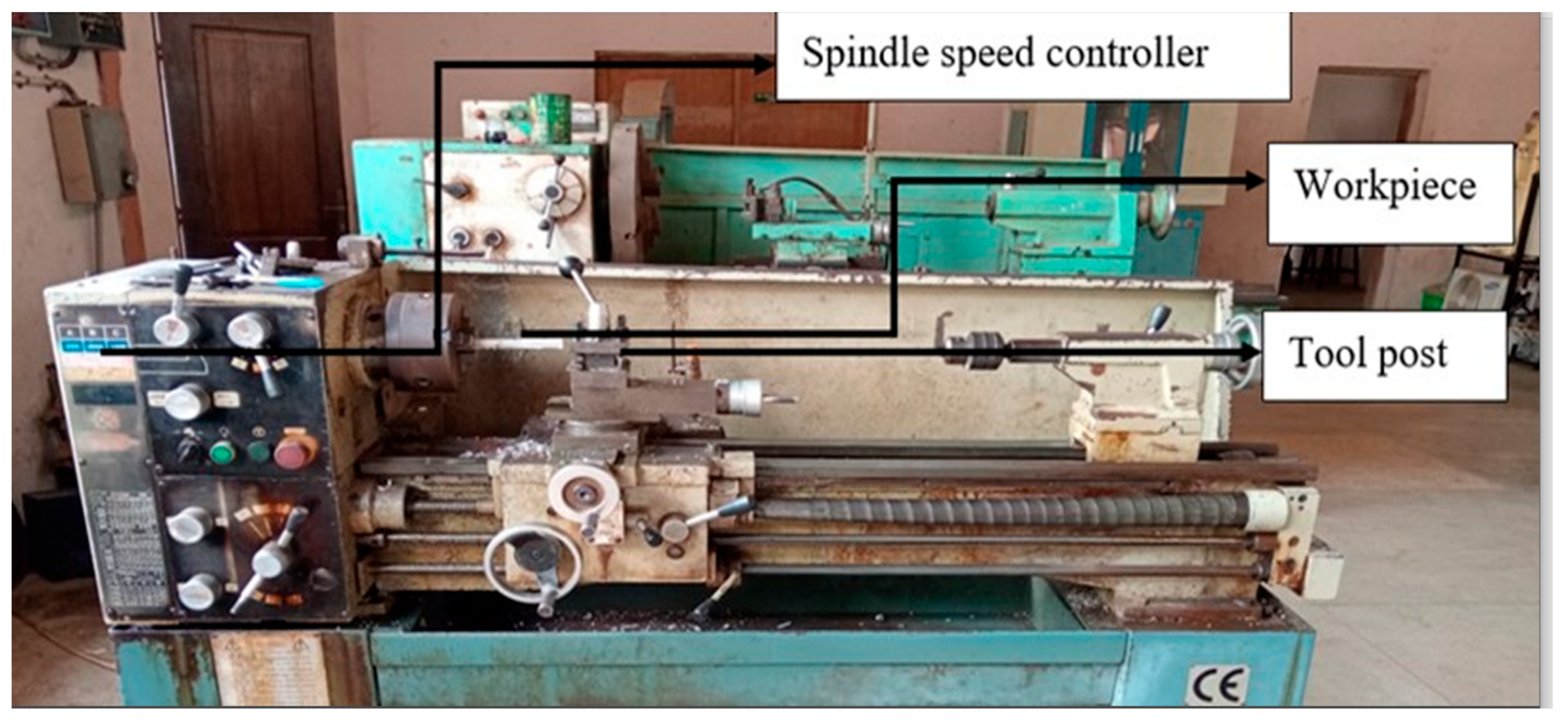
2.5.3. Machine Setup
- 36-inch distance between centres.
- Spindle speed range: 82–2000 rev/min.
- Spindle bore: 38 mm.
- Power: 220 V, single-phase.
- Weight: 645 kg.
2.6. Measurement of Machining Parameters
2.6.1. Cutting Speed
2.6.2. Feed Rate
2.6.3. Depth of Cut
2.6.4. Surface Roughness Measurement
2.6.5. Tool Wear Measurement
2.6.6. Temperature Measurement
3. Results and Discussion
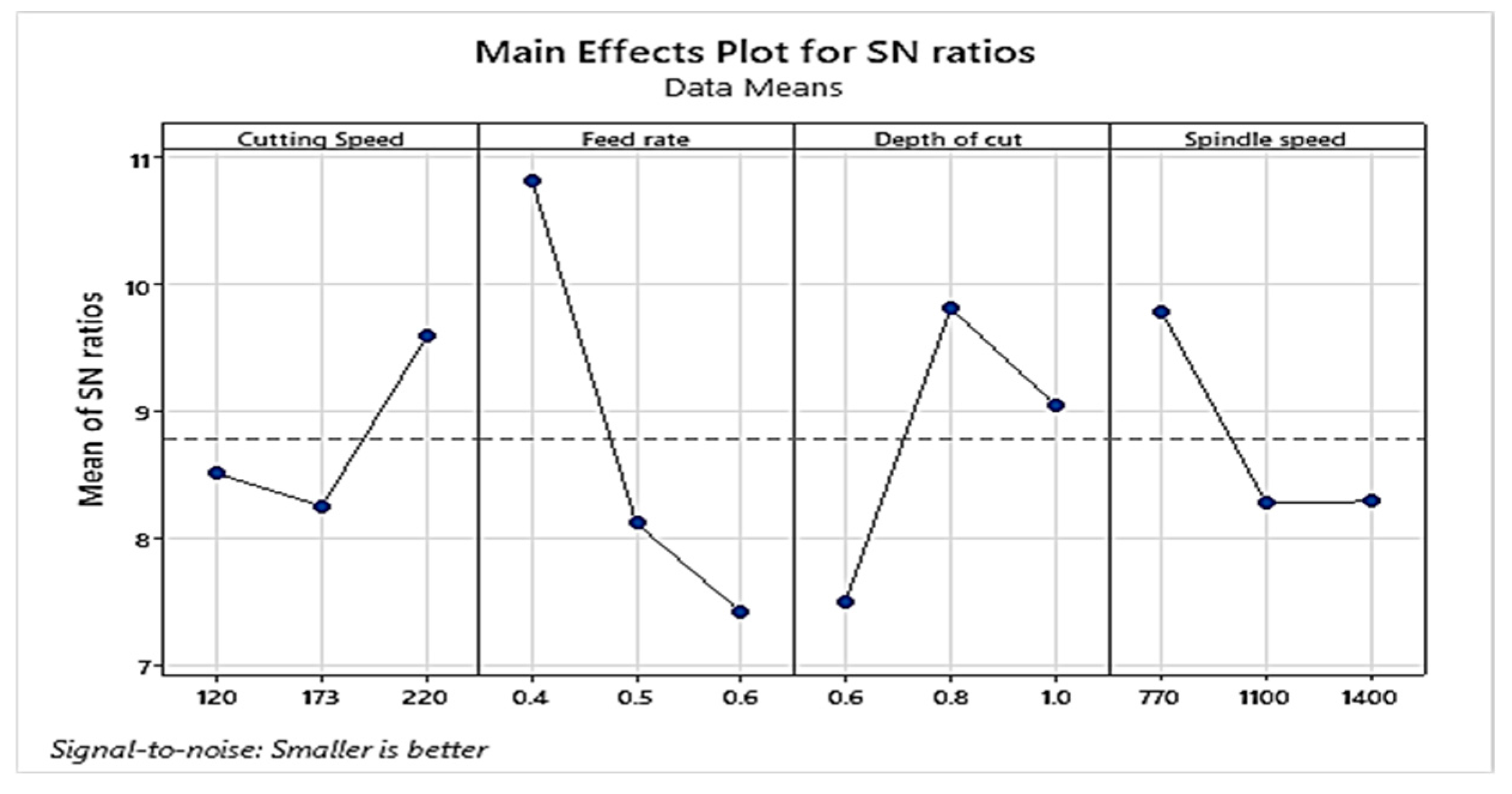
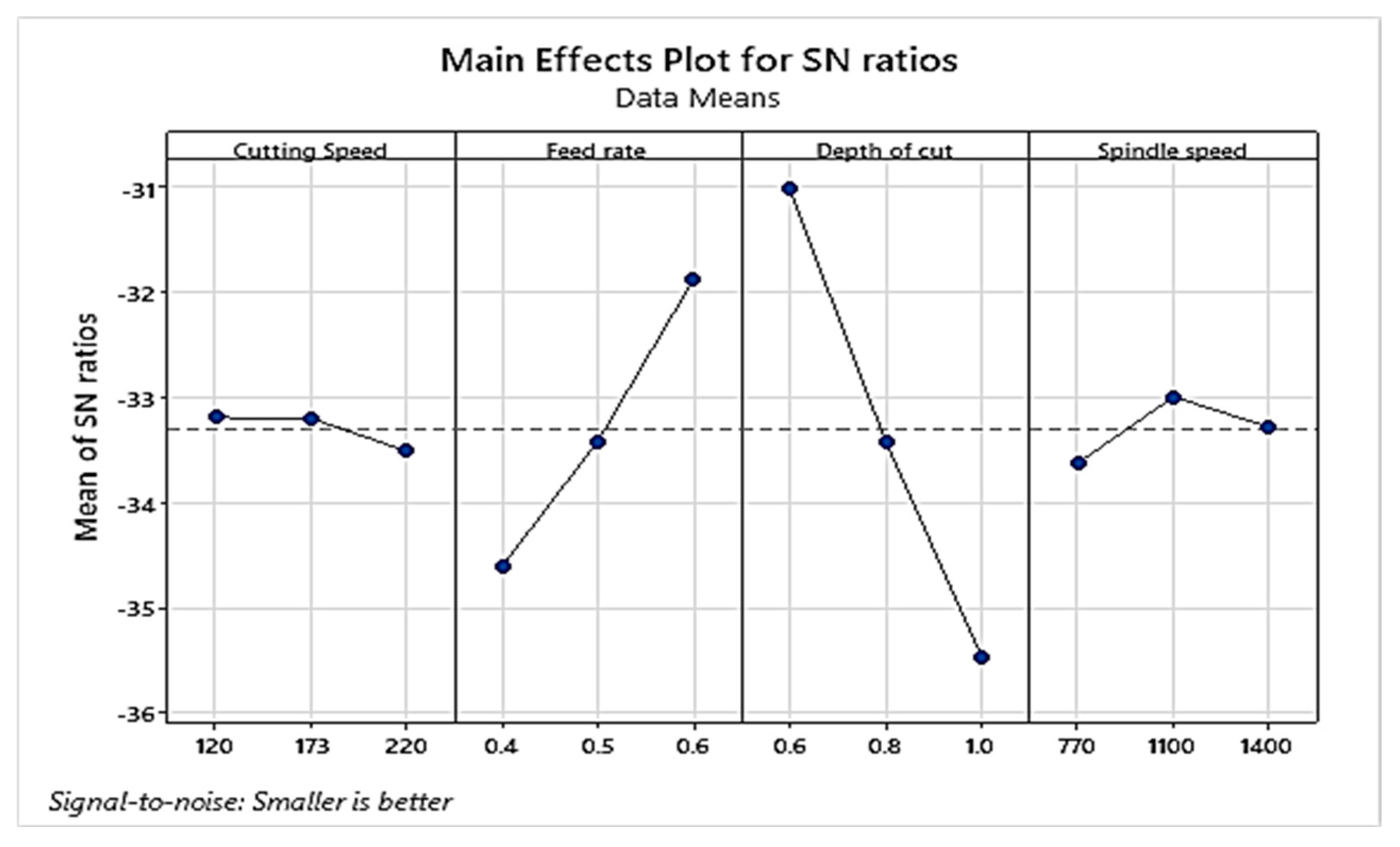
3.1. Taguchi Signal-to-Noise Ratio Analysis
3.2. Analysis of the Experimental Results
3.2.1. ANOVA Analysis for Surface Roughness
3.2.2. ANOVA Analysis for Tool Surface Temperature
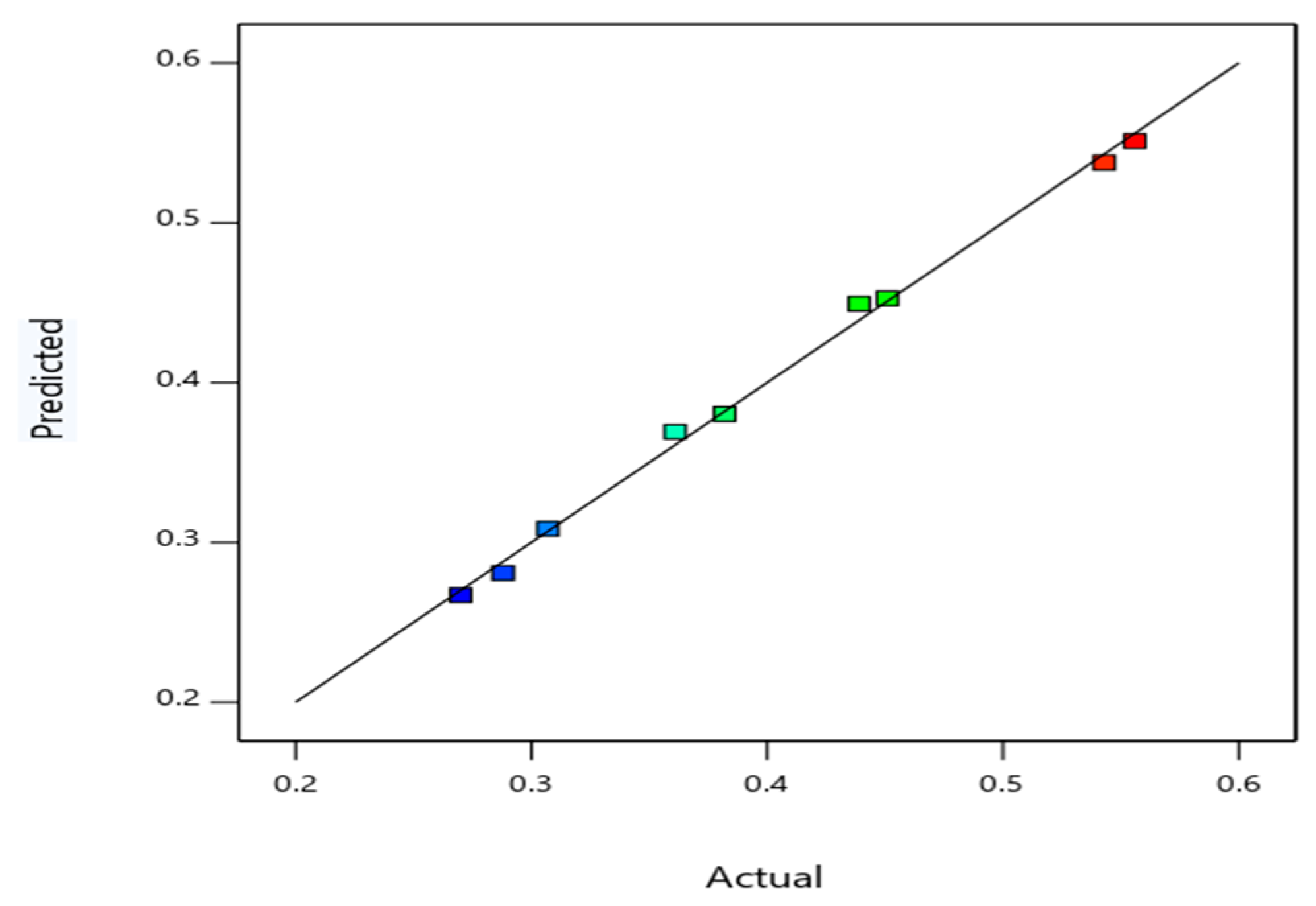
3.2.3. Regression Analysis for Surface Roughness
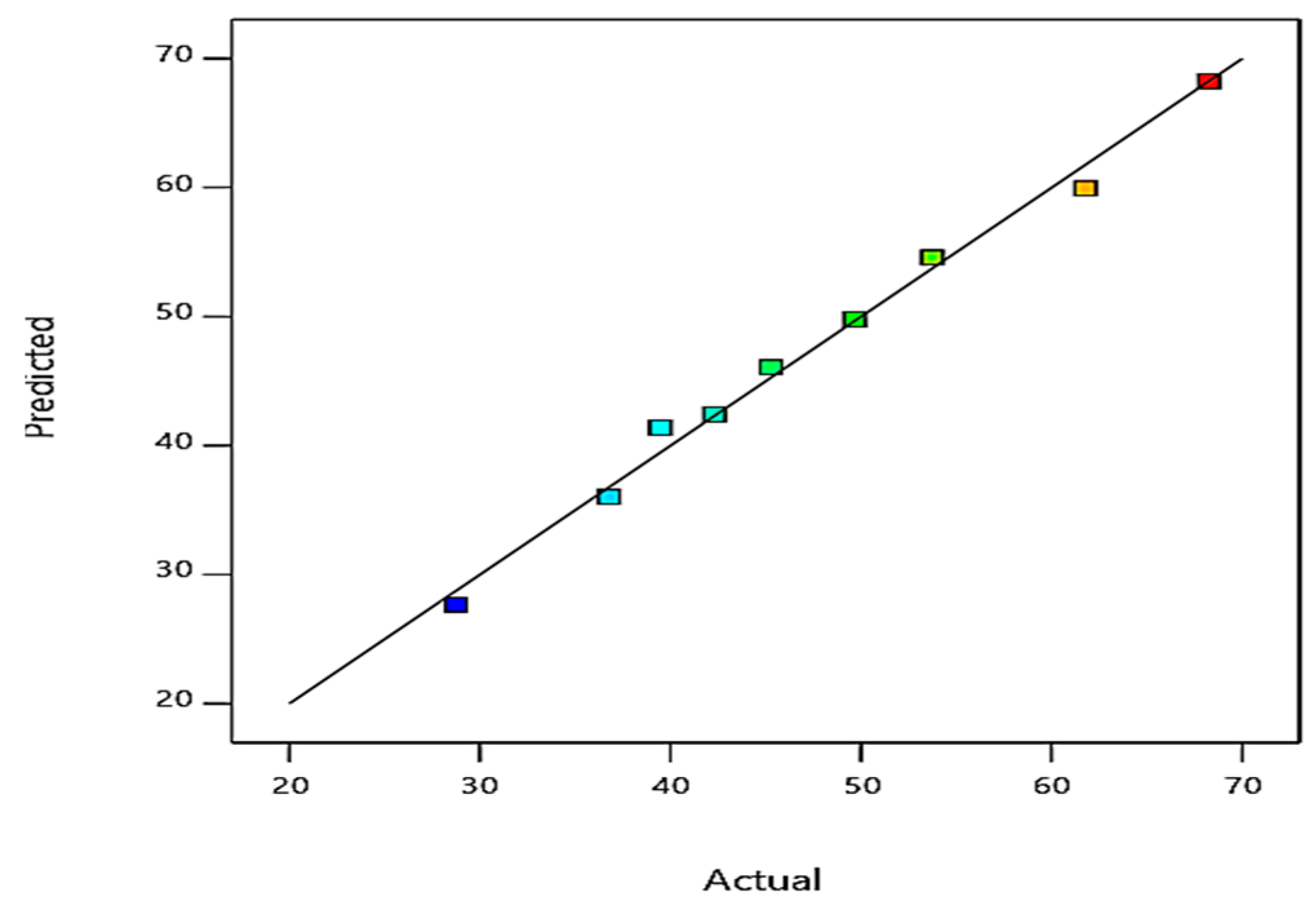
3.2.4. Regression Analysis for Cutting Temperature
3.2.5. Surface Roughness
3.2.6. Cutting Temperature
3.2.7. Quantitative Comparison Between Uco-Cf and Conventional Ccf
3.2.8. Limitations of UCO-CF
4. Conclusions
Author Contributions
Funding
Institutional Review Board Statement
Informed Consent Statement
Data Availability Statement
Acknowledgments
Conflicts of Interest
References
- Abdelrazek, A.H.; Choudhury, I.A.; Nukman, Y.; Kazi, S.N. Metal cutting lubricants and cutting tools: A review on the performance improvement and sustainability assessment. Int. J. Adv. Manuf. Technol. 2020, 106, 4221–4245. [Google Scholar] [CrossRef]
- Dennison, M.S.; Jebabalan, S.K.; Barik, D. Applicability of nano-cutting fluids for enhanced cooling, low tool wear, and high tribological performance during machining—A review. Discov. Appl. Sci. 2024, 6, 663. [Google Scholar] [CrossRef]
- Anyanwu, B.; Olamide, O.; Owoeye, S.; Adekunle, N.; Durodola, F.; Nuga, O.; Ismaila, S.; Aiyedun, P. Performance Evaluation of Selected Animal and Vegetable Oil Based Cutting Fluids in Mild Steel Turning Operation. J. Eng. Res. 2023, 28, 13–23. [Google Scholar] [CrossRef]
- Wu, X.; Li, C.; Zhou, Z.; Nie, X.; Chen, Y.; Zhang, Y.; Cao, H.; Liu, B.; Zhang, N.; Said, Z.; et al. Circulating purification of cutting fluid: An overview. Int. J. Adv. Manuf. Technol. 2021, 117, 2565–2600. [Google Scholar] [CrossRef]
- Rajendran, S.; Al-Samydai, A.; Palani, G.; Trilaksana, H.; Sathish, T.; Giri, J.; Saravanan, R.; Lalvani, J.I.J.; Nasri, F. Replacement of Petroleum Based Products with Plant-Based Materials, Green and Sustainable Energy—A Review. Eng. Rep. 2025, 7, e70108. [Google Scholar] [CrossRef]
- Gan, C.K.; Liew, P.J.; Leong, K.Y.; Yan, J. Biodegradable cutting fluids for sustainable manufacturing: A review of machining mechanisms and performance. Int. J. Adv. Manuf. Technol. 2024, 131, 955–975. [Google Scholar] [CrossRef]
- Wang, W.; Lin, H.; Zhou, M.; Xie, H.; Dai, B.; Han, S. Formulation, characterization, mechanism, and application of vegetable oil-based nano-cutting fluids. Int. J. Adv. Manuf. Technol. 2025, 136, 909–923. [Google Scholar] [CrossRef]
- Rapeti, P.; Pasam, V.K.; Gurram, K.M.R.; Revuru, R.S. Performance evaluation of vegetable oil based nano cutting fluids in machining using grey relational analysis—A step towards sustainable manufacturing. J. Clean. Prod. 2018, 172, 2862–2875. [Google Scholar] [CrossRef]
- Shafi, W.K.; Raina, A.; Haq, M.I.U. Friction and wear characteristics of vegetable oils using nanoparticles for sustainable lubrication. Tribol.-Mater. Surf. Interfaces 2018, 12, 27–43. [Google Scholar] [CrossRef]
- Adlina, M.N.; Kamaleshwaran, T.; Fairuz, M.A.; Azwan, I. A Study of Surface Roughness & Surface Integrity in Drilling Process Using Various Vegetable–Oil Based Lubricants in Minimum Quantity Lubrication. Aust. J. Basic Appl. Sci. 2014, 8, 191–197. [Google Scholar]
- Deshpande, V.; Jyothi, P.N.; Shivaprasad, H.B.; Gouder, V.; Prasad, C.D. Physico-Chemical Properties of Bio-Oils as Cutting Fluids: A Comparative Investigation. J. Bio-Tribo-Corros. 2024, 11, 7. [Google Scholar] [CrossRef]
- Ali, M.M.; Shah, M.A.M.; Alias, S.K.; Pahroraji, H.F.; Abdullah, B.; Hairi, H.M.; Shamsudin, A.H. Arachis Hypogaea’S concentration effect on AISI 1020 carbon steel for corrosion protection. J. Eng. Appl. Sci. 2024, 71, 56. [Google Scholar] [CrossRef]
- Sharma, N.; Sharma, O.; Dewangan, S. Microstructure and Mechanical Behavior of Welded and Heat-Treated AISI 1020 Steel. J. Inst. Eng. Ser. D 2024, 106, 1381–1392. [Google Scholar] [CrossRef]
- Nouioua, M.; Cherfia, A. Monitoring and Optimization of the Machining Process When Turning of AISI 316L Based on RSM-DF and ANN-NGSAII Approaches. Preprint 2022. [Google Scholar] [CrossRef]
- Zerti, A.; Yallese, M.A.; Zerti, O.; Nouioua, M.; Khettabi, R. Prediction of machining performance using RSM and ANN models in hard turning of martensitic stainless steel AISI 420. Proc. Inst. Mech. Eng. Part C J. Mech. Eng. Sci. 2019, 233, 4439–4462. [Google Scholar] [CrossRef]
- Agu, C.; Lawal, S.; Abolarin, M.; Agboola, J.; Abutu, J.; Awode, E. Multi-response optimisation of machining parameters in turning AISI 304L using different oil-based cutting fluids. Niger. J. Technol. 2019, 38, 364. [Google Scholar] [CrossRef]
- Ramya, T.; Venu, M.; Kumar, K.T.S.; Francy, K.A. Influence of Vegetable Oil Based Lubricants with Nano Particles on Surface Roughness of AISI 1020 and AA 2024 Alloy. In Advanced Manufacturing Systems and Innovative Product Design: Select Proceedings of IPDIMS 2020; Springer: Berlin/Heidelberg, Germany, 2021; pp. 163–173. [Google Scholar]
- Naresh, C.; Sameer, M.D.; Bose, P.S.C. Comparative Analysis of RSM, ANN and ANFIS Techniques in Optimization of Process Parameters in Laser Assisted Turning of NITINOL Shape Memory Alloy. Lasers Manuf. Mater. Process. 2024, 11, 371–401. [Google Scholar] [CrossRef]
- Touggui, Y.; Belhadi, S.; Mechraoui, S.E.; Yallese, M.A.; Temmar, M. Statistical Study and Multi-Response Optimization of Cutting Parameters for Dry Turning Stainless Steel AISI 316L Using Cermet Tool. Adv. Eng. Forum 2020, 36, 28–46. [Google Scholar] [CrossRef]
- Nur, R.; Noordin, M.; Izman, S.; Kurniawan, D. Machining parameters effect in dry turning of AISI 316L stainless steel using coated carbide tools. Proc. Inst. Mech. Eng. Part E J. Process. Mech. Eng. 2015, 231, 676–683. [Google Scholar] [CrossRef]
- Ahmad, A.; Akram, S.; Jaffery, S.H.I.; Khan, M.A. Evaluation of specific cutting energy, tool wear, and surface roughness in dry turning of titanium grade 3 alloy. Int. J. Adv. Manuf. Technol. 2023, 127, 1263–1274. [Google Scholar] [CrossRef]
- Akbar, A.A.; Shwaish, R.R.; Hadi, N.D. Study the effect of cutting parameters on temperature distribution and tool life during turning stainless steel 316L. Al-Khwarizmi Eng. J. 2018, 14, 112–122. [Google Scholar] [CrossRef]
- Singh, A.; Sinha, M.K. Multi-Response Optimization During Dry Turning of Bio-Implant Steel (AISI 316L) Using Coated Carbide Inserts. Arab. J. Sci. Eng. 2020, 45, 9397–9411. [Google Scholar] [CrossRef]
- Rodríguez, J.; Muñoz-Escalona, P.; Cassier, Z. Influence of cutting parameters and material properties on cutting temper-ature when turning stainless steel. Rev. Fac. Ing. Univ. Cent. Venez. 2011, 26, 71–80. [Google Scholar]
- Sathishkumar, S.D.; Rajmohan, T. Multi-response optimization of machining parameters in CNC turning of AISI 316L stainless steel using MQL nano fluids. IOP Conf. Ser. Mater. Sci. Eng. 2018, 390, 012049. [Google Scholar] [CrossRef]
- Zaharudin, A.M.; Budin, S. Influence of cutting speed on coated TiCN cutting tool during turning of AISI 316L stainless steel in dry turning process. IOP Conf. Ser. Mater. Sci. Eng. 2019, 505, 012044. [Google Scholar] [CrossRef]
- Prasad, B.S.; Prabha, K.A.; Ganesh Kumar, P.V.S. Condition monitoring of turning process using infrared thermography technique—An experimental approach. Infrared Phys. Technol. 2017, 81, 137–147. [Google Scholar] [CrossRef]
- Borokinni, F.; Bello, K.A.; Bolaji, B.O. Optimization of Machining Parameters in AISI 304 Stainless Steel Using Response Surface Methodology. FUOYE J. Eng. Technol. 2026, 10, 321–325. [Google Scholar] [CrossRef]
- Jeyakumar, S.; Marimuthu, K.; Ramachandran, T. Prediction of cutting force, tool wear and surface roughness of Al6061/SiC composite for end milling operations using RSM. J. Mech. Sci. Technol. 2013, 27, 2813–2822. [Google Scholar] [CrossRef]
- Kilickap, E.; Yardimeden, A.; Çelik, Y.H. Mathematical Modelling and Optimization of Cutting Force, Tool Wear and Surface Roughness by Using Artificial Neural Network and Response Surface Methodology in Milling of Ti-6242S. Appl. Sci. 2017, 7, 1064. [Google Scholar] [CrossRef]
- Meddour, I.; Yallese, M.A.; Bensouilah, H.; Khellaf, A.; Elbah, M. Prediction of surface roughness and cutting forces using RSM, ANN, and NSGA-II in finish turning of AISI 4140 hardened steel with mixed ceramic tool. Int. J. Adv. Manuf. Technol. 2018, 97, 1931–1949. [Google Scholar] [CrossRef]
- Bagaber, S.A.; Yusoff, A.R. Multi-objective optimization of cutting parameters to minimize power consumption in dry turning of stainless steel 316. J. Clean. Prod. 2017, 157, 30–46. [Google Scholar] [CrossRef]
- Jadhav, P.K.; Sahai, R.; Solanke, S.; Gawande, S. Multi-objective optimization of EN19 steel milling parameters using Taguchi, ANOVA, and TOPSIS approaches. J. Alloys Met. Syst. 2024, 7, 100102. [Google Scholar] [CrossRef]



| Parameters/Factors | Units | Experimental Levels | ||
|---|---|---|---|---|
| Cutting speed (Csp) | m/mm | 120 | 173 | 220 |
| Feed rate (Frt) | mm/rev | 0.4 | 0.5 | 0.6 |
| Depth of cut (dct) | mm | 0.6 | 0.8 | 1.0 |
| Spindle Speed (Ssp) | rev/min | 770 | 1100 | 1400 |
| FPC (Run) | Csp (m/mm) | Frt (mm/rev) | dct (mm) | Ssp (rev/min) | SRns (μm) | CTempt (°C) | Twear (mm) | Signal-to-Noise Ratios (S/N) of the Response Parameters | ||
|---|---|---|---|---|---|---|---|---|---|---|
| S-N-SRns (μm) | S-N-CTempt (°C) | S-N-Twear (mm) | ||||||||
| FPC-1 | 173 | 0.4 | 0.8 | 1400 | 0.288 | 53.743 | 0.186 | 10.812 | −34.606 | 14.610 |
| FPC-2 | 220 | 0.4 | 1 | 1100 | 0.270 | 68.263 | 0.201 | 11.373 | −36.684 | 13.936 |
| FPC-3 | 220 | 0.6 | 0.8 | 770 | 0.307 | 42.315 | 0.180 | 10.257 | −32.530 | 14.895 |
| FPC-4 | 120 | 0.4 | 0.6 | 770 | 0.307 | 42.315 | 0.180 | 10.257 | −32.530 | 14.895 |
| FPC-5 | 173 | 0.5 | 1 | 770 | 0.361 | 61.779 | 0.260 | 8.850 | −35.817 | 11.701 |
| FPC-6 | 220 | 0.5 | 0.6 | 1400 | 0.439 | 36.798 | 0.380 | 7.151 | −31.316 | 8.404 |
| FPC-7 | 120 | 0.5 | 0.8 | 1100 | 0.382 | 45.283 | 0.239 | 8.359 | −33.119 | 12.432 |
| FPC-8 | 120 | 0.6 | 1 | 1400 | 0.451 | 49.680 | 0.318 | 6.916 | −33.924 | 9.951 |
| FPC-9 | 173 | 0.6 | 0.6 | 1100 | 0.556 | 28.765 | 0.492 | 5.099 | −29.177 | 6.161 |
| Factors | Units | DF | Average S-N at Different Levels | Contribution Percentage (CP) | Standard Deviation | p-V | ||
|---|---|---|---|---|---|---|---|---|
| 1 | 2 | 3 | ||||||
| Csp | (m/mm) | 1 | 8.511 | 8.254 | 9.594 | 10.11% | ±1 | 0.0059 |
| Frt | (mm/rev) | 1 | 10.814 | 8.12 | 7.424 | 47.53% | ±1 | 0.0001 |
| dct | (mm) | 1 | 7.502 | 9.809 | 9.046 | 27.62% | ±1 | 0.0005 |
| Ssp | (rev/min) | 1 | 9.788 | 8.277 | 8.293 | 11.41% | ±1 | 0.1965 |
| Error | - | 4 | - | - | - | 3.33% | - | |
| Total | - | 8 | - | - | - | 100.00% | - | |
| R2 | 0.9967 | - | - | - | - | - | - | |
| Adj R2 | 0.9934 | - | - | - | - | - | - | |
| Factors | Units | DF | Average S-N at Different Levels | Contribution Percentage (CP) | Standard Deviation | p-V | ||
|---|---|---|---|---|---|---|---|---|
| 1 | 2 | 3 | ||||||
| Csp | (m/mm) | 1 | −33.19 | −33.2 | −33.51 | 1.43% | ±1 | 0.1307 |
| Frt | (mm/rev) | 1 | −34.61 | −33.42 | −31.88 | 26.30% | ±1 | 0.0003 |
| dct | (mm) | 1 | −31.01 | −33.42 | −35.47 | 71.53% | ±1 | 0.0001 |
| Ssp | (rev/min) | 1 | −33.63 | −32.99 | −33.28 | 0.54% | ±1 | 0.4397 |
| Error | - | 4 | - | - | - | 0.21% | - | |
| Total | - | 8 | - | - | - | 100.00% | - | |
| R2 | 0.9918 | - | - | - | - | - | - | |
| Adj R2 | 0.9836 | - | - | - | - | - | - | |
Disclaimer/Publisher’s Note: The statements, opinions and data contained in all publications are solely those of the individual author(s) and contributor(s) and not of MDPI and/or the editor(s). MDPI and/or the editor(s) disclaim responsibility for any injury to people or property resulting from any ideas, methods, instructions or products referred to in the content. |
© 2026 by the authors. Licensee MDPI, Basel, Switzerland. This article is an open access article distributed under the terms and conditions of the Creative Commons Attribution (CC BY) license.
Share and Cite
Bello, K.; Maladzhi, R.; Kanakana-Katumba, M.; Balogun, S. Evaluation of Cooking Oil-Based Cutting Fluid’s Performance on Turning Operation Using Taguchi Approach. Mater. Proc. 2026, 31, 21. https://doi.org/10.3390/materproc2026031021
Bello K, Maladzhi R, Kanakana-Katumba M, Balogun S. Evaluation of Cooking Oil-Based Cutting Fluid’s Performance on Turning Operation Using Taguchi Approach. Materials Proceedings. 2026; 31(1):21. https://doi.org/10.3390/materproc2026031021
Chicago/Turabian StyleBello, Kazeem, Rendani Maladzhi, Mukondeleli Kanakana-Katumba, and Samuel Balogun. 2026. "Evaluation of Cooking Oil-Based Cutting Fluid’s Performance on Turning Operation Using Taguchi Approach" Materials Proceedings 31, no. 1: 21. https://doi.org/10.3390/materproc2026031021
APA StyleBello, K., Maladzhi, R., Kanakana-Katumba, M., & Balogun, S. (2026). Evaluation of Cooking Oil-Based Cutting Fluid’s Performance on Turning Operation Using Taguchi Approach. Materials Proceedings, 31(1), 21. https://doi.org/10.3390/materproc2026031021