
Proceeding Paper

Synthesis, Integration with Textiles, and Application in Sensors of SrMoO4:Ag †

by
Vinícius Prado Corrallo
1,
Vitória Silva Novoa
1,
Noemy Rodrigues Santos
2,
Daniel Tetsuo Gonçalves Mori
2,
Julia Carina Orfão Costa
3,
Rogério de Almeida Vieira
1,
Paulo Henrique Silva Marques de Azevedo
4,
Graça Soares
5,
Roseli Künzel
3 and
Ana Paula de Azevedo Marques
2,*
1
Department of Chemistry Engineering, Federal University of São Paulo, Diadema Campus, São Paulo 09913-030, Brazil
2
Department of Chemistry, Federal University of São Paulo, Diadema Campus, São Paulo 09913-030, Brazil
3
Department of Physics, Federal University of São Paulo, Diadema Campus, São Paulo 09913-030, Brazil
4
Department of Human Movement Sciences, Federal University of São Paulo, Santos Campus, São Paulo 11010-908, Brazil
5
Department of Textile Engineering, Minho University, Azurém Campus, 4800-058 Guimarães, Portugal
*
Author to whom correspondence should be addressed.
Presented at the 23rd International Conference on Advanced Nanomaterials, ANM 2025, Aveiro, Portugal, 23–25 July 2025.
Mater. Proc. 2026, 30(1), 3; https://doi.org/10.3390/materproc2026030003

Published: 9 March 2026
(This article belongs to the Proceedings of The International Conference on Advanced Nano Materials)

Abstract

This study investigates pure and Ag-doped SrMoO4 powders (Sr1−xAgxMoO4, x = 0, 0.01, 0.07), focusing on structural, optical, and functional properties. We evaluate its photocatalytic performance, capacitance response in lactate solution and water, and antimicrobial activity in textiles. The diffraction patterns could be indexed to the pure tetragonal phase SrMoO4. The doping of SrMoO4 with Ag+ ions affects the morphology and particle size of the samples designed by co-precipitation. SrMoO4 pure and Ag+-doped samples exhibited promising results in detecting water and lactate solutions, as well as photocatalysis. Pure SrMoO4 was more efficient in the photodegradation of methylene blue (MB) than the sample doped with Ag+. Among the bactericidal test results, sample SMO:0.01-P4, without light, in S. aureus, and SMO:0.07-P3, with light in E. coli, showed a slight distance from the inhibition halo. These results suggest that the treated textile may possess a characteristic bactericidal capacity that deserves further exploration. This comprehensive analysis offers insights into the structure–function relationship of SrMoO4:Ag and advances the development of multifunctional materials.

1. Introduction

The growing demand for sustainable energy storage and environmental solutions has highlighted the significance of multifunctional materials, particularly scheelite-type molybdates (AMoO4; A = Ca, Sr, Ba, Pb) [1,2,3,4]. Strontium molybdate (SrMoO4) is notable for its exceptional chemical and thermal stability, as well as its optical performance and potential applications in photocatalysis, sensors, and optoelectronics [3,5,6,7]. Photocatalysis is a promising method for environmental remediation, including pollutant degradation and hydrogen generation. However, common photocatalysts such as TiO2 and ZnO are limited in their response to visible light and suffer from rapid charge recombination [8,9,10]. Molybdates present a viable alternative due to their tunable band gaps and low toxicity [2,5,11,12,13,14].
Nevertheless, pure SrMoO4 exhibits poor photocatalytic activity under visible light due to its wide band gap, usually higher than 4.0 eV [14]. To address these issues, the doping of the SrMoO4 compounds with silver (Ag) ions can enhance their visible light absorption and reduce electron-hole recombination, while also introducing luminescent and antimicrobial properties for potential applications in medicine and textiles [12,13]. This study investigates pure and Ag-doped SrMoO4 (Sr1−xAgxMoO4, x = 0, 0.01, 0.07), focusing on its structural, optical, and functional properties. We evaluate its photocatalytic performance, luminescence behavior, and antimicrobial activity, as well as its potential applications in smart textiles and water detection. This comprehensive analysis offers insights into the structure–function relationship of SrMoO4:Ag and advances the development of multifunctional materials.

2. Experimental Procedure

2.1. Synthesis and Characterization of SrMoO4:Ag

The SrMoO4:Ag samples were synthesized using the co-precipitation method associated with a microwave-assisted hydrothermal (MAH) system. For this purpose, molybdenum trioxide (MoO3) was dissolved and added to distilled water under vigorous stirring. The solution pH was adjusted to 12 by adding KOH. Then, the surfactant PEG 400, Sr(C4H6O4), and AgCl were added, according to the defined synthesis conditions. The SrMoO4:Ag reaction mixture was transferred to a silicon carbide vial, and the hydrothermal treatment was performed in microwave equipment, model Monowave 400 (Anton Paar, Graz, Austria). The hydrothermal process (HAM) was carried out under a heating rate of 100 °C min−1, followed by a constant treatment temperature of 100 °C for 16 min and agitation at 600 rpm. After the HAM process, the mixture was centrifuged to separate the resulting white precipitate. This solid was washed with water and ethanol and then dried in an oven at 60 °C for 24 h. SrMoO4 was doped with silver in mol relative to strontium in the proportions Sr1−xAgxMoO4, where x = 0, 0.01, or 0.07. The code P-y was used, where y = 3 or 4, to describe the P synthesis parameters: with HAM and without PEG 400 (P3) and with HAM and with PEG 400 (P4). Hereafter, the samples will be designated as follows: SMO-P3, SMO:0.07Ag-P3, SMO-P4, and SMO:0.01Ag-P4.
The structural, morphological, and optical properties of the pure and doped SrMoO4 powders were analyzed using several characterization techniques. The phase composition and the crystal structure of the designed samples were evaluated using powder X-ray diffraction (PXRD) patterns measured with the use of a STADIP diffractometer (STOE & Cie GmbH, Darmstadt, Germany) in transmission geometry employing a CuKα radiation (λ = 0.15418 nm), and a Ge(111) monochromator, using 40 kV tube voltage and 40 mA tube current. The data scans were collected over the 2θ range from 15 ° to 75 ° with an integration time of 50 s at each 0.015 ° step size, resulting in a total of 5200 data points. The cell parameters and unit cell volumes were calculated using the least-squares refinement REDE93 program. The 2θ, height, and FWHM (Full Width at Half Maximum) values was were estimated using the (112), (004), (200), (202), (114), (204), (220), (116), and (312) diffraction peaks of the SrMoO4 phase using the second derivative mode of the OriginPro 2025 program. The particles’ morphologies and sizes were observed using a scanning electron microscope (SEM; Jeol JSM-6610LV, Jeol, Akishima, Tokyo, Japan) The Raman spectra provides a unique chemical fingerprint of materials, revealing information about their chemical structure, phase, and crystallinity. The data were recorded in the range of 300 to 1000 cm−1 using a Raman Renishaw microscope (Renishaw plc, Wotton-under-Edge, Gloucestershire, UK), InVia model, with a multichannel CCD detector and a He-Ne laser (632.8 nm) set to 0.17 mW at the sample. The automatic cosmic ray removal option was on during the measurements. Fourier-transform infrared (FTIR) spectra furnish information about molecular bonds and functional groups that exhibit a permanent dipole moment, offering valuable insights into the structures of the designed samples. The FTIR spectra from the SrMoO4 powders were registered on a Shimadzu IR Prestige-21 spectrophotometer, using 120 scans and a spectral range of 400–1000 cm−1. The FTIR spectra were smoothed using a Savitzky–Golay filter before calculating the second derivative. The adopted smoothing procedure was based on the Savitzky–Golay filtering, which involves local least-squares fitting of the data using polynomials. In this work, we adopted a 5-point window and a third-order polynomial fit coefficient for smoothing the FTIR spectra of all the samples. The second derivative was applied to evaluate changes in the FTIR profile induced by silver ion doping and overlapping of vibration bands [15]. The optical absorbance from the pure and doped SrMoO4 powders were recorded on a Shimadzu UV-2600 spectrophotometer (Shimadzu Corporation, Kyoto, Japan) in the wavelength range of 200 to 800 nm with a spectral resolution of 0.1 nm. The conversion of the absorbance spectra from a wavelength scale to an energy scale was performed using the Jacobian conversion method [16]. The bandgap energy was determined from the absorbance spectra using the Tauc relation [17,18]. All measurements were performed at room temperature.

2.2. Photocatalytic Performance of SrMoO4 Samples for the Degradation of the Methylene Blue (MB) Molecule

The photocatalytic degradation of a methylene blue (MB) solution at a concentration of 10−5 mol L−1 was monitored using a Shimadzu UV-2600 spectrophotometer. In this experimental setup, 0.05 g of the photocatalyst (SrMoO4 sample) was added to 50 mL of the MB solution. The photocatalytic system, identified as either SMO-P4, SMO:0.01-P4, or SMO:0.07-P3, was maintained under agitation inside the photoreactor in the dark for 20 min. Following this, a 2 mL aliquot was taken from the stirred solutions, which were subsequently illuminated with 100 W white-light LED lamps. The photocatalytic activity was monitored over a period of 180 min, with 2 mL aliquots collected every 20 min. At the conclusion of this duration, the mixture was centrifuged at 13,000 rpm for 10 min to separate the photocatalyst. The aliquots were then analyzed in the UV-vis region using the Shimadzu spectrophotometer, where the intensity of the MB absorption band was employed to quantify the residual dye.

2.3. Sensory Response of SrMoO4 Samples to Water and Lactate

To evaluate the sensory response of SrMoO4 powders to water and lactate molecules, the powders were transformed into pellets to measure capacitance changes. A hydraulic press applied a pressure of 1.5 tons for 25 min to form the pellets. Thereafter, the pellets were submitted to heat treatment at 600 °C for 2 h, with a heating rate of 5 °C min−1. The pellets were then subjected to two distinct environments: pure moisture mist and lactate solution mist. For the capacitance measurements, an ANDEEN-HAGERLING 2700A (ANDEEN-HAGERLING, INC., Cleveland, OH, USA), precision instrument was utilized. All data were collected after the standard 25 min exposure to moisture using a vaporizer. After this period, the vaporizer was switched off, and a series of capacitance values associated with variations in the material’s response to the environment was recorded.

2.4. Textile Integration of SrMoO4 Samples

The study used the integration of five different dispersions into a textile matrix to investigate the bactericidal activity of the modified fabrics. An untreated textile was used as a control (T1). SMO:0.01Ag-P4 and SMO:0.07Ag-P3 were used to formulate dispersions with chitosan (CHI), citric acid (CA), and Tween 80 (TWEEN). The first dispersion containing CHI, CA, and TWEEN was used to coat the textile (T2). The remaining textiles were obtained by incorporating the Ag-doped powders and are named as follows: T3 (two variants)—(a) CHI + CA + TWEEN matrix + SMO:0.01Ag-P4 and (b) TWEEN matrix + SMO:0.01Ag-P4. T4 (two variants)—(c) CHI + CA + TWEEN matrix + SMO:0.07Ag-P3 and (d) TWEEN matrix + SMO:0.07Ag-P3. The dispersions were produced according to the method of Sarwar et al. [19]. The modified textiles were characterized by FEG-SEM, FTIR, and UV–vis spectroscopy. Antibacterial activity was evaluated using the inhibition halo test against Escherichia coli and Staphylococcus aureus, with exposure for 20 min under commercial LED light and in the dark.

3. Results and Discussions

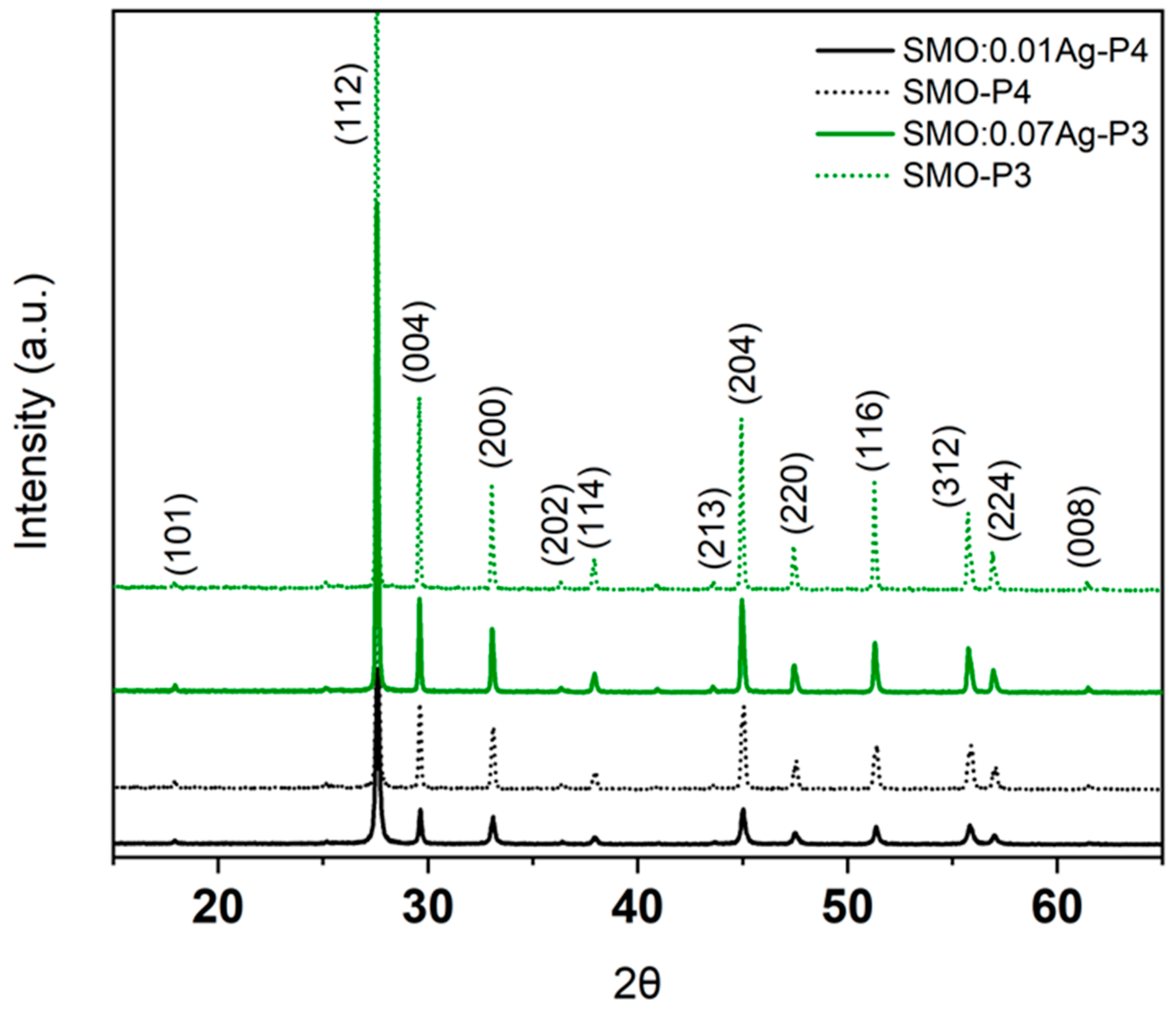
Figure 1 shows the X-ray diffraction patterns for pure and silver-doped SrMoO4 samples, synthesized by co-precipitation using hydrothermal treatment. One set of samples was designed using polyethylene glycol (PEG 400), while another set of samples was prepared without PEG 400. The registered XRD patterns are used to identify the crystal structure of SrMoO4:Ag samples, and the observed diffraction peaks can be indexed to the SrMoO4 scheelite-type (tetragonal structure) with the space group I41/a, which is in complete agreement with JCPDS card #08-0482.5. All samples exhibit well-defined peaks characteristic of the tetragonal scheelite structure, indicating that the incorporation of silver ions, even at high doping levels, does not compromise the material’s phase purity. This finding is significant for potential applications of SrMoO4.
Table 1 shows the lattice parameters, unit cell volume, and mean crystallite size (Dcrys) for SrMoO4:Ag powders. The computed lattice parameters were found to be similar among the samples and are in good agreement with those reported in JCPDS #08-0482.
The mean crystallite size (Dcrys) was estimated using the (112) diffraction peak, which is centered at 27.6° (2θ) for each sample, as depicted in Table 1. The peak height and FWHM values for nine significant peaks in the X-ray diffraction (XRD) data were analyzed using OriginPro software 2024b, with the results outlined in Table 2. The findings indicate a consistent decreasing trend in the peak heights, following this order: SMO-P3, SMO:0.01Ag-P3, SMO-P4, and SMO:0.07Ag-P4. In contrast, the FWHM values exhibited an increasing trend in the same sequence. The 2θ values for all samples were found to be comparable, suggesting a similarity in their crystallographic structures [20,21].
The comparison between samples synthesized with PEG 400 (P4) and those without PEG 400 (P3) reveals that the polymeric additive has a significant influence on crystallinity (Table 1). The samples designed with PEG 400 (SMO-P4 and SMO:0.01Ag–P4) exhibit smaller crystallite sizes (Table 1), as well as lower intensities (height values) and higher FWHM (Table 2). This enhancement is assigned to the role of the PEG capping agent, which affects nucleation and kinetic growth during the hydrothermal synthesis process. Regarding the silver doping, the sample doped with 1% Ag ions (SMO:0.01Ag–P4) shows a pattern with peak shapes and positions that closely resemble those of the undoped sample, suggesting minimal lattice distortion. On the other hand, the higher-doped sample (SMO:0.07Ag–P3) presents slightly broadened peaks, likely due to the introduction of lattice defects, microstrain, or smaller crystallites.
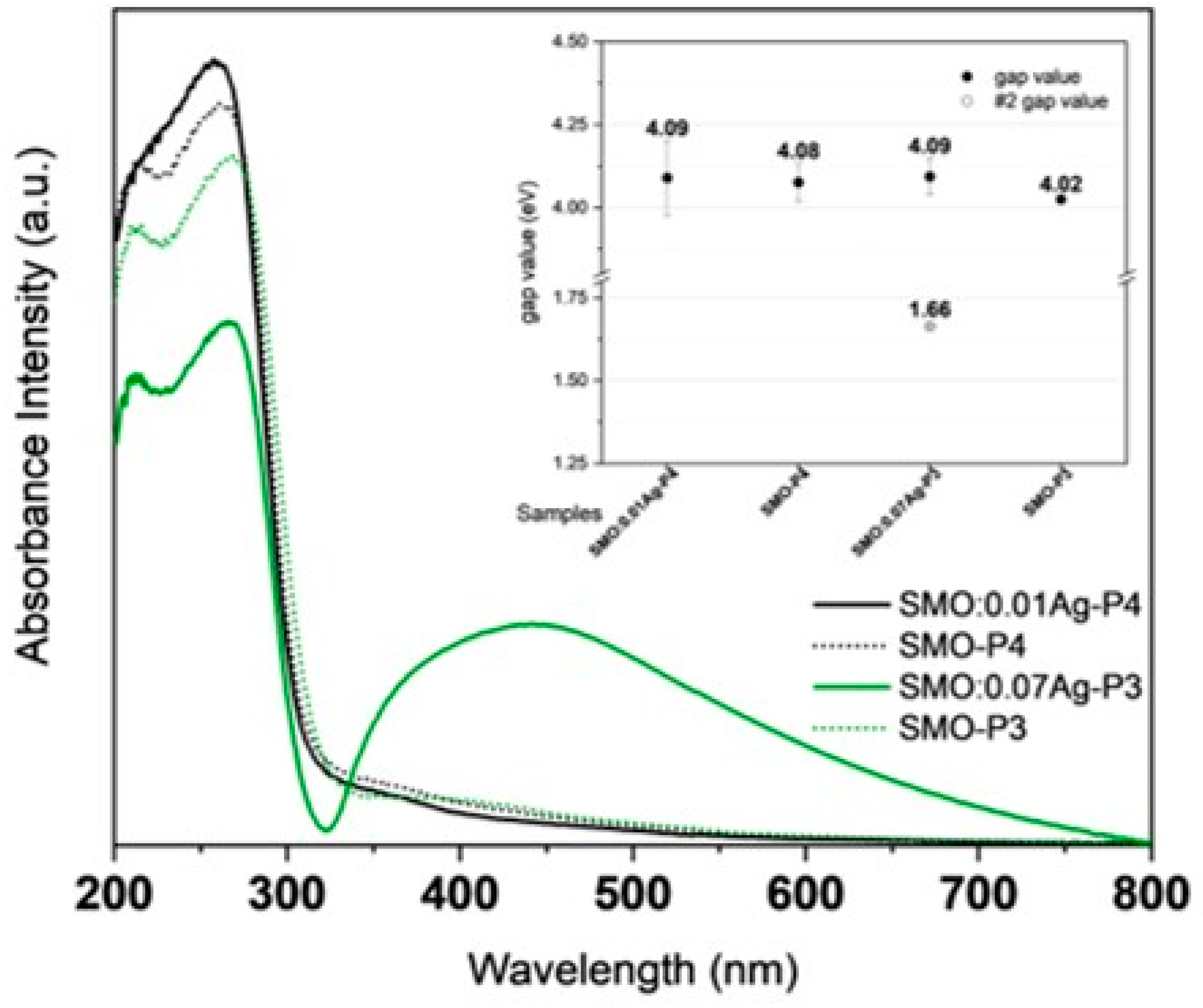
Figure 2 displays the UV-Vis spectra and the computed band gap values for each sample. The UV-Vis spectra show two regions, between 300 nm and 200 nm, with maximum absorption at 214 nm and 258 nm, that can be assigned to the electronic transitions of the [MoO4]2− group [20]. Although only SMO:0.07-P3 exhibits an absorption band around 450 nm, we cannot associate it with the dopant. In other studies, using pure molybdates, we also observed the same characteristic absorption profile, which suggests that the band can be attributed to crystalline defects caused by the dopant and silver ions and to the pressure and heating employed during the hydrothermal treatment [22]. The analysis of bandgap energy, determined using the Tauc relation, indicates that hydrothermal treatment results in a band gap value between 4.09 eV and 4.02 eV; however, this variation does not have values with significant differences. The SMO:0.07-P3 presented an additional band gap, located around 1.66 eV, attributed to crystalline defects caused by Ag+ doping and hydrothermal treatment [22].
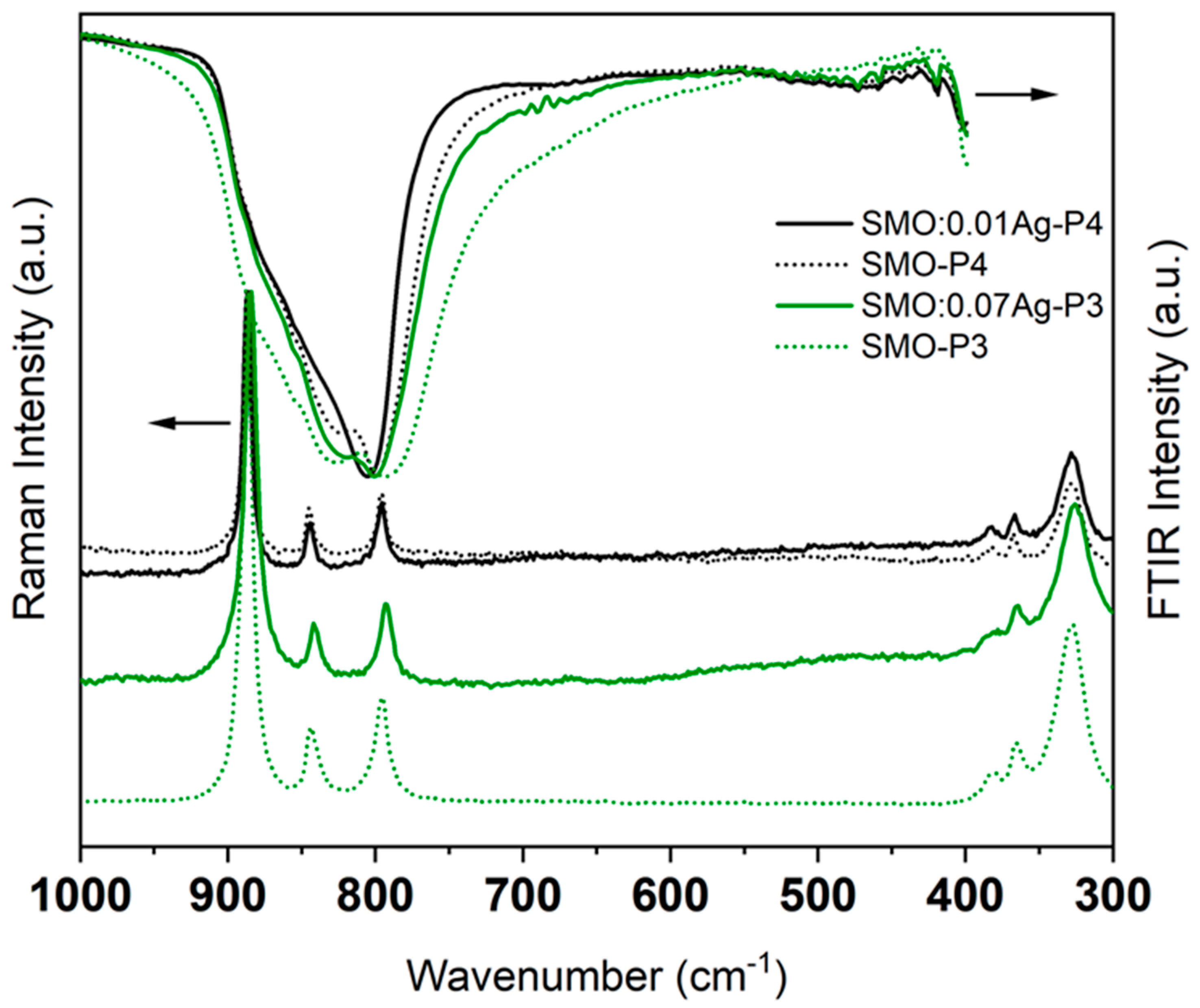
Figure 3 depicts the Raman and FTIR spectra from pure and Ag+ ion-doped samples. The FTIR spectra show the F2(ν3) mode between 750 and 890 cm−1 and are related to the antisymmetric Mo-O stretching vibration in [MoO4]2− tetrahedra. The vibrational mode Au(ν4) of the Mo-O vibrations, low-intensity stretch, occurs around 404 cm−1 or lower; however, the vibration modes found in the wavenumber values lower than 400 cm−1 were not detected due to the detection limit of the employed FTIR equipment [20,23].
The Raman spectra illustrated in Figure 3 display the characteristic vibrational modes of scheelite-type SrMoO4. The band observed around 880–900 cm−1 corresponds to the ν1 symmetric stretching mode of the Mo–O bonds, while additional bands between 400 and 300 cm−1 are attributed to the bending (ν2, ν4) and asymmetric stretching (ν3) of the [MoO4]2− tetrahedra [20]. The sample submitted to hydrothermal treatment, identified by the P4 code, as observed in Figure 3 and Table 3, shows sharper and better-resolved internal modes, indicating improved crystallinity and reduced structural disorder. In contrast, the samples designed without hydrothermal treatment (P3) exhibit broader and less defined peaks, indicating a higher defect density. The Ag doping at low concentration (SMO:0.01Ag-P4) does not significantly affect the Raman modes, suggesting that silver incorporation at low concentrations does not distort the tetrahedral structure. However, higher Ag (SMO:0.07-P3) results in broader Raman bands, which are compatible with higher lattice disorder and the shift to lower wavenumber values. The bands positions indicate that the hydrothermal treatment preserves short, well-ordered Mo–O bonds [24]. The doping with Ag ions, without PEG400 surfactant, causes a slight Mo–O bond length increase, consistent with increased local disorder.
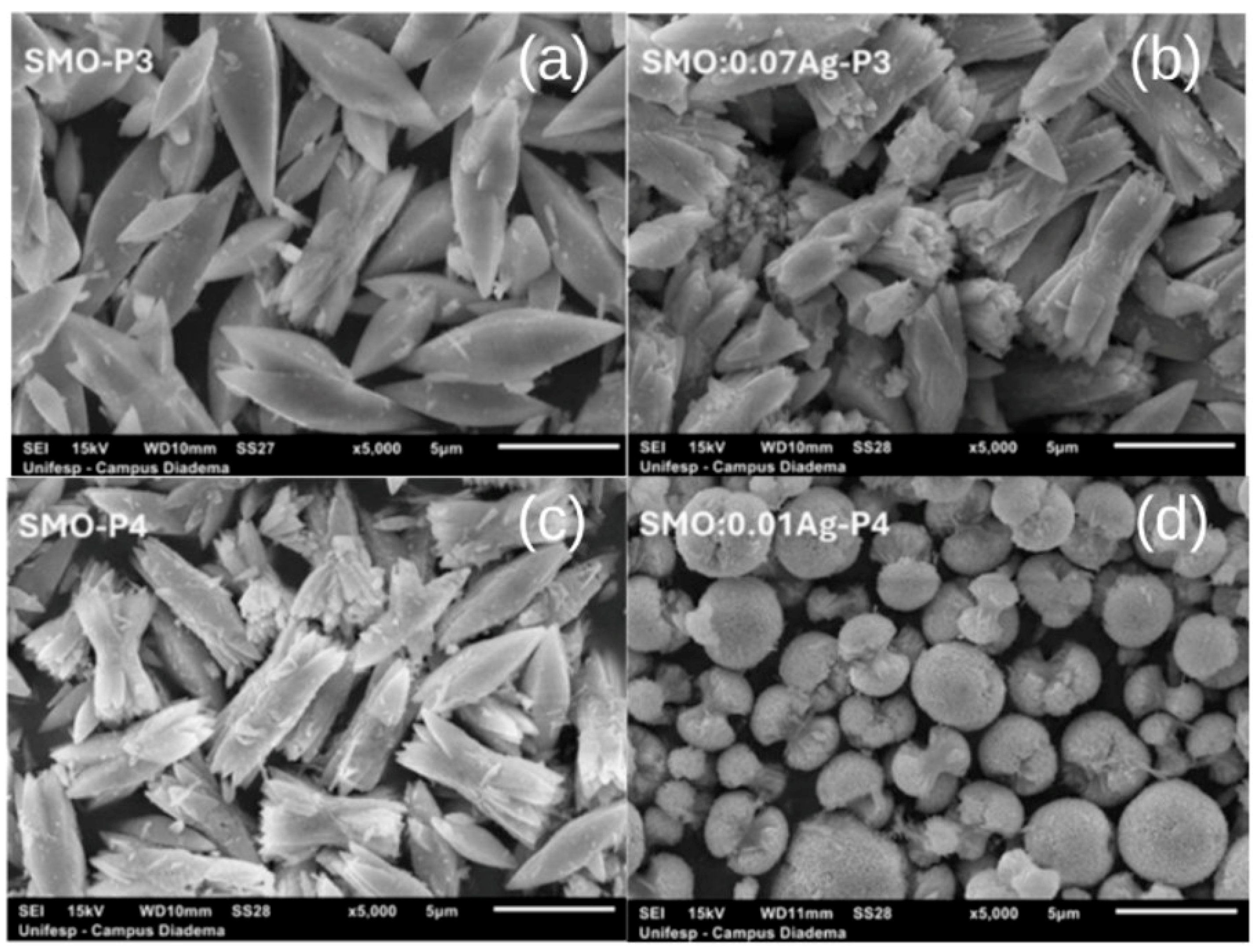
The micrographs of the SrMoO4 samples exhibit octahedral morphologies, as expected. Materials doped with Ag+ ions and produced using PEG-400 surfactant tend to form pompom-shaped agglomerates, an arrangement that promotes the decrease in surface energy caused by the addition of the silver dopant, which has an ionic charge different from that of the substituted element. The pure SMO-P4 material, processed with PEG-400 surfactant, exhibits a change in the octahedral morphology compared to SMO-P3, which was not produced using surfactant. These differences demonstrate that the dopant ion and the surfactant cause surface modifications in the particle structure, which agglomerate and form different arrangements (Figure 4a–d), resulting in different particle types and defect levels [25].
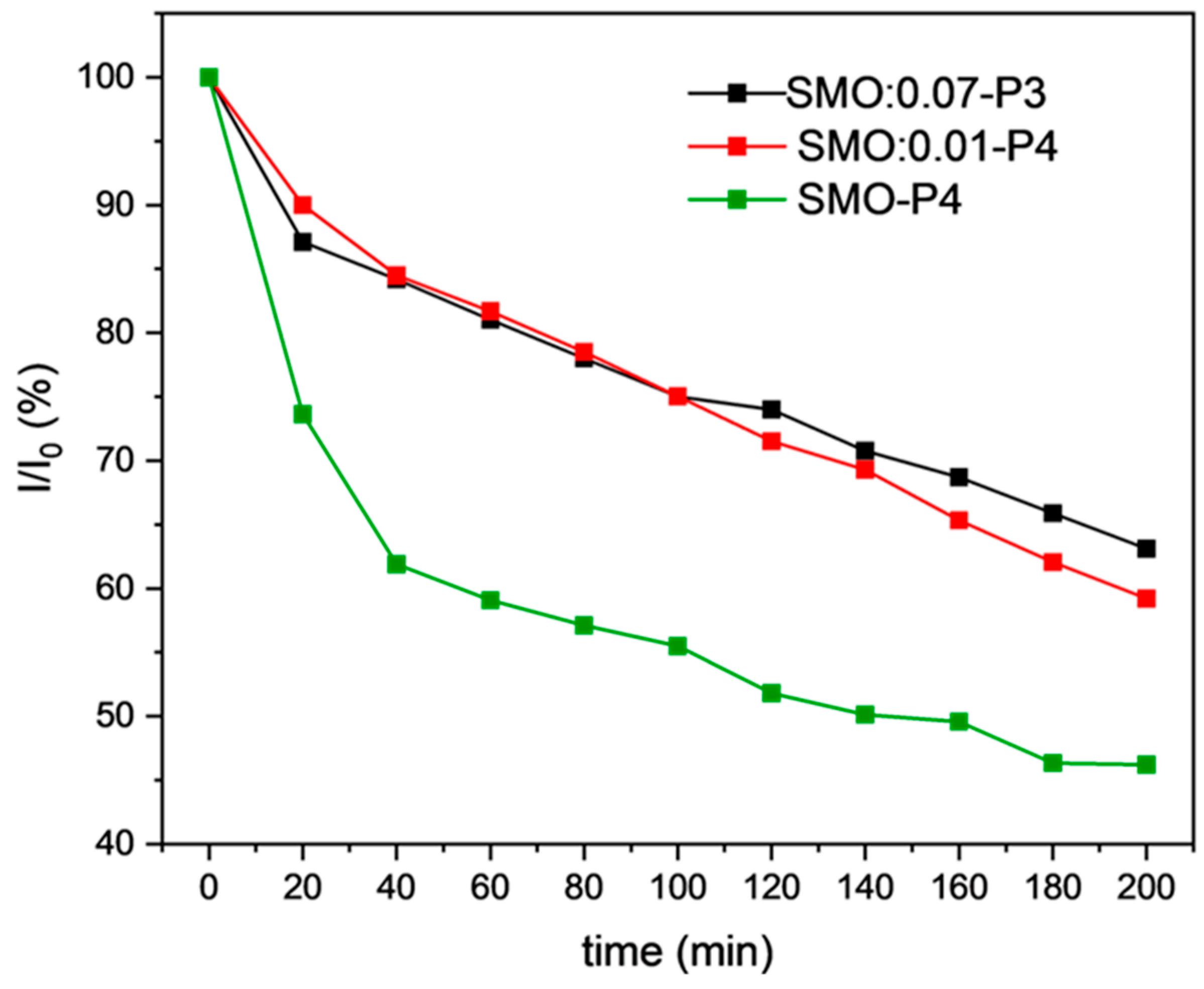
The photocatalytic degradation of methylene blue (MB) exhibits a distinct dependence on the synthesis route and the presence of Ag dopants, as evidenced in Figure 5. The system is kept in the dark for 20 min, after which the commercial LED lamp is turned on and the photocatalytic study is conducted. Considering the MB degradation yield, the interaction process between the substrate and the photocatalyst is a mandatory step. At 20 min, the SMO-P4 system showed a 26% decrease in MB concentration compared to its initial concentration, while the SMO:0.07-P3 and SMO:0.01-P4 systems showed decreases of 13% and 10%, respectively. Among the investigated samples, SMO-P4 showed the highest photocatalytic efficiency, with the MB concentration decreasing to approximately 45% of the initial value after 200 min. The decreases in the MB concentration in the SMO:0.07-P3 and SMO:0.01-P4 systems were 63% and 59%, respectively.
This prominent performance can be attributed to the improved crystallinity and reduced defect density provided by the PEG400 additive, which favors the interaction stage between the substrate and the SrMoO4 surface. The sample designed with PEG400 and doped with a low Ag content (SMO: 0.01Ag-P4) showed intermediate activity, achieving approximately 55% of the initial MB concentration at the same irradiation time. Although Ag can introduce defect states and enhance light absorption, it also promotes recombination tracks that partially suppress the photocatalytic activity compared to undoped material. The lowest photocatalytic efficiency was observed for SMO:0.07Ag-P3, which was synthesized without PEG400 and contained a higher Ag concentration. In this case, structural disorder combined with Ag aggregation induces recombination centers, significantly limiting photocatalytic activity and resulting in approximately 40% degradation of MB after 200 min. Overall, these results highlight that hydrothermal synthesis and the use of PEG400 are important factors driving photocatalytic performance in SrMoO4. In contrast, Ag doping under the studied conditions does not enhance activity and can even be detrimental when incorporated at higher concentrations or without the use of the capping agent PEG400.
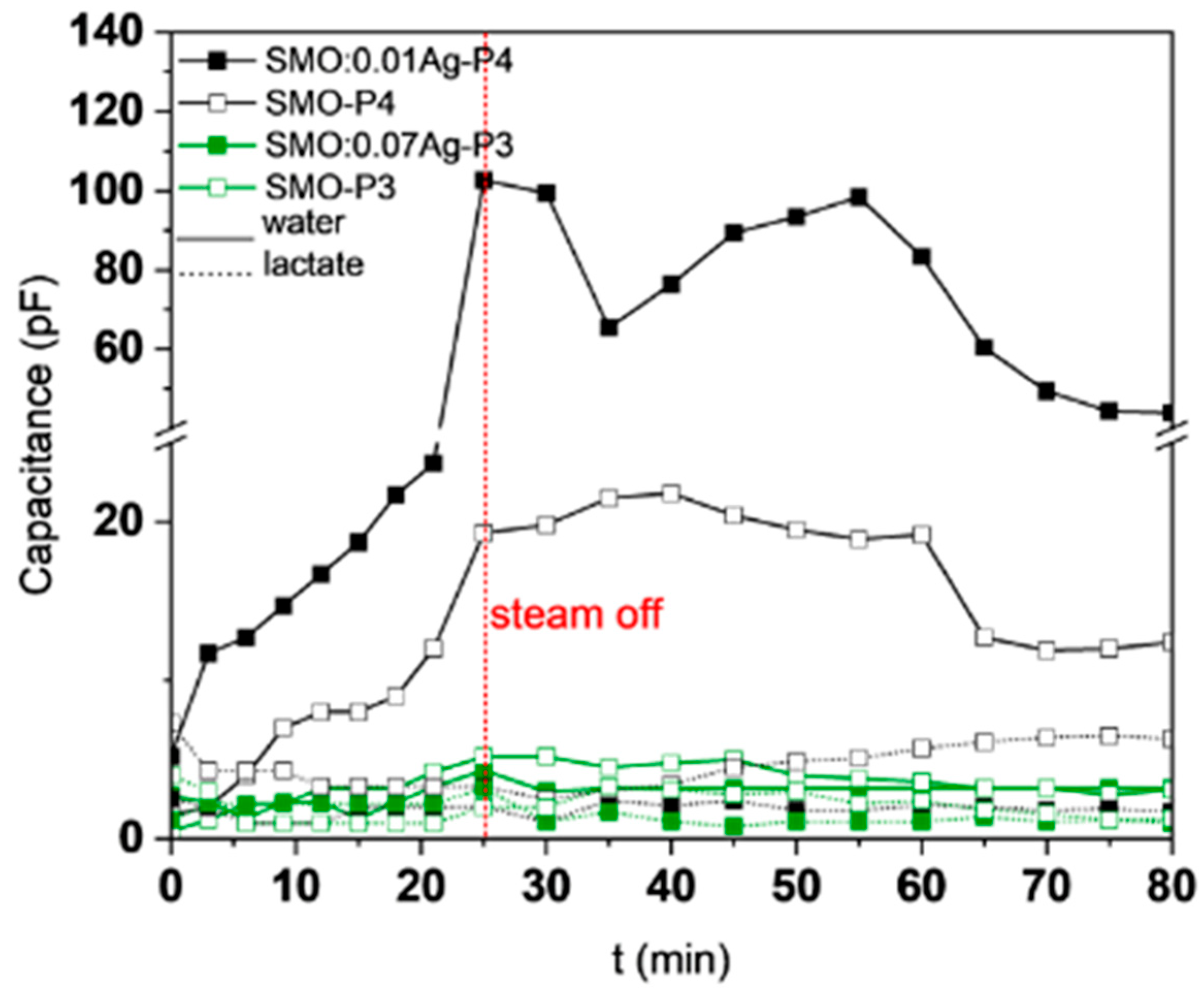
Figure 6 shows the change in capacitance value over time during steam exposure. The measurements were performed to understand the behavior of the designed materials under humid environments and to evaluate the response of the samples in contact with water vapor and lactate. The capacitance variation in the SrMoO4 samples under steam environmental conditions indicates a strong dependence on the synthesis route and silver doping content. The results suggest that PEG400 (P4) improves the material sensitivity compared to the samples designed without PEG400 (P3). In particular, the SMO:0.01Ag-P4 sample shows the most pronounced response during water vapor exposure, with capacitance increasing sharply to ~120 pF and then slowly decaying after the vapor is removed (after 25 min). The undoped SMO-P4 sample also exhibits a notable increase in capacitance, reaching a value of approximately 20–25 pF, which demonstrates that the use of PEG400 enhances the dielectric capacity of the SrMoO4 samples.
On the other hand, the samples prepared without PEG400 exhibit a low variation in capacitance values with water vapor exposure, indicating minimal sensitivity to the vapor. This result suggests that the structural modifications induced by the additive facilitate efficient interfacial polarization. The introduction of a small amount of Ag in SrMoO4 (SMO:0.01Ag-P4) and PEG enhances the material’s response, likely due to the shallow defect states that potentially act as adsorption sites for water molecules, thereby increasing polarization under humid conditions. In the samples designed without PEG400, the results suggest that the combination of structural disorder and excessive Ag aggregation inhibits the polarization and suppresses the material’s dielectric response. Regarding the use of a sensor that differentiates the lactate solution (artificial sweat) from pure water, the system whose molybdate is obtained using the PEG400 surfactant with low concentrations of the silver dopant is more efficient, since the capacitance response between the analyzed systems is quite different. Overall, the results demonstrate that the use of PEG400 is essential for activating the dielectric response of SrMoO4 powders, and low-level Ag doping under these conditions maximizes the sensitivity of the response.
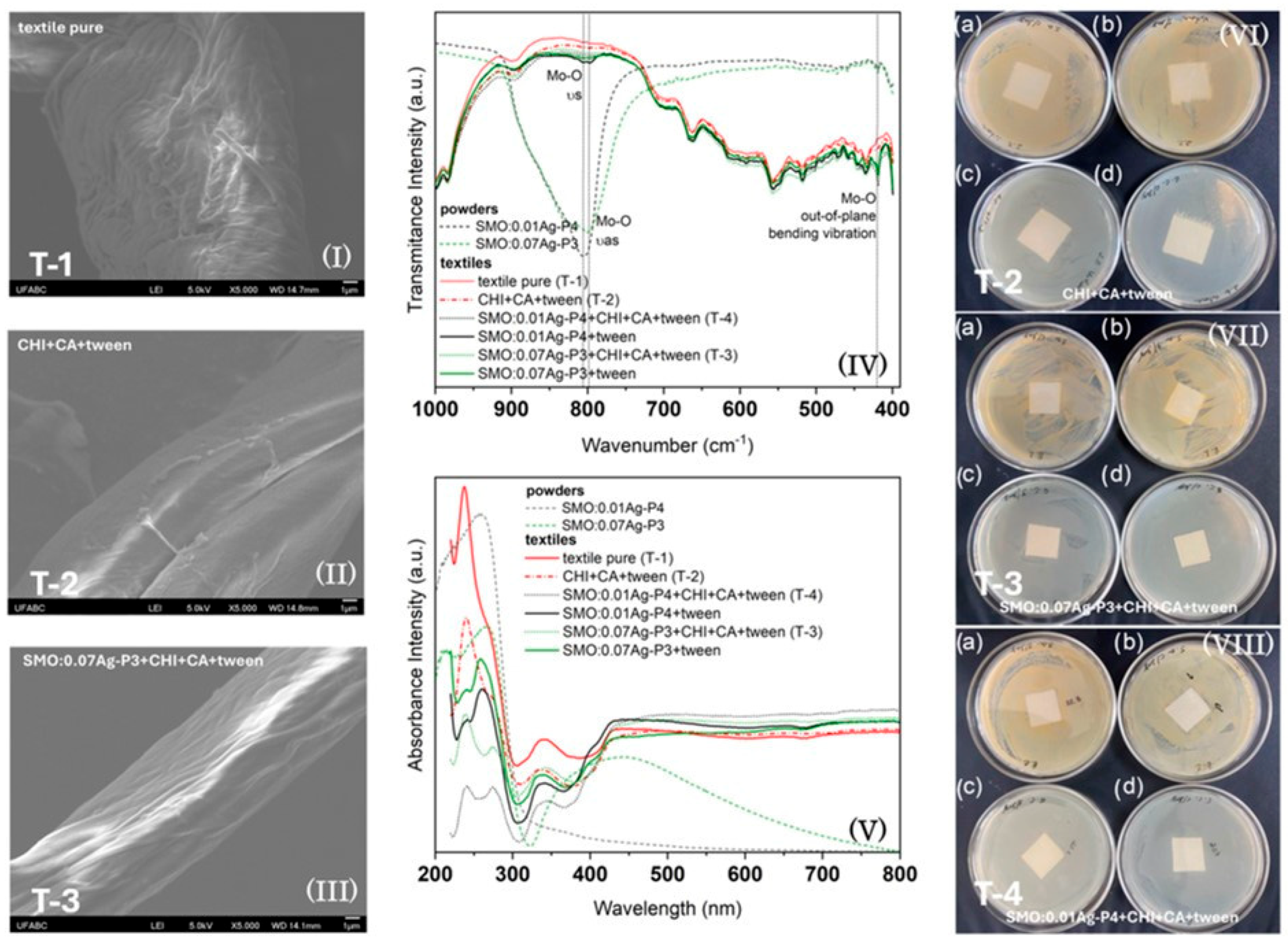
Figure 7 presents several results for textile samples of this study, namely pure textile (T-1), textile treated with chitosan, citric acid and tween 80 (T-2), textile treated with chitosan, citric acid, tween 80 and SMO:0.07Ag-P3 (T-3), and textile treated with chitosan, citric acid, tween 80 and SMO:0.01Ag-P4 (T-4). SEM images of textile fibers, pure (T-1) and subjected to different surface treatments (T-2 and T-3), are illustrated in Figure 7I–III. Figure 7I corresponds to the pure textile sample (T-1), showing the natural fibrous morphology with relatively smooth surfaces. Figure 7II displays the textile after coating with chitosan (CHI), citric acid (CA), and tween 80 (T-2), where the fiber surface becomes more homogeneous and coated, indicating the formation of a polymeric layer. Figure 7III shows the textile after incorporating SMO:0.07Ag-P3 nanoparticles in combination with chitosan, citric acid, and tween 80 (T-3), where the fibers appear to be covered with a continuous layer containing the oxide particles, suggesting adequate adhesion of the particles to the textile structure. This morphological evidence highlights the role of polymeric additives in promoting strong interaction between the oxide particles and the textile fibers.
The FTIR spectra (Figure 7IV) confirm the coexistence of both textile-related functional groups and SrMoO4 vibrational modes after integration. The characteristic Mo–O stretching (~850–900 cm−1) and bending (~400–500 cm−1) vibrations are clearly observed in the coated textiles, overlapping with the signals of the polymer matrix. Additional bands associated with chitosan and citric acid confirm the presence of the organic modifiers, suggesting the formation of a hybrid organic–inorganic interface. The preservation of the Mo–O vibrational features indicates that the crystal structure of SrMoO4 is maintained after immobilization in T-3 and T-4 textile samples [20,23].
The UV–Vis spectra (Figure 7V) further support the successful functionalization of textiles with SMO:Ag powders. Compared to pure textiles, which exhibit only weak absorption in the UV region, the coated textiles display strong absorption edges characteristic of SrMoO4, occurring around 300–350 nm [20,23]. Notably, the presence of Ag-doped SrMoO4 slightly extends the absorption into the visible region, which is beneficial for photocatalytic applications. The textile–polymer–oxide composites, therefore, combine the structural flexibility of fabrics with the optical properties of SrMoO4:Ag, enabling their potential application in photocatalysis and sensor devices.
It was possible to observe in Figure 7(VI, a–d) that the bactericidal halo inhibition test for T-2 (tissue without SMO:Ag) did not show bactericidal activity for any of the four proposed systems (Staphylococcus aureus and Escherichia coli, both without illumination and with LED illumination). Sample T-3 (Figure 7(VII d)), E. coli with LED light, showed a level of elimination of the inhibition zone. Sample T-4 (Figure 7(VIII b)), S. aureus without light, shows a certain distance from the inhibition zone. These results are not substantial, but they suggest that the treated textile may possess some bactericidal capacity, which can be further explored. An adjustment in the concentration of SMO:Ag in the treatment resin is expected to enhance the biological inhibition of the functionalized textile.

4. Conclusions

The diffraction patterns could be indexed to the pure tetragonal phase SrMoO4 (JCPDS card No. 08-048). The doping of SrMoO4 with Ag+ ions affects the morphology and particle size of the samples designed by co-precipitation. The syntheses were efficient, yielding the desired materials. SrMoO4 pure and Ag+-doped samples exhibited promising results in detecting water and lactate solutions, as well as photocatalysis of MB. However, the SrMoO4 pure sample was more efficient than the doped sample. Integration of SMO:Ag into tissues was achieved. Among the bactericidal test results, sample SMO:0.01-P4 (T-4), without light in S. aureus, and SMO:0.07-P3 (T-3), with light in E. coli, showed a slight distance from the inhibition halo. These results suggest that the treated fabric may possess a specific bactericidal capacity that deserves further investigation.

Author Contributions

Investigation, V.P.C., V.S.N., R.d.A.V., N.R.S., D.T.G.M., A.P.d.A.M., J.C.O.C., R.K., P.H.S.M.d.A. and G.S.; Validation and Methodology, A.P.d.A.M., R.d.A.V., P.H.S.M.d.A., G.S. and R.K.; Conceptualization, A.P.d.A.M. and R.K.; Writing—review and editing, A.P.d.A.M. and R.K.; Supervision, Resources, Funding Acquisition, and Project Administration, A.P.d.A.M. All authors have read and agreed to the published version of the manuscript.

Funding

This work was funded by national funds through FCT—Fundação para a Ciência e a Tecnologia, I.P. and Programa de Recuperação e Resiliência (PRR) through NextGenerationEU from the European Union, under the Strategic Projects UID/00264/2025 and UID/PRR/00264/2025 of the 2C2T—Centro de Ciência e Tecnologia Têxtil (https://doi.org/10.54499/UID/00264/2025 and https://doi.org/10.54499/UID/PRR/00264/2025.

Institutional Review Board Statement

Not applicable.

Informed Consent Statement

Not applicable.

Data Availability Statement

All the data are reported here.

Acknowledgments

The authors are grateful to 2C2T-UMinho, NIPE-Unifesp and CEM-UFABC for experimental support, especially Haddad, P.S. (LAMP), Vasconcellos, S.P. (LMSMA), Ferreira, F.F. (LCCEM) and Lanfredi A. (LMA), and Coordenação de Aperfeiçoamento de Pessoal de Nível Superior—Brazil (CAPES)—Finance Code 001.

Conflicts of Interest

The authors declare no conflicts of interest.

References

  1. Li, Y.; Ma, M.; Hua, X.; Lv, X.; Fan, Z.; Liu, G.; Mu, X.; Wang, D.; Sheng, Y.; Shen, T.; et al. Enhanced energy storage performance of iron molybdate by Ni doping. Mater. Chem. Phys. 2021, 261, 124211. [Google Scholar] [CrossRef]
  2. Zhang, W.; Xing, P.; Zhang, C.; Zhang, J.; Hu, X.; Zhao, L.; He, Y. Facile synthesis of strontium molybdate coupled g-C3N4 composite for effective tetracycline and dyes degradation under visible light. Adv. Powder Technol. 2022, 33, 103573. [Google Scholar] [CrossRef]
  3. Swathi, S.; Yuvakkumar, R.; Senthil Kumar, P.; Ravi, G.; Nanthini, D.; Velauthapillai, D. Flower like strontium molybdate for efficient energy conversion applications. Fuel 2022, 308, 122051. [Google Scholar] [CrossRef]
  4. Kaewnuam, E.; Wantana, N.; Saikaew, S.; Kaewkhao, J. The luminescence, optical, and structural properties of SrMoO4:Ce3+ phosphor for photonics material applications. J. Met. Mater. Miner. 2020, 30, 73–79. [Google Scholar] [CrossRef]
  5. Gulzar, A.; Hassan, S.; Imran, Z. Exploring the photocatalytic activity of doped novel SrMoO4 nanoparticles in dye degradation: Catalyzing change. Ceram. Int. 2024, 50, 54630–54642. [Google Scholar] [CrossRef]
  6. Islam, M.S.; Jeon, S.Y.; Namgung, Y.; Park, J.; Shin, D.; Park, J.Y.; Song, S.J. SrMoO4-based mixed-potential gas sensor for NH3 sensing in direct ammonia-fed fuel cells. Sens. Actuators B Chem. 2024, 413, 135870. [Google Scholar] [CrossRef]
  7. Muralidharan, M.; Anbarasu, V.; Elaya Perumal, A.; Sivakumar, K. Enhanced ferromagnetism in Cr doped SrMoO4 scheelite structured compounds. J. Mater. Sci. Mater. Electron. 2015, 27, 2545–2556. [Google Scholar] [CrossRef]
  8. Njema, G.G.; Kibet, J.K. A review of novel materials for nano-photocatalytic and optoelectronic applications: Recent perspectives, water splitting and environmental remediation. Prog. Eng. Sci. 2024, 1, 100018. [Google Scholar] [CrossRef]
  9. Liao, Z.; Du, J.; Wang, L.; Yang, M.; Zhao, L.; Zhan, X.; Yang, H.; Yang, W.; Hou, H. Advances in Z-scheme photocatalysts for efficient photocatalytic H2O2 production: A comprehensive review. J. Alloys Compd. 2024, 976, 173322. [Google Scholar] [CrossRef]
  10. Sapcharoenkun, C.; Kanpairee, P.; Phaitakeaw, P.; Punklahan, N.; Butburee, T.; Sangkhun, W.; Treetong, A.; Theanngern, K.; Muensri, P.; Wutikhun, T.; et al. Synergistic enhancement of photocatalytic oxidation in wastewater treatment using Cu/Ag co-doped TiO2 nanoparticles. J. Alloys Compd. 2025, 1036, 181788. [Google Scholar] [CrossRef]
  11. Yao, Z.; Zheng, G.; Dai, Z.; Zhang, L. Synthesis of the Dy:SrMoO4 with High Photocatalytic Activity under Visible Light Irradiation. Appl. Organomet. Chem. 2018, 32, e4412. [Google Scholar] [CrossRef]
  12. Gu, Y.; Guo, B.; Yi, Z.; Wu, X.; Zhang, J.; Yang, H. Synthesis of a Self-assembled Dual Morphologies Ag-NPs/SrMoO4 Photocatalyst with LSPR Effect for the Degradation of Methylene Blue Dye. ChemistrySelect 2022, 7, e202201274. [Google Scholar] [CrossRef]
  13. Xia, Z.; Min, J.; Zhou, S.; Ma, H.; Zhang, B.; Tang, X. Photocatalytic performance and antibacterial mechanism of Cu/Agmolybdate powder material. Ceram. Int. 2021, 47, 12667–12679. [Google Scholar] [CrossRef]
  14. Laranjeira, J.A.S.; Azevedo, S.A.; de Sousa, A.G.; Fabris, G.S.L.; Paskocimas, C.A.; Sambrano, J.R. Effects of the surface-dependent properties on the morphological modeling of SrMoO4 nanoparticles. Mater. Chem. Phys. 2023, 305, 128017. [Google Scholar] [CrossRef]
  15. Roy, I.G. On computing first and second order derivative spectra. J. Comput. Phys. 2015, 295, 307–321. [Google Scholar] [CrossRef]
  16. Mooney, J.; Kambhampati, P. Get the basics right: Jacobian conversion of wavelength and energy scales for quantitative analysis of emission spectra. J. Phys. Chem. Lett. 2013, 4, 3316–3318. [Google Scholar] [CrossRef]
  17. Kolobanov, V.; Kamenskikh, I.; Mikhailin, V.; Shpinkov, I.; Spassky, D.; Zadneprovsky, B.; Potkin, L.; Zimmerer, G. Optical and luminescent properties of anisotropic tungstate crystals. Nucl. Instr. Meth. A 2002, 486, 496–503. [Google Scholar] [CrossRef]
  18. Wood, D.; Tauc, J. Weak absorption tails in amorphous semiconductors. Phys. Rev. B Condens. Matter. 1972, 5, 3144–3151. [Google Scholar] [CrossRef]
  19. Sarwar, N.; Humayoun, U.B.; Kumar, M.; Nawaz, A.; Zafar, M.S.; Rasool, U.; Kim, Y.H.; Yoon, D.H. A bio based immobilizing matrix for transition metal oxides (TMO) crosslinked cotton: A facile and green processing for photocatalytic self-cleaning and multifunctional textile. Mater. Lett. 2022, 309, 131338. [Google Scholar] [CrossRef]
  20. Künzel, R.; Martins, F.Z.; Ferreira, F.F.; de Azevedo Marques, A.P. Structural and luminescent properties of BaMoO4:Gd3+ phosphors prepared by microwave-hydrothermal synthesis. J. Alloys Compd. 2025, 1010, 178095. [Google Scholar] [CrossRef]
  21. Erasmus, R.M.; Comins, J.D. Raman Scattering. In Handbook of Advanced Nondestructive Evaluation; Ida, N., Meyendorf, N., Eds.; Springer: Cham, Switzerland, 2019; pp. 541–594. [Google Scholar] [CrossRef]
  22. Lopes, F.H.P.; Noleto, L.F.G.; Vieira, V.E.M.; de Sousa, P.B.; Jucá, A.C.S.; Oliveira, Y.L.; Costa, K.R.B.S.; Almeida, M.A.P.; Gouveia, A.F.; Cavalcante, L.S. Experimental and Theoretical Correlation of Modulated Architectures of β-Ag2MoO4 Microcrystals: Effect of Different Synthesis Routes on the Morphology, Optical, Colorimetric, and Photocatalytic Properties. J. Inorg. Organomet. Polym. Mater. 2023, 33, 424–450. [Google Scholar] [CrossRef]
  23. Nakamoto, K. Infrared and Raman Spectra of Inorganic and Coordination Compounds; Wiley: New York, NY, USA, 1986. [Google Scholar]
  24. Hardcastle, S.F.D.; Wachs, I.E. Determination of molybdenum-oxygen bond distances and bond orders by Raman spectroscopy. J. Raman Spectrosc. 1990, 21, 683–691. [Google Scholar] [CrossRef]
  25. Paradelas, S.M.V.; Gonçalves, R.F.; Motta, F.V.; Lima, R.C.; Li, M.S.; Longo, E.; de Azevedo Marques, A.P. Effects of microwave-assisted hydrothermal treatment and of use of capping reagent on the photophysical properties of SrMoO4 phosphors. J. Lumin. 2017, 192, 818–826. [Google Scholar] [CrossRef]
Figure 1. XRD spectra from pure and doped SrMoO4 samples designed using PEG 400 (P4) and without PEG (P3), submitted to microwave-assisted hydrothermal treatment.
Materproc 30 00003 g001
Figure 2. Illustration of the UV-Vis spectra from pure and Ag+ ion-doped SrMoO4 samples designed using PEG 400 (P4) and without PEG (P3), both submitted to microwave-assisted hydrothermal treatment. The inset shows the calculated band gap for each sample.
Materproc 30 00003 g002
Figure 3. Raman and FTIR spectra from pure and Ag+ ion-doped SrMoO4 samples designed using PEG 400 (P4) and without PEG (P3), both submitted to microwave-assisted hydrothermal treatment. The left arrow indicates the Raman spectroscopy reading, and the right arrow indicates the FTIR spectroscopy reading. The left arrow indicates the Raman spectroscopy reading, and the right arrow indicates the FTIR spectroscopy reading.
Materproc 30 00003 g003
Figure 4. Micrographs obtained by scanning electron microscopy: (a) SMO-P3, (b) SMO:0.07Ag-P3, (c) SMO-P4, and (d) SMO:0.01Ag-P4.
Materproc 30 00003 g004
Figure 5. Photocatalytic performance of SrMoO4 samples (SMO:0.07Ag-P3, SMO-P4, and SMO-0.01Ag-P4) in the degradation of methylene blue (MB).
Materproc 30 00003 g005
Figure 6. Monitoring of the capacitance measurement of SrMoO4 samples (SMO:0.07Ag-P3, SMO-P4, and SMO-0.01Ag-P4), when in contact with humidity and with aqueous lactate solution.
Materproc 30 00003 g006
Figure 7. Results of textile samples to FEG (IIII), FTIR (IV), and UV-Vis (V) spectra and bactericidal halo inhibition test with Staphylococcus aureus and Escherichia coli bacteria with exposure for 20 min. under commercial LED light and without exposure (VIVIII), where (a) S. aureus with LED exposure; (b) S. aureus without LED exposure; (c) E. coli without LED exposure; and (d) E. coli with LED exposure.
Materproc 30 00003 g007
Table 1. Lattice parameters, unit cell volume, and mean crystallite size Dcrys for SrMoO4:Ag powders.
SampleLattice ParametersDcrys (nm) 2
V (A3)a = b (Å) 2C (Å) 2c/a
JCPDS 1-5.39412.02--
SMO-P3344.75.334(0.163)12.11(0.34)2.27184.36(4.22)
SMO:0.07Ag-P3344.25.331(0.162)12.11(0.34)2.27169.14(3.46)
SMO-P4349.05.382(0.143)12.05(0.29)2.23856.20(2.81)
SMO:0.01Ag-P4342.85.324(0.161)12.09(0.33)2.27142.02(2.10)
1 PDF No. 08-0482; 2 error data presented in parentheses.
Table 2. The 2θ range and FWHM values for XRD of SrMoO4:Ag powders.
SamplePeak 1Peak 2Peak 3Peak 4
XcFWHMXcFWHMXcFWHMXcFWHM
JCPDS 127.550.09729.590.09233.030.10047.430.136
SMO-P327.570.11929.590.10333.060.14747.470.192
SMO:0.07Ag-P327.610.14629.610.13633.120.17347.560.222
SMO-P427.610.19529.640.14633.100.20547.530.208
SMO:0.01Ag-P427.550.09729.590.09233.030.10047.430.136
1 PDF No. 08-0482.
Table 3. The peak range and FWHM values for Raman spectra of SrMoO4:Ag powders.
SamplePeak 1Peak 2Peak 3Peak 4
XcFWHMXcFWHMXcFWHMXcFWHM
SMO-P38847.9(0.2)8415.9(0.2)7938.2(0.3)32616.8(0.2)
SMO:0.07Ag-P38875.2(0.2) 8454.3(0.3)7965.3(0.2)32913.3(0.4)
SMO-P48875.7(0.2)8445.4(0.2)7966.0(0.3)32813.9(0.4)
SMO:0.01Ag-P48877.0(0.3)8437.3(0.5)7968.3(0.3)32915.3(0.4)
Disclaimer/Publisher’s Note: The statements, opinions and data contained in all publications are solely those of the individual author(s) and contributor(s) and not of MDPI and/or the editor(s). MDPI and/or the editor(s) disclaim responsibility for any injury to people or property resulting from any ideas, methods, instructions or products referred to in the content.