


Abstract
Ultrafast sonochemical synthesis of SBA-15 performed via the pH-adjustment method at 25 °C was reported. Ultrasound treatment was applied to the entire synthesis process for a period of 90 min. The sonication synthesis was compared with the aging-mediated sonication method. Ultrasound assistance under the studied conditions allows the aging step to be replaced and minimizes the structural deterioration of SBA-15 due to the pH-adjustment effect. In addition, the hydrophilic character and CO2 adsorption capacity of these materials were studied using contact-angle techniques and CO2 adsorption, respectively. Ultrasonic synthesis at 25 °C results in the best uniformity of a mesopore structure relative to its peers.
1. Introduction
SBA-15 is one of the most relevant mesostructured materials in advanced materials science, with potential applications in different fields [1]. This material has promising potential to address challenges such as global warming by capturing CO2 [2] or by valorizing renewable raw materials [3,4] in the field of adsorption and catalysis, given its characteristics: a well-defined pore structure, its capacity to modulate its textural parameters, and its capacity for functionalization by incorporating heteroatoms into its structure [5]. The pH-adjustment method is efficient at incorporating high-heteroatom loadings into its mesophase to functionalize SBA-15 [6]. However, this method includes an additional aging step, extending the synthesis process by 24–48 h. Likewise, pH-adjustment treatment has been applied in the traditional synthesis of SBA-15 to generate a bimodal mesopore structure [2]. This pH adjustment leads to deterioration of the hexagonal structure of SBA-15, decreasing its structural uniformity.
Ultrasound-assisted synthesis is a potential alternative that can accelerate the formation process of SBA-15 through the cavitation phenomenon induced by sound waves [7]. Unlike conventional synthesis, ultrasonic synthesis transfers energy directly to the sample, generating high-temperature and pressure zones in the solution; it is implied to have a faster and more efficient methodology by minimizing the time and energy consumed during the process [8,9]. It is also possible to control the textural properties of the material by adjusting the operating parameters of the ultrasonic probe, such as its pulse and power.
Studies that report the application of ultrasound during the synthesis of SBA-15 are limited to the gelation step or the aging step and are usually accompanied by additional periods of aging or hydrothermal treatment and/or prolonged gelation times at high temperatures [7,10,11,12]. Furthermore, the literature reporting the use of an ultrasonic probe during SBA-15 synthesis is scarce. Considering that ultrasound technology is an environmentally friendly methodology, this research aims to provide a method of preparation of SBA-15 treated by pH-adjustment in a short period at room temperature with ultrasound assistance without significantly damaging the structural integrity of the material.
In this work, the application of ultrasound throughout the entire synthesis process of SBA-15 prepared by the pH-adjustment method and at a temperature of 25 °C is reported. Additionally, other samples were prepared at temperatures of 25 and 40 °C. Some of the achieved sonochemical SBA-15 at room temperature were further evaluated in terms of the contact angle and applied as solid adsorbent in the CO2 capture.
2. Materials and Methods
2.1. Synthesis of SBA-15
SBA-15 powders were synthesized by the pH-adjusting method through different synthesis routes. In general terms, the synthesis of these materials consisted of three main stages: (1) the surfactant dissolution stage; (2) the gelation stage; and (3) the pH-adjustment stage. This last stage (3) was sometimes preceded by an aging stage, as determined by the specific case. In a typical synthesis by ultrasound, 4.0 g of Pluronic P123 (P-123, Sigma-Aldrich, St. Louis, MI, USA) was dispersed in 100 g of distilled water and mixed with 14 g of concentrated HCl solution (37% wt%, Merck, Germany). This suspension was vigorously stirred for 30 min. Next, 8.55 g of TEOS (98% wt%, Sigma-Aldrich, Shanghai, China) was added dropwise and stirred for another 30 min. Depending on the case, the reaction mixture was subjected to an aging stage, and then the pH of the reaction could be adjusted to 7.5 with 5 M KOH (Sigma-Aldrich, Saint-Quentin-Fallavier, France) solution under stirring for 30 min (though this was not performed for every case). The resulting products were filtered, washed with distilled water, dried at 100 °C overnight, and calcined at 500 °C for 5 h (1 °C min−1). In the case of ultrasound-synthesized samples, for each of these stages, durations of 30 min or 1 h with/without an aging time of 40 h were adopted, depending on each case, and the reaction mixture was sonicated during each of these stages with an ultrasonic probe (Ultrasonic Homogenizer model N° JY92-IIN, Ningbo Scientz Biotechnology Co., Ltd. (Scientz), Ningbo, China) at a frequency of 25 kHz (output power of 150 W). The synthesis temperature of each sample was kept constant during each of these stages. Two series of samples were prepared. One pair of samples was synthesized at a temperature of 25 °C with a pH-adjustment stage (Series A). Another pair of samples was synthesized at 40 °C without applying the pH-adjustment stage (Series B). In series A, samples SBA-15 US 25-A1 and SBA-15 US 25-A2 were synthesized using ultrasound during the three stages of synthesis, with sonication times of 30 min per stage. Sample SBA-15 US 25-A2 was subjected to an aging stage in an autoclave reactor at 25 °C for 40 h after the gelation stage. From the B series, sample SBA-15 US 40-B1 was synthesized by applying ultrasound during the 3 stages of synthesis, with sonication times of 1 h per stage. The synthesis of sample SBA-15 CO 40-B2 was carried out following the conventional method, the methodology of which is detailed in the Supplementary Materials.
2.2. Characterization
The materials were characterized using N2 adsorption–desorption techniques, X-ray diffraction (XRD) [13,14,15,16], high-resolution transmission electron microscopy (HRTEM), and infrared spectroscopy (FTIR). CO2 adsorption and contact angle measurements were also performed. The characterization methods are described in detail in the Supplementary Materials.
3. Results and Discussion
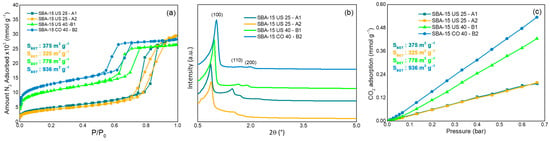
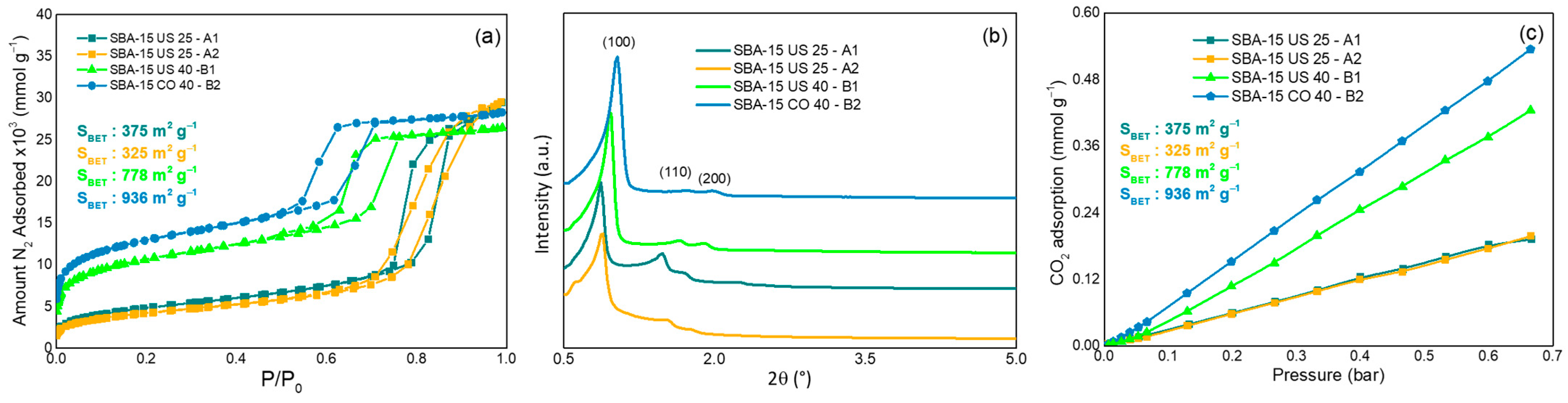
In this work, we investigated the formation of SBA-15 under different sample processing conditions (Series A and Series B). The textural and structural characteristics of the materials are presented in Figure 1. The pore size distribution curves and the wide-angle XRD patterns of all SBA-15 samples are shown in Figure S1 of the Supplementary Materials. The display of a type IV isotherm and the presence of the reflection peak relative to the (100) plane in these materials confirm the formation of a 2D hexagonal mesostructure [1]. The images obtained by HRTEM (Figure S2) revealed the characteristic hexagonal arrangement of mesopores in all samples, confirming the formation of SBA-15 in line with the results obtained using XRD, as discussed below. From Series A, the SBA-15 US 25-A2 sample presents a hysteresis loop with less pronounced adsorption–desorption branches and a slightly broader pore distribution curve (Figure S1a) compared to the SBA-15 US 25-A1 sample. In turn, the diffraction peaks associated with the (100), (110), and (200) planes are of lower intensity. These results suggest a slight decrease in the structural uniformity and length of the mesopore channels of this material [2], as expressed by the textural and structural parameter values given in Table 1.
Figure 1.
Characterization of SBA-15 samples: (a) N2 adsorption–desorption isotherms. (b) Small-angle XRD patterns; wide-angle XRD patterns. (c) CO2 adsorption capacity at 30 °C for SBA-15 samples up to a maximum pressure of 0.67 bar.
Table 1.
Physicochemical properties of the synthetic materials determined by nitrogen adsorption–desorption, XRD, and CO2 adsorption measurements.
On the other hand, in Series B, both samples present an isotherm with a similar hysteresis loop of the H1 type (Figure 1a), which exhibits a wider distance between the adsorption–desorption branches, suggesting the presence of mesopores with increased length and structural uniformity. This was corroborated by the resolution of the diffraction peaks in the low-angle diffraction profiles (Figure 1b), the textural and structural parameters presented in Table 1, and the HRTEM images (Figure S2). Otherwise, the differences in the characteristics of the materials between the two series of samples (Series A and Series B) can be attributed to the degradation effect of the mesoporous structure caused by the pH adjustment treatment (Series A). This is also reflected in the differences in the pore size distribution curves (Figure S1a) and the SBET, dp, and Vµ values presented in Table 1. In the FTIR spectra of the samples (Figure S3), the characteristic absorption bands of silica were observed, confirming the formation of the SBA-15 structure [8,17,18]. These results are discussed in the Supplementary Materials.
Two approaches oriented the present discussion: the first approach emphasizes the mediating effect of aging in ultrasonic synthesis by comparing SBA-15 US 25-A1 and SBA-15 US 25-A2. The aging step during synthesis generally leads to the densification of the silicon walls, which likely reduces the wall thickness and increases the pore size as the silicon species reorganize, filling the spaces of the wall of SBA-15 [19]. On the other hand, the pH-adjustment stage leads to structural degradation of SBA-15. A neutral medium promotes the dissolution of silica oligomers and deprotonation of the PEO chains of the surfactant, resulting in a weakening of the attractive forces in the precursor mesophase formed by silica-surfactant self-assembly and the degree of order of the structure [2,20]. This is exactly what we are observing by comparing these two samples in Table 1. The aging step formed the SBA-15 US 25-A2 with a pore size of 13.3 nm and a pore wall thickness of 0.2 nm. Densification causes the distribution of silica between micelles, increases the pore radius, and reduces the wall thickness, leading to changes in the morphology of the outer surface, which affects the surface area and connectivity of the pores. Then, the pH-adjustment stage causes the dissolution of the mesopore walls that were densified during the aging stage, further reducing the wall thickness to a value of 0.2 nm. The second approach emphasizes the comparison of the SBA-15 US 40-B1 and SBA-15 CO 40-B2 samples. This view highlights the effect of the presence of US on the synthesis. The application of ultrasound accelerates the hydrolysis and condensation processes of the silica precursor, facilitating the formation of the hybrid mesophase [8]. The ultrasound primarily heats the reaction medium instead of the vessel [21] through bubble collapse (cavitation), creating local hot spots that induce an increase in hydrolysis/condensation of TEOS [22] and a well-organized structure for ultrasound-assisted synthesis (SBA-15-US 40-B1) similar to the conventional sample (SBA-15 CO 40-B2). In addition, it was observed that the SBA-15 B series (Figure S2g–l) had greater long-range structural organization compared to Series A, due to the absence of pH adjustment treatment.
Regarding CO2 adsorption measurements (Figure 1c), in general, the SBA-15 samples showed CO2 adsorption capacity, which was higher in materials that were not subjected to the pH treatment stage; this was attributed to the presence of microporosity in these materials. Contact angle results (Figure 2a) revealed no significant variation between materials: Water contact angles (WCAs) on SBA-15 US 25-A1 (θ = 19.86° ± 0.52°) and SBA-15 US 25-A2 (θ = 18.65° ± 1.94°) were statistically similar (p = 0.1777), as were the diiodomethane contact angles (DIMCAs) (θ = 25.72° ± 1.69° vs. θ = 28.36° ± 2.56°; p = 0.1050, respectively). Within each material, WCAs and DIMCAs differed significantly (p** < 0.005), confirming contrasting surface interactions with polar vs. non-polar liquids. Figure 2(b) shows the time-dependent evolution of contact angles for ultrapure water and diiodomethane on SBA-15 surfaces. A continuous decrease in WCAs was observed over time, indicating progressive droplet penetration into the mesopores. In contrast, DIMCAs remained stable (Δθ < 2° after 5 s), consistent with their non-penetrating behavior on hydrophilic silica. Notably, the WCA decrease rate was significantly faster for SBA-15 US 25-A2 compared to SBA-15 US 25-A1. At t = 5 s, WCAs on SBA-15 US 25-A2 dropped to 9.71° versus 13.40° on SBA-15 US 25-A1 (p* < 0.05). The accelerated wetting kinetics suggests enhanced water absorption in the aged sample, likely due to its slightly wider pore size distribution, as confirmed by N2 physisorption (Figure 1a and Table 1).
Figure 2.
(a) Time-dependent evolution of contact angles for ultrapure water and diiodomethane on SBA-15 surfaces. (The p-value ** and *** are measures the probability that observed study results occurred by random chance, assuming the null hypothesis is true. For example, p* < 0.05 means that there is less than a 5% chance that the results occurred by coincidence. Meanwhile, p* < 0.001, there is less than a 0.1% chance that the results occurred by chance. The result is considered highly significant.) (b) Wettability of SBA-15 pellet surfaces.
4. Conclusions
The synthesis of SBA-15 at 25 °C by the pH-adjustment method was achieved with the assistance of ultrasound. Ultrasound assistance under the conditions studied reduces the structural deterioration of the material caused by the pH-adjustment effect, leading to a unimodal mesopore structure. Synthesis mediated by the aging process showed a lower degree of mesostructural uniformity of SBA-15, possibly because the process temperature did not provide the energy to form the structure. Meanwhile, continuous ultrasound assistance provided sufficient energy to form the mesostructure and minimize structural deterioration due to the pH-adjustment effect.
Supplementary Materials
The following supporting information can be downloaded at: https://www.mdpi.com/article/10.3390/materproc2026030002/s1. The Supplementary Material cites the references [13,14,15,16] associated with the treatment of XRD data and the references [8,18] corresponding to the discussion of the FTIR results.
Author Contributions
J.G.: Conceptualization, Methodology, Investigation, Writing—original draft, Writing—review and editing. J.C.-Z.: Writing—review and editing. G.G.: Writing—review and editing. F.G.-G.: Resources, Writing—review and editing. A.H.: Resources, Writing—review and editing. R.J.C.: Conceptualization, Resources, Writing—original draft, Writing—review and editing, Supervision, Project administration, and Funding acquisition. All authors have read and agreed to the published version of the manuscript.
Funding
The Regular Fondecyt project N° 1220355 from the national development and research agency (ANID) supported this work. Postgraduate Direction Department of the University of Concepción funded part of the travel expenses for attending the conference.
Institutional Review Board Statement
Not applicable.
Informed Consent Statement
Not applicable.
Data Availability Statement
All data analyzed or created in the preparation of the article are included in the published article.
Acknowledgments
The authors thank Regular Fondecyt project N° 1220355 from the national development and research agency (ANID), the National Doctoral Scholarship N° 21231855 from the national development and research agency (ANID). Jorge Gajardo appreciates the financing provided by the Postgraduate Direction Department of the University of Concepción. Adolfo Henríquez Poblete thanks the ANID/Fondecyt project N° 11220876.
Conflicts of Interest
The authors declare no conflicts of interest regarding the publication of this paper.
References
- Iga, G.D.; Vieira, J.L.; Santos, É.A.; Albuquerque, J.S.; Urquieta-González, E.A.; Bueno, J.M.C.; Gallo, J.M.R. Should we still be using HCl in the synthesis of SBA-15 and Al-SBA-15? Microporous Mesoporous Mat. 2024, 378, 113222. [Google Scholar] [CrossRef] [Scilit]
- Zhao, H.M.; Ma, L.; Lin, D.; Han, K.K.; Chun, Y.; Xu, Q.H. Preparation of cross-linked bimodal mesoporous SBA-15 with numerous pore openings. J. Nanosci. Nanotechnol. 2012, 12, 8955–8962. [Google Scholar] [CrossRef] [Scilit] [PubMed]
- Mahato, B.N.; Krithiga, T. Recent developments in metal-doped SBA-15 catalysts for heterogeneous catalysis and sustainable chemistry. Can. J. Chem. 2022, 100, 9–17. [Google Scholar] [CrossRef] [Scilit]
- Velty, A.; Corma, A. Advanced zeolite and ordered mesoporous silica-based catalysts for the conversion of CO2 to chemicals and fuels. Chem. Soc. Rev. 2023, 52, 1773–1946. [Google Scholar] [CrossRef] [Scilit]
- Pinto, F.; Caldeira, V.; Villarroel-Rocha, J.; Sapag, K.; Pergher, S.B.C.; Santos, A.G.D. Al/SBA-15 Mesoporous Material: A Study of pH Influence over Aluminum Insertion into the Framework. Nanomaterials 2024, 14, 208. [Google Scholar] [CrossRef] [Scilit] [PubMed]
- Oliveira, M.S.M.d.; Bieseki, L.; Alencar, A.E.V.d.; Braga, T.P.; Pergher, S.B.C. Incorporating Aluminum Into the Structure of SBA-15 by Adjusting the pH and Adding NaF. Mater. Res. 2019, 22, e20180657. [Google Scholar] [CrossRef] [Scilit]
- Palani, A.; Wu, H.-Y.; Ting, C.-C.; Vetrivel, S.; Shanmugapriya, K.; Chiang, A.S.T.; Kao, H.-M. Rapid temperature-assisted sonochemical synthesis of mesoporous silica SBA-15. Microporous Mesoporous Mat. 2010, 131, 385–392. [Google Scholar] [CrossRef] [Scilit]
- Glowniak, S.; Szczesniak, B.; Choma, J.; Jaroniec, M. Recent Developments in Sonochemical Synthesis of Nanoporous Materials. Molecules 2023, 28, 2639. [Google Scholar] [CrossRef] [Scilit] [PubMed]
- Li, Z.; Dong, J.; Zhang, H.; Zhang, Y.; Wang, H.; Cui, X.; Wang, Z. Sonochemical catalysis as a unique strategy for the fabrication of nano-/micro-structured inorganics. Nanoscale Adv. 2021, 3, 41–72. [Google Scholar] [CrossRef] [Scilit] [PubMed]
- Bera, B.; Das, N. Synthesis of high surface area mesoporous silica SBA-15 for hydrogen storage application. Int. J. Appl. Ceram. Technol. 2018, 16, 294–303. [Google Scholar] [CrossRef] [Scilit]
- Chareonpanich, M.; Nanta-ngern, A.; Limtrakul, J. Short-period synthesis of ordered mesoporous silica SBA-15 using ultrasonic technique. Mater. Lett. 2007, 61, 5153–5156. [Google Scholar] [CrossRef] [Scilit]
- Flores-Cantera, J.; Cruz-Mérida, J.A.; Velázquez-Herrera, F.D.; Paredes-Carrera, S.P.; Zarazua-Aguilar, Y. Synchronous microwave and ultrasound irradiation for the synthesis of SBA-15. MRS Commun. 2022, 12, 388–393. [Google Scholar] [CrossRef] [Scilit]
- Coelho, A.A. TOPASandTOPAS-Academic: an optimization program integrating computer algebra and crystallographic objects written in C++. J. Appl. Crystallogr. 2018, 51, 210–218. [Google Scholar] [CrossRef] [Scilit]
- Rietveld, H.M. A profile refinement method for nuclear and magnetic structures. Appl. Crystallogr. 1969, 2, 65–71. [Google Scholar] [CrossRef] [Scilit]
- Pawley, G.S. Unit-cell refinement from powder diffraction scans. J. Appl. Crystallogr. 1981, 14, 357–361. [Google Scholar] [CrossRef] [Scilit]
- Kruk, M.; Jaroniec, M.; Sakamoto, Y; Terasaki, O.; Ryong, R.; Chang Hyun, K. Determination of Pore Size and Pore Wall Structure of MCM-41 by Using Nitrogen Adsorption, Transmission Electron Microscopy, and X-ray Diffraction. J. Phys. Chem. B 2000, 104, 292–301. [Google Scholar] [CrossRef] [Scilit]
- Betiha, M.A.; Hassan, H.M.A.; Al-Sabagh, A.M.; Khder, A.E.R.S.; Ahmed, E.A. Direct synthesis and the morphological control of highly ordered mesoporous AlSBA-15 using urea-tetrachloroaluminate as a novel aluminum source. J. Mater. Chem. 2012, 22, 17551–17559. [Google Scholar] [CrossRef] [Scilit]
- Liu, T.; Wu, W.; Bai, X. Ultrasonic in-situ reduction preparation of SBA-15 loaded ultrafine RuCo alloy catalysts for efficient hydrogen storage of various LOHCs. Ultrason. Sonochem. 2024, 105, 106861. [Google Scholar] [CrossRef] [Scilit]
- Hiraide, S.; Yamada, M.; Kataoka, S.; Inagi, Y.; Endo, A. Time evolution of the framework structure of SBA-15 during the aging process. Colloids Surf. A Physicochem. Eng. Asp. 2019, 583, 123807. [Google Scholar] [CrossRef] [Scilit]
- Bai, K.; Hao, J.; Yang, Y.; Qian, A. The effect of hydrothermal temperature on the properties of SBA-15 materials. Heliyon 2020, 6, e04436. [Google Scholar] [CrossRef] [Scilit] [PubMed]
- Legay, M.; Gondrexon, N.; Le Person, S.; Boldo, P.; Bontemps, A.; Barigou, M. Enhancement of Heat Transfer by Ultrasound: Review and Recent Advances. Int. J. Chem. Eng. 2011, 2011, 670108. [Google Scholar] [CrossRef] [Scilit]
- El-Fiqi, A.; Bakry, M. Facile and rapid ultrasound-mediated synthesis of spherical mesoporous silica submicron particles with high surface area and worm-like mesoporosity. Mater. Lett. 2020, 281, 128620. [Google Scholar] [CrossRef] [Scilit]



Disclaimer/Publisher’s Note: The statements, opinions and data contained in all publications are solely those of the individual author(s) and contributor(s) and not of MDPI and/or the editor(s). MDPI and/or the editor(s) disclaim responsibility for any injury to people or property resulting from any ideas, methods, instructions or products referred to in the content. |
© 2026 by the authors. Licensee MDPI, Basel, Switzerland. This article is an open access article distributed under the terms and conditions of the Creative Commons Attribution (CC BY) license (https://creativecommons.org/licenses/by/4.0/).