1. Introduction
The increasing demand for safe, efficient, and modern food processing tools in both domestic and educational environments has driven interest in automated root crop processing machines. Root crops such as cassava, sweet potatoes, and carrots are staple food ingredients across many regions. Still, their traditional processing—often involving hand graters or rudimentary mechanical tools—remains labor-intensive and hazardous. These conventional methods require significant physical effort, pose injury risks, and are time-consuming, especially in settings where frequent or large-scale food preparation is necessary. This issue becomes even more critical in Technical–Vocational Education and Training (TVET), where learners must develop hands-on skills aligned with modern industry standards. A shift toward electronically controlled, integrated processing tools offers the potential to improve learning, ensure user safety, and reflect real-world practices in the food manufacturing sector.
Over time, food processing technology has evolved from basic mechanical tools to motorized systems capable of high-speed operation. Early innovations such as the rotary grater, first patented in France in the 1940s, laid the foundation for modern equipment focused on user productivity and safety. Recent studies have emphasized the value of portable and multi-functional food processors that can deliver improved operational efficiency and safety in both household and instructional settings. Improving energy efficiency has also become a major focus in modern food processing technologies, as advancements in equipment design aim to reduce energy consumption while maintaining high productivity levels [
1]. These developments highlight the growing need for educational institutions to integrate modern, technology-enhanced equipment into learning laboratories that support skill development in industrial food preparation while promoting sustainable practices.
Although innovations have emerged in individual food processing steps, such as grating or dewatering, few machines combine these essential operations in a single, automated unit. For example, a mechanized cassava grater powered by an AC motor was developed to provide higher grating capacity compared to manual alternatives; however, it did not incorporate a dewatering function [
2]. Another study addressed the dehydration component by developing a vegetable dehydration device that utilizes a motor-driven rotating inner barrel to remove moisture through centrifugal force. The device was designed for vegetable dehydration and facilitated efficient loading and unloading through a removable inner cylinder. However, it did not incorporate a grating mechanism required for processing hard root crops prior to moisture extraction [
3]. A more recent development introduced a dual-function cassava machine that combines grating and dewatering into a single unit powered by a 2.2 kW electric motor [
4]. Although effective in agricultural applications, this machine requires manual adjustments, is specifically designed for cassava, and lacks features such as automation, portability, and enhanced safety mechanisms, limiting its applicability in instructional settings.
Despite the availability of existing root crop processing machines, most commercial and semi-commercial processors are designed primarily for high-capacity agricultural production rather than instructional adaptability, safety integration, and automated system learning. For instance, a mechanized root crop grater developed for rapid grating performance utilizes a motor-driven mechanism but does not incorporate an integrated dewatering assembly or sensor-based automation [
4]. Similarly, a cassava grater with a presser combines grating and pressing functions; however, it relies heavily on manual operation and lacks electronic control, real-time sensing, and automated activation features [
5]. In addition, a device for processing cassava tubers demonstrates improved processing capability but remains crop-specific and does not emphasize modular control systems or educational simulation of automated workflows [
6]. Compared to these existing innovations and typical commercial processors, the present electronically controlled root crop processor offers a more instructionally valuable design by integrating a grating assembly, gravity-assisted dewatering assembly, microcontroller-based control unit, laser sensor detection, and liquid level monitoring within a single compact apparatus. This integrated and sensor-assisted configuration enhances safety, consistency, and operational efficiency while providing learners with hands-on exposure to automated food processing principles, thereby addressing the limitations of prior technologies that are predominantly mechanical, manually adjusted, and less suited for modern TVET laboratory instruction.
TVET programs increasingly emphasize outcome-based education, which prioritizes real-world competencies, hands-on training, and familiarity with technologies used in professional industries. However, many current laboratory tools fail to simulate modern, automated processes, placing learners at a disadvantage when transitioning to actual job environments. The use of outdated or single-function tools not only slows laboratory activities but also introduces safety risks and limits students’ exposure to integrated system operations. There is a need for localized, automated simulators that reflect current industrial standards in food processing while remaining safe, efficient, and adaptable to different root crops. Integrating advanced technologies into TVET instruction—particularly in food preparation and production—has been shown to significantly improve learner engagement, skill acquisition, and confidence in addressing real-world industry challenges, thereby strengthening alignment between education and evolving workplace demands [
7].
This study introduces the design, development, and evaluation of an Electronically Controlled Root Crop Processor that integrates grating and dewatering functions into a compact, automated, and safe system tailored explicitly for TVET learning environments. The machine features a vertically rotating flat disk with perforations enclosed in a sealed housing to enhance juice extraction, reduce waste, and minimize user exposure to sharp or moving components. The automation component eliminates the need for manual operation and adjustment, making the device ideal for repeated classroom use. By simulating industry-relevant processing workflows, the tool enhances students’ learning experience and builds their readiness for employment in food technology and industrial arts sectors.
Furthermore, this study emphasizes the importance of technology integration in TVET curricula to ensure students acquire practical skills in operating automated systems. Experiential learning, through direct interaction with laboratory simulators, enables learners to understand not only technical aspects of food processing but also principles of machine safety, process efficiency, and equipment maintenance. As schools adopt more outcome-based and competency-driven models, providing students with access to such advanced tools becomes a critical step in aligning education with industry expectations. The integration of this root crop processor into TVET instruction supports these goals by offering a realistic, scalable, and pedagogically sound platform for skill development in food-related trades.
Despite the availability of separate grating or dewatering machines, few studies have addressed the combined functionality, automation, and educational utility of such systems in laboratory instruction. There remains a notable research gap in developing compact, electronically controlled root crop processors that serve both instructional and practical functions. This study aims to fill this gap by introducing a localized laboratory simulator for root crop processing in TVET environments, bridging traditional processing methods with modern, industry-ready practices.
3. Results and Discussion
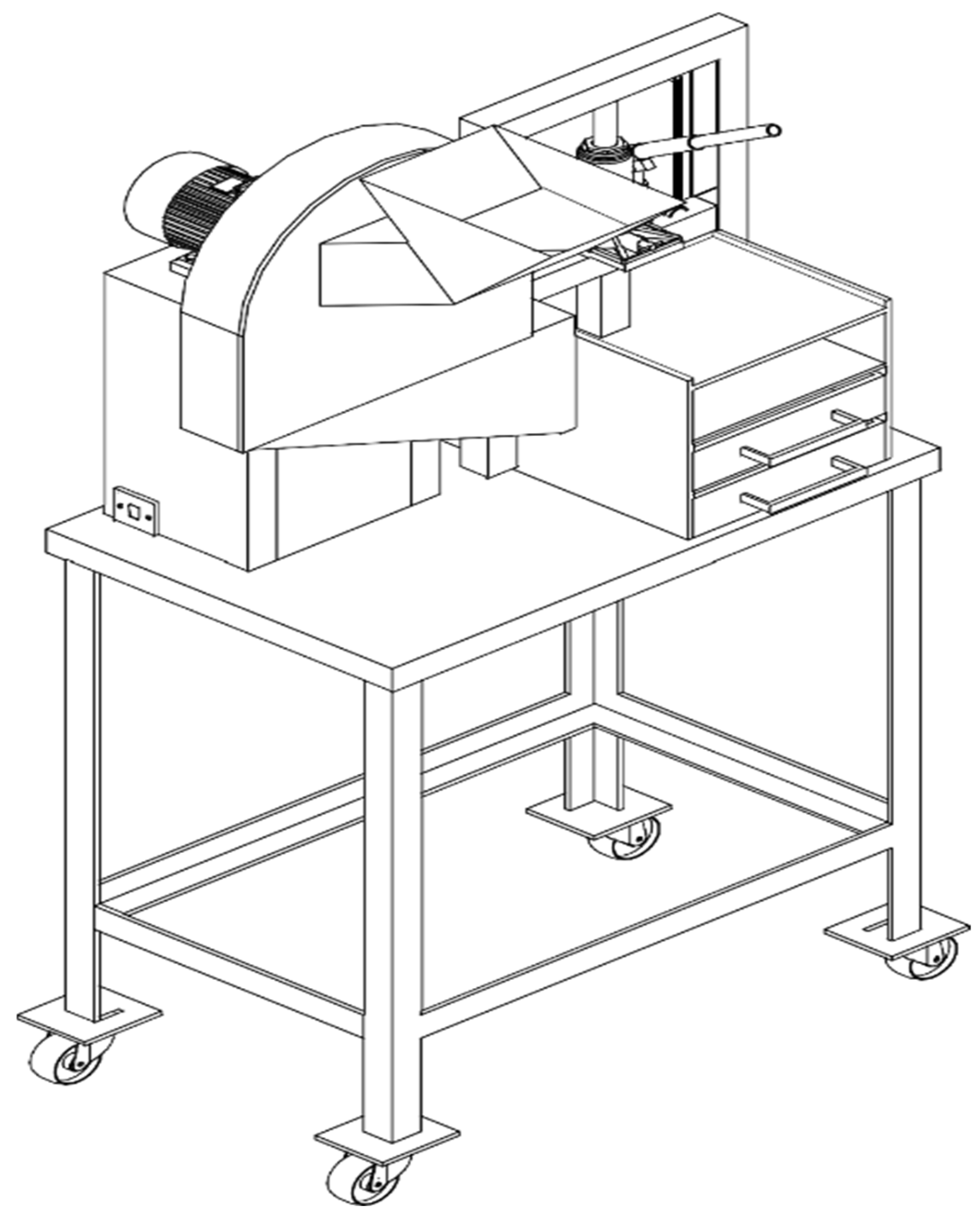
Figure 1 below illustrates the isometric drawing of the Electronically Controlled Root Crop Processor designed as a localized laboratory simulator for Technical–Vocational Education and Training (TVET). The unit is positioned on a sturdy rectangular table to ensure operational stability and ergonomic handling during instructional use. At the top is a funnel-shaped input hopper where root crops such as cassava, sweet potatoes, or carrots are loaded for processing. Directly below the hopper is the central processing chamber that houses the grating mechanism. Attached to the side is a motor or drive unit that powers the vertical rotation of the grater. At the same time, a control box—located nearby—contains the electronic components and operating switches for automation and control. An output section is situated beneath the processing area to collect the grated material. The overall setup is compact, portable, and designed to simulate real-world food processing in a controlled learning environment, making it an effective instructional tool for TVET learners.
Table 1 presents the experts’ evaluation of the product in terms of design, construction, and availability of materials, yielding an overall mean of 3.89 with a standard deviation of 0.11, interpreted as “Strongly Agree.” This indicates that the evaluators perceived the machine as structurally sound, safe, and practical for instructional use. The highest-rated indicator was the use of corrosion-resistant, food-grade stainless steel for all crop-contact areas (Mean = 4.00, SD = 0.00), demonstrating unanimous agreement on its hygienic and durable construction. Other indicators related to safety features, ease of assembly, accessibility of components, and the use of locally available materials also received strong approval. The lowest mean score (3.80, SD = 0.41) was observed in the indicator concerning technical simplicity using modular components and an Arduino-based control system. Although still rated highly, this slightly lower score suggests that some experts perceived minor complexity in the electronic integration. Additionally, prototype development encountered challenges such as sensor calibration, subsystem synchronization, and precision in fabrication, which may have influenced perceptions of simplicity. Overall, the findings confirm that the product aligns well with practical, safe, and locally sustainable design principles, with minor areas identified for refinement.
Table 2 shows the experts’ evaluation of the product’s functionality, with an overall mean of 3.88 and a standard deviation of 0.12, interpreted as “Strongly Agree.” The results indicate that the machine effectively integrates grating and dewatering processes into a cohesive automated system. The highest rating (Mean = 4.00, SD = 0.00) was given to the indicator stating that the machine completes tasks as intended, reflecting unanimous agreement that all components work harmoniously to meet processing objectives. Indicators related to multi-function capability, actuator force, automation accuracy, and timely response were also strongly endorsed. However, the lowest mean scores (3.80, SD = 0.41) were recorded for the smooth operation of the juice extraction system and the efficiency of juice separation. These slightly lower ratings suggest potential areas for improvement, particularly in enhancing pressing uniformity and optimizing juice flow mechanisms. Overall, the evaluation confirms that the processor performs reliably and efficiently, while highlighting opportunities to further refine extraction consistency.
Table 3 presents the evaluation results in terms of usability, yielding an overall mean of 3.91 with a standard deviation of 0.16, corresponding to “Strongly Agree.” This demonstrates that experts found the machine highly user-friendly and accessible. Indicators concerning clearly labeled controls, operational safety, and smooth performance received perfect mean scores of 4.00, reflecting unanimous agreement on the clarity of interface design and safety features. The automation system, intuitive layout, and minimal physical effort required were also positively rated. The lowest mean score (3.80, SD = 0.41) pertained to ease of maintenance and cleaning. While still strongly positive, this suggests that disassembly and cleaning processes could be simplified further, possibly through improved quick-release mechanisms or enhanced component accessibility. Overall, the results indicate that the product is well-suited for instructional environments, requiring minimal training while ensuring efficient and safe operation.
Table 4 reflects the experts’ assessment of the product’s aesthetic qualities, with an overall mean of 3.83 and a standard deviation of 0.08, interpreted as “Strongly Agree.” The findings indicate that the machine is generally perceived as visually appealing and innovative. The highest mean score (3.95) was given to indicators highlighting the integration of novel features such as the laser sensor and actuator-driven pressing system, as well as the presence of a user-friendly interface. These results demonstrate a strong appreciation for the machine’s modern technological character. However, the lowest mean score (3.65, SD = 0.49) was associated with the product’s clean and professional appearance. This relatively lower rating may be attributed to visible fabrication marks, industrial-style finishing, or prototype-level craftsmanship that prioritized functionality over visual refinement. These findings suggest that improvements in polishing, symmetry, and finishing details could enhance the product’s aesthetic appeal and market readiness.
Table 5 presents the evaluation of modularity, achieving an overall mean of 3.83 with a standard deviation of 0.11, interpreted as “Strongly Agree.” This indicates that experts recognized the system’s modular architecture, particularly the separation of the grater and juice extractor as independent units, which received the highest mean score (3.95). Indicators related to component interchange, independent repair, and subsystem access were also rated positively, reflecting appreciation for maintainability and adaptability. The lowest mean score (3.65, SD = 0.59) referred to the ease of part replacement using bolt-on components. This suggests that although modularity is present, replacement procedures may require tools or careful disassembly, limiting quick access. The slightly lower ratings imply opportunities to enhance plug-and-play features or improve spacing and accessibility. Overall, the results confirm that the product supports sustainable maintenance and future upgrades, with room for refinement in the convenience of replacement.
Table 6 displays the experts’ evaluation of ergonomics, which obtained the highest overall mean of 3.96 with a standard deviation of 0.15, interpreted as “Strongly Agree.” This demonstrates that the product excels in supporting user comfort, safety, and efficiency. Several indicators—including accessible controls, automation that reduces manual effort, streamlined workflow, comfortable standing operation, and accommodation of various user sizes—received perfect mean scores of 4.00, indicating unanimous agreement. The slightly lower mean score (3.85) related to the machine’s width and height, suggesting minor adjustments could further optimize ergonomic compatibility for a broader range of users. Overall, the findings highlight that the processor significantly reduces physical strain, minimizes fatigue, and enhances safe operation, making it highly suitable for repetitive instructional use in TVET settings.
Table 7 presents the grating performance of the processor, demonstrating consistent operational efficiency. Standardized trials with 5 kg batches recorded an average processing time of approximately 1 min and 18 s, producing final grated weights ranging from 4.6 to 4.7 kg. This corresponds to a high material retention rate of approximately 94% to 96%, indicating minimal waste during processing. Minor differences between initial and final weights may be attributed to residual material inside the chamber or slight moisture reduction during grating. These results confirm that the machine performs reliably, maintains consistent output, and operates with efficient speed. Importantly, the high grating efficiency and consistent throughput support the previously noted usability and functionality ratings, demonstrating that the processor not only meets its design objectives but also provides a smooth, user-friendly, and effective experience for instructional use in TVET laboratories.
4. Conclusions
Based on expert evaluations across six key areas, namely design and material availability, functionality, usability, aesthetics, modularity, and ergonomics, the Electronically Controlled Root Crop Processor was consistently rated as highly effective, with all categories receiving a “Strongly Agree” interpretation. Its strongest aspects included the use of food-grade stainless steel, integrated automation features, and the ability to efficiently perform both grating and dewatering within a single system. The use of locally available materials and safety mechanisms, such as the enclosed grating disc and sensor-triggered activation, further contributed to its acceptability among technical professionals and educators.
Operational performance demonstrated high ratings in functionality and usability, with experts noting the intuitive control interface, smooth mechanical operation, and reduced physical effort due to automation. Indicators for clearly labeled controls, safety features, and ease of operation received unanimous agreement, highlighting accessibility even for users with a limited technical background. Although dewatering efficiency and ease of cleaning scored slightly lower, these areas were still favorable and suggest minor refinements, such as improving pressing consistency and enhancing component access for maintenance. Preliminary feedback from instructors and students supported the processor’s instructional value, reporting improved engagement, better understanding of automated processing, and increased confidence in handling semi-industrial equipment.
The processor’s modular design and ergonomic configuration were recognized as major strengths. Detachable and replaceable components, including the hydraulic jack assembly, pressing plate, and control modules, allow for simplified maintenance, scalability, and future upgrades. Its compact and organized layout promotes intuitive learning by clearly showing the relationship between mechanical processing and electronic control. Overall, the processor demonstrates strong potential for both instructional and practical applications in TVET environments.