1. Introduction
Additive manufacturing (AM), particularly material-extrusion-based three-dimensional (3D) printing, has become an increasingly important production approach in engineering, education, product development, and small-scale fabrication [
1]. Its appeal lies in the ability to produce parts directly from digital models with relatively low tooling requirements, short development cycles, and high flexibility for customized applications. Among the different AM methods, fused filament fabrication and related material-extrusion processes are especially attractive in academic and community-based settings because of their accessibility, ease of deployment, and compatibility with low-cost desktop systems [
1,
2].
Despite these advantages, the broader use of 3D printing in many developing and resource-constrained settings remains limited by the cost and availability of filament [
3]. Commercial filaments are commonly derived from virgin polymer feedstocks and are often imported, which increases both material cost and supply vulnerability. This issue is particularly significant for educational institutions and local innovators seeking to integrate additive manufacturing into instruction, prototyping, and applied research, but with limited budgets for recurring material costs. In this context, converting recyclable plastic waste into usable filament offers a practical pathway to improve affordability while advancing more sustainable production practices.
Recent literature has shown growing interest in the use of recycled polymers as feedstock for additive manufacturing, particularly within circular economy and distributed recycling frameworks [
3,
4,
5]. Such approaches support the recovery of post-consumer plastics and their conversion into new fabrication inputs, thereby extending material life cycles and reducing dependence on virgin raw materials. From a sustainability perspective, this direction is relevant not only to manufacturing efficiency but also to waste reduction, resource conservation, and the development of local innovation ecosystems. These considerations are increasingly important in university settings, where engineering projects are expected to address both technical functionality and broader social or environmental concerns.
Within this context, the present study focuses on the development of an automated filament extrusion system for 3D printing using recycled thermoplastics at Caraga State University, Cabadbaran Campus (CSUCC). The work responds to a practical institutional need, like the absence of a locally available, low-cost system for processing recyclable thermoplastic waste into filament suitable for additive manufacturing applications. Rather than relying solely on commercially produced filament, the project explores the feasibility of designing a prototype that integrates thermal, mechanical, and electronic subsystems to automate extrusion and spooling with minimal operator intervention. In doing so, the study situates additive manufacturing within a more localized, sustainability-oriented framework.
The study’s relevance extends beyond technical prototyping. The project aligns with several United Nations Sustainable Development Goals (SDGs). It supports SDG 12: Responsible Consumption and Production by promoting the reuse of plastic waste as a productive resource. It contributes to SDG 9: Industry, Innovation and Infrastructure by encouraging the development of locally appropriate fabrication technologies that strengthen an academic institution’s innovation capacity. The system also advances SDG 4: Quality Education by providing a platform for hands-on learning in electronics engineering technology, automation, process control, and sustainable design. In a broader sense, the reuse of thermoplastic waste and the reduction in reliance on virgin filament materials also relate to SDG 13: Climate Action, particularly through more resource-efficient production practices, thus helping frame the study as both technically relevant and socially responsive.
The research problem addressed by this study is to develop a locally relevant automated extrusion and spooling system that can convert recycled thermoplastic waste into 3D-printable filament and evaluate whether such a system meets functional, usability, modularity, and ergonomic expectations in an academic setting.
This study had the following objectives:
Develop an automated filament extrusion prototype for recycled thermoplastics at CSUCC using locally obtainable mechanical, electrical, and control components;
Evaluate the prototype using a validated product-development instrument across design, functionality, usability, aesthetics, modularity, and ergonomics;
Interpret the prototype’s institutional relevance for sustainable additive manufacturing, electronics engineering technology education, and circular economy practice.
2. Related Work
Recent studies show that recycling plastics for additive manufacturing has developed from an experimental concept into a more established research area focused on feedstock preparation, extrusion behavior, filament quality, printability, material degradation, and environmental performance [
3]. A key theme in this body of work is distributed recycling via additive manufacturing (DRAM), which links mechanical recycling with localized production systems. DRAM is a promising pathway for circular manufacturing because it enables post-consumer plastic waste to be converted into new 3D printing inputs at or near the point of use [
6]. This perspective is relevant to the present study because it frames recycled-filament production not only as a materials-processing activity but also as a strategy for improving accessibility and sustainability in additive manufacturing.
Among recyclable polymers, polyethylene terephthalate (PET) has received sustained attention because of its abundance in consumer waste streams and its potential for reprocessing into filament. Post-consumer PET flake can be integrated into a distributed recycling workflow, while emphasizing that feeding conditions, extrusion stability, and active cooling significantly influence the quality of printed output [
7]. Similarly, recycled PET bottle flakes can be transformed into filament suitable for material-extrusion printing, although the resulting quality depends strongly on screw configuration and operating parameters during extrusion [
7,
8,
9].
Meanwhile, a persistent issue in the literature is the degradation of polymer properties during repeated thermal and mechanical reprocessing. Current practices in printing with recycled thermoplastics have noted that reprocessing history can substantially affect the final properties of printed components [
10,
11]. This observation is consistent with common engineering problems reported in recycled-filament systems, including moisture sensitivity, rheological inconsistency, nozzle clogging, contamination effects, and dimensional variation [
12]. These outcomes should therefore be interpreted not as isolated deficiencies but as challenges that are widely recognized in the broader recycled-thermoplastic extrusion literature.
Polypropylene (PP) presents another important but distinct material pathway. Although PP is attractive because of its availability in waste streams and its thermoplastic recyclability, it does not behave identically to PET during extrusion and printing. Arrigo et al. showed that recycled PP can be adapted for 3D printing through careful blend design, rheological adjustment, and process optimization [
13]. PP requires its own validated processing conditions rather than the simple transfer of PET settings. This means PP may be considered a logical extension of the prototype’s intended capability, but its full integration should be supported by separate validation of extrusion temperature, flow stability, spoolability, and print quality [
13,
14].
The literature also points to the value of academic institutions as sites for sustainability-oriented fabrication research. The development of a prototype pultrusion system for recycled PET bottles within an education-for-sustainable-development framework, showing that student-centered equipment development can simultaneously support technical instruction and environmental awareness [
14]. In a broader review, PET, PLA, and ABS are among the most commonly investigated recycled polymers in additive manufacturing, with hot-melt extrusion remaining central to filament production research [
5].
Environmental assessment studies further strengthen the case for recycled-filament systems. Filament production from recycled plastics can reduce impacts across several environmental categories relative to virgin-plastic supply chains, although the magnitude of benefit depends on the energy context of the process [
15]. It is important for the present work because it suggests that even small-scale extrusion research conducted in educational settings can contribute to waste valorization, circular manufacturing awareness, and more resource-conscious fabrication practices [
16].
Taken together, the literature suggests four important themes. First, recycled-polymer filament production is technically feasible [
3,
4,
7]. Second, process control remains the main constraint on consistent filament quality and print reliability [
4,
7,
17]. Third, PET and PP require material-specific optimization and should not be treated as interchangeable feedstocks [
4,
13]. Fourth, educational institutions can serve as effective platforms for localized circular manufacturing and sustainability-driven innovation [
5,
14]. The gap addressed by the present study is therefore not the general feasibility of recycled filament production, which is already supported in current literature, but the contextualized development and evaluation of a locally deployable automated prototype for use in an underserved regional academic setting.
3. Materials and Methods
3.1. Research Design
This study employed a developmental–descriptive research design [
18,
19] to develop and assess an automated filament extrusion system using recycled thermoplastics for 3D printing at Caraga State University, Cabadbaran Campus (CSUCC). The developmental component focused on prototype design, fabrication, assembly, and initial testing, while the descriptive component was used to evaluate the developed system based on relevant functional and operational criteria. This approach was appropriate because the study aimed both to generate a working engineering prototype and to assess its suitability for institutional use.
3.2. Prototype Development
The development phase began with a review of related technical literature and design references to establish the conceptual framework of the prototype. The system was intended to convert recycled thermoplastic feedstock into filament through coordinated heating, extrusion, and spooling processes. The prototype incorporated locally obtainable components, including heating elements, motors, an extrusion nozzle, a spooler mechanism, sensors, and a microcontroller-based control unit.
Assembly proceeded through an iterative engineering process in which the identified components were integrated into a single automated platform. Preliminary trials were conducted to verify whether the system could perform the intended sequence of feeding, melting, extrusion, cooling, and spooling. Revisions were made as necessary during assembly and initial testing to improve continuity of operation and subsystem coordination. The verified materials supplied for this manuscript do not include full material-characterization and process-validation datasets; therefore, the present study is limited to the documented development process and prototype-level evaluation.
System Architecture and Process Flow
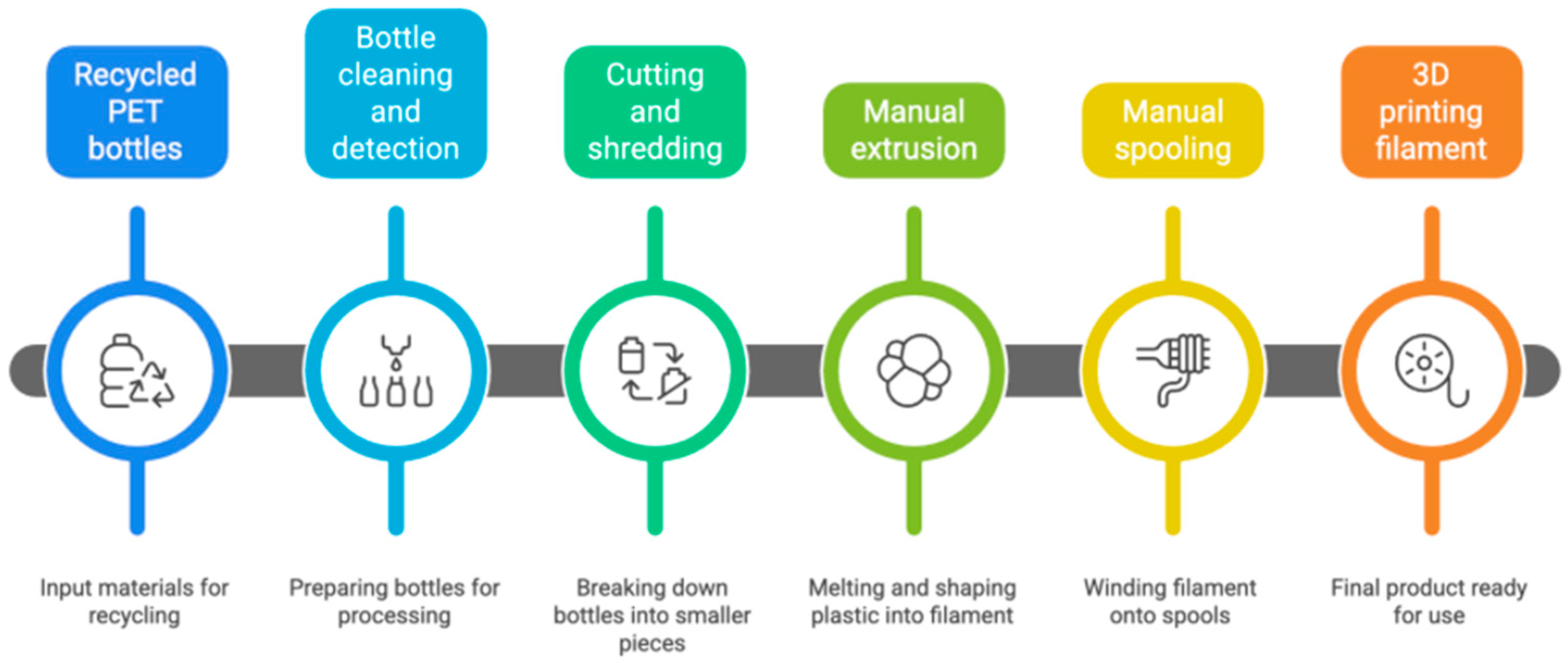
Figure 1 presents the system architecture and process flow of the bottle-to-filament pathway adopted in the study. The sequence begins with recycled PET bottles as the primary feedstock, followed by bottle cleaning and detection, cutting and shredding, extrusion, spooling, and finally the use of the produced filament for 3D printing. As a method, this process flow is consistent with the distributed recycling via additive manufacturing framework [
2], in which post-consumer PET waste is converted into locally usable feedstock for additive manufacturing rather than being treated only as disposal material [
3,
4].
The cleaning and detection stage is a necessary preprocessing step because recycled PET is sensitive to contamination and residual moisture. Prior studies on recycled PET filament production show that adequate drying before extrusion is important, since moisture can accelerate degradation during melt processing [
4]. Related work on bottle-grade PET also shows that contamination from closures and rings, particularly HDPE, can influence the structure and performance of the recycled material, which justifies including detection and preparation before thermal processing [
12]. In the context of the present figure, this stage helps define feedstock quality before the material enters the extrusion system [
20,
21].
The cutting and shredding stage converts cleaned bottles into smaller pieces or flakes suitable for controlled feeding into the heating and extrusion unit. This step is methodologically important because particle size and feed geometry affect material flow and extrusion stability. Little et al. reported that granulation, sifting, and heating influenced the size and shape distribution of recycled PET flakes and affected subsequent processing behavior [
20]. Bustos Seibert et al. likewise showed that extrusion screw design and process parameters materially affect the quality of filament produced from recycled PET bottle flakes [
4]. Thus, in the present system, shredding should be understood not only as a size-reduction step but also as a control point that influences downstream extrusion consistency [
7].
The extrusion and spooling stages form the core of the system architecture because they transform the prepared thermoplastic feedstock into continuous filament. Methodologically, this stage involves coordinated heating, melt conveyance, shaping, cooling, and winding. Current literature suggests that recycled-thermoplastic extrusion is highly sensitive to process control, including thermal history, rheological behavior, and parameter stability [
13,
14]. This means that filament production quality depends not only on whether melting occurs, but also on whether the process can maintain uniform flow and produce filament suitable for later printing. In this sense, the extrusion-spooling segment in
Figure 1 represents the principal engineering function of the prototype [
14].
The final stage, labeled 3D printing filament, serves as the end-use validation step of the method. In practical terms, the system is not fully validated by extrusion alone; the produced filament must also be suitable for downstream material-extrusion printing. This interpretation is consistent with studies showing that recycled PET can be extruded into filament and subsequently used in additive-manufacturing workflows, although print performance remains dependent on processing conditions [
17]. It is also consistent with educational and sustainability-oriented PET-to-filament prototype studies, where bottle recovery, filament formation, and printing application are treated as part of one integrated workflow [
5]. Accordingly,
Figure 1 may be discussed as a closed bottle-to-filament-to-print process flow that supports localized circular manufacturing in an academic setting.
3.3. Evaluation Procedure
The developed prototype was evaluated using a validated research instrument reviewed by an expert panel. The instrument assessed the system across several criteria, including design, functionality, usability, aesthetics, modularity, and ergonomics. These dimensions were selected to capture the practical and developmental quality of the prototype within an academic engineering context. Five (5) faculty members from the Computer Engineering, Electrical Technology, and Electronics Technology departments served as expert evaluators through purposive sampling.
Table 1 shows that the study used a four-point Likert scale, with weighted-mean ranges interpreted from Strongly Disagree to Strongly Agree.
4. Results and Discussion
Prototype Evaluation
The results show that the developed system obtained an overall mean of 2.77, verbally interpreted as “Agree,” which indicates general acceptability of the prototype’s functional performance; see
Table 2. The highest rating was recorded for multi-function capability (3.20), followed by completeness of functions, accomplishment of specified tasks, and resource sufficiency (each 3.00). Ratings for efficiency, correct results, timely response, and maximum functional limits were all 2.80, while relatively lower means were observed for operational accuracy (2.60), resource sharing with other products (2.60), information exchange between systems (2.60), functional flexibility (2.40), and quality of each desired function during operation (2.40). Taken together, these results suggest that the prototype was able to perform its intended core functions, although its precision, adaptability, and integration capacity remain limited at the present stage of development.
The stronger ratings for multi-function capability, task accomplishment, and completeness of functions may suggest that the prototype successfully integrated its main subsystems into a workable bottle-to-filament platform. This interpretation is consistent with prior studies showing that recycled-polymer processing systems for additive manufacturing can be configured as functional localized production tools, particularly within distributed recycling and educational settings [
14]. Current literature suggests that recycled PET workflows can support filament-oriented manufacturing, but that successful operation depends on maintaining stable feed preparation, extrusion, and handling conditions [
7].
The lower ratings for operational accuracy, functional flexibility, and quality consistency may indicate that the system is still affected by the common technical constraints reported in recycled-thermoplastic extrusion research. Prior literature indicates that recycled feedstocks are sensitive to thermal history, moisture, contamination, rheological variation, and processing-parameter instability, all of which can reduce extrusion repeatability and downstream print quality [
2]. In this sense, the lower scores in
Table 2 do not necessarily indicate failure of the prototype; rather, they may reflect the normal difficulties associated with early-stage recycled-filament systems, where process control remains a major bottleneck [
3,
4,
5].
The ratings for resource sharing and information exchange, both at 2.60, may suggest that the current prototype functions more effectively as a stand-alone developmental system than as a fully interoperable platform. Because the supplied dataset does not include interface-level performance tests, real-time control logs, or comparative system-integration trials, stronger claims about interoperability cannot yet be made. What can be stated from the present evidence is that the system demonstrates prototype-level functionality, while further refinement is needed to improve consistency, adaptability, and system integration.
Overall, the functionality results indicate that the developed extrusion system has reached a credible prototype stage. Consistent with prior findings, the results support the technical feasibility of recycled-plastic-based filament production, while also suggesting that improved control of feedstock preparation, extrusion conditions, and output regulation may be necessary to achieve more stable and repeatable performance [
1,
2,
3,
4,
5]. Thus, the CSUCC prototype appears suitable for academic and developmental use, but further validation would be required before broader claims about process robustness or deployment readiness can be justified.
5. Conclusions
This study presented the development and initial evaluation of an automated filament extrusion system for 3D printing applications using recycled thermoplastics at Caraga State University, Cabadbaran Campus. Based on the supplied evaluation data, the prototype obtained an overall mean score of 2.77, interpreted as “Agree,” indicating general acceptability at the prototype level. Higher ratings in multi-function capability, task accomplishment, completeness of functions, and resource efficiency suggest that the system successfully integrated its major subsystems into a functional, institutionally relevant platform.
However, the prototype remains at an early stage of development. Lower ratings in operational accuracy, flexibility, quality consistency, and interoperability indicate the need for further refinement before stronger claims can be made regarding stability, adaptability, and wider deployment. Thus, the present contribution is best understood as demonstrating prototype feasibility rather than full material-process optimization.
Within the CSUCC context, the system shows potential as a locally relevant and sustainability-oriented engineering innovation. By converting recycled plastic waste into possible filament feedstock, the project supports resource recovery, instructional innovation, and accessible additive manufacturing. Nevertheless, the study is limited by the absence of full material characterization, filament-diameter monitoring, print-quality assessment, lifecycle analysis, and economic evaluation. Future work should therefore focus on process validation, material-specific optimization, and broader technical and environmental assessment. Overall, the study indicates that the developed system has promise for academic and localized applications, while also highlighting the improvements required for more reliable and scalable use.
Author Contributions
Conceptualization, M.J.M.B., R.V.C., R.C.C., L.M.G.C. and M.A.A.V.; methodology, M.J.M.B., R.V.C., R.C.C., L.M.G.C. and M.A.A.V.; software, R.C.C. and L.M.G.C.; validation, M.A.A.V. and R.V.C.; formal analysis, M.J.M.B.; investigation, R.V.C.; resources, R.C.C., L.M.G.C. and M.A.A.V.; data curation, M.J.M.B.; writing—original draft preparation, M.J.M.B., R.V.C., R.C.C., L.M.G.C. and M.A.A.V.; writing—review and editing, M.J.M.B.; visualization, R.V.C.; supervision, M.J.M.B.; All authors have read and agreed to the published version of the manuscript.
Funding
This research received no external funding.
Institutional Review Board Statement
Not applicable.
Informed Consent Statement
Informed consent was obtained from all subjects involved in the study.
Data Availability Statement
The datasets used and analyzed during the current study are available from the corresponding author upon reasonable request.
Acknowledgments
The authors gratefully acknowledge Caraga State University, Cabadbaran Campus, for its institutional support of this research. The authors also extend their appreciation to the technical staff, administrative personnel, and expert evaluators whose assistance and professional insights contributed to the development, testing, and evaluation of the Automated Filament Extrusion System Using Recycled Thermoplastics for 3D Printing. During the preparation of this manuscript, the authors used ChatGPT (GPT-5.4 Thinking, OpenAI) for language refinement and manuscript organization. The authors have reviewed and edited the output and take full responsibility for the content of this publication.
Conflicts of Interest
The authors declare no conflicts of interest.
Abbreviations
The following abbreviations are used in this manuscript:
| 3D | Three-dimensional |
| AM | Additive Manufacturing |
| DRAM | Distributed Recycling via Additive Manufacturing |
| HDPE | High Density Polyethylene |
| PET | Polyethylene Terephthalate |
| PP | Polypropylene |
| SD | Standard Deviation |
| VI | Verbal Interpretation |
References
- Huang, S.H.; Liu, P.; Mokasdar, A.; Hou, L. Additive manufacturing and its societal impact: A literature review. Int. J. Adv. Manuf. Technol. 2013, 67, 1191–1203. [Google Scholar] [CrossRef] [Scilit]
- Nassar, M.; El Farahaty, M.; Ibrahim, S.; Hassan, Y. Design of 3D filament extruder for Fused Deposition Modeling (FDM) additive manufacturing. Int. Des. J. 2019, 9, 55–62. [Google Scholar] [CrossRef] [Scilit]
- Sanchez, F.A.C.; Boudaoud, H.; Camargo, M.; Pearce, J.M. Plastic recycling in additive manufacturing: A systematic literature review and opportunities for the circular economy. J. Clean. Prod. 2020, 264, 121602. [Google Scholar] [CrossRef] [Scilit]
- Little, H.A.; Tanikella, N.G.; Reich, M.J.; Fiedler, M.J.; Snabes, S.L.; Pearce, J.M. Towards Distributed Recycling with Additive Manufacturing of PET Flake Feedstocks. Materials 2020, 13, 4273. [Google Scholar] [CrossRef] [Scilit] [PubMed]
- Maraveas, C.; Kyrtopoulos, I.V.; Arvanitis, K.G. Evaluation of the Viability of 3D Printing in Recycling Polymers. Polymers 2024, 16, 1104. [Google Scholar] [CrossRef] [Scilit]
- Sola, A.; Trinchi, A. Recycling as a Key Enabler for Sustainable Additive Manufacturing of Polymer Composites: A Critical Perspective on Fused Filament Fabrication. Polymers 2023, 15, 4219. [Google Scholar] [CrossRef] [Scilit]
- Seibert, M.B.; Capote, G.A.M.; Gruber, M.; Volk, W.; Osswald, T.A. Manufacturing of a PET Filament from Recycled Material for Material Extrusion (MEX). Recycling 2022, 7, 69. [Google Scholar] [CrossRef] [Scilit]
- Vaucher, J.; Demongeot, A.; Michaud, V.; Leterrier, Y. Recycling of Bottle Grade PET: Influence of HDPE Contamination on the Microstructure and Mechanical Performance of 3D Printed Parts. Polymers 2022, 14, 5507. [Google Scholar] [CrossRef] [Scilit]
- Oussai, A.; Bártfai, Z.; Kátai, L. Development of 3D Printing Raw Materials from Plastic Waste. A Case Study on Recycled Polyethylene Terephthalate. Appl. Sci. 2021, 11, 7338. [Google Scholar] [CrossRef] [Scilit]
- Toth, L.; Slezák, E.; Bocz, K.; Ronkay, F. Progress in 3D printing of recycled PET. Mater. Today Sustain. 2024, 26, 100757. [Google Scholar] [CrossRef] [Scilit]
- Nikam, M.; Pawar, P.; Patil, A.; Patil, A.; Mokal, K.; Jadhav, S. Sustainable fabrication of 3D printing filament from recycled PET plastic. Mater. Today Proc. 2024, 103, 115–125. [Google Scholar] [CrossRef] [Scilit]
- Ror, C.K.; Negi, S.; Mishra, V. Development and characterization of sustainable 3D printing filaments using post-consumer recycled PET: Processing and characterization. J. Polym. Res. 2023, 30, 350. [Google Scholar] [CrossRef] [Scilit]
- Gomes, T.E.; Cadete, M.S.; Dias-de-Oliveira, J.; Neto, V. Controlling the properties of parts 3D printed from recycled thermoplastics: A review of current practices. Polym. Degrad. Stab. 2022, 196, 109850. [Google Scholar] [CrossRef] [Scilit]
- Méndez, G.M.; del Cerro Pérez, A.; del Cerro Velázquez, F. Prototype Pultrusion of Recycled Polyethylene Terephthalate Plastic Bottles into Filament for 3D Eco-Printing: Education for a Sustainable Development Project. Sustainability 2024, 16, 8347. [Google Scholar] [CrossRef] [Scilit]
- Caceres-Mendoza, C.; Santander-Tapia, P.; Sanchez, F.A.C.; Troussier, N.; Camargo, M.; Boudaoud, H. Life cycle assessment of filament production in distributed plastic recycling via additive manufacturing. Clean. Waste Syst. 2023, 5, 100100. [Google Scholar] [CrossRef] [Scilit]
- Al Rashid, A.; Koç, M. Additive manufacturing for sustainability, circularity and zero-waste: 3DP products from waste plastic bottles. Compos. Part C Open Access 2024, 14, 100463. [Google Scholar] [CrossRef] [Scilit]
- Arrigo, R.; Battegazzore, D.; Bernagozzi, G.; Cravero, F.; Pedraza, D.N.R.; Frache, A. Recycled PP for 3D Printing: Material and Processing Optimization through Design of Experiment. Appl. Sci. 2022, 12, 10840. [Google Scholar] [CrossRef] [Scilit]
- Ishak, S.A.; Din, R.; Hasran, U.A. Defining digital game-based learning for science, technology, engineering, and mathematics: A new perspective on design and developmental research. J. Med. Internet Res. 2021, 23, e20537. [Google Scholar] [CrossRef] [Scilit]
- Atmowardoyo, H. Research Methods in TEFL Studies: Descriptive Research, Case Study, Error Analysis, and R & D. J. Lang. Teach. Res. 2018, 9, 197. [Google Scholar] [CrossRef] [Scilit]
- Bakır, A.A.; Atik, R.; Özerinç, S. Effect of fused deposition modeling process parameters on the mechanical properties of recycled polyethylene terephthalate parts. J. Appl. Polym. Sci. 2021, 138, 49709. [Google Scholar] [CrossRef] [Scilit]
- Exconde, M.K.J.E.; Co, J.A.A.; Manapat, J.Z.; Magdaluyo, E.R. Materials Selection of 3D Printing Filament and Utilization of Recycled Polyethylene Terephthalate (PET) in a Redesigned Breadboard. Procedia CIRP 2019, 84, 28–32. [Google Scholar] [CrossRef] [Scilit]
| Disclaimer/Publisher’s Note: The statements, opinions and data contained in all publications are solely those of the individual author(s) and contributor(s) and not of MDPI and/or the editor(s). MDPI and/or the editor(s) disclaim responsibility for any injury to people or property resulting from any ideas, methods, instructions or products referred to in the content. |



 ,
,