Proceeding Paper

Review of Hybrid MPPT Algorithms for Improved Solar Energy Extraction in Low Earth Orbit †
by
Khumbulani Masinga
,
Musasa Kabeya
and
Welcome Khulekani Ntuli
*
Department of Electrical Power Engineering, Durban University of Technology, Durban 4001, South Africa
*
Author to whom correspondence should be addressed.
Presented at the 34th Southern African Universities Power Engineering Conference (SAUPEC 2026), Durban, South Africa, 30 June–1 July 2026.
Eng. Proc. 2026, 140(1), 74; https://doi.org/10.3390/engproc2026140074
Published: 29 June 2026

Abstract

The solar energy generation in Low Earth Orbit is experiencing rapid periodic fluctuations in irradiance and temperature due to orbital motion, eclipse transitions, and thermal cycling. All these conditions significantly affect the efficiency of conventional system algorithms. The hybrid MPPT strategies that combine classical methods and intelligent controllers have promised a good solution for improving tracking speeds, reducing steady-state oscillations, and increasing energy extraction under high variation conditions. This paper presents a structured review of hybrid MPPT algorithms suitable for LEO applications under these control strategies, Incremental-Artificial Neural Network (INC-ANN) and Perturb & Observe-Fuzzy Logic Control (P&O-FLC). The review highlights their advantages, limitations, computational specifications, and suitability for LEO solar power subsystems. This work forms an ongoing study since the simulation of this subsystem is not yet available. This paper aims to establish the technical foundation and methodology direction for the future implementation and evaluation of hybrid MPPT techniques under simulated LEO conditions.

1. Introduction

Low Earth Orbit (LEO) satellites face extreme thermal conditions, transitioning between sunlight and eclipse [1], causing overheating and thermal stress on hardware [2,3]. They are vital for Earth observation and require precise orbit determination (POD) for measurement accuracy, with the reduced-dynamic POD method being widely used. LEO satellites utilize photovoltaic (PV) arrays for energy [4], experiencing rapid irradiance shifts and significant temperature fluctuations, complicating the effectiveness of conventional maximum power point tracking (MPPT) methods [5,6]. There is growing investment in small satellites like Nano, Pico, and Microsatellites [5,7], which require adaptable power subsystems amid continuous illumination changes. Improving charge controller performance is crucial under dynamic LEO conditions [8,9], leading to the exploration of conventional, AI-based, and meta-heuristic MPPT strategies that vary in complexity and robustness [10].
Popular methods include Perturb and Observe (P&O), Incremental Conductance (INC), and Fractional methods [9], with INC showing better performance in fluctuating conditions despite its sensitivity to noise. AI techniques such as Artificial Neural Networks (ANNs) and Fuzzy Logic Controllers (FLCs) are favored for their adaptability in nonlinear systems, though they come with challenges like slow convergence and complexity in selection [11,12]. Hybrid systems like Adaptive Neuro-Fuzzy Inference Systems (ANFISs) have potential but face issues with dataset limitations affecting their applicability in LEO missions [13,14,15].
In CubeSat missions [16], the battery plays a dual role in energy storage and active participation in energy management, necessitating a battery-aware MPPT approach for efficient solar power harvesting and extended battery life [17,18].
This paper is divided into these sections. In Section 2, explain the overview of the system model, which includes the PV array, the DC-DC boost converter, and a review summary. Section 3 describes the modeling and simulation of photovoltaic panels and gives a block diagram of the proposed hybrid MPPT algorithms. Section 4 discusses the analysis of the results. Finally, Section 5 gives concluding remarks about the research paper.

2. PV System Model

2.1. PV Array

PV cells operate on the fundamental principle of the PV effect, converting sunlight into electricity through a semiconductor material like silicon. When sunlight photons strike the semiconductor, they create electron-hole pairs, generating an electrical current [19]. The harnessed current is then provided as output, usable directly or integrated into solar panels for diverse applications. This makes PV cells a clean and sustainable source of renewable energy.
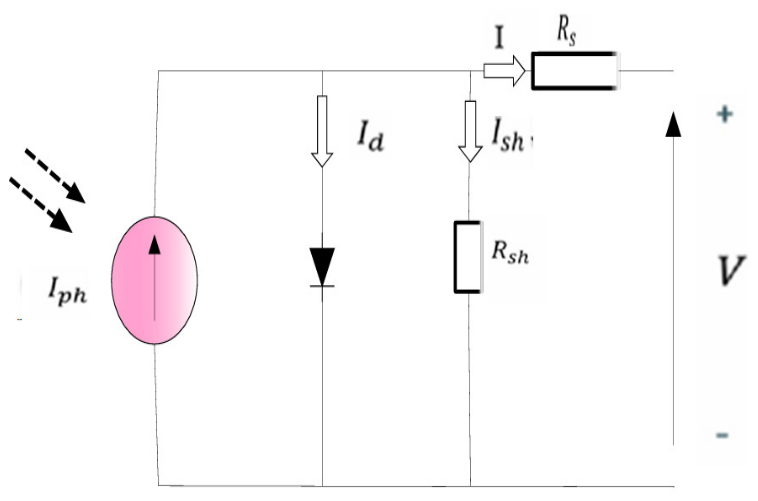
Equations (1)–(3) describe the temperature-dependent single diode model for a photovoltaic cell, which is a commonly used model for the analysis of space power systems because it offers a good balance between accuracy and computational simplicity. These equations describe the generation and variation of the output current from a solar cell [20], as illustrated in Figure 1, which are primarily dependent on two environmental factors for Low Earth Orbit (LEO) platforms: irradiance and temperature.
I p v = I p h I d [ e ( q ( V + I × R s ) K T n N s ) 1 ] V + R S I p v R s h
I p h = ( I s c + k i ( T 270 ) ) G 1000
I d = I d v ( T 298 ) 3 e ( q E q n s k b V t ( 1 298 1 T ) )
Equations (1)–(3) show how the PV current is generated,
  • I s c representing the short-circuit current,
  • I p h Signifying the photocurrent; it is used in PV systems.
  • I d is the symbol for diode saturation current, while I d v is the reference value for this diode saturation current.
The PV panel comprises N s series cells, where R s h is the shunt resistance is, and denotes the series resistance.
  • V t signifies the thermal voltage.
  • k i for temperature, k b for the Boltzmann constant, e stands for the electron charge, and k b for the photon energy.
  • T is temperature (Sunlight), and G is irradiated.
The photovoltaic current is produced by the interaction of photons with energy greater than the semiconductor material’s band gap, causing electrons from the valence band to be excited to the conduction band, resulting in the formation of electron-hole pairs in the p-n junction. These electrons are separated by the built-in electric field in the junction, with the electrons being directed towards the n-side and the holes being directed towards the p-side of the junction, resulting in the photovoltaic current I p h , which is directly proportional to the irradiance and has a weak temperature dependence, as expressed in (2) [20]. The net current I p v is obtained by subtracting the recombination and leakage currents from the photovoltaic current [21], which is expressed by the saturation current and the parasitic resistances in the single diode equation, expressed in (1) and the saturation current expressed in (3) [20]. This physical and mathematical model represents the nonlinear I–V curve of the PV cell, which is the basis for the MPPT in space and terrestrial applications.

2.2. DC-DC Boost Converter Modeling

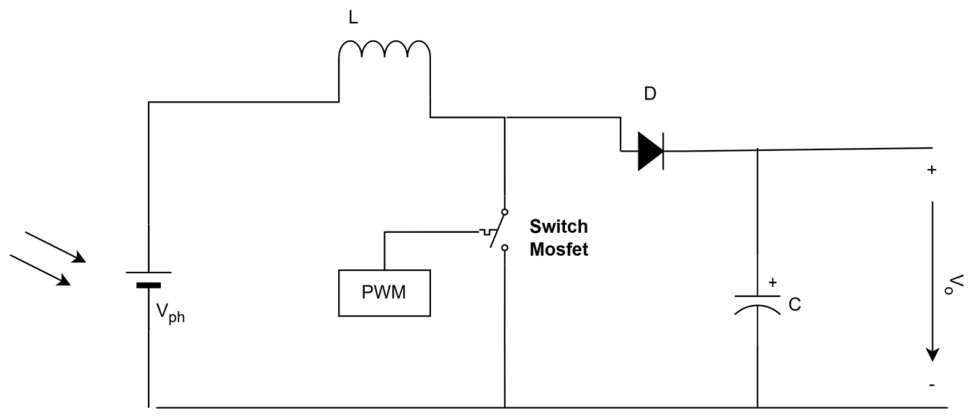
A sizable element of the PV conversion chain is DC-DC converters. These converters change a system’s input voltage to match the intended output voltage. Among them are converters for the buck, boost, buck-boost, and Ćuk [22]. A boost-type converter is typically used as the first stage rather than a transformer to enhance the dual-stage PV’s construction’s broad voltage range or when fewer modules are needed for a given desired output voltage. As seen in Figure 2, this converter circuit is made up of a power switch (S), a diode, a capacitor (C), an inductor (L), a switching controller, and a load (R). This architecture can be utilized as an interface link between the PV array and the load to track the PV array’s MPP in addition to adjusting voltage levels. A MOSFET can be used as the switch, offering a variable duty cycle (D) and an operating frequency (f) that enable frequent on/off cycles. The switches and diodes’ complementary conductivities allow the boost converter to operate in two modes depending on the switch’s position. The switch operates in two modes: closed (ON) and open (OFF). The relationship between the input and output voltages ( V o and V p v ) is expressed in the following expression [23]:
V o = 1 1 D V p h
L = V p v ( V o V p v ) f I V o
Equations (4) and (5) show the voltage output and how to obtain the inductance for the DC-DC boost converter in the PV model system.
  • V o is the output voltage.
  • V p h is the photon or the input voltage from PV arrays.
  • D is the duty cycle.
  • L is the inductor.
  • f is frequency and I current input.
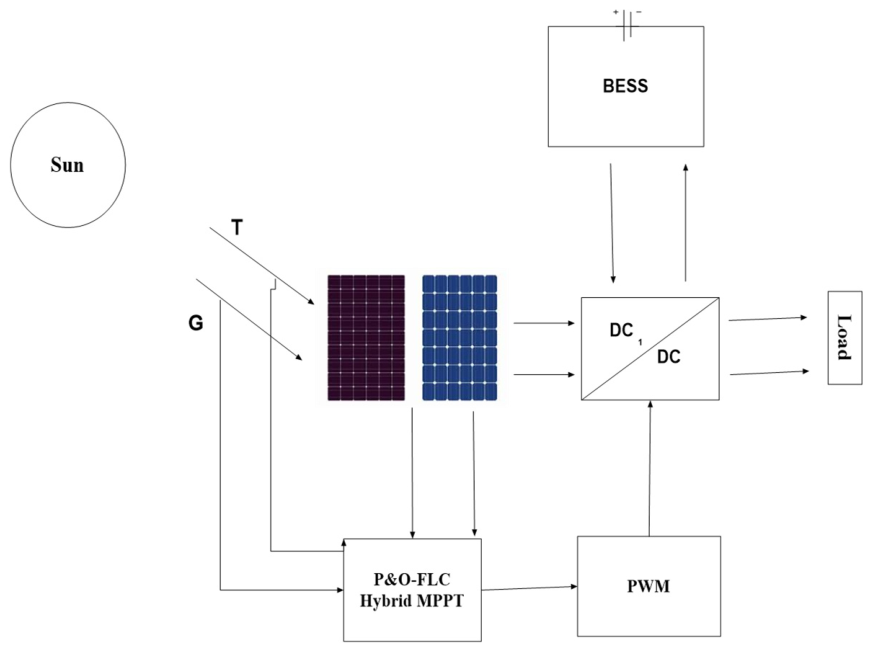
The core focus of this work is to study the impact of combining P&O and fuzzy logic techniques on the performance of photovoltaic panels to optimize the effectiveness of converting solar energy into electrical power and improve the tracking system for powering a satellite at LEO altitudes. The PV module is set up by connecting the suggested photovoltaic module to a boost DC-DC converter, creating a unit. The performance of the INC-ANN-based MPPT control and P&O-FCL will be verified through MATLAB/Simulink R2024b simulations and validated under two different conditions, as illustrated in Figure 3 below.

2.3. Summary of the Literature Review of Hybrid MPPT

Multiple research studies validate hybrid MPPT methods, such as INC and P&O, with intelligent technologies (ANN and FLC), significantly improving tracking accuracy [24], dynamic response, and robustness under rapidly changing irradiance. ANN enhances the prediction accuracy of INC-based MPPT, while FLC compensates for P&O’s steady-state oscillation and improves the non-linear response. These findings strongly support selecting INC ANN or P&O-FLC for advanced hybrid MPPT development, as presented in Table 1.

3. Method

3.1. Simulink Model Development

The hybrid model adapts its optimization strategy based on proximity to the MPP, using P&O for the transition and FL for optimization when the MPP is almost reached, while keeping stability when the MPP is maintained. Figure 4 illustrates the MATLAB/Simulink implementation of the proposed photovoltaic power management system for a Low Earth Orbit (LEO) satellite [28]. The model consists of a photovoltaic array receiving irradiance and temperature profiles representative of orbital operation, followed by a DC–DC boost converter regulated through pulse-width modulation (PWM) [29]. The upper subsystem implements the hybrid MPPT decision logic, where the controller selects the appropriate duty-cycle command to maximize energy extraction under varying operating conditions. The boost converter increases the PV output voltage to meet the load requirements while maintaining operation at the maximum power point. This architecture enables continuous adaptation to rapid irradiance transitions experienced during sunlight and eclipse periods in LEO, thereby improving power availability and system efficiency.

3.2. Hybrid MPPT (P&O-FLC)

The rationale behind the integration of Perturb and Observe (P&O) and Fuzzy Logic Control (FLC) techniques with maximum power point tracking (MPPT) for small satellites in Low Earth Orbits (LEOs) is based on the principle of achieving an effective balance between methodological simplicity and adaptive performance. P&O is considered particularly suitable for implementation with CubeSats due to the low computational complexity and simplicity of implementation; however, it is associated with steady-state oscillations and lower accuracy under high environmental dynamics. On the other hand, FLC techniques provide better adaptability to nonlinear variations in environmental irradiance and temperature, albeit at the potential expense of higher computational complexity. The hybrid implementation of P&O and FLC techniques is likely to improve tracking performance and energy extraction efficiency, which are critical performance parameters in the context of reliable power management in LEO orbits [19,30].
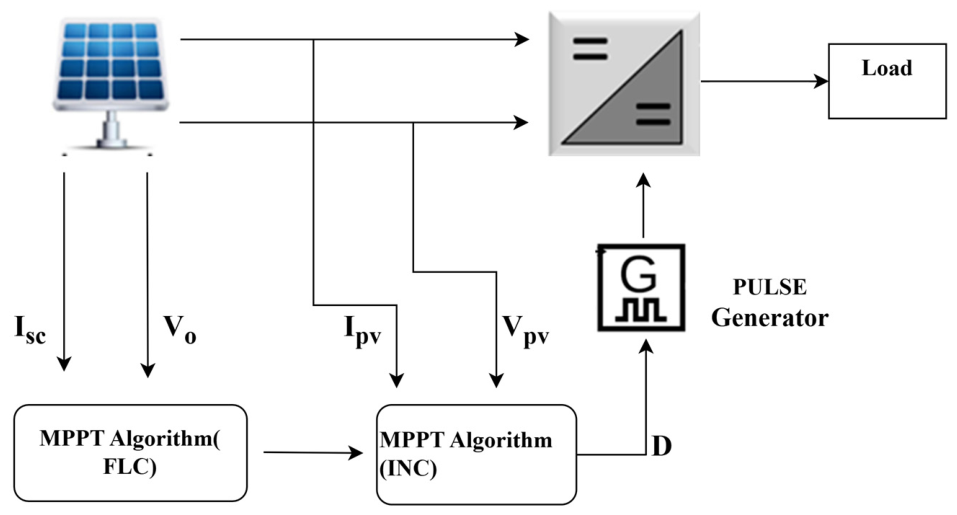
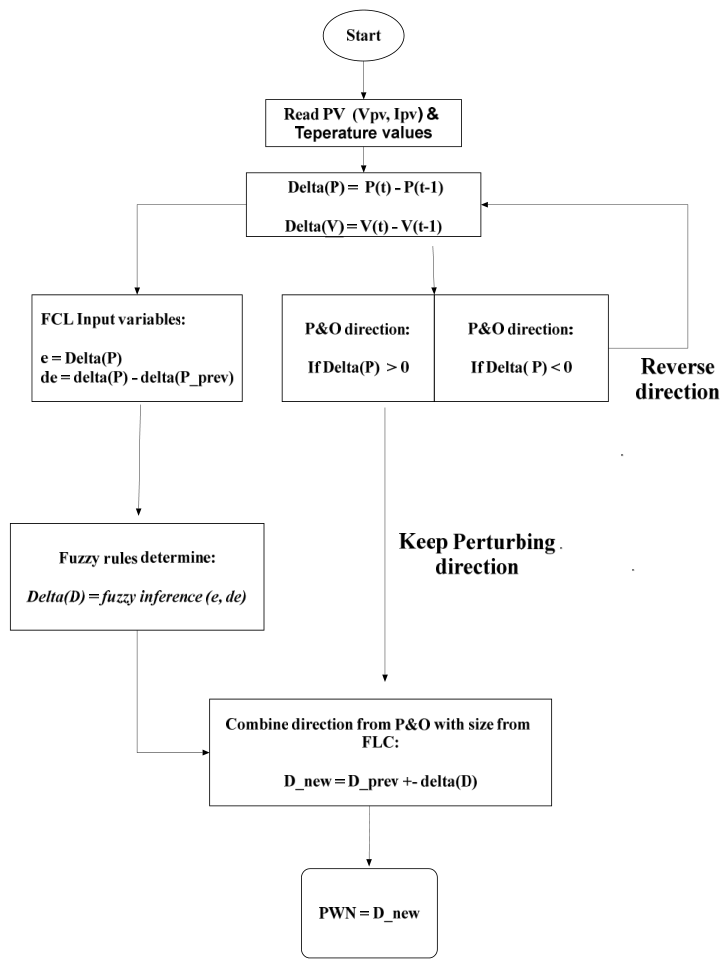
The P&O algorithm defines the perturbation step size according to the instantaneous rate of change of power and voltage. The fuzzy inference mechanism evaluates both the magnitude and polarity of these variations, enabling fine perturbations when operating near the MPPT and larger corrective actions when the system is displaced from the optimal operating region. P&O-FLC hybrid algorithm provides accelerated tracking during large irradiance transitions and substantially lowers steady-state oscillatory behaviors [31,32]. We suggest FLC-P&O, a modified algorithm, to enhance and overcome the limitations of the traditional P&O approach, which has a fixed step size [14]. A fuzzy logic approach is employed to determine the variable step size (ΔD), allowing for automatic adjustment of PV array operating points. The fuzzy logic system uses two inputs based on power variance (ΔP) and voltage variation (ΔV) to determine the changeable step size (ΔD), as depicted in the flowchart representing the hybrid control sequence in Figure 5.

3.3. Hybrid MPPT Design (INC-ANN)

Artificial Neural Networks (ANNs) can be used as an add-on to the Incremental Conductance method to improve the performance of the maximum power point tracking process with respect to both speed and accuracy under varying environmental conditions. Although the conventional INC method relies on the comparison of incremental conductance and the instantaneous conductance to arrive at the maximum power point [29], it sometimes experiences slower convergence and oscillations under varying environmental conditions, such as irradiance and temperature. The incorporation of the ANNs will improve the performance of the MPPT process by enabling the controller to predict the maximum power point based on the relationships between the solar irradiance, temperature, and the PV characteristics. For Low Earth Orbit small satellites, which experience frequent variations in solar irradiance due to the Sun–Eclipse cycles, the proposed method will be an effective solution to maximize the energy utilization while ensuring reliable operation of the power system.
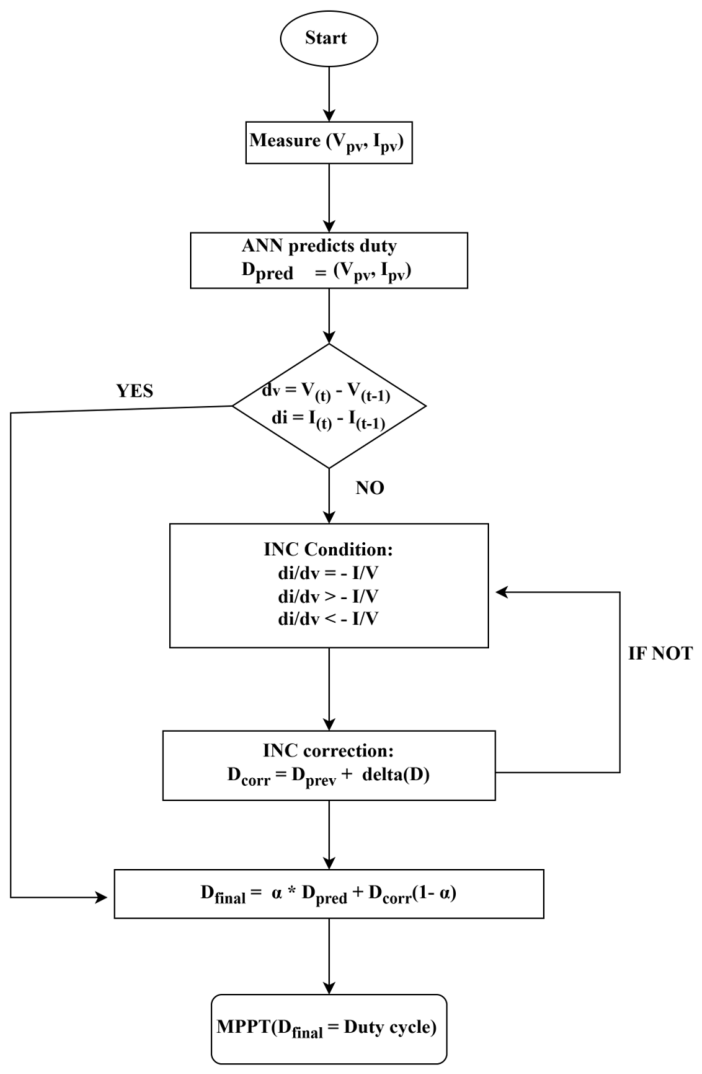
The Incremental Conductance (INC) technique determines the maximum power point by comparing the instantaneous conductance and the incremental conductance of the PV generator. Although INC provides improved tracking accuracy relative to the classical P&O approach, its performance deteriorates under rapidly changing irradiance profiles, such as those observed in LEO environments during sunlight–eclipse transitions. To mitigate this limitation, an ANN is incorporated with INC to establish a hybrid ANN-INC MPPT controller [27]. The ANN is trained to predict the optimal duty cycle using measured PV voltage and current as input features. The ANN provides a fast estimate of the desired operating point, enabling accelerated convergence under abrupt irradiance variations. The INC algorithm serves as a corrective layer, ensuring algorithmic stability and compensating for prediction errors arising from the ANN’s generalization constraints. This combined structure enhances transient response while preserving high tracking accuracy. The operational sequence of the hybrid ANN-INC MPPT is represented in Figure 6, the flowchart below.

4. Results and Discussion

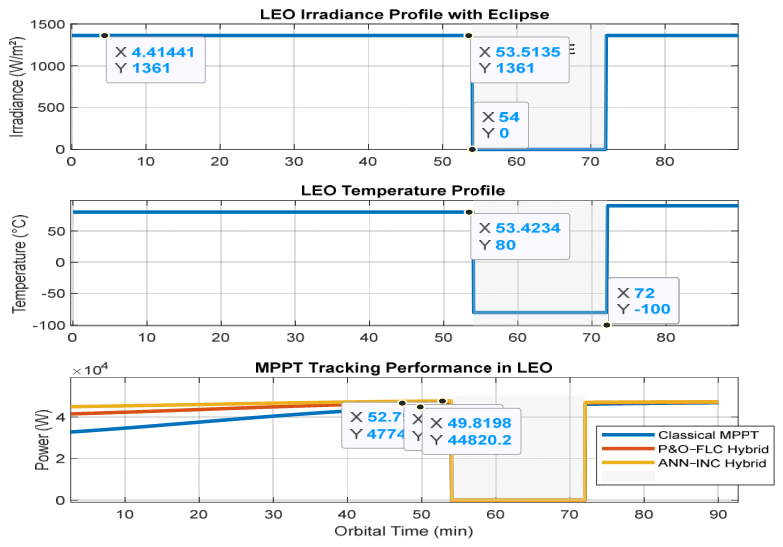
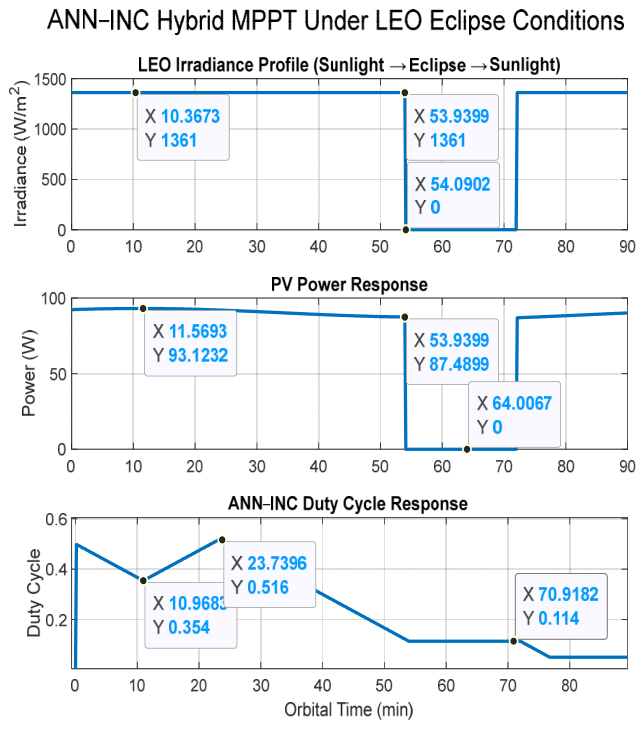
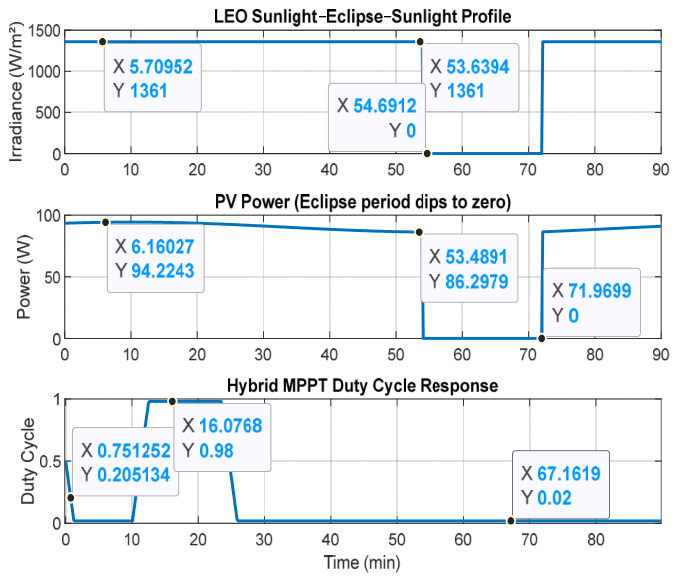
The results represent the expectational behaviors of solar power during the operation of satellites in the Low Earth Orbit (LEO) environment, where the satellite repeatedly transitions between sunlight and eclipse. These transitions directly affect irradiance, cell temperature, and consequently the performance of the MPPT algorithms. Figure 7, Figure 8 and Figure 9 show irradiance, temperature, and power tracking response as follows:

4.1. Irradiance Behavior During LEO

  • Sunlight Phase (0–60 min)
Irradiance remains constant at approximately 1361 W/m2, which corresponds to the solar constant outside Earth’s atmosphere. This stable period represents uninterrupted solar exposure as the satellite travels on the sunlit side of its orbit.
  • Eclipse Phase (≈60–72 min)
At around 53–54 min, irradiance abruptly drops from 1361 W/m2 to 0 W/m2, marking the entry into Earth’s shadow. This is consistent with typical LEO eclipse durations, where the satellite no longer receives direct sunlight.
  • Re-entry to Sunlight (72 min onward)
At approximately 72 min, irradiance sharply returns to 1361 W/m2, indicating the spacecraft has re-emerged from eclipse. This sharp transition is characteristic of LEO orbits, where entry and exit from shadow occur rapidly.

4.2. Temperature Response to Orbital Conditions

  • Sunlight Phase
Temperature remains high at +80 °C, reflecting the continuous thermal input from solar radiation.
  • Eclipse Phase
As irradiance falls to zero, temperature drops drastically to approximately −80 °C, matching extreme LEO thermal conditions when solar heating is lost.
  • Post-Eclipse Sunlight
On returning to sunlight, the temperature rises back to +90 °C, which represents the expected thermal overshoot after eclipse due to rapid warming from direct sunlight. This thermal behavior directly influences PV efficiency, which decreases at high temperatures and increases during colder eclipse periods, though no power is available in eclipse due to zero irradiance.
The three MPPT methods exhibit clear performance differences under sunlight eclipse transitions, as illustrated in Figure 9. The classical P&O/INC algorithm responds the slowest, converging to a lower power level, recovering gradually after the eclipse, losing energy due to its limited ability to handle abrupt irradiance change. The P&O-FCL hybrid improves significantly, achieving faster convergence, higher power extraction, and quicker post-eclipse recovery as the fuzzy logic adaptively adjusts perturbation steps for dynamic behavior. The ANN-INC hybrid delivers the best performance, producing the highest power, showing the steepest and fastest convergence after eclipse. There is strong robustness during transitions, as the ANN predicts the operating region while the INC method fine-tunes in the final tracking.

4.3. Summary of Key Observations

Table 2 presents a comparative evaluation of the investigated MPPT methods based on tracking speed, response following an eclipse event, and extracted power. The results indicate that the hybrid MPPT approaches exhibit superior performance compared with the conventional MPPT method [28,29]. Among the evaluated techniques, the INC-ANN hybrid demonstrates the fastest tracking speed, immediate post-eclipse response, and the highest power extraction, whereas the P&O-FLC hybrid provides improved performance over the classical MPPT algorithm [33,34].

5. Conclusions

The results show that LEO orbital conditions cause rapid fluctuations in irradiance and temperature, which significantly affect PV performance. The hybrid ANN-INC and P&O-FLC algorithms demonstrate superior tracking speed and energy extraction efficiency compared to classical MPPT methods. ANN-INC provides the best overall performance, making it the most suitable choice for future LEO solar power subsystems. The proposed technique was developed in the MATLAB/Simulink environment to implement modern techniques and achieve superior tracking speed, efficiency, and steady state, and to show how the PV responds during an orbital mission.

Author Contributions

Conceptualization, K.M. and W.K.N.; methodology, K.M.; formal analysis, K.M.; investigation, K.M.; resources, W.K.N. and M.K.; supervision, M.K. and W.K.N.; writing—original draft preparation, K.M.; writing—review and editing, W.K.N. and M.K. All authors have read and agreed to the published version of the manuscript.

Funding

This research received no external funding.

Institutional Review Board Statement

Not applicable.

Informed Consent Statement

Not applicable.

Data Availability Statement

Data is contained within the article.

Conflicts of Interest

The authors declare no conflict of interest.

Abbreviations

ANNArtificial Neural Network
FLCFuzzy Logic Controller
MPPTMaximum Power Point Tracking
INCIncremental Conductance
PVPhotovoltaic
P&OPerturb and Observe
LEOLow Earth Orbit

References

  1. Gordo, P.; Frederico, T.; Melício, R.; Duzellier, S.; Amorim, A. System for space materials evaluation in LEO environment. Adv. Space Res. 2020, 66, 307–320. [Google Scholar] [CrossRef] [Scilit]
  2. Nahari, A.; Mousavi, S.M.; Ebrahimi, A.; Biglarahmadi, M. Design of Photovoltaic Simulator to Supply Satellite Power. Int. J. Electron. Commun. Comput. Eng. (IJECCE) 2014, 5, 450–454. [Google Scholar]
  3. Daghouri, A.; El Hani, S.; El Hachimi, Y.; Mediouni, H. Enhanced hybrid energy storage system combining battery and supercapacitor to extend nanosatellite lifespan. Results Eng. 2024, 23, 102634. [Google Scholar] [CrossRef] [Scilit]
  4. Mokhtar, M.A.; ElTohamy, H.A.F.; Yehia, Z.E.; Mohamed, E.H. Developing a novel battery management algorithm with energy budget calculation for low Earth orbit (LEO) spacecraft. Aerosp. Syst. 2024, 7, 143–157. [Google Scholar]
  5. Mostacciuolo, E.; Iannelli, L.; Sagnelli, S.; Vasca, F.; Luisi, R.; Stanzione, V. Modeling and power management of a LEO small satellite electrical power system. In Proceedings of the 2018 European Control Conference (ECC), Limassol, Cyprus, 12–15 June 2018; IEEE: New York, NY, USA, 2018; pp. 2738–2743. [Google Scholar]
  6. Noroozi, S.; Shayanfar, H.; Nasirian, M. Design of an intelligent MPPT for a PV array mounted on a satellite considering outer space. Int. Trans. Electr. Energy Syst. 2021, 31, e12984. [Google Scholar] [CrossRef] [Scilit]
  7. Mostacciuolo, E.; Baccari, S.; Sagnelli, S.; Iannelli, L.; Vasca, F. An optimization approach for electrical power system supervision and sizing in low Earth orbit satellites. IEEE Access 2024, 12, 151864–151875. [Google Scholar] [CrossRef] [Scilit]
  8. Soon, J.J.; Chia, J.W.; Aung, H.; Lew, J.M.; Goh, S.T.; Low, K.-S. A photovoltaic model based method to monitor solar array degradation on-board a microsatellite. IEEE Trans. Aerosp. Electron. Syst. 2018, 54, 2537–2546. [Google Scholar] [CrossRef] [Scilit]
  9. Schirone, L.; Granello, P.; Massaioli, S.; Ferrara, M.; Pellitteri, F. An approach for maximum power point tracking in satellite photovoltaic arrays. In Proceedings of the 2024 International Symposium on Power Electronics, Electrical Drives, Automation and Motion (SPEEDAM), Ischia, Italy, 19–21 June 2024; IEEE: New York, NY, USA, 2024; pp. 788–793. [Google Scholar]
  10. Park, J.-E.; Han, J.-K.; Park, K.-B.; Lee, B.-H.; Moon, G.-W. A new direct charging control for electrical power systems in low Earth orbit satellites. IEEE Trans. Aerosp. Electron. Syst. 2022, 59, 2566–2578. [Google Scholar] [CrossRef] [Scilit]
  11. Abbas, A.; Farhan, M.; Shahzad, M.; Liaqat, R.; Ijaz, U. Power tracking and performance analysis of hybrid perturb–observe, particle swarm optimization, and fuzzy logic-based improved MPPT control for standalone PV system. Technologies 2025, 13, 112. [Google Scholar]
  12. Vaishnav, M.; Patnaik, S. Optimizing Solar Battery Charging Through MPPT-Based Control Systems. In AI-Driven Solutions and Emerging Power Technologies for Sustainable Future; Lecture Notes in Electrical Engineering; Springer: Singapore, 2026; Volume 1485, pp. 155–166. [Google Scholar]
  13. Ibrahim, A.-W.; Al-Shamma’a, A.A.; Xu, J.; Li, D.; Farh, H.M.H.; Alwesabi, K. A Novel Red-Billed Blue Magpie Optimizer Tuned Adaptive Fractional-Order for Hybrid PV-TEG Systems Green Energy Harvesting-Based MPPT Algorithms. Fractal Fract. 2025, 9, 704. [Google Scholar]
  14. Dwaza, K.N.; Krishnamurthy, S.; Mataifa, H. Time-Domain Modeling and Simulation of Hybrid Perturb and Observe–Particle Swarm Optimization Maximum Power Point Tracking for Enhanced CubeSat Photovoltaic Energy Harvesting. Energies 2025, 18, 5957. [Google Scholar]
  15. Tao, H.; Ghahremani, M.; Ahmed, F.W.; Jing, W.; Nazir, M.S.; Ohshima, K. A novel MPPT controller in PV systems with hybrid whale optimization-PS algorithm based ANFIS under different conditions. Control Eng. Pract. 2021, 112, 104809. [Google Scholar] [CrossRef] [Scilit]
  16. Seddjar, A.; Kerrouche, K.D.E.; Wang, L. Simulation of the proposed combined fuzzy logic control for maximum power point tracking and battery charge regulation used in CubeSat. Arch. Electr. Eng. 2020, 69, 521–543. [Google Scholar] [CrossRef] [Scilit]
  17. Razmi, N.; Matthiesen, B.; Teodorescu, R.; Dekorsy, A.; Popovski, P. Satellite Battery Lifetime Extension via Scheduling of Onboard Computing and Energy Harvesting. IEEE Access 2026, 14, 13025–13040. [Google Scholar] [CrossRef] [Scilit]
  18. Chen, F.; Wang, Q.; Ran, Y. Dynamic routing algorithm for maximizing battery life in LEO satellite networks. In Proceedings of the 2022 IEEE 8th International Conference on Computer and Communications (ICCC), Chengdu, China, 9–12 December 2022; IEEE: New York, NY, USA, 2022; pp. 671–676. [Google Scholar]
  19. Harrison, A.; Feudjio, C.; Mbobda, C.R.F.; Alombah, N.H. A new framework for improving MPPT algorithms through search space reduction. Results Eng. 2024, 22, 101998. [Google Scholar] [CrossRef] [Scilit]
  20. Siddique, M.A.B.; Zhao, D.; Rehman, A.U. Emerging maximum power point control algorithms for PV system: Review, challenges and future trends: MA B Siddique et al. Electr. Eng. 2025, 107, 9807–9839. [Google Scholar]
  21. Stephen, A.A.; Musasa, K.; Davidson, I.E. Modelling of solar PV under varying conditions with an improved incremental conductance and integral regulator. Energies 2022, 15, 2405. [Google Scholar] [CrossRef] [Scilit]
  22. Ravindran, R.; Massoud, A.M. State-of-the-art DC-DC converters for satellite applications: A comprehensive review. Aerospace 2025, 12, 97. [Google Scholar]
  23. Haq, I.U.; Khan, Q.; Ullah, S.; Khan, S.A.; Akmeliawati, R.; Khan, M.A.; Iqbal, J. Neural network-based adaptive global sliding mode MPPT controller design for stand-alone photovoltaic systems. PLoS ONE 2022, 17, e0260480. [Google Scholar] [PubMed]
  24. Masry, M.Z.-E.; Mohammed, A.; Amer, F.; Mubarak, R. New hybrid MPPT technique including artificial intelligence and traditional techniques for extracting the global maximum power from partially shaded PV systems. Sustainability 2023, 15, 10884. [Google Scholar] [CrossRef] [Scilit]
  25. Elobaid, L.M.; Abdelsalam, A.K.; Zakzouk, E.E. Artificial neural network-based photovoltaic maximum power point tracking techniques: A survey. IET Renew. Power Gener. 2015, 9, 1043–1063. [Google Scholar] [CrossRef] [Scilit]
  26. Khakim, A.L.; Triwiyatno, A.; Handoko, S. Analysis of MPPT Output Results Based on P&O-Fuzzy and Flow Changes Combination Compared to Classic P&O Algorithms. In Proceedings of the 2021 3rd International Symposium on Material and Electrical Engineering (ISMEE); IEEE: New York, NY, USA, 2021; pp. 309–314. [Google Scholar]
  27. Kumar, A.; Chaudhary, P.; Shah, O.A. Intelligent Controller Based on Artificial Neural Network and INC Based MPPT for Grid Integrated Solar PV System. Int. J. Robot. Control Syst. 2023, 3, 839. [Google Scholar] [CrossRef] [Scilit]
  28. Kumar, M.; Panda, K.P.; Rosas-Caro, J.C.; Valderrabano-Gonzalez, A.; Panda, G. Comprehensive Review of Conventional and Emerging Maximum Power Point Tracking Algorithms for Uniformly and Partially Shaded Solar Photovoltaic Systems. IEEE Access 2023, 11, 31778–31812. [Google Scholar] [CrossRef] [Scilit]
  29. Chandola, J.; Pundir, S.; Sharma, A.; Song, Y.; Fekete, G.; Singh, T. Recent advances in MPPT techniques for photovoltaic systems: A review of classical (P&O, IC), intelligent (ANN), optimization (PSO) and hybrid (ANN-PSO) methods. Results Eng. 2026, 29, 109395. [Google Scholar]
  30. Mrhar, O.; Kandoussi, K.; Eljouad, M. A new hybrid MPPT algorithm combining P&O and fuzzy logic techniques. Int. J. Power Electron. Drive Syst. (IJPEDS) 2025, 16, 497–508. [Google Scholar] [CrossRef] [Scilit]
  31. Chen, T.; Harrison, A.; Alombah, N.H.; Aurangzeb, M.; Iqbal, S.; Mahmoud, H.A. A simplified control algorithm for efficient and robust tracking of the maximum power point in PV systems. Control Eng. Pract. 2024, 148, 105945. [Google Scholar] [CrossRef] [Scilit]
  32. Wei, X.; Harrison, A.; Naser, A.T.; Mbasso, W.F.; Dagal, I.; Alombah, N.H.; Jangir, P.; Sharaf, M.; El-Meligy, M. A new intelligent control and advanced global optimization methodology for peak solar energy system performance under challenging shading conditions. Appl. Energy 2025, 390, 125808. [Google Scholar] [CrossRef] [Scilit]
  33. Bollipo, R.B.; Mikkili, S.; Bonthagorla, P.K. Hybrid, optimal, intelligent and classical PV MPPT techniques: A review. CSEE J. Power Energy Syst. 2021, 7, 9–33. [Google Scholar]
  34. Nadhim, N.N.; Salim, M.S. Maximum Power Point Tracking Techniques for Photovoltaic Systems: A Review. Al-Nahrain J. Eng. Sci. 2025, 28, 653–660. [Google Scholar] [CrossRef] [Scilit]
Figure 1. The single diode model of a PV cell.
Engproc 140 00074 g001
Figure 2. DC-DC boost converter Simulink.
Engproc 140 00074 g002
Figure 3. Proposed hybrid MPPT model system architecture.
Engproc 140 00074 g003
Figure 4. Simulink model development.
Engproc 140 00074 g004
Figure 5. Hybrid MPPT algorithm flowchart (P&O-FLC).
Engproc 140 00074 g005
Figure 6. Hybrid MPPT flowchart (INC-ANN).
Engproc 140 00074 g006
Figure 7. ANN-INC hybrid MPPT under LEO eclipse condition.
Engproc 140 00074 g007
Figure 8. P&O-FLC hybrid MPPT with eclipse.
Engproc 140 00074 g008
Figure 9. Expected results simulation for LEO with eclipse.
Engproc 140 00074 g009
Table 1. Summary of hybrid MPPT literature relevant to LEO solar power systems.
Authors and YearHybrid MethodsContributions
Elobaid et.al., 2015 [25] INC-FLCFast tracking and reduced oscillation.
Khakim et al. (2021) [26]P&O-FLCFuzzy logic achieved lower oscillations, improved stability, and more accurate MPPT than conventional P&O under varying irradiance
Antil Kumar, P. Chaudhary, 2023 [27]INC-ANNThese findings show that our method has the potential to greatly improve the efficiency and dependability of solar PV systems. The results of this study have implications for renewable energy in general and present a viable path toward enhancing the resilience and sustainability of energy infrastructure.
Table 2. Comparing the MPPT algorithm and its performance.
MPPT MethodsTracking SpeedResponse After EclipseExtracted Power
Classical MPPTSlowSlowLowest
P&O-FLC hybridMediumSlow recoveryHigh
INC-ANN hybridFastestImmediateHighest
Disclaimer/Publisher’s Note: The statements, opinions and data contained in all publications are solely those of the individual author(s) and contributor(s) and not of MDPI and/or the editor(s). MDPI and/or the editor(s) disclaim responsibility for any injury to people or property resulting from any ideas, methods, instructions or products referred to in the content.