1. Introduction
The global shift toward renewable and distributed generation has led to an increasing share of inverter based-resources (IBRs) in modern power systems. While this transition supports environmental sustainability, it introduces new challenges in maintaining frequency stability due to the reduction in system inertia [
1,
2]. In low-inertia power systems, conventional synchronous generators, which inherently provide an inertia response, are being replaced by IBRs that lack physical inertia, which is very important for system resilience during disturbances. Consequently, system operators are exploring advanced control strategies and ESSs to provide synthetic or virtual inertia to improve overall frequency resilience.
Among the promising solutions are FESSs and BESSs. FESSs offer rapid response and high cycling capability, making them suitable for short-term frequency regulation, while BESSs provide high energy capacity and longer discharge duration, which is beneficial for sustained power support [
3,
4]. However, operating these two systems independently often leads to suboptimal performance, since each technology has limitations. FESSs suffer from relatively low energy density, whereas BESSs experience degradation under frequent cycling.
Recent studies have explored hybrid or complementary FESS–BESS configurations to combine the fast dynamics of flywheels with energy storage capability. For instance, in Refs. [
3,
4] demonstrated that coordinated control can effectively enhance system response during transient disturbances. In Ref. [
5], assignments of the frequency deviation ranges to FESS, BESS, and generators, using coordinated control to improve frequency support in microgrids. Another work reported in Ref. [
6], utilizes MPC-based coordination where the fast FESS responds first to frequency disturbances and the slower BESS compensates gradually. Nonetheless, most of these works focus on simplified coordination strategies or individual storage operation, without addressing the dynamic interaction and coordinated control mechanisms of both storage systems under realistic low-inertia conditions [
7].
Moreover, the growing integration of electric vehicles (EVs), further contributes to reducing system inertia and complex power flow dynamics. Their bidirectional charging capability can both support and challenge frequency stability depending on the control approach used [
8]. This makes the coordinated operation of complementary storage systems even more crucial.
Therefore, this paper proposes an AD-MPC-based coordinated control strategy for FESS–BESS systems to enhance frequency stability in low-inertia power networks. The proposed approach exploits the complementary characteristics of FESSs and BESSs to deliver a system inertia response, mitigate battery degradation, and maintain system stability under variable load and generation conditions.
2. Novelty and Originality of This Paper
The main novelty of this study lies in the development of an AD-MPC controller for the coordinated operation of FESS–BESS systems in low-inertia power networks. Unlike synchronous control methods, the proposed strategy enables independent and asynchronous decision-making among distributed controllers, enhancing scalability and robustness under communication delays. Furthermore, the control algorithm leverages the complementary dynamics of FESS and BESS, utilizing the inertia response capability of FESS and the high-energy capacity of BESS for primary frequency response. The inclusion of IBRs and EV loads in the network model provides a realistic representation of modern low-inertia grids. This coordinated approach will not only improve frequency regulation performance but also mitigate battery degradation, offering a practical and efficient solution for future renewable-dominated power systems.
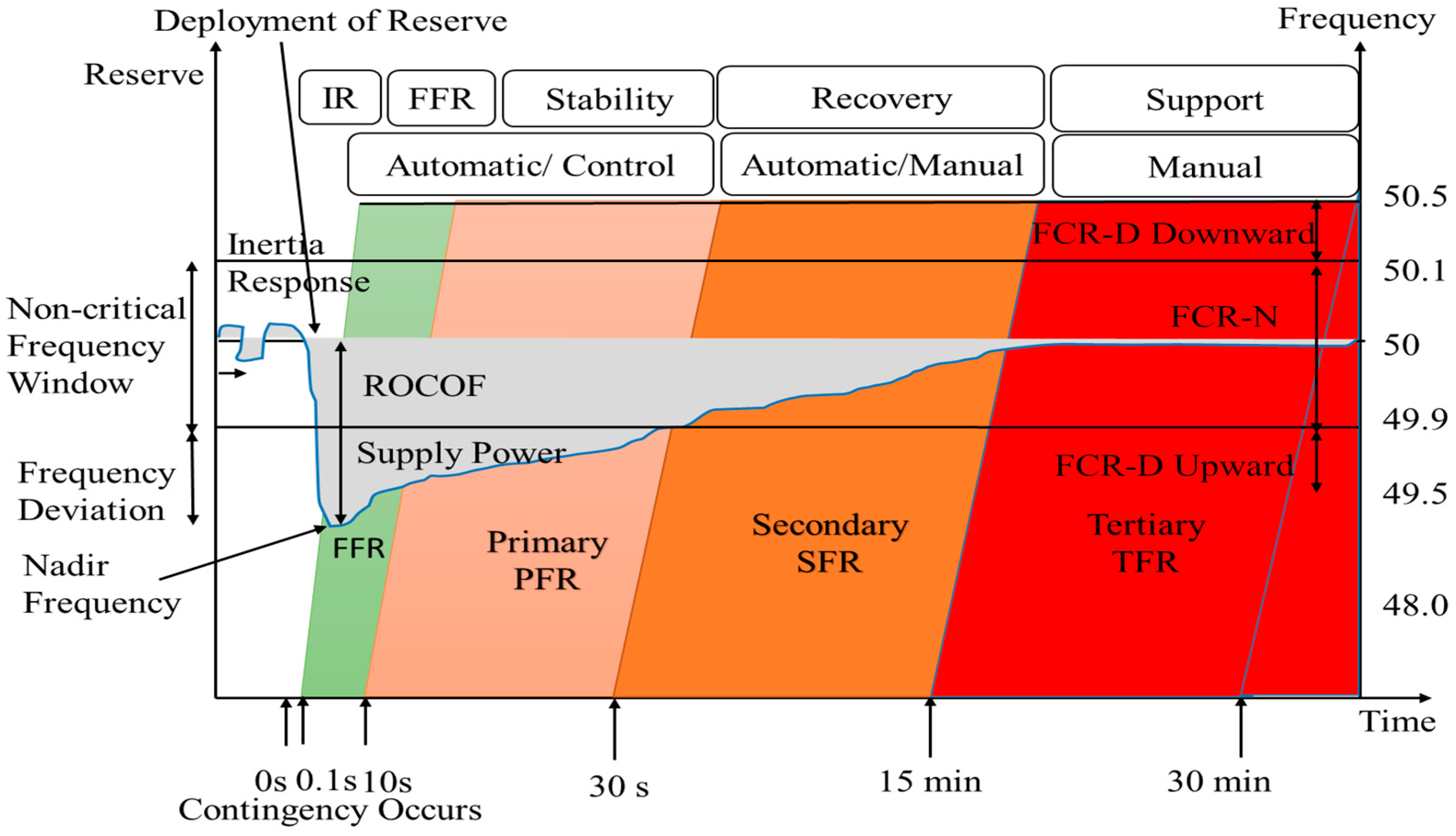
When dynamic disturbances occur on a power system, there are basically four main stages for the system to recover to the nominal frequency: the inertia response, the primary frequency response, the secondary frequency response, and the tertiary frequency response as shown in
Figure 1 which was also discussed in Ref. [
9]. Recent literature shows that ESS, especially FESS, BESS, and hybrid ESS have been applied with control schemes such as droop control, and voltage source generator (inertia emulation), model predictive control (MPC) and its distributed variants, and hybrid supervisory architectures to provide support across those four stages, delivering ultra-fast inertia response, primary arresting of RoCoF and nadir, and coordinated secondary/tertiary recovery and energy management [
10,
11,
12,
13].
Recent research demonstrates growing interest in the use of ESSs for enhancing frequency stability across all response stages of modern power grids. Various ESS technologies, such as batteries, flywheels, and hybrid configurations, have been investigated under advanced control frameworks, including MPC, synchronous MPC, and optimization-based coordination schemes. For instance, Ref. [
10] reviewed global fast frequency response strategies leveraging ESSs in renewable-dominant grids; Ref. [
11] provided an in-depth analysis of FESSs and their frequency control applications; Ref. [
12] applied optimal MPC for ESS coordination to stabilize grid frequency under dynamic disturbances; and Ref. [
13] proposed a multi-ESS task allocation MPC framework for secondary frequency regulation, improving overall system robustness and response speed.
3. Mathematical Comprehension of the Problem
The power system is represented by a set of nodes N, the FESS by a subset
of nodes, and the BESS by a subset
. Thus,
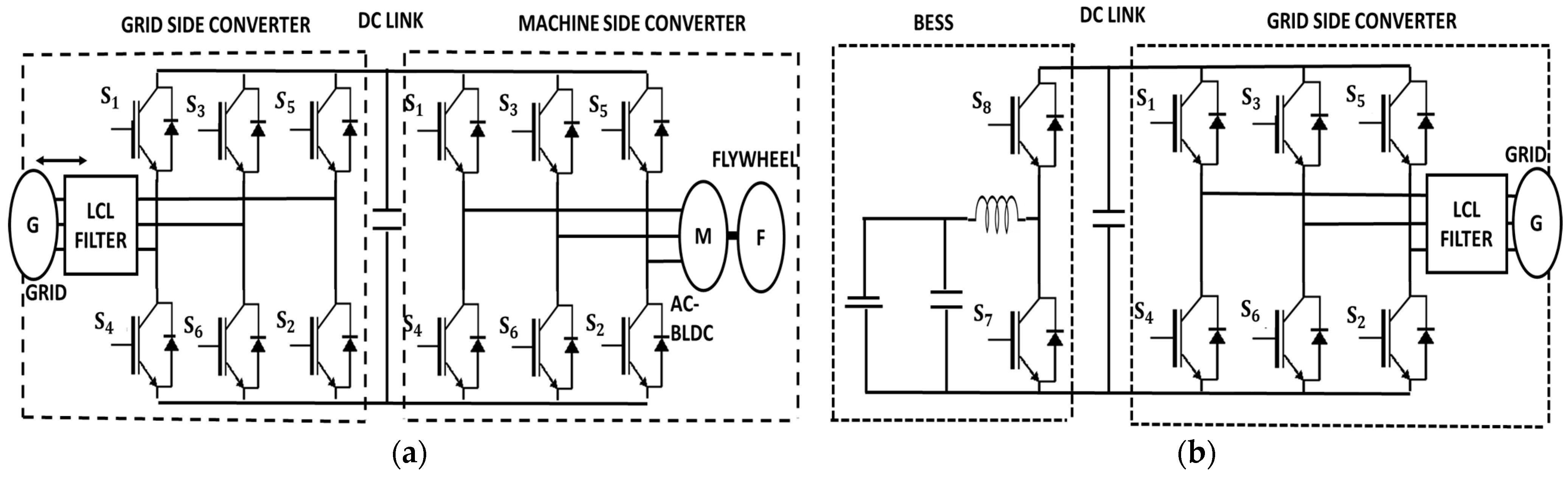
⊂ N, and the FESS unit is connected as shown in
Figure 2a, while
⊂ N, and the BESS units are installed as shown in
Figure 2b. The rest of the grid model includes synchronous generators, IBRs, EV loads, and lines.
3.1. Small Signal of FESS
FESS dynamics (rotor/speed), rotor kinetic energy store
(J), and electrical pow exchange, mechanical speed, converter power, and the SoC are, respectively, as discussed in Ref. [
3] and are shown in Equation (1):
where: J is the moment of inertia of the PMSM machine rotor system in kg·m
2. It quantifies the resistance of the rotor to changes in rotational speed.
is the rotor angular speed in rad/s.
The focus is on how the FESS active power changes in response to frequency deviations, as discussed in [
14] with BESS, which requires a linearized dynamic model, as shown in Ref. [
15].
where J is the flywheel moment of inertia in kg·m
2,
,
, and
are, respectively, the angular speed, speed deviation, and speed acceleration in rad/s, rad/s, and rad/s
2;
is the mechanical damping coefficient in
; Tm and
are the mechanical torque and torque deviation in
;
and
are the converter active power and changing output power in W;
and
are the power references from the controller in W;
is the inverter power control time constant in s;
is the inverter power control gain in % or p.u.;
and
are the SoC in % or p.u; and
is the maximum stored kinetic energy in J.
Equation (2) is the minimal continuous-time state-space of the FESS. The state vector is chosen as
, the control input vector is
and the disturbance vector is
and the continuous state equation can then be formulated as:
The output that typically matters is the power from the inverter: .
3.2. Small-Signal BESS Dynamics Modeling
A BESS can be represented by three main components: a battery cell model, usually an equivalent circuit model (ECM); converter dynamics; an inverter; and a power controller. For small-signal studies (LFC, transient stability), the focus is on how the BESS affects the active power. Changes in response to frequency deviations require a linearized dynamic model, as shown in Ref. [
16]. The states are chosen as
the input is
, and the output is
, which is the power output of the converter. The linearized continuous model is given by Equation (3):
where
is the deviation of the DC-link (Thevenin) voltage in V
is the time derivative of the DC-link voltage deviation in V/s;
is the equivalent Thevenin resistance of the battery–converter DC interface;
is the equivalent DC-link capacitance in F;
is the nominal battery voltage in V;
is the deviation of the converter output power (AC side) in W;
is the inverter control loop time constant in s;
is the small commanded power reference in W; and ∆SoC is the deviation from the nominal operating point in p.u. Using the linearized continuous model in Equation (3), the small-signal model of the BESS can be obtained. That yields the compact sate-space:
3.3. Devices Injected into the Low-Inertia Power System (Swing Equation)
For each generator/area (i) with mechanical inertia
= 2
inertia per machine, the small-signal swing with injections becomes Equation (4).
where
and
are the active-power contributions from the FESS and BESS mapped to area
. For a single unit at bus
connected to generator
the injection is mapped as
or simply add
to
if bus i = machine bus.
3.4. Coordination Law (Control Allocation)
There are two complementary control levels, with the FESS time constant being shorter than the BESS time constant. The output power command of each inverter simulates its virtual inertia, as shown in Equation (5). For immediate response, each device may implement a local emulation law:
where
and
are respectively, the emulated inertia of the FESS and BESS proportional to the estimated RoCoF, and
,
are respectively, the emulated droop of the FESS and BESS. In small-signal linearization,
is approximated by state differences or a filtered derivative.
3.5. Objective Function of the AD-MPC Controller
The objective function minimizes the cumulative performance index J over a prediction horizon
by optimally selecting the control commands
(flywheel power command) and
(battery power command). The cost function penalizes frequency deviations, tie-line power deviations, control effort, and SoC deviation from a desired reference. At each local controller, the AD-MPC solves a quadratic program, as shown in Equation (6)
where the priority weighting sets
small and
larger to preserve BESS energy for a longer duration. A term penalizing the energy usage of the FESS is also included if its
becomes low. The disturbance matrix
maps load steps into the swing equations and possible mechanical torque disturbances into the FESS.
The weighting coefficients,,, and determine the trade-off between frequency regulation performance, tie-line damping, control effort minimization, and energy management. Proper tuning of these parameters allows coordinated operation where the flywheel typically provides fast dynamic support, while the battery handles slower, energy-balancing actions.
4. AD-MPC Design for Coordination of FESS and BESS Using an Augmented Small-Signal State Vector on a 2A-LFC
The system states of the low-inertia power system, including frequency
, FESS, and BESS are stacked as
, where
is defined in Equation (2), and
is defined in Equation (3). The discrete augmented model used in the AD-MPC controller is given by Equation (7):
where
represents the control commands from AD-MPC/local MPCs, and
represents the disturbances (load steps, generator trips). The block structure (symbolic) is given below.
where
is the representation of the grid matrix;
and
are, respectively, the local device matrices extracted from the small-signal equations in
Section 3.1 and
Section 3.2; and
and
are, respectively, the matrices associated with the injection of ∆
and ∆
into the frequency dynamics.
4.1. Small-Signal State-Space Modeling
The small-signal state-space modeling of each subsystem defined in
Section 3.1 and
Section 3.2 can adopt a local model extracted from the global linear system’s local state subset, while the effects of the other systems are modeled as measured disturbances. The discrete form
is the predictive model inside the AD-MPC optimization, where
,
, and
. In practice,
and
are computed using available functions.
should be chosen consistently with the fastest time to have different
per system. In practice, compute
,
with available functions. Choose
consistent with the fastest time to have different
per system.
4.2. Remarks on Parameter Selection and Linearization
To increase the fidelity, the state vector was extended to include converter filter currents (dq), DC-link voltage, or rotor speed for FESS, and linearize those nonlinear dynamics around the operating point. The Jacobian yields matrices for use in MPC. For multiple BESS/FESS, stack local state vectors and include coupling terms in the frequency equation. Each system power enters the right-hand side of the frequency equation with a sign convention.
5. Frequency Regulation in a Modified IEEE 39-Bus System with FESS and BESS Support
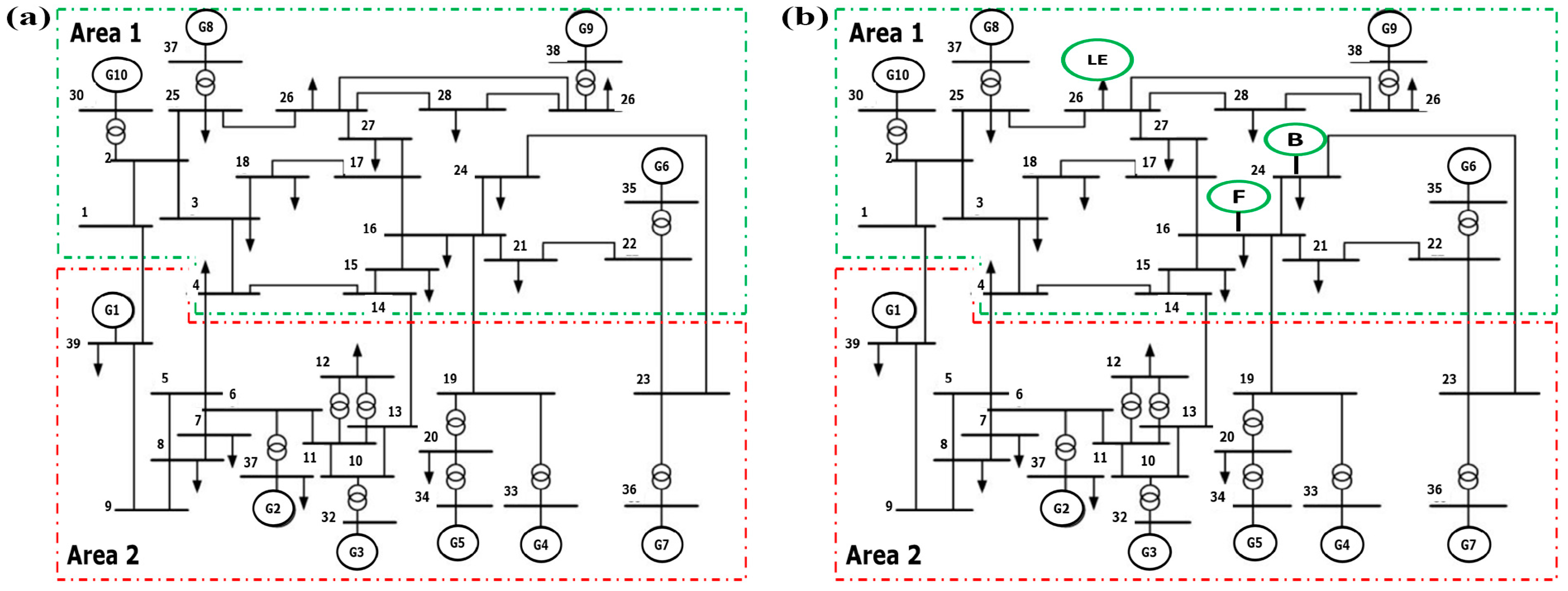
To assess the effectiveness of the proposed control strategies, a dynamic case study was performed on a modified IEEE 39-bus testing system. The original network configuration is shown in
Figure 3a, Area 1, while the modified system integrates IBR to emulate the system to reproduce dynamic systems behavior, along with coupled FESS and BESS units, as illustrated in
Figure 3b, Area 2. These additions create a realistic low-inertia 199 environment representative of modern renewable-rich power grids.
where
is the load gain and
is the time constant of the load response.
The test system incorporates a total of 5 MW of IBRs in one area, consisting of a 3 MW WEC S and a 2 MW Solar PV plant. The integration of these IBRs effectively reduces the system’s overall inertia, increasing the vulnerability of frequency stability following a 5 MW EV load emulator disturbance, which is connected at one of the area buses to simulate demand variations. To mitigate these effects, a HESS, comprising 10 identical FESS units rated at 100 kW each and two 1 MW BESS units (totaling 2 MW), was deployed within the same area. The modified inertia constant of the affected area is reduced according to the equation in Ref. [
18].
Table 1 summarizes the original inertia constants of the IEEE 39-bus generators and the reduced inertia values obtained after integrating the 3 MW wind and 2 MW solar units, which effectively lower the synchronous inertia in the affected area.
At the initial stage, the system operates in a steady state at the nominal frequency of 50 Hz. After 6 s, the load emulator increases its demand by 30%, resulting in a total load of 6.5 MW. This sudden load step causes a frequency deviation due to the imbalance between generation and demand. Three distinct scenarios were simulated to compare the dynamic frequency behavior:
Scenario 1—FESS Support Only Using the Small Signal Developed in Equation (2): The FESS responds via its AD-MPC (or conventional droop/PI loop), injecting active power proportional to the frequency deviation and its rate of change.
Scenario 2—BESS Support Only Using the Small Signal Developed in Equation (3): The BESS contributes through its slower dynamic response, governed by its AD-MPC or droop controller, providing sustained active power support to restore the frequency.
Scenario 3—Coordinated FESS+BESS Using Small Signal AD-MPC: Both storage systems operate in a coordinated manner. The FESS delivers immediate inertial support, while the BESS supplies sustained power to complete the recovery process.
6. Results and Discussion
In the event of a sudden disturbance, the voltage level of the system remains constant; only the current changes as a result of load variation. The system response was analyzed in MATLAB/Simulink 2025a, using a discrete-time simulation with a 10 ms sampling step. The following performance indicators were observed:
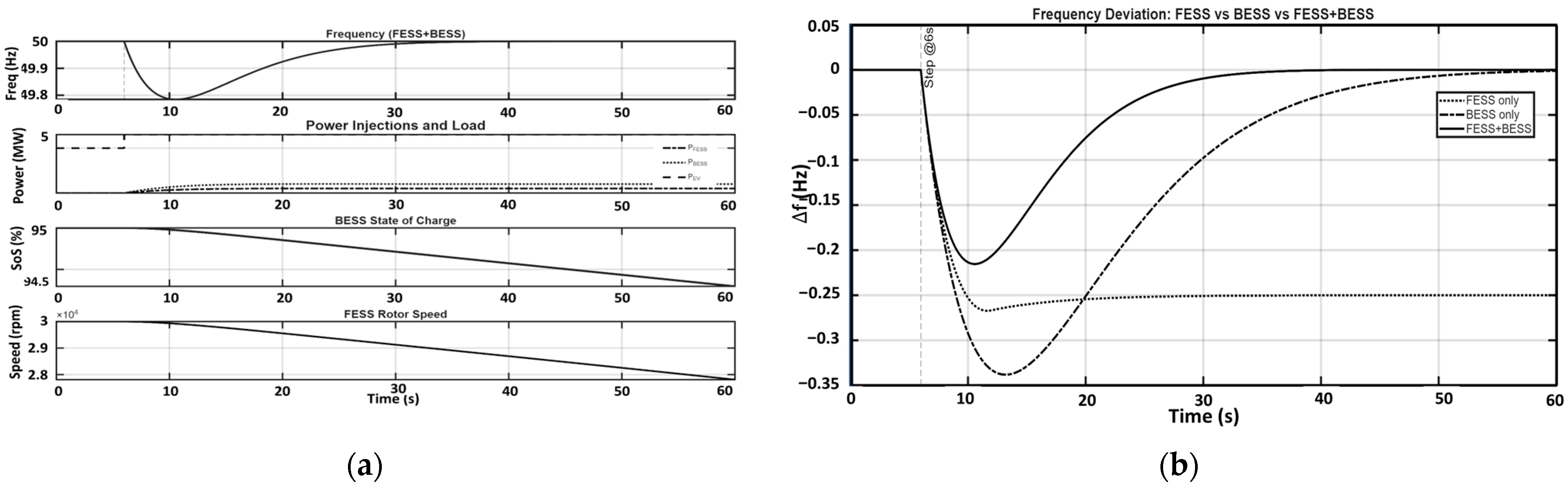
Figure 4a shows that the FESS-only configuration released 50% of the energy rapidly for 6 s, and could not restore the frequency to nominal.
The BESS-only system recovered within 10 s, with a slightly larger frequency nadir, while the coordinated FESS+BESS control achieved the best performance, recovering the frequency within 4 s with minimal overshoot. During the transient, as shown in
Figure 4b, the FESS delivered rapid active power for the first few seconds, while the BESS maintained support until frequency stabilization.
This complementary behavior illustrates the advantage of hybrid operation. The FESS rotor speed decreased during the discharge phase and gradually returned to nominal after the power balance was restored. The BESS SoC dropped moderately during support and recharged once the system frequency was stabilized.
7. Conclusions and Recommendations for Future Trends
The combined FESS–BESS configuration improved the frequency nadir, recovery time, and voltage stability compared with the individual systems. The proposed AD-MPC framework demonstrated robust performance under asynchronous communication and renewable variability, confirming its suitability for modern low-inertia grids.
Future work will focus on extending the approach to include additional distributed energy resources, applying learning-based MPC to improve dynamic tuning, and performing power-hardware-in-the-loop validation for real-time implementation before the project can be commercialized.
Author Contributions
Conceptualization, methodology, software, validation, investigation, data curation, writing—review and editing, and original draft preparation were conducted by W.S.N. and J.V.C. normal analysis, resources, project administration, and funding acquisition were conducted by C.G. All authors have read and agreed to the published version of the manuscript.
Funding
This research received no external funding.
Institutional Review Board Statement
Not applicable.
Informed Consent Statement
Not applicable.
Data Availability Statement
The authors are available for any supplementary data.
Acknowledgments
MATLAB/Simulink 2025a and Grammarly were used for the purposes of simulation and proofreading, respectively. The authors have reviewed and edited the output and take full responsibility for the content of this publication. The authors would like to acknowledge Witwatersrand University and the Vaal University of Technology, and their families.
Conflicts of Interest
The authors declare no conflict of interest. The funders had no role in the design of the study; in the collection, analyses, or interpretation of data; in the writing of the manuscript; or in the decision to publish the results.
Abbreviations
The following abbreviations are used in this manuscript:
| AD-MPC | Asynchronous distributed model predictive control |
| BESSs | Battery energy storage systems |
| FESSs | Flywheel energy storage systems |
| IBRs | Inverter-based resources |
| MPC | Model predictive control |
| SoC | State-of-charge |
References
- Grigsby, L.L. Power System Stability and Control; CRC Press: Boca Raton, FL, USA, 2007. [Google Scholar]
- Saha, S.; Saleem, M.I.; Roy, T.K. Impact of high penetration of renewable energy sources on grid frequency behaviour. Int. J. Electr. Power Energy Syst. 2023, 145, 108701. [Google Scholar] [CrossRef]
- Gambôa, P.; Silva, J.F.; Pinto, S.F.; Margato, E. Predictive Optimal Matrix Converter Control for a Dynamic Voltage Restorer with Flywheel Energy Storage. In Proceedings of the Energy Storage in the Emerging Era of Smart Grids; IEEE: New York, NY, USA, 2010. [Google Scholar]
- Ye, C.; Yao, K.; Liu, Y.; Cao, G.; Qi, X.; Li, Z. Design and Experimental Study of a Toroidal Winding Flywheel Energy Storage Motor. IEEE Trans. Energy Convers. 2025, 40, 2010–2021. [Google Scholar] [CrossRef]
- Faraji, M.; Mahdavi, M.S.; Nurmanova, V.; Gharehpetian, G.B.; Bagheri, M. Coordinated Control of Flywheel and Battery Energy Storage Systems for Frequency Regulation in Diesel Generator-based Microgrid. IEEE Access 2025, 13, 65980–65996. [Google Scholar] [CrossRef]
- Nguyen, T.T.; Yoo, H.J.; Kim, H.M. Coordinated Frequency Control of FESS and BESS in Microgrid based on Model Predictive Control Strategy. Int. J. Control Autom. 2017, 10, 383–394. [Google Scholar] [CrossRef]
- Akram, U.; Khalid, M. A coordinated frequency regulation framework based on hybrid battery-ultracapacitor energy storage technologies. IEEE Access 2017, 6, 7310–7320. [Google Scholar] [CrossRef]
- Chen, T.; Bu, S.; Liu, X.; Kang, J.; Yu, F.R.; Han, Z. Peer-to-peer energy trading and energy conversion in interconnected multi-energy microgrids using multi-agent deep reinforcement learning. IEEE Trans. Smart Grid 2022, 13, 715–727. [Google Scholar] [CrossRef]
- Varhegyi, G.; Nour, M. Advancing Fast Frequency Response Ancillary Services in Renewable-Heavy Grids: A Global Review of Energy Storage-Based Solutions and Market Dynamics. Energies 2024, 17, 3737. [Google Scholar] [CrossRef]
- Wang, X.; Li, X.; Ni, W.; Wen, F. A Model Predictive Control Based Optimal Task Allocation among Multiple Energy Storage Systems for Secondary Frequency Regulation Service Provision. Energies 2023, 16, 1228. [Google Scholar] [CrossRef]
- Xu, K.; Guo, Y.; Lei, G.; Zhu, J. A Review of Flywheel Energy Storage System Technologies. Energies 2023, 16, 6462. [Google Scholar] [CrossRef]
- Taher, A.M.; Hasanien, H.M.; Abdel Aleem, S.H.E.; Tostado-Véliz, M.; C’alasan, M.; Turky, R.A.; Jurado, F. Optimal model predictive control of energy storage devices for frequency stability of modern power systems. J. Energy Storage 2023, 57, 106310. [Google Scholar] [CrossRef]
- Lei, M.; Meng, K.; Feng, H.; Bai, J.; Jiang, H.; Zhang, Z. Flywheel energy storage controlled by model predictive control to achieve smooth short-term high-frequency wind power. J. Energy Storage 2023, 63, 106949. [Google Scholar] [CrossRef]
- Alsharafi, A.S.; Besheer, A.H.; Emara, H.M. Primary frequency response enhancement for future low inertia power systems using hybrid control technique. Energies 2018, 11, 699. [Google Scholar] [CrossRef]
- Pena-Alzola, R.; Campos-Gaona, D.; Ordonez, M. Control of flywheel energy storage systems as virtual synchronous machines for microgrids. In Proceedings of the 2015 IEEE 16th Workshop on Control and Modeling for Power Electronics (COMPEL); IEEE: New York, NY, USA, 2015; pp. 1–7. [Google Scholar]
- Calero, F.; Cañizares, C.A.; Bhattacharya, K. Dynamic modeling of battery energy storage and applications in transmission systems. IEEE Trans. Smart Grid 2020, 12, 589–598. [Google Scholar] [CrossRef]
- Villarina, K.C.; Pacis, M.C. Multi-machine transient stability study of an IEEE bus 39 test case with hybrid distributed generation using matlab. In Proceedings of the 2020 IEEE 12th International Conference on Humanoid, Nanotechnology, Information Technology, Communication and Control, Environment, and Management (HNICEM); IEEE: New York, NY, USA, 2020; pp. 1–6. [Google Scholar]
- Ulbig, A.; Borsche, T.S.; Andersson, G. Impact of low rotational inertia on power system stability and operation. IFAC Proc. Vol. 2014, 47, 7290–7297. [Google Scholar] [CrossRef]
| Disclaimer/Publisher’s Note: The statements, opinions and data contained in all publications are solely those of the individual author(s) and contributor(s) and not of MDPI and/or the editor(s). MDPI and/or the editor(s) disclaim responsibility for any injury to people or property resulting from any ideas, methods, instructions or products referred to in the content. |