Grid Stability Enhancement Using Machine Learning-Tuned Virtual Synchronous Generator †

Abstract
1. Introduction
- (1)
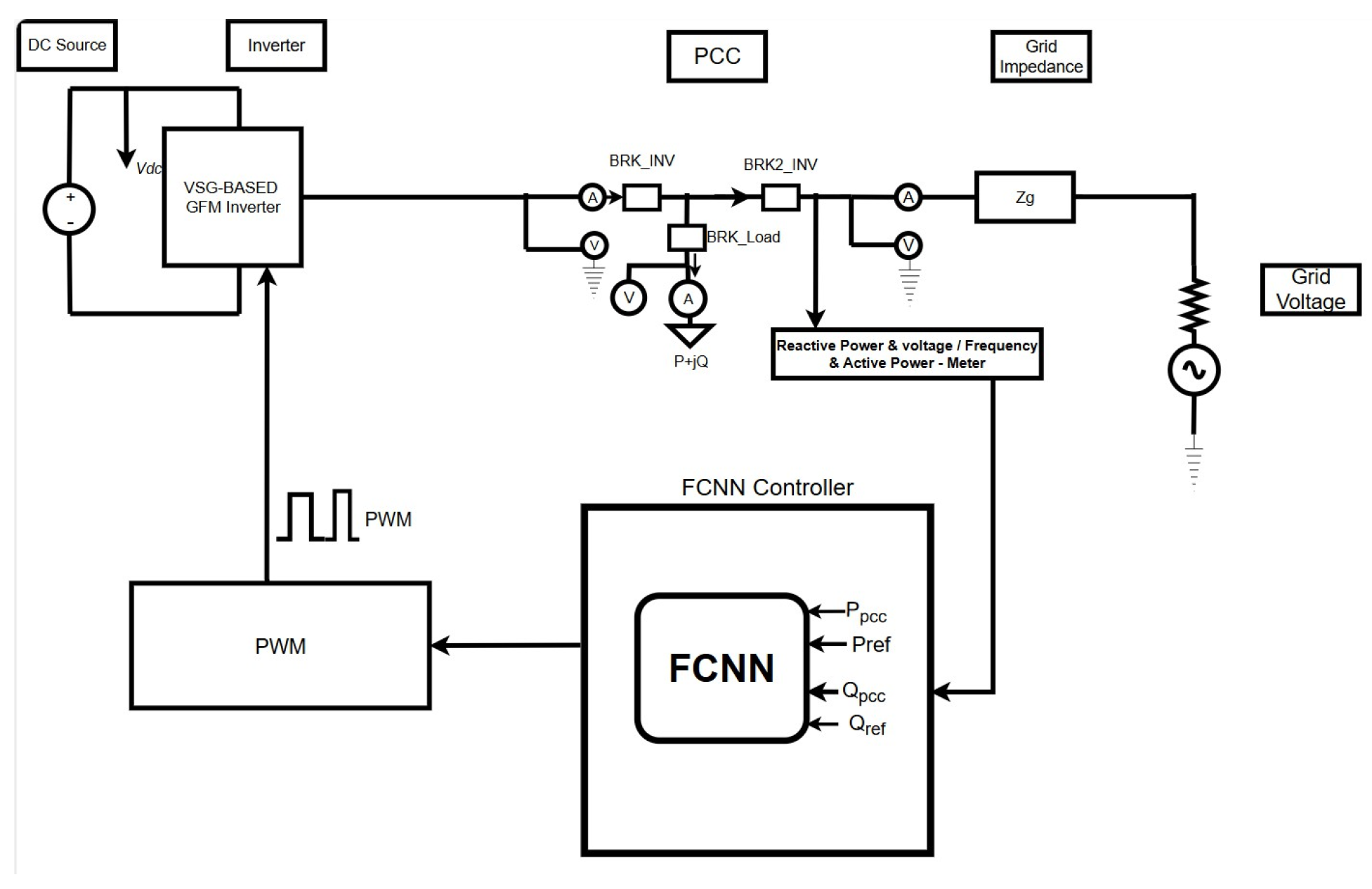
- To improve the grid stability in VSG control by implementing a fully connected Feedforward neural network to dampen frequency and active power oscillations.
- (2)
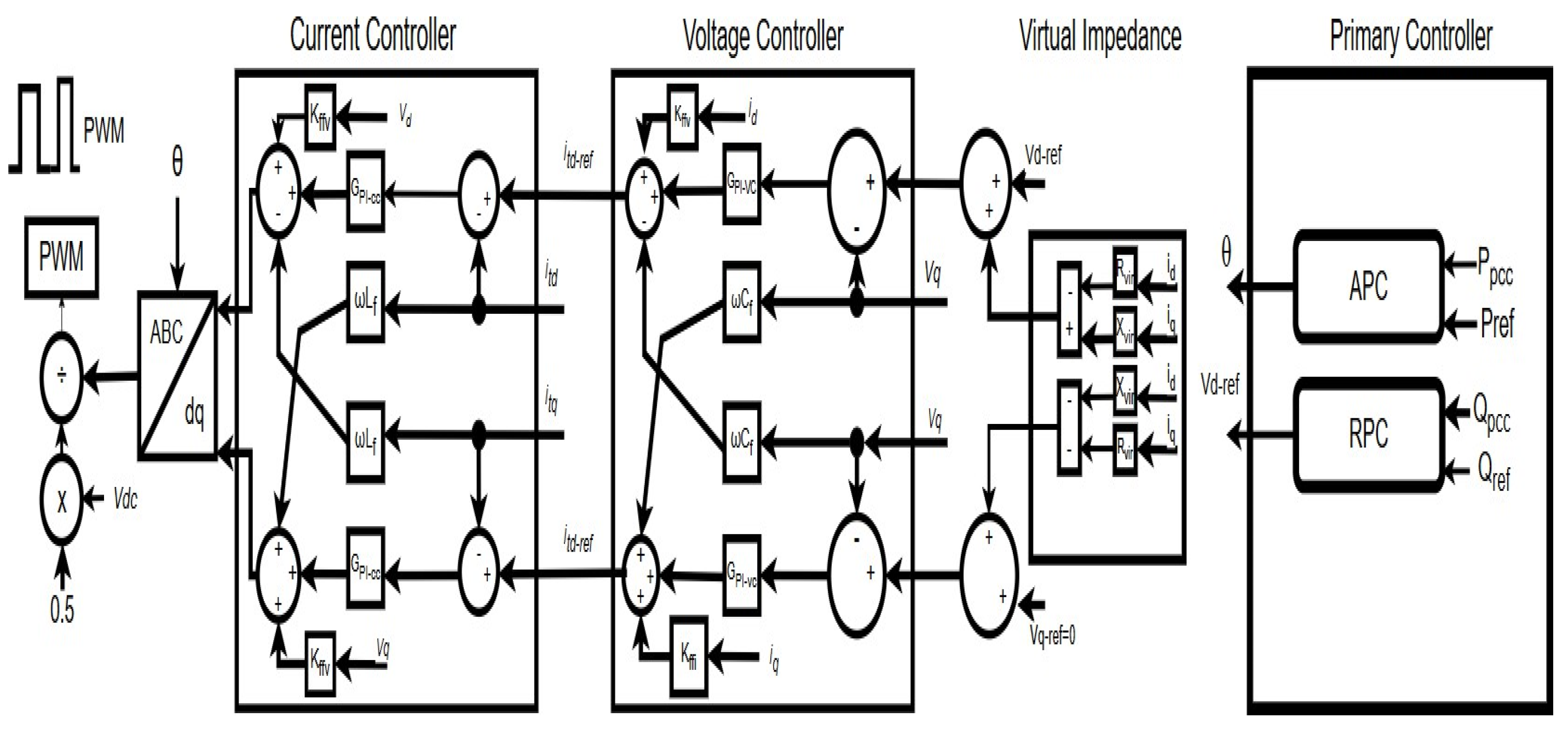
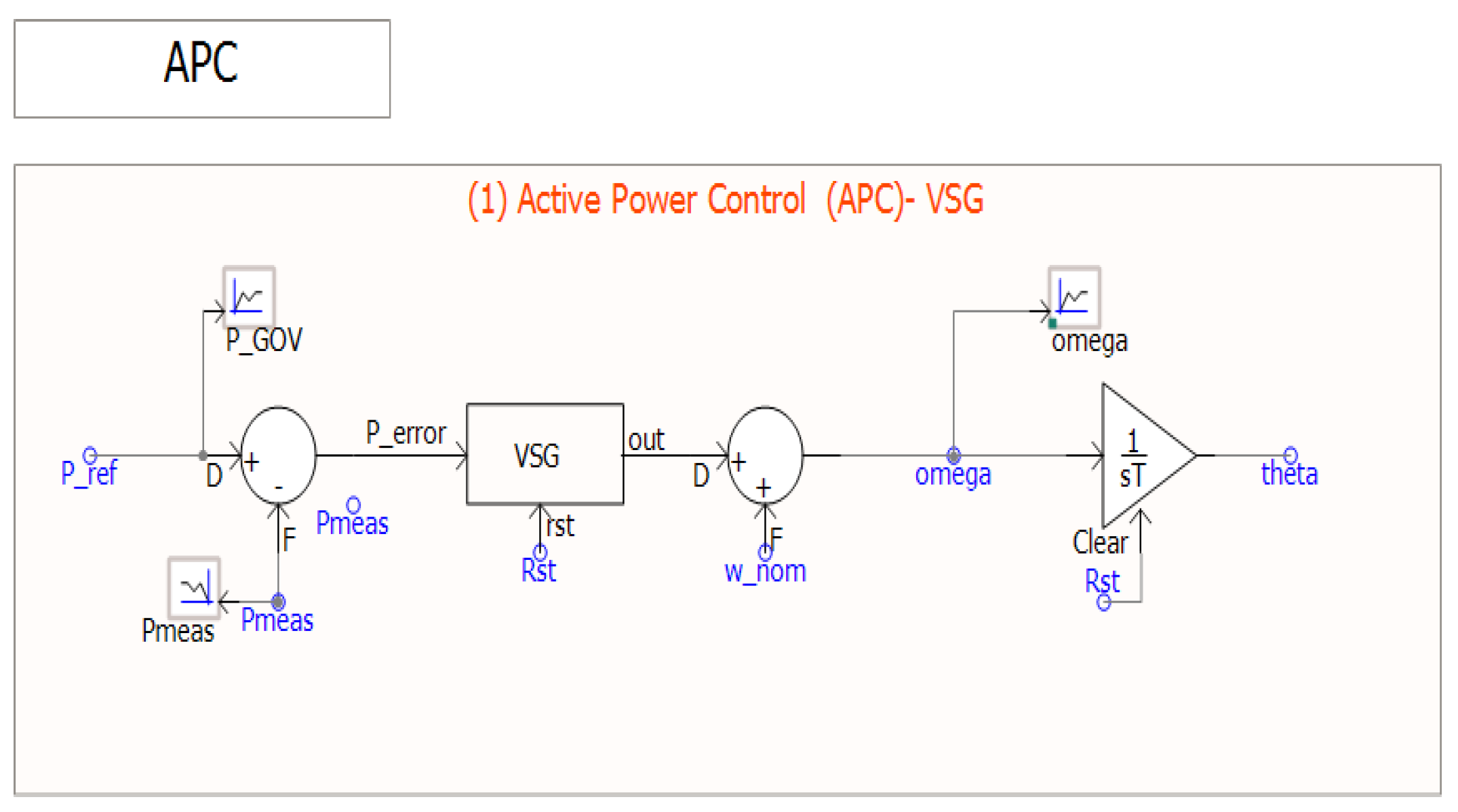
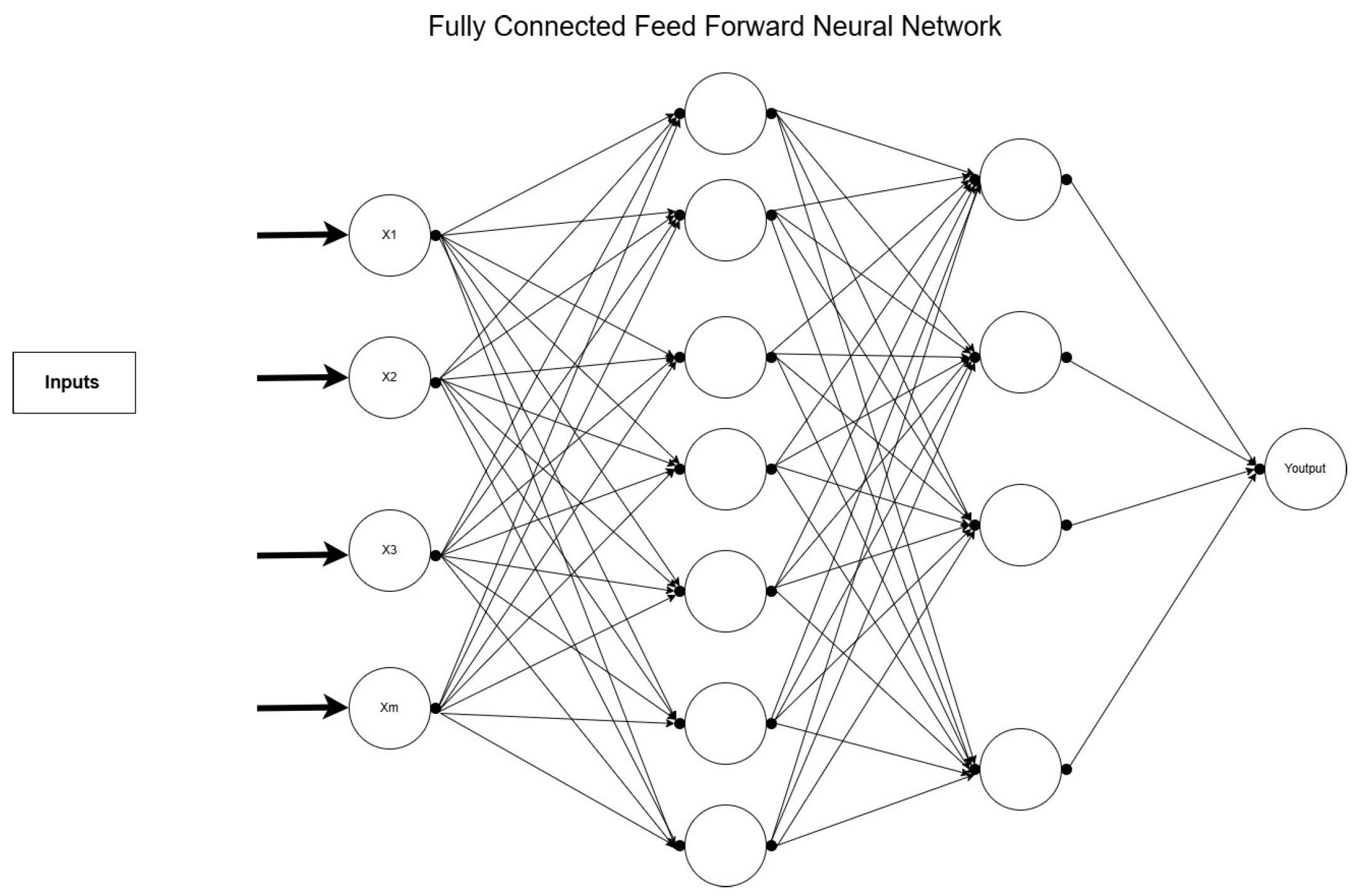
- The FCNN controller dynamically maps out the relationship between the damping factor and inertia constant to frequency and active power under different X/R and short circuit ratios.
- (3)
- The FCNN controller response is then compared to the VSG controller under the same grid conditions.
2. Principle Behind the Primary Loop of the VSG
2.1. Control Architecture
2.2. Primary Control Loop
2.3. Feedforward Neural Network Controller
2.4. Multi-Layered Feedforward Neural Network
2.5. The FCNN Structure
3. Results
4. Discussions
5. Conclusions
Author Contributions
Funding
Informed Consent Statement
Data Availability Statement
Conflicts of Interest
References
- Mirmohammad, M.; Azad, S.P. Control and stability of grid-forming inverters: A comprehensive review. Energies 2024, 17, 3186. [Google Scholar] [CrossRef]
- Kroposki, B.; Johnson, B.; Zhang, Y.; Gevorgian, V.; Denholm, P.; Hodge, B.-M.; Hannegan, B. Achieving a 100% renewable grid: Operating electric power systems with extremely high levels of variable renewable energy. IEEE Power Energy Mag. 2017, 15, 61–73. [Google Scholar] [CrossRef]
- Arghandeh, R.; Von Meier, A.; Mehrmanesh, L.; Mili, L. On the definition of cyber-physical resilience in power systems. Renew. Sustain. Energy Rev. 2016, 58, 1060–1069. [Google Scholar] [CrossRef]
- Gu, Y.; Green, T.C. Power system stability with a high penetration of inverter-based resources. Proc. IEEE 2022, 111, 832–853. [Google Scholar] [CrossRef]
- Ghodsi, M.R.; Tavakoli, A.; Samanfar, A. Microgrid stability improvement using a deep neural network controller based vsg. Int. Trans. Electr. Energy Syst. 2022, 2022, 7539173. [Google Scholar] [CrossRef]
- Pattabiraman, D.; Lasseter, R.H.; Jahns, T.M. Comparison of grid following and grid forming control for a high inverter penetration power system. In 2018 IEEE Power & Energy Society General Meeting (PESGM); IEEE: New York, NY, USA, 2018; pp. 1–5. [Google Scholar]
- Li, Y.; Gu, Y.; Green, T.C. Revisiting grid-forming and grid- following inverters: A duality theory. IEEE Trans. Power Syst. 2022, 37, 4541–4554. [Google Scholar] [CrossRef]
- Rathnayake, D.B.; Akrami, M.; Phurailatpam, C.; Me, S.P.; Hadavi, S.; Jayasinghe, G.; Zabihi, S.; Bahrani, B. Grid forming inverter modeling, control, and applications. IEEE Access 2021, 9, 114781–114807. [Google Scholar] [CrossRef]
- Ulbig, A.; Borsche, T.S.; Andersson, G. Impact of low rotational inertia on power system stability and operation. IFAC Proc. Vol. 2014, 47, 7290–7297. [Google Scholar] [CrossRef]
- Danish, M.S.S. Unified Vision for a Sustainable Future; Springer: Berlin/Heidelberg, Germany, 2024. [Google Scholar]
- Rathore, B.; Chakrabarti, S.; Anand, S. Frequency response improvement in microgrid using optimized vsg control. In 2016 National Power Systems Conference (NPSC); IEEE: New York, NY, USA, 2016; pp. 1–6. [Google Scholar]
- Kumar, A.W.; Mufti, M.U.D.; Zargar, M.Y. Fuzzy based virtual inertia emulation in a multi-area wind penetrated power system using adaptive predictive control-based flywheel storage. Sustain. Energy Technol. Assess. 2022, 53, 102515. [Google Scholar] [CrossRef]
- Li, J.; Wen, B.; Wang, H. Adaptive virtual inertia control strategy of vsg for micro-grid based on improved bang-bang control strategy. IEEE Access 2019, 7, 39509–39514. [Google Scholar] [CrossRef]
- Im, M.S.; Dasari, V.R. Computational complexity reduction of deep neural networks. arXiv 2022, arXiv:2207.14620. [Google Scholar] [CrossRef]
- Yao, J.; Luo, X.; Li, F.; Li, J.; Dou, J.; Luo, H. Research on hybrid strategy particle swarm optimization algorithm and its applications. Sci. Rep. 2024, 14, 24928. [Google Scholar] [CrossRef] [PubMed]
- Svozil, D.; Kvasnicka, V.; Pospichal, J. Introduction to multi-layer feed-forward neural networks. Chemom. Intell. Lab. Syst. 1997, 39, 43–62. [Google Scholar] [CrossRef]
- Lamnatou, C.; Cristofari, C.; Chemisana, D. Renewable energy sources as a catalyst for energy transition: Technological innovations and an example of the energy transition in France. Renew. Energy 2024, 221, 119600. [Google Scholar] [CrossRef]
- Mohammed, N.; Udawatte, H.; Zhou, W.; Hill, D.J.; Bahrani, B. Grid-forming inverters: A comparative study of different control strategies in frequency and time domains. IEEE Open J. Ind. Electron. Soc. 2024, 5, 185–214. [Google Scholar] [CrossRef]



| Input Grid Parameters | Value | Unit | Description |
|---|---|---|---|
| Vgrid | 690 | V | Grid Voltage |
| Fgrid | 50 | Hz | Grid Frequency |
| SCR | 1.5 | - | Worst Case Grid Condition |
| SCR | 3 | - | Weak Grid |
| SCR | 8 | - | Strong Grid |
| SCR | 14 | - | Robust Strong Grid |
| Srated | 1 | MVA | Inverter Rated Power |
| Prated | 1 | MW | Inverter rated Active Power |
| Qrated | 0 | MVar | Inverter Reactive Power |
| Vdc | 1.7 | kV | DC bus voltage |
| Lf | 1.5 × ϵ0.5 | H | filter Inductance |
| Rf | 0.01 | Ohm | Filter Resistance |
| Cf | 0.002 | F | Filter Reactance |
| MpV SG | 1/3.141 × ϵ0.6 | W.s/rad | VSG Damping Coefficient |
| JV SG | 506.6 | W.s2/rad | VSG Inertia Constant |
| kqV SG | 1/5.520 × ϵ0.5 | V/Var | VSG Droop Coefficient |
| Neural Network Model | Mean Absolute Error | Loss Function |
|---|---|---|
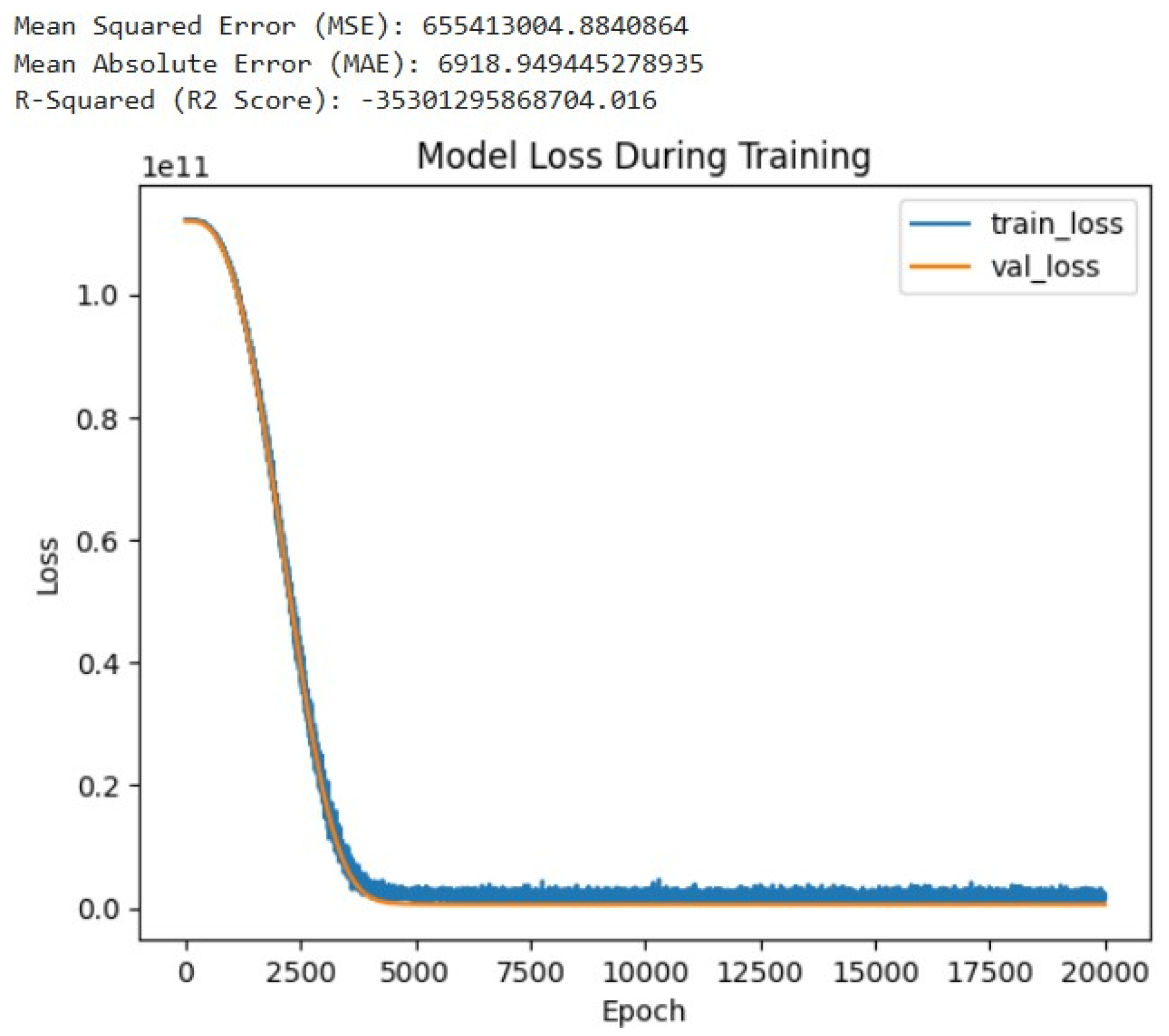
| FCNN | 6918.949 | 920489586 |
| Type of Grid | SCR | X/R | Performed or Underperformed |
|---|---|---|---|
| Strong Grid 15 | 11 | 10 | performed |
| Strong Grid 4 | 7 | 14 | performed |
| Strong Grid 18 | 7 | 10 | performed |
| Strong Grid 2 | 7 | 11 | underperformed |
| Weak Grid 16 | 6 | 2 | performed |
| Weak Grid 14 | 7 | 2 | performed |
| Weak Grid 18 | 6 | 2 | performed |
| Weak Grid 19 | 5 | 5 | performed |
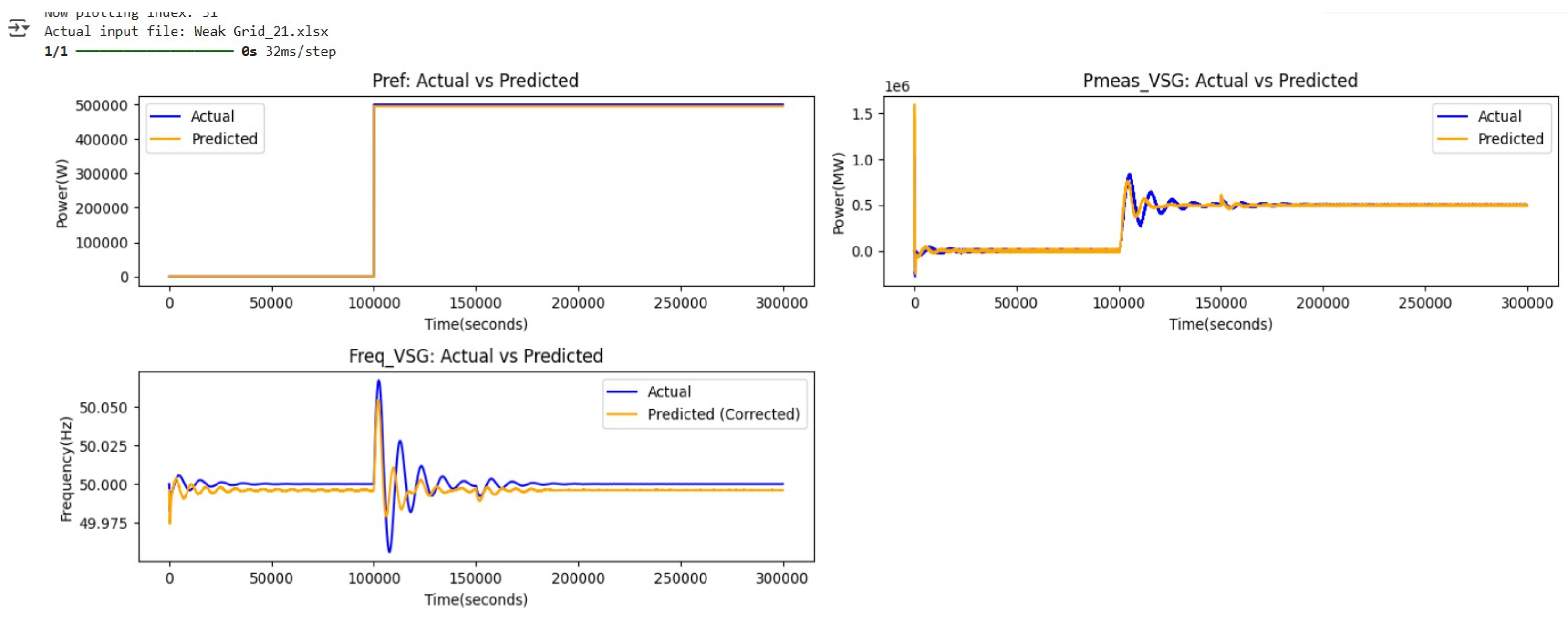
| Weak Grid 21 | 6 | 6 | underperformed |
Disclaimer/Publisher’s Note: The statements, opinions and data contained in all publications are solely those of the individual author(s) and contributor(s) and not of MDPI and/or the editor(s). MDPI and/or the editor(s) disclaim responsibility for any injury to people or property resulting from any ideas, methods, instructions or products referred to in the content. |
© 2026 by the authors. Licensee MDPI, Basel, Switzerland. This article is an open access article distributed under the terms and conditions of the Creative Commons Attribution (CC BY) license.
Share and Cite
Mjekula, A.; Thokozani, S.; Olukanmi, P. Grid Stability Enhancement Using Machine Learning-Tuned Virtual Synchronous Generator. Eng. Proc. 2026, 140, 10. https://doi.org/10.3390/engproc2026140010
Mjekula A, Thokozani S, Olukanmi P. Grid Stability Enhancement Using Machine Learning-Tuned Virtual Synchronous Generator. Engineering Proceedings. 2026; 140(1):10. https://doi.org/10.3390/engproc2026140010
Chicago/Turabian StyleMjekula, Ayabonga, Shongwe Thokozani, and Peter Olukanmi. 2026. "Grid Stability Enhancement Using Machine Learning-Tuned Virtual Synchronous Generator" Engineering Proceedings 140, no. 1: 10. https://doi.org/10.3390/engproc2026140010
APA StyleMjekula, A., Thokozani, S., & Olukanmi, P. (2026). Grid Stability Enhancement Using Machine Learning-Tuned Virtual Synchronous Generator. Engineering Proceedings, 140(1), 10. https://doi.org/10.3390/engproc2026140010