Proceeding Paper

Addition of Al2O3 Fine to Aluminum–Alumina Composite by Stir Casting Manufacture †
Department of Mechanical Engineering, Universitas Wahid Hasyim, Kota Semarang 50224, Indonesia
*
Author to whom correspondence should be addressed.
Presented at the 9th Mechanical Engineering, Science and Technology International Conference (MEST 2025), Samarinda, Indonesia, 11–12 December 2025.
Eng. Proc. 2026, 137(1), 9; https://doi.org/10.3390/engproc2026137009

Published: 20 May 2026

Abstract

Aluminum waste is one of the oldest wastes to be decomposed and can be processed again. Processing of aluminum waste can be done using casting, but re-casting results in reduced aluminum strength. How to strengthen aluminum by making composites is of interest. Composites with aluminum waste base material can be reinforced with alumina. This research makes aluminum composites with the addition of alumina powder variations at 0; 15; 20; and 25%. The manufacturing uses stir casting at 500 rpm for 5 min and a pouring temperature of 750 °C. The casting results were photographed for tensile test specimens. The results of the macrostructure show the largest open porosity with the addition of 20% alumina. Meanwhile the results of tensile testing show that material without reinforcement has an average value of tensile strength of 182.33 MPa.

1. Introduction

Aluminum is a type of metal that has excellent corrosion resistance, is lightweight, and can conduct heat [1]. However, the use of large amounts of aluminum also generates a lot of waste that must be properly managed so as not to have a negative impact on the environment [2]. In the era of advanced technology, the rapid development of technology has opened up opportunities to create materials from waste materials [3,4,5,6]. One of the trending materials being developed today is aluminum-based composites.
Composite materials made from aluminum have a number of advantages, including being lightweight, resistant to corrosion, easy to maintain, and flexible [3,7]. This study on aluminum-based composites aims to determine the optimal composition between the matrix and the reinforcement used to make them stronger by adding reinforcing materials [3,8]. Reinforcing materials can be nanoscale particles including titanium dioksida (TiO2), corundum (Al2HAl3) [9], silicon carbide (SiC), boron carbide (B4C), titanium carbide (TiC) [10], alumina (Al2O3), and fly-ash [6]. Particle reinforcement at the micro level can improve the hardness, strength, and wear characteristics of composites, while still maintaining the integrity of the matrix framework [9]. One of the processes for effective addition of nanoparticles is stir casting.
Stir casting and compocasting offer the convenience of stirring to flatten the particles in the molten metal, thereby improving the matrix structure, and are relatively more economical in terms of production costs [8,11]. The stir casting process is one method for producing composite materials by mixing materials while in a liquid state [8,12,13]. Materials are mixed in the form of particles.
The addition of alumina particles to the aluminum composite material was performed. The wear test results decreased as the volumetric fraction of alumina increased until it reached 20%. However, in specimens containing a 25% alumina volume fraction, the hardness value decreased. This is because the number of holes available for alumina attachment is the highest in specimens with an alumina volumetric fraction of 25% [5]. Another study used Al2O3 reinforcement with volume fractions of 1; 3; and 5%. The tensile strength increased by about 40%. Upon the addition of alumina reinforcement at 10%, the hardness value increased [14], while the addition of SiC alone decreased with fractions of 2.5; 5; 10; and 15% [15].
This study aims to determine the effect of adding 15; 20; and 25% alumina variations in aluminum metal casting using the stir casting method on aluminum metal waste, which is expected to produce composite materials with better physical and mechanical properties.

2. Research Methodology

The research method used in the manufacture of aluminum composite materials was the experimental method. This method aims to test the characteristics of variations in the addition of alumina powder (Al2O3) to scrap aluminum metal. Experiments were carried out in the Foundry Laboratory and Materials Laboratory of the Mechanical Engineering Study Program, Faculty of Engineering, Wahid Hasyim University Semarang. The base material used aluminum waste which was made into aluminum alloy ingots with 3.128 Si, 0.974 Fe, 7.752 Cu, 0.137 Mn, 0.43 Mg, 0.323 Cr, 0.18 Ni, 6.349 Zn, 0.068 Ti, 1.228 Pb, 0.46 Sn, 0.045 V, 0.061 Sr, 0.064 Zr, 0.042 Cd, 0.161 Co, 0.072 B, 0.021 Ag, 0.171 Bi, 0.039 Ca, 0.978 Li, and 77.06 Al. The material used as reinforcement was alumina Al2O3. Alumina is a powder sifted with a 220-mesh sieve or equivalent to alumina powder with a diameter of 63 μm.
Both materials were melted with a mixture of 0; 15; 20; and 25% alumina. The melting temperature was 750 °C. During melting the molten state was stirred at a stirring speed of 500 rpm. The stirring time was 5 min. Then it was poured into a mold in the shape of a rectangular prism measuring 150, 150, and 10 mm3.
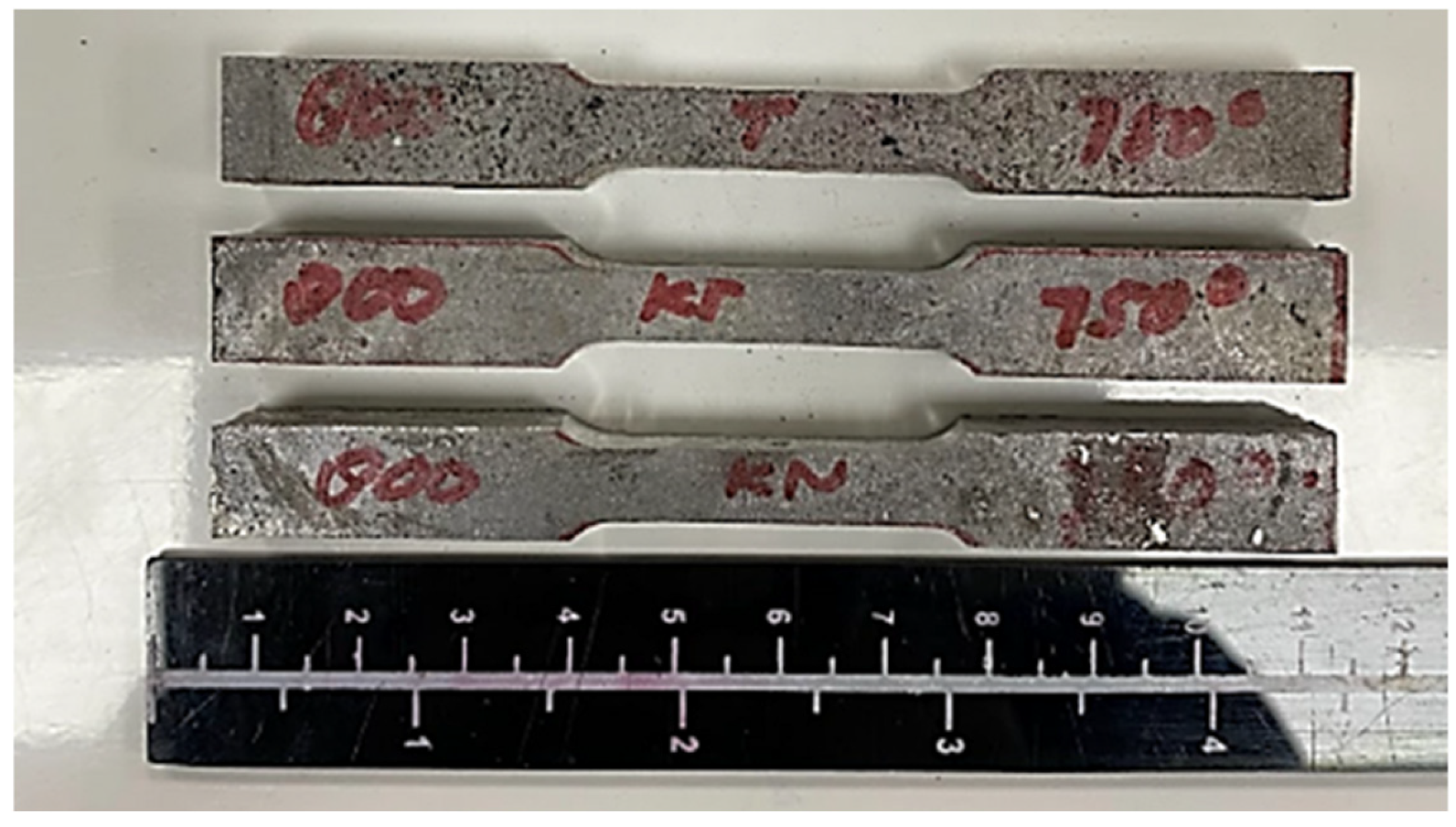
The casting results were photographed to be observed visually. After completing the photography, the casting results were cut into the shape of a tensile test specimen with ASTM E8M standards. The shape of the specimen can be seen in Figure 1.

3. Results and Discussion

3.1. Visual Testing

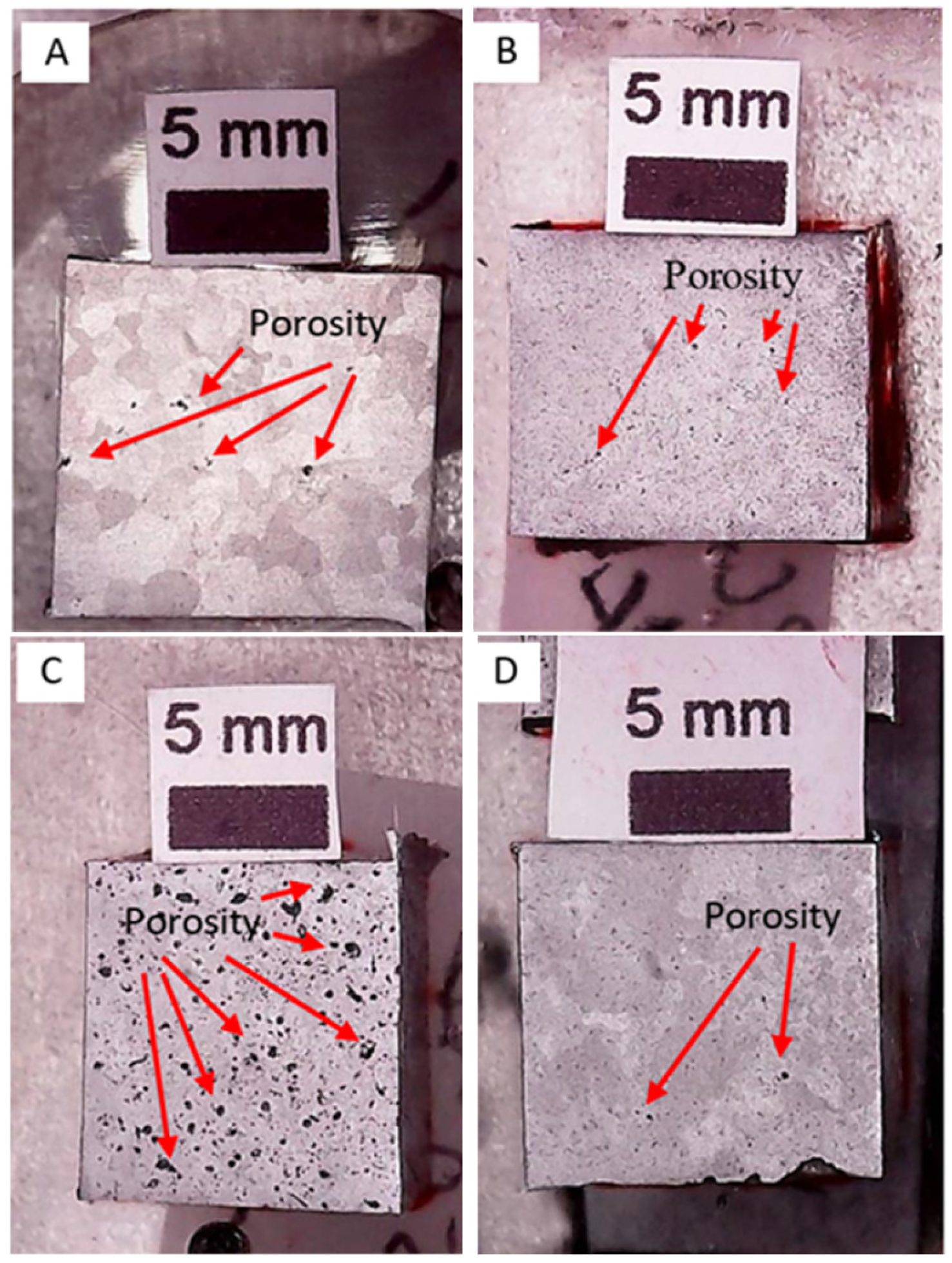
In this study, visual testing was carried out to gain a comprehensive understanding of material properties and behavior. This visual testing is to get an overview of structural integrity and approach larger defects or characters that affect the volume of the material. Based on visual observation data with variations in the addition of the volume fraction of alumina powder (Al2O3), namely 15; 20; and 25%, the test results are shown in Figure 2.
Based on the results of visual testing using the macro photos in Figure 2, Figure 2C shows that the most porosity is produced in the 20% specimen. This porosity shows that the addition of 20% alumina makes it more evenly distributed and aluminum can still be associated. This addition also reduces the quality of aluminum castings. Ceramics are difficult to bond to metal [16]. This condition is due to gravity pouring without emphasis, causing the metal liquid to become porous or experience porosity [2]. However, porosity occurs only on the surface with alumina released. Meanwhile inside there is no porosity so it can strengthen the aluminum. This is evidenced by the results of tensile testing.

3.2. Tensile Testing

The process of casting aluminum metal with the addition of 15; 20; and 25% volume fractions of alumina reinforcing powder was performed. Therefore, to find the properties of each of the variations in the addition of the volume fraction of alumina powder, three specimens were made for each treatment and then examined using tensile testing. The results of the tensile testing of the specimens are shown in Figure 3 and Figure 4.
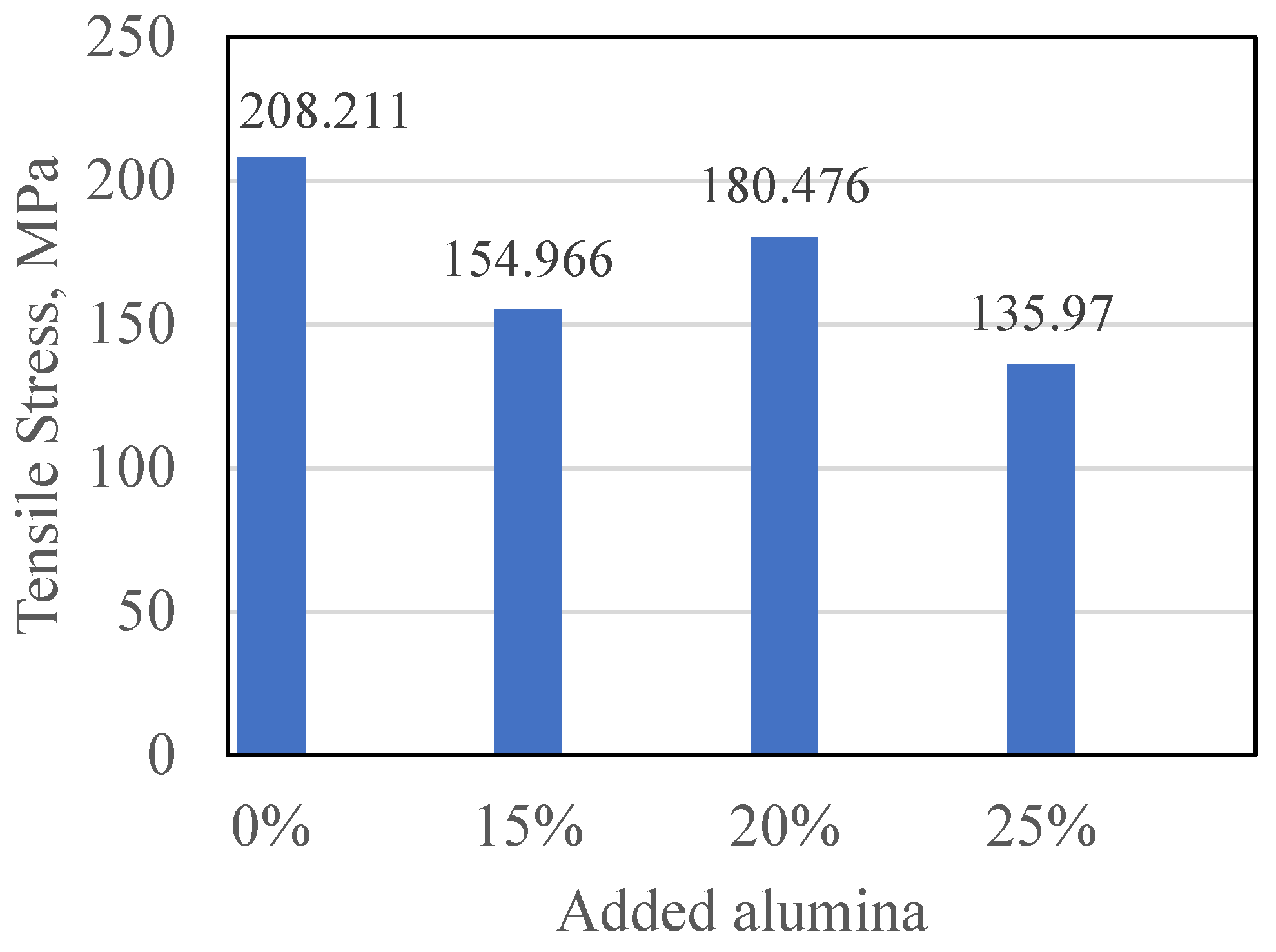
Figure 3 is the tensile strength result. The highest tensile strength results occurred in the raw material, which was 182.33 MPa, and the maximum stress was 208.21 MPa. So from the table and graph above, it can be explained that in the process of adding variations in the volume fraction of alumina powder, the tensile strength and maximum stress experience ups and downs. The highest tensile strength is found in the addition of an alumina powder volume fraction of 20%, which is 163.26 MPa, with a maximum tensile stress of 180.47 MPa. This shows that the addition of a 20% alumina powder volume fraction is the best because it produces the highest tensile strength value compared to the addition of 15% and 25% alumina powder volume fractions. The decrease in tensile strength in composite materials can be caused by several factors. Among them are the lack of bonding between aluminum and alumina in the composite material, the uneven distribution of reinforcing particles in the aluminum matrix, and the incomplete interaction between reinforcing particles and the aluminum matrix [13]. The lack of bonding between aluminum and alumina can trigger crack initiation; the higher the porosity level, the greater the possibility of cracks that can significantly reduce tensile strength. In addition, the presence of interfaces also contributes to the crack nucleation process. An increased number of interfaces in a given unit volume will lead to an increase in the number of crack nucleations At high volume fractions (25%), the tendency for alumina particles to agglomerate increases. The agglomerated particles form weak zones in the aluminum matrix. This condition causes uneven stress distribution during tensile testing, making the material more susceptible to crack initiation. Visual observation shows that porosity increases, especially in the 20% variation. Open porosity on the surface can reduce material density and act as a stress concentrator. During tensile testing, pores become crack initiation sites. Although at 20% porosity the porosity is relatively uniform and the alumina–aluminum bond is still quite good (so tensile strength increases compared to 15%), at 25% the number of pores and microcracks increases, causing tensile strength to decrease dramatically. In other words, the decrease in tensile strength at >20% alumina is mainly due to the accumulation of porosity and weak aluminum–alumina bonds, which overcome the strengthening effect of hard particles.
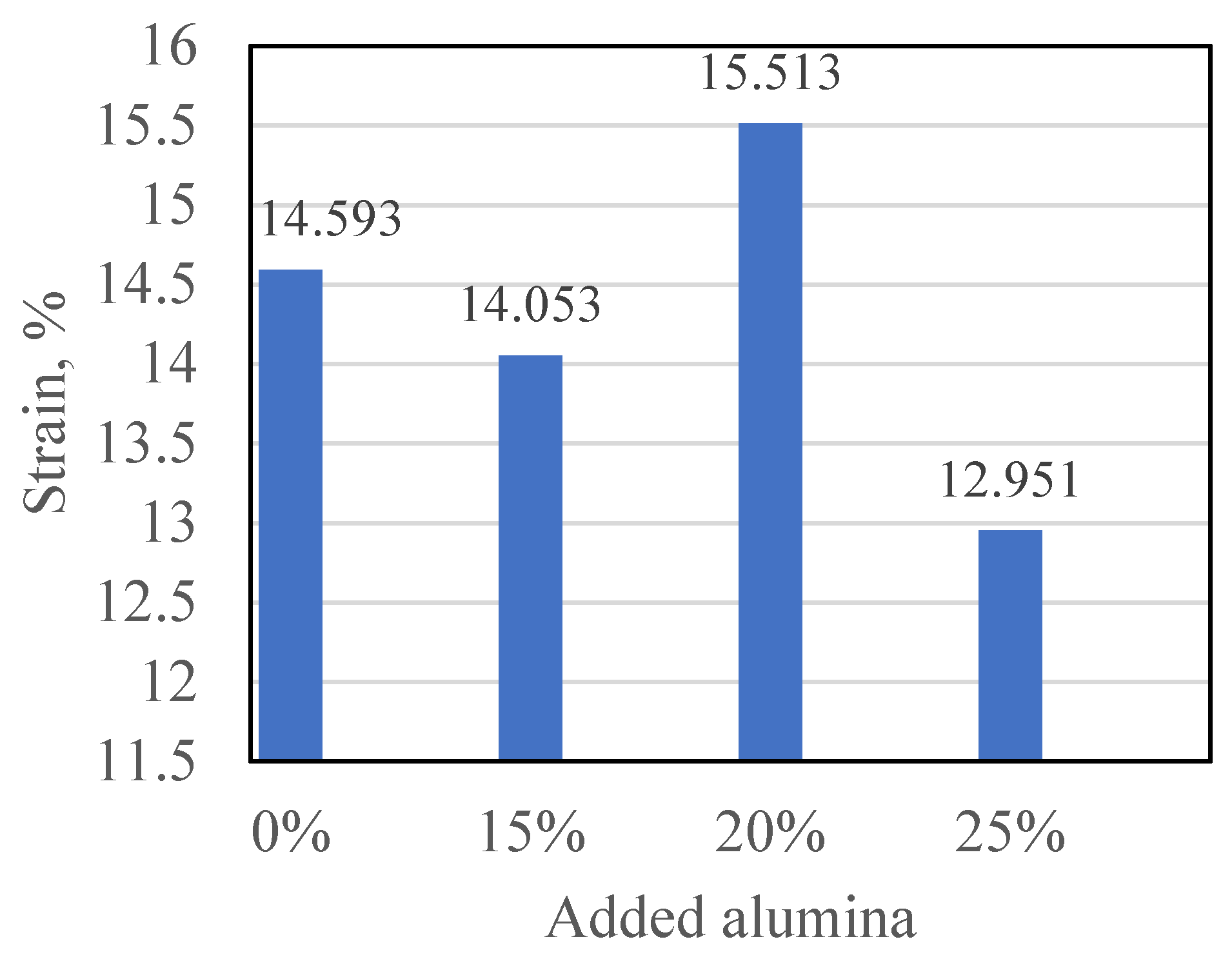
Figure 4 explains that the strain value can be found through tensile testing. In this study, the strain of Al-Al2O3 composites showed a rise and fall as the percentage of Al2O3 powder increased, namely aluminum without reinforcement at 14.593, and addition of 15; 20; and 25% alumina powder at 14.05; 15.51; and 12.951% respectively. Figure 3 shows that strain goes up and down for each mixture, in line with the percentage addition of alumina powder. The highest strain was at a 20% alumina powder percentage, with an average value of 15.51%, and the lowest strain was at a 25% alumina powder percentage, with an average value of 12.95%.

4. Conclusions

In terms of the effect of the percentage of alumina powder reinforcement on the aluminum matrix’s porosity, the largest porosity is achieved with an alumina powder volume fraction of 20% while the others are less. The results of tensile testing on aluminum composite materials reinforced with alumina powder particles (Al2O3) are lower than the tensile strength value of raw materials. Meanwhile the composite material with added alumina has the greatest tensile strength upon the addition of 20% alumina. The highest strain is at 20% alumina powder addition, even more than without reinforcement. The addition of alumina powder (Al2O3) to the aluminum waste matrix through the stir casting method shows that a 20% fraction produces the best combination of tensile strength and strain compared to 15% and 25%, although it is still lower than the raw material due to the effects of porosity and weak interfacial bonding. Increasing the fraction above 20% actually reduces mechanical properties due to the accumulation of porosity and non-homogeneous particle distribution. These findings emphasize the importance of casting process control and open up opportunities for further research through variations in reinforcing particle size, heat treatment, and hybrid reinforcements to obtain more optimal aluminum composites.

Author Contributions

Conceptualization, S.M.B.R. and N.K.; methodology, N.K.; software, S.M.B.R.; validation, S.M.B.R., N.K. and J.S.; formal analysis, N.K.; investigation, S.M.B.R.; resources, N.K.; data curation, J.S.; writing—original draft preparation, S.M.B.R.; writing—review and editing, S.M.B.R.; visualization, S.M.B.R.; supervision, S.M.B.R.; project administration, N.K.; funding acquisition, N.K. All authors have read and agreed to the published version of the manuscript.

Funding

This research was funded by Kementerian Pendidikan Tinggi, Sains dan Teknologi Indonesia, grant number 19/LP2M-UWH/PFR/VIII/2024.

Institutional Review Board Statement

Not applicable.

Informed Consent Statement

Not applicable.

Data Availability Statement

The original contributions presented in this study are included in the article. Further inquiries can be directed to the corresponding author.

Acknowledgments

Our deepest gratitude goes to LP2M Wahid Hasyim University for providing funding for this research.

Conflicts of Interest

The authors declare no conflicts of interest.

References

  1. Rosyadi, I.; Pinem, M.P.; Aswata, A.; Yusuf, Y.; Satria, D.; Lega, A. ANALISA PENGARUH KELEMBABAN SAMPAH KAYU DAN SISA MAKANAN PADA INCENERATOR PORTABLE SKALA RUMAH TANGGA. J. Tek. Mesin Untirta 2017, 3, 21–31. [Google Scholar]
  2. Kholis, N.; Purwanto, H.; Adib, A. Optimasi parameter proses pembuatan komposit aluminium daur ulang yang diperkuat serbuk alumina dengan metode stir casting. J. Taman Vokasi 2023, 11, 119–129. [Google Scholar]
  3. Surojo, E.; Wibowo, H.F.; Triyono, T.; Suprihanto, A. Pengaruh Perlakuan Preheat Partikel Al2o3 Pada Proses Stir Casting terhadap Sifat Fisik dan Mekanik Komposit Al6061-Al2O3. Mek. Maj. Ilm. Mek. 2020, 19, 83–89. [Google Scholar] [CrossRef]
  4. Srivastava, N.; Anas, M. A consolidated effect of processing and squeeze pressure on Al2O3 + SiC reinforced AA6061 cast composite. Mater. Today Proc. 2021, 47, 6913–6918. [Google Scholar] [CrossRef]
  5. Sabry, I.; Mourad, A.-H.I.; Elwakil, M. Effect of Al2O3 particle volume fraction on the microstructure and mechanical properties of aluminum matrix composites prepared by friction stir processing. Mater. Today Commun. 2026, 51, 114782. [Google Scholar] [CrossRef]
  6. Chauhan, H.; Irfan; Chauhan, A. VARIATION OF MECHANICAL PROPERTIES (TENSILE STRENGTH & MICROSTRUCTURE) OF Al6061/(Al2O3 AND FLY-ASH), HYBRID METAL MATRIX COMPOSITE PRODUCED BY STIR CASTING. Int. Res. J. Eng. Technol. 2017, 4, 2407–2414. [Google Scholar]
  7. Nafili, A.I.; Respati, S.M.B.; Santoso, B. Pengaruh kandungan alumina terhadap kekasaran permukaan dan foto mikro permesinan pada komposit Al-Al2O3. J. Tek. Mesin Indones. 2018, 12, 94–97. [Google Scholar] [CrossRef]
  8. Kim, I.; Song, M.; Kim, J. Effects of Ti–B and Si additions on microstructure and mechanical properties of Al–Cu–Mg based aluminum matrix composites. J. Alloys Compd. 2020, 832, 154827. [Google Scholar] [CrossRef]
  9. Sharma, V.K.; Kumar, V.; Joshi, R.S. Investigation of rare earth particulate on tribological and mechanical properties of Al-6061 alloy composites for aerospace application. J. Mater. Res. Technol. 2019, 8, 3504–3516. [Google Scholar] [CrossRef]
  10. Kareem, A.; Abu Qudeiri, J.; Abdudeen, A.; Ahammed, T.; Ziout, A. A Review on AA 6061 Metal Matrix Composites Produced by Stir Casting. Materials 2021, 14, 175. [Google Scholar] [CrossRef] [PubMed]
  11. Andari, G.A.S. Pengaruh Kecepatan Putaran Pada Aluminium Matrix Composite Produk Pengecoran Sentrifugal. Bachelor’s Thesis, Institut Teknologi Sepuluh Nopember, Surabaya, Indonesia, 2019. [Google Scholar]
  12. Ansyori, A.; Rajaguguk, T.O.; Safii, R.N.; Hendronursito, Y. Percent basal variations and the time stirring the steering casting composite al-basal matrix on the hardness and density. In Proceedings of the Seminar Nasional Tahunan Teknik Mesin XVIII (SNTTM XVIII), Jakarta, Indonesia, 9–10 October 2019. [Google Scholar]
  13. Aziizudin, A.; Purnomo, A.; S, A.; Yogiswara, C.W.; Halim, D.A.; Putra, S.D.H. ANALISIS NILAI KEKERASAN DAN STRUKTUR MIKRO PADA PENGECORAN LIMBAH PISTON BEKAS DENGAN PENAMBAHAN MATERIAL SILIKON KARBIDA (SiC). Sci. J. Mech. Eng. Kinemat. 2025, 10, 61–69. [Google Scholar] [CrossRef]
  14. Supriyanto, A.; Margono; Roni, K. EFEK VARIASI KOMPOSISI PASA KOMPOSIT ALUNIMUM—SILIKONDENGAN VARIASI SUHU SINTERIG TERHADAP KEKERASAN DAN STRUKTUR MIKRO. Teknika 2023, 8, 47–54. [Google Scholar] [CrossRef]
  15. Khan, M.A. An Overview on Effect of Reinforcement and Process Parameters on Properties of Aluminium Based Metal Matrix Composite. Int. J. Res. Eng. Sci. 2014, 2, 8–12. [Google Scholar]
  16. Respati, S.M.B.; Soenoko, R.; Irawan, Y.S.; Suprapto, W. Interfacial Shear Stress with Pull-out Test at Zeolite Ceramic Matrix and SS316 Single Fiber. Matéria 2018, 23, e-1198. [Google Scholar] [CrossRef]
Figure 1. Tensile test sample.
Engproc 137 00009 g001
Figure 2. Macro photographs: (A) Al without reinforcement; (B) Al-Al2O3 15% specimen; (C) Al-Al2O3 20% specimen; (D) Al-Al2O3 25% specimen.
Engproc 137 00009 g002
Figure 3. Tensile stress.
Engproc 137 00009 g003
Figure 4. Strain.
Figure 4. Strain.
Engproc 137 00009 g004
Disclaimer/Publisher’s Note: The statements, opinions and data contained in all publications are solely those of the individual author(s) and contributor(s) and not of MDPI and/or the editor(s). MDPI and/or the editor(s) disclaim responsibility for any injury to people or property resulting from any ideas, methods, instructions or products referred to in the content.