


Abstract
Effective water management is a core function of nature-based solutions (NBSs), enabling them to deliver vital ecosystem services and enhance urban resilience. This study examines the hydrological performance of a specific NBS, the Blue-Green Roof (BGR). In contrast to conventional green roofs, the BGR incorporates a subsurface storage layer that retains infiltrated rainfall, thereby sustaining vegetation, boosting evapotranspiration and cooling, and reducing the burden on urban drainage systems. The research evaluates the BGR’s hydrological dynamics over the long term, drawing on data collected between May 2021 and May 2025 at a pilot site in Central Italy.
1. Introduction
Urban areas are increasingly exposed to pressures from population growth, rapid land-use change, and climate extremes, including prolonged droughts and intense rainfall events [1]. These factors heighten the risk of pluvial flooding and intensify urban heat islands, posing challenges to infrastructure, public health, and overall urban livability [2]. The COVID-19 pandemic has further emphasized the importance of accessible green spaces in cities, which provide critical benefits for physical and mental well-being [3].
To address these intertwined challenges, cities are implementing a mix of conventional stormwater measures, such as rainwater harvesting [4], alongside nature-based solutions (NBSs) that enhance urban resilience while delivering multiple co-benefits, including biodiversity support, improved air quality, and local cooling [5]. Among NBSs, green roofs (GRs) are widely adopted for their ability to reduce stormwater runoff, lower building energy demand, and moderate surface temperatures [6].
An evolution of traditional GRs, the multilayer blue-green roof (BGR) combines vegetated layers with engineered subsurface storage to retain, regulate, and potentially reuse rainfall. By integrating the hydrological benefits of water retention with the ecological and thermal advantages of vegetation, BGRs offer enhanced stormwater management, flood mitigation, and cooling capacity in densely built urban areas [7].
Recent implementations in Mediterranean contexts have demonstrated their capacity to adapt to highly variable climatic conditions, including seasonal droughts and episodic heavy rainfall [8,9,10]. Building on these advances, this study assesses a pilot BGR installation in Central Italy, analyzing a four-year dataset (May 2021–May 2025) to evaluate its real-world hydrological performance at the monthly scale, allowing considerations about its contribution to urban resilience.
2. Materials and Methods
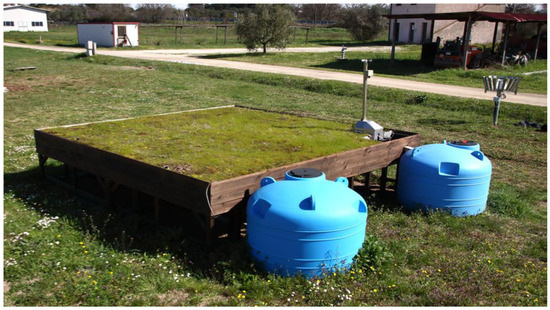
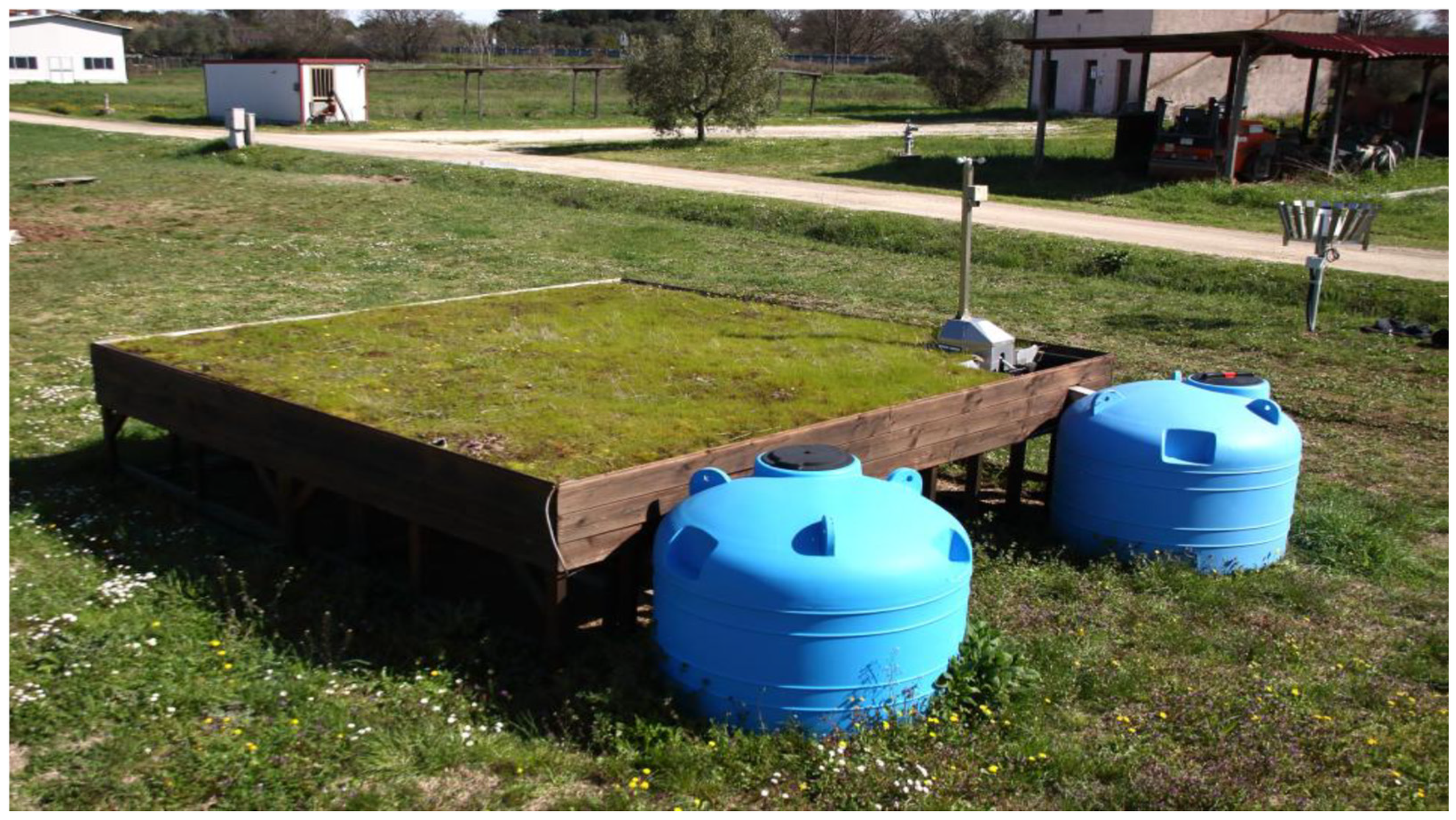
The BGR examined in this study is the Polder Roof system (Figure 1) developed by Metropolder (Amsterdam, The Netherlands), and installed at the Tuscia University hydrological experimental site (https://mechydrolab.unitus.it/pages/?page=homepage, accessed on 1 April 2026). The Polder Roof is a multilayer technology specifically designed to enhance rooftop water retention and controlled release [11]. The investigated prototype consists of a vegetated layer composed of Sedum album and Sedum acre, species selected for their high tolerance to arid Mediterranean conditions, underlain by a lightweight engineered soil substrate (70% pumice, 20% peat, 10% sand).
Figure 1.
The investigated Polder Roof.
Below the soil, a geotextile filter fabric allows percolation while preventing particle migration into the 8 cm Permavoid storage layer. The structure is sealed by a waterproof membrane that protects the underlying roof. A smart, remotely controlled valve—set at a 7 cm water level for this study—was used to maximize storage capacity and maintain consistent management rules, allowing for a direct comparison with conventional green roofs in terms of stormwater retention and release dynamics under Mediterranean climatic conditions. Outflow was directed into two rain barrels (each one with a volume of 1000 L) equipped with Baro-Diver® sensors (Vanessen) for continuous monitoring.
Meteorological forcing was measured at the nearby Tuscia macro-hydrological station [12], which includes four rain gauges, an air thermometer, a pyranometer, and an anemometer. In addition, on-site thermometers and Baro-Diver® sensors were used to measure local air temperature and water level variations, ensuring accurate barometric compensation. All variables were logged at a temporal resolution of 5 min. The dataset analyzed in this work spans four years (May 2021–May 2025). The present analysis focuses on the hydrological response of the BGR at the monthly scale, with data processing procedures including time synchronization to CET+1 and filtering to remove barometric noise and spurious fluctuations related to evaporation processes.
3. Results and Conclusions
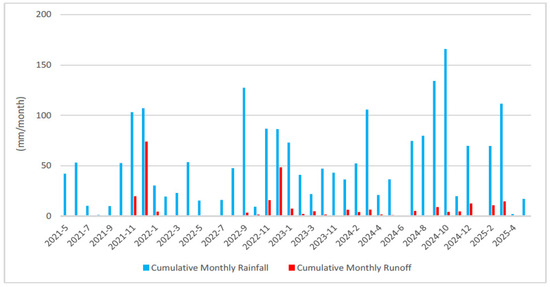
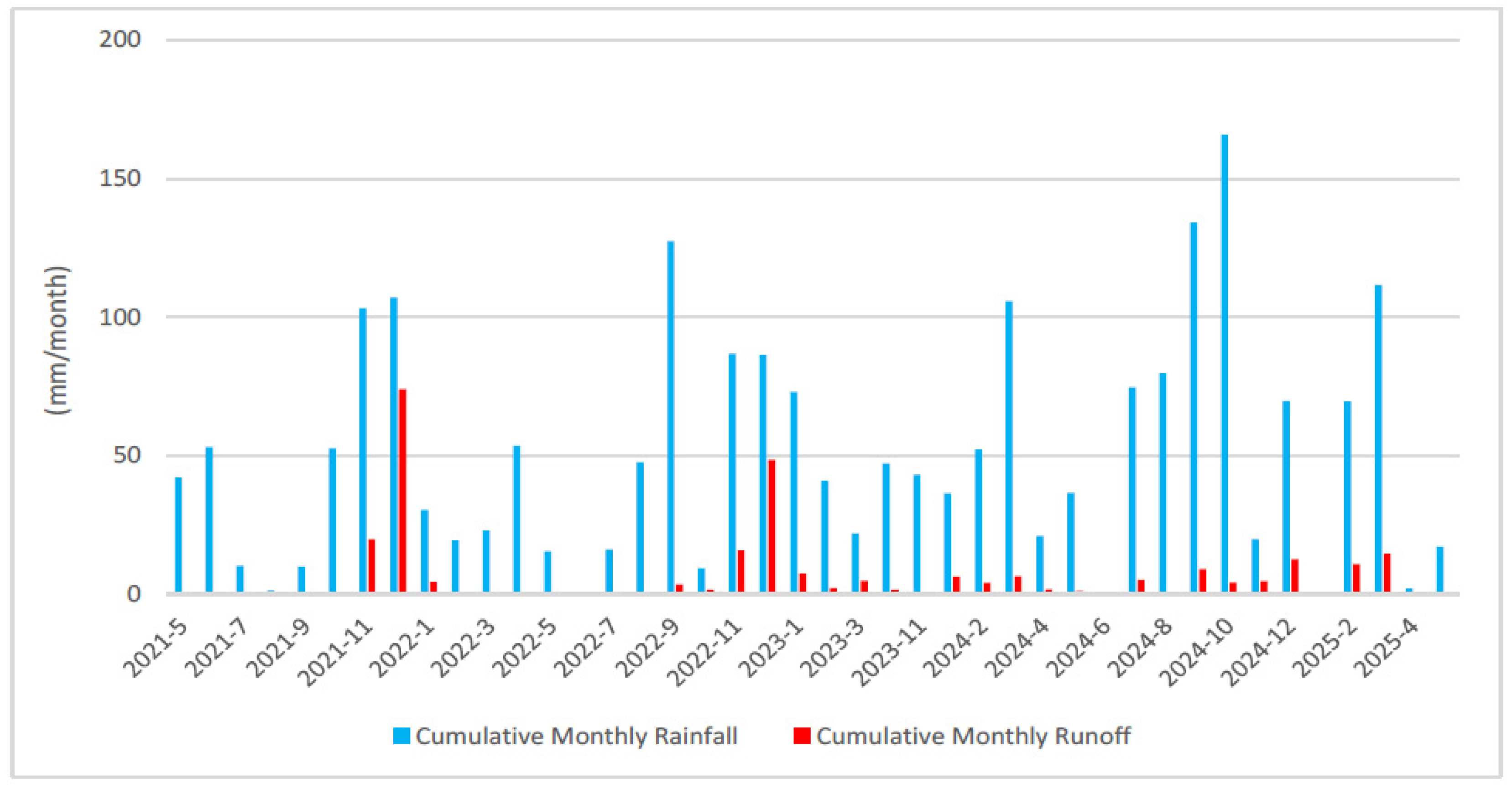
Figure 2 presents the monthly cumulative rainfall alongside the corresponding runoff from the polder roof over the four-year monitoring period (May 2021–May 2025). The data highlights the polder roof’s consistent performance in retaining rainfall and mitigating urban runoff in a densely built environment. Over multiple months, cumulative precipitation varied widely—from as little as 10 mm to over 130 mm—yet runoff was often negligible, with runoff coefficients frequently at 0%. Even during wetter periods, when some runoff was observed, coefficients typically remained below 20%, with only occasional peaks exceeding 50%, such as in December 2021 (69.2%) and December 2022 (56.0%). Such variability in runoff coefficients likely reflects differences in antecedent moisture, rainfall characteristics, and seasonal evapotranspiration. Thus, total rainfall alone does not determine runoff response; the timing and temporal patterns of rainfall are crucial for understanding BGR hydrology.
Figure 2.
Monthly cumulative rainfall and runoff measured on the Polder Roof.
Previous studies conducted at the event scale have demonstrated that BGR can moderate both the volume and intensity of runoff entering urban drainage systems in Medi-terranean climates [9,10]. The results presented here show that the Polder Roof functions as an effective urban water buffer across different years and seasons. This is particularly relevant in urban areas, where impervious surfaces often accelerate runoff and exacerbate drainage challenges. However, large-scale implementation of BGR can be challenging in several urban contexts. Combining them with other NBSs, such as permeable pavements and vegetated swales, could contribute to a more distributed and adaptive approach to stormwater management and a reduction in urban flood risk.
The findings suggest that incorporating polder roofs into urban landscapes represents a viable nature-based strategy for strengthening urban resilience, supporting sustainable stormwater management, mitigating climate-related risks such as flooding and heat, and promoting the multifunctional utilization of rooftop areas.
Author Contributions
Conceptualization, A.P., C.A., R.P., F.T. and S.G.; methodology, A.P., C.A., R.P., F.T. and S.G.; software, A.P., C.A. and R.P.; validation, A.P., C.A. and R.P.; formal analysis, A.P., C.A., R.P., F.T. and S.G.; investigation, A.P., C.A., R.P., F.T. and S.G.; resources, A.P., C.A., R.P., F.T. and S.G.; data curation, A.P., C.A. and R.P.; writing—original draft preparation, A.P., C.A., R.P., F.T. and S.G.; writing—review and editing, A.P., C.A., R.P., F.T. and S.G.; visualization, A.P., C.A., R.P., F.T. and S.G.; supervision, S.G.; project administration, A.P.; funding acquisition, A.P. All authors have read and agreed to the published version of the manuscript.
Funding
The following tests were carried out as part of the activities developed under the project PIANO NAZIONALE DI RIPRESA E RESILIENZA (PNRR)—MISSIONE 4 COMPONENTE 2 INVESTIMENTO 1.3—Partenariati estesi a università, centri di ricerca, imprese e finanziamento progetti di ricerca—PE00000005—CUP: E63C22002000002, within the framework of the Bando a cascata “TEMATICA5_BANDO_SPOKE5_1—Sustainable Urban areas by Nature-based solution implementation to mitigate climate impacts and achieve a Resilient, Innovative and Smart Environment-SUNRISE”.
Institutional Review Board Statement
Not applicable.
Informed Consent Statement
Not applicable.
Data Availability Statement
Data are available from the corresponding author upon reasonable request.
Conflicts of Interest
The authors declare no conflicts of interest.
References
- Treppiedi, D.; Cipolla, G.; Francipane, A.; Noto, L. Detecting precipitation trend using a multiscale approach based on quantile regression over a Mediterranean area. Int. J. Climatol. 2021, 41, 5938–5955. [Google Scholar] [CrossRef] [Scilit]
- Arnone, E.; Pumo, D.; Francipane, A.; La Loggia, G.; Noto, L.V. The role of urban growth, climate change, and their interplay in altering runoff extremes. Hydrol. Process. 2018, 32, 1755–1770. [Google Scholar] [CrossRef] [Scilit]
- Pelorosso, R.; La Rosa, D.; Floris, S.C.N. Planning Accessible Urban Green Infrastructure for Healthy and Fair Historical Towns: The Study Case of Viterbo, Central Italy. In Innovation in Urban and Regional Planning; La Rosa, D., Privitera, R., Eds.; Lecture Notes in Civil Engineering; Springer: Cham, Switzerland, 2021; Volume 146. [Google Scholar]
- Cristiano, E.; Farris, S.; Deidda, R.; Viola, F. Comparison of blue-green solutions for urban flood mitigation: A multi-city large-scale analysis. PLoS ONE 2021, 16, e0246429. [Google Scholar] [CrossRef] [Scilit] [PubMed]
- Pelorosso, R.; Gobattoni, F.; Leone, A. Increasing Hydrological Resilience Employing Nature-Based Solutions: A Modelling Approach to Support Spatial Planning. In Smart Planning: Sustainability and Mobility in the Age of Change; Papa, R., Fistola, R., Gargiulo, C., Eds.; Springer International Publishing: Cham, Switzerland, 2018; pp. 71–82. [Google Scholar]
- Recanatesi, F.; Petroselli, A. Land Cover Change and Flood Risk in a Peri-Urban Environment of the Metropolitan Area of Rome (Italy). Water Resour. Manag. 2020, 34, 4399–4413. [Google Scholar] [CrossRef] [Scilit]
- Cristiano, E.; Deidda, R.; Viola, F. The role of green roofs in urban Water-Energy-Food-Ecosystem nexus: A review. Sci. Total Environ. 2021, 756, 143876. [Google Scholar] [CrossRef] [Scilit] [PubMed]
- Cristiano, E.; Annis, A.; Apollonio, C.; Pumo, D.; Urru, S.; Viola, F.; Deidda, R.; Pelorosso, R.; Petroselli, A.; Tauro, F.; et al. Multilayer blue-green roofs as nature-based solutions for water and thermal insulation management. Hydrol. Res. 2022, 53, 1129–1149. [Google Scholar] [CrossRef] [Scilit]
- Pelorosso, R.; Petroselli, A.; Cappelli, F.; Noto, S.; Tauro, F.; Apollonio, C.; Grimaldi, S. Blue-green roof as nature-based solution for urban areas: Hydrological performance and climatic indexes analyses. Environ. Sci. Pollut. Res. 2024, 31, 5973–5988. [Google Scholar] [CrossRef] [Scilit] [PubMed]
- Pelorosso, R.; Petroselli, A.; Apollonio, C.; Grimaldi, S. Climate driven hydrological performance of Nature-based solutions: An empirical assessment of a blue-green roof. Lect. Notes Civ. Eng. 2024, 463, 566–576. [Google Scholar]
- Busker, T.; de Moel, H.; Haer, T.; Schmeits, M.; van den Hurk, B.; Myers, K.; Cirkel, D.G.; Aerts, J. Blue-Green Roofs with Forecast-Based Operation to Reduce the Impact of Weather Extremes. J. Environ. Manag. 2022, 301, 113750. [Google Scholar] [CrossRef] [Scilit] [PubMed]
- Grimaldi, S.; Petroselli, A.; Baldini, L.; Gorgucci, E. Description and Preliminary Results of a 100 Square Meter Rain Gauge. J. Hydrol. 2018, 556, 827–834. [Google Scholar] [CrossRef] [Scilit]
Disclaimer/Publisher’s Note: The statements, opinions and data contained in all publications are solely those of the individual author(s) and contributor(s) and not of MDPI and/or the editor(s). MDPI and/or the editor(s) disclaim responsibility for any injury to people or property resulting from any ideas, methods, instructions or products referred to in the content. |
© 2026 by the authors. Licensee MDPI, Basel, Switzerland. This article is an open access article distributed under the terms and conditions of the Creative Commons Attribution (CC BY) license.