1. Introduction
Urban expansion has converted natural landscapes into impervious surfaces, reducing infiltration and increasing flood risk [
1]. Sustainable urban drainage systems (SuDSs) address these issues by reproducing natural processes, with permeable pavements offering significant hydraulic and environmental benefits [
2]. Their performance, however, depends on design and maintenance, and while deterioration under heavy traffic is documented, the effectiveness of maintenance interventions remains uncertain [
3]. This study investigates infiltration rates across different pavement types and evaluates recovery following maintenance.
2. Materials and Methods
2.1. Pavement Types and Test Sites
Two sites in Melbourne, Australia, were investigated. At Monash University’s Living Laboratories (Clayton Campus), three pedestrian permeable pavement types were examined: porous concrete (PC1, PC2) and permeable interlocking concrete pavement (PICP). The installation of these pavements was executed in alternating sections, thereby enabling direct comparison under uniform environmental conditions. It should be noted that stratigraphic profiles were unavailable at the time. Additional tests were conducted at Eades Place Car Park, a permeable pavement exposed to regular vehicular traffic and sediment inputs. This dual-site approach allowed assessment under pedestrian/light-traffic versus vehicular/heavy-traffic conditions.
2.2. Infiltration Test Methods and Procedures
Preliminary calculations indicated that a constant head with a double-ring infiltrometer would require excessive water volumes; thus, tests at Monash were conducted with a 200 mm single-ring infiltrometer under the falling-head method [
4,
5,
6]. Infiltration rates were derived from regression analysis of water level decline [
7], with test volumes deter-mined by filling the ring to the 25 cm target height and measuring the actual water used. This procedure verified infiltration uniformity across multiple points on the same pavement surfaces.
To assess maintenance effects, the ASTM C1701 method was adopted [
8,
9]. The procedure was applied before and after maintenance on PC1 and PC2 at Monash and on the Eades Place car park site, ensuring consistent comparison under different conditions. It requires a 300 ± 10 mm ring, replicated using a modified cylindrical container [
8]. The method includes a pre-wetting phase that defines the test volume: 18 L if infiltration occurs in less than 30 s, otherwise 3.6 L are used again. In both sites, water levels were recorded on video for frame-by-frame analysis, and Ecoflex 5 silicone rubber (Smooth-On, Macungie, PA, USA) was used as sealing material, ensuring accuracy and easy removal.
2.3. Maintenance Interventions
To assess the impact of maintenance on permeable pavements, two cleaning methods were used: vacuum and pressure washing [
9,
10]. Both methods were tested separately, excluding their combination, as pressure washing accounted for most of the effectiveness [
9]. Tests were conducted on PC1 and PC2 at Monash University and at Eades Place Car Park. For each pavement, two adjacent spots were prepared with ASTM C1701 infiltrometers: one treated with vacuum cleaning, and the other with pressure washing. In all cases, infiltration tests were repeated after cleaning to quantify performance changes, and sediments mobilized during cleaning were collected for analysis. Vacuum cleaning was carried out with an Ozito 18V 10L Cordless Wet and Dry Vacuum/Inflator, with a maximum suction power of80 mbar (Ozito, Australia), selected for portability and sediment collection [
11]. Pressure washing was performed with a K4 Premium Full Control Kärcher, with a maximum pressure of approximately130 bar (Kärcher, Winnenden, Germany).
2.4. Sediment Analysis
Sediments mobilized during vacuum cleaning and pressure washing were collected from PC1, PC2, and Site-1 to investigate clogging mechanisms. Samples were analyzed by sieving (>150 µm), Particle Sizing System (PSS) (<150 µm), and Total Suspended Solids (TSSs). The 150 µm threshold was adopted for PSS compatibility because fine particles, often <20 µm, are the main contributors to clogging [
11,
12,
13]. Clogging can be physical, biological, or chemical [
3,
9,
14], but in permeable pavements it is predominantly physical, with fine sediments—especially <6 µm—causing pore obstruction [
12]. This analysis provided insight into site-specific clogging and a framework for interpreting infiltration performance decline.
3. Results
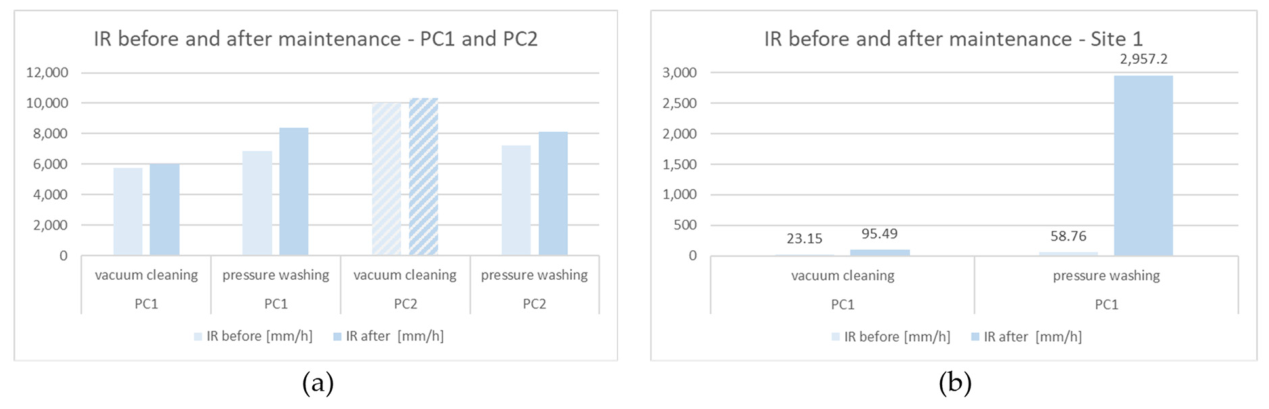
Figure 1 presents infiltration rate measurements before and after maintenance. These results were later complemented by sediment characterization (sieving, PSS, and TSS), allowing a broader assessment of pavement hydraulic performance and maintenance effectiveness.
At Monash University, PC1 and PC2 (porous concrete, pedestrian/light traffic) showed very high infiltration (>5000 mm/h) even before cleaning, with only marginal gains: +4.38% after vacuuming on PC1, +22.27% after pressure washing on PC1, and +12.24% on PC2. Sediments were mainly coarse (>1.18 mm), though PC2 retained more material, likely due to occasional car use. PSS confirmed consistent distributions in pressure samples (D50 ≈ 55 µm; Cu ≈ 3.5), while vacuum samples showed broader variation (CuPC1 = 5.38; CuPC2 = 6.39). At Site-1 (vehicular car park), infiltration was critically low before cleaning (23.15–58.76 mm/h), below the minimum design limit of 97.2 mm/h [
5,
7], 100 mm/h as an operational threshold [
9], and 250 mm/h as a maintenance trigger [
3]. Maintenance produced strong improvements: vacuuming raised rates by +312.5%, while pressure washing restored infiltration by +4932.3% to nearly 3000 mm/h. Sediment data supported these results, showing higher fine and intermediate fractions (<150 µm) and greater suspended solids than at Monash.
4. Discussion
The integrated analysis of infiltration and sediment data highlights strong contrasts between pedestrian/light-traffic pavements (PC1, PC2) and the vehicular site (Site-1). At Monash, pavements were dominated by coarse fractions and retained high infiltration capacity (>5000 mm/h) even after years without maintenance. Cleaning produced only marginal improvements, indicating mainly preventive value.
At Site-1, clogging was linked to fine sediment accumulation, with critically low initial infiltration (<100 mm/h). Maintenance was decisive: vacuum cleaning removed sur-face deposits but did not restore functionality, while pressure washing mobilized finer particles within the pores, achieving recovery above 3000 mm/h. From a practical perspective, pressure washing was significantly more effective in restoring infiltration, but required continuous water and power supply, higher operator input, and resulted in substantial water use, potentially limiting large-scale application. Vacuum cleaning, although less powerful hydraulically, proved advantageous in terms of portability, reduced resource demand, and compatibility with existing urban cleaning equipment.
Overall, findings support a complementary strategy: vacuum sweeping as a routine, low-effort practice for preventive maintenance, and pressure washing as a corrective intervention for heavily clogged pavements. Importantly, sediment mass alone does not reliably indicate hydraulic performance; rather, the type and size of particles—particularly fines—determine the true impact on infiltration capacity.
5. Conclusions
This study confirms that the long-term performance of permeable pavements depends on effective maintenance. Field results showed that pedestrian pavements retained high infiltration even without intervention, while vehicular pavements required corrective cleaning. Vacuum cleaning is suitable for routine prevention, whereas pressure washing is essential for restoring clogged surfaces. Integrating monitoring and maintenance into SuDS planning is crucial to ensure durability and functionality.
Author Contributions
Conceptualization, A.S., B.W. and G.G.; methodology, A.S., B.W.; validation, C.M., B.W. and G.G.; formal analysis, A.S. and B.W.; investigation, A.S. and B.W.; resources, B.W. and G.G.; data curation, A.S.; writing—original draft preparation, A.S. and C.M.; writing—review and editing, A.S., C.M., B.W. and G.G.; visualization, A.S.; supervision, B.W. and G.G. All authors have read and agreed to the published version of the manuscript.
Funding
This research received no external funding.
Institutional Review Board Statement
Not applicable.
Informed Consent Statement
Not applicable.
Data Availability Statement
Data are available upon request from the corresponding author.
Conflicts of Interest
The authors declare no conflict of interest.
References
- Arnold, C.L.; Gibbons, C.J. Impervious Surface Coverage: The Emergence of a Key Environmental Indicator. J. Am. Plan. Assoc. 1996, 62, 243–258. [Google Scholar] [CrossRef]
- Turco, M.; Brunetti, G.; Palermo, S.A.; Capano, G.; Grossi, G.; Maiolo, M.; Piro, P. On the Environmental Benefits of a Permeable Pavement: Metals Potential Removal Efficiency and Life Cycle Assessment. Urban Water J. 2020, 17, 619–627. [Google Scholar] [CrossRef]
- Weiss, P.T.; Kayhanian, M.; Gulliver, J.S.; Khazanovich, L. Permeable Pavement in Northern North American Urban Areas: Research Review and Knowledge Gaps. Int. J. Pavement Eng. 2017, 20, 143–162. [Google Scholar] [CrossRef]
- Bean, E.Z.; Hunt, W.F.; Bidelspach, D.A. Field survey of permeable pavement surface infiltration rates. J. Irrig. Drain. Eng. 2007, 133, 249–255. [Google Scholar] [CrossRef]
- Cipolla, S.S.; Maglionico, M.; Stojkov, I. Experimental Infiltration Tests on Existing Permeable Pavement Surfaces. CLEAN-Soil Air Water 2015, 44, 89–95. [Google Scholar] [CrossRef]
- Zhao, J.; Xie, X.; Liu, R.; Lin, C.; Gu, J.; Wang, Y.; Wang, Z. Comparison of Field Infiltration Test Methods for Permeable Pavement: Towards an Easy and Accurate Method. CLEAN-Soil Air Water 2019, 47, 1900174. [Google Scholar] [CrossRef]
- Lucke, T.; Boogaard, F.; Van De Ven, F. Evaluation of a New Experimental Test Procedure to More Accurately Determine the Surface Infiltration Rate of Permeable Pavement Systems. Urban Plan. Transp. Res. 2014, 2, 22–35. [Google Scholar] [CrossRef]
- ASTM C1701/C1701M-17a; Standard Test Method for Infiltration Rate of in Place Pervious Concrete. ASTM International: West Conshohocken, PA, USA, 2017. [CrossRef]
- Browne, D.; Buck, S.; Brown, S.; Luxton, J.; Li, B. Permeable Pavements Maintenance and Monitoring Outcomes. City of Melbourne Urban Water 2019. Available online: https://www.melbourne.vic.gov.au/sustainable-water-projects (accessed on 28 September 2025).
- Golroo, A.; Tighe, S.L. Pervious Concrete Pavement Performance Modeling: An Empirical Approach in Cold Climates. Can. J. Civ. Eng. 2012, 39, 1100–1112. [Google Scholar] [CrossRef]
- Kayhanian, M.; Anderson, D.; Harvey, J.T.; Jones, D.; Muhunthan, B. Permeability Measurement and Scan Imaging to Assess Clogging of Pervious Concrete Pavements in Parking Lots. J. Environ. Manag. 2011, 95, 114–123. [Google Scholar] [CrossRef] [PubMed]
- Siriwardene, N.; Deletic, A.; Fletcher, T. Clogging of Stormwater Gravel Infiltration Systems and Filters: Insights from a Laboratory Study. Water Res. 2007, 41, 1433–1440. [Google Scholar] [CrossRef] [PubMed]
- Lee, J.-W.; Yang, E.; Jang, J.; Yun, T.S. Effect of Clogging and Cleaning on the Permeability of Pervious Block Pavements. Int. J. Pavement Eng. 2021, 23, 3147–3156. [Google Scholar] [CrossRef]
- Bouwer, H. Artificial Recharge of Groundwater: Hydrogeology and Engineering. Hydrogeol. J. 2002, 10, 121–142. [Google Scholar] [CrossRef]
| Disclaimer/Publisher’s Note: The statements, opinions and data contained in all publications are solely those of the individual author(s) and contributor(s) and not of MDPI and/or the editor(s). MDPI and/or the editor(s) disclaim responsibility for any injury to people or property resulting from any ideas, methods, instructions or products referred to in the content. |