1. Introduction
Detection of defects in the welding contacts of voltage regulator ICs for automobile charging is essential, as undetected issues may lead to functional instability within the vehicle’s onboard electronics. This is especially important with the widespread adoption of electric vehicles, where solder joint quality directly affects system performance and lifespan. Traditional manual inspection is inefficient and heavily relies on subjective judgment. Although automated optical inspection (AOI) can partially replace manual checks, it remains susceptible to variations in lighting conditions and solder joint appearance. Soukup [
1] pointed out that AOI systems often produce false calls during the post-soldering stage, causing good products to be misclassified as defective, which increases the burden of manual re-inspection and reduces automation efficiency. Ebayyeh and Mousavi [
2] also noted that AOI methods are limited by lighting and solder joint appearance, highlighting the need for improved strategies to enhance detection performance. To address these limitations, Zhang and Shen [
3] introduced a multi-scale structure with enhanced features aimed at solder joint defect detection, which effectively improves AOI accuracy and demonstrates the potential of deep learning in detecting small and ambiguous solder joint defects.
To further improve detection accuracy and efficiency, deep learning techniques have gradually become a major research focus. These methods automatically learn features from solder joint images through end-to-end training, eliminating the tedious feature design and threshold setting required by traditional approaches. Zhang and Shen [
4] demonstrated that an improved Faster Region-based Convolutional Neural Network model enhances both detection accuracy and recall in identifying solder joint anomalies. Wang et al. [
5] presented a few-shot method for identifying solder joint irregularities utilizing enhanced features and a multi-scale fusion strategy, which improves detection accuracy and generalization even with limited samples.
Xin et al. [
6] improved You Only Look Once Version 4 (YOLOv4) for printed circuit board (PCB) defect detection by subdividing input images according to defect size and optimizing the feature extraction network, effectively enhancing detection accuracy and reliability, demonstrating the potential applicability of their method. Sha et al. [
7] designed an automated system for inspecting solder joints using YOLOv5, capable of identifying multiple types of anomalies simultaneously, demonstrating excellent stability and real-time detection capability. Compared with two-stage detection architectures, YOLO adopts a single-stage detection pipeline, achieving high accuracy while enabling fast inference, which is particularly suitable for real-time inspection on production lines. Additionally, Liu et al. [
8] proposed a series of improvements on YOLOv7 to enhance the detection of small solder joint defects. They added small-object detection layers, introduced a lightweight SimAM attention mechanism, replaced some convolution modules with more efficient alternatives, and utilized multi-scale feature fusion, demonstrating improved detection accuracy and model efficiency.
Zhang et al. [
9] further proposed the LPCB-YOLO algorithm, which reconstructs the feature extraction network of YOLOv8 and integrates lightweight modules, allowing precise identification of small defects in complex backgrounds while maintaining real-time computational efficiency. In summary, the YOLO series exhibits high accuracy, strong generalization, and real-time performance in solder joint defect detection, making it a key technological foundation for improving the efficiency and reliability of automotive electronics inspection.
Based on the advantages of YOLO models, we employed the YOLOv8 framework to detect solder joint defects in automotive voltage regulator ICs. First, solder joints were located using ROI techniques and then classified with YOLOv8 to identify normal and defective types. By leveraging end-to-end training and multi-scale feature learning, YOLOv8 effectively handles small and diverse solder joints while maintaining high detection performance. Experimental data were collected from a surface-mount technology (SMT) production line using an automated inspection machine, covering various common solder joint scenarios and ensuring the model’s applicability and stability across different conditions.
2. Region of Interest (ROI)-Based Defect Detection for IC Solder Joints
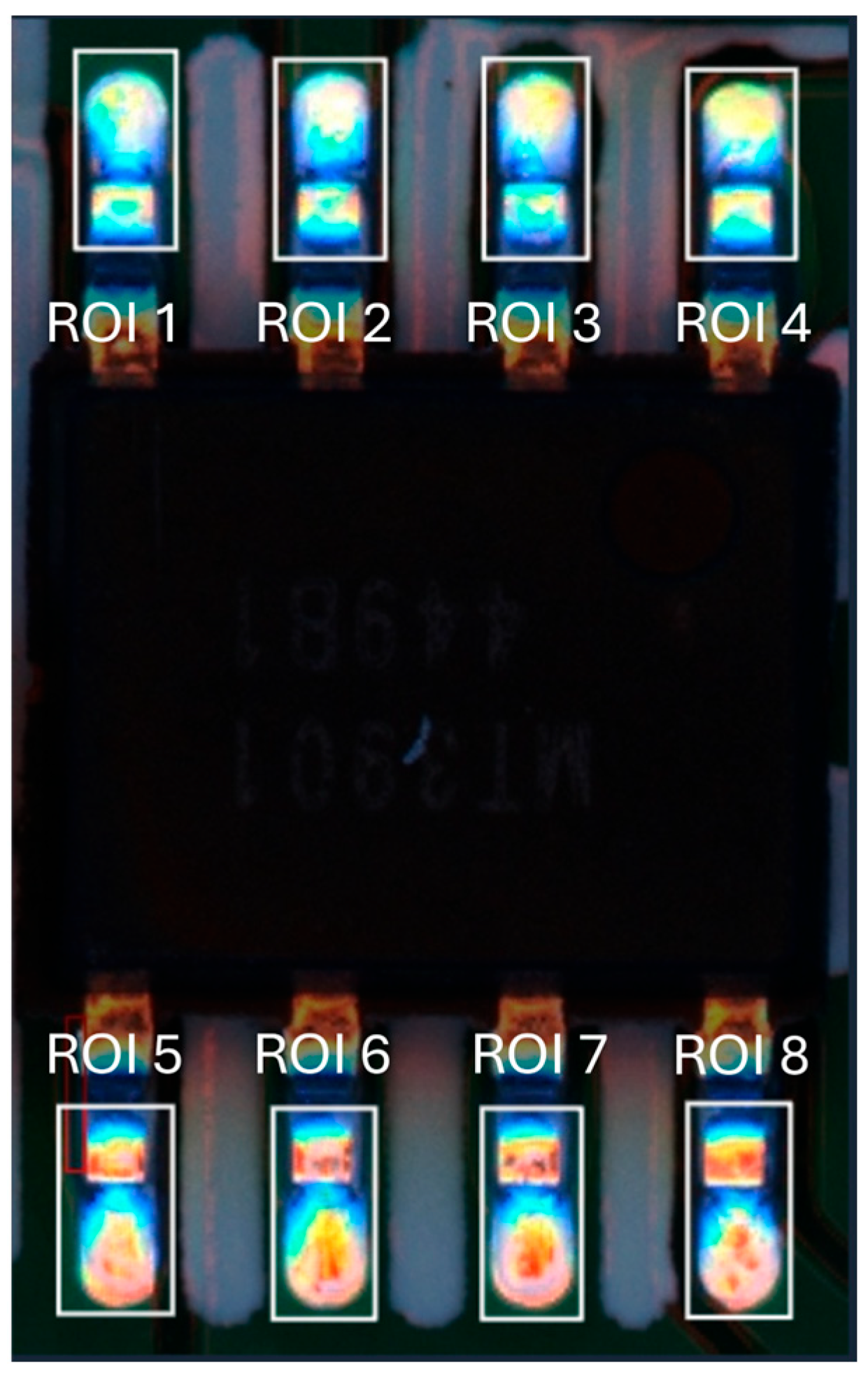
The object of this study is an 8-pin voltage regulator IC (VR IC) for automobile charging (36 V/5 A synchronous buck converter with a dual-channel current-limit function), serving as the core controller of a charging module responsible for providing stable voltage and load protection. This study focuses on detecting defects in each solder joint, including cold joints, insufficient fillets, and misalignment. The image data were collected from an SMT production line, covering the entire process from solder paste printing to reflow soldering and automatic inspection. Each original image had a resolution of 363 × 572 pixels and contained the complete VR IC with all eight pins, allowing the observation of solder distribution, positional deviations, and soldering integrity, which facilitates subsequent YOLO-based joint classification and defect detection.
Figure 1 shows ROIs corresponding to all eight pins of the VR IC, highlighting the areas used for solder joint inspection. Each ROI was carefully defined to include only the solderable tip of the pin, rather than the entire pin body. VR IC pins consist of a metallic lead providing mechanical support and electrical connection, and a solderable tip at the end to ensure reliable contact with the PCB pad. Since the pin body has minimal influence on solder quality, focusing the ROIs on the solderable tips allows the model to concentrate on the critical regions for defect detection, avoiding irrelevant information that could interfere with feature learning and improving classification accuracy. The cropped single-pin ROI images had a resolution of approximately 55 × 87 pixels, precisely covering the solderable tip to ensure that the critical solder features were retained while minimizing background interference.
The raw images were first manually annotated to precisely crop ROIs corresponding to each solder joint, ensuring that only the relevant soldering area was retained for model input. This manual annotation minimized background interference and maintained consistent alignment across samples.
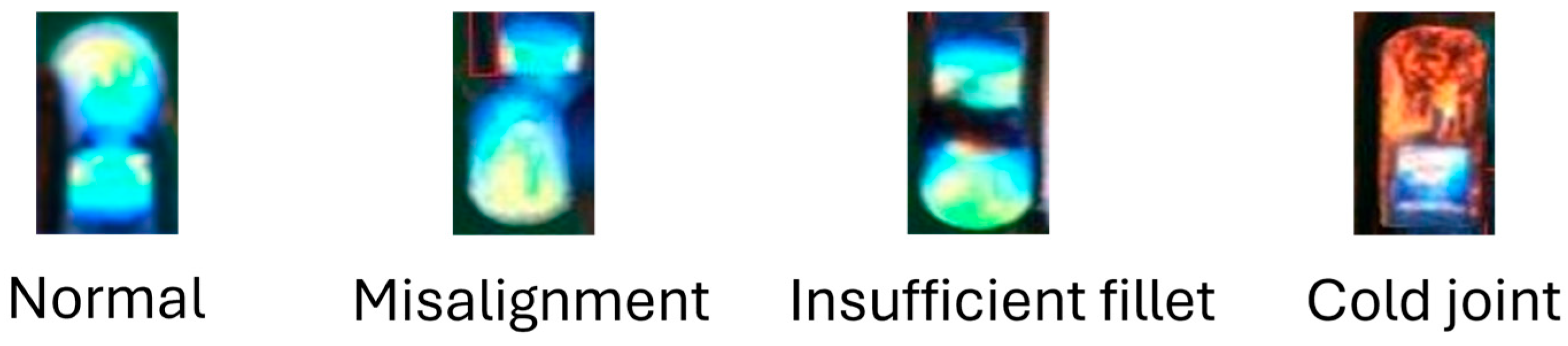
Figure 2 shows the examples of the normal type and three defect types, illustrating the visual characteristics used for classification. Each cropped solder joint image was treated as an individual sample and subsequently used for model training and testing. The solder joints were classified into four categories based on their visual characteristics: normal, misalignment (solder joint center offset from the pad center by more than one-third of the pad width), insufficient fillet (coverage less than 75%), and cold joint (surface cracks or discoloration). Representative samples from each defect type were distributed between training and test datasets to ensure exposure to all categories, including less common defects. Colors indicate the visual solder condition in the image: blue represents joints where solder is visibly present (including normal, misaligned, and insufficient solder joints), while orange represents cold joints, where the solder is severely insufficient or nearly absent, resulting in little to no visible solder in the image.
3. Training of YOLOv8
The YOLOv8 model used in this study detects four types of solder joints: normal, misalignment, insufficient fillet, and cold joint. The model was trained on 4000 single-pin samples from 500 VR ICs, with epochs = 50 and batch = 16. All samples were resized to 320 × 320 pixels to standardize the input dimensions, preserve sufficient details of the solder joints, and maintain a reasonable computational load during training.
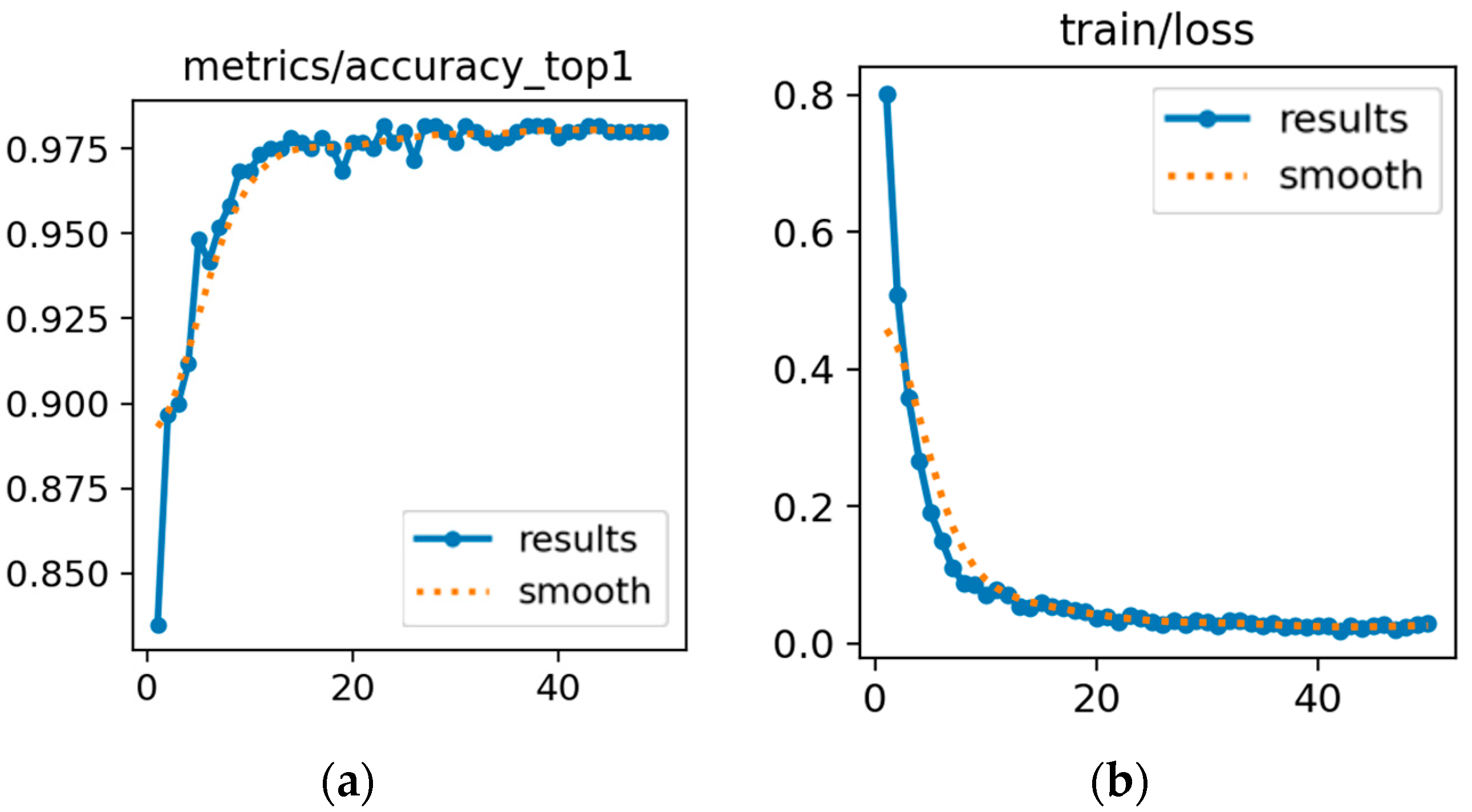
Figure 3 presents the YOLOv8 model’s training performance for the VR IC solder joint classification task, illustrating how training accuracy improved and training loss decreased throughout the training process.
Figure 3 shows the trends in top-1 accuracy and training loss over training cycles, illustrating that the model learned effectively and converged stably as the loss decreased and accuracy increased. During training, the model achieved consistently high accuracy, and although minor confusions may exist between visually similar categories, the curves indicate that it was learning to differentiate between the solder joint types. These observations suggest that the model captured the subtle features of VR IC solder joints and formed a solid basis for the subsequent testing phase. Solid blue lines represent the original metric values recorded at each epoch, while dashed orange lines represent moving-averaged curves, highlighting overall training trends.
4. Testing of YOLOv8
We used 4800 single-pin samples from 600 VR ICs as additional data to see how the model performs on inputs that were not part of its training. Performance was measured using conventional statistical indicators that quantify classification consistency, error tendencies, and correct prediction rates.
Table 1 summarizes the model’s predictions for individual pins, highlighting correct classifications and possible misclassifications across the four solder joint types: normal, misalignment, insufficient fillet, and cold joint.
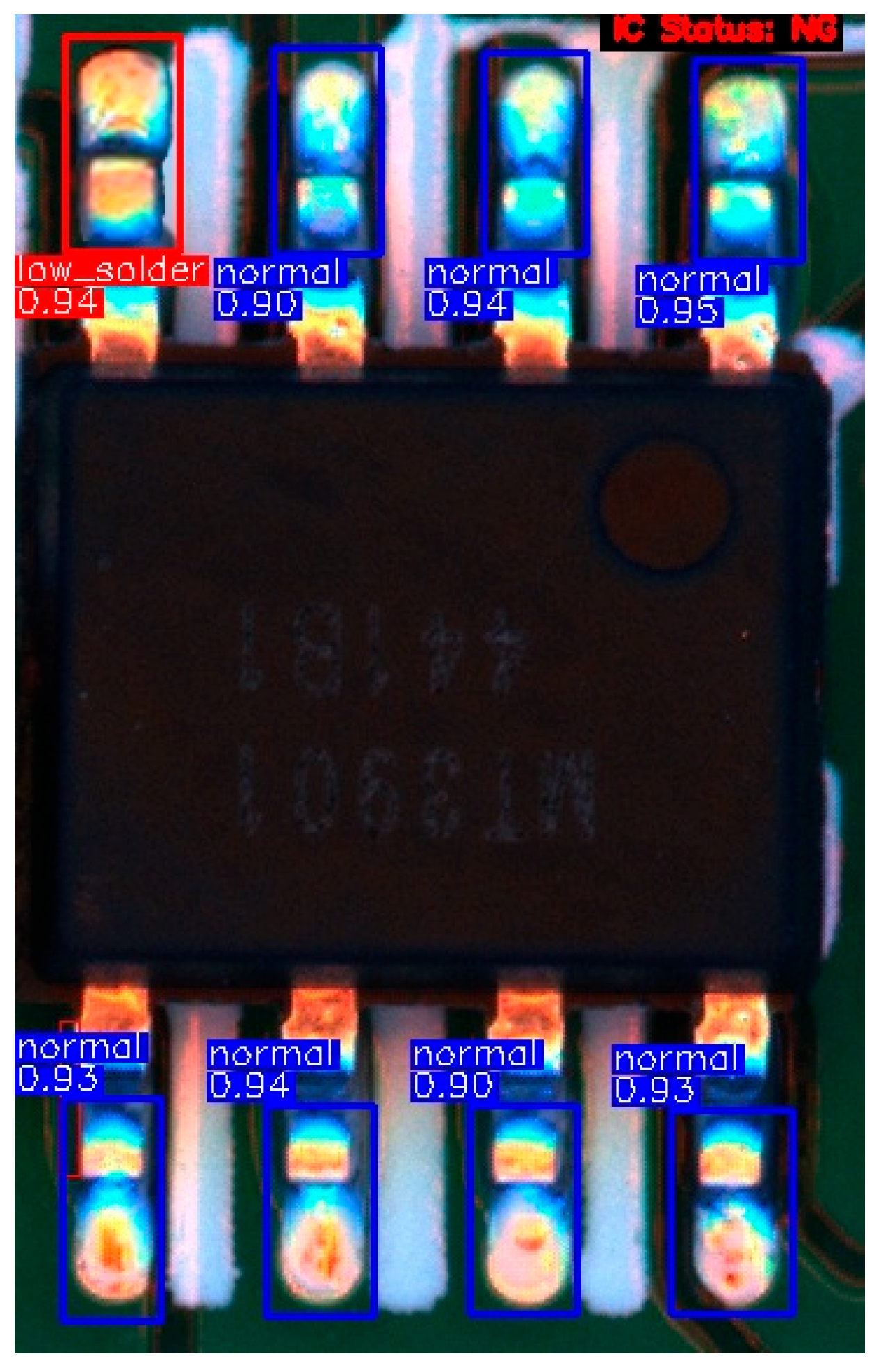
The model demonstrates reliable classification performance, achieving an overall accuracy of 0.973, calculated as (3816 + 200 + 352 + 304)/4800 = 0.973, with precision and recall for the other categories determined using the same approach. Both the normal and cold joint classes achieve excellent precision and recall, while the insufficient fillet category performs well despite occasional misclassifications. The misalignment category shows somewhat lower metrics, suggesting that some misaligned joints are confused with other defect types. These findings demonstrate that the YOLOv8 model generalizes effectively to new VR IC samples, correctly identifying most solder joint types, with minor errors mainly occurring between visually similar defect categories. To provide an intuitive illustration of the pin-level and IC-level classification process,
Figure 4 presents a schematic overview of a VR IC and the model’s predicted classes for its eight solder pins. ROI 1 is identified as defective and is highlighted with a red bounding box and red text indicating the defect type and predicted value. ROIs 2–8 are normal, highlighted with blue bounding boxes and blue text showing their predicted values.
The predicted class and confidence for each pin are displayed next to it. The IC status is determined using a conservative strategy: if any pin is defective, the IC is marked as NG; if all pins are normal, it is marked as OK. Among the 600 tested VR ICs, 551 were classified as OK and 49 as NG. The overall result is shown in the figure’s upper-right corner.
This combination of pin-level classification and IC-level aggregation enables both individual pin assessment and overall IC evaluation, enhancing detection sensitivity and interpretability. It assists the production line in detecting issues at an early stage, reducing the likelihood of defective ICs moving into later processes. In the figure, the defect termed insufficient fillet is shown as low solder for clarity, a simplified label used solely for visualization and without impact on the defect’s definition or accuracy.
5. Conclusions
We explored solder joint defect detection for automotive voltage regulator ICs, using a YOLOv8-based single-pin classification model. The model achieves a single-pin accuracy of 0.987 on training data and 0.973 on test data, with IC-level judgment exceeding 90%, indicating reliable defect recognition. Normal and cold joints were detected most accurately, while occasional misclassifications of insufficient fillet and misalignment could mark ICs as NG. Overall, YOLOv8 effectively detects automotive IC solder joint defects, aids manual inspection, and improves production quality.
Author Contributions
Conceptualization, K.-C.L.; methodology, Y.-H.C. and K.-C.L.; software, Y.-H.C.; validation, Y.-H.C.; formal analysis, K.-C.L.; investigation, Y.-H.C.; resources, K.-C.L.; data curation, Y.-H.C.; writing—original draft preparation, Y.-H.C.; writing—review and editing, Y.-H.C. and K.-C.L.; visualization, Y.-H.C.; supervision, K.-C.L.; project administration, K.-C.L.; All authors have read and agreed to the published version of the manuscript.
Funding
This research received no external funding.
Institutional Review Board Statement
According to institutional regulations, this study did not require IRB approval, as it involved no human participants, animals, or sensitive personal data.
Informed Consent Statement
As this study did not include human participants or personally identifiable information, obtaining informed consent was unnecessary.
Data Availability Statement
Anyone wishing to obtain the datasets or code from this study may reach out to the lead author for further information.
Conflicts of Interest
None of the authors have any personal or financial interests that might have influenced the findings presented in this work.
References
- Soukup, R. A methodology for optimization of false call rate in automated optical inspection post reflow. In Proceedings of the 33rd International Spring Seminar on Electronics Technology, ISSE 2010, Warsaw, Poland, 12–16 May 2010; IEEE: New York, NY, USA, 2010. [Google Scholar]
- Ebayyeh, A.M.A.; Mousavi, A. A Review and Analysis of Automatic Optical Inspection and Quality Monitoring Methods in Electronics Industry. IEEE Access 2020, 8, 183192–183271. [Google Scholar] [CrossRef]
- Zhang, K.; Shen, H. An Effective Multi-Scale Feature Network for Detecting Connector Solder Joint Defects. Machines 2022, 10, 94. [Google Scholar] [CrossRef]
- Zhang, K.; Shen, H. Solder Joint Defect Detection in the Connectors Using Improved Faster-RCNN Algorithm. Electronics 2021, 11, 576. [Google Scholar] [CrossRef]
- Wang, H.; Xie, J.; Xu, X.; Zheng, Z. Few-Shot PCB Surface Defect Detection Based on Feature Enhancement and Multi-Scale Fusion. IEEE Access 2022, 10, 129911–129924. [Google Scholar] [CrossRef]
- Xin, H.; Chen, Z.; Wang, B. PCB Electronic Component Defect Detection Method Based on Improved YOLOv4 Algorithm. J. Phys. Conf. Ser. 2021, 1827, 012167. [Google Scholar] [CrossRef]
- Sha, J.; Wang, J.; Hu, H.; Ye, Y.; Xu, G. Development of an Accurate and Automated Quality Inspection System for Solder Joints on Aviation Plugs Using Fine-Tuned YOLOv5 Models. Appl. Sci. 2023, 13, 5290. [Google Scholar] [CrossRef]
- Liu, Z.; Cao, W.; Gao, J. Defect Detection of Small Object Solder Joints Based on Improved YOLOv7. Chin. J. Liquid Cryst. Displays 2024, 39, 1332–1340. [Google Scholar]
- Zhang, H.; Li, Y.; Kayes, D.M.H.; Song, Z.; Wang, Y. Research on PCB defect detection algorithm based on LPCB-YOLO. Front. Phys. 2024, 12, 1472584. [Google Scholar] [CrossRef]
| Disclaimer/Publisher’s Note: The statements, opinions and data contained in all publications are solely those of the individual author(s) and contributor(s) and not of MDPI and/or the editor(s). MDPI and/or the editor(s) disclaim responsibility for any injury to people or property resulting from any ideas, methods, instructions or products referred to in the content. |