1. Introduction
As the global population increases, the consumption of animal meat has increased as well. Eventually, the demand for plant-based meat sources has also significantly increased in the past decades due to environmental sustainability, animal cruelty, and health concerns [
1]. These alternatives mimic the taste, texture, and appearance of animal-based meats, making them visually and sensorially similar. For many consumers, the choice between these products is not merely a matter of preference but is influenced by social, religious, lifestyle, or environmental considerations [
2].
Food authentication continues to attract a lot of attention from different researchers and organizations as the variety of food products available in the market continues to increase. The need for reliable analytical methods of detecting and classifying food products is growing due to the production of counterfeit food and mislabeled products [
3]. Traditional methods of food authentication, such as human panel tests, are often subjective and time-consuming. To address these limitations, researchers developed and tested various analytical methods for verification, including biomimetic sensor technologies like an electronic nose [
4,
5,
6,
7].
The visual and sensory similarities between animal-based and plant-based meat products make it challenging for consumers to distinguish between the two [
8]. To address this gap, we used an e-nose system with an array of MQ gas sensors and the fuzzy logic algorithm. We evaluated the developed electronic nose (e-nose) system for classifying animal-based meat products and plant-based meat products. For the animal meat, only beef and pork are included. The plant-based meat products that are used in this study are products marketed to mimic the properties of beef and pork. The result of the system will only show either Animal-based meat or plant-based meat.
2. Methodology
2.1. System Workflow
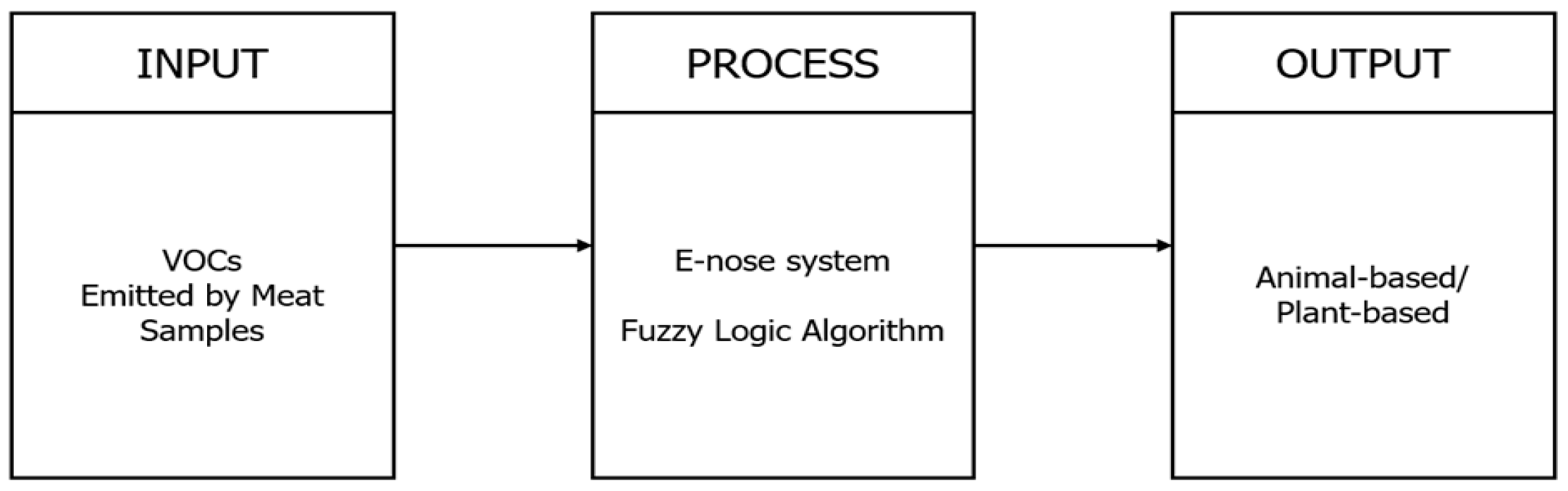
The system was developed by using a systematic process for classifying animal-based and plant-based meat products using an e-nose system. As shown in
Figure 1, the system workflow begins with the input, which consists of meat samples that can be either animal-based or plant-based. These samples emit volatile organic compounds (VOCs) that are unique in their composition. The e-nose system, equipped with an array of MQ gas sensors, detects these VOCs as part of the process phase. The detected VOCs are then analyzed using a fuzzy logic algorithm, which processes the sensor data to classify the sample based on predefined criteria and patterns associated with animal-based and plant-based meats. Finally, the output phase displays the classification result on an LCD screen, indicating whether the sample is animal-based meat or plant-based meat.
2.2. Hardware
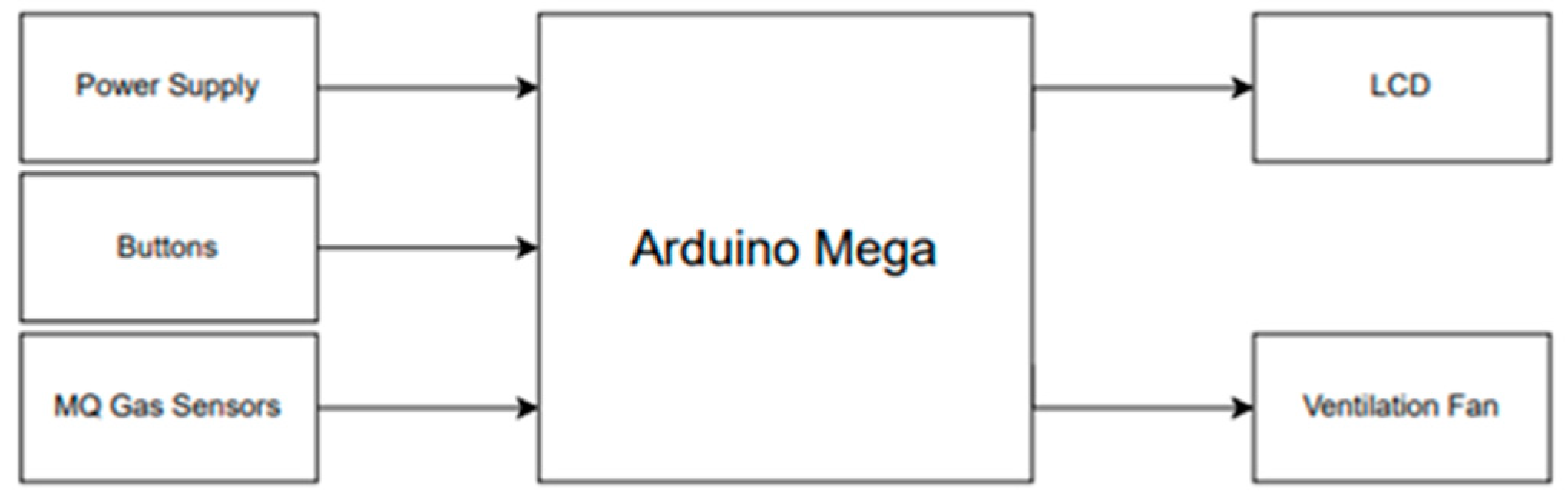
Figure 2 shows that the system comprises several key components. A power supply provides the necessary energy for operation. At the core of the system is an Arduino microcontroller, which functions as the central processing unit by controlling operations, processing sensor data, and managing communication among components. Six MQ-series gas sensors (MQ-2, MQ-3, MQ-7, MQ-135, MQ-136, and MQ-138) are employed to detect volatile organic compounds (VOCs) associated with different types of meat. The system status and measurement results are displayed on an LCD screen. To ensure reliable sensor readings, a fan is incorporated to remove residual gases from the testing chamber.
2.3. Software
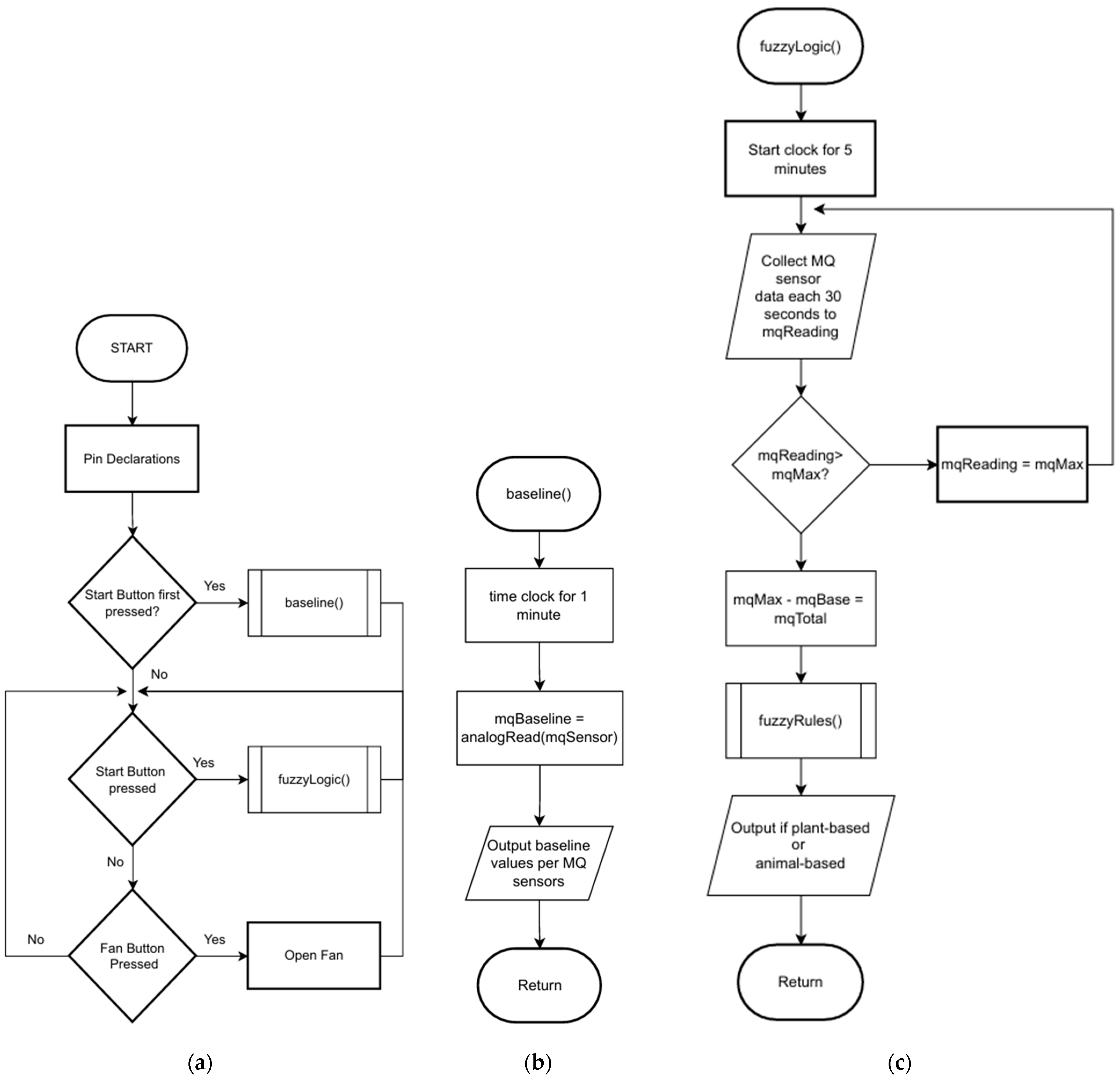
Figure 3a shows the flowchart of the system software, which begins with the initialization phase, where all required peripherals are configured, including the LCD, MQ gas sensors, fan, and control buttons. Upon startup, the LCD shows the system title, and the microcontroller enters an idle loop, continuously checking for user inputs.
Figure 3b shows the baseline module, which is responsible for obtaining background reference readings of the clean air environment before the introduction of a sample. During this stage, the sensors measure the ambient gas concentration inside the sealed chamber to establish a reference voltage level for each MQ sensor. Once the baseline is established, the fuzzy logic module performs measurement and classification. The primary objective of this module is to collect gas concentration data over a defined period and use these values to classify the sample. Upon activation, the system initiates a five-minute timer during which the MQ sensors record the VOC readings of the sample. At the end of this interval, the system calculates the difference between each sensor’s maximum and baseline readings, referred to as the total value (
mqTotal =
mqMax −
mqBase). These differences serve as the input parameters for the fuzzy inference process.
The fuzzy logic algorithm evaluates these normalized differences and computes the corresponding membership degrees for each sensor based on predefined linguistic terms such as low, medium, and high. The evaluation proceeds according to the rule base defined in the fuzzyRules() module. Once the inference process is complete, the system determines the most probable category of the sample. The classification result is displayed on the LCD screen.
2.4. Experimental Setup
The system consists of two main sections. The upper section houses the Arduino Mega microcontroller, LCD interface, control buttons, and an array of MQ gas sensors. The lower section serves as the testing chamber, where meat samples are placed for VOC measurement. A fan is installed in the lower compartment to remove residual gases before subsequent trials.
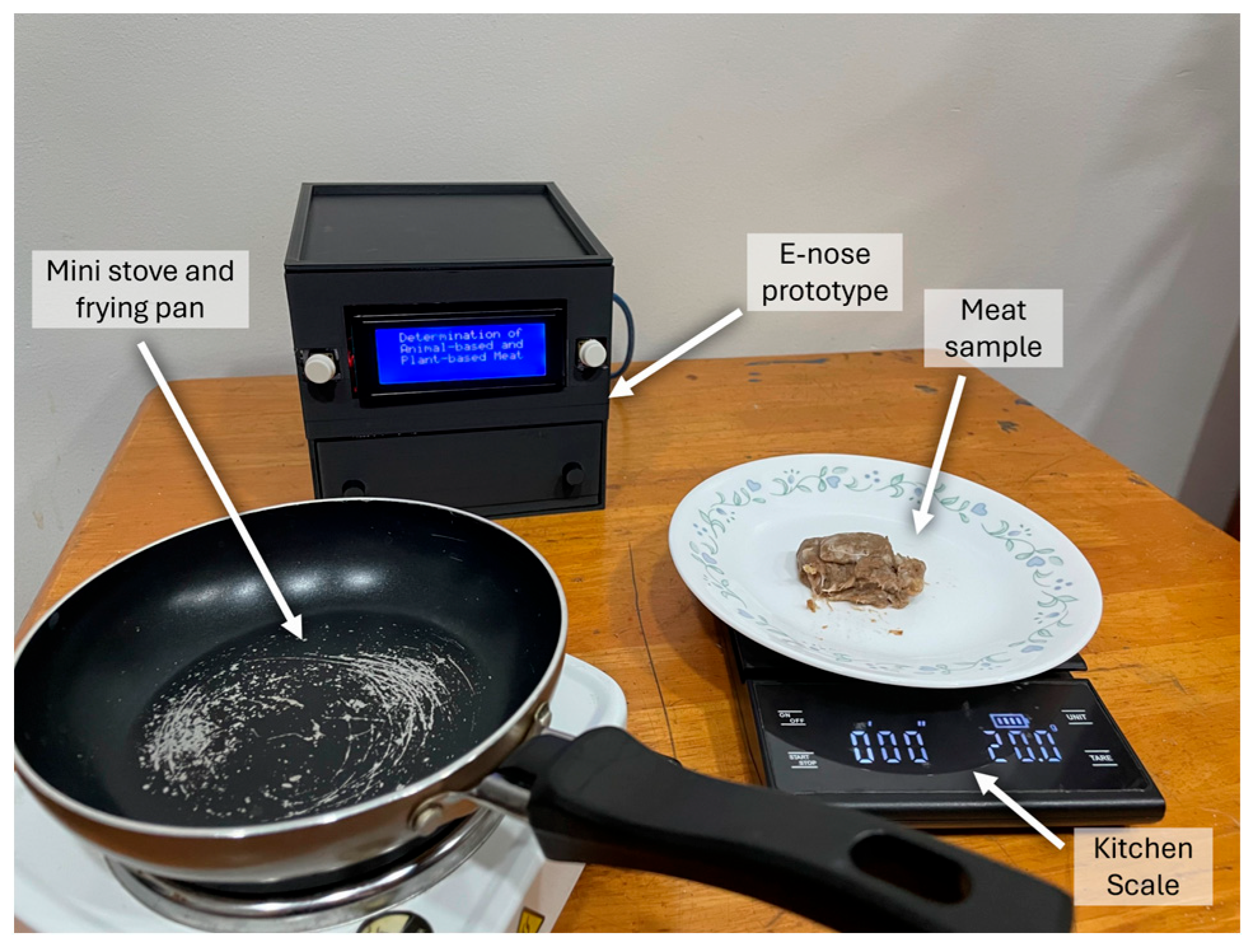
The physical implementation and testing setup of the electronic nose system are shown in
Figure 4. Before testing, each meat sample is weighed using a digital kitchen scale to ensure consistency in data collection. The samples are cooked, as heat-induced reactions increase VOC release. The cooked sample is placed inside the testing chamber, positioned in front of the MQ gas sensors. The system records the VOC profiles, which are subsequently processed using the fuzzy logic algorithm to determine the classification of the meat product.
3. Results and Discussion
We collected 200 samples for the training dataset, consisting of 100 animal-based meats and 100 plant-based meats. Each meat sample was cooked for 3 min before gathering its VOC readings for 5 min. The established baseline from getting the readings of clean air is then deducted from the meat sample readings. Twenty meat samples, consisting of 10 animal-based and 10 plant-based meats, were tested for the accuracy of the e-nose.
Table 1 shows the results of the 20 meat samples for the testing of the electronic nose for determining the meat type. The first column shows the actual classification, while the second column shows the result that the electronic nose system displayed after reading the VOCs of the meat sample. Lastly, the remarks indicated whether the results are true or false.
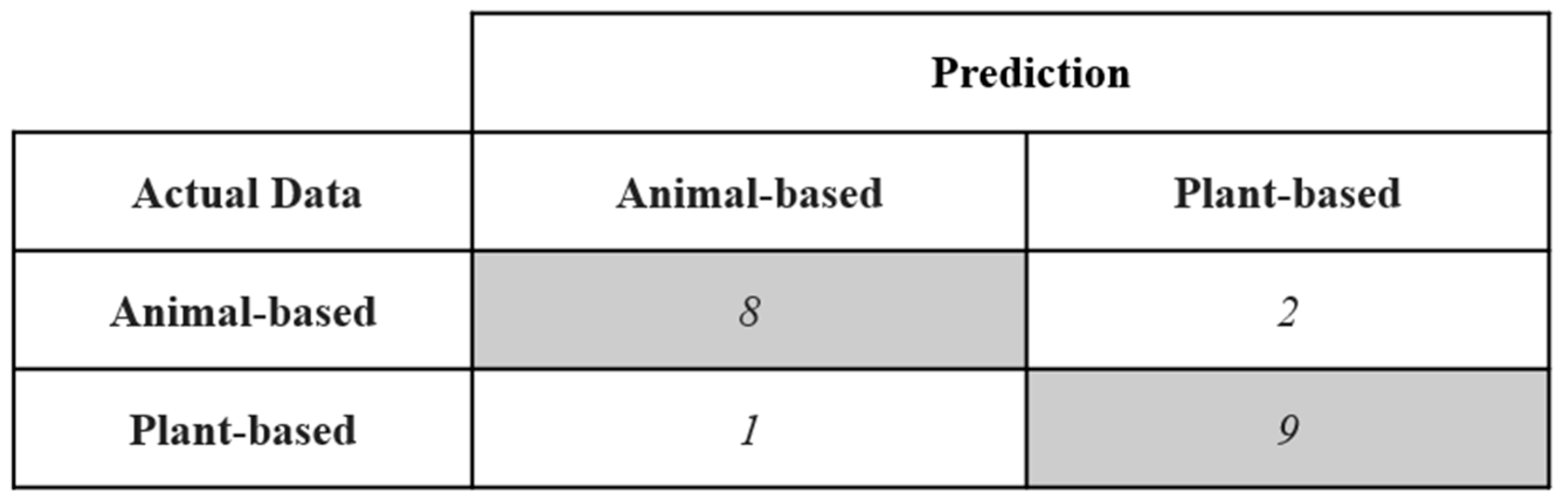
A confusion matrix, shown in
Figure 5, was used to validate the accuracy of the e-nose system. The category label on the y-axis represents the actual meat that was tested, while the category label on the x-axis represents the predicted data that was gathered after the trials. Correct classification results from the e-nose are the true positive (TP) and true negative (TN), which are shaded in the confusion matrix. The false positive (FP) and false negative (FN) are the incorrect classifications and are shown in the unshaded cells.
TP: E-nose classified animal-based meat, and it is animal-based meat;
TN: E-nose classified plant-based meat, and it is plant-based meat;
FP: E-nose classified animal-based meat, but it is plant-based meat;
FN: E-nose classified plant-based meat, but it is animal-based meat.
After testing, the accuracy of the meat determination was computed by dividing the value of the correct classification for a type of meat by the number of samples. The accuracy of the electronic nose system was evaluated by dividing the total of correct predictions by the total number of meat samples.
4. Conclusions
We developed and evaluated an e-nose system capable of classifying animal-based and plant-based meat products through the integration of MQ gas sensors and a fuzzy logic algorithm. The system effectively analyzed VOCs emitted by the samples and employed rule-based decision-making to determine meat type. Experimental results demonstrated that the proposed e-nose system achieved an accuracy of 85% in distinguishing between the two categories, thereby confirming its reliability as a food authentication tool.
Combining fuzzy logic with gas sensor technology provides a low-cost, efficient, and objective alternative to conventional sensory or chemical testing methods. This approach contributes to greater transparency in food labeling and enhances consumer trust, particularly within the expanding market for plant-based alternatives. Future work will focus on expanding the dataset to include a wider range of meat and plant-based products, as well as optimizing environmental control to further improve the precision and consistency of sensor measurements.
Author Contributions
Conceptualization, K.M.W.C., V.S.R.D.P. and J.F.V.; methodology, K.M.W.C. and V.S.R.D.P.; software, K.M.W.C. and V.S.R.D.P.; validation, J.F.V.; formal analysis, K.M.W.C. and V.S.R.D.P.; investigation, K.M.W.C. and V.S.R.D.P.; resources, K.M.W.C. and V.S.R.D.P.; data curation, K.M.W.C. and V.S.R.D.P.; writing—original draft preparation, K.M.W.C. and V.S.R.D.P.; writing—review and editing, K.M.W.C., V.S.R.D.P. and J.F.V.; visualization, K.M.W.C. and V.S.R.D.P.; supervision, J.F.V.; project administration, J.F.V.; funding acquisition, K.M.W.C. and V.S.R.D.P. All authors have read and agreed to the published version of the manuscript.
Funding
This research received no external funding.
Institutional Review Board Statement
Not applicable.
Informed Consent Statement
Not applicable.
Data Availability Statement
The dataset is available upon request from the corresponding author.
Conflicts of Interest
The authors declare no conflicts of interest.
References
- Saini, M.; Prakash, G.; Yaqub, M.Z.; Agarwal, R. Why Do People Purchase Plant-Based Meat Products from Retail Stores? Examining Consumer Preferences, Motivations and Drivers. J. Retail. Consum. Serv. 2024, 81, 103939. [Google Scholar] [CrossRef]
- He, J.; Evans, N.M.; Liu, H.; Shao, S. A Review of Research on Plant-Based Meat Alternatives: Driving Forces, History, Manufacturing, and Consumer Attitudes. Compr. Rev. Food Sci. Food Saf. 2020, 19, 2639–2656. [Google Scholar] [CrossRef] [PubMed]
- Danezis, G.P.; Tsagkaris, A.S.; Brusic, V.; Georgiou, C.A. Food Authentication: State of the Art and Prospects. Curr. Opin. Food Sci. 2016, 10, 22–31. [Google Scholar] [CrossRef]
- Sanaeifar, A.; ZakiDizaji, H.; Jafari, A.; de la Guardia, M. Early Detection of Contamination and Defect in Foodstuffs by Electronic Nose: A Review. TrAC Trends Anal. Chem. 2017, 97, 257–271. [Google Scholar] [CrossRef]
- Wijaya, D.R.; Sarno, R.; Daiva, A.F. Electronic Nose for Classifying Beef and Pork Using Naïve Bayes. In Proceedings—2017 International Seminar on Sensor, Instrumentation, Measurement and Metrology: Innovation for the Advancement and Competitiveness of the Nation, ISSIMM 2017; IEEE: New York, NY, USA, 2017; pp. 104–108. [Google Scholar] [CrossRef]
- Ibarra, D.M.A.; Patajo, S.J.G.; Caya, M.V.C. Characterization and Classification of Mangifera Indica Ripeness with Electronic Nose Using Fuzzy Logic Algorithm. In 2022 IEEE 14th International Conference on Humanoid, Nanotechnology, Information Technology, Communication and Control, Environment, and Management, HNICEM 2022; IEEE: New York, NY, USA, 2022. [Google Scholar] [CrossRef]
- Caya, M.V.C.; Maramba, R.G.; Mendoza, J.S.D.; Suman, P.S. Characterization and Classification of Coffee Bean Types Using Support Vector Machine. In 2020 IEEE 12th International Conference on Humanoid, Nanotechnology, Information Technology, Communication and Control, Environment, and Management, HNICEM 2020; IEEE: New York, NY, USA, 2020. [Google Scholar] [CrossRef]
- Kumari, S.; Alam, A.N.; Hossain, M.J.; Lee, E.Y.; Hwang, Y.H.; Joo, S.T. Sensory Evaluation of Plant-Based Meat: Bridging the Gap with Animal Meat, Challenges and Future Prospects. Foods 2024, 13, 108. [Google Scholar] [CrossRef] [PubMed]
| Disclaimer/Publisher’s Note: The statements, opinions and data contained in all publications are solely those of the individual author(s) and contributor(s) and not of MDPI and/or the editor(s). MDPI and/or the editor(s) disclaim responsibility for any injury to people or property resulting from any ideas, methods, instructions or products referred to in the content. |