Proceeding Paper

Contactless Footprint Acquisition and Automated Identification Using Convolutional Neural Network †
by
Angelica A. Claros
,
Elmo Joaquin D. Estacion
and
Jocelyn F. Villaverde
*
School of Electrical, Electronics, and Computer Engineering, Mapúa University, Manila City 1002, Philippines
*
Author to whom correspondence should be addressed.
Presented at the 7th Eurasia Conference on IoT, Communication and Engineering 2025 (ECICE 2025), Yunlin, Taiwan, 14–16 November 2025.
Eng. Proc. 2026, 134(1), 30; https://doi.org/10.3390/engproc2026134030
Published: 3 April 2026

Abstract

Biometric systems are widely used in security and forensic applications. Conventionally, contact-based footprint scanners require physical contact, which presents significant limitations. These devices raise hygiene concerns and are impractical in field identification conditions, such as forensic investigations or disaster victim identification, where quick and non-invasive methods are essential. To address these challenges, a contactless footprint acquisition and identification system was developed using image processing techniques and a Convolutional Neural Network (CNN) based on the Visual Geometry Group–16 layer architecture. The system employs a Raspberry Pi 4, a Logitech C922 camera, and a ring light to capture footprints without direct surface contact. Captured images are processed with Contrast Limited Adaptive Histogram Equalization (CLAHE) to improve contrast and mean thresholding to generate binary images for clearer feature extraction. System performance was evaluated using a multiclass confusion matrix. The CNN correctly classified 158 of 160 test images, achieving an accuracy of 98.75%. This result demonstrates higher accuracy than earlier studies that used older CNN models, such as Alex Krizhevsky’s Network and LeCun’s Network-5, which performed with fewer subjects and lower accuracy rates. The developed system shows potential for biometric security, forensic investigations, and disaster response, where contactless and reliable identification is required. Future research can expand the dataset with more diverse footprints, test performance under varied conditions, and extend the approach to other contactless biometrics such as palmprints or ears.

1. Introduction

Biometrics originated from the Greek words “bios” (life) and “metron” (measure), meaning that biometrics refers to the recognition of measurements found within a person’s body [1]. Biometrics now serves greater importance, with accounts often requiring facial features, fingerprints, footprints, and passwords to ensure correct user identification and authentication [2]. This technology is used in banking, forensics, and security [3]. As a result, smartphones now offer various identification features, such as facial recognition and fingerprint scanners, for security purposes before granting access to the user [4].
Footprints provide distinctive ridge patterns and shapes that can be effectively utilized for authentication purposes [5]. A local study implemented footprint biometrics for identification using LeCun’s Network-5 (LeNet-5) Convolutional Neural Network (CNN) model on a Raspberry Pi 3, achieving an accuracy of 91.67% with 10 test subjects [6]. Moreover, CNNs remain widely used for image classification across various studies [7,8]. Interest in iris and voice recognition systems has also been growing. One study developed an iris recognition system on a Raspberry Pi using Otsu’s thresholding technique, attaining 96.60% accuracy [9], while another created a dual iris recognition system employing a Raspberry Pi camera module and a Support Vector Machine (SVM) model, yielding 95% accuracy [10]. During the COVID-19 pandemic, a two-tier biometric system integrating iris and voice recognition was proposed to promote non-contact security verification [11]. Researchers have further investigated alternative biometric traits such as the ear, lips, tongue, and teeth. An ear-based identification system utilizing Contrast Limited Adaptive Histogram Equalization (CLAHE) and an SVM classifier was developed [12]. Additionally, Raspberry Pi-based tongue print recognition studies have applied various algorithms, including ORB, BRIEF, SIFT, YOLOv2, and InceptionV3, with YOLOv2 demonstrating the best performance [13,14,15].
Moreover, current studies on footprint recognition continue to utilize earlier Convolutional Neural Network architectures, such as AlexNet and LeNet-5. The exploration of modern architecture models, such as the Visual Geometry Group–16-layer network, has not been applied to footprint recognition systems. Furthermore, few studies—if any—have developed a contactless and portable footprint biometric system.
This study aims to develop a contactless footprint recognition system that utilizes image processing techniques and a CNN algorithm to acquire and identify footprints without needing physical contact with a person. Additionally, this research specifically aims to design and develop a contactless footprint biometric system using a Raspberry Pi; (2) to implement image processing techniques and algorithms to create a system that acquires and identifies footprints for contactless biometric purposes; and (3) to use a confusion matrix to assess the system’s accuracy in identification.
A contactless footprint identification system using a Raspberry Pi contributes to the field of biometric systems. The system can capture both footprints simultaneously without physical contact, but it identifies individuals using one footprint at a time. The CNN algorithm was used to train the system to identify individuals. The subjects in this study consist of 15 individuals and one unregistered individual, all of whom have no scars or wounds on their footprints for better identification. Therefore, the system also requires recording data in a database for accurate footprint identification. Furthermore, the system does not determine whether the scanned footprints are spoofed.

2. Methodology

2.1. Conceptual Framework

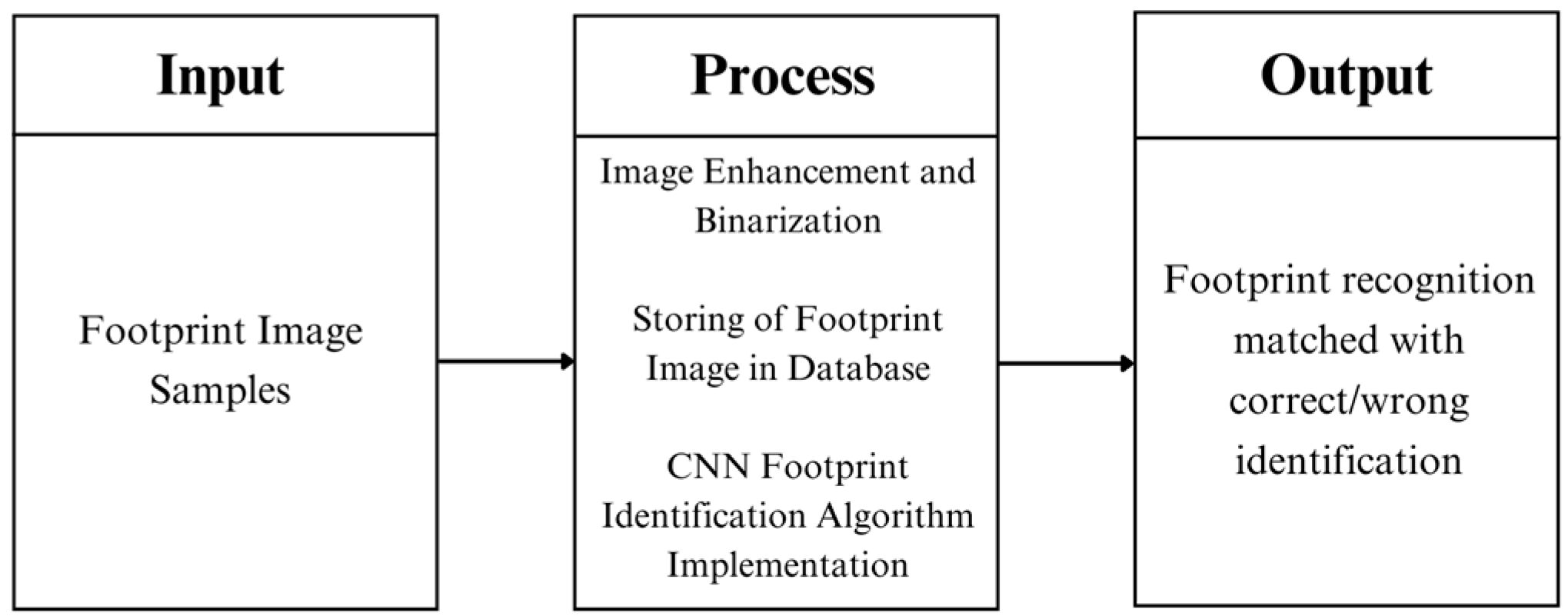
Figure 1 displays the study’s conceptual framework. We collected 760 footprint image samples to feed into the system, 600 for training and 160 for testing. All images were processed using image enhancement and binarization techniques. Then, the CNN algorithm was trained to identify footprints based on the footprint images stored in the database. The system’s output consisted of the recognized footprint, matched with its corresponding correct or incorrect identification result.

2.2. Hardware Block Diagram

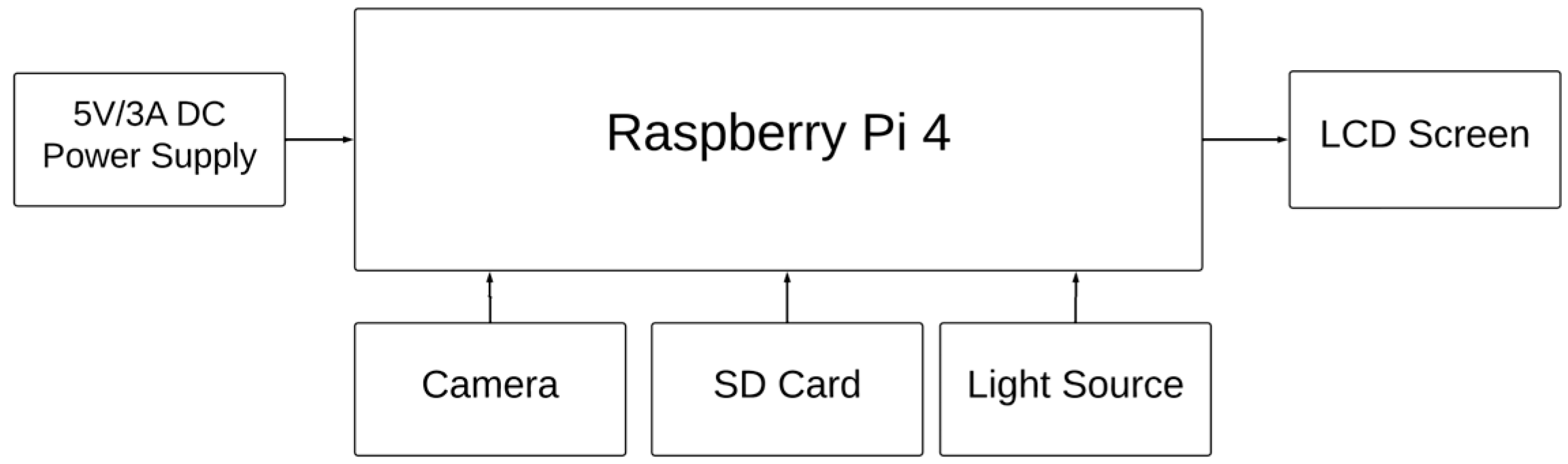
The hardware components of the system and their relationships are illustrated in Figure 2. The system consisted of a Raspberry Pi 4, a secure digital card, a camera, a light source, an LCD, and a 5V power supply. The Raspberry Pi 4 handled the processing of the system’s inputs and outputs. A 5V power supply powered the Raspberry Pi 4. A Logitech C922 webcam was connected to the Raspberry Pi 4. A light source supported the camera, enhancing the visibility of the footprints as it captured them. All training images were stored on the SD card. Lastly, the recognized footprint and identification result were displayed on the LCD. A graphical user interface on the LCD was accessible to the user.

2.3. Software Development

In the development of the software for the footprint biometric system, three modules are used: image enhancement, image binarization, and CNN training. Each module plays an important role in building the footprint identification system. First, the image undergoes the imageEnhancement() module for background removal, image masking, and the application of CLAHE techniques. Then, the image binarization module binarizes the enhanced images using mean thresholding. The binarized images are subsequently fed into the CNN training module for training and testing. The binarized footprint images are processed by convolutional layers to extract key features, Rectified Linear Unit activations for pattern recognition, max pooling layers to down-sample feature maps, and dense layers to combine features for classification.

2.4. CNN Algorithm

We employed a CNN algorithm to train the system for classification. In particular, the VGG-16 model, a type of CNN architecture known for its strong performance in image identification and classification, was used in the study. Moreover, this model was adapted to classify or identify user identities using footprints as input. The photos were first fed into the input layer and resized to 224 × 224 pixels before being passed through the convolutional layers. After that, stacks consisting of multiple convolutional layers processed the images. To extract footprint features, the initial convolutional layer employed 64 filters, generating a convolved feature map. After each stack of convolutional layers, the data moved to a max-pooling layer, which reduced the number of pixels by half, from 224 × 224 to 112 × 112, and so on. After the convolutional and pooling layers processed the input, the data passed through fully connected layers, which flattened the features and classified the user based on footprint patterns.

2.5. Experimental Setup

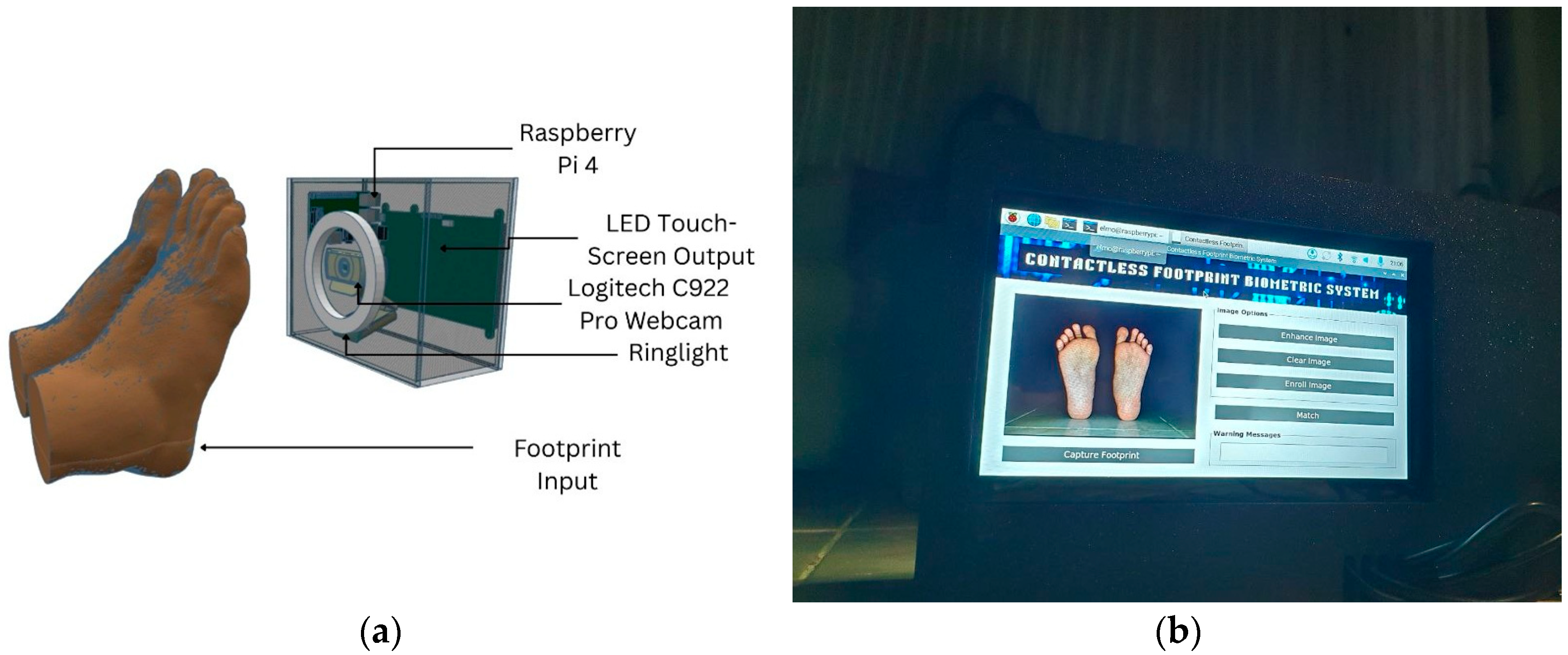
Figure 3 illustrates how the system classifies a user’s identity by capturing and analyzing their footprint. The prototype is positioned on the floor, and the user places their foot in front of the camera during the capture process. To capture the footprint image, press the capture button on the LCD screen, then press the buttons under the image options group to choose whether to enhance the image, clear the image to retake, or enroll the captured image. Finally, pressing the match button displays the identification result on the LCD screen.

2.6. Data Gathering and Analysis

Fifteen participants (7 women and 8 men) were registered in the system, and one additional male participant was included as the unregistered individual, as shown in Table 1 below.
For the evaluation of the model’s performance, we utilized a confusion matrix and an accuracy test. The confusion matrix was obtained to evaluate the performance of the trained model and displays the results gathered by the proposed system. The system’s accuracy was calculated using the multiclass accuracy formula derived from the confusion matrix.
A c c u r a c y = n = 1 16 A n n i = 1 16 j = 1 16 A i j
Equation (1) shows how to calculate the accuracy of a multiclass confusion matrix. The numerator, A n n which represents the sum of diagonal elements of the confusion matrix, corresponds to the correctly classified instances of each class, and the term n = 1 16 A n n sums the correct classifications across all 16 classes. The denominator, A i j represents the total number of samples, which is the sum of all elements in the confusion matrix.

3. Results and Discussion

The system compares the model’s 160 predictions with the actual labels. The registered individuals are labeled as R1 to R15, while the unregistered individual is labeled as UR1, as presented in Table 2. Out of the 16 classes, 14 were classified perfectly. Errors occurred only in Registered Classes 8 and 10, where one image from Class 8 was misclassified as Registered Class 15, and one image from Class 10 was misclassified as Registered Class 4. These two errors account for all the false positives and false negatives. Furthermore, the model presented 158 true positives (TP), meaning it correctly identified 158 out of 160 footprints. Using the multiclass accuracy formula, the model’s overall accuracy was evaluated at 98.75%, corresponding to 158 correct classifications out of 160 test images.

4. Conclusions and Recommendations

We developed a CNN algorithm based on the VGG-16 architecture, which was trained on 600 images from 15 registered individuals and tested on 160 images, including an unregistered subject. The system achieved an overall accuracy of 98.75%, demonstrating high reliability in correctly identifying individuals based on their footprints. This result surpassed the accuracy rates of similar systems in previous studies, validating the effectiveness of using a modern CNN architecture for footprint recognition.
To enhance the performance and applicability of the developed contactless footprint identification system, the number of participants and images included in the dataset must be increased. By expanding the dataset, the model’s training efficiency is enhanced, reducing the likelihood of overfitting and improving the system’s ability to generalize across a wider range of users. Given its effectiveness, the same architecture can be applied to systems involving palmprints, ear features, or other contactless biometric traits may yield similarly promising results.

Author Contributions

Conceptualization, J.F.V., A.A.C. and E.J.D.E.; methodology, A.A.C. and E.J.D.E.; software, A.A.C. and E.J.D.E.; validation, J.F.V.; formal analysis, A.A.C. and E.J.D.E.; investigation, J.F.V., A.A.C. and E.J.D.E.; resources, J.F.V., A.A.C. and E.J.D.E.; data curation, A.A.C. and E.J.D.E.; writing—original draft preparation, A.A.C. and E.J.D.E.; writing—review and editing, J.F.V., A.A.C. and E.J.D.E.; visualization, J.F.V.; supervision, J.F.V.; project administration, J.F.V.; funding acquisition, A.A.C. and E.J.D.E. All authors have read and agreed to the published version of the manuscript.

Funding

This research received no external funding.

Institutional Review Board Statement

Not applicable.

Informed Consent Statement

Not applicable.

Data Availability Statement

Data available on reasonable request from the corresponding author.

Conflicts of Interest

The authors declare no conflicts of interest.

References

  1. Jain, A.K.; Deb, D.; Engelsma, J.J. Biometrics: Trust, But Verify. IEEE Trans. Biom. Behav. Identity Sci. 2022, 4, 303–323. [Google Scholar] [CrossRef]
  2. Dasgupta, D. Biometrics and its use: Viewpoint. Biostat. Biom. Open Access J. 2018, 7, 555714. [Google Scholar] [CrossRef]
  3. Khan, H.U.; Malik, M.Z.; Nazir, S.; Khan, F. Utilizing Bio Metric System for Enhancing Cyber Security in Banking Sector: A Systematic Analysis. IEEE Access 2023, 11, 80181–80198. [Google Scholar] [CrossRef]
  4. Torres, J.; de los Santos, S.; Alepis, E.; Patsakis, C. User Behavioral Biometrics and Machine Learning Towards Improving User Authentication in Smartphones. In Information Systems Security and Privacy; Springer: Cham, Switzerland, 2020; pp. 250–271. [Google Scholar]
  5. Ibrahim, Y.I.; Alhamdani, I.M. A hyprid technique for human footprint recognition. Int. J. Electr. Comput. Eng. 2019, 9, 4060–4068. [Google Scholar] [CrossRef]
  6. Caya, M.V.C.; Yumang, A.N.; Ansino, R.D.; Dela Torre, M.S.E.; Chung, R.-L.; Chung, W.-Y. Footprint Biometrics on Person Identification Using CNN Algorithm. In Proceedings of the 2023 13th International Conference on Biomedical Engineering and Technology, New York, NY, USA, 15–18 June 2023. [Google Scholar]
  7. Batacan, J.J.; Chua, V.P.H.; Manlises, C.O. Smart Eyewear: African Lovebirds Classification Using Convolutional Neural Networks. In Proceedings of the TENCON 2024—2024 IEEE Region 10 Conference (TENCON), Singapore, 1–4 December 2024. [Google Scholar]
  8. Uy, J.N.; Villaverde, J.F. A Durian Variety Identifier Using Canny Edge and CNN. In Proceedings of the 2021 IEEE 7th International Conference on Control Science and Systems Engineering (ICCSSE), Qingdao, China, 30 July–1 August 2021. [Google Scholar]
  9. Virtusio, D.T.U.; Tapaganao, F.J.D.; Maramba, R.G. Enhanced Iris Recognition System Using Daugman Algorithm and Multi-Level Otsu’s Thresholding. In Proceedings of the 2022 International Conference on Electrical, Computer and Energy Technologies (ICECET), Prague, Czech Republic, 20–22 July 2022. [Google Scholar]
  10. Orpilla, G.T.; Salazar, J.R.C.M.; Linsangan, N.B. Raspberry Pi-Based Dual Iris Recognition System Using Coiflet Wavelet. In Proceedings of the 2024 4th International Conference on Neural Networks, Information and Communication (NNICE), Guangzhou, China, 19–21 January 2024. [Google Scholar]
  11. Enriquez, A.J., III; Tuazon, G.E.H.; Dimaunahan, E.D.; Ballado, A.H. Development of a Non-contact Two-Tier Biometric Security System for the DSWD 4Ps using Iris recognition and Speech Recognition. In Proceedings of the 2021 4th International Seminar on Research of Information Technology and Intelligent Systems (ISRITI), Yogyakarta, Indonesia, 16–17 December 2021. [Google Scholar]
  12. Balangue, R.D.; Padilla, C.D.M.; Linsangan, N.B.; Cruz, J.P.T.; Juanatas, R.A.; Juanatas, I.C. Ear Recognition for Ear Biometrics Using Integrated Image Processing Techniques via Raspberry Pi. In Proceedings of the 2022 IEEE 14th International Conference on Humanoid, Nanotechnology, Information Technology, Communication and Control, Environment, and Management (HNICEM), Boracay Island, Philippines, 1–4 December 2022. [Google Scholar]
  13. Caya, M.V.C.; Caringal, M.E.C.; Manuel, K.A.C. Tongue Biometrics Extraction Based on YOLO Algorithm and CNN Inception. In Proceedings of the 2021 IEEE 13th International Conference on Humanoid, Nanotechnology, Information Technology, Communication and Control, Environment, and Management (HNICEM), Manila, Philippines, 28–30 November 2021. [Google Scholar]
  14. Caya, M.V.C.; Lechoncito, A.R.D.; Deveraturda, G.Q. Recognition of Tongue Print Biometric using Oriented FAST and Rotated BRIEF (ORB). In Proceedings of the 2022 International Conference on Data Science and Its Applications (ICoDSA), Bandung, Indonesia, 6–7 July 2022. [Google Scholar]
  15. Caya, M.V.C.; Durias, J.P.H.; Linsangan, N.B.; Chung, W.-Y. Recognition of tongue print biometric using binary robust independent elementary features. In Proceedings of the 2017 IEEE 9th International Conference on Humanoid, Nanotechnology, Information Technology, Communication and Control, Environment and Management (HNICEM), Manila, Philippines, 1–3 December 2017. [Google Scholar]
Figure 1. Conceptual framework for contactless footprint biometrics.
Engproc 134 00030 g001
Figure 2. Hardware diagram.
Engproc 134 00030 g002
Figure 3. Experimental setup: (a) Proposed system; (b) Fabricated system.
Engproc 134 00030 g003
Table 1. Description of footprint dataset.
DatasetNumber of Subjects
Registered individual15
Unregistered individual1
Table 2. Confusion matrix of the results.
ObservationPrediction
R1R2R3R4R5R6R7R8R9R10R11R12R13R14R15UR1
R110000000000000000
R201000000000000000
R300100000000000000
R400010000000000000
R500001000000000000
R600000100000000000
R700000010000000000
R80000000900000010
R900000000100000000
R100001000009000000
R1100000000001000000
R1200000000000100000
R1300000000000010000
R1400000000000001000
R1500000000000000100
UR100000000000000010
Disclaimer/Publisher’s Note: The statements, opinions and data contained in all publications are solely those of the individual author(s) and contributor(s) and not of MDPI and/or the editor(s). MDPI and/or the editor(s) disclaim responsibility for any injury to people or property resulting from any ideas, methods, instructions or products referred to in the content.