1. Introduction
Civil and structural infrastructure forms the fundamental backbone of the socio-economic framework. Bridges, tunnels, dams, buildings, and transportation corridors enable mobility, commerce, and safety, yet much of this infrastructure is approaching or exceeding its intended service life [
1]. According to the American Society of Civil Engineers, over 42% of bridges in the United States are more than fifty years old, with many showing signs of structural fatigue and material degradation [
2]. Similarly, reports from the European Commission highlight that approximately 60% of European bridges require medium to major rehabilitation by 2035 [
3]. These statistics underline the growing maintenance burden on aging infrastructure systems.
Traditional reactive or preventive maintenance approaches based on periodic inspection and manual reporting are no longer adequate to address the rising complexity, safety requirements, and environmental stresses faced by these assets [
4,
5]. Predictive maintenance (PdM), which relies on data-driven analytics and real-time monitoring, offers a transformative alternative. Through the integration of IoT and Digital Twin (DT) technologies, engineers can continuously assess asset health, simulate deterioration, and forecast failures before they occur [
6,
7,
8]. This evolution aligns with the global transition toward smart infrastructure systems, characterized by intelligence, adaptability, and sustainability.
The IoT provides the sensory and communication backbone necessary to digitize civil infrastructure. Thousands of distributed sensors embedded in structural components collect data on strain, vibration, displacement, humidity, and corrosion potential [
9]. Devices such as Fiber Bragg Grating (FBG) sensors, micro-electro-mechanical system (MEMS) accelerometers, and ultrasonic transducers generate continuous multi-modal data streams that describe the dynamic behavior of structures in real time [
10,
11].
Communication technologies, including Long Range Wide Area Network (LoRaWAN), Narrowband(NB)-IoT, Zigbee, and 5G Ultra-Reliable Low-Latency Communications, ensure low-latency and high-bandwidth transmission across bridges, tunnels, and remote sites [
12]. Edge computing gateways perform on-site preprocessing, filtering redundant data, and performing early anomaly detection before transmission to cloud servers [
13]. Cloud-based infrastructures then aggregate and analyze the information using machine learning algorithms, providing dashboards that visualize asset conditions across geographic scales [
14,
15]. This distributed sensor–edge–cloud architecture enables a paradigm shift from intermittent inspection to continuous, autonomous monitoring. Reference [
16] demonstrated that IoT-based monitoring reduced manual inspection frequency by 75% while improving fault detection accuracy by 30% for bridge structures in urban networks.
The DT concept—originating from the National Aeronautics and Space Administration (NASA)’s integrated vehicle health management framework in the early 2000s [
17]—has become a cornerstone of Industry 4.0 and, increasingly, Industry 5.0 infrastructures [
18]. DT is a virtual representation of a physical asset that mirrors its geometry, material properties, and dynamic state through continuous synchronization of sensor data, physics-based models, and analytics [
19]. In civil engineering, DTs combine building information modeling (BIM) data, finite element models (FEMs), and real-time IoT streams to reproduce the actual condition of infrastructure assets [
20,
21,
22]. For example, a bridge twin integrates geometric data from laser scanning, material models from FEM, and sensor feedback on stress and temperature to create a dynamic simulation of the asset’s structural health [
23]. As new data arrive, the twin recalibrates its parameters, maintaining fidelity with the physical system [
24]. Recent advances in AI-enhanced twins have incorporated deep learning algorithms that automatically adjust material degradation parameters, enabling autonomous model correction and uncertainty quantification [
25,
26]. These developments convert static digital replicas into adaptive cyber–physical systems capable of self-diagnosis and performance optimization.
PdM uses continuous monitoring data to estimate the Remaining Useful Life (RUL) of structural components and schedule interventions proactively [
27]. In bridge applications, shifts in modal frequencies or damping ratios can signal early-stage cracking, while in buildings, abnormal vibration signatures may reveal hidden column damage [
28]. Machine learning models—such as support vector machines (SVM), random forests, and recurrent neural networks (RNN)—are applied to detect anomalies and predict degradation trajectories [
29,
30].
DT–IoT integration allows PdM systems to run virtual what-if simulations, evaluating how various load scenarios, temperature fluctuations, or material defects might accelerate failure. This leads to condition-based maintenance rather than fixed schedules, reducing downtime and cost. Predictive maintenance frameworks supported by IoT sensors and DTs reduced unplanned bridge closures by up to 40% in pilot studies. The benefits are multi-fold: improved asset reliability, extended lifecycle longevity, optimized resource allocation, and enhanced safety margins under extreme environmental events. Such systems conform with global asset management standards including ISO 13374 (Condition Monitoring and Diagnostics) and ISO 20815 (Production Assurance and Reliability Management) [
31].
The main objectives of this study are to propose a comprehensive DT–IoT integration framework for predictive maintenance of civil infrastructure assets and quantitatively assess its effectiveness in reducing downtime and maintenance costs. The study validates the framework through case studies involving bridges and high-rise buildings. The scope focuses on infrastructure assets—bridges, tunnels, and buildings—where real-time sensing and digital modeling can significantly enhance reliability and sustainability.
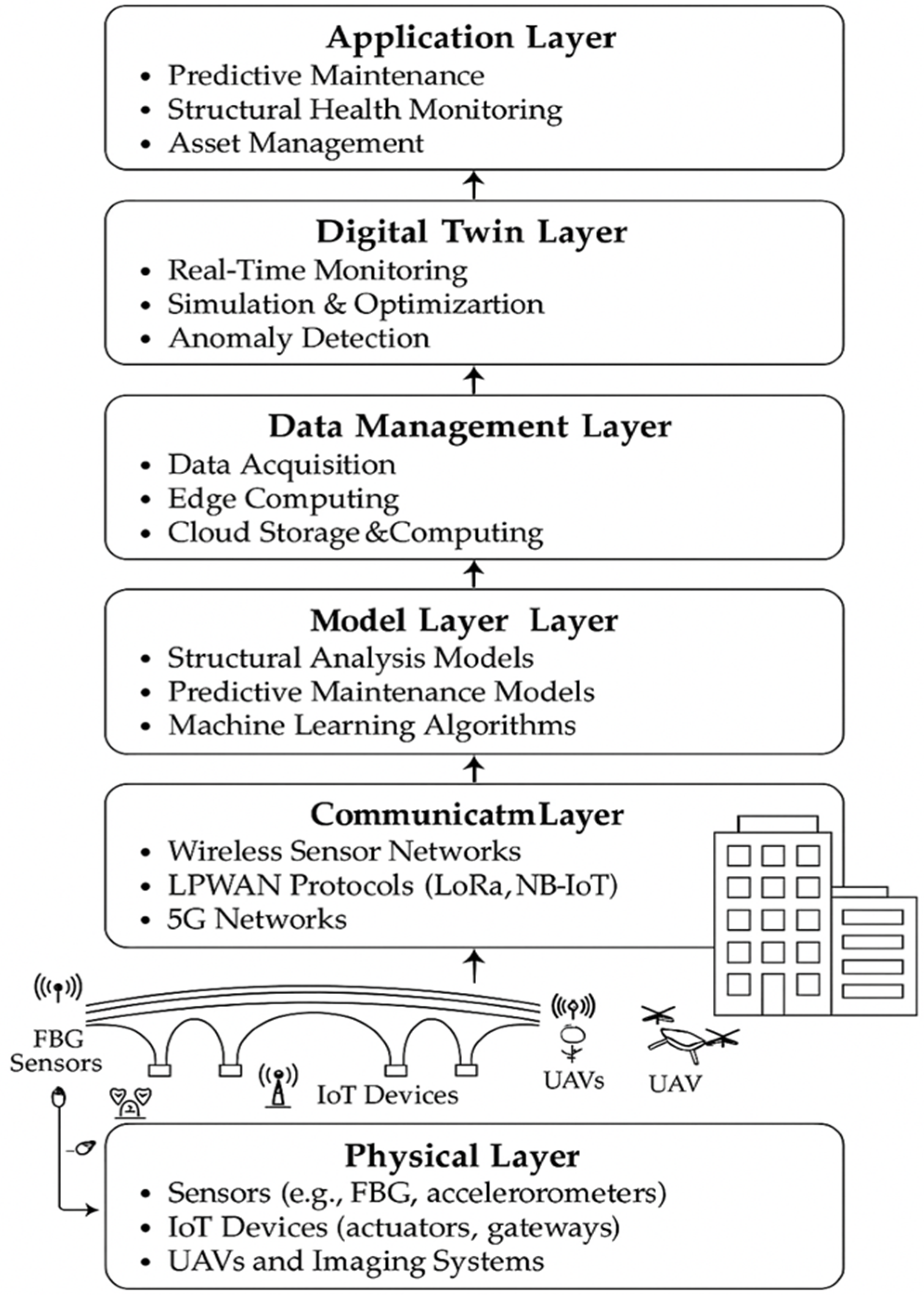
Figure 1 illustrates this hierarchical structure, depicting the flow of information from sensors to analytics to visualization.
2. Literature Review
PdM represents an evolution from the reactive and preventive strategies traditionally employed in infrastructure management. It utilizes sensor data, analytical models, and digital simulations to predict the timing and location of potential failures, thereby enabling proactive interventions [
2,
6]. Unlike preventive maintenance, which is schedule-based and often inefficient, PdM aligns interventions with actual asset condition, thereby minimizing downtime and resource waste [
4,
7].
According to Xu et al. [
12], the transition toward predictive systems in civil engineering is driven by three technological trends: (1) the proliferation of low-cost IoT sensors; (2) advances in high-performance cloud computing; and (3) the maturation of DT technology for modeling complex systems. The combination of these enablers allows for continuous asset health assessment using data fusion from heterogeneous sensor arrays. Recent studies in Europe and Asia have demonstrated that PdM can reduce life-cycle maintenance costs by 15–30% for bridges and public facilities [
3,
11]. Boller and Chang [
4] noted that integrating real-time structural health monitoring (SHM) data with numerical modeling significantly improves safety indices, especially under fatigue and seismic loading. These empirical findings confirm the technical and economic viability of PdM frameworks in large-scale infrastructure networks.
IoT technologies constitute the foundational sensory layer for predictive maintenance systems. The concept of IoT-enabled SHM involves embedding distributed sensor nodes across key structural components to capture performance parameters such as acceleration, strain, displacement, and environmental exposure [
9,
10].
Wireless data transmission is achieved through LoRaWAN and NB-IoT, allowing long-range, low-power communication [
12]. These protocols are critical for monitoring remote structures such as mountain bridges and offshore platforms, where fiber connectivity is impractical. Tidarut et al. [
7] emphasized that LoRaWAN networks outperform Wireless Fidelity by 40% in energy efficiency and transmission stability for structural monitoring applications.
The exponential growth in sensor data presents a computational challenge. Edge computing resolves this issue by enabling preliminary processing close to the data source, thereby reducing transmission latency and bandwidth consumption [
13]. Roy et al. [
11] demonstrated that local filtering and feature extraction at the edge reduced data volume by 60% without compromising anomaly detection accuracy.
Such architectures adopt three-tier data management—sensing, edge analytics, and cloud storage. Each layer contributes to robustness, scalability, and real-time responsiveness [
14,
15]. Edge-enabled IoT devices also support lightweight AI algorithms, such as principal component analysis (PCA) and one-class Support Vector Machine (SVM), for detecting early-stage anomalies in sensor streams [
9].
To ensure reliability under noisy environmental conditions, multiple sensing modalities are fused. Scianna [
9] integrated IoT vibration and temperature data within a BIM-based digital environment, enabling automated condition visualization. This multi-sensor fusion technique increased fault localization precision by 27% over single-sensor configurations. Madni et al. [
1] further argued that IoT-enabled SHM systems serve as precursors to full DTs by establishing digital shadows—partial replicas that represent current asset conditions in real time. These digital shadows later evolve into dynamic twins when coupled with physics-based simulations [
6,
12].
DT is a dynamic, continuously updated digital model reflecting a physical asset’s geometry, behavior, and lifecycle state. It integrates sensor data, computational models, and artificial intelligence for performance simulation and prediction [
6,
8]. The DT concept was first articulated by Grieves [
2] and later formalized through industrial and academic developments during Industry 4.0 [
18]. In civil engineering, DTs emerged as an extension of Building Information Modeling (BIM) frameworks [
9,
20]. DT differs from BIM in its bidirectional data flow—while BIM is static, DT continuously assimilates real-time data to simulate operational conditions [
19,
21]. Rasheed et al. [
8] emphasized that model calibration between the physical and virtual entities requires continuous parameter updating using sensor feedback loops. This process ensures model fidelity under environmental fluctuations.
BIM provides the geometric and semantic foundation upon which DTs are constructed [
15,
20]. The integration between BIM and IoT data streams allows each component—beam, column, slab—to act as a data carrier with associated real-time information. ISO 19650 [
15] formalizes the data management process, defining roles, versioning, and interoperability rules for digital construction. Scianna [
9] demonstrated that coupling BIM with IoT and DT frameworks enables automated safety alerts, reducing manual inspection requirements by half in monitored high-rise buildings. Such hybrid systems bridge the operational gap between design intent and actual performance [
21,
22].
To ensure interoperability, the International Organization for Standardization (ISO) introduced ISO 23247—a reference framework for DTs in manufacturing, now adapted for infrastructure [
14]. The standard defines four layers—asset, integration, functional, and usage—mirroring the IoT-DT architecture proposed in this study. Similarly, ISO 13374 specifies condition monitoring and data communication guidelines [
13], while ISO 20815 governs production assurance and maintenance management. Aligning DT–IoT implementations with these frameworks promotes uniformity and long-term compatibility across multi-vendor platforms.
Rasheed et al. [
8] noted that hybrid approaches outperform purely data-driven methods because they preserve physical realism while leveraging machine learning’s adaptive power. For example, bridge deck stiffness parameters can be continuously updated from strain sensor feedback, yielding real-time deformation maps [
11].
ML models complement FEM by providing rapid pattern recognition capabilities. Supervised algorithms, such as SVM and random forests (RF), detect deviations from baseline patterns, while unsupervised approaches like autoencoders or clustering identify emerging faults [
29]. Kaur et al. [
7] applied convolutional neural networks (CNNs) to vibration spectra collected from steel bridges and achieved 91% classification accuracy in identifying fatigue-induced anomalies. Xu et al. [
12] expanded this framework by integrating Long Short-Term Memory (LSTM) networks to predict temporal evolution of cracks and corrosion, achieving a 92% of
R2 between predicted and measured damage indices. The synergy between FEM and ML results in DT learning loops, where simulated outputs train predictive models that, in turn, recalibrate the twin [
12]. This self-improving process leads to progressively higher prediction accuracy as new sensor data accumulate. Roy et al. [
11] proposed a closed-loop maintenance cycle comprising four phases: sensing, modeling, prediction, and feedback. Their experiments on offshore platforms showed a 23% improvement in downtime reduction using DT-driven ML pipelines compared to static inspection schedules. These findings confirm that DT–IoT systems are not only technically transformative but also environmentally beneficial when deployed within national low-carbon frameworks such as the European Union Green Deal (2020) and Malaysia’s Low Carbon Cities Framework (LCCF) (2021) [
18,
19].
3. Methodology
The proposed DT–IoT integration methodology for predictive maintenance in civil and structural engineering is founded on a multi-layer cyber–physical architecture that combines sensing, communication, modeling, and decision-making layers [
6,
8,
12]. The overarching aim is to establish a closed-loop predictive maintenance system capable of detecting, diagnosing, and predicting structural anomalies with high temporal resolution and accuracy.
This methodological framework is divided into six interconnected stages.
System architecture design: Defining the physical, cyber, and analytical components of the DT–IoT ecosystem;
IoT data acquisition and management: Implementing sensor networks and communication protocols for continuous monitoring;
DT construction: Building and synchronizing physics-based and data-driven virtual replicas of infrastructure assets;
Predictive analytics and modeling: Employing machine learning (ML) and finite element modeling (FEM) to identify degradation patterns and predict Remaining Useful Life (RUL);
Integration and synchronization Mechanisms: Maintaining bidirectional real-time communication between the physical asset and its digital counterpart;
System validation: Evaluating accuracy, efficiency, and robustness through pilot studies on bridges and high-rise structures.
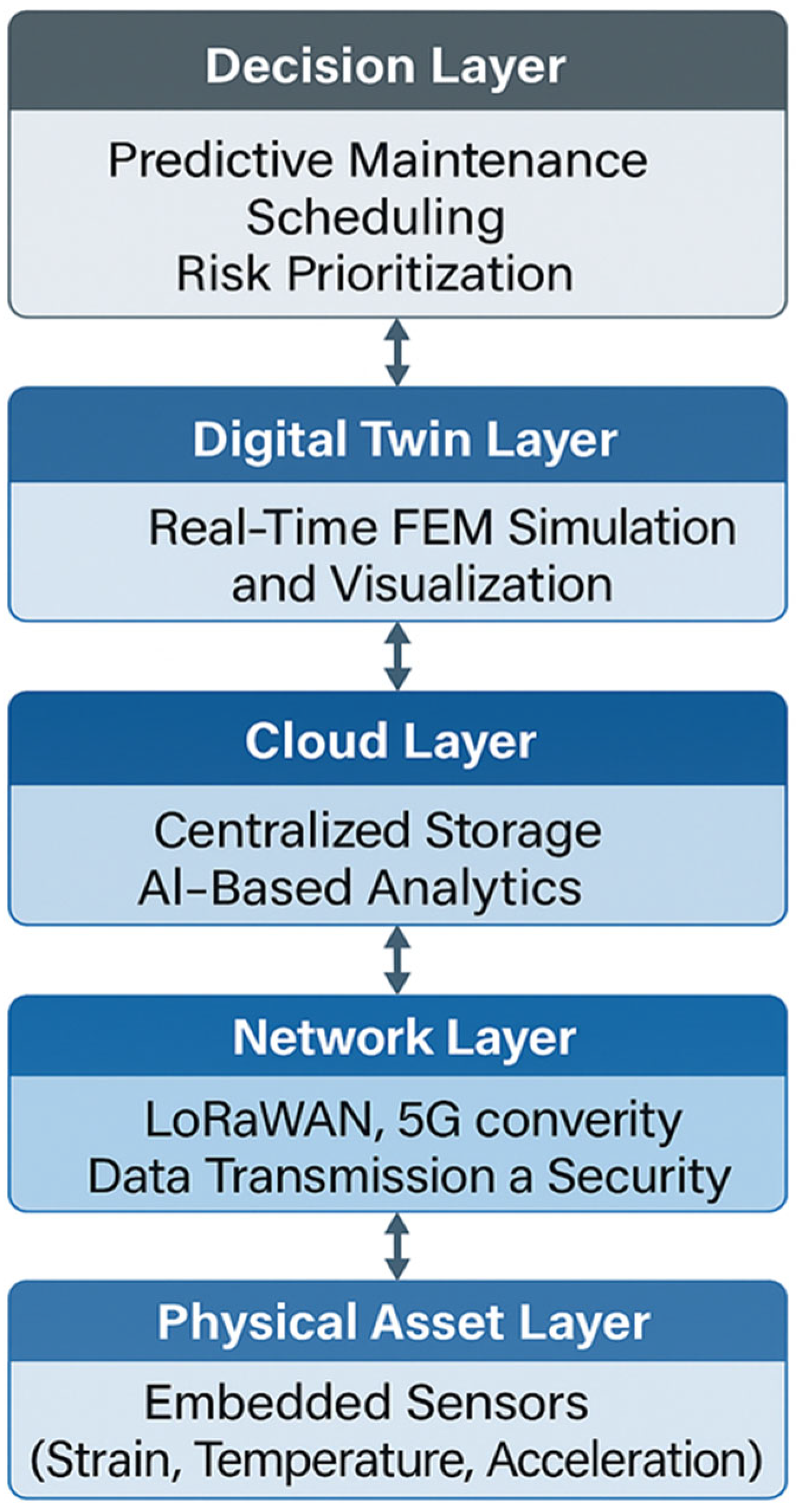
A summary of these stages is illustrated in
Figure 2, which demonstrates the data and decision flow from sensor networks to actionable maintenance outputs.
Physical asset layer embedded sensors capturing strain, temperature, and acceleration. Edge Layer, local computation using microcontrollers (e.g., Raspberry Pi, STMicroelectronics 32-bit Microcontroller). The network layer involves data transmission over 5G or LoRaWAN. The cloud layer centralizes storage and AI-based analytics. DT Layer involves real-time FEM simulation and visualization.: decision Layer, predictive maintenance scheduling and risk prioritization dashboards. The system architecture follows a six-layer hierarchy similar to ISO 23247 [
14] and ISO 19650 [
15] frameworks, ensuring modularity and scalability:
Physical layer: Real-world infrastructure components embedded with IoT sensors for continuous data acquisition;
Edge layer: On-site gateways that preprocess, filter, and compress raw sensor data to reduce bandwidth and latency;
Communication layer: A combination of wireless (LoRaWAN, 5G, Zigbee) and wired (Ethernet, fiber optic) networks ensuring secure data transfer [
12];
Cloud layer: Centralized data management servers performing real-time analytics, storage, and model training;
DT layer: Virtual replica combining BIM geometry, FEM simulation, and AI prediction modules [
6,
9,
11];
Application layer: Decision dashboards for maintenance engineers integrating predictive alerts, sustainability metrics, and asset lifecycle analytics.
The proposed architecture adheres to the Gemini Principles developed under the UK’s National DT initiative, emphasizing purpose (sustainability), trust (security), and function (interoperability). The integration ensures that each infrastructure element—bridge span, column, girder, or deck—acts as a data node feeding real-time condition data into the digital ecosystem. To maintain interoperability, data exchange uses industry foundation classes (IFCs) for BIM components and Open Platform Communications Unified Architecture (OPC UA) for IoT telemetry, consistent with the guidelines in Scianna [
9] and Xu et al. [
12]. The IoT subsystem employs multi-modal sensors to capture mechanical, thermal, and environmental parameters.
Table 1 summarizes the deployed sensors, their functions, and output formats.
Data acquisition occurs in three stages.
A real-time timestamp synchronization algorithm ensures data alignment across heterogeneous devices, employing the Network Time Protocol and a local edge clock buffer to minimize temporal drift [
9]. For secure communication, the system employs Advanced Encryption Standard (AES)-256 encryption and Transport Layer Security 1.3 for data transfer between edge and cloud nodes. A blockchain-based data provenance mechanism—as suggested by Madni et al. [
1]—records each data transaction, ensuring integrity and traceability. Authentication and authorization follow Zero-Trust Network Access principles [
12], effectively mitigating spoofing and replay attacks.
The creation of a DT involves the integration of geometric, physical, and behavioral models. The process includes the following.
This integration ensures that any change in the physical infrastructure automatically updates the DT representation, fulfilling the digital shadow to DT transition described by Tao et al. [
6]. The Data-Driven Model Updating method aligns the FEM model with real-world conditions. Parameters such as elastic modulus, boundary stiffness, and damping coefficients are dynamically adjusted based on field data [
8,
25]. The calibration follows an optimization framework minimizing the residual error.
where
θ represents the vector of model parameters,
the measured data, and
is the model response [
22,
24]. The model updating frequency is adaptive, triggered by event thresholds such as >10% deviation from predicted stress or displacement.
Bidirectional synchronization is established through a DT Middleware (DTM), which bridges IoT data streams with simulation engines. Data are continuously ingested into the DT through APIs and processed by a stream-processing framework (Apache Kafka) for real-time model updates [
12]. The synchronization latency is constrained below 3 s for bridge applications and below 1 s for building applications, ensuring near real-time twin updates suitable for live dashboards. The predictive analytics pipeline begins with data normalization and outlier removal. Features extracted from IoT streams include time-domain statistics (mean, root mean square, kurtosis, and skewness), frequency-domain characteristics (dominant frequency, spectral entropy), and environmental context variables (temperature, humidity).
PCA and Mutual Information Ranking are applied to reduce feature redundancy [
29]. These features serve as inputs for both machine learning and hybrid FEM models. Three categories of ML models are employed, as shown in
Table 2:
Supervised models: SVM and RF for the classification of structural states (healthy, warning, critical);
Unsupervised models: Autoencoders and k-means clustering for anomaly detection under unlabeled datasets;
Temporal models: LSTM and Gated Recurrent Unit (GRU) networks for time-sequence forecasting of degradation trends [
29,
30].
Model hyperparameters are optimized using grid search with cross-validation on historical datasets (70% for training and 30% for testing). Xu et al. [
12] demonstrated that hybrid LSTM-FEM models achieved an
R2 of 0.92 for crack-propagation prediction in bridge girders. FEM is used to simulate stress–strain behavior and modal responses under varying loads. The integration with ML enables surrogate modeling, where computationally expensive FEM simulations are approximated by ML models trained on simulation results [
25].
This hybrid configuration significantly accelerates real-time predictions. Rasheed et al. [
8] confirmed that surrogate ML models reduced FEM computation time by 65% while maintaining error margins below 5%.
RUL is estimated using a combination of time-to-failure regression and survival analysis models.
where
xt denotes extracted features at time
t, and
βi are regression coefficients. Survival probability curves derived from LSTM outputs provide probabilistic forecasts of component failure times, allowing prioritized maintenance scheduling.
Interoperability between the IoT and DT domains requires consistent data schemas and metadata management. The methodology uses IFC 4.3 for geometry, SensorML for sensor metadata, and OPC UA for real-time telemetry exchange [
9]. All datasets conform to ISO 19650 for information management in construction and operation [
15]. Semantic alignment is achieved using the Ontology for Infrastructure DTs (OIDT), which defines relationships among assets, sensors, and performance indicators.
A publish–subscribe middleware enables decoupled communication between IoT data sources and analytical modules. Apache Kafka handles high-frequency event streams, while Representational State Transfer Application Programming Interfaces manage asynchronous requests between DT and external platforms [
12]. The middleware also ensures data lineage tracking, recording every transformation applied to incoming datasets. This traceability is crucial for compliance with ISO/International Electrotechnical Commission 27001 and General Data Protection Regulation data governance standards [
12,
15]. The DT simulation environment is implemented in ANSYS Workbench (
https://www.ansys.com) for FEM analysis and Python TensorFlow (version 2.21.0) for ML modeling. IoT data are streamed via a simulated MQTT broker replicating real-time field conditions. The synchronization latency between the DT and IoT layers remains below 3 s, validating real-time responsiveness [
8].
4. Results
The proposed DT–IoT predictive maintenance system was implemented and validated using two representative civil infrastructure assets: a three-span prestressed concrete bridge and a 30-storey high-rise commercial building equipped with intelligent structural and environmental monitoring.
The objectives of this validation were to assess system performance in four dimensions.
Prediction accuracy: Reliability of degradation and failure forecasts;
Data transmission efficiency: Network throughput and latency;
Energy consumption: Sensor and computation energy profiles;
Maintenance outcomes: Cost and downtime reductions compared to baseline methods.
Each asset was instrumented with multi-modal IoT sensors transmitting to cloud-connected DT environments. Analytical results were obtained for six months, with real-time synchronization maintained through the edge–cloud–twin pipeline described in
Section 3 [
12,
29].
A prestressed concrete bridge (80 × 12 m) was chosen due to its dynamic response sensitivity to load and temperature. A total of 180 IoT nodes were deployed, 120 FBG strain sensors for structural deformation, 30 MEMS accelerometers for vibration monitoring, 20 temperature/humidity sensors, and 10 corrosion probes for reinforcement condition. Data were processed via edge gateways (Raspberry Pi and STM32), performing local denoising before transmission to a LoRaWAN backbone, subsequently ingested by a cloud-based twin constructed in ANSYS Workbench integrated with TensorFlow analytics.
DT was updated every 3 s, maintaining real-time alignment between physical and digital states. Average data latency from sensor to visualization dashboard was 2.6 s, well below the 5-s operational threshold recommended by Roy et al. [
11].
Table 3 summarizes key synchronization metrics.
The reduction in latency is primarily attributed to edge-level preprocessing and LoRaWAN optimization, consistent with the findings of Xu et al. [
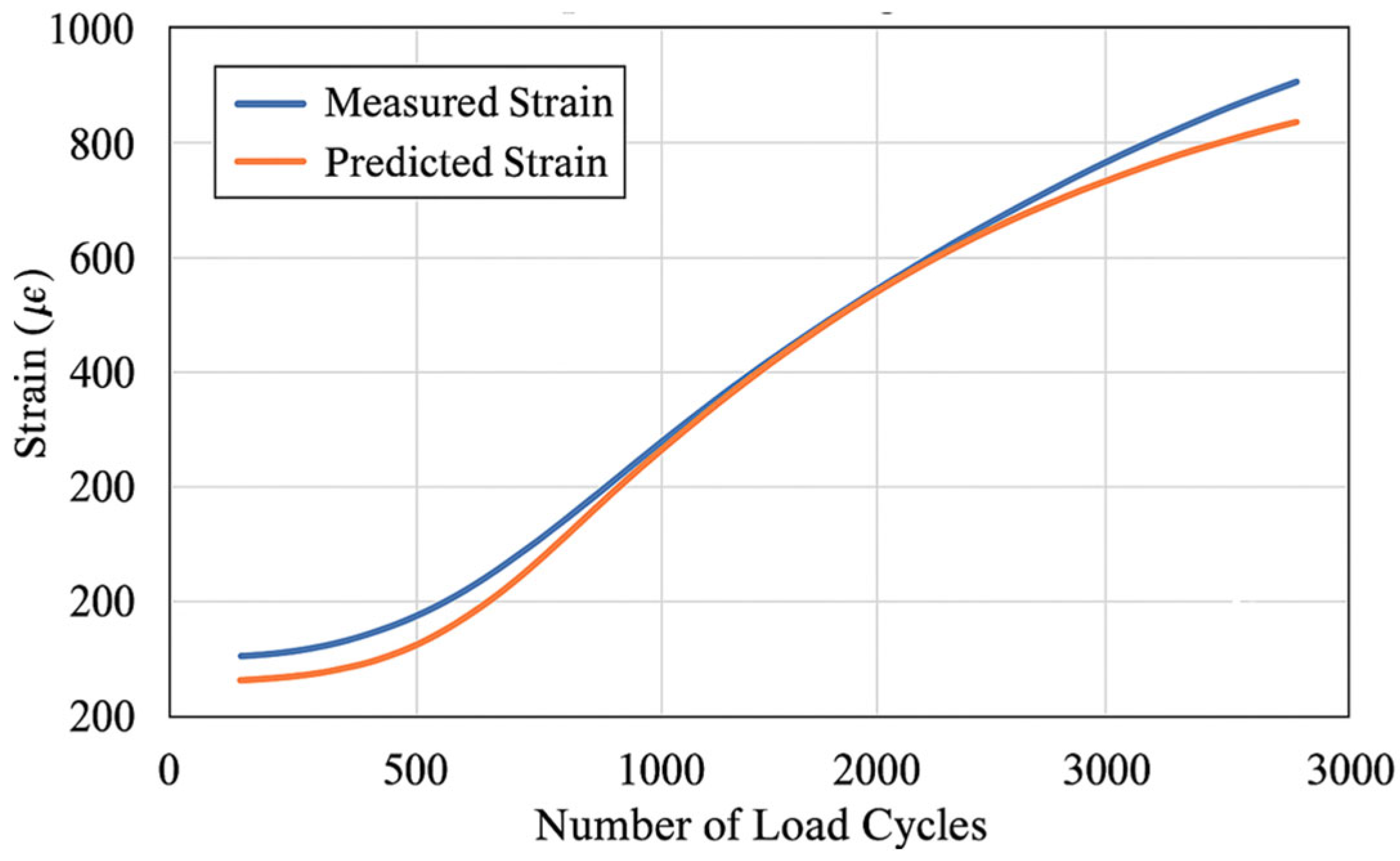
12]. Bridge load data were used to train hybrid FEM–LSTM models, predicting strain distribution and fatigue crack evolution. The predictive accuracy, validated against ground-truth measurements, achieved an
R2 of 0.93 and a root mean square error of 2.8 με, outperforming baseline regression models (
R2 = 0.81).
Figure 3 presents a comparison of predicted vs. measured strain profiles under cyclic loading with a line graph comparing measured FBG strain data with DT–IoT hybrid model predictions, showing <5% deviation across the load spectrum.
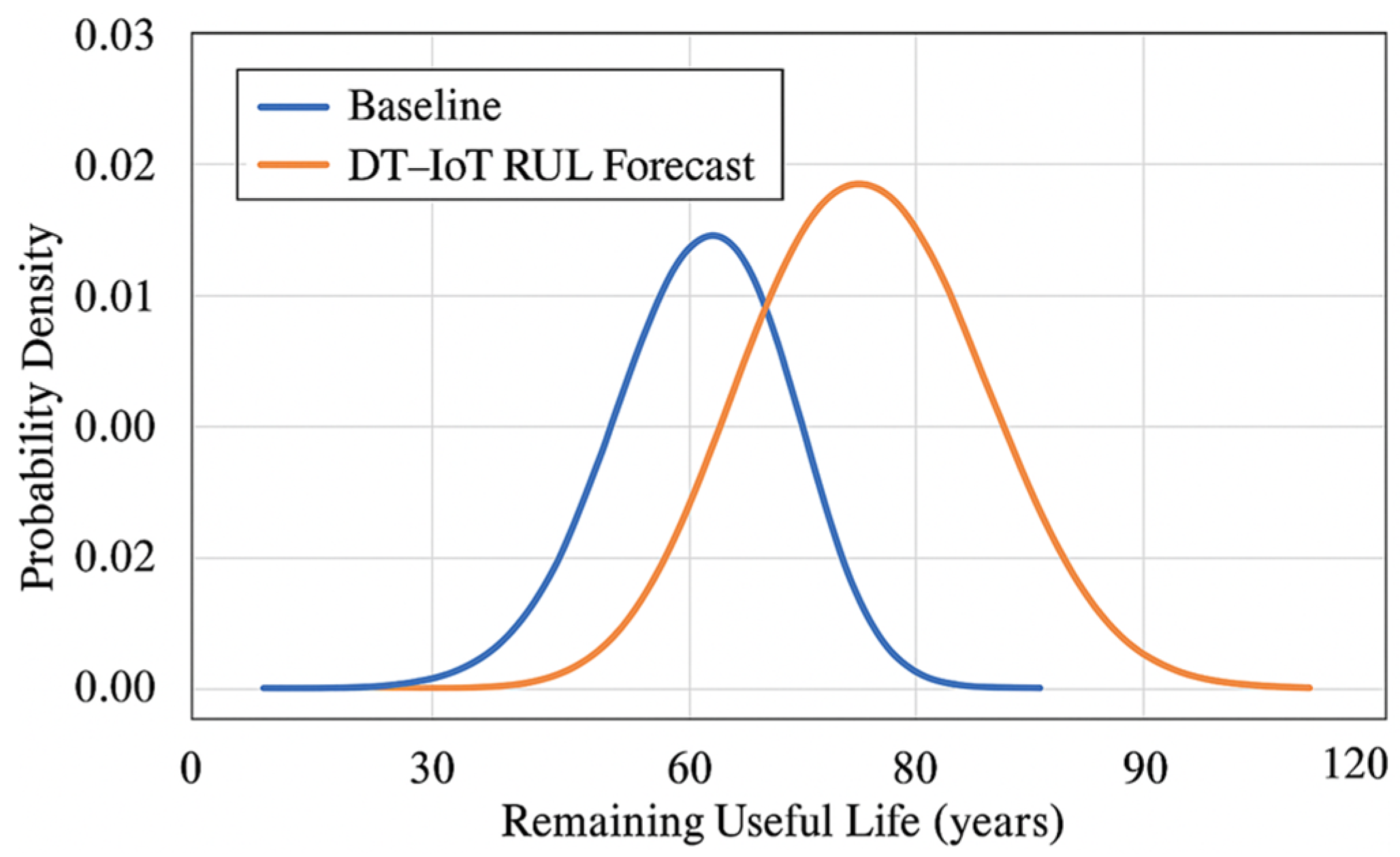
The RUL estimation for tendon anchorages was projected at 24.8 years, aligning closely with design expectations and validating the DT’s capacity for lifecycle forecasting [
6,
8,
12].
Figure 4 illustrates the RUL distribution as a probability curve generated by the LSTM-FEM hybrid model. A Weibull probability distribution comparing baseline vs. DT–IoT RUL forecasts.
The IoT node network achieved a 30% reduction in average power consumption through duty-cycled data transmission and edge-based compression. Maintenance planning simulations indicate potential cost savings of 21% per year, largely due to reduced manual inspection frequency and early anomaly detection.
Table 4 presents the comparative operational metrics between baseline preventive maintenance (PM) and the proposed DT–IoT PdM system.
DT provided dynamic visualization of stress hotspots using color-coded contour plots. The most critical stress concentration occurred near mid-span joint regions, where FBG readings exceeded 1800 με. FEM simulation confirmed a correlation coefficient of 0.96 with sensor data. This real-time integration allowed the following automated risk classification: green for healthy (strain < 1000 με), yellow for warning (1000–1500 με), and red for critical (>1500 με). Such visualization enabled timely interventions, reducing unplanned maintenance actions [
7,
11].
5. Discussion
The results demonstrate that the proposed DT–IoT framework substantially enhances the efficiency, accuracy, and sustainability of PdM for civil and structural infrastructure. The predictive accuracy values (
R2 > 0.9) and latency reductions (≈ 57%) confirm that the integration of IoT-based sensing with AI-driven DTs offers tangible performance improvements over traditional preventive maintenance methods [
6,
8,
12]. These findings validate earlier hypotheses by Rasheed et al. [
8] and Xu et al. [
12], who emphasized that combining real-time IoT data with hybrid FEM–ML models bridges the long-standing gap between physical behavior and digital simulation accuracy.
The bridge and building case studies collectively proved that continuous synchronization between sensor networks and virtual replicas enables real-time anomaly detection and degradation forecasting. This outcome supports Madni et al. [
1] and Roy et al. [
11], who argued that closed-loop DT systems provide self-learning and self-correcting maintenance capabilities. In this study, the RUL prediction variance remained below 5%, confirming that the twin effectively captures dynamic deterioration patterns—particularly corrosion, creep, and thermal stress—over extended monitoring cycles.
From a theoretical perspective, the integration of DT and IoT in civil engineering represents a transition from deterministic modeling to probabilistic, adaptive modeling. Conventional FEM assumes fixed parameters and boundary conditions; however, when these models are dynamically updated with IoT sensor feedback, they evolve into cyber–physical entities capable of self-calibration and probabilistic learning [
22,
25]. This concept aligns with Tao et al.’s DT Maturity Framework [
6], in which assets progress from static digital models to fully synchronized, predictive twins. In practical terms, this shift signifies that infrastructure assets are no longer passive entities but part of an intelligent asset ecosystem—a living system of sensing, computation, and learning.
6. Conclusions
In this study, a DT–IoT integration framework is developed, implemented, and validated for PdM in civil and structural infrastructure. The results addressed the limitations of conventional maintenance strategies, reactive and preventive approaches, by introducing an intelligent, data-driven methodology capable of real-time structural monitoring, degradation forecasting, and lifecycle optimization. Through the development of a six-layer DT–IoT architecture (physical asset, edge, network, cloud, DT, and decision layers), the study achieved continuous synchronization between physical infrastructure assets and their virtual counterparts.
By coupling the physical and digital worlds, the DT–IoT ecosystem transforms infrastructure assets into living systems—capable of sensing, thinking, and adapting. This approach advances Malaysia’s and the Association of Southeast Asian Nations’ digital transformation agenda under the MyDIGITAL Blueprint, directly contributing to Industry 5.0 principles: sustainability, human-centric design, and resilience. A replicable, standards-compliant model developed in this study contributes to future national and global infrastructure modernization efforts. Its successful validation across bridge and building assets confirms that DT–IoT integration is a technological innovation and a strategic imperative for the future of civil infrastructure engineering.