Proceeding Paper

Smart Design of an Innovative Generation of Structural Resins Loaded with Carbon Nanostructured Forms †

by
Liberata Guadagno
1,
Marialuigia Raimondo
1,
Francesca Aliberti
1,
Raffaele Longo
1,
Michelina Catauro
2 and
Luigi Vertuccio
2,*
1
Department of Industrial Engineering, University of Salerno, Via Giovanni Paolo II, 132, 84084 Fisciano, SA, Italy
2
Department of Engineering, University of Campania “Luigi Vanvitelli”, Via Roma 29, 813031 Aversa, CE, Italy
*
Author to whom correspondence should be addressed.
Presented at the 15th EASN International Conference, Madrid, Spain, 14–17 October 2025.
Eng. Proc. 2026, 133(1), 39; https://doi.org/10.3390/engproc2026133039

Published: 23 April 2026

Abstract

This study introduces advanced epoxy formulations incorporating carbon-based nanofillers, carbon nanotubes, nanofibers, and functionalized graphene. The epoxy matrix was optimized to lower moisture absorption and enhance multifunctional properties. A non-stoichiometric epoxy/hardener ratio reduced equilibrium water concentration (Ceq) by up to 30% compared to unmodified epoxy, achieved by minimizing polar groups responsible for water bonding. These improvements benefit the aerospace, marine, and wind energy sectors. All nanofillers form a secondary phase with reduced glass transition temperature (Tg), but functionalized graphene performs best. Its self-assembled sheet architectures trap resin, limit water interaction, and create conductive pathways, improving strength, reducing moisture uptake, and achieving a low electrical percolation threshold (EPT).

1. Introduction

The design of functional nanocomposites for structural applications requires a careful balance between matrix selection and nanofiller integration to transfer nanoscale properties to bulk materials effectively. Recent advances in controlling matter at the nanoscale level have enabled the development of next-generation composites capable of meeting stringent structural and multifunctional requirements [1,2,3,4,5,6]. In aerospace engineering, the increasing replacement of metallic components with lightweight composites is driven by the need to reduce fuel consumption, operational costs, and environmental impact, while maintaining high mechanical performance and resistance to fatigue and corrosion. For instance, a weight reduction of 1 kg in an aircraft’s primary structure corresponds to a decrease of approximately 3.15 kg of CO2 emissions. Carbon-fiber reinforced polymers have played a pivotal role in this transition [7,8,9,10,11]; however, their full potential remains limited by performance under severe service conditions, including lightning strikes, icing, humidity, and wide temperature variations. To overcome these limitations, functional nanocomposites can be engineered to exhibit properties beyond conventional strength and stiffness [12]. Incorporating small amounts of electrically conductive nanoparticles into epoxy matrices or interlaminar regions can significantly improve electrical and thermal conductivity [13,14,15,16,17,18,19], enabling anti-lightning and anti-icing functionalities and enhancing thermal dissipation [4]. Nevertheless, moisture absorption remains a critical challenge, as water uptake adversely affects mechanical properties by reducing the glass transition temperature (Tg) through disruption of strong hydrogen bonds in the cured network [20,21,22,23]. Among high-performance epoxy systems, Tetra-Glycidyl-MethyleneDiAniline (TGMDA) cured with 4,4′-diaminodiphenyl sulfone (DDS) offers superior thermal and mechanical properties but exhibits higher water absorption compared to more common bifunctional precursors such as DGEBA, with reported values up to 7.76 wt%, leading to a significant Tg decrease. This study addresses these issues by proposing nanofilled TGMDA/DDS epoxy formulations with reduced moisture uptake and enhanced multifunctionality. The approach combines the use of reactive diluents to lower viscosity—critical for nanoparticle dispersion—with optimized hardener ratios and post-curing treatments to minimize water sorption. The resulting chemical architecture demonstrates unique water absorption behavior and improved electrical and mechanical performance, paving the way for advanced composites suitable for demanding aerospace and marine applications.

2. Experimental Part

2.1. Materials

The epoxy matrix was formulated by mixing tetraglycidylmethylenedianiline (TGMDA, epoxy equivalent weight 117–133 g/eq) with the reactive diluent 1,4-butanediol diglycidyl ether (BDE) at 80:20 wt%. The curing agent, 4,4′-diaminodiphenyl sulfone (DDS), was added in stoichiometric and non-stoichiometric ratios relative to epoxy groups. Samples were designated as:
  • Epoxy (chemical composition TGMDA + DDS without reactive diluent). This sample was hardened in stoichiometric conditions.
  • Epoxy/Dil (chemical composition TGMDA/BDE + DDS with reactive diluent). This sample was hardened in stoichiometric conditions.
  • Epoxy/Dil (NST) (chemical composition TGMDA/BDE + DDS with reactive diluent).
This sample was hardened in non-stoichiometric conditions (DDS at 44.4 phr).
BDE was used for improving the curing by increasing reactive group mobility, particularly beneficial for nanoparticle-filled systems requiring higher curing temperatures.
The carbon nanofillers, multi-walled carbon nanotubes (MWCNTs), carbon nanofibers (CNFs), and carboxylated partially exfoliated graphite (GNP), were dispersed in the epoxy mixture to enhance mechanical, electrical, and moisture-resistance properties. In particular, the following nanofillers were used:
  • MWCNTs (Nanocyl 3100): diameter 10–30 nm, length up to several micrometers, 4–20 walls, surface area 250–300 m2/g, >95% carbon purity.
  • CNFs (Pyrograf III): heat-treated at 2500 °C for optimal electrical and mechanical performance.
  • GNP: prepared via acid intercalation (HNO3/H2SO4) and thermal expansion at 900 °C, yielding 2D sheets with edge carboxyl groups and 60% exfoliation degree.
After electrical characterization, in which the samples were prepared in a range between 0 and 1% for the CNT-based system and in a range between 0 and 2% for the CNF- and EPG-based systems, respectively, both mechanical characterization and water absorption were performed at concentrations above the electrical percolation threshold (EPT). The latter approach was used to study epoxy systems in which the electrically conductive paths were well structured. Specifically, concentrations of 0.5% and 1.0% were selected.

2.2. Characterization

2.2.1. Transport Properties-Setting

Fully cured epoxy samples (40 × 20 × 0.50 mm3) were prepared to analyze the water sorption behavior. A reduced thickness was used to minimize edge effects, allowing one-dimensional diffusion analysis. Before testing, specimens were conditioned at 120 °C under vacuum for 24 h to ensure complete dryness, including removal of bound water, as confirmed by the disappearance of the related peak in the dynamic mechanical spectrum. Samples were then immersed in distilled water at 25 °C, periodically removed, wiped with lint-free tissue, and weighed using a digital balance (0.01 mg resolution). Water uptake (Ct%) was calculated using the following equation:
C t = W t     W d W t 100
where Wt is the weight at time t, and Wd is the initial dry weight. The equilibrium concentration (Ceq) was determined at the plateau of the absorption curve.
A Fickian behavior was obtained for the curves Ct/Ceq against the square root of time of the resin loaded with 0.5% and 1.0% of CNTs, CNFs, and GNP.
This behavior allowed us to determine the diffusion parameter, D, by the initial linear part of the curve using Equation (2) [24].
C t C e q = 4 d ( D   t π ) 1 2

2.2.2. Dynamic Mechanical Properties-Setting

The dynamic mechanical properties of the samples were analyzed using a dynamic mechanical thermo-analyzer (Tritec 2000 DMA, Triton Technology, Worcester, MA, USA). Solid specimens with dimensions of 2 × 10 × 35 mm3 were tested under variable flexural deformation in a three-point bending mode. The displacement amplitude was set to 0.03 mm, and measurements were carried out at a frequency of 1 Hz. The temperature range spanned from −90 °C to 315 °C, with a heating rate of 3 °C·min−1.

2.2.3. Electrical Characterization

DC conductivity was measured on disk specimens (~2 mm thick, 50 mm diameter). To ensure ohmic contact and minimize surface roughness effects, samples were coated with silver paint (~50 μm, resistivity 0.001 Ω∙cm). Tests were conducted in a shielded, temperature-controlled cell managed by LABVIEW®. For samples above the Electrical Percolation Threshold (EPT), a Keithley 6517A (Keithley Instruments, Solon, OH, USA) acted as a voltage source (±1000 V) and voltmeter (±200 V), while an HP34401A ammeter (Agilent Technologies, Santa Clara, CA, USA) measured currents down to 0.1 μA. Below EPT, the Keithley 6517A also served as a picoammeter, detecting currents as low as 0.1 fA, ensuring accurate conductivity characterization. These experimental conditions allowed us to obtain the Electrical percolation threshold (EPT) curves from which the values of electrical conductivity in the plateau condition were derived.

3. Results

3.1. Transport Properties

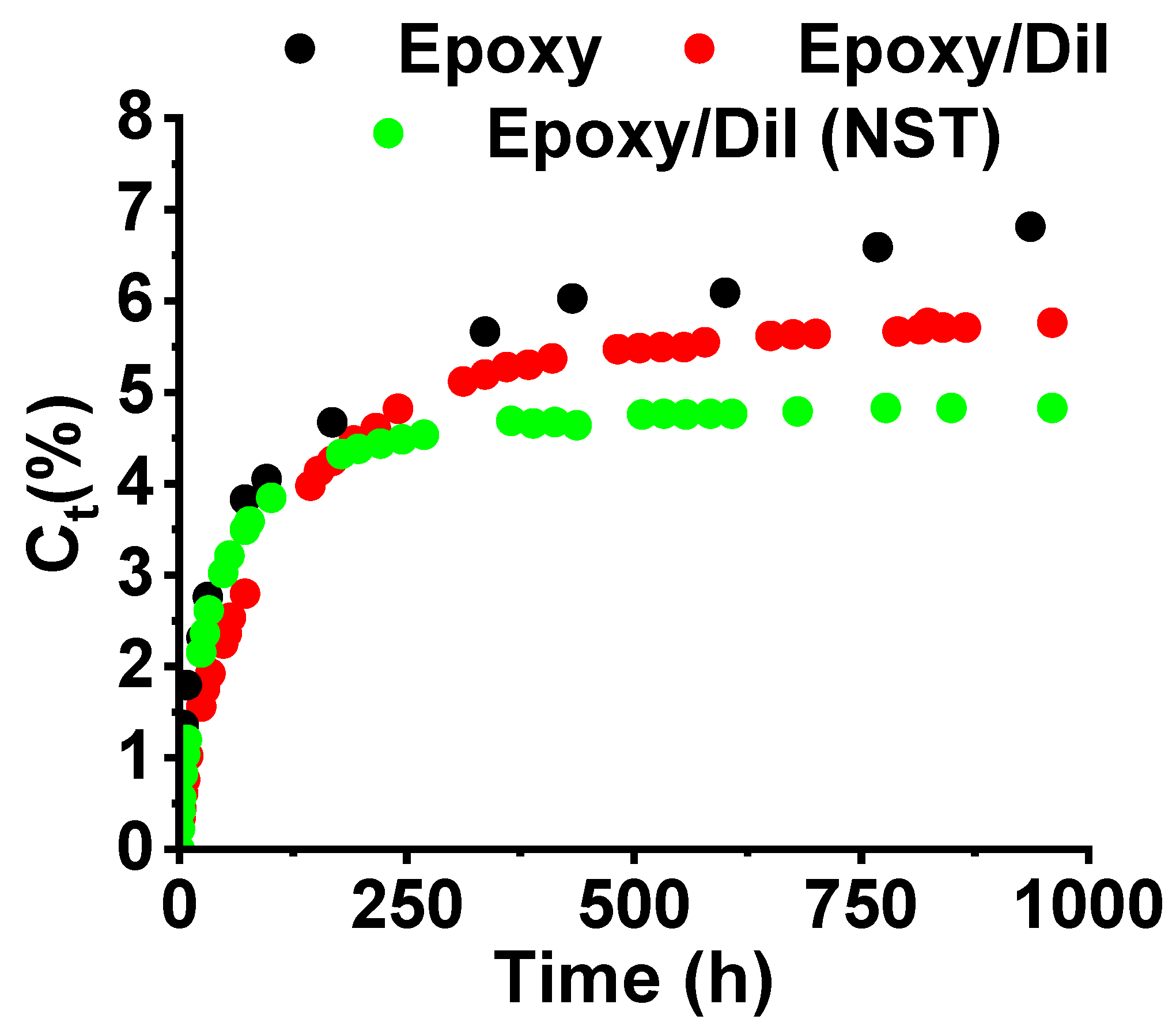
Figure 1 shows the curve of Ct as a function of the time (hours) of the epoxy resin without diluent, and the epoxy mixture containing the diluent at stoichiometric and non-stoichiometric ratios of amine/epoxy.
The equilibrium sorption of liquid water (Ceq) decreases from 6.81% for TGMDA + DDS (Epoxy system) to 5.76% for the Epoxy/Dil sample cured under stoichiometric hardener conditions, and to 4.83% for the Epoxy/Dil (NST) sample cured under non-stoichiometric conditions. The resin reduces its Ceq by approximately 15% to 30%. This reduction is highly significant for the use of epoxy resins in aeronautical and other structural applications, as absorbed moisture can lead to increased degradation and compromised mechanical performance. Table 1 shows the values of the diffusion parameter, D (cm 2/s), and the sorption values at equilibrium (Ceq) of the unfilled and filled epoxy formulation.
These findings indicate that a small amount of nanofiller (up to 1%) does not influence the diffusion coefficient. Comparing all results, it is evident that the Epoxy/Dil (NST) sample, as well as the nanofilled epoxy resins, exhibit a lower water uptake. This value is comparable to that obtained for DGEBA cured with DDS in stoichiometric proportions (4.03%) or cured with a tertiary amine [25], which promotes polyetherification through nucleophilic ring opening of the oxirane ring, resulting in a network with significant structural differences compared to those formed with primary amines, as in the present study.

3.2. Dynamic Mechanical Properties

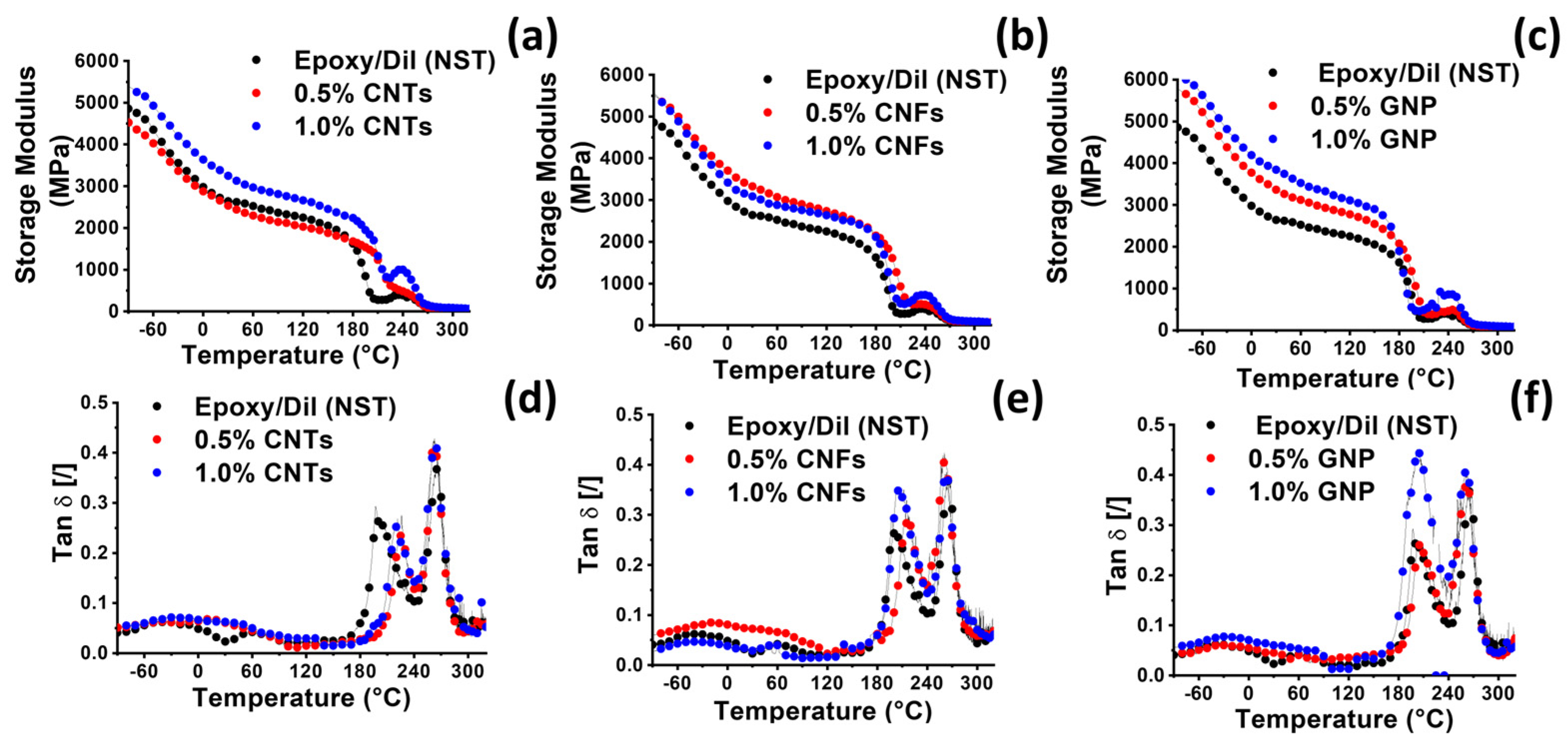
Figure 2 shows the curves of the storage modulus (a), (b), and (c), and the loss factor (tanδ) (d), (e), (f) of the unfilled epoxy formulation Epoxy/Dil (NST) and epoxy formulations at loading rates of 0.5% and 1% by weight of CNTs, CNFs, and GNP cured in non-stoichiometric conditions.
Figure 2 highlights the effect of non-stoichiometric systems with two nanoparticle concentrations to assess the filler effects. Both nanofiller addition and non-stoichiometric curing increase the low-Tg phase, whose peak height and width depend on filler type and its amount. The system filled with GNP at 1 wt% produces the most pronounced low-Tg peak and significant reinforcement in storage modulus, altering properties like toughness and flexibility. GNP’s edge-carboxylation enhances polymer–filler interactions, improving mechanical and electrical performance while reducing moisture uptake, aided by self-assembly of graphitic [26]. CNTs also provide reinforcement, though less at low loadings. These behaviors reflect complex curing chemistry, where network structure, and thus Tg and material properties, depend on resin formulation, hardener type, stoichiometry, and cure kinetics.

3.3. Electrical Properties

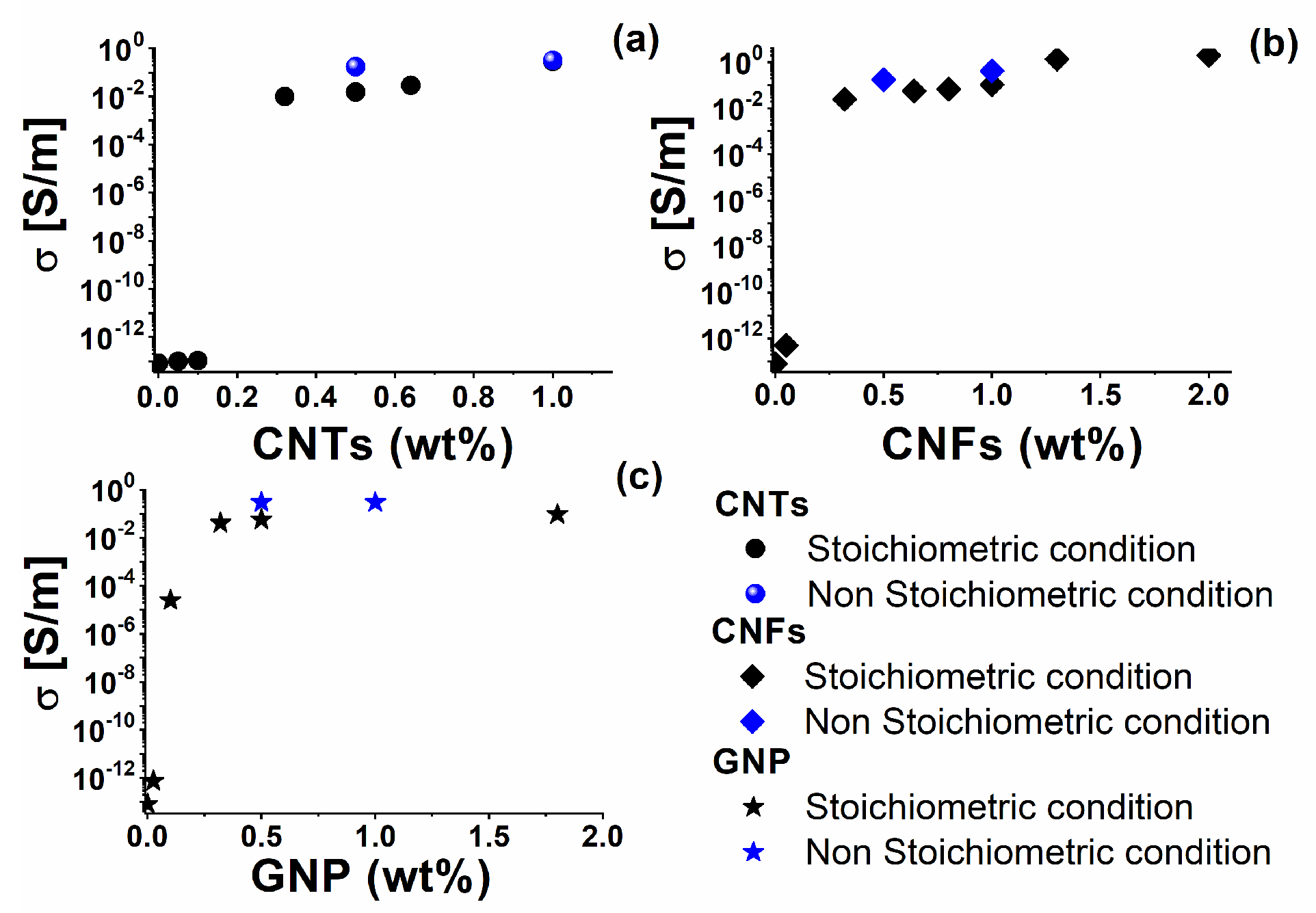
From the EPT curves (reported in Figure 3a–c), it was demonstrated that GNP enabled electrical percolation at very low filler content (0.025–0.1 wt%), due to self-assembly and strong matrix interaction. At 0.5 wt%, GNP increased conductivity by an order of magnitude (up to 0.31 S·m−1), as shown in Table 2, which reports the values of the electrical conductivity σ (S/m) for the non-stoichiometric samples loaded with 0.5 and 1.0 wt% of carbonaceous fillers.

4. Conclusions

Multifunctional epoxy systems were developed to reduce moisture uptake while enhancing electrical and mechanical properties. Water sorption at equilibrium (Ceq) decreased from 6.81% to 5.76% for TGMDA/BDE + DDS (stoichiometric curing) and to 4.83% for TGMDA/BDE + DDS(NS) (non-stoichiometric). This reduction (15–30%) is significant for industrial applications. Nanofilled samples with CNTs, CNFs, and GNP showed Ceq values only slightly higher than the unfilled matrix, with GNP composites exhibiting the lowest moisture content and improved mechanical performance. GNP also enabled electrical percolation at very low filler content (0.025–0.1 wt%), due to self-assembly and strong matrix interaction, which reinforced the elastic modulus. At 0.5 wt%, GNP increased conductivity by an order of magnitude (up to 0.31 S·m−1), making these systems ideal for wind energy, aerospace, and marine applications. Self-assembly likely contributes to reduced moisture uptake by limiting water access to polar sites. Dynamic mechanical analysis confirmed increased chain mobility near fillers, especially GNP, due to its functionalization and morphology. Tg variations induced by nanofillers were also investigated.

Author Contributions

Conceptualization, L.G. and L.V.; methodology, L.V.; software, F.A., R.L., M.R. and M.C.; formal analysis, L.V.; investigation, L.G. and L.V.; data curation, L.V.; writing—original draft preparation, L.G.; writing—review and editing, L.G. and L.V.; visualization, F.A., R.L., M.R. and M.C.; supervision, L.G. and L.V.; project administration, L.G.; funding acquisition, L.G. All authors have read and agreed to the published version of the manuscript.

Funding

This research has received funding from the European Union’s Horizon Europe research and innovation program under the Grant Agreement No 101091828.

Institutional Review Board Statement

Not applicable.

Informed Consent Statement

Not applicable.

Data Availability Statement

The data presented in this study are available on request from the corresponding author due to privacy reasons.

Conflicts of Interest

The authors declare no conflicts of interest.

References

  1. Bifulco, A.; Imparato, C.; Climaco, I.; Battegazzore, D.; Perrella, M.; Vitiello, G.; Aronne, A.; Malucelli, G. Multifunctional fire-resistant and flame-triggered shape memory epoxy nanocomposites containing carbon dots. Chem. Eng. J. 2024, 484, 149327. [Google Scholar] [CrossRef]
  2. Jatothu, P.; Rathore, S.; Singh, A. Enhancement of mechanical properties in high content electrophoretically deposited carboxyl graphene carbon fiber composites using combined hand layup and VARTM fabrication processes. Compos. Part B Eng. 2026, 311, 113198. [Google Scholar] [CrossRef]
  3. Longo, R.; Calabrese, E.; Aliberti, F.; Vertuccio, L.; De Piano, G.; Pantani, R.; Raimondo, M.; Guadagno, L. Effects of the Mixing Method of Expanded Graphite on Thermal, Electrical, and Water Transport Properties of Thermosetting Nanocomposites. Polymers 2025, 17, 2759. [Google Scholar] [CrossRef]
  4. Longo, R.; Vertuccio, L.; Aliberti, F.; Raimondo, M.; Pantani, R.; Russo, S.; Iannuzzo, G.; Guadagno, L. Adaptative electrothermal activation of hybrid composites for anti-icing function. Adv. Compos. Hybrid Mater. 2025, 8, 268. [Google Scholar] [CrossRef]
  5. Louis, S.; Arukula, R.; Yang, D.; Kim, T.; Wu, X.; Qi, X. Effects of dispersion methods on dynamic and thermal mechanical properties of GNP–epoxy nanocomposite coatings. Prog. Org. Coat. 2026, 210, 109652. [Google Scholar] [CrossRef]
  6. Niu, Y.; Su, J.; Yao, J.; Wang, Z.; Yang, L.; Qin, Z. Construction of Energy-Efficient Electro-Thermal Anti-Icing/De-Icing System for Composite Wings Based on MWCNT Films. Polym. Compos. 2025, 47, 6269. [Google Scholar] [CrossRef]
  7. Farooq, U.; Bertana, V.; Mossotti, G.; Ferrero, S.; Scaltrito, L. Sustainable Manufacturing of Lightweight Hybrid Nanocomposites for Electric Vehicle Battery Enclosures. Polymers 2025, 17, 1056. [Google Scholar] [CrossRef]
  8. Girish, S.; Vinay, M.S.; Bavan, D.S.; Ahmed, R.; Asdaque, P.M.G.B.; Revanasiddappa, M.; Dandapani, P.; Ravitej, Y.P. Evaluation of thermal properties of epoxy composites filled by nanofiller materials. Discov. Appl. Sci. 2025, 7, 1269. [Google Scholar] [CrossRef]
  9. Guadagno, L.; Naddeo, C.; Sorrentino, A.; Raimondo, M. Thermo-Mechanical Performance of Epoxy Hybrid System Based on Carbon Nanotubes and Graphene Nanoparticles. Nanomaterials 2023, 13, 2427. [Google Scholar] [CrossRef]
  10. Haghgoo, M.; Ansari, R.; Hassanzadeh-Aghdam, M.K.; Sahmani, S.; Jang, S.-H. Numerical simulation of thermomagnetic carbon nanotube-graphene nanoplatelet polymeric conductive composites. Compos. Part A Appl. Sci. Manuf. 2025, 199, 109217. [Google Scholar] [CrossRef]
  11. Zare, Y.; Naqvi, M.; Rhee, K.Y.; Park, S.-J. Unraveling the roles of network and tunnels in the conductivity of carbon nanofiber composites. Sci. Rep. 2025, 15, 35459. [Google Scholar] [CrossRef]
  12. Spinelli, G.; Lamberti, P.; Tucci, V.; Guadagno, L.; Vertuccio, L. Damage Monitoring of Structural Resins Loaded with Carbon Fillers: Experimental and Theoretical Study. Nanomaterials 2020, 10, 434. [Google Scholar] [CrossRef]
  13. Atif, R.; Inam, F. Reasons and remedies for the agglomeration of multilayered graphene and carbon nanotubes in polymers. Beilstein J. Nanotechnol. 2016, 7, 1174–1196. [Google Scholar] [CrossRef]
  14. Bauhofer, W.; Kovacs, J.Z. A review and analysis of electrical percolation in carbon nanotube polymer composites. Compos. Sci. Technol. 2009, 69, 1486–1498. [Google Scholar] [CrossRef]
  15. Caradonna, A.; Badini, C.; Padovano, E.; Pietroluongo, M. Electrical and Thermal Conductivity of Epoxy-Carbon Filler Composites Processed by Calendaring. Materials 2019, 12, 1522. [Google Scholar] [CrossRef]
  16. Kymakis, E.; Amaratunga, G.A.J. Electrical properties of single-wall carbon nanotube-polymer composite films. J. Appl. Phys. 2006, 99, 084302. [Google Scholar] [CrossRef]
  17. Mohd Radzuan, N.A.; Yusuf Zakaria, M.; Sulong, A.B.; Sahari, J. The effect of milled carbon fibre filler on electrical conductivity in highly conductive polymer composites. Compos. Part B Eng. 2017, 110, 153–160. [Google Scholar] [CrossRef]
  18. Yi, G.; Li, J.; Henderson, L.C.; Lei, W.; Du, L.; Zhao, S. Enhancing Thermal Conductivity of Polyvinylidene Fluoride Composites by Carbon Fiber: Length Effect of the Filler. Polymers 2022, 14, 4599. [Google Scholar] [CrossRef]
  19. Yu, A.; Ramesh, P.; Sun, X.; Bekyarova, E.; Itkis, M.E.; Haddon, R.C. Enhanced Thermal Conductivity in a Hybrid Graphite Nanoplatelet—Carbon Nanotube Filler for Epoxy Composites. Adv. Mater. 2008, 20, 4740–4744. [Google Scholar] [CrossRef]
  20. Alamri, H.; Low, I.M. Effect of water absorption on the mechanical properties of nano-filler reinforced epoxy nanocomposites. Mater. Des. 2012, 42, 214–222. [Google Scholar] [CrossRef]
  21. Apicella, A.; Nicolais, L. Effect of Water on the Properties of Epoxy Matrix and Composite; Springer: Berlin/Heidelberg, Germany, 2005; pp. 69–77. [Google Scholar] [CrossRef]
  22. Nogueira, P.; Ramirez, C.; Torres, A.; Abad, M.J.; Cano, J.; Lopez, J.; Lopez-Bueno, I.; Barral, L. Effect of water sorption on the structure and mechanical properties of an epoxy resin system. J. Appl. Polym. Sci. 2001, 80, 71–80. [Google Scholar] [CrossRef]
  23. Papanicolaou, G.C.; Kosmidou, T.V.; Vatalis, A.S.; Delides, C.G. Water absorption mechanism and some anomalous effects on the mechanical and viscoelastic behavior of an epoxy system. J. Appl. Polym. Sci. 2006, 99, 1328–1339. [Google Scholar] [CrossRef]
  24. Crank, J. The Mathematics of Diffusion; Oxford University Press: New York, NY, USA, 1975; Volume 19752, pp. 1–21. [Google Scholar]
  25. Guadagno, L.; Vertuccio, L.; Sorrentino, A.; Raimondo, M.; Naddeo, C.; Vittoria, V.; Iannuzzo, G.; Calvi, E.; Russo, S. Mechanical and barrier properties of epoxy resin filled with multi-walled carbon nanotubes. Carbon 2009, 47, 2419–2430. [Google Scholar] [CrossRef]
  26. Zhao, Y.; Byshkin, M.; Cong, Y.; Kawakatsu, T.; Guadagno, L.; De Nicola, A.; Yu, N.; Milano, G.; Dong, B. Self-assembly of carbon nanotubes in polymer melts: Simulation of structural and electrical behaviour by hybrid particle-field molecular dynamics. Nanoscale 2016, 8, 15538–15552. [Google Scholar] [CrossRef]
Figure 1. Ct as a function of the time (hours) of the samples Epoxy, Epoxy/Dil, and Epoxy/Dil (NST).
Engproc 133 00039 g001
Figure 2. Storage modulus (ac) and the loss factor (Tan δ) (df) of the unfilled epoxy formulation Epoxy/Dil (NST) and epoxy formulations at loading rates of 0.5% and 1% by weight of: CNTs, CNFs and GNP cured in non-stoichiometric conditions.
Engproc 133 00039 g002
Figure 3. Electrical conductivity values of the nanocomposites versus filler weight percentage, reinforced with (a) CNTs; (b) CNFs; (c) GNP.
Engproc 133 00039 g003
Table 1. Diffusion parameter, D (cm 2/s), and the sorption values at equilibrium (Ceq) of the unfilled and filled epoxy formulation.
SampleD (cm2/s)Ceq (%)
Epoxy/Dil (NST)1.39 × 10⁻⁹ ± 4.94 × 10−104.83 ± 0.02
0.5% CNTs1.25 × 10−9 ± 3.40 × 10−115.89 ± 0.06
0.5% GNP1.52 × 10−9 ± 2.60 × 10−105.54 ± 0.02
0.5% CNFs1.31 × 10−9 ± 1.08 × 10−105.60 ± 0.01
1.0% CNTs1.44 × 10−9 ± 5.45 × 10−115.55 ± 0.11
1.0% GNP1.36 × 10−9 ± 1.71 × 10−105.11 ± 0.02
1.0% CNFs1.83 × 10−9 ± 1.51 × 10−105.51 ± 0.12
Table 2. Electrical conductivity σ (S/m) of the non-stoichiometric epoxy and the samples loaded with 0.5 and 1.0 wt% of carbonaceous fillers.
Sampleσ (S/m)
Epoxy/Dil (NST)8.17 × 10⁻¹⁴
0.5% CNTs1.73 × 10−1
1.0% CNTs3.24 × 10−1
0.5% CNFs1.80 × 10−1
1.0% CNFs4.22 × 10−1
0.5% GNP3.08 × 10−1
1.0% GNP3.03 × 10−1
Disclaimer/Publisher’s Note: The statements, opinions and data contained in all publications are solely those of the individual author(s) and contributor(s) and not of MDPI and/or the editor(s). MDPI and/or the editor(s) disclaim responsibility for any injury to people or property resulting from any ideas, methods, instructions or products referred to in the content.