Proceeding Paper

Synthetic Measurements of Triple-Component GNSS Meta-Signals †
by
Daniele Borio
1,*,
Melania Susi
2 and
Kinga Wȩzka
3
1
European Commission, Joint Research Centre (JRC), 21027 Ispra, Italy
2
Topcon Positioning System Inc., 41033 Concordia, Italy
3
Faculty of Geodesy and Cartography, Department of Geodesy and Geodetic Astronomy, Warsaw University of Technology (WUT), 00-661 Warsaw, Poland
*
Author to whom correspondence should be addressed.
Presented at the European Navigation Conference 2025 (ENC 2025), Wrocław, Poland, 21–23 May 2025.
Eng. Proc. 2026, 126(1), 51; https://doi.org/10.3390/engproc2026126051

Published: 23 April 2026
(This article belongs to the Proceedings of European Navigation Conference 2025)

Abstract

The fact that a large Gabor bandwidth promotes measurement accuracy has motivated research on Global Navigation Satellite System (GNSS) meta-signals, which are obtained by jointly processing components from different frequencies. When two side-band components are considered, the resulting meta-signal has characteristics close to that of a pure carrier and measurement ambiguities can arise: a third signal in between side-band components can alleviate this problem and help estimating the integer ambiguities. This paper provides a framework for the generation of measurements from triple-component GNSS meta-signals with the goal of reducing the ambiguity problem. The whole meta-signal is at first decomposed as two dual-component meta-signals with the central component used as pivot. Measurements on the dual-component meta-signals are computed using the synthetic approach based on the Hatch-Melbourne-Wübbena (HMW) combination. Triple-component pseudoranges are then obtained as the narrow lane combination of the pseudoranges from the dual-component meta-signals. Theoretical results have been supported through experimental analyses based on measurements from two Septentrio PolaRx5S multi-frequency, multi-constellation receivers set up in a zero-baseline configuration. Results based on the Galileo E5a, E5b and E6 components show the effectiveness of the proposed framework.

1. Introduction

The fact that a large Gabor bandwidth promotes measurement accuracy has motivated research on GNSS meta-signals, which are obtained by jointly processing components from different frequencies [1,2]. When two side-band components are considered, the resulting meta-signal has characteristics close to that of a pure carrier and measurement ambiguities can arise. Signal energy placed in between side-band components can alleviate the ambiguity problem and meta-signals with three components can lead to more reliable measurements than the corresponding dual-frequency signals with large spectral gaps. While a signal processing framework for effectively tracking triple-component meta-signals has been recently proposed [3], the measurement reconstruction from the observations of its individual components is still an open problem. This is the focus of the paper, which provides a synthetic measurement generation framework for triple-component GNSS meta-signals. It is first recognized that reconstructed triple-component pseudoranges should have the accuracy of a carrier component spanning the whole spectral occupation of the meta-signal. This accuracy can be achieved by reconstructing the pseudorange from the wide lane combination of the carrier phases of the side-band components of the meta-signal. This wide lane combination is indeed the subcarrier, which spans the whole meta-signal spectrum. In order to solve the ambiguities associated to the subcarrier, the whole meta-signal is at first decomposed as two dual-component meta-signals with the central component used as pivot. Integer ambiguities on the dual-component meta-signals are estimated using the HMW combinations and pseudoranges are reconstruced using the synthetic approach proposed by [4]. Triple-component pseudoranges are then obtained as the narrow lane combination of the pseudoranges from the dual-component meta-signals. Theoretical results have been experimentally analysed using measurements from two Septentrio PolaRx5S multi-frequency, multi-constellation receivers set up in a zero-baseline configuration. The Galileo E5a, E5b and E6 case has been specifically considered. Ambiguity resolution on the dual-component meta-signals has been improved using satellite bias corrections and by implementing a receiver bias estimation approach. Results in the measurement and position domains show the effectiveness of the proposed framework.

2. Meta-Signal Measurement Reconstruction

This section provides the theoretical foundations for obtaining equivalent pseudoranges for triple-component meta-signals. A summary on the reconstruction of dual-frequency meta-signal pseudoranges is first provided. Then, the concept of triple-component meta-signal is detailed. Finally, the procedure for reconstructing triple-component meta-signal pseudoranges is described.

2.1. Dual-Component Meta-Signal Measurement Reconstruction

A dual-component meta-signal is obtained by jointly processing two side-band components from different frequencies [1,2]. Rather than considering the two components separately with two independent carriers, the meta-signal is characterized by a single carrier with nominal frequency equal to the average of the side-band Radio Frequencies (RFs) and by a subcarrier with nominal frequency equal to the semi-difference of the side-band RFs. The subcarrier is a periodic waveform, usually complex, which splits the signal away from the common centre frequency. In this way, the side-band components are moved from the meta-signal RF to their nominal RFs. The recovery of the phase and frequency of the subcarrier allows one to coherently combine the signal power from the side-band components obtaining a signal processing gain.
Dual-frequency meta-signal measurements can be reconstructed from the side-band observations following the procedure outlined in [4]. The meta-signal carrier and subcarrier phases are directly linked to the narrow and wide lane combinations of the side-band carrier phases and can be compute through a Hadamard transform of order two. The high accuracy pseudorange of a dual-frequency pseudorange is computed as [4]:
ρ + = Φ w l round Φ w l ρ n l λ w l λ w l ,
where Φ w l is the wide lane combination of the side-band carrier phases expressed in metres:
Φ w l = f 2 Φ 2 f 1 Φ 1 f 2 f 1 .
f 1 and f 2 denote the RFs of the side-band components. Similarly, ρ n l is the narrow lane combination of the side-band pseudoranges:
ρ n l = f 2 ρ 2 + f 1 ρ 1 f 2 + f 1 .
In the following, the symbol Φ will be consistently used to denote carrier phases in metres and ρ will indicate pseudoranges also expressed in metres. λ w l = c f 2 f 1 is the wavelength of the wide lane combination with c being the speed of light. Meta-signal pseudoranges are obtained by correcting Φ w l by an integer number of cycles estimated through the rounding operation in (1). The term
C h m w = Φ w l ρ n l λ w l
is the HMW combination expressed in cycles and it is used as an unbiased estimator of the integer ambiguities of the wide lane carrier phase combination of the meta-signal side-band components. If the ambiguities are correctly fixed, pseudorange (1) has the accuracy of Φ w l , which is the phase of the subcarrier component spanning the whole spectral occupation of the dual-frequency meta-signal.

2.2. Triple-Component Meta-Signals

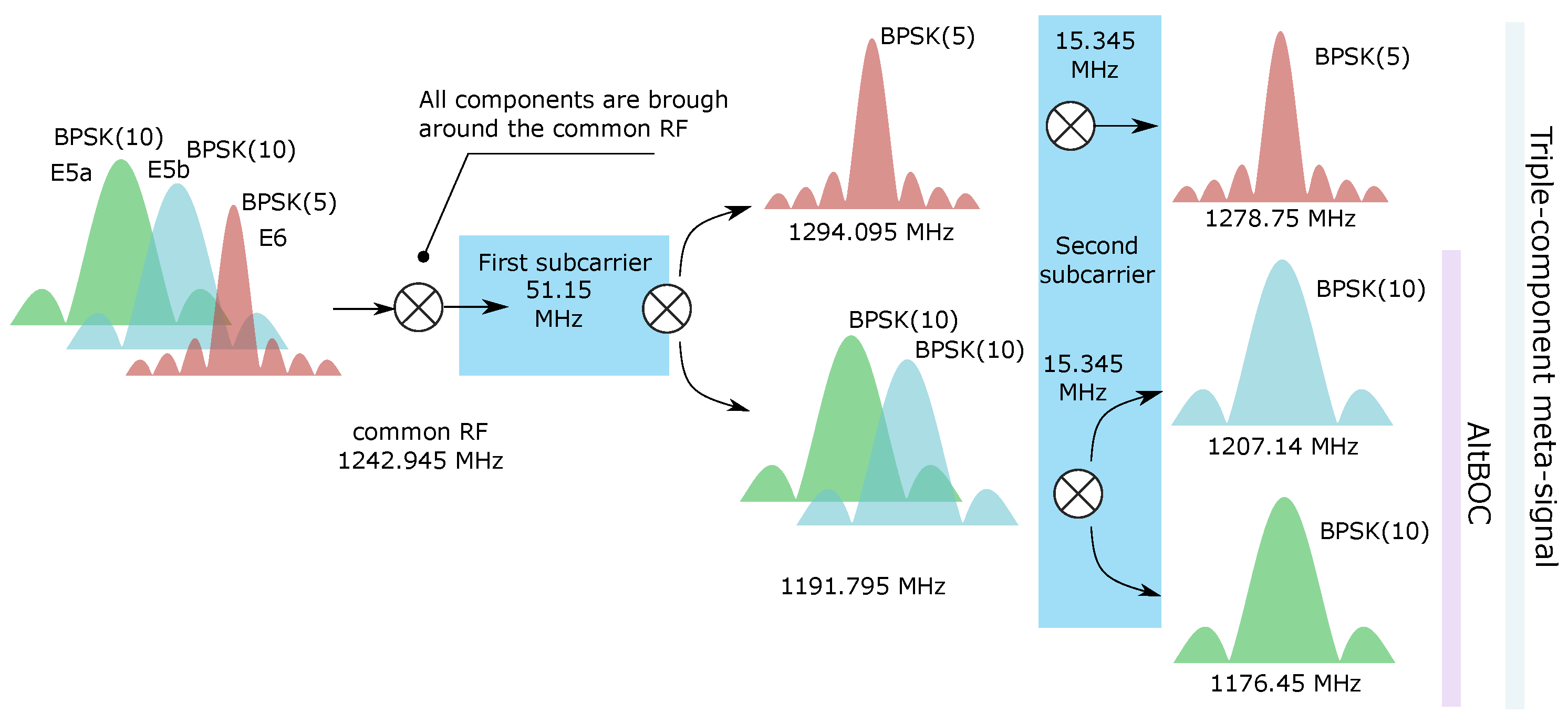
A general theory for constructing GNSS meta-signals with an arbitrary number of components has been recently proposed by [3]. The theory shows that a GNSS meta-signal can be constructed from N baseband components using a common carrier and N 1 subcarriers. The N 1 subcarriers split the baseband components on N intermediate frequencies, whereas the common carrier brings the GNSS meta-signal to RF. When three components are considered, the construction shown in Figure 1 is obtained. In this case, the Galileo E5a, E5b and E6 components are considered. They are at first up-converted to a common RF equal to 1242.945 MHz. Then, a first subcarrier with frequency equal to 51.15 MHz is used to split the three signals into two blocks around the 1191.795 MHz and 1294.095 MHz RFs, respectively. Note that 1191.795 MHz is the centre frequency of the Galileo Alternative Binary Offset Carrier (AltBOC) [5]. A second subcarrier with frequency equal to 15.345 MHz is then used to bring the three components at their expected RFs.
The carrier and subcarrier frequencies are obtained from the RFs of the original components through the following transformation [3]:
f c f s u b 1 f s u b 2 = 1 2 H 3 f 1 f 2 f 3 = 1 2 0 1 1 1 1 0 1 0 1 f 1 f 2 f 3 ,
where 1 2 H 3 is obtained as the inverse of a truncated Hadamard matrix. The first line of H 3 defines the meta-signal carrier frequency, which is the average of f 2 and f 3 , the RFs of the second and third components. The frequencies of the individual components are ordered in ascending order and f 2 is the frequency of the central component. In the Galileo case considered here, f 1 is the frequency of the E5a component, f 2 the frequency of the E5b signal and f 3 that of the E6 modulation. The second and third rows of H 3 define extra-wide and wide lane combinations, respectively. For the case shown in Figure 1, the second row of H 3 leads to the subcarrier frequency of the AltBOC modulation, whereas the third row corresponds to the subcarrier frequency of the E6-E5a meta-signal.
The construction just illustrated is used in the following as a basis for the reconstruction of triple-component pseudoranges.

2.3. Triple-Component Pseudorange Reconstruction

In Section 2.1, it was shown that the dual-frequency pseudoranges have the accuracy of the subcarrier component that spans the whole spectral occupation of the meta-signal. Similarly, for the triple-component case, one aims at obtaining a pseudorange with the accuracy of a carrier component spanning the whole meta-signal spectral occupation. This carrier is defined by the wide lane combination associated to the f 3 and f 1 frequencies, i.e., associated to the subcarrier with the smallest wavelength.
Following this principle, triple-component pseudoranges can be formally reconstructed in the same way as in the dual-frequency case:
ρ + = Φ w l 2 N w l 2 λ w l 2
where Φ w l 2 is the wide lane combination considering the components at the left and right sides of the spectrum of the triple-component meta-signal. N w l 2 is an estimate of the integer ambiguity associated to Φ w l 2 and λ w l 2 = c f 3 f 1 . Rather than estimating N w l 2 directly using the associated HMW combination, it is convenient to exploit the central signal at frequency f 2 as a pivot, in a manner similar to the Three Carrier Ambiguity Resolution (TCAR) approach [6]. More specifically, (5) can be decomposed as:
ρ + = λ w l 2 φ w l 2 N w l 2 = λ w l 2 φ w l a + φ w l b N w l a N w l b = λ w l 2 λ w l a ρ a + + λ w l 2 λ w l b ρ b + ,
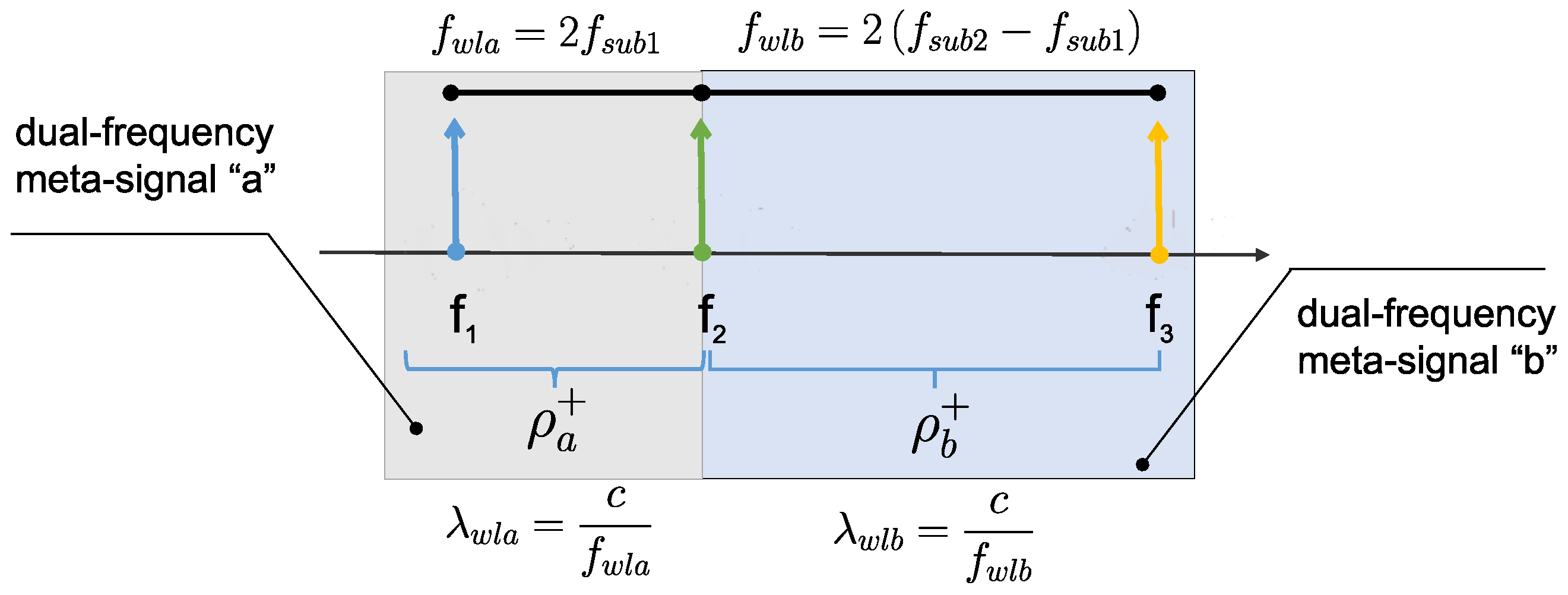
where symbol φ is used to denote carrier phases expressed in cycles. φ w l a and φ w l b are the wide lane combinations obtained considering signal pairs at f 1 and f 2 and at f 2 and f 3 , respectively. N w l a and N w l b are the associated ambiguities, which can be obtained using the related HMW combinations. Finally, ρ a + and ρ b + are the pseudoranges reconstructed using (1) for the mentioned signal pairs. The different quantities are illustrated in Figure 2, which shows that a triple-component meta-signal can be decomposed as two frequency-contiguous dual-frequency meta-signals. Equation (6) shows that the triple-component meta-signal pseudoranges are obtained as the narrow lane combination of the synthetic dual-frequency pseudoranges, ρ a + and ρ b + , obtained by considering frequency-contiguous dual-component meta-signals.

3. Material and Methods

The triple-component meta-signal reconstruction approach has been evaluated using the data collected from two Septentrio PolaRx5S multi-frequency, multi-constellation GNSS receivers setup in a zero-baseline configuration. The receivers were placed under open-sky static conditions at the Warsaw University of Technology (52°13′15″ N, 21°00′37″ E). The data are the same used by the authors for the analysis of quad-frequency meta-signal-inspired measurement combinations [7] and can be found openly at https://zenodo.org/records/15118153 (accessed on 01 April 2025). Additional details on the experimental setup adopted for the data collection can be found in [7].
Data have been processed using a custom software developed in Python (Version 3.11) and implementing the different steps detailed above. In order to reliably solve for the integer ambiguities associated to the wide lane combinations, code and carrier inter-frequency biases have also been applied. These biases have been downloaded from the Centre National d’Études Spatiales (CNES) Precise Point Positioning (PPP) Wizard project [8] (products retrieved from http://www.ppp-wizard.net/products/POST_PROCESSED/, accessed on 15 March 2025). Moreover fractional receiver biases have also been estimated and removed from the HMW combinations using a procedure similar to that suggested by [9]. In this way, it was possible to reliably solve for the integer ambiguities.
Finally, performance of the reconstructed pseudoranges has been analysed in the position domain using a custom Single Point Positioning (SPP) software (Version 1.0).

4. Results

Sample results obtained by processing Galileo multi-frequency observations are briefly described in this section. Findings obtained in the measurement domain are analysed first. Results in the position domain are then discussed.

4.1. Measurement Domain Analysis

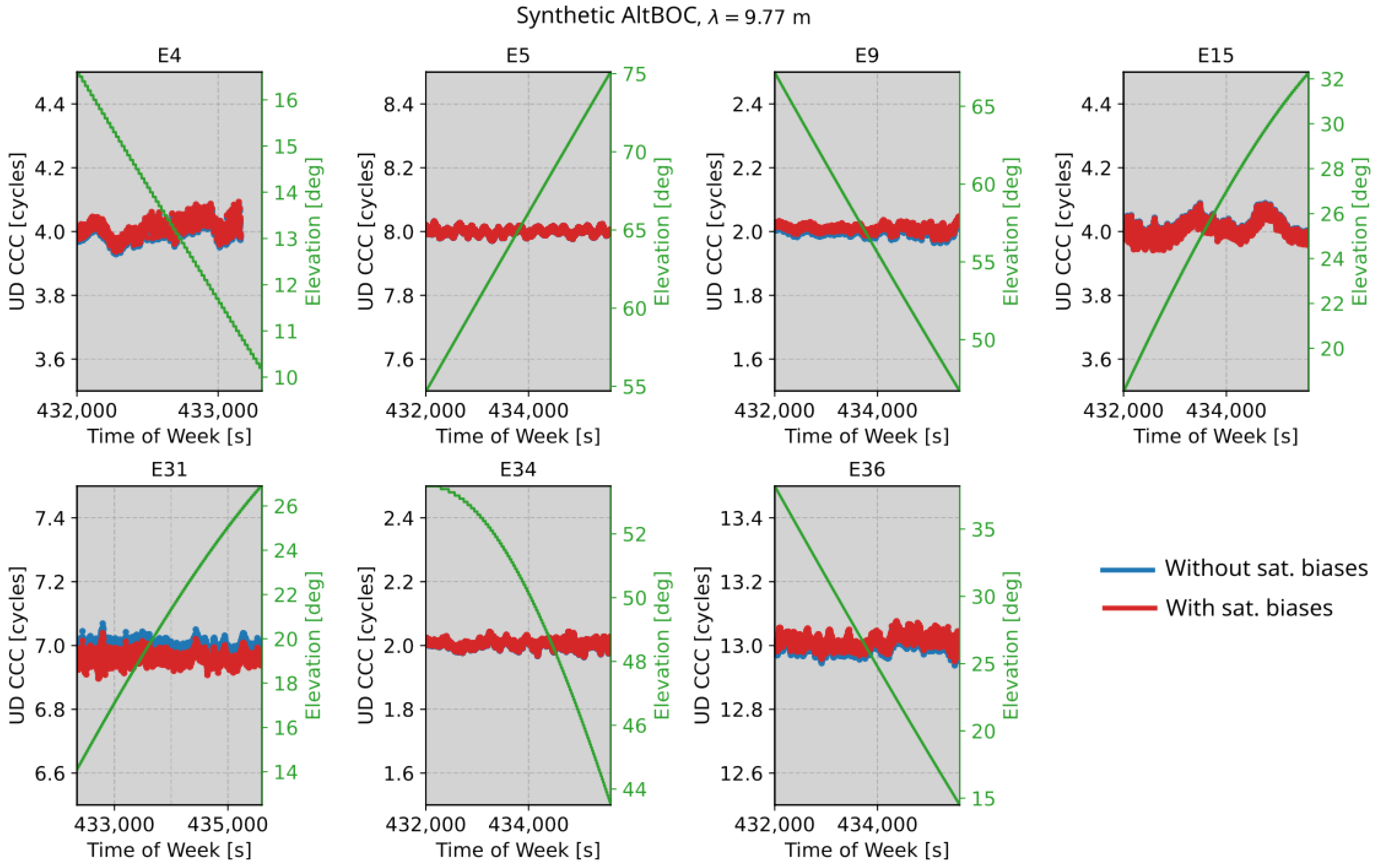
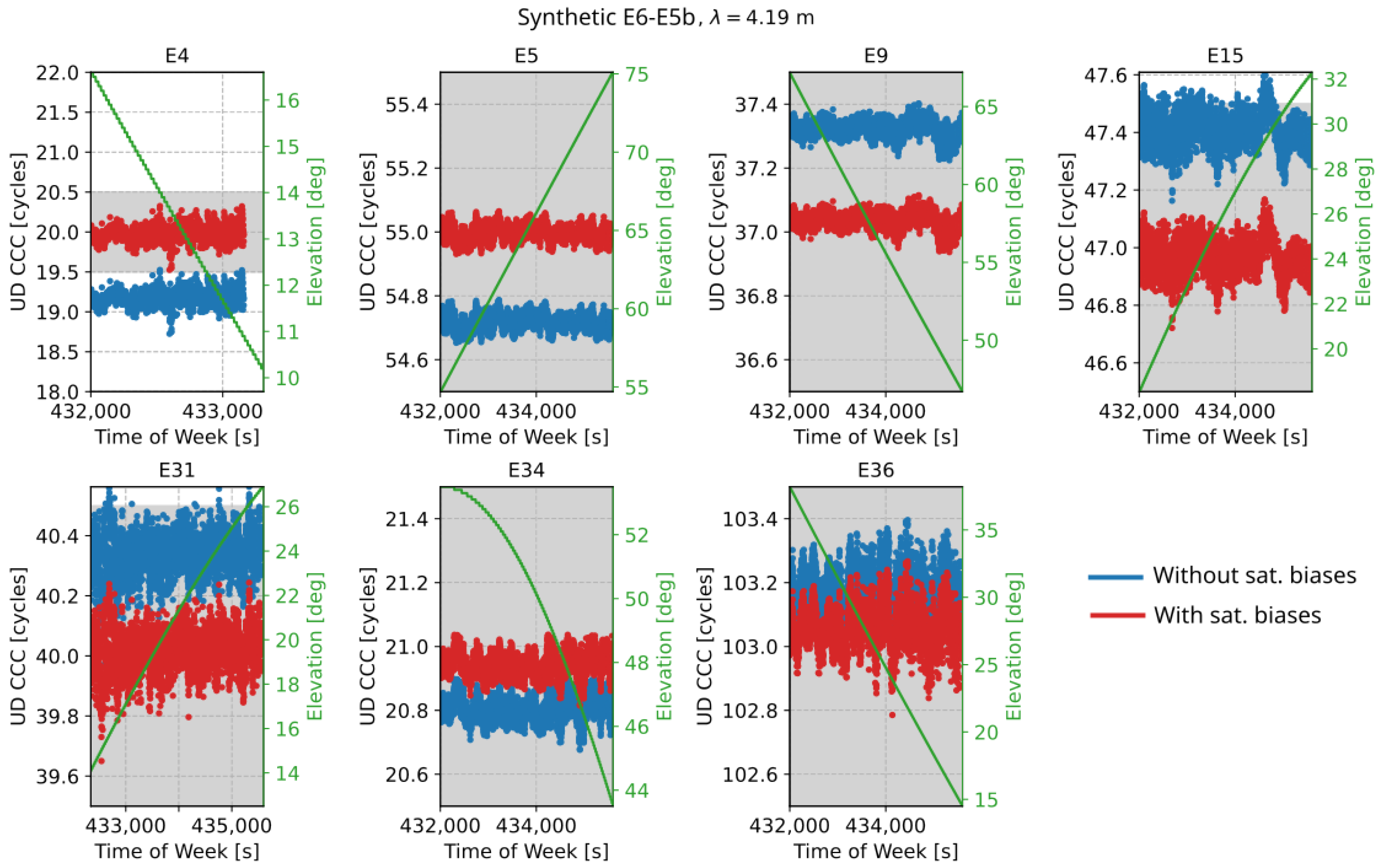
The first step for the successful reconstruction of triple-component pseudoranges is the estimation of the integer ambiguities, N w l a and N w l b , on the two frequency-contiguous meta-signals. This is done by rounding the HMW combinations obtained for the AltBOC and E6-E5b meta-signals. Figure 3 shows the HMW combinations expressed in cycles computed for the AltBOC case. Different satellites are considered. Moreover, the impact of the code and carrier bias corrections is also analysed. Similarly to previous analyses [4], the results shown in Figure 3 confirm that the integer ambiguities associated to the synthetic AltBOC pseudoranges can be reliably solved: the HMW combinations are well within a single decision region that maps them unequivocally to a single integer value. The satellite biases for the AltBOC combinations are in the order of 0.1 cycles and assume similar values across the different satellites. The impact of such biases is thus very limited and it is mostly absorbed by the algorithm estimating the common receiver fractional bias. This is not the case for the second dual-frequency combination, which is analysed in Figure 4. The impact of the satellite biases clearly emerges from the figure.
When bias corrections are used, it is possible to reliably solve for the ambiguities associated to the E6-E5b case. The red curves in Figure 4 are practically aligned along integer values and have variations lower than 0.2 cycles. The actual level of variations depends on the satellite elevation and the signal Carrier-to-Noise Power Spectral Density Ratio ( C / N 0 ). When bias corrections are not used, the HMW combinations are clearly shifted with respect to integer values. This effect reduces the number of satellites for which it is possible to reliably solve for the ambiguities. However, biases are practically constant for a few hours and can be retrieved only sporadically.
Due to space limitations, the HMW combinations for the E6-E5a case are not reported. In this case, decomposition (6) facilitate the reconstruction of triple-component pseudoranges.
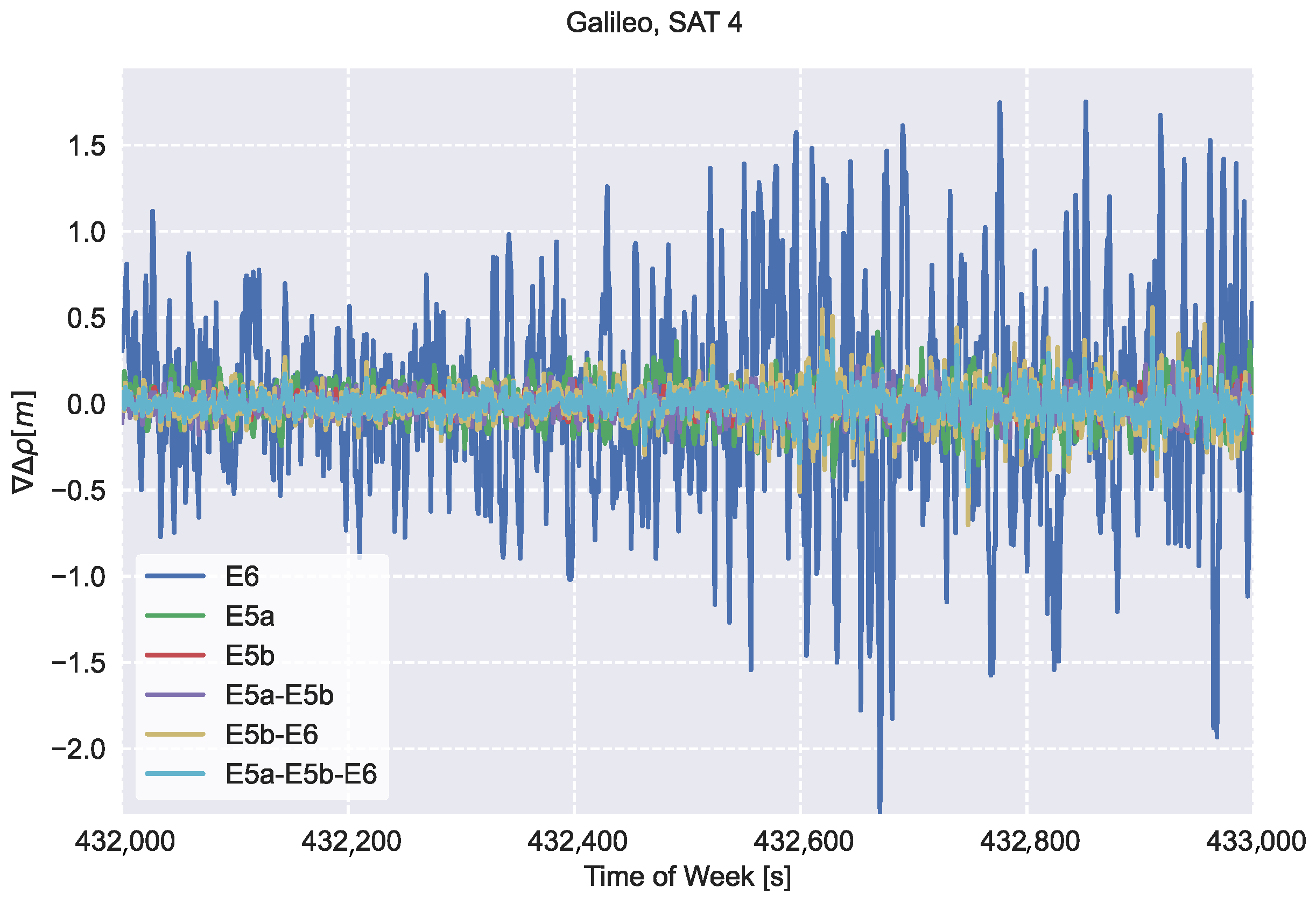
Using measurements collected using the zero-baseline configuration described in Section 3, it was possible to assess the quality of the pseudoranges reconstructed for the different signal combinations. In this respect, Figure 5 shows the pseudorange double differences, Δ ρ , for the different signal combinations including individual components (E6, E5a and E5b), dual-frequency meta-signals (E5b-E5a and E6-E5b) and triple-component meta-signals (E6-E5b-E5a). Measurements from a satellite with Pseudo Random Number (PRN) 4 are used as an example.
Galileo E6 double differences are the noisiest with standard deviations of several decimeters (for satellite E4, the standard deviation is ∼60 cm). On the contrary, the Galileo E5b signals are characterized by very high C / N 0 value and good quality measurements (for satellite E4, the standard deviation is about 12 cm). This disparity in the measurement quality limits the improvement expected for the reconstructed measurements. Despite this fact, the pseudoranges reconstructed for the triple-component meta-signals have the lowest standard deviation (∼9 cm for satellite E4). Also dual-frequency measurements show improvements with respect to single-component cases. However, a saturation effect is observed and the quality improvement becomes more and more marginal as new components are introduced. While more clear benefits are expected for the case where single-component measurements have similar qualities, a complete analysis addressing the impact of different noise levels is left for future work.

4.2. Position Domain Analysis

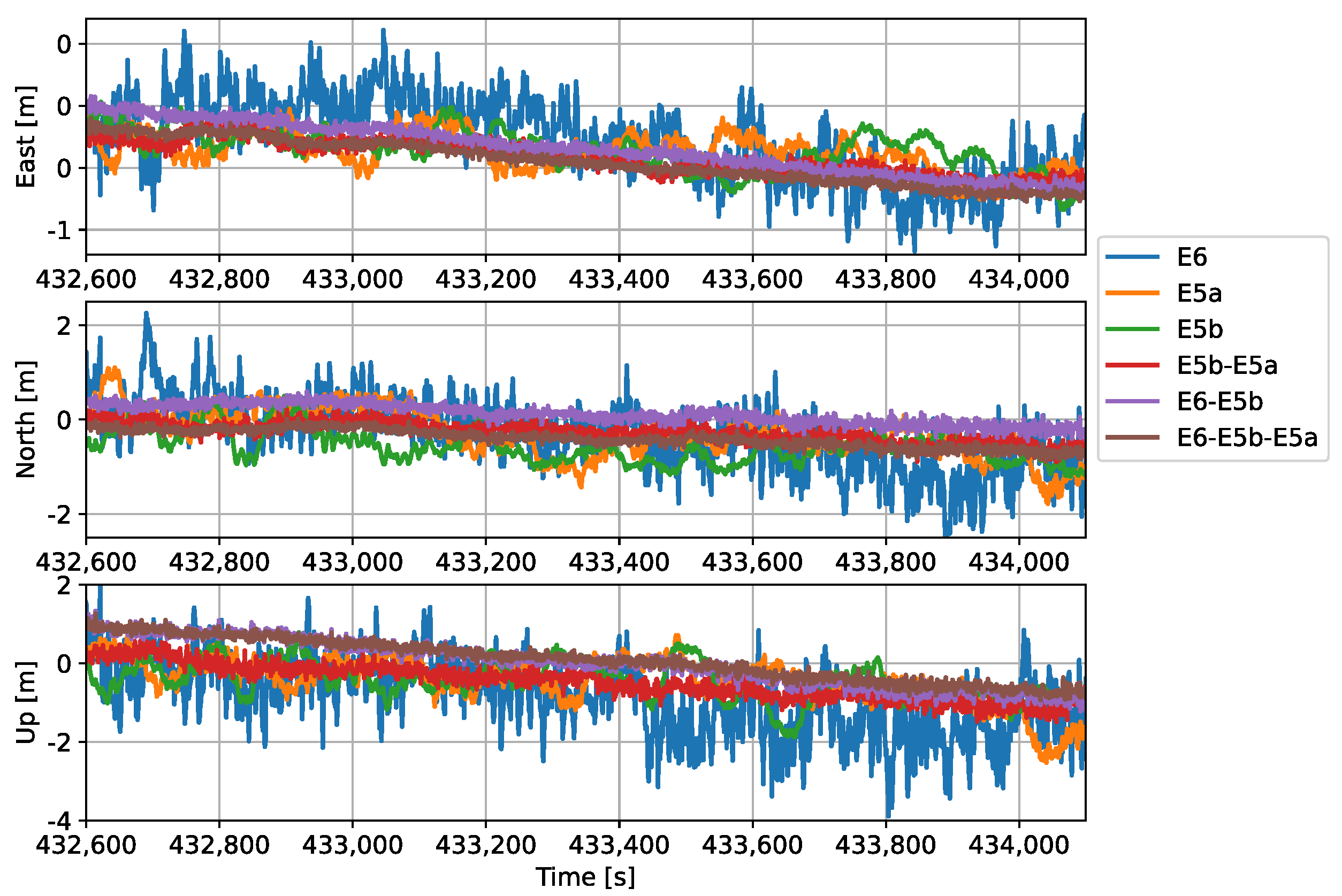
Figure 6 compares different SPP position solutions obtained considering original measurements, dual- and triple-component synthetic pseudoranges. The horizontal and vertical standard deviations obtained by de-trending with a second order polynomial the time series shown in Figure 6 are also provided in Table 1.
The position domain results shown in Figure 6 confirm the findings obtained in the measurement domain. The noisiest solution is the one obtained using E6 pseudoranges and a progressive noise reduction is observed as more components are combined. This shows the benefits of the meta-signal approach. While the solution computed using triple-component meta-signals is the most precise, a progressive performance saturation is observed.

5. Discussion

This paper analysed the problem of reconstructing triple-frequency pseudoranges from the observations of its individual components. In this respect, the theory of synthetic meta-signal reconstruction has been extended to the case with three components. To obtain unambiguous pseudoranges, it is necessary, however, to solve for the integer ambiguities associated to the wide lane carrier phase combination. This is done through a two-step process. In the first step, the pseudoranges of two dual-frequency meta-signals are reconstructed. These meta-signals share the central component, which is used as pivot. Ambiguity resolution is performed on these two meta-signals, which are characterized by subcarriers with large wavelengths. Finally, the triple-component pseudorange is obtained as the narrow lane combination of the dual-frequency meta-signal pseudoranges. The paper shows the deep connection between triple-component meta-signals, extra-wide, wide and narrow laning. The two-step reconstruction approach is also directly linked to the classical TCAR methodology.
Theoretical findings have been supported by experiments conducted using measurements collected under open-sky conditions from two receivers setup in a zero-baseline configuration. Additional analysis is required to better investigate the benefits and limitations of triple-component meta-signals under dynamic conditions or in the presence of weak signals. Finally, the impact of code and carrier biases should be further studied.

Author Contributions

Conceptualization, All; methodology, D.B.; software, All; validation, M.S. and K.W.; data curation, K.W.; writing—original draft preparation, D.B.; writing—review and editing, M.S. and K.W. All authors have read and agreed to the published version of the manuscript.

Funding

This research received no external funding.

Institutional Review Board Statement

Not applicable.

Informed Consent Statement

Not applicable.

Data Availability Statement

The original data presented in the study are openly available at https://zenodo.org/records/15118153 [DOI 10.5281/zenodo.15118152] (accessed on 1 April 2025). Sample code is available at https://github.com/borioda/RinexTools (accessed on 1 April 2025).

Conflicts of Interest

Author Malania Susi was employed by the company Topcon Positioning System Incorporated. The remaining authors declare that the research was conducted in the absence of any commercial or financial relationships that could be construed as potential conflicts of interest.

References

  1. Issler, J.L.; Paonni, M.; Eissfeller, B. Toward centimetric positioning thanks to L- and S-Band GNSS and to meta-GNSS signals. In Proceedings of the ESA Workshop on Satellite Navigation Technologies and European Workshop on GNSS Signals and Signal Processing (NAVITEC), Noordwijk, The Netherlands, 8–10 December 2010; pp. 1–8. [Google Scholar] [CrossRef]
  2. Nardin, A.; Dovis, F.; Zanier, F.; Melman, F. Adaptable Meta-Signal Tracking for Next-Generation Satellite Navigation Systems and LEO PNT. IEEE Access 2025, 13, 5706–5718. [Google Scholar] [CrossRef]
  3. Borio, D. Global Navigation Satellite System Meta-Signals with an Arbitrary Number of Components. Remote Sens. 2025, 17, 571. [Google Scholar] [CrossRef]
  4. Borio, D.; Gioia, C. Reconstructing GNSS Meta-Signal Observations Using Sideband Measurements. Navigation 2023, 70, 1–22. [Google Scholar] [CrossRef]
  5. Lestarquit, L.; Artaud, G.; Issler, J.L. AltBOC for Dummies or Everything You Always Wanted To Know About AltBOC. In Proceedings of the 21st International Technical Meeting of the Satellite Division of the Institute of Navigation (ION GNSS 2008), Savannah, GA, USA, 16–19 September 2008; pp. 961–970. [Google Scholar]
  6. Tang, W.; Deng, C.; Shi, C.; Liu, J. Triple-frequency carrier ambiguity resolution for Beidou navigation satellite system. GPS Solut. 2014, 18, 335–344. [Google Scholar] [CrossRef]
  7. Borio, D.; Susi, M.; Wezka, K. Meta-Signal Inspired Quad-Frequency GNSS Measurement Combinations. In Proceedings of the 37th International Technical Meeting of the Satellite Division of the Institute of Navigation (ION GNSS+), Baltimore, MD, USA, 16–20 September 2024; pp. 2203–2217. [Google Scholar] [CrossRef]
  8. Laurichesse, D.; Privat, A. An Open-source PPP Client Implementation for the CNES PPP-WIZARD Demonstrator. In Proceedings of the 28th International Technical Meeting of the Satellite Division of the Institute of Navigation (ION GNSS+), Tampa, FL, USA, 14–18 September 2015; pp. 2780–2789. [Google Scholar]
  9. Gazzino, C.; Lelarge, N. A Cascading Approach for Multi-Frequency Widelanes and Extra-Widelanes Carrier Phase Integer Ambiguity Resolution. In Proceedings of the 37th International Technical Meeting of the Satellite Division of the Institute of Navigation (ION GNSS+), Baltimore, MD, USA, 16–20 September 2024; pp. 2136–2150. [Google Scholar] [CrossRef]
Figure 1. Construction of a triple-component GNSS meta-signal using two subcarriers. The subcarrier components are directly related to the wide and extra-wide lane combinations obtained using the E5a, E5b and E6 signals. In analogy with the dual-component case, they are at the basis for the synthetic generation of triple-component meta-signal measurements.
Engproc 126 00051 g001
Figure 2. Decomposition of a triple-component meta-signal as two contiguous dual-frequency meta-signals. The signal at frequency f 2 is used as pivot and facilitates the ambiguity resolution process of the whole triple-component meta-signal.
Engproc 126 00051 g002
Figure 3. HMW combinations in cycles computed for the E5b-E5a case for different satellites. Red curves have been obtained using code and carrier biases from the CNES PPP Wizard project. In blue, HMW combinations obtained without satellite biases.
Engproc 126 00051 g003
Figure 4. HMW combinations in cycles computed for the E6-E5b case for different satellites. Red curves have been obtained using code and carrier biases from the CNES PPP Wizard project. In blue, HMW combinations obtained without satellite biases.
Engproc 126 00051 g004
Figure 5. Pseudorange double differences for the different signal combinations including individual components (E6, E5a and E5b), dual-frequency meta-signals (E5b-E5a and E6-E5b) and triple-component meta-signal (E6-E5b-E5a).
Engproc 126 00051 g005
Figure 6. Comparison between different SPP solutions obtained considering original measurements and dual- triple-component synthetic observations. The noisiest solution is the one obtained using E6 pseudoranges. Solution quality improves as more components are combined.
Engproc 126 00051 g006
Table 1. Horizontal and vertical standard deviations (in meters) evaluated from the different SPP solutions shown in Figure 6.
E6 E5aE5bE5b-E5aE6-E5bE6-E5b-E5a
Hor. std (meters) 0.57 0.38 0.32 0.14 0.10 0.08
Ver. std (meters) 0.75 0.39 0.41 0.16 0.13 0.094
Disclaimer/Publisher’s Note: The statements, opinions and data contained in all publications are solely those of the individual author(s) and contributor(s) and not of MDPI and/or the editor(s). MDPI and/or the editor(s) disclaim responsibility for any injury to people or property resulting from any ideas, methods, instructions or products referred to in the content.