1. Introduction
The term nanofluids was introduced by Choi in 1995 to describe engineered suspensions of nanoparticles in conventional heat-transfer liquids [
1]. Due to their enhanced thermal conductivity and heat dissipation, the use of nanofluids has been investigated in applications such as electronics cooling, energy systems, and heat exchangers [
2].
Their performance depends on particle material, size, concentration, and base fluid, and recent reviews further highlight their potential and limitations. In aeronautics, interest in nanofluids is growing due to the high heat loads of More-Electric and Hybrid-Electric Aircraft. Weight and volume are key constraints; Caggese et al. [
3] report that nanofluids can reduce the size of a liquid–liquid heat exchanger in a TMS for hybrid-electric aircraft, achieving a 15% volume reduction and 10% weight reduction compared to a baseline system without nanofluids. Experimental and numerical studies have also shown that nanofluids can enhance cooling system performance: they improve thermal behaviour in high-power aircraft electric motors [
4], and experimental investigations on UAV radiators confirm measurable gains in heat transfer efficiency with various nanoparticle formulations [
5]. Additionally, comprehensive reviews highlight the potential and limitations of nanofluids in advanced thermal systems [
6].
Despite these advances, most studies focus on components or laboratory-scale systems under steady-state conditions, and a systematic assessment of nanoparticle type, concentration, size, and coolant choice in a full aircraft-scale TMS is lacking. This study addresses this gap with a dynamic simulation of a hybrid-electric aircraft TMS (26 kW heat load), evaluating nine nanoparticles, the most prevalent in the state of the art [
7,
8,
9,
10,
11,
12,
13,
14,
15,
16,
17,
18,
19,
20,
21,
22,
23,
24], (Al
2O
3, CuO, Ag, SiO
2, Cu, ZnO, TiO
2, Fe
2O
3, SiC), and quantifying the effects of volumetric fraction, particle size, and base fluid on heat-source temperature and system pressure drop. The aim is to determine whether nanofluids can reduce operating temperatures without modifying the TMS design, and to identify the most effective nanoparticle features for aeronautical cooling.
2. Materials and Methods
Several theoretical, empirical, and computational approaches have been proposed to capture the intricate interplay of factors influencing the thermal properties of nanofluids [
1,
8,
9,
10,
11,
13,
16,
17,
18,
20,
21,
22]. Recent advancements have extended beyond the simplistic assumptions of Maxwell’s model to consider the size, shape, and concentration distribution of nanoparticles within the fluid.
Nanofluid models are based on base fluid thermal properties, nanoparticle concentration, and temperature dependence [
1]. The fundamental properties to analyze are density, thermal conductivity, specific heat, and viscosity. Throughout the manuscript, the subscripts
,
, and
are used to refer to nanofluid, nanoparticle, and base fluid, respectively. The volume fraction will be defined by the
φ symbol.
Nanofluid density,
[kg/m
3], is modelled by the sequent equation:
Nanofluid specific heat,
[J/kg/K], is modelled as
Nanofluid thermal conductivity,
[W/m/K], is characterized by the Brownian motion of nanoparticles, with Brownian velocity,
, and can be expressed as
where
is the Boltzmann constant,
is the fluid temperature, and
is the nanoparticle diameter. Thermal conductivity can be expressed as
where
is the freezing base fluid temperature,
is the Prandtl number, and
is the nanoparticle diameter.
Finally, the nanofluid dynamic viscosity,
[
], is modelled by the following equation:
The model is developed in a Python environment. The Python script calculates the base fluid properties thanks to the CoolProp library.
2.1. Test Case Application
The electrification of aircraft propulsion introduces significant challenges in managing the thermal power generated by high-performance electric equipment. The proposed TMS model simulates the cooling of a 26 kW heat source, representative of an electric motor or power electronics unit, and can be adapted to different thermal loads.
Dynamic Simulation Setup
The TMS is modelled in Simcenter™ Amesim™ software as an air–liquid cooling architecture [
25], where mass, momentum, and energy balances are solved across all components using ready-to-use multi-physics libraries (thermo-hydraulic, heat, signal, and mechanical domains). The main system elements are summarized here:
An air-to-liquid crossflow heat exchanger, sized to reject heat to the external airflow.
A heat source, simplified as a thermal mass with constant thermal power and a switch-off logic to emulate electric-motor shutdown.
A piping network for coolant distribution, modelled as compressible cylindrical pipes with frictional losses, distributed thermal capacities, and four 90° bends to reproduce a representative layout.
A centrifugal pump driven by a torque-controlled electric motor, with constant efficiency and torque/speed limits; the shaft is assumed frictionless, and the pump is regulated to provide the required mass-flow rate.
A pressure-cap and expansion tank to compensate thermal expansion and prevent pressure surges; a dead-band logic avoids over- and under-pressurization, while the pressure cap manages coolant exchange with the overflow tank during heating and cooling phases.
An overflow tank, modelled as a thermo-hydraulic accumulator, which temporarily stores and reintegrates coolant as a function of system pressure.
A control unit, regulating coolant flow and system pressure to track the target heat-source temperature.
The external air stream is computed from the flight conditions of a reference mission using the ISA standard atmosphere. The dynamic model captures transient temperature evolution during climb, cruise, and descent.
Nanofluids are implemented in AMESim using the Media Property Assistant (MPA), by importing thermophysical properties—density, specific heat, viscosity, and thermal conductivity—computed via Python v3.11 according to the nanofluid models described in
Section 2. This ensures thermodynamic consistency and allows parametric variations in nanoparticle type, concentration, and size. The baseline coolant is an ethylene glycol/water mixture (EG20W80) with spherical nanoparticles of 40 nm diameter.
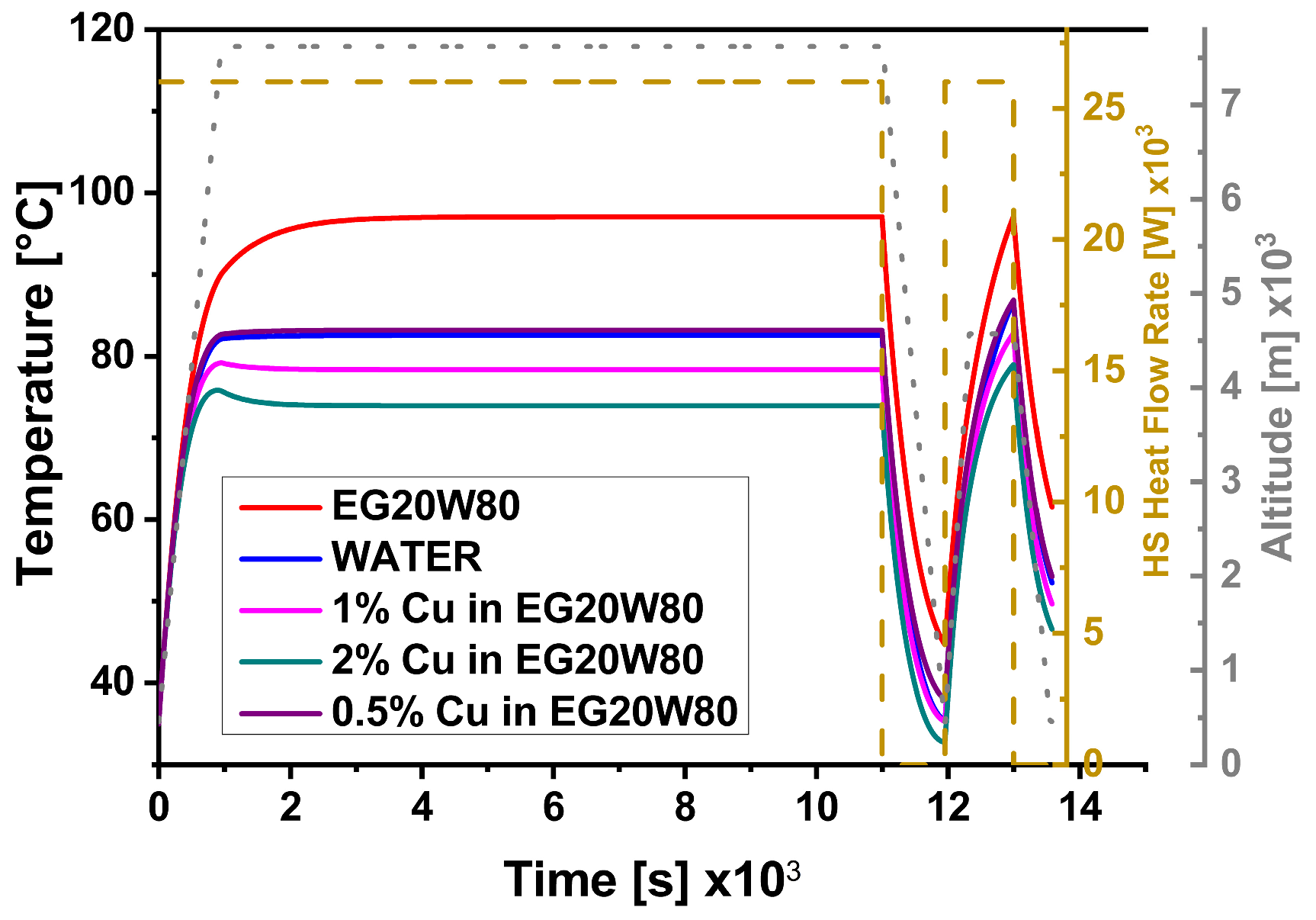
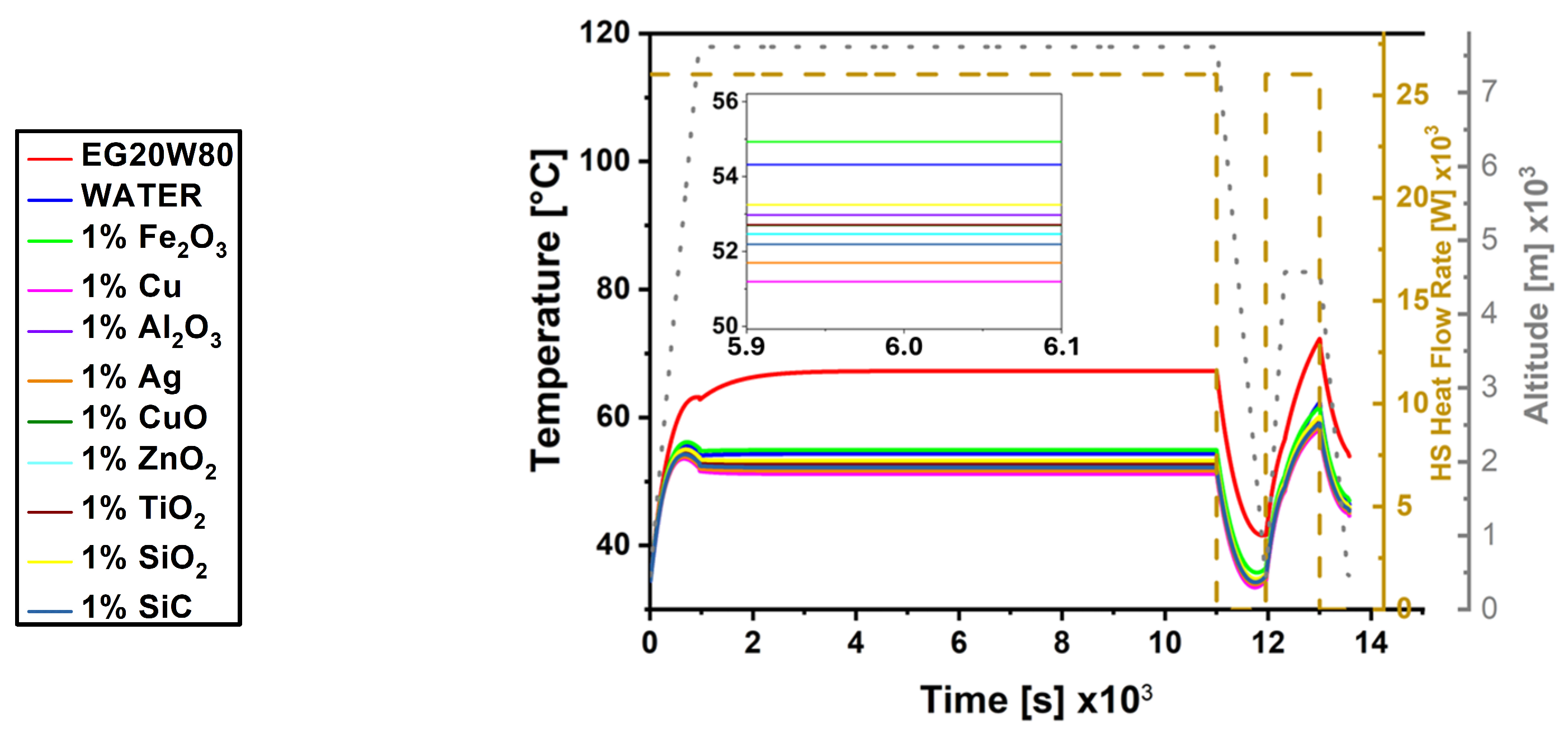
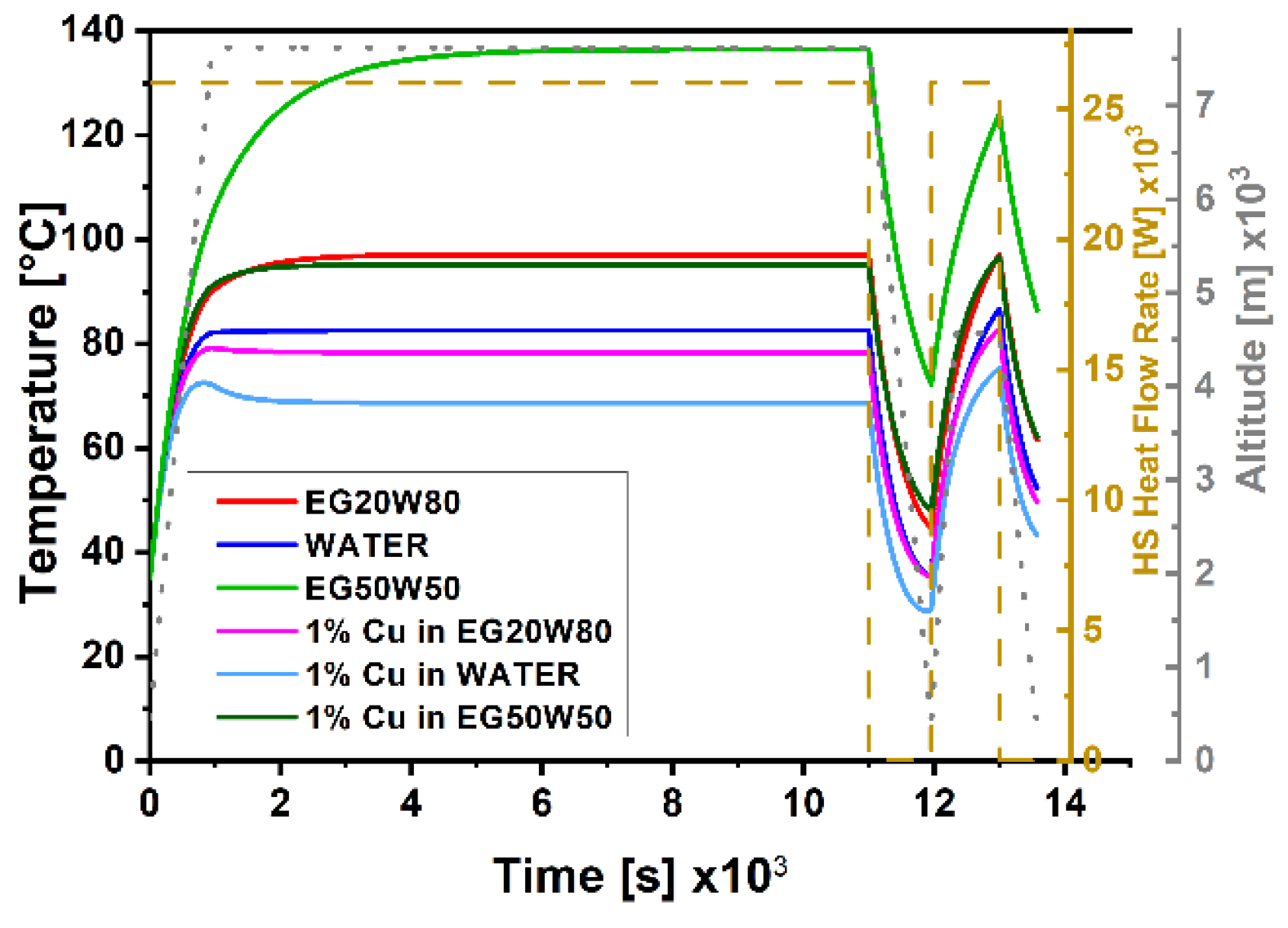
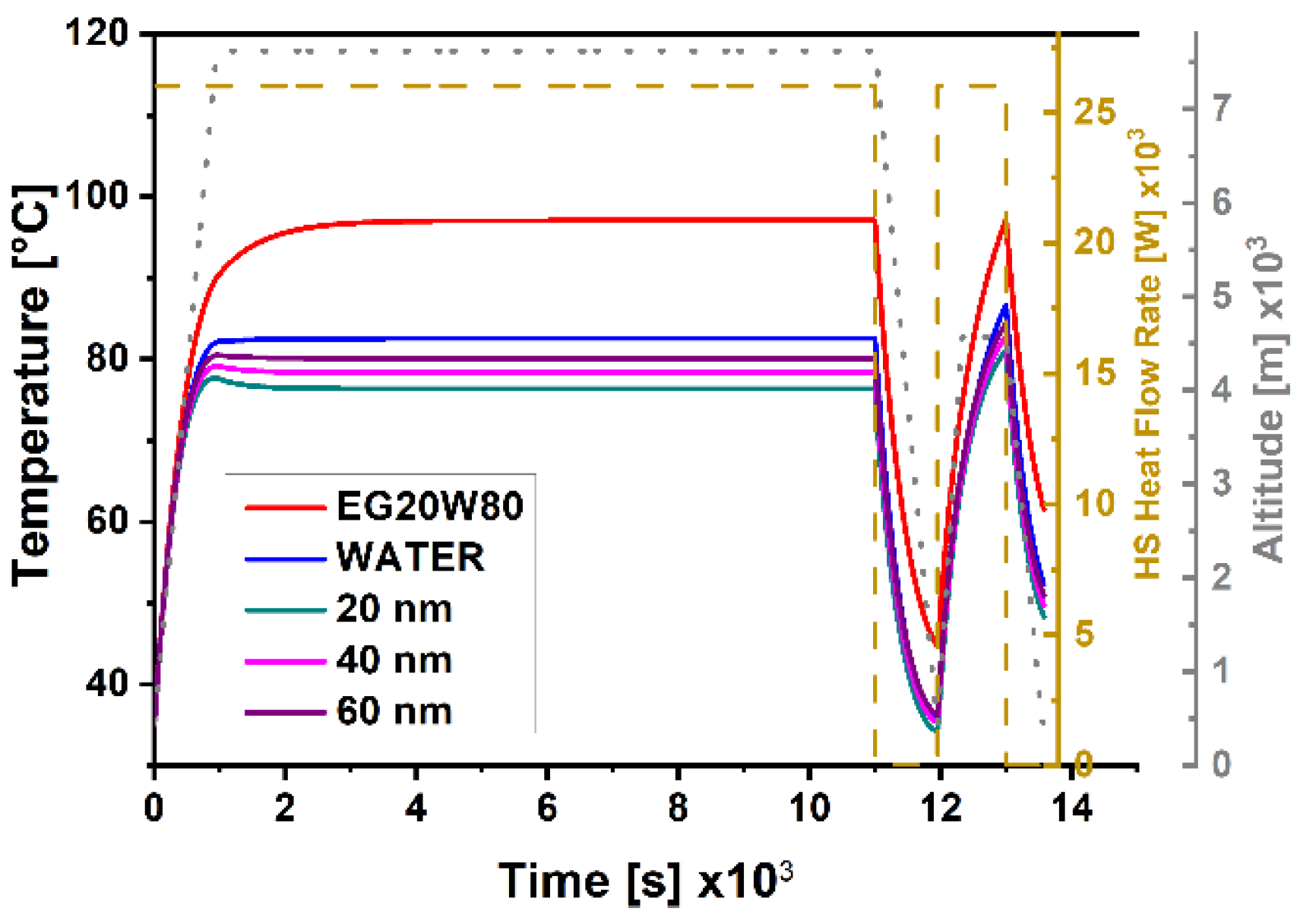
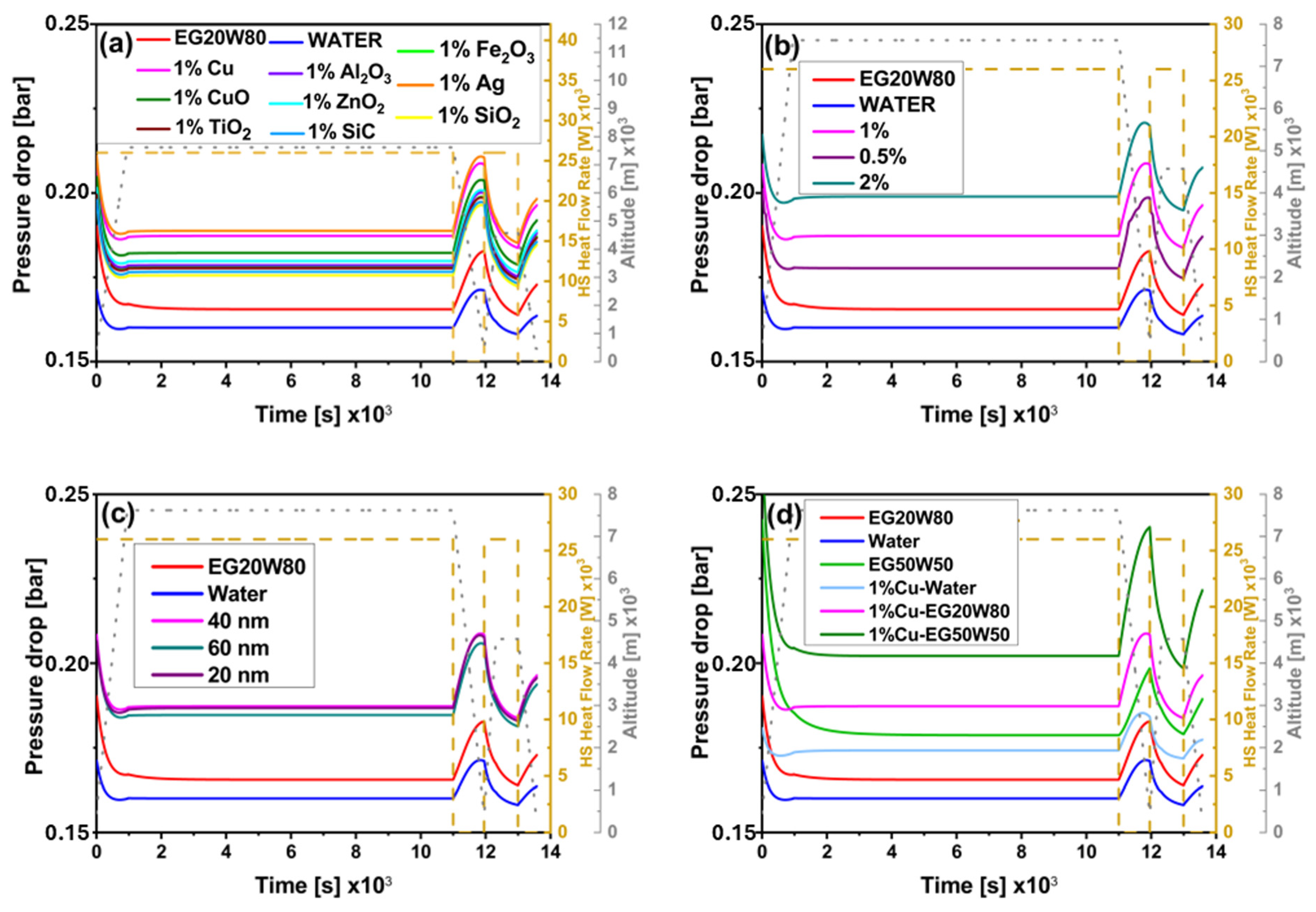
The simulation results are compared against two reference coolants (EG20W80 and pure water). In all figures, the dashed yellow curve shows the thermal power generated by the heat source, while the dotted grey line indicates mission altitude.
3. Results
The investigation of nanoparticle types aims to identify the most suitable one. The model assumes the same nanoparticle diameter (40 nm), the same base fluid (EG20W80), and the same volume fraction (1%).
Table 1 compares the benefits for the heat source mean temperature due to the adoption of different types of nanoparticles in the TMS test case.
Figure 1 shows a close-up representation comparing the heat exchanger coolant outlet temperature reached by each studied nanoparticle. The red line represents the EG20W80 case, without nanoparticles. The blue line, the pure water scenario, exhibits lower temperatures due to its superior thermal properties compared to the mixture. According to the literature [
7], metal nanoparticles perform better due to their thermal conductivity.
The green and magenta lines depict two nanofluids, namely the Fe2O3-EG20W80 nanofluid and Cu-EG20W80 nanofluid, representing the least and most favourable cases. Despite meeting the operating requirements, the application of nanofluids results in a significant improvement over the baseline model. The powertrain equipment temperature reaches a 14.8% reduction for the Fe2O3 nanoparticle and 19.3% for the Cu nanoparticle. The comparison across all nanoparticles allows for the identification of the best case, on which subsequent investigations will be focused.
Key Feature Sensitivity
This section assesses the impacts of the key features related to the study of nanofluids: volume fraction, base fluid comparison, nanoparticles’ size, and impact on pressure drop.
The volume fraction strongly affects nanofluid thermophysical and heat transfer properties, according to [
26,
27,
28]. However, increased viscosity and nanoparticle agglomeration at high concentrations can reduce efficiency.
Figure 2 shows the trends in the mean temperature of the heat source at three different concentrations of Cu-EG20W80 nanofluid. Increasing the volumetric fraction improves thermal exchange in the TMS, leading to a reduction in temperature of the heat source by 24%, compared to 19% and 14% for 2% for 1% and 0.5% volume fractions, respectively.
Various base fluids, such as water, ethylene glycol, propylene glycol, and oil-based fluids, have been explored in the state of the art [
1,
2,
7,
8,
9,
10,
11,
12,
13,
14,
15,
16,
17,
18,
19,
20,
21,
22,
23,
24]. Water-based nanofluids are widely studied due to their excellent heat transfer characteristics. However, the environmental incompatibility with flight scenarios makes it an unattractive choice for aircraft TMS. Ethylene glycol-based nanofluids offer improved stability and anti-corrosive properties, making them suitable for automotive and thermal management applications.
The dynamic simulation compares pure water-based nanofluids and 20:80% and 50:50% of ethylene glycol and water mixtures: EG20W80 and EG50W50, respectively. The heat source mean temperature, shown in
Figure 3 displays a reduction of 2% at EG50W50, 19% at EG20W80, and 29% for water-based nanofluids compared to the EG20W80 baseline without nanoparticles. Comparing the 1% Cu-EG50W50 with the nanofluid-free base fluid results in a reduction of 30%. Comparing the pure water with 1% Cu-water nanofluid reveals a 17% reduction.
The size of the nanoparticles directly influences their surface area-to-volume ratio, affecting their ability to absorb and dissipate heat. Smaller nanoparticles, having larger surface area-to-volume ratios, increase interaction with the host fluid and enhance Brownian motion [
29], resulting in better performance in cooling applications. As expressed by Equation (3), Brownian motion is mainly affected by four factors: temperature, particle size, particle number, and viscosity [
30,
31].
Figure 4 compares three dimensions with diameters of 20 nm, 40 nm, and 60 nm, assuming a spherical shape for all three analyses. It was found that using 20 nm diameter nanoparticles reduced the mean temperature by 2.5%, while 60 nm diameter nanoparticles increased it by 2.2%. When compared to the nanofluid-free coolant, EG20W80, the smaller 20 nm diameter nanoparticles resulted in a 21.3% reduction in heat source mean temperature, compared to the 17.5% reduction obtained by 60 nm nanoparticles. The results fit the literature review prediction.
Nanofluids generally increase pressure drop and pumping power due to the increase in viscosity with higher nanoparticle volume fractions [
10,
24]. While this effect is common in mono-nanofluids, hybrid nanofluids can enhance heat transfer while mitigating pressure drop by balancing individual nanoparticle effects [
16]. Studies in the literature [
10,
12,
18,
19] show conflicting findings regarding thermal and hydraulic performance.
Figure 5 depicts the impact of the analyzed key features on pumping power. The most promising conditions in terms of nanoparticle type (metallic) and volumetric fraction (higher values) result in an increased pressure drop. In contrast, variations in nanoparticle size do not lead to any significant change. As for the host fluid, water consistently proves to be the best option, as it causes the smallest increase in pressure drop.
4. Conclusions
This paper introduces a new type of fluid called nanofluids, consisting of nanoparticle suspensions with superior thermal properties compared to conventional base fluids. The primary benefits of nanofluid technology include lowering operating temperatures and minimizing the size of the cooling system.
This study focuses on nine widely used nanoparticles and their impact on cooling, a critical factor in maintaining the performance of aircraft equipment. They are introduced as a cooling medium in the Thermal Management System (TMS) of a hybrid-electric aircraft with a thermal heat of 26 kW to simulate the dynamic performance of the coolant.
The results indicate that nanofluids can reduce recorded temperatures with the same TMS design. Metal nanoparticles provide the largest thermal improvement, consistent with SoTA, due to their high thermal conductivity. In the best case, the heat source temperature is reduced by 19.3% compared to the baseline simulation without nanofluids. Each key feature of the nanofluid theory is evaluated, including particle type, volumetric fraction, coolant, particle size, and the effect on system pressure drop and pump power. Thermal conductivity increases with nanoparticle concentration, and smaller nanoparticles dissipate heat more effectively due to Brownian motion. Water-based nanofluids show the best cooling performance, although they are not suitable for aeronautical applications.
While experimental validation of the TMS model is beyond the scope of this study, the simulations are based on well-established physical principles and consistent with trends reported in the literature. Future research should include experimental studies to further validate the results and explore additional nanoparticles, while also considering environmental sustainability, human health impacts, and long-term stability, including sedimentation, agglomeration, and corrosion investigation.
Author Contributions
Conceptualization, S.C., M.F., and F.D.F.; methodology, S.C.; software, S.C.; formal analysis, S.C.; investigation, S.C.; resources, S.C. and F.D.F.; data curation, S.C.; writing—original draft preparation, S.C.; writing—review and editing, S.C., F.D.F., and G.A.; visualization, S.C. and G.A.; supervision, G.A. and M.F.; project administration, G.A. All authors have read and agreed to the published version of the manuscript.
Funding
This research received no external funding.
Institutional Review Board Statement
Not applicable.
Informed Consent Statement
Not applicable.
Data Availability Statement
The datasets presented in this article are not readily available due internal company policy. Requests to access the datasets should be directed to the corresponding author.
Conflicts of Interest
The authors declare that Sofia Caggese, Flavio Di Fede and Grazia Accardo are employees of Leonardo S.p.A. The company had no role in the design of the study; in the collection, analyses, or interpretation of data; in the writing of the manuscript; or in the decision to publish the results.
Abbreviations
The following abbreviations are used in this manuscript:
| EG20W80 | Ethylene Glycol and Water (20–80% ratio) |
| EG50W50 | Ethylene Glycol and Water (50–50% ratio) |
| HS | Heat Source |
| SoTA | State of The Art |
| TMS | Thermal Management System |
References
- Das, S.K.; Choi, S.U.S.; Yu, W.; Pradeep, T. Nanofluids, Science and Technology, 1st ed.; John Wiley & Sons, Inc.: Hoboken, NJ, USA, 2007. [Google Scholar]
- Wong, K.V.; De Leon, O. Applications of Nanofluids: Current and Future. Adv. Mech. Eng. 2010, 2. [Google Scholar] [CrossRef] [Scilit]
- Caggese, S.; Fioriti, M.; Di Fede, F. A parametric model for thermal management system for more electric and hybrid aircraft. Mater. Res. Proc. 2023, 37, 76–79. [Google Scholar] [CrossRef] [Scilit]
- Di Lorenzo, G.; Romano, D.G.; Carozza, A.; Pagano, A. Nanofluids as Coolants to Improve the Thermal Management System of a High-Power Aircraft Electric Motor. Electronics 2025, 14, 911. [Google Scholar] [CrossRef] [Scilit]
- Erdogan, B.; Günes, A.; Çakmak, G. Experimental Investigation of the Effect of Nanofluid Utilization on Heat Transfer Performance in Unmanned Aircraft Radiators with Various Spring-Type Fins. Nanomaterials 2025, 15, 489. [Google Scholar] [CrossRef] [Scilit]
- Peer, M.S.; Cascetta, M.; Migliari, L.; Petrollese, M. Nanofluids in Thermal Energy Storage Systems: A Comprehensive Review. Energies 2025, 18, 707. [Google Scholar] [CrossRef] [Scilit]
- Can, A.; Selimefendigil, F.; Oztop, H.F. A review on soft computing and nanofluid applications for battery thermal management. J. Energy Storage 2022, 53, 105214. [Google Scholar] [CrossRef] [Scilit]
- Mondal, B.; Lopez, C.F.; Mukherjee, P.P. Exploring the efficacy of nanofluids for lithium-ion battery thermal management. Int. J. Heat Mass Transf. 2017, 112, 779–794. [Google Scholar] [CrossRef] [Scilit]
- Lenin, R.; Joy, P.A.; Bera, C. A review of the recent progress on thermal conductivity of nanofluid. J. Mol. Liq. 2021, 338, 116929. [Google Scholar] [CrossRef] [Scilit]
- Pordanjani, A.H.; Aghakhani, S.; Afrand, M.; Mahmoudi, B.; Mahian, O.; Wongwises, S. An updated review on application of nanofluids in heat exchangers for saving energy. Energy Convers. Manag. 2019, 198, 111886. [Google Scholar] [CrossRef] [Scilit]
- Mahian, O.; Kolsi, L.; Amani, M.; Estellé, P.; Ahmadi, G.; Kleinstreuer, C.; Marshall, J.S.; Siavashi, M.; Taylor, R.A.; Niazmand, H.; et al. Recent advances in modeling and simulation of nanofluid flows—Part I: Fundamentals and theory. Phys. Rep. 2019, 790, 1–48. [Google Scholar] [CrossRef] [Scilit]
- Mahian, O.; Kianifar, A.; Kalogirou, A.S.; Pop, I.; Wongwises, S. A review of the applications of nanofluids in solar energy. Int. J. Heat Mass Transf. 2013, 57, 582–594. [Google Scholar] [CrossRef] [Scilit]
- Mahian, O.; Kianifar, A.; Kleinstreuer, C.; Al-Nimr, M.A.; Pop, I.; Sahin, A.Z.; Wongwises, S. A review of entropy generation in nanofluid flow. Int. J. Heat Mass Transf. 2013, 65, 514–532. [Google Scholar] [CrossRef] [Scilit]
- Shelare, S.D.; Aglawe, K.R.; Matey, M.S.; Shelke, K.S.; Sakhale, C.N. Preparation, applications, challenges and future prospects of nanofluid materials with a solar systems in the last decade. Mater. Today Proc. 2024, 100, 196–202. [Google Scholar] [CrossRef] [Scilit]
- Taha-Tijerina, J.J. Thermal Transport and Challenges on Nanofluids Performance. In Microfluidics and Nanofluidics; IntechOpen: London, UK, 2018; Chapter 9. [Google Scholar] [CrossRef] [Scilit]
- Maghrabie, H.M.; Elsaid, K.; Sayed, E.T.; Abdelkareem, M.A.; Wilberforce, T.; Ramadan, M.; Olabi, A.G. Intensification of heat exchanger performance utilizing nanofluids. Int. J. Thermofluids 2021, 10, 100071. [Google Scholar] [CrossRef] [Scilit]
- Kumar, V.; Tiwari, A.K.; Ghosh, S.K. Application of nanofluids in plate heat exchanger: A review. Energy Convers. Manag. 2015, 105, 1017–1036. [Google Scholar] [CrossRef] [Scilit]
- Islam, M.R.; Shabani, B.; Rosengarten, G.; Andrews, J. The potential of using nanofluids in PEM fuel cell cooling systems: A review. Renew. Sustain. Energy Rev. 2015, 48, 523–539. [Google Scholar] [CrossRef] [Scilit]
- Esfe, M.H.; Afrand, M. A review on fuel cell types and the application of nanofluid in their cooling. J. Therm. Anal. Calorim. 2020, 140, 1633–1654. [Google Scholar] [CrossRef] [Scilit]
- Pordanjani, A.H.; Aghakhani, S.; Afrand, M.; Sharifpur, M.; Meyer, J.P.; Xu, H.; Ali, H.M.; Karimi, N.; Cheraghian, G. Nanofluids: Physical phenomena, applications in thermal systems and the environment effects—A critical review. J. Clean. Prod. 2021, 320, 128573. [Google Scholar] [CrossRef] [Scilit]
- Wang, X.; Mujumdar, A.S. A review on nanofluids—Part II: Experiments and applications. Braz. J. Chem. Eng. 2008, 25, 631–648. [Google Scholar] [CrossRef] [Scilit]
- Rafati, M.; Hamidi, A.A.; Shariati Niaser, M. Application of nanofluids in computer cooling systems (heat transfer performance of nanofluids). Appl. Therm. Eng. 2012, 45–46, 9–14. [Google Scholar] [CrossRef] [Scilit]
- Xian, H.W.; Sidik, N.A.C.; Najafi, G. Recent state of nanofluid in automobile cooling systems. J. Therm. Anal. Calorim. 2019, 135, 981–1008. [Google Scholar] [CrossRef] [Scilit]
- Jiang, W.; Song, J.; Jia, T.; Yang, L.; Li, S.; Li, Y.; Du, K. A comprehensive review on the pre-research of nanofluids in absorption refrigeration systems. Energy Rep. 2022, 8, 3437–3464. [Google Scholar] [CrossRef] [Scilit]
- Caggese, S.; Di Fede, F.; Fioriti, M. Dynamic Model of a Thermal Management System for Hybrid-Electric Aircraft Propulsion Using Different Coolants. In Proceedings of the AIAA Aviation Forum and Ascend, Las Vegas, NV, USA, 29 July–2 August 2024. [Google Scholar] [CrossRef] [Scilit]
- Sallal, A.S.; Smaisim, G.F.; Thahab, S.M. The heat transfer from fined perforated pipe improved due to nano-fluid. J. Phys. Conf. Ser. 2021, 1973, 012075. [Google Scholar] [CrossRef] [Scilit]
- Taghizadeh, A.; Taghizadeh, M.; Azimi, M.; Alsagri, A.S.; Alrobaian, A.A.; Afrand, M. Influence of cerium oxide nanoparticles on thermal conductivity of antifreeze. J. Therm. Anal. Calorim. 2020, 139, 225–236. [Google Scholar] [CrossRef] [Scilit]
- Hussein, A.M.; Sharma, K.V.; Bakar, R.A.; Kadirgama, K. The Effect of Nanofluid Volume Concentration on Heat Transfer and Friction Factor inside a Horizontal Tube. J. Nanomater. 2013, 2013, 859563. [Google Scholar] [CrossRef] [Scilit]
- Available online: https://www.atascientific.com.au/brownian-motion/ (accessed on 3 February 2025).
- Alktranee, M.; Bencs, P. Factors affecting nanofluids behaviour: A review. Int. Rev. Appl. Sci. Eng. 2023, 14, 241–255. [Google Scholar] [CrossRef] [Scilit]
- Azizian, M.R.; Aybar, H.S.; Okutucu Özyurt, H.T. Effect of nanoconvection due to Brownian motion on thermal conductivity of nanofluids. In Proceedings of the WSEAS International Conference on Heat Transfer, Thermal Engineering and Environment (HTE ’09), Moscow, Russia, 20–22 August 2009. [Google Scholar]
| Disclaimer/Publisher’s Note: The statements, opinions and data contained in all publications are solely those of the individual author(s) and contributor(s) and not of MDPI and/or the editor(s). MDPI and/or the editor(s) disclaim responsibility for any injury to people or property resulting from any ideas, methods, instructions or products referred to in the content. |