1. Introduction
Collaborative Research Centres (CRCs) are funded by the German Research Foundation (Deutsche Forschungsgemeinschaft, DFG). They are research institutions in which researchers from several German universities work together within a multidisciplinary research programme. They are characterized by a large number of projects which are required to succeed in innovative, challenging, complex and long-term research undertakings. The individual projects are either led by one researcher or collaboratively by several researchers from the participating research institutions. An Integrated Research Training Programme (IRTG) may be be part of the CRC’s supporting projects. It offers a structured training programme to support the doctoral researchers in their research activities but also to make an engagement in the CRC attractive to young researchers. Key aims are to promote the doctoral researchers’ academic independence and to enable them to gain further qualifications.
The main research question of the CRC SFB-TRR 364 SynTrac - Synergies of Highly Integrated Transport Aircraft [
1] is as follows:
Which means of interaction and integration of physical models as well as experimental and numerical methods beyond the current state of the art are successful in realizing the synergies and potentials of highly integrated transport aircraft, and how large are these potentials?
The CRC mimics the envisaged future framework conditions under which work will take place in the aerospace industry. According to [
2], work in industrial capitalist societies is charactarized, amongst other factors, by a high degree of division of labour, work as a virtue, maximum reward and a separation of work from other institutions. Yet, the way we work and the labour market are in a state of constant flux. Digitization and the continuous development and improvement of numerical and experimental methods have decreased the proportion of routine tasks [
3]. The level of division of labour is reduced in favour of specialists with a broader range of skills [
3]. Typically, teams are distributed across several locations. Increasingly digitized, globalized, and automized working environments meet changing lifestyles in society that are not necessarily solely driven by economic needs. Flexible working hours with fluid transitions between work and private life are accepted if they offer significant personal benefits in terms of life satisfaction [
4]. The CRC SynTrac acts in the context of these changes. In contrast to an industrial environment, the motivation and cohesion of the team of doctoral researchers originate from an interdisciplinary and high-level research question rather than from an appealing product in a global market. In the CRC SynTrac, work is distributed across several locations which are the Technical University of Braunschweig, the University of Stuttgart, Leibniz University Hannover and the German Aerospace Centre (DLR).
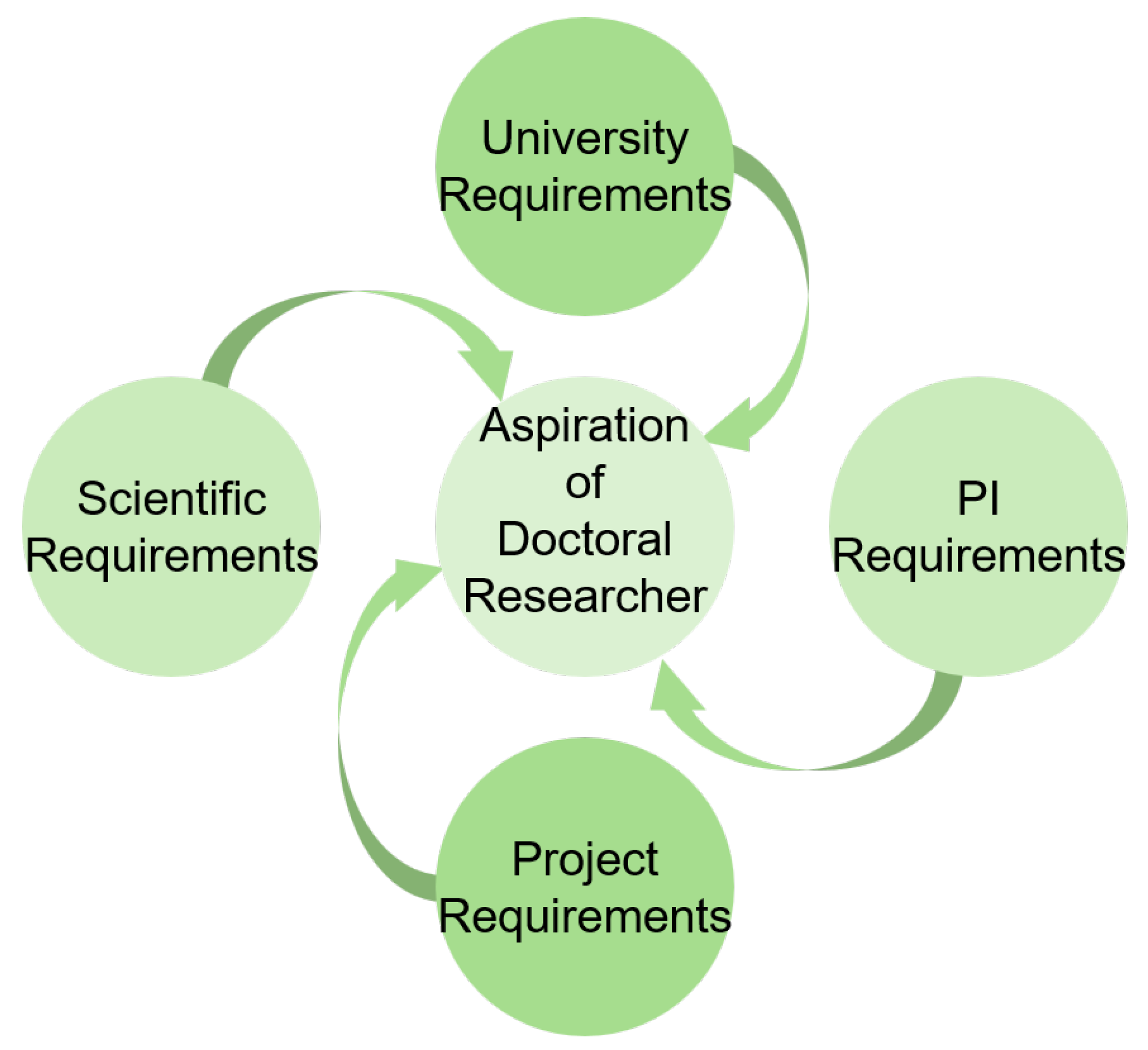
The integrated research training group of the CRC SynTrac has been designed in this context. It supports the research environment of the doctoral researchers and reflects the five forces affecting their research activities and their ability to achieve their objectives. These are shown in
Figure 1.
The project requirements are defined in the project proposal, e.g., in the form of milestones to be achieved, interfaces to be shared, joint publications to be realized and outreach activities to be supported. The scientific requirements result from the research aspiration to extend the current state of the art in numerical methods and experiments, to carry out original research and to understand complex interactions and synergies across disciplines. The university requirements result from the standards and quality regulations defined by the participating research institutions. The principal investigators (PIs) involved in SynTrac have a proven track record in supporting doctoral students. They represent a particular field in engineering sciences with well-established paradigms. They have a direct and personal relationship to the doctoral researchers. They interact with the doctoral researchers on a day-to-day basis. They are also role models. Hence, they are regarded a key influencing force for the doctoral researchers. Yet, the most powerful source is the individual aspiration of the doctoral researchers.
The doctoral researchers are highly talented, young academics who demonstrated excellent performance during their studies. Choosing doctoral studies as part of their careers must be seen as one alternative amongst a number of career opportunities about which they had to make a choice [
5]. They are focused and target-oriented. They want to succeed in this phase of their career, and hence in their challenging research. They are digital natives. The diversity of their individual needs has to be reflected.
With this target group in mind, the thoughts underlying the thinking paradigms of New Work serve as an inspiration for the design of the integrated research training group [
6]. In accordance with [
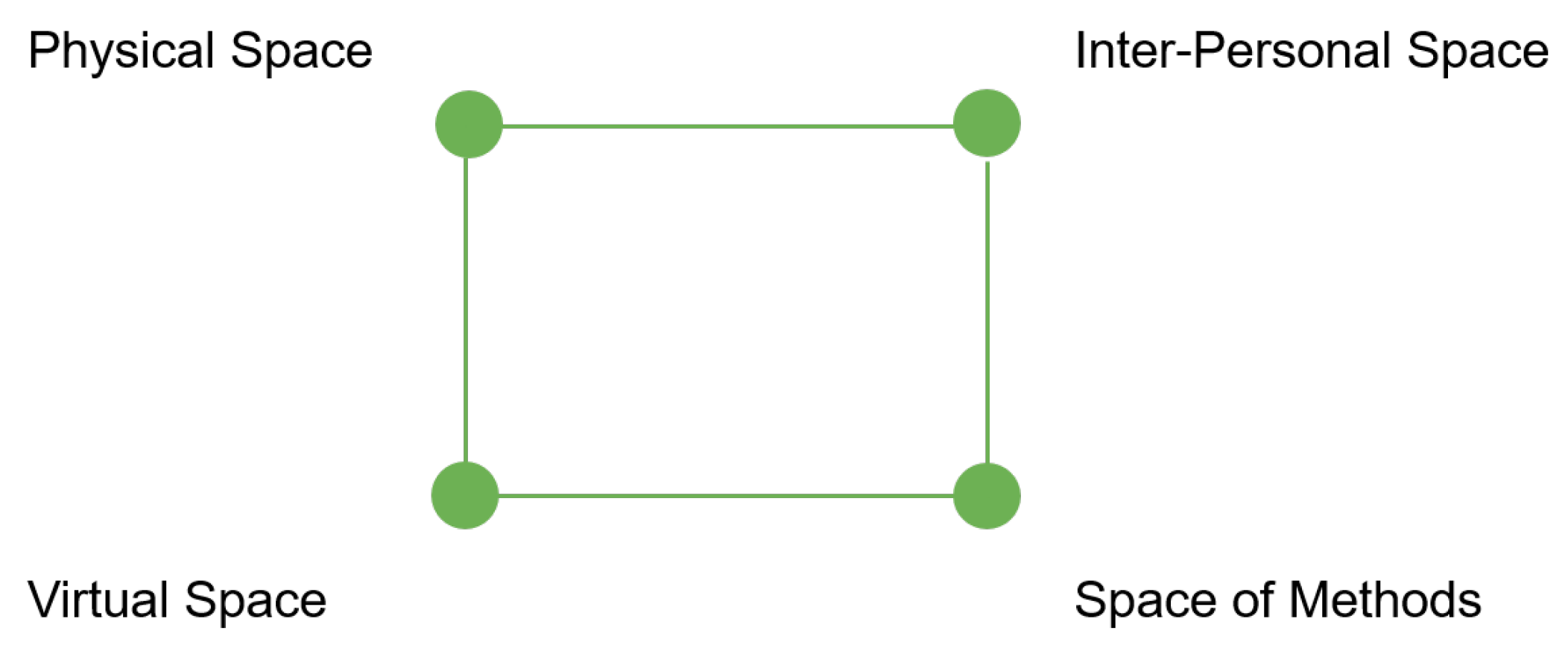
7], we define New Work as a concept of the work-space in which people perform the activities they ‘really, really’ want to do. It comprises four realizations which are shown in
Figure 2.
On this basis, we the designed the physical, inter-personal and virtual work-space and the methods. Their definitions are given in the following chapter.
2. Materials and Methods
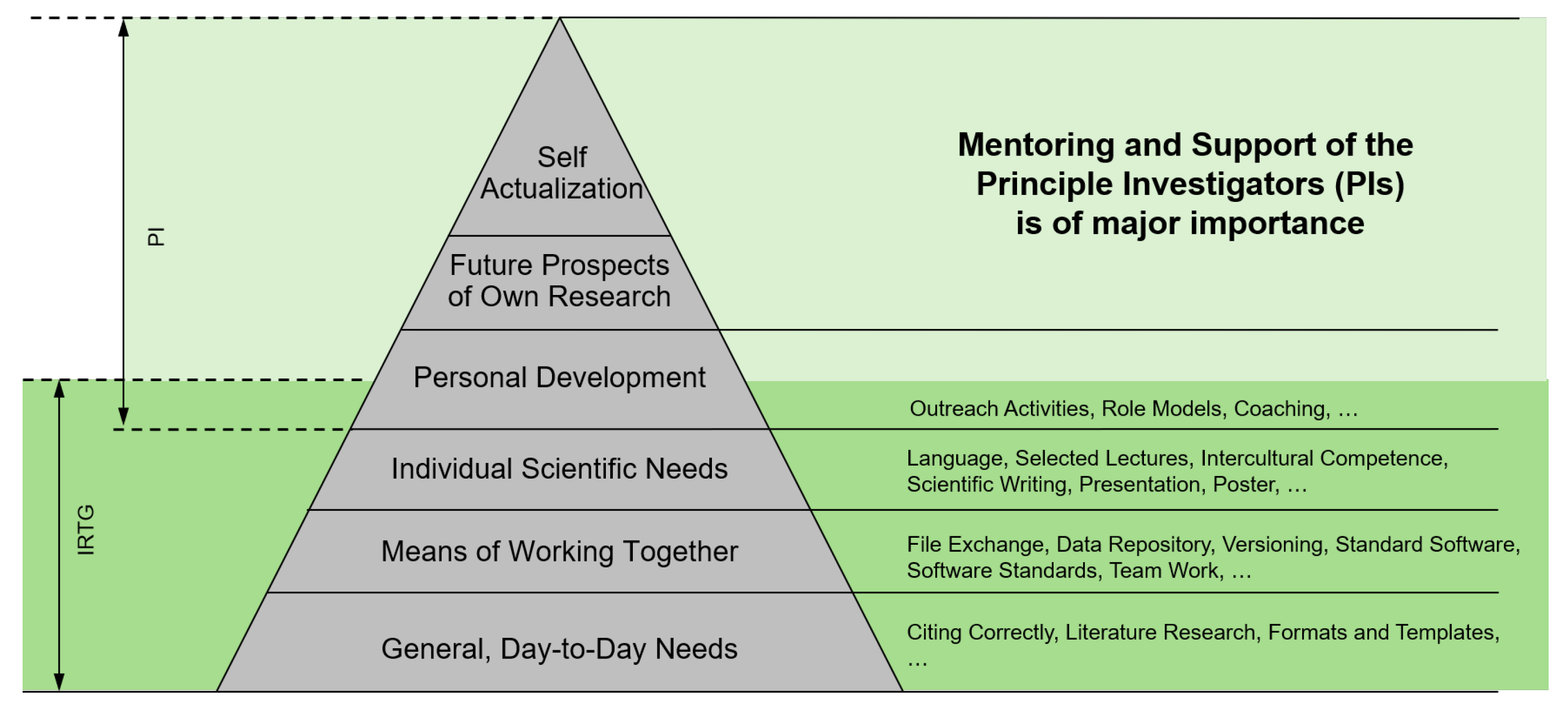
The physical space in which the doctoral researchers and the principle investigators (PIs) do their research work embraces the work-places whether remote or not. The virtual space plays an important role in the work of digital natives. This is exaggerated by the particular setting with four participating research institutions, although located in Germany with a significant geographical distance from each other. The virtual space embraces Hardware, software and digital means of communication. The space of methods covers so-called how-tos, e.g., literature research, citing, and scientific writing. The inter-personal space includes role models, coaching, mentoring and consulting. It is characterized by the diversity of individual needs of the doctoral researchers. In doing so, the integrated research training group serves the pyramid of support-needs of the doctoral researchers shown in
Figure 3.
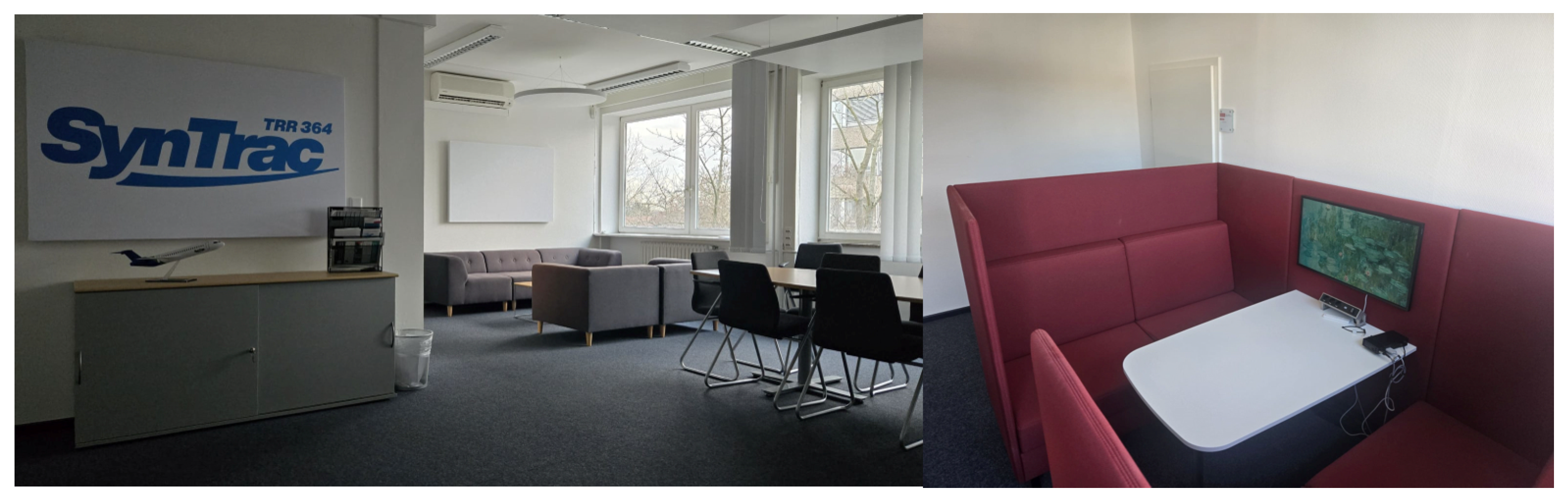
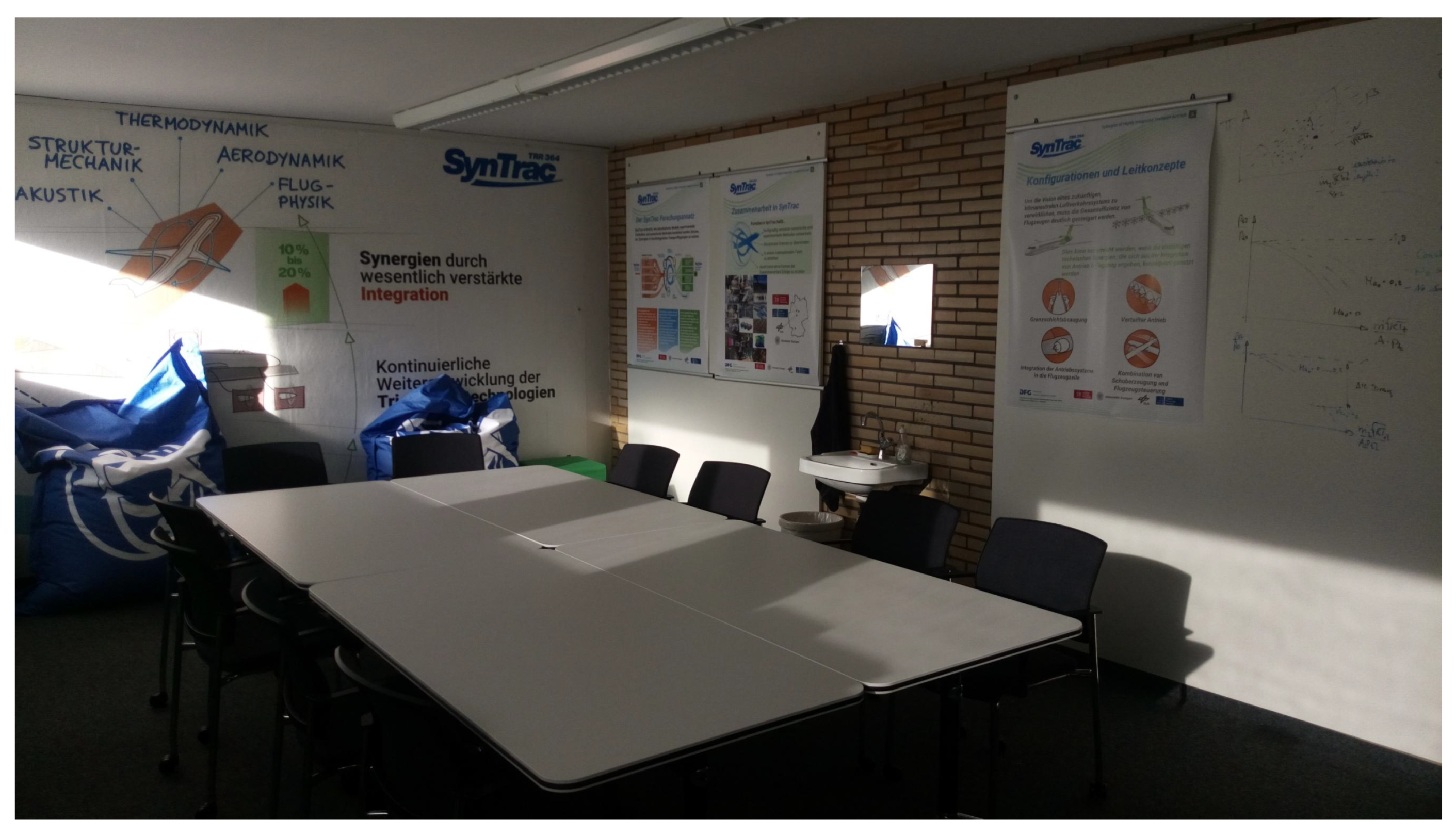
The space of methods, the physical space and the virtual space serve the general, day-to-day needs, the means of working together and part of the individual scientific needs. The inter-personal space is important for needs such as personal development, future prospects of own research and self-actualization. The basic delivery as well as the consistency of the offering of the integrated research training group is covered in person or virtually by so-called by-weekly meetings. The required personalized support and the training on soft factors and soft skills is covered by interaction in person, work-shops, and away-days as well as by the offering of so-called co-working spaces such as the team rooms. An example design of a SynTrac team room is shown in
Figure 4.
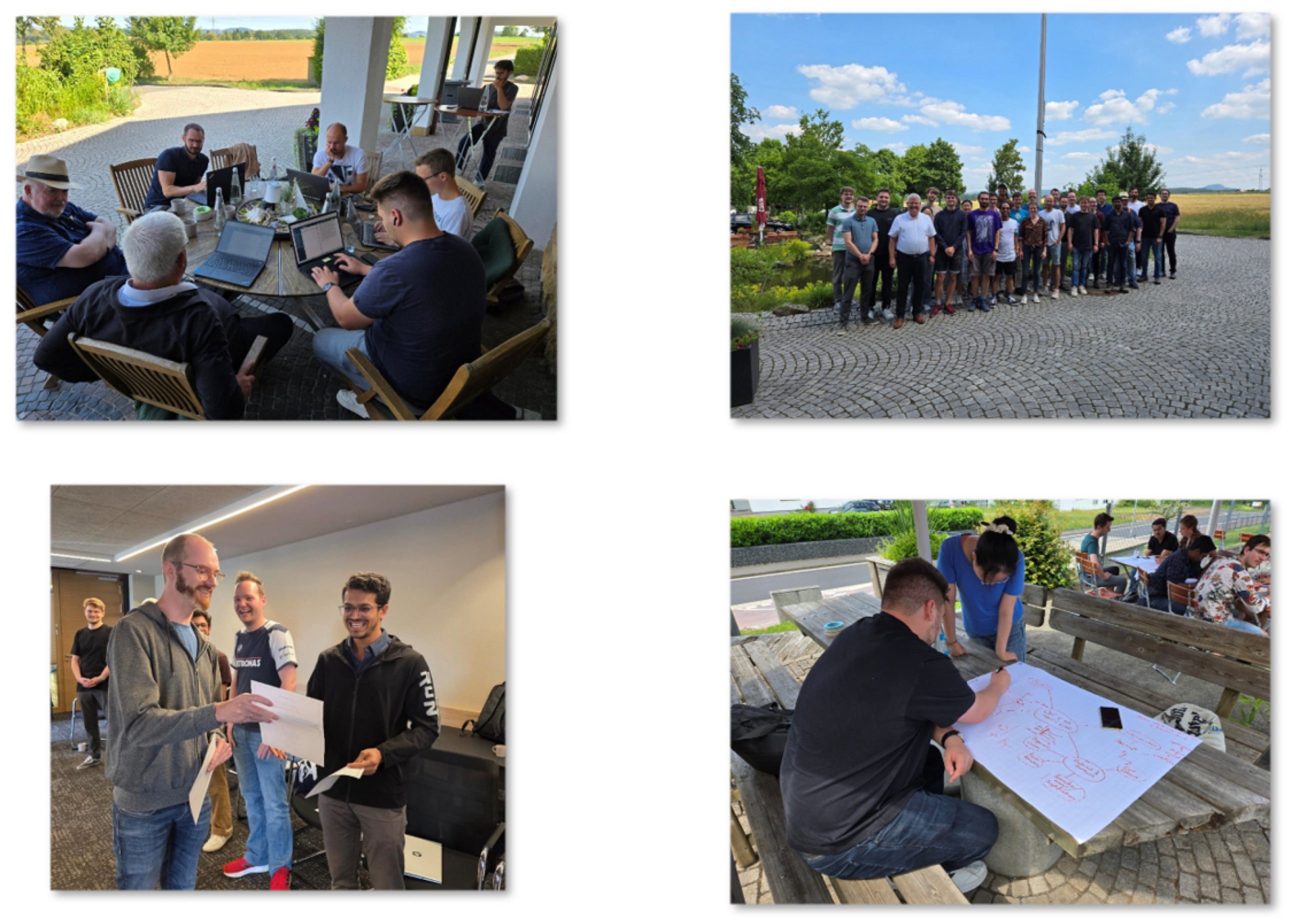
One wall has been covered with a graph showing the main idea and the promise of the CRC SynTrac. Parts of a second wall allow writing on them and also the erasure of the written content such that they serve as a large white board. Not shown is the interactive means of digital communication and information sharing which builds on state-of-the-art media technology. Seating sacks and seating cubes form a space which invites one to spend time and to reflect. The intent of this design is to improve inter-personal communication by providing a room which invites people to become creative. The way to create such a physical space is not pre-defined nor is there a best practice. The solutions shown in
Figure 5 serve the above purposes equally well but have different physical appearances.
Outstanding role models have a huge impact on the motivation of the principle investigators and the doctoral researchers. Exchange with world-wide experts not only transfers their knowledge and their esteem but also underpins the attractiveness of their own research. A yearly winter school organized by the doctoral researchers gives room to meet such role models.
The space of methods facilitates the transfer of basic skills such as professional scientific citing or sustainable software development. Carried out in work-shops, it allows the fostering of team spirit and the mutual understanding of the doctoral researchers. Team events and research training camps have been integrated into the programme to reflect this aspect. The courses on scientific writing are shown in an example below in
Figure 6.
It has to be pointed out that the target orientation of the doctoral researchers and their will to be successful in their individual research activity place high expectations on such events since—at first sight—they take away time and capacity to carry out their own research activity. Careful planning, discussion with the team and a clear value proposition of the events have been proven to be reliable success factors.
3. Results and Discussion
The CRC SynTrac trains a new generation of aeronautical engineers, who are being specially prepared to work in a future development environment of highly integrated transport aircraft with interlinked numerical and experimental methods and dissolved traditional hierarchies and priorities. The integrated research training group (IRTG) is designed to support the young doctoral researchers to become scientifically independent and to be successful in their own research aspirations. Its design, which is based on creating a work-space for those highly talented researchers for the work they “really, really” want to do, has been proven to be successful.
The provided virtual space proved effective in providing networking opportunities that make hierarchies superfluous and create more efficient, horizontal working structures. We found virtual formats to be highly effective in transferring factual/required information. It is worth investing in the development of the virtual space since the doctoral researchers are digital natives. Hence, they use the physical space selectively and with a clear idea about the associated value added. Yet, immersion is a challenge in all virtual formats transferring more than factual information. In our experience, the physical space still outdoes the virtual space in this aspect.
Meeting in person plays an important role in creating an inter-personal space. Hence, creating this space with a clear conception complements today’s established ways of virtual interaction. Role models that you can touch and feel as individuals exemplify this importance. They are key to motivation of the principle investigators and doctoral researchers.
With intercultural teams being a normality in the CRC, we found that intercultural trainings are of utter importance. Experience shows that it is a challenge to design trainings which cover the diverse perspectives of an intercultural team in one training. Again, careful planning, discussion with the team and a clear outline of such trainings have proven successful.
4. Discussion
Whilst being concise, the presented experience with an integrated research training group based on the New Work principle demonstrates how important it is to understand the target group of its offering. There is research on today’s young, talented researchers which allows us to tailor the offerings to their needs. We found it worth researching this information and designing the offerings on this basis.
Yet, we recommend working collaboratively and continuously exchanging with the young, talented doctoral researchers to continuously adjust the offerings at every part of the joint journey.
Author Contributions
Conceptualization, T.R. and S.S.; methodology, T.R. and S.S.; writing—original draft preparation, S.S.; writing—review and editing, T.R. and S.S.; visualization, T.R. and S.S.; supervision, T.R. and S.S.; project administration, T.R. and S.S. All authors have read and agreed to the published version of the manuscript.
Funding
This research is part of the CRC SynTrac. The Collaborative Research Centre (CRC) SynTrac is founded by the Deutsche Forschungsgemeinshaft (DFG, German Research Foundation)-Project ID 498601949-TRR 364.
Institutional Review Board Statement
Not applicable.
Informed Consent Statement
Not applicable.
Data Availability Statement
Data are available in this manuscript.
Acknowledgments
The present work has been achieved as part of the Collaborative Research Centre SynTrac. The authors thank the Deutsche Forschungsgemeinshaft (DFG, German Research Foundation). The Collaborative Research Centre (CRC) SynTrac is founded by the Deutsche Forschungsgemeinshaft (DFG, German Research Foundation)-Project ID 498601949-TRR 364.
Conflicts of Interest
The authors declare no conflicts of interest.
Abbreviations
The following abbreviations are used in this manuscript:
| CRC | Collaborative Research Centre |
| DFG | Deutsche Forschungsgemeinschaft |
| IRTG | Integrated Research Training Group |
| PI | Principal Investigator |
References
- Anon. Available online: https://www.trr-syntrac.com/ (accessed on 19 May 2026).
- Edgell, S. The Sociology of Work-Continuity and Change in Paid and Unpaid Work; SAGE: Thousand Oaks, CA, USA, 2012; ISBN 978-1-84920-412-5. [Google Scholar]
- Teichert, M.A.; Pospisil, R.; Brugger, D.P.; Loedige, M. Future of Work—New Work as a Saviour? Int. J. Organ. Leadersh. 2023, 12, 442–467. [Google Scholar] [CrossRef] [Scilit]
- Zinte, H.; Zimmermann, K.F. Zeitenwende auf dem Arbeitsmarkt-Wie der Demographische Wandel Die Erwerbsgesellschaft Aendert; Bundeszentrale für politische Bildung: Bonn, Germany, 2013; ISBN 978-3-8389-0292-0.
- McCulloch, A.; Guerin, C.; Jayatilaka, A.; Calder, P. Choosing to study for a PhD: A framework for examining decisions to become a research student. High. Educ. Rev. 2017, 49, 85–106. [Google Scholar]
- Bergmann, F. Neue Arbeit (New Work)–Das Konzept und seine Umsetzung in der Praxis. Jahrb. Arb. Und Tech. 1990, 71–80. [Google Scholar]
- Krings, B.J. New Work und die Zukunft der Arbeit. Aus Polit. Und Zeitgesch. Das Parlam. 2023, 73, 4. [Google Scholar]
| Disclaimer/Publisher’s Note: The statements, opinions and data contained in all publications are solely those of the individual author(s) and contributor(s) and not of MDPI and/or the editor(s). MDPI and/or the editor(s) disclaim responsibility for any injury to people or property resulting from any ideas, methods, instructions or products referred to in the content. |