Proceeding Paper

Experimental Investigation of Pressure Reducing Valves Under Transient Conditions: A Laboratory Study †

1
Department of Civil and Environmental Engineering, University of Perugia, 06125 Perugia, Italy
2
Department of Civil and Mineral Engineering, Toronto, ON M5S 1A4, Canada
*
Author to whom correspondence should be addressed.
Presented at II International Conference on Challenges and Perspectives in Urban Water Management Systems (CSDU-CSSI DAYS 25), Trieste, Italy, 18–19 November 2025.
Eng. Proc. 2026, 135(1), 30; https://doi.org/10.3390/engproc2026135030

Published: 23 May 2026

Abstract

Pressure-reducing valves (PRVs) play a key role in water distribution networks (WDNs), where they are employed to regulate pressure levels and mitigate leakage. The present work describes an experimental study designed to investigate the transient response of a PRV installed at the inlet of a laboratory-scale district metered area (DMA). The closure of a downstream valve along a service line reproduces a typical end-user action and generates a pressure surge propagating through the system. Two distinct operating scenarios were examined, and the analysis of the measured pressure signals offers a basis for discussing the effect of hydraulic transients on the network.

1. Introduction

Pressure management is widely recognized as one of the most cost-effective approaches for mitigating real water losses in distribution networks, with pressure-reducing valves (PRVs) representing essential components of this strategy [1,2,3,4,5]. When installed at the inlets of district metered areas (DMAs), PRVs regulate downstream pressure to a prescribed setpoint, regardless of upstream fluctuations—those, for example, induced by pump operations [6]—and variations in flow rate. While their steady-state hydraulic performance has been extensively documented, the transient response of PRVs remains an open research challenge. At the same time, user-driven maneuvers have been recognized as a significant source of pressure transients in distribution networks [7,8]. Laboratory investigations have highlighted that inappropriate valve sizing or operation under very low-flow conditions may induce self-excited oscillations and amplify water-hammer phenomena [9], a risk subsequently confirmed in field applications [10]. More recent studies have further advanced this understanding: in [11], unstable dynamics of piston-actuated PRVs at extremely low discharges are reported, whereas field-scale measurements by [12] demonstrated that PRVs may behave similarly to a dead end, reflecting pressure waves and interacting non-trivially with pipe-wall viscoelasticity.
In this context, the present work reports on a laboratory-scale experimental campaign specifically designed to investigate the dynamic response of a PRV under controlled hydraulic conditions.

2. Laboratory Setup and Tests

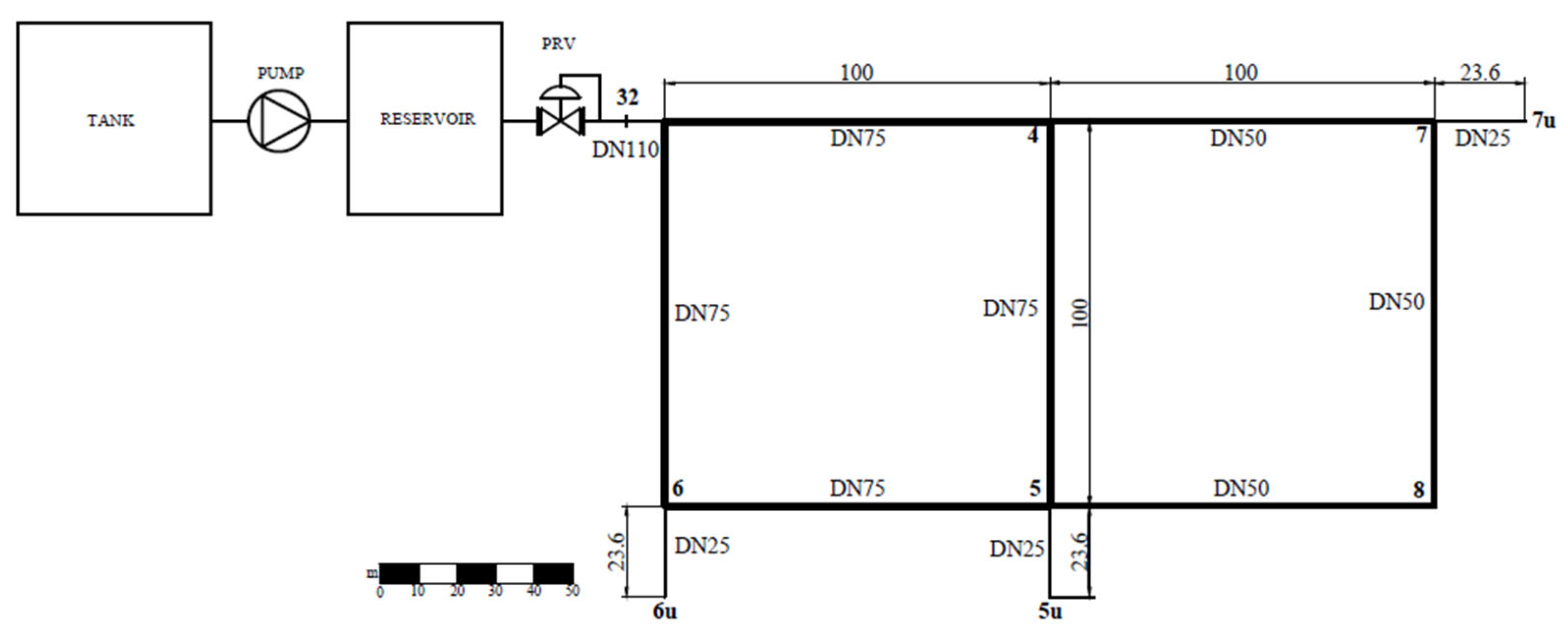
The experimental facility (Figure 1) consists of a laboratory-scale water distribution network (WDN) entirely constructed from high-density polyethylene (HDPE) pipes and supplied by a constant-head reservoir. The main supply line is a DN110 pipe, 43.17 m in length, with an internal diameter D = 93.3 mm and a wall thickness e = 8.1 mm, which connects to a two-loop network. The first loop comprises four DN75 pipes, each 100 m long (D = 63.8 mm, e = 5.6 mm), whereas the second loop shares one link with the first and consists of three DN50 pipes, also 100 m in length (D = 42.6 mm, e = 3.7 mm).
A DN25 service line (SL), 23.60 m in length (D = 20 mm, e = 3 mm), is connected to nodes 5, 6, and 7. Each SL branch terminates with a ball valve, used to simulate end-user withdrawals at demand points 5u, 6u, and 7u. A DN80 pilot-operated pressure-reducing valve (PRV) is installed along the main supply line to regulate downstream pressure.
The WDN is equipped with pressure transducers placed at multiple key locations to record pressure fluctuations during transient events, with a sampling frequency of 2048 Hz. System demand is continuously monitored by means of an electromagnetic flowmeter installed on the DN110 main line.
The analysis presented in this work focuses on the pressure transients generated by valve closures at end-users and on their effects on the pressure signal measured at section 32, located immediately downstream of the PRV. Two operating scenarios were defined to study the influence of the PRV’s control mode. In scenario #1 (non-regulating condition), the network was supplied by a pump delivering a head of 2 bar, resulting in an initial steady-state discharge of approximately Q0 = 0.21 L/s. In this configuration, the PRV was kept fully open, thus behaving as a pass-through device. In scenario #2 (regulating condition), the system was instead fed by a pump operating at 5 bar, while the PRV was adjusted to regulate the downstream pressure to the same steady-state value observed at section 32 during scenario #1.

3. Results

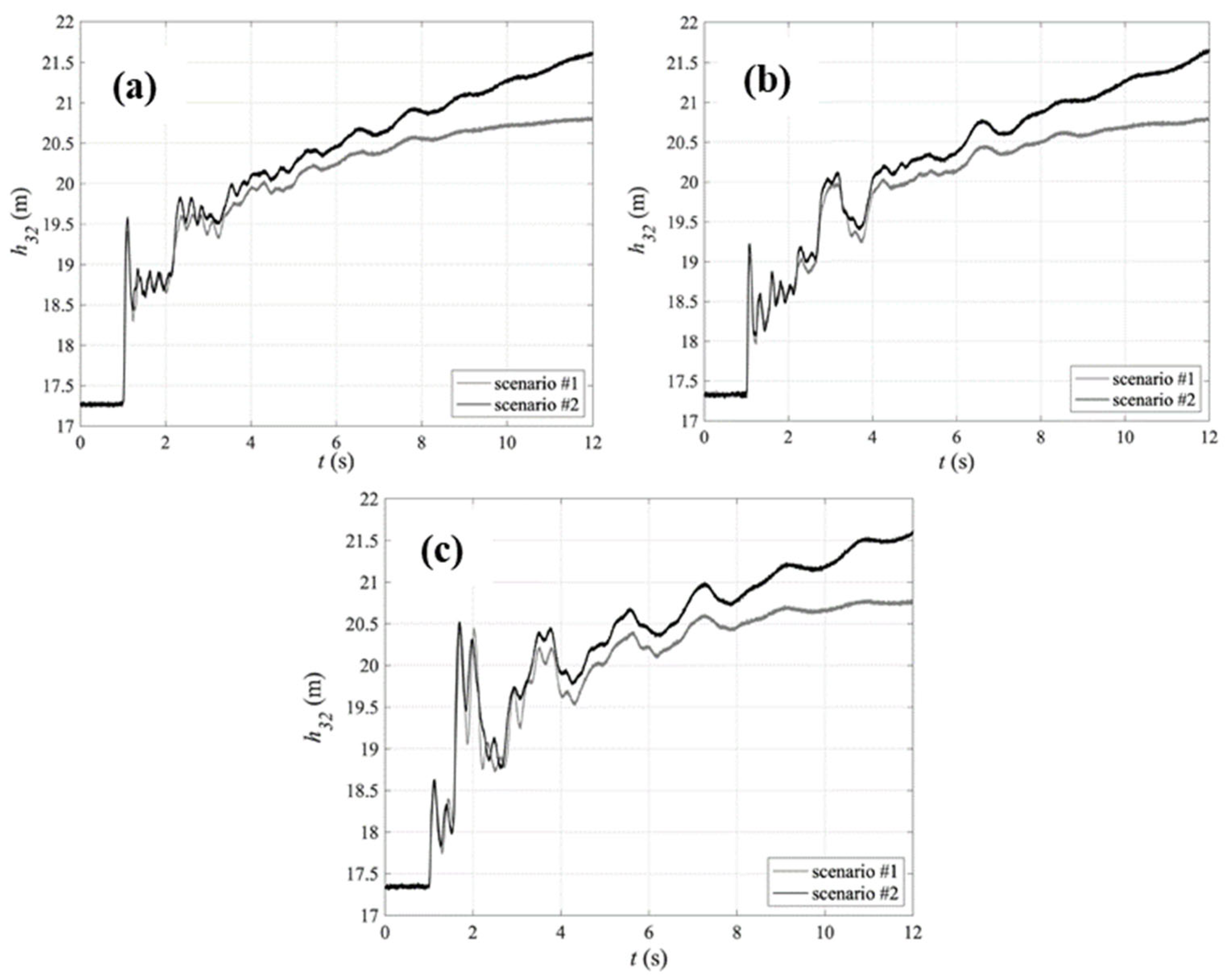
Figure 2a–c shows the pressure signals recorded at section 32 during transients induced by the rapid closure of the end-user valves 5u, 6u, and 7u, respectively. For each case, the responses obtained under both operating scenarios are reported. A comparison of the two scenarios reveals that, irrespective of the end-user performing the closure, the first overpressure peak is essentially coincident. This observation confirms that the steady-state pressure at node 32 and the initial discharge Q0 were identical in both configurations. However, following the initial pressure variations, the signals begin to diverge. In particular, under scenario #2, the pressure consistently rises above the corresponding trace of scenario #1, exceeding the setpoint imposed on the PRV when operating in regulating mode.

4. Conclusions

This study has presented preliminary results from laboratory tests conducted at the Water Engineering Laboratory of the University of Perugia. The experiments focused on user-induced transients in a complex water distribution network equipped with a pressure-reducing valve (PRV). Two operating scenarios were examined: in the first, the PRV was fully open and operating in a non-regulating mode, whereas in the second, it was set to regulate the downstream pressure.
The comparison between these two scenarios, based on pressure measurements taken immediately downstream of the PRV, highlights a critical aspect of its behavior. Specifically, when an end-user valve closure occurs, the downstream pressure in the regulating scenario tends to rise above the imposed setpoint, revealing limitations in the valve’s ability to maintain effective control under transient conditions.

Author Contributions

Conceptualization, C.C., D.F., B.K., B.B. and S.M.; methodology, C.C., D.F., B.K., B.B. and S.M.; software, C.C., D.F., B.K., B.B. and S.M.; validation, C.C., D.F., B.K., B.B. and S.M.; formal analysis, C.C., D.F., B.K., B.B. and S.M.; investigation, C.C., D.F., B.K., B.B. and S.M.; resources, C.C., D.F., B.K., B.B. and S.M.; data curation, C.C., D.F., B.K., B.B. and S.M.; writing—original draft preparation, C.C., D.F., B.K., B.B. and S.M.; writing—review and editing, C.C., D.F., B.K., B.B. and S.M.; visualization, C.C., D.F., B.K., B.B. and S.M.; supervision, C.C., D.F., B.K., B.B. and S.M.; project administration, C.C., D.F., B.K., B.B. and S.M.; funding acquisition, C.C., D.F., B.K., B.B. and S.M. All authors have read and agreed to the published version of the manuscript.

Funding

This research has been jointly supported by: the University of Perugia “Fondi di ricerca di Ateneo-edizione 2022”; the European Union—Next Generation EU, Mission 4, Component 2, under the Project of Relevant Interest PRIN2022 (D.D. 104/2022 MUR) “Hybrid Transient-Machine Learning Approach for Anomaly Detection and Classification in Water Transmission Mains (TAN-DEM)” (project 2022FR5FB7; CUP: J53D23002110006); and by MUR (Italy) (CUP: J93C23002030006, C57J24000010001), FCT (Portugal), Fapesc (Brazil), and the European Union’s Horizon Europe Programme under the 2022 Joint Transnational Call of the European Partnership Water4All, under the project MORE4WATER (Grant Agreement n° 101060874).

Institutional Review Board Statement

Not applicable.

Informed Consent Statement

Not applicable.

Data Availability Statement

Dataset available on request from the authors.

Conflicts of Interest

The authors declare no conflicts of interest.

References

  1. Ferrarese, G.; Fontana, N.; Gioffreda, S.; Malavasi, S.; Marini, G. Pressure reducing valve setting performance in a variable demand water distribution network. Environ. Sci. Proc. 2022, 21, 61. [Google Scholar]
  2. Janus, T.; Ulanicki, B. Hydraulic modelling for pressure reducing valve controller design addressing disturbance rejection and stability properties. Procedia Eng. 2017, 186, 635–642. [Google Scholar] [CrossRef]
  3. Latifi, M.; Naeeni, S.T.; Gheibi, M.A. Upgrading the reliability of water distribution networks through optimal use of pressure-reducing valves. J. Water Resour. Plan. Manag. 2018, 144, 04017086. [Google Scholar] [CrossRef]
  4. Price, E.; Abhijith, G.R.; Ostfeld, A. Pressure management in water distribution systems through PRVs optimal placement and settings. Water Res. 2022, 226, 119236. [Google Scholar] [CrossRef] [PubMed]
  5. Yu, T.; Li, L.; Liu, C.; Shen, H.; Shao, Y.; Chu, S. Optimal placement and configuration of pressure reducing valves in water distribution networks considering building-level hydraulics. J. Water Resour. Plan. Manag. 2025, 151, 04025046. [Google Scholar] [CrossRef]
  6. Capponi, C.; Falocci, D.; Brunone, B.; Yu, X.; Yu, C.; Meniconi, S. Pump operations-induced transients in water distribution systems. Laboratory experiments. Phys. Fluids 2025, 37, 037155. [Google Scholar] [CrossRef]
  7. Meniconi, S.; Maietta, F.; Alvisi, S.; Capponi, C.; Marsili, V.; Franchini, M.; Brunone, B. Consumption change-induced transients in a water distribution network: Laboratory tests in a looped system. Water Resour. Res. 2022, 58, e2021WR031343. [Google Scholar] [CrossRef]
  8. Meniconi, S.; Rubin, A.; Tirello, L.; Doro, A.; Brunone, B.; Capponi, C. Mapping pressure surge source in urban water networks: Integrating low-and high-Frequency pressure data with an illustrative real case study. Water Resour. Res. 2024, 60, e2023WR036773. [Google Scholar] [CrossRef]
  9. Meniconi, S.; Brunone, B.; Mazzetti, E.; Laucelli, D.B.; Borta, G. Hydraulic characterization and transient response of pressure reducing valves: Laboratory experiments. J. Hydroinform. 2017, 19, 798–810. [Google Scholar] [CrossRef]
  10. Capponi, C.; Veritti, L.; Tirello, L.; Rubin, A.; Brunone, B.; Meniconi, S. Swinging pressure reducing valve in a real water distribution network: Where is the catch? Phys. Fluids 2025, 37, 075202. [Google Scholar] [CrossRef]
  11. Zarbo, R.; Marsili, V.; Alvisi, S.; Franchini, M. Laboratory analysis of a piston-actuated pressure reducing valve under low-flow conditions. Proceedings 2020, 48, 26. [Google Scholar]
  12. Yan, H.C.; Lam, M.Y.; Lee, J.H.W. Field measurements and numerical modeling of hydraulic transients in HDPE pipeline with PRV Interaction. J. Hydraul. Eng. 2021, 147, 04021018. [Google Scholar] [CrossRef]
Figure 1. Sketch of the experimental setup.
Engproc 135 00030 g001
Figure 2. Pressure signals acquired at section 32 during transients generated by the rapid closure of end-user valves: (a) 5u, (b) 6u, and (c) 7u. For each case, the results obtained under scenario #1 (non-regulating condition) and scenario #2 (regulating condition) are reported.
Engproc 135 00030 g002
Disclaimer/Publisher’s Note: The statements, opinions and data contained in all publications are solely those of the individual author(s) and contributor(s) and not of MDPI and/or the editor(s). MDPI and/or the editor(s) disclaim responsibility for any injury to people or property resulting from any ideas, methods, instructions or products referred to in the content.