Integrated UAS–Satellite Communications in 6G: An Overview †
 , , , , and
Abstract
1. Introduction
2. Materials and Methods
3. Technical Background and Recent Developments
3.1. Technical Research in UAS-TN-NTN Integration
3.2. Industry Implementation Progress
3.3. Standardization Evolution
Spectrum Allocation Evolution and Spectrum Sharing Frameworks
4. Communication Architecture Analysis
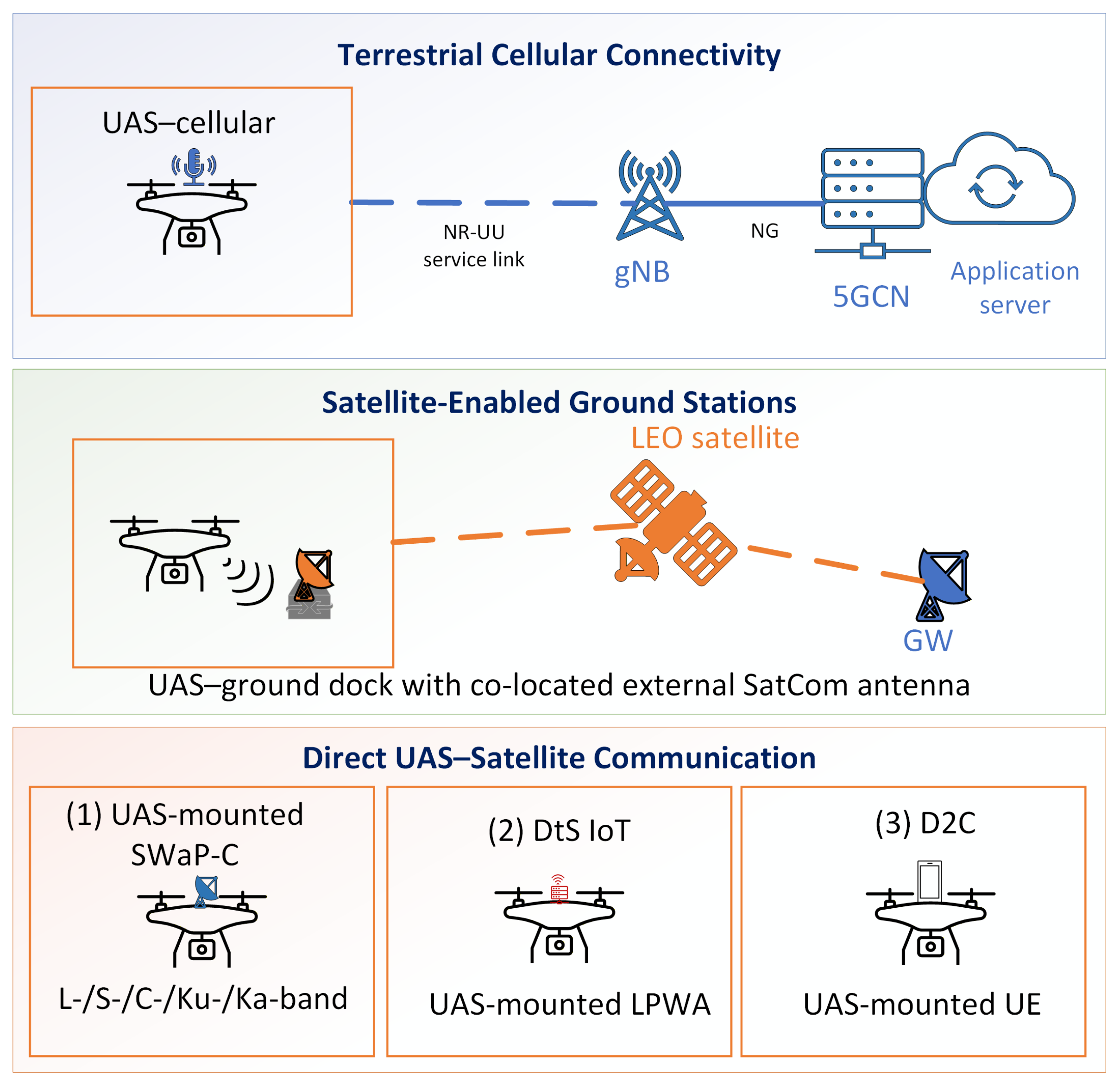
- Terrestrial Cellular Connectivity: . an UAS is equipped with onboard cellular antennas connected directly to terrestrial base stations (such as gNB in 5G). In Figure 1, the gNB is connected to a 5G Core Network (5G CN), where an application server may reside for data processing. This approach provides high data rates and low latency in areas with adequate cellular coverage but suffers from coverage limitations in rural areas. The maximum communication range with sufficient link quality to the gNB will depend on the communication frequency and will be less than 1 km for 5G [14]. The reliability of the communication link may be compromised at higher altitudes due to potential interference or diminished signal strength resulting from base station antenna down-tilt [6,15].
- Indirect Satellite Access via Satellite-Enabled Ground Stations (GSs): an UAS has a direct connection to a ground dock station equipped with satellite backhaul. The satellite terminal is located at the dock station, enabling efficient UAS-to-dock communication with uplink capability. While this type of connectivity can provide a sufficient data rate, a visual line of sight might be needed between the UAS and the dock station to maintain good link quality. When Wi-Fi technology is used for communications between the UAS and the dock station, the maximum range is restricted to a few kilometers. The application server in this case can be located at the gateway (GW) to minimize the communication delay. The dock station can also be connected directly to the terrestrial network if available.
- Direct UAS–Satellite Communication: an UAS equipped with satellite communication capabilities connects directly to satellite networks. Implementation options include: (1) SWaP-C-optimized satellite terminals, offering limited throughput; (2) Direct-to-Satellite IoT (DtS IoT) for sensor data applications [16]; (3) Direct-to-Cell (D2C) technology using mounted UE. In the case of the DtS IoT option, the satellite must employ an IoT GW onboard. This type of connectivity may support a limited amount of data, from hundreds of kbps to several Mbps.
5. Communication Requirement Analysis
5.1. Control and Command (C2) Requirements
5.2. Payload Requirements
6. Discussion
6.1. Antenna Design Constraints
6.2. Positioning and Navigation
6.3. Channel Modeling
6.4. Spectrum Sharing
7. Conclusions and Future Work
Author Contributions
Funding
Institutional Review Board Statement
Informed Consent Statement
Data Availability Statement
Conflicts of Interest
References
- PwC Drone Powered Solutions. Strategic Insights for Thriving in the Unmanned Traffic Management Ecosystem. 2024. Available online: https://www.pwc.de/en/transport-und-logistik/pwc-drone-powered-solutions.pdf (accessed on 20 August 2025).
- World Bank. Attachment 3: Drones for Good, Use Cases for Drone Technology in Development Activities in Latin America. 2024. Available online: https://documents1.worldbank.org/curated/en/099092424171525114/pdf/P176634-56a00660-1873-4f00-846d-ed7491edcbbd.pdf (accessed on 20 August 2025).
- Agmis. GreenBee: Agmis, Thrust, and Kelių Priežiūra Launch AI-Powered Drone System for Smarter, Greener Road Inspection. 2025. Available online: https://agmis.com/ai-uavs-to-monitor-road-infrastructure/ (accessed on 5 May 2026).
- Araniti, G.; Iera, A.; Pizzi, S.; Rinaldi, F. Toward 6G non-terrestrial networks. IEEE Netw. 2021, 36, 113–120. [Google Scholar] [CrossRef] [Scilit]
- Shrestha, R.; Bajracharya, R.; Kim, S. 6G enabled unmanned aerial vehicle traffic management: A perspective. IEEE Access 2021, 9, 91119–91136. [Google Scholar] [CrossRef] [Scilit]
- Wang, F.; Zhang, S.; Shi, J.; Li, Z.; Quek, T.Q.S. Sustainable UAV Mobility Support in Integrated Terrestrial and Non-Terrestrial Networks. IEEE Trans. Wirel. Commun. 2024, 23, 17115–17128. [Google Scholar] [CrossRef] [Scilit]
- Lv, X.; Liu, R.; Hou, R.; Liu, Q.; Zhu, Q.; Zang, Y.; Thompson, J.S. Enhanced Sensing in 6G NTN: Imaging with LEO Satellite and UAV Communication Network. IEEE Sens. J. 2025, 25, 33005–33021. [Google Scholar] [CrossRef] [Scilit]
- Liang, T.; Zhang, T.; Zhang, Q. Toward seamless localization and communication: A satellite-UAV NTN architecture. IEEE Netw. 2024, 38, 103–110. [Google Scholar] [CrossRef] [Scilit]
- Leon, V.; Christofilos, I.; Nesiadis, A.; Paraskevas, I.; Perrela, J.; Ioannopoulos, G.; Tasoulis-Nonikas, A.; Bernou, M.; Reading, J. Towards Enabling 5G-NTN Satellite Communications for Manned and Unmanned Rotary Wing Aircraft. In Proceedings of the 2024 IEEE 29th International Workshop on Computer Aided Modeling and Design of Communication Links and Networks (CAMAD), Athens, Greece, 21–23 October 2024; pp. 1–6. [Google Scholar]
- Benzaghta, M.; Geraci, G.; Nikbakht, R.; López-Pérez, D. UAV communications in integrated terrestrial and non-terrestrial networks. In Proceedings of the GLOBECOM 2022—2022 IEEE Global Communications Conference, Rio de Janeiro, Brazil, 4–8 December 2022; pp. 3706–3711. [Google Scholar]
- Marchese, M.; Moheddine, A.; Patrone, F. UAV and Satellite Employment for the Internet of Things Use Case. In Proceedings of the 2020 IEEE Aerospace Conference, Big Sky, MT, USA, 7–14 March 2020; pp. 1–8. [Google Scholar] [CrossRef] [Scilit]
- Giambene, G.; Addo, E.O.; Chen, Q.; Kota, S. Design and Analysis of Low-Power IoT in Remote Areas with NTN Opportunistic Connectivity. IEEE Trans. Aerosp. Electron. Syst. 2025, 61, 2309–2328. [Google Scholar] [CrossRef] [Scilit]
- Saad, M.M.; Tariq, M.A.; Khan, M.T.R.; Kim, D. Non-Terrestrial Networks: An Overview of 3GPP Release 17 & 18. IEEE Internet Things Mag. 2024, 7, 20–26. [Google Scholar] [CrossRef] [Scilit]
- Yastrebova, A.; Ojanperä, T.; Mäkelä, J.; Höyhtyä, M. Hybrid Connectivity for Autonomous Vehicles: Conceptual View & Initial Results. In Proceedings of the 2021 IEEE 93rd Vehicular Technology Conference (VTC2021-Spring), Helsinki, Finland, 25–28 April 2021; pp. 1–6. [Google Scholar]
- Tian, Y.; Pan, G.; Kishk, M.A.; Alouini, M.S. Stochastic Analysis of Cooperative Satellite-UAV Communications. IEEE Trans. Wirel. Commun. 2022, 21, 3570–3586. [Google Scholar] [CrossRef] [Scilit]
- Asad Ullah, M.; Mikhaylov, K.; Alves, H. An Overview of Direct-to-Satellite IoT: Opportunities and Open Challenges. In Proceedings of the 2023 IEEE 9th World Forum on Internet of Things (WF-IoT), Aveiro, Portugal, 12–17 October 2023; pp. 1–8. [Google Scholar]
- Plastras, S.; Tsoumatidis, D.; Skoutas, D.N.; Rouskas, A.; Kormentzas, G.; Skianis, C. Non-terrestrial networks for energy-efficient connectivity of remote iot devices in the 6G era: A survey. Sensors 2024, 24, 1227. [Google Scholar] [CrossRef] [Scilit]
- Mahfuz, M.M.H.; Park, C.W. Review of Patch Antennas used in Drone Applications. IEEE Access 2023, 11, 58367–58388. [Google Scholar] [CrossRef] [Scilit]
- Gogoi, S.; Peesapati, R. A hybrid hardware oriented motion estimation algorithm for HEVC/H.265. J. Real.-Time Image Process. 2021, 18, 953–966. [Google Scholar] [CrossRef] [Scilit]
- Pasandi, H.B.; Fraire, J.A.; Ratnasamy, S.; Rivano, H. A survey on direct-to-device satellite communications: Advances, challenges, and prospects. In Proceedings of the 2nd International Workshop on LEO Networking and Communication, Washington, DC, USA, 18–22 November 2024; pp. 7–12. [Google Scholar]
- ECC. ECC/DEC/(22)07 Aircraft. 2025. Available online: https://docdb.cept.org/document/28575 (accessed on 2 February 2026).
- TRAFICOM. Regulation 15 on Collective Frequencies for Licence-Exempt Radio Transmitters and on Their Use. 2025. Available online: https://www.traficom.fi/sites/default/files/media/regulation/Regulation%2015AV2025M.pdf (accessed on 5 May 2026).
- ITU-R. ITU-R Preparatory Studies for WRC-27. 2025. Available online: https://www.itu.int/en/ITU-R/study-groups/rcpm/Pages/wrc-27-studies.aspx (accessed on 2 February 2026).
- ESA. HAPSAT. 2020. Available online: https://business.esa.int/projects/haps4esa (accessed on 24 August 2025).
- ESA. Broadband Satellite Communications to Remotely Piloted Aircraft Systems (RPAS) Using High Altitude Pseudo-Satellites. 2025. Available online: https://connectivity.esa.int/projects/rpashaps (accessed on 24 August 2025).
- ESA. The NTN Forum. 2025. Available online: https://connectivity.esa.int/artes-4-0-programme-overview/space-for-5g-6g-sustainable-connectivity/the-ntn-forum (accessed on 5 May 2026).
- ESA. 6G and Satellites: Intelligent Connectivity for a Sustainable Future; Technical Report; European Space Agency (ESA): Paris, France, 2022. [Google Scholar]
- SkyDIO. Caltrans|2024 Aerial Achievement Award Winner–Achievements in Innovation. 2024. Available online: https://www.skydio.com/customers/awards/caltrans-aerial-achievement-awards-winner-achievements-in-innovation/ (accessed on 13 August 2025).
- uAvionix. Pushing the Envelope–Testing the Future of Multiple Link SATCOM Solutions with StarLink. 2024. Available online: https://uavionix.com/pushing-the-envelope-testing-the-future-of-multiple-link-satcom-solutions-with-starlink/ (accessed on 5 May 2026).
- TTP. Developing a Low SWaP-C Satellite Communications Terminal for UAVs with Viasat. 2025. Available online: https://www.ttp.com/case-studies/developing-a-low-swap-c-satellite-communications-terminal-for-uavs-with-viasat (accessed on 5 May 2026).
- Skydio, I. Skydio Dock for X2/S2+ Connectivity. 2025. Available online: https://support.skydio.com/hc/en-us/articles/13571390652571-Skydio-Dock-for-X2-S2-Connectivity (accessed on 13 November 2025).
- EASA. Commission Delegated Regulation (EU) 2019/945 of 12 March 2019 on Unmanned Aircraft Systems and on Third-Country Operators of Unmanned Aircraft Systems. 2019. Available online: https://www.easa.europa.eu/en/document-library/regulations/commission-delegated-regulation-eu-2019945 (accessed on 2 February 2026).
- EASA. Document Library. Easy Access Rules. 2025. Available online: https://www.easa.europa.eu/en/document-library/easy-access-rules?page=1 (accessed on 2 February 2026).
- ESA. HAPS4esa Workshop. 2024. Available online: https://atpi.eventsair.com/haps4esa2024/ (accessed on 13 August 2025).
- 3GPP. TR 38.821, Solutions for NR to Support Non-Terrestrial Networks (NTN) (Release 16). Available online: https://portal.3gpp.org/desktopmodules/Specifications/SpecificationDetails.aspx?specificationId=3525 (accessed on 2 February 2026).
- ESA. ETSI TS 122 125. 5G; Unmanned Aerial System (UAS) Support in 3GPP (3GPP TS 22.125 Version 17.6.0 Release 17). Available online: https://www.etsi.org/deliver/etsi_ts/122100_122199/122125/17.06.00_60/ts_122125v170600p.pdf (accessed on 2 February 2026).
- Garcia-Cabeza, J.; Albert-Smet, J.; Frias, Z.; Mendo, L.; Azcoitia, S.A.; Yraola, E. Direct-to-Cell: A First Look into Starlink’s Direct Satellite-to-Device Radio Access Network Through Crowdsourced Measurements. IEEE Commun. Mag. 2025; Early Access. [CrossRef] [Scilit]
- MAVLink. Protocol Overview. 2025. Available online: https://mavlink.io/en/about/overview.html (accessed on 26 June 2025).
- NI. How Do I Calculate the Bandwidth Required for My Image Acquisition? 2024. Available online: https://knowledge.ni.com/KnowledgeArticleDetails?id=kA03q000000YI5bCAG&l=en-US (accessed on 5 May 2026).
- Höyhtyä, M.; Huusko, J.; Kiviranta, M.; Solberg, K.; Rokka, J. Connectivity for autonomous ships: Architecture, use cases, and research challenges. In Proceedings of the 2017 International Conference on Information and Communication Technology Convergence (ICTC), Jeju, Republic of Korea, 18–20 October 2017; pp. 345–350. [Google Scholar]


| Connectivity Type | Communication Frequency | Communication Range | Max Data Rate UL | Coverage | Redundancy | Ref. |
|---|---|---|---|---|---|---|
| Cellular | 700–2600 MHz, 3.4–3.8 GHz, 24–28 GHz | 640 m @ 3.5 GHz | 50 Mbps– 1 Gbps | Urban/ near-urban | Only terrestrial | [14] |
| Satellite- Enabled GS | 5 GHz | ∼4 km @ 5 GHz | 5–10 Mbps | Near GS | Terrestrial or NTN | [31] |
| SWaP-C terminal | L-band, LTE bands | from 3 km (LTE) to several hundred km (L-band) | 200 Kbps | Global | Terrestrial + NTN | [30] |
| DtS IoT | Sub-GHz, L-, S- bands | several hundred km | few hundred Kbps | Depending on the constellation size | NTN | [16] |
| D2C | L-, S- band | several hundred km | several Mbps | Global | Terrestrial + NTN | [37] |
Disclaimer/Publisher’s Note: The statements, opinions and data contained in all publications are solely those of the individual author(s) and contributor(s) and not of MDPI and/or the editor(s). MDPI and/or the editor(s) disclaim responsibility for any injury to people or property resulting from any ideas, methods, instructions or products referred to in the content. |
© 2026 by the authors. Licensee MDPI, Basel, Switzerland. This article is an open access article distributed under the terms and conditions of the Creative Commons Attribution (CC BY) license.
Share and Cite
Yastrebova-Castillo, A.; Tocklin, S.; Kokkinen, H.; Asad Ullah, M.; Höyhtyä, M.; Majanen, M. Integrated UAS–Satellite Communications in 6G: An Overview. Eng. Proc. 2026, 133, 157. https://doi.org/10.3390/engproc2026133157
Yastrebova-Castillo A, Tocklin S, Kokkinen H, Asad Ullah M, Höyhtyä M, Majanen M. Integrated UAS–Satellite Communications in 6G: An Overview. Engineering Proceedings. 2026; 133(1):157. https://doi.org/10.3390/engproc2026133157
Chicago/Turabian StyleYastrebova-Castillo, Anastasia, Sami Tocklin, Heikki Kokkinen, Muhammad Asad Ullah, Marko Höyhtyä, and Mikko Majanen. 2026. "Integrated UAS–Satellite Communications in 6G: An Overview" Engineering Proceedings 133, no. 1: 157. https://doi.org/10.3390/engproc2026133157
APA StyleYastrebova-Castillo, A., Tocklin, S., Kokkinen, H., Asad Ullah, M., Höyhtyä, M., & Majanen, M. (2026). Integrated UAS–Satellite Communications in 6G: An Overview. Engineering Proceedings, 133(1), 157. https://doi.org/10.3390/engproc2026133157