Proceeding Paper

Thermodynamic Pathways Towards Sustainable Aviation—A Synergistic Research Perspective †
Institute of Thermodynamics, Leibniz University Hannover, An der Universität 1, 30823 Garbsen, Germany
*
Author to whom correspondence should be addressed.
Presented at the 15th EASN International Conference, Madrid, Spain, 14–17 October 2025.
Eng. Proc. 2026, 133(1), 142; https://doi.org/10.3390/engproc2026133142 (registering DOI)
Published: 14 May 2026

Abstract

Decarbonizing aviation requires innovative propulsion technologies and thermodynamic systems that enable efficient, sustainable energy conversion. The Institute of Thermodynamics at Leibniz University Hannover is engaged in several interdisciplinary research projects focusing on advanced, low-emission aircraft propulsion solutions. Two major areas of research are presented: high-temperature solid oxide fuel cells (SOFCs) for hybrid aircraft propulsion and thermal management systems for proton exchange membrane (PEM) fuel cell propulsion, including additively manufactured heat exchangers for aviation applications. These research activities contribute to the technological foundation of more climate-friendly aviation. Concepts are investigated through numerical simulations, experiments, and system-level analyses to develop future propulsion solutions. This paper provides a comprehensive overview of the Institute of Thermodynamics’ ongoing research and the synergies between its various fields. It offers insights into the challenges and opportunities of more sustainable aviation technologies.

1. Introduction

Aviation is a major economic sector. In addition to two million jobs in the European Union (EU) alone, the industry’s economic output in 2023 was EUR 830 billion, accounting for approximately 4.5% of the combined annual gross domestic product (GDP) of all EU countries. Taking into account additional supply chains and economic stimulus from tourism, a total of 9.2 million jobs are supported [1,2]. Thanks to this economic success and the cultural added value it brings, the aviation industry is growing rapidly and contributing significantly to the climate crisis through emissions of carbon dioxide and nitrogen oxides, see, for example, [3]. To counteract this, various international agreements have been made, such as the Paris Agreement [4] and the European Union’s Flightpath 2050 [5], which set ambitious targets for reducing the climate impact of aviation.
These ambitious goals pose major challenges for the industry. This includes developing innovative propulsion and aircraft concepts, researching climate-neutral or climate-friendly fuels, and improving existing technologies to reduce the fleet emissions of current aircraft. All these approaches are fundamentally thermodynamic problems that need to be addressed during development. For example, in order to develop a new propulsion concept, the underlying thermodynamic cycle must first be well understood, made operational, and optimized in order to achieve maximum efficiency. The same applies to the further development of existing concepts; for example, the condensation and re-injection of water within the engine or the development of thermal management systems for component cooling, which is particularly relevant in conjunction with new concepts such as low-temperature proton exchange membrane (PEM) fuel cells. For this reason, this paper presents current research topics from a thermodynamic perspective and addresses issues relating to thermal management systems and novel propulsion systems.

2. Thermal Management Systems

Modern aircraft exhibit an increasing degree of electrification. In the context of future aircraft generations, the discussion has expanded to encompass hybrid- and all-electric powertrain concepts. A consequence of the increasing degree of electrification is the rising waste heat at low temperatures due to the good, but still limited efficiencies of the electric components [6]. In contrast to conventional aircraft powered by gas turbines, the generated waste heat is no longer dissipated by the exhaust gas. Instead, an efficient, reliable, and lightweight thermal management system is required [7]. The heat exchanger (HEX) to the ambient is of particular interest, as it is typically the largest and heaviest component in the thermal management system and induces a significant amount of drag [8].

2.1. Overall Design and Optimization

Within the Cluster of Excellence Sustainable and Energy Efficient Aviation (SE2A), a comprehensive analysis of the overall thermal management system of electric aircraft is carried out. Initially, a list of potential heat sources on an electric aircraft is compiled to establish the thermal requirements for a specific system. The potential for various heat sinks to effectively dissipate the waste heat is subsequently evaluated. A comparative evaluation of potential system configurations is performed based on the list of relevant heat sources. Variations in these configurations are characterized by their interconnectivity, reliability, weight, drag, and volume. Subsequently, models of the thermal management system configurations are developed to estimate their impact at the aircraft level. Lastly, an off-design analysis is performed to demonstrate the system’s functionality across the entire flight mission. Detailed information and initial results regarding the project can be found in [9].
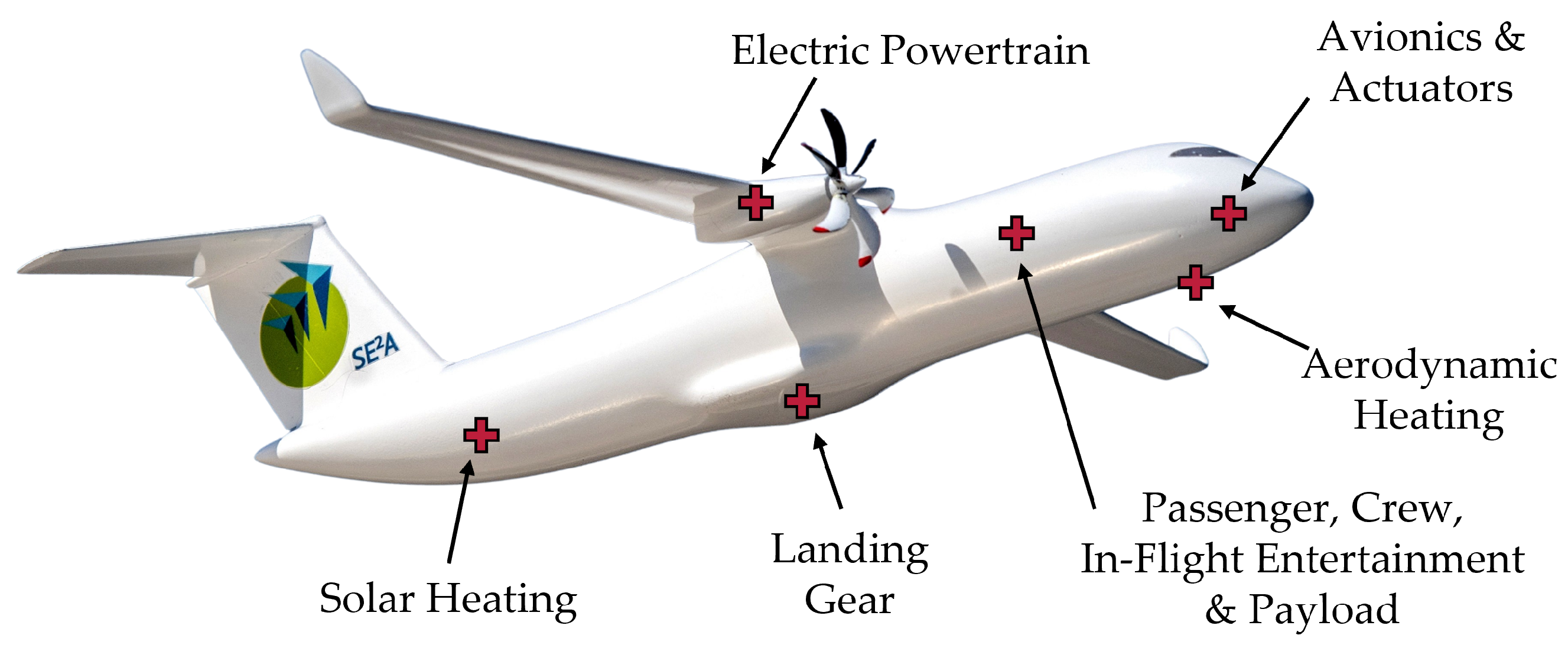
The primary heat sources are illustrated in Figure 1. The fuel cell is the predominant contributor to the total waste heat. The remaining powertrain components generate comparable, but much lower, waste heat than the fuel cell.
In electric aircraft, heat sinks are significantly limited due to the absence of hot exhaust gases. An additional heat sink in conventional gas-turbine-powered aircraft can be the kerosene fuel tank. This principle partially applies to fuel cell-powered aircraft, since hydrogen is expected to be stored in its liquid state at temperatures around 20 K. Waste heat can be utilized to vaporize the hydrogen and bring it to the operating temperature of the fuel cell at around 80 °C. However, the heat required for this process constitutes less than 5% of the total waste heat produced on board an electric aircraft. Consequently, compact HEXs are necessary to dissipate the remaining waste heat to the ambient air.
The thermal management system is modeled and designed based on the specified thermal requirements. It encompasses several potential design variables, each influencing the system’s drag, weight, power consumption, and volume. Therefore, an optimization approach is essential to achieve the most efficient design. The optimization yields a Pareto front, which illustrates a trade-off between weight and induced drag of the HEX. Representative results can be found in [10].
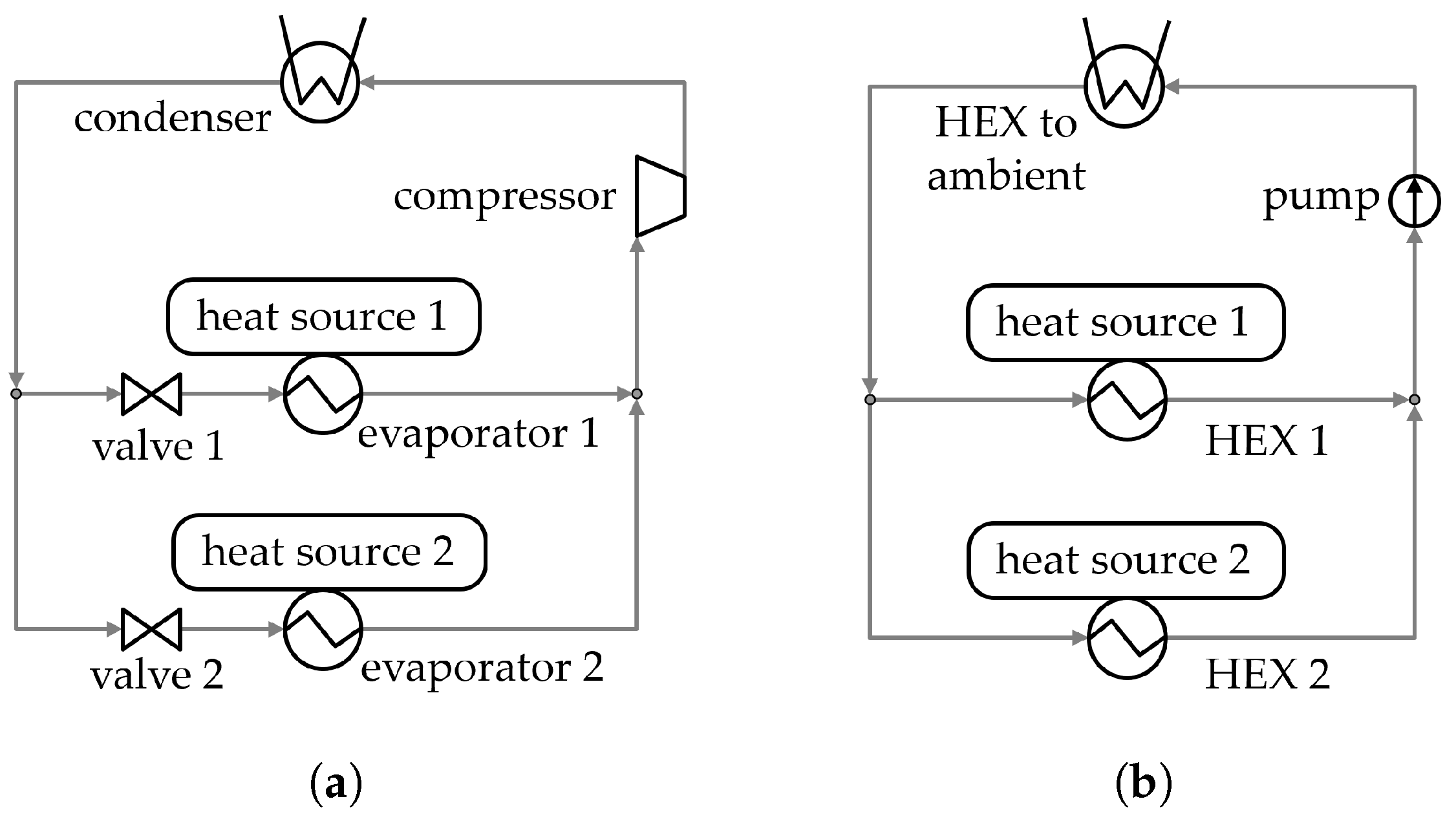
In addition to the comprehensive design and analysis of the entire thermal management system, research is focused on specific arrangements of cooling cycles. Specifically, the effects of a vapor compression cycle are examined and compared to a more conventional liquid cooling cycle for cooling power electronics, which are limited to a maximum operating temperature of 70 °C. The vapor compression cycle, as depicted in Figure 2, offers the advantage of reducing the cooling temperature to levels near or below ambient temperatures through the interaction of an expansion valve and a compressor. This approach not only allows for lower component temperatures compared to a liquid cooling cycle but also increases the temperature of the cooling fluid in the condenser for more effective heat dissipation. The resulting reduction in drag compensates for the increased power consumption compared to the liquid cooling cycle. Overall, this leads to a lower power requirement for the aircraft. Details about the investigation can be found in [11].

2.2. Additively Manufactured Heat Exchangers

Current concepts for the heat dissipation to the ambient envisage large air intakes in the nacelle that direct the flow to rectangular HEXs. In order to minimize the impact on the external shape of the aircraft, highly integrated HEXs that can be adapted to the outer contours and make optimal use of available installation space are ideal. This approach results in an integrated overall solution that combines thermal management and aircraft geometry. Additive manufacturing offers an ideal basis for this approach, as it enables the implementation of complex geometries [12].
Heat exchangers can be constructed from elementary cells, which are first simulated and optimized on a structural level. For this purpose, thermo-fluid dynamic and structural mechanical properties are determined and described [13].
Validated correlations are then established through experimental investigations under operating conditions. These experiments quantify the structures used in terms of pressure loss and heat transfer, forming the basis for apparatus development. The component mass is subsequently determined using CAD-based modeling approaches.
Various sub-models are then combined in a metaheuristic optimization framework to evaluate the overall system. The following aspects are taken into account: heat fluxes to be dissipated during the flight mission, drag induced by the HEX, mass, overall nacelle performance, structural stability.
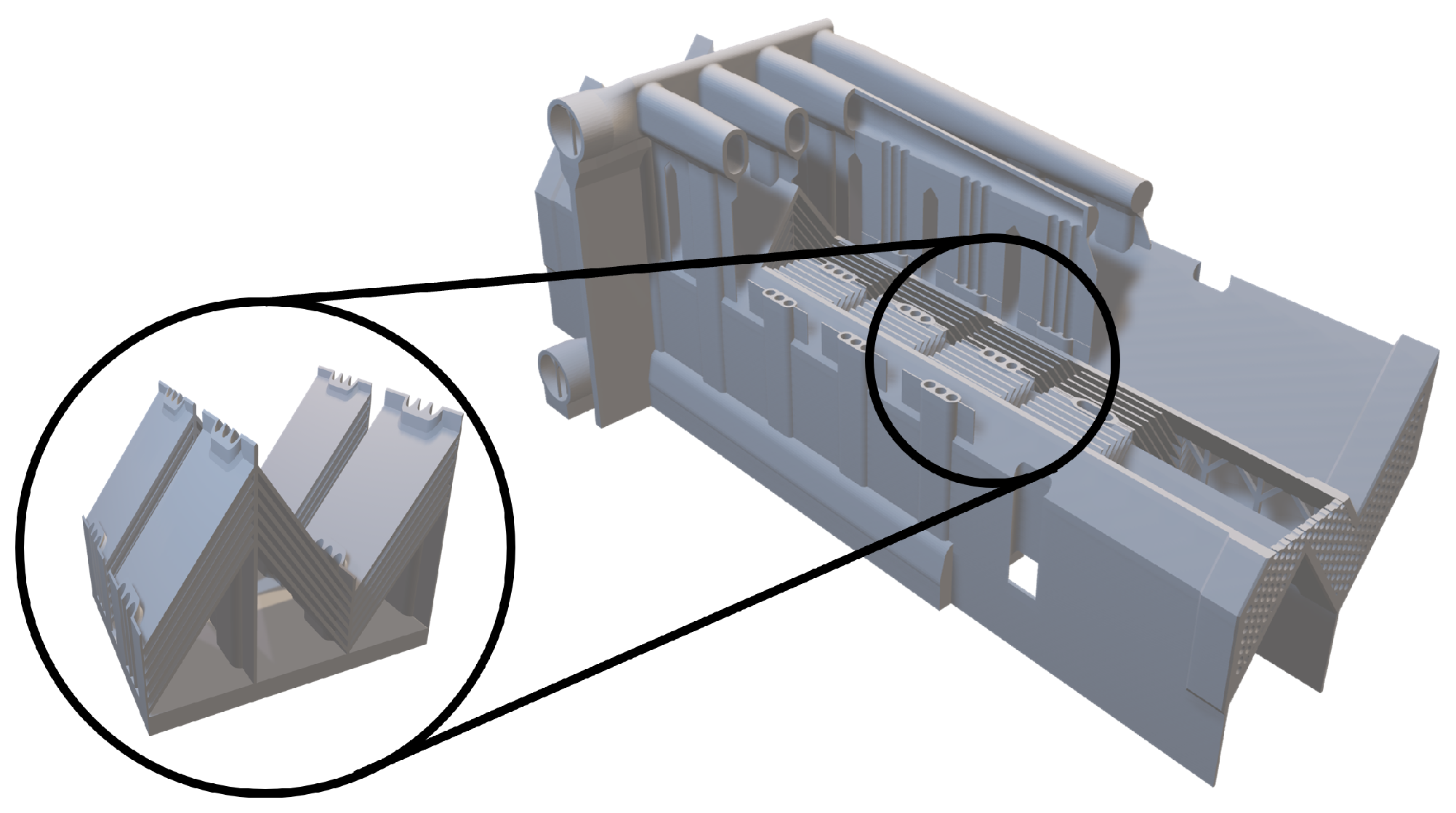
A concept of an optimized HEX structure can be seen in Figure 3. The outer contours are based on the nacelle geometry so that aerodynamic efficiency is only minimally affected. This results in lower air resistance and better overall performance.

3. Propulsion Systems

As part of the development of sustainable propulsion systems, two approaches are investigated: an SOFC-GT concept study and the dehumidification of exhaust gas. Both approaches can increase fuel efficiency or reduce contrail formation.

3.1. Novel High-Temperature Fuel-Cell-Based Propulsion System

An alternative to battery- and PEM-fuel-cell electric propulsion is the use of high-temperature solid oxide fuel cells (SOFCs). Especially when coupled with a gas turbine (GT), the combined SOFC-GT systems can reach high thermal efficiencies exceeding 60%. To make this promising technology feasible in the future, two major advances are required before building and testing SOFC-GT propulsion systems:
  • Developing shape-optimized and lightweight SOFCs to reach sufficient gravimetric and volumetric power densities (Section 3.1.1).
  • Building highly efficient thermodynamic cycles employing optimized heat-integration methods with respect to the preheating of the incoming fluids to ensure the operability of the SOFC itself (Section 3.1.2).

3.1.1. Investigation of Lightweight SOFC Design

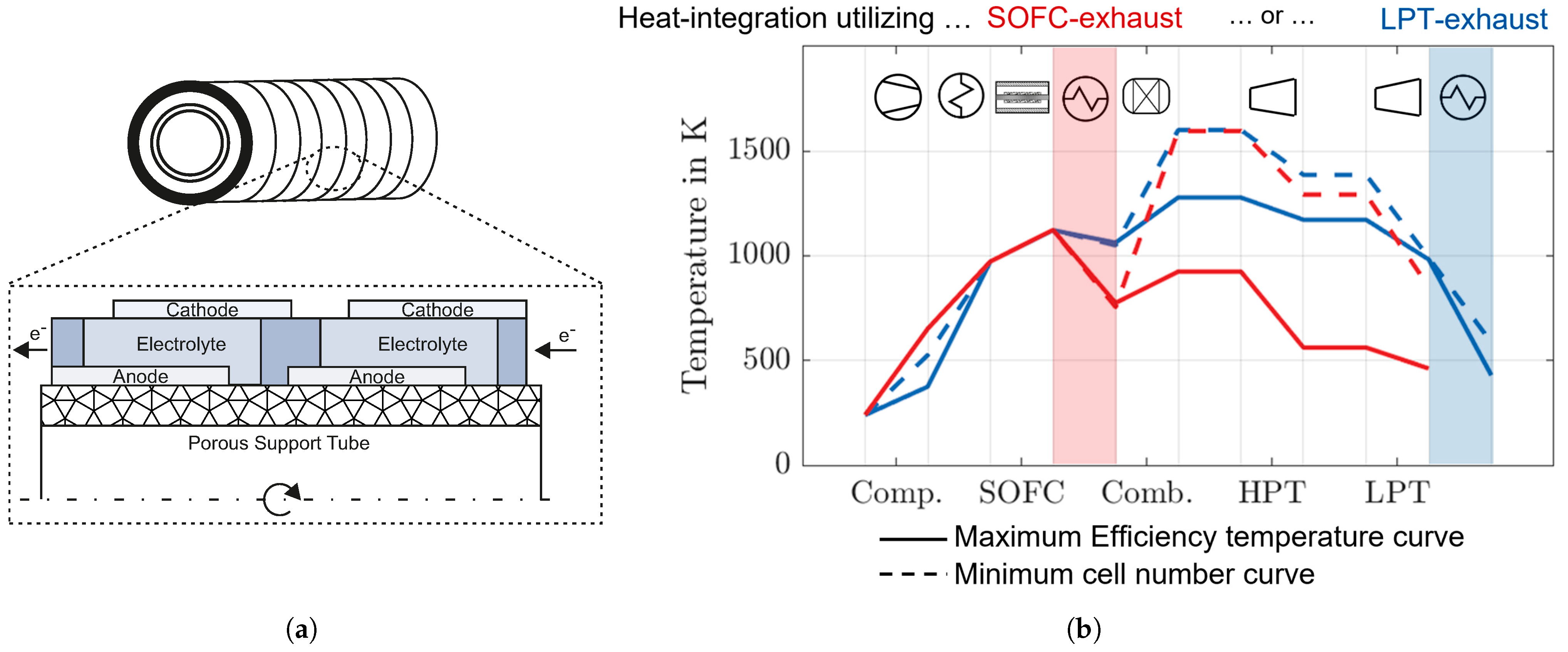
Despite their high efficiency, SOFCs still face major challenges for mobile applications. Beyond mechanical robustness and dynamic loads, the main limitation is their low gravimetric power density. Today, the primary domain of SOFC application has been stationary systems, resulting in limited focus on optimizing gravimetric power density, while conventional, stationary SOFCs typically achieve only about 0.05 to 0.1 kW/kg, mobile systems would require around 3 kW/kg—a target that requires improvements by one order of magnitude. Consequently, a radical redesign is required. Besides material advancements, microtubular SOFCs offer a promising path forward [14,15]. Thanks to advances in additive manufacturing of ceramics, they can be made lighter and more reliable. By removing heavy bipolar plates and using a segmented approach, these designs achieve high power output at low currents and elevated voltage levels with reduced system weight—key advantages for aviation applications (Figure 4a).
The use of microtubular SOFCs involves additional in-plane electrical losses that depend on the cell’s geometry, materials, and operating conditions. The cathode often shows relatively low electrical conductivity, which can be partly compensated by using shorter cells to reduce resistance and improve current collection. Further optimization is being pursued through microstructural improvements, aiming to minimize these losses and enhance overall cell performance. The achievable gravimetric power density varies widely and is strongly influenced by the operating temperature range, which also limits interconnect materials and increases design requirements.
Although theoretical gravimetric power densities can reach double-digit kW/kg values, they are often associated with limited mechanical strength. The pursuit of very high gravimetric power densities remains a central goal, yet self-supported cells capable of reaching these theoretical values are frequently mechanically fragile. As an early reference, Nehter et al. [16] reported around 2 kW/kg for an anode-supported microtubular SOFC, though only at the single-cell level. Continued research on materials, geometry, and system integration is therefore essential to bridge the gap between laboratory performance and practical application.
Figure 4. (a) Scheme of a segmented tubular SOFC (adapted from [17]) and (b) temperature profiles for SOFC-GT systems using a high-temperature heat exchanger upstream of the SOFC that utilizes the SOFC exhaust (blue) or the LPT exhaust (red) at highest efficiency (solid line) and minimum cell count (dashed line).
Engproc 133 00142 g004

3.1.2. Analysis of SOFC-GT System Architectures

Research involving SOFC-GT systems for aircraft propulsion has gained increasing attention in recent years [18,19]. An important aspect that must be taken into account during the development phase is the high operating temperature of the fuel cell itself, which is typically above 600 °C. Since the compressor outlet temperature at high altitudes is significantly below SOFC requirements, even at high pressure ratios, it is essential to establish temperature-driven heat integration. An effective method of achieving this is to use a HEX as a recuperator [20]. While there are a variety of preheating options, this work examines preheating via a high-temperature HEX that utilizes either the SOFC exhaust or the low-pressure turbine (LPT) exhaust. A detailed study of various concepts under the same boundary conditions was carried out as part of the HYLENA project. Particularly noteworthy here are the configurations that utilize SOFC or LPT exhaust for preheating, which can achieve thermal efficiencies of 63% (SOFC) and 69% (LPT), respectively. As shown in Figure 4b, relatively low turbine inlet temperatures yield high efficiencies. However, if the turbine inlet temperature is increased, the number of SOFCs or stacks required is reduced, and with it the weight of the system, but also the efficiency decreases to 50% (SOFC-exhaust) or 62% (LPT-exhaust) [21].
Further work on SOFC-GT cycle processes will be carried out in future studies, including the EU-funded HYLENA project. In addition to analyzing the off-design behavior of the described architectures, system layouts with heat integration methods that avoid a HEX will also be investigated. Parallel to purely thermodynamic considerations, system engineering considerations are also important, while in the above case the SOFC-GT configuration that utilizes the low-pressure turbine exhaust achieves the highest thermal efficiency, initial calculations show that a significant increase in the size and thus the weight of the required heat exchanger will be needed compared with the second system configuration. Since both the installation space and the weight of the propulsion system have a considerable effect on the aircraft, it is important to find an optimal solution at the overall system level. In addition to the other necessary components, the focus is therefore once again on the HEX.

3.2. Dehumidification of Exhaust Gas

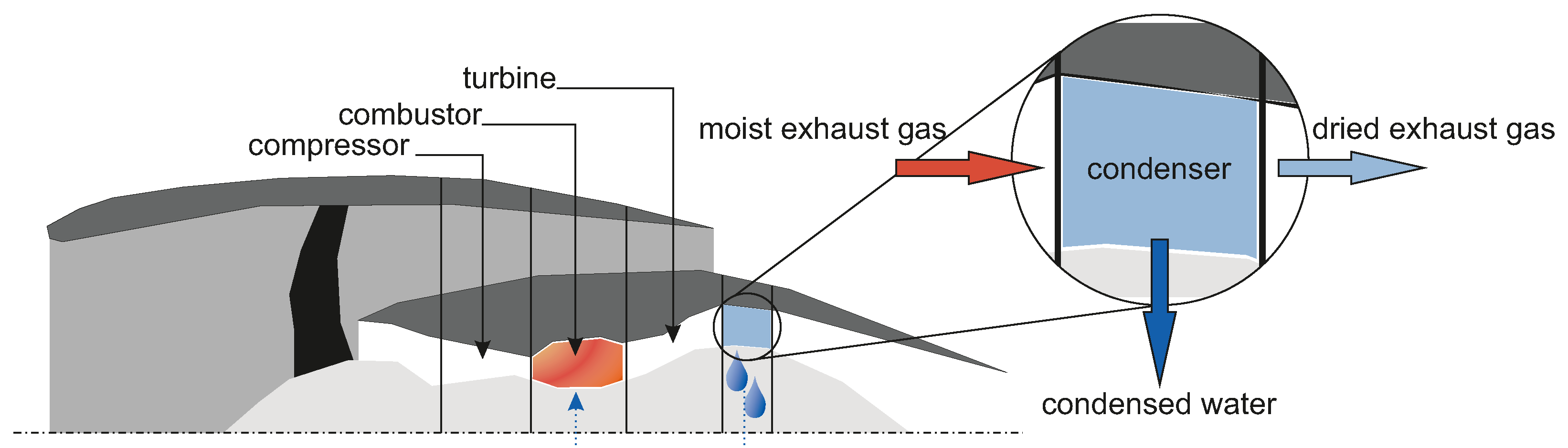
The exhaust gas of conventional and future propulsion systems will contain water vapor due to the hydrogen content of the fuels. This water can be re-injected into the combustor to reduce fuel consumption, mitigate thermal NOx formation by lowering flame temperature peaks, and reduce contrail formation. Therefore, dehumidifying the exhaust gas, for example, in steam-injection aero engines [22,23,24], is an important field of research Figure 5.
An experimental platform has been designed at the Institute of Thermodynamics to evaluate different HEX geometries. The test setup includes an open cold air cycle and a closed humid air loop. A steam injector is mounted in front of the HEX hot-side inlet. This setup allows precise control of the humidity levels of the hot, moist air. To separate the water droplets from the moist air exiting the HEX, a cyclone separator is installed. Furthermore, it is possible to vary the pressure of the closed humid air loop between 0.4 bar(a) and 1.5 bar(a).
The key parameters measured around the HEX specimen include the pressure drops Δ p i , temperatures T i , relative humidities ϕ i , mass flows m ˙ i and the mass flow distributions. Both the mass flow of injected steam and the mass flow of liquid water, collected after the cyclone, are measured using Coriolis flowmeters.
The main goal is to determine the effectiveness of the condensers for different operating conditions. The well-known HEX effectiveness calculations depend on inlet and outlet temperatures, and so they are only useful for single-phase heat exchangers. Because condensation occurs within the condenser HEX, the exiting hot, moist air carries liquid water droplets. Therefore, water recovery (WR) is defined as
WR = m ˙ H 2 O , liquid , out m ˙ H 2 O , vapor , in
to classify the condenser effectiveness and is described as the ratio of the mass flow of condensed liquid water (measured by a Coriolis flowmeter) to the incoming water-vapor mass flow (determined from relative humidity, temperature, and pressure at the hot-side inlet).

4. Conclusions and Outlook

This study emphasizes that thermodynamics is a fundamental driver in the development of future aviation propulsion and energy systems. As emerging aircraft concepts shift towards hybrid cycles, electrified subsystems, and fuel cell-based architectures, the need for a holistic application of thermodynamic principles becomes critical. Cycle analysis, (high-temperature) fuel cell integration, and innovative heat exchanger design are not isolated research fields, but rather tightly interconnected elements of a unified system. Accurately capturing and improving interdependencies among thermal management and (sub)system analyses requires an integrated approach.
An interdisciplinary thermodynamic approach allows researchers to identify synergies across subsystems, reveal hidden performance potentials, and evaluate trade-offs between competing design parameters in a systematic way. This is crucial for developing propulsion systems that meet challenging requirements for efficiency, emissions, and sustainability while ensuring operational reliability under realistic flight conditions. Combining fuel cell modeling, advanced heat exchanger concepts, and cycle-based system evaluation provides a robust foundation for future propulsion architectures and supports the transition towards environmentally responsible aviation technologies.

Author Contributions

P.K., M.N., F.M., L.R., J.H. and C.N.D. contributed equally in conceptualization, methodology, software, validation, formal analysis, investigation, data curation, writing—original draft preparation, writing—review and editing, and visualization; supervision, S.K. and M.R. All authors have read and agreed to the published version of the manuscript.

Funding

Section 2.1: We would like to acknowledge the funding by the Deutsche Forschungsgemeinschaft (DFG, German Research Foundation) under Germany’s Excellence Strategy-EXC 2163/1-Sustainable and Energy Efficient Aviation-Project-ID 390881007. Section 2.2: The WuE-FLuB project is funded by the Federal Ministry of Transport (BMV) as part of Phase 2 of the National Innovation Program for Hydrogen and Fuel Cell Technology. The funding guidelines are coordinated by NOW GmbH and implemented by Project Management Jülich (PtJ). Section 3.1: Funded by the European Union. Views and opinions expressed are however those of the author(s) only and do not necessarily reflect those of the European Union or CINEA. Neither the European Union nor the granting authority can be held responsible for them.

Institutional Review Board Statement

Not applicable.

Informed Consent Statement

Not applicable.

Data Availability Statement

Data can be made available on request.

Conflicts of Interest

The authors declare no conflicts of interest.

References

  1. Air Transport Action Group (ATAG). Supporting Economic & Social Development. 2025. Available online: https://atag.org/industry-topics/supporting-economic-social-development (accessed on 18 April 2025).
  2. Gelhausen, M.C.; Berster, P.; Wilken, D. Post-COVID-19 Scenarios of Global Airline Traffic until 2040 That Reflect Airport Capacity Constraints and Mitigation Strategies. Aerospace 2021, 8, 300. [Google Scholar] [CrossRef]
  3. Lee, D.S.; Fahey, D.W.; Skowron, A.; Allen, M.R.; Burkhardt, U.; Chen, Q.; Doherty, S.J.; Freeman, S.; Forster, P.M.; Fuglestvedt, J.; et al. The Contribution of Global Aviation to Anthropogenic Climate Forcing for 2000 to 2018. Atmos. Environ. 2021, 244, 117834. [Google Scholar] [CrossRef] [PubMed]
  4. United Nations Framework Convention on Climate Change (UNFCCC). The Paris Agreement. 2015. Available online: https://unfccc.int/process-and-meetings/the-paris-agreement (accessed on 28 September 2025).
  5. European Commission. Flightpath 2050: Europe’s Vision for Aviation; Publications Office of the European Union: Luxembourg, 2012. [Google Scholar] [CrossRef]
  6. Barzkar, A.; Ghassemi, M. Electric Power Systems in More and All Electric Aircraft: A Review. IEEE Access 2020, 8, 169314–169332. [Google Scholar] [CrossRef]
  7. van Heerden, A.; Judt, D.; Jafari, S.; Lawson, C.; Nikolaidis, T.; Bosak, D. Aircraft thermal management: Practices, technology, system architectures, future challenges, and opportunities. Prog. Aerosp. Sci. 2022, 128, 100767. [Google Scholar] [CrossRef]
  8. Gkoutzamanis, V.G.; Tsentis, S.E.; Valsamis Mylonas, O.S.; Kalfas, A.I.; Kyprianidis, K.G.; Tsirikoglou, P.; Sielemann, M. Thermal Management System Considerations for a Hybrid-Electric Commuter Aircraft. J. Thermophys. Heat Transf. 2022, 36, 650–666. [Google Scholar] [CrossRef]
  9. Nozinski, M.; Kabelac, S. Analysis of Potential Thermal Management Systems for Electric Short-Range Aircraft in the Cluster of Excellence SE2A. In Proceedings of the Deutscher Luft- und Raumfahrtkongress 2024, Hamburg, Germany, 30 September–2 October 2024. [Google Scholar]
  10. Nozinski, M.; Benam, B.P.; De Servi, C.; Kabelac, S.; Falsetti, C. Physically Based Heat Exchanger Sizing Method for the Thermal Management System of All-Electric Regional Aircraft. J. Phys. Conf. Ser. 2024, 2766, 012101. [Google Scholar] [CrossRef]
  11. Nozinski, M.; Kramer, T.; Sprenger, J.; Xu, Y.; Thomas, C.; Kabelac, S. Transient investigation of a parallel vapor compression cycle for electric aircraft. Appl. Therm. Eng. 2026, 290, 130085. [Google Scholar] [CrossRef]
  12. Saltzman, D.; Bichnevicius, M.; Lynch, S.; Simpson, T.W.; Reutzel, E.W.; Dickman, C.; Martukanitz, R. Design and evaluation of an additively manufactured aircraft heat exchanger. Appl. Therm. Eng. 2018, 138, 254–263. [Google Scholar] [CrossRef]
  13. Sain, C.K.; Kazula, S. Comparative Assessment of Compact Air Heat Exchangers for Fuel Cell-Powered Electric Aircraft. In Proceedings of the AIAA Aviation Forum and ASCEND 2024, Las Vegas, NV, USA, 29 July–2 August 2024. [Google Scholar] [CrossRef]
  14. Hashimoto, S.; Hirota, T.; Suzuki, K.; Namioka, T.; Ito, H.; Miyata, R.; Kobayashi, K.; Yashiro, K.; Takamura, H.; Kawada, T.; et al. Material Development Strategy of Lightweight Solid Oxide Fuel Cells for Airplane System Electrification. ECS Trans. 2019, 91, 311–318. [Google Scholar] [CrossRef]
  15. Zhang, X.; Jin, Y.; Li, D.; Xiong, Y. A review on recent advances in micro-tubular solid oxide fuel cells. J. Power Sources 2021, 506, 230135. [Google Scholar] [CrossRef]
  16. Nehter, P.; Geisler, H.; Ahilan, V.; Friedl, S.; Rohr, O.; Walter, A.; Metzner, C.; Zimmermann, K. Solid Oxide Fuel Cells for Aviation. ECS Trans. 2023, 111, 143–154. [Google Scholar] [CrossRef]
  17. Costamagna, P.; Grosso, S.; Travis, R.; Magistri, L. Integrated Planar Solid Oxide Fuel Cell: Steady-State Model of a Bundle and 284 Validation through Single Tube Experimental Data. Energies 2015, 8, 16311–16333. [Google Scholar] [CrossRef]
  18. Fernandes, M.D.; de P. Andrade, S.T.; Bistritzki, V.N.; Fonseca, R.M.; Zacarias, L.G.; Gonçalves, H.; de Castro, A.F.; Domingues, R.Z.; Matencio, T. SOFC-APU systems for aircraft: A review. Int. J. Hydrogen Energy 2018, 43, 16311–16333. [Google Scholar] [CrossRef]
  19. Azizi, M.A.; Brouwer, J. Progress in solid oxide fuel cell-gas turbine hybrid power systems: System design and analysis, transient operation, controls and optimization. Appl. Energy 2018, 215, 237–289. [Google Scholar] [CrossRef]
  20. Köhler, P.; Tillner, J.; Kabelac, S. Thermodynamic Assessment of Hydrogen-Fueled Solid Oxide Fuel Cell–Gas Turbine (SOFC-GT) Systems for Low-Emission Aircraft Propulsion. In Proceedings of the Deutscher Luft- und Raumfahrtkongress 2024, Hamburg, Germany, 30 September–2 October 2024. [Google Scholar]
  21. Köhler, P.; Hollmann, J.; Kabelac, S. Hydrogen-fueled Solid Oxide Fuel Cell-Gas Turbine (SOFC-GT) hybrid engines for aircraft propulsion: Comprehensive thermodynamic heat integration study. Energy Convers. Manag. X 2026, 30, 101883. [Google Scholar] [CrossRef]
  22. Pratt & Whitney. Alternative Fuel. Available online: https://www.rtx.com/en/prattwhitney/future-of-flight/alternative-fuel (accessed on 7 May 2026).
  23. MTU Aero Engines AG WET Engine: MTU Aero Engines Develops Drive of the Future with Wet Combustion. MTU Aero Engines, 23 June 2022. Available online: https://www.mtu.de/newsroom/press/press-archive/press-archive-detail/wet-engine-mtu-aero-engines-develops-drive-of-the-future-with-wet-combustion (accessed on 28 August 2025).
  24. Schmitz, O.; Klingels, H.; Kufner, P. Aero Engine Concepts Beyond 2030: Part 1—The Steam Injecting and Recovering Aero Engine. J. Eng. Gas Turbines Power 2021, 143, 021001. [Google Scholar] [CrossRef]
Figure 1. Heat sources in an all-electric aircraft.
Engproc 133 00142 g001
Figure 2. Schematic layouts of a vapor compression cycle (a) and a more conventional liquid cooling cycle (b) for low temperature electronic cooling.
Engproc 133 00142 g002
Figure 3. Heat exchanger structural element.
Engproc 133 00142 g003
Figure 5. Scheme of a steam-injecting aero engine.
Engproc 133 00142 g005
Disclaimer/Publisher’s Note: The statements, opinions and data contained in all publications are solely those of the individual author(s) and contributor(s) and not of MDPI and/or the editor(s). MDPI and/or the editor(s) disclaim responsibility for any injury to people or property resulting from any ideas, methods, instructions or products referred to in the content.