Proceeding Paper

Enhanced DME Carrier Phase Tracking Approach for Alternative PNT in UAV Applications †
1
Faculty of Engineering and Applied Science, Cranfield University, Bedford MK43 0AL, UK
2
Telespazio, Luton LU1 3LU, UK
3
European Space Agency, European Space Research and Technology Centre (ESTEC), 2201 AZ Noordwijk, The Netherlands
*
Author to whom correspondence should be addressed.
Presented at the European Navigation Conference 2025 (ENC 2025), Wrocław, Poland, 21–23 May 2025.
Eng. Proc. 2026, 126(1), 54; https://doi.org/10.3390/engproc2026126054
Published: 12 May 2026
(This article belongs to the Proceedings of European Navigation Conference 2025)

Abstract

The demand for reliable Positioning, Navigation, and Timing (PNT) solutions is rapidly increasing due to the growing need for precision, efficiency, and safety in unmanned systems. As operations become more autonomous, the reliance on accurate and continuous PNT data becomes critical for maintaining system integrity. The Global Navigation Satellite System (GNSS), while serving as the primary global PNT service, is vulnerable to interference, jamming, and spoofing attacks. This raises serious concerns, particularly for safety-critical applications, and urgently requires resilient Alternative PNT (A-PNT) solutions. An existing worldwide infrastructure, the Distance Measuring Equipment (DME) system, is considered one of the most promising candidates for A-PNT to address GNSS vulnerabilities. Utilising the carrier phase of the DME signal enables distance measurements with centimetre-level accuracy. However, due to the pulse system nature of DME transmissions and the sparsity of phase observations, conventional carrier tracking loops such as PLLs and FLLs struggle to maintain a reliable phase lock. To address these challenges, this work proposes a zero-crossing-integrated Kalman filter-based approach to track the DME carrier signal at an irregular rate. The performance of the proposed algorithm is validated through a series of drone tests at Cranfield University, UK. The validation results demonstrate that the proposed enhanced carrier tracking approach consistently delivers stable and accurate performance.

1. Introduction

The increasing dependency on Global Navigation Satellite Systems (GNSSs) for Positioning, Navigation, and Timing (PNT) has raised critical concerns regarding system reliability and resilience. GNSS signals are inherently vulnerable to jamming, spoofing, signal occlusion, and degradation in urban or indoor environments. Therefore, there is a growing demand to develop alternative and complementary PNT (A-PNT) solutions that are robust, infrastructure-based, and independent of GNSS. Distance Measuring Equipment (DME), a legacy aviation navigation aid, offers significant potential in this context. With a globally deployed network of ground-based transponders and mature regulatory support, DME provides a readily available signal source that can be leveraged for navigation [1,2]. Study [3] explores the use of DME as a backup service in aviation when GPS is out of service. It concludes that with modest upgrades, the existing DME infrastructure can provide reliable APNT service. In study [4], a DME based navigation solution is proposed and validated through a series of simulation tests. The findings confirm the capability of DME navigation, highlighting its reliability for aircraft positioning. The traditional DME system offers limited positioning accuracy, typically on the order of hundreds of meters.
Recent advances in signal processing have presented the possibility of using carrier phase measurements of DME signals to achieve sub-meter level positioning accuracy, analogous to carrier-phase-based GNSS techniques. By exploiting the phase of the DME carrier rather than the pulse envelope, significantly finer resolution in range estimation becomes feasible. However, tracking the carrier phase of DME signals introduces several technical challenges, and the methodology of DME carrier tracking is not well developed. Unlike continuous wave signals typically used in GNSS, DME transmissions are bursty and intermittent, consisting of Gaussian-shaped pulses. In the DME signal, the carrier signal information can only be measured when the DME pulse is present. Conventional tracking techniques, such as Phase-Locked Loops (PLLs) and Frequency-Locked Loops (FLLs), which require a consistent and uniform period of measurements, are poorly suited to this environment. Studies [5,6] proposed integrating a certain period of DME signal before the PLL process. The flight test results show that this approach is effective; however, the update rate is limited by the length of the pre-integration period.
To overcome these limitations, this paper proposes an adaptive rate Kalman filter-based approach to track the DME carrier phase at an arbitrary rate. The Kalman filter framework allows for the explicit modeling of the carrier dynamics, including phase and frequency evolution, and supports optimal state estimation even in the presence of intermittent or noisy measurements. To address the phase ambiguity inherent in Kalman filter–based DME tracking, a zero-crossing-based frequency measurement is employed as an additional observation to enhance estimation accuracy.
In this work, we present the formulation, implementation, and validation of the adaptive rate Kalman filter designed for DME carrier tracking. Through a series of field tests, the proposed method achieves a stable and robust phase and frequency estimation in scenarios where traditional PLL/FLL architectures are not suitable. These results support the case for DME as a viable and high-performance component in A-PNT solutions, particularly in GNSS-denied or degraded environments.
The remainder of the paper is organised as follows. Section 2 reviews the generic signal structure of DME signals. Section 3 presents the proposed carrier phase measurement approach, including zero crossing frequency estimation and Kalman filter-based carrier tracking detail design, detailing the state-space formulation measurement model. Section 4 provides the details of the experiment design and results validation. Finally, Section 5 concludes the paper with a summary of findings and a discussion of future work directions for real-world implementation.

2. DME Signal Overview

Distance measuring equipment (DME) is a pulse ranging system that provides a slant range distance between an aircraft and a ground-based transponder. The interrogating aircraft sends a pair of pulses that is received by a ground DME transponder, which then inserts a known delay and sends it back with a different frequency. The DME interrogator then calculates the slant range based on the measured round-trip delay. A single DME pulse from the ground transmitter can be modelled as in Equation (1),
p ( t ) = A · e ( t τ ) 2 ,
where A is the pulse amplitude, τ is the pulse width equal to 3.5 μ s, and T is time. Thus, a pair of pulse can be expressed as
s ( t ) = p ( t ) + p ( t T ) ,
where T is the pulse separation equal to 12 μ s. The RF signal with L1 band carrier frequency equal to f c is formed as
x ( t ) = s ( t ) · c o s ( 2 π f c t ) = ( p ( t ) + p ( t T ) ) · c o s ( 2 π f c t ) ,
One can observe from Equation (3) that the pulse pair p ( t ) + p ( t T ) acts as an envelope to switch on the carrier signal. If no pulse signal is presented, no carrier information can be measured.

3. Kalman Filter-Based DME Carrier Phase Tracking

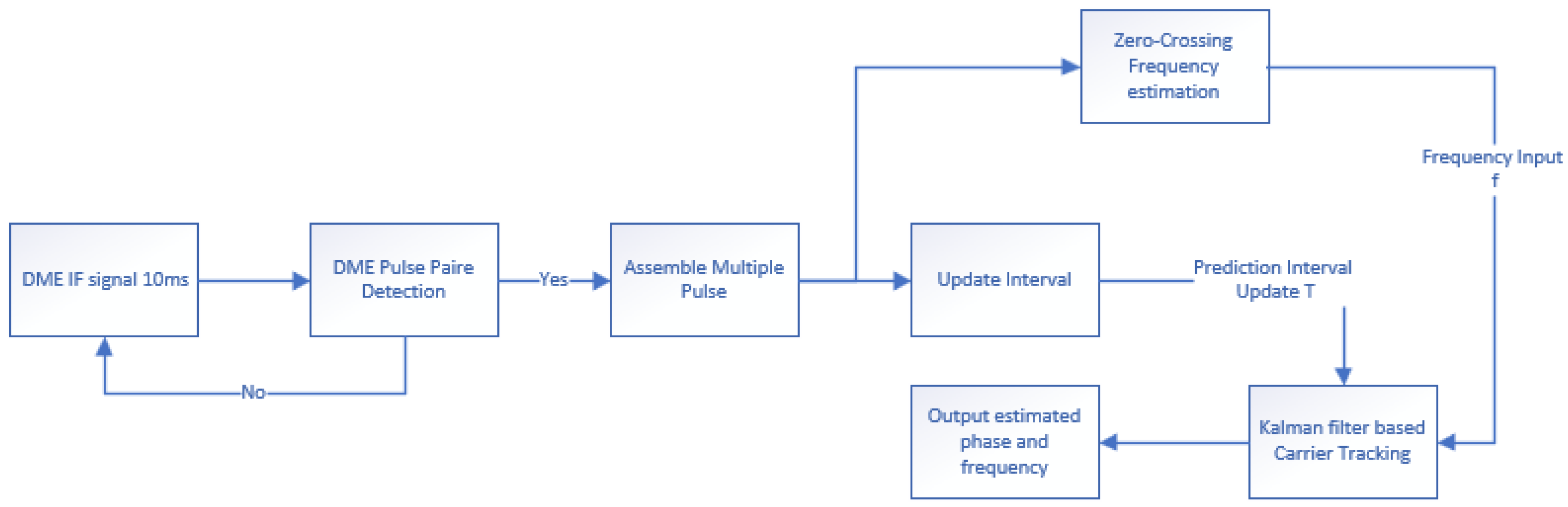
As a pulsed system, the DME carrier phase signal can only be measured when a pulse is present. A Kalman filter approach, which can update measurements at irregular intervals, is more favourable for tracking the DME carrier phase. The generic processing diagram is presented as Figure 1.
Once multiple DME pulse pairs are detected within 1 ms of raw data, the frequency is estimated using a zero-crossing approach applied to the detected DME pulses. Since DME pulses occur at irregular times, the prediction interval in the Kalman filter is updated based on the exact moment each DME pulse is detected. Finally, the estimated frequency and updated interval are fed into the Kalman filter to estimate the carrier phase and frequency. The following sections will describe the zero-crossing frequency estimation process and the Kalman filter model in detail.

3.1. Zero-Cross Based Frequency Estimation

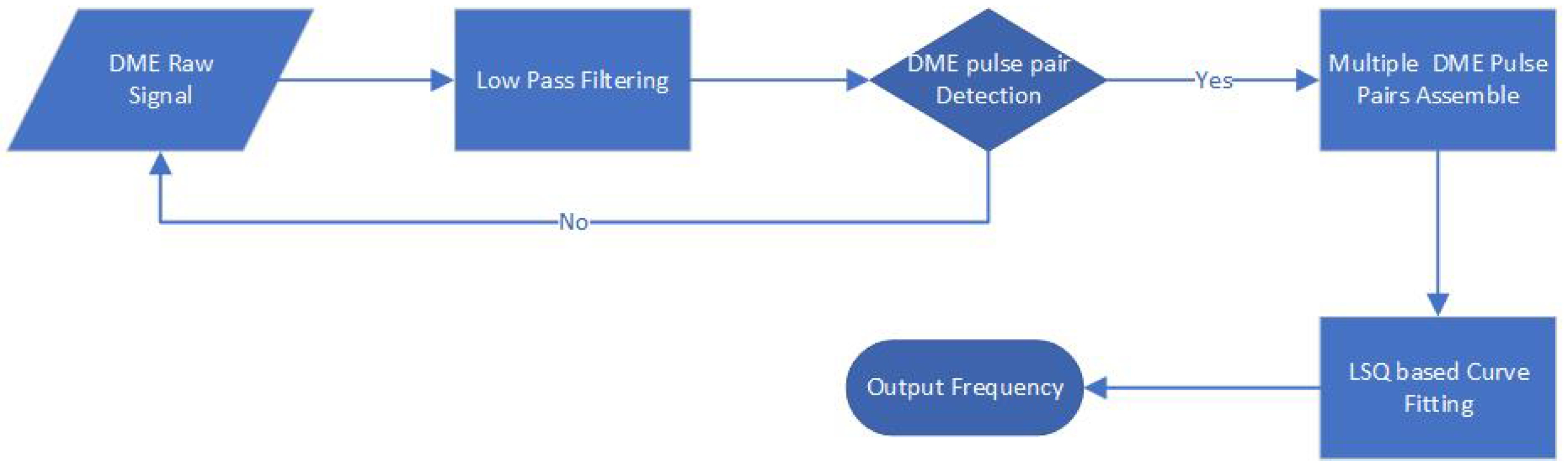
As aforementioned, the DME signals are pulse-type signals, and the carrier frequency can only be measured when DME pulses are detected. Thus, the traditional heterodyne method is not suitable for DME carrier frequency estimation. A curve fitting approach is a technique to estimate the parameters of a model that allows for the best fit, and the least square rule is one of the most common methods [7,8,9]. In theory, a least square base curve fitting approach can be applied to estimate the DME carrier frequency due to its ability to model the underlying signal pattern by approximating the observed data points even in the presence of noise. Figure 2 demonstrates a generic procedure of the LSQ-based curve fitting approach to estimate the DME carrier frequency. The process starts from DME pulse pair detection; once multiple DME pulses are detected, samples around the pulse are extracted to form a new synthetic signal for curve fitting.
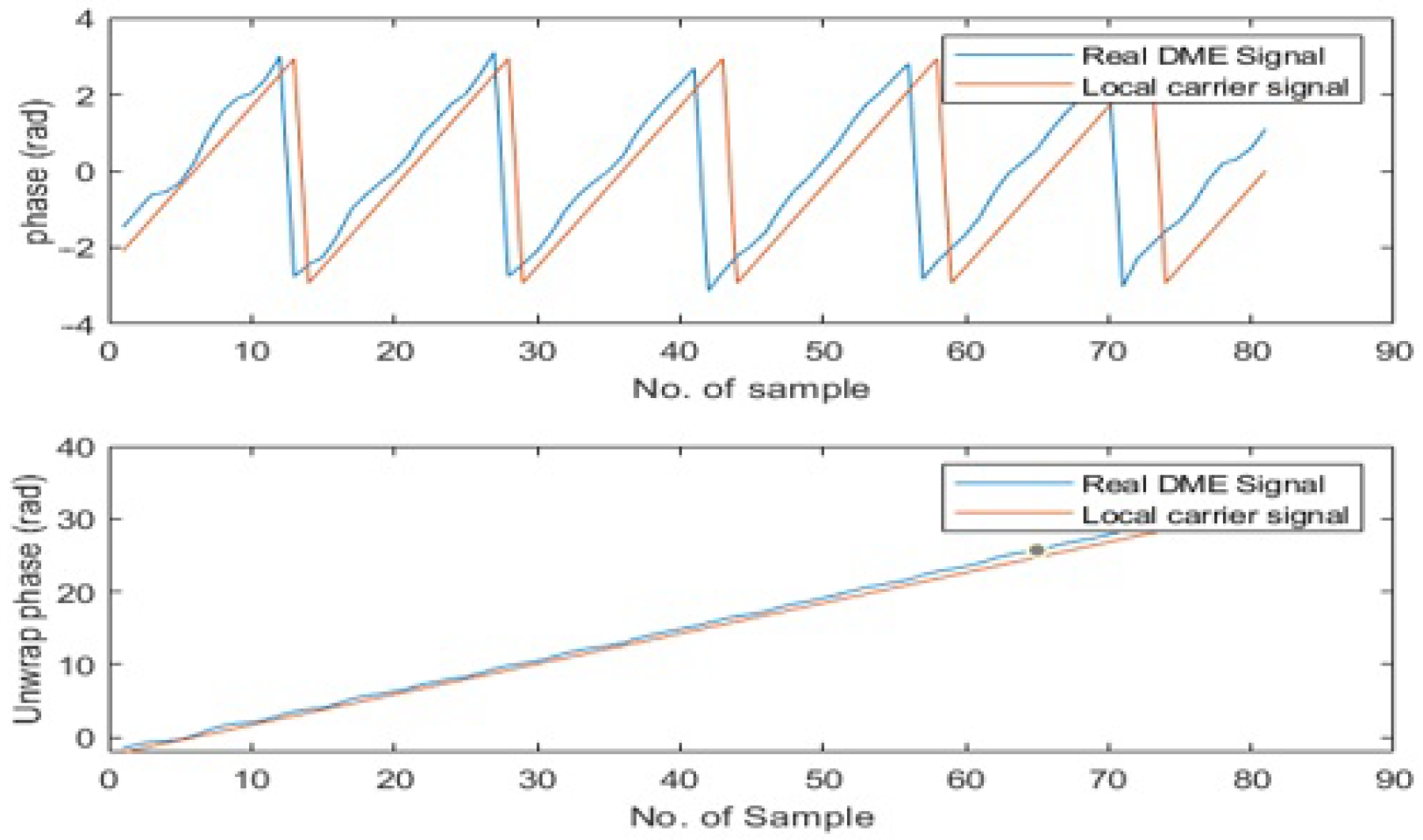
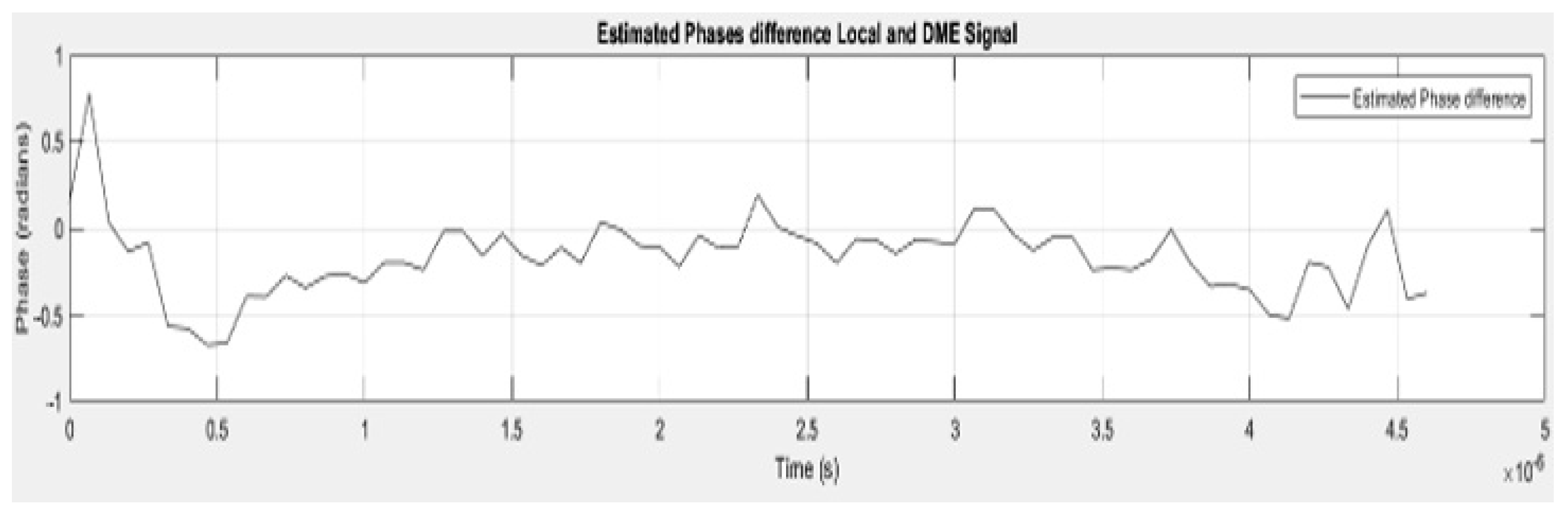
The preliminary results in Figure 3 and Figure 4 show that under a 1 MHz reference frequency, the estimated frequency using the LSQ-based curve fitting approach is 1,000,659 Hz, equivalent to 0.13889 rad.
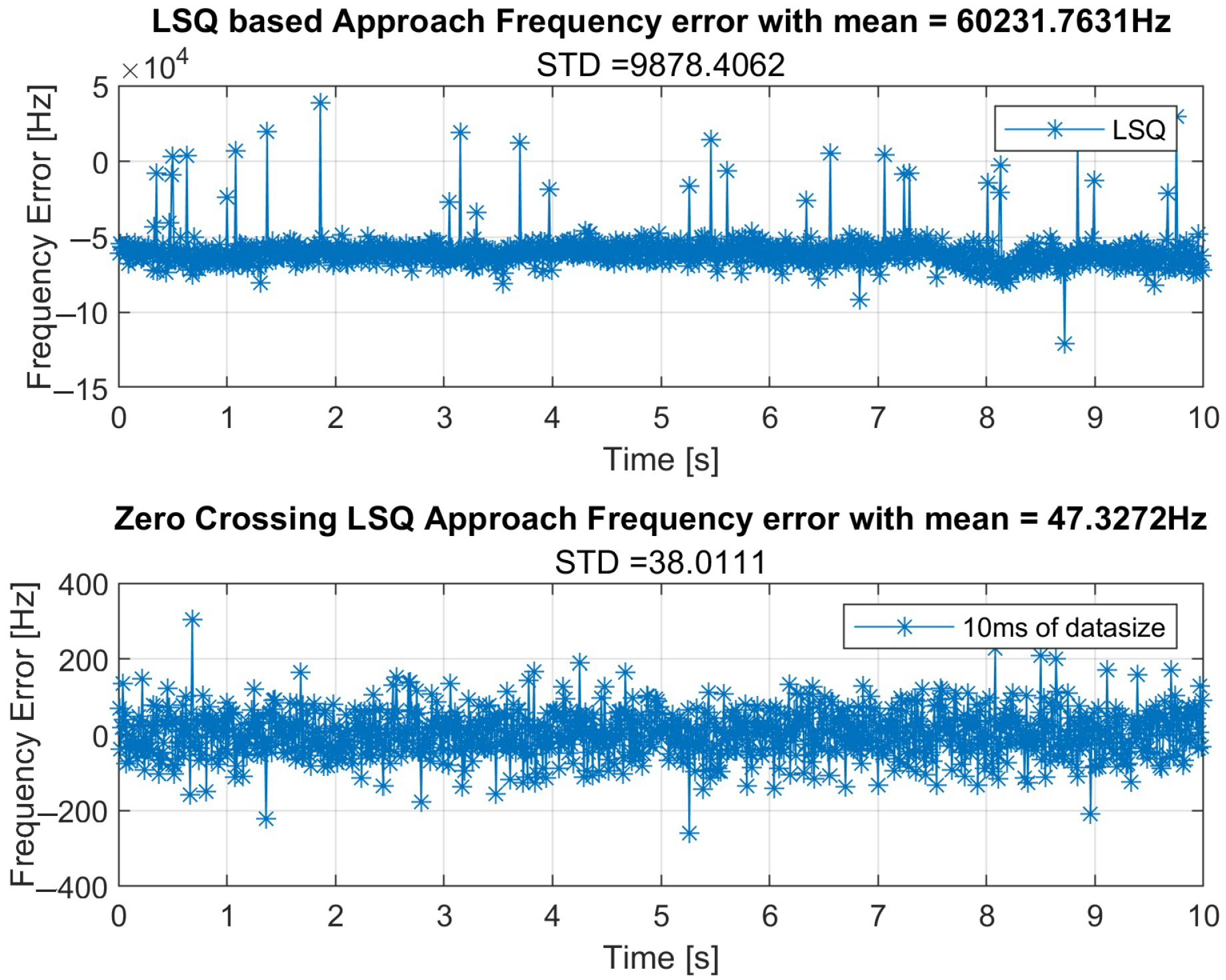
However, one can see that the stable estimation period in the preliminary testing is less than 5 μ s, which is not long enough to cover one entire DME pulse pair. For a longer period, the mean estimated frequency error can be greater than 60 KHz, as Figure 5 presents; this is due to the curve fitting assuming a relatively stable signal model, and the noise accumulated over a long period degrades the curve fitting approach accuracy.
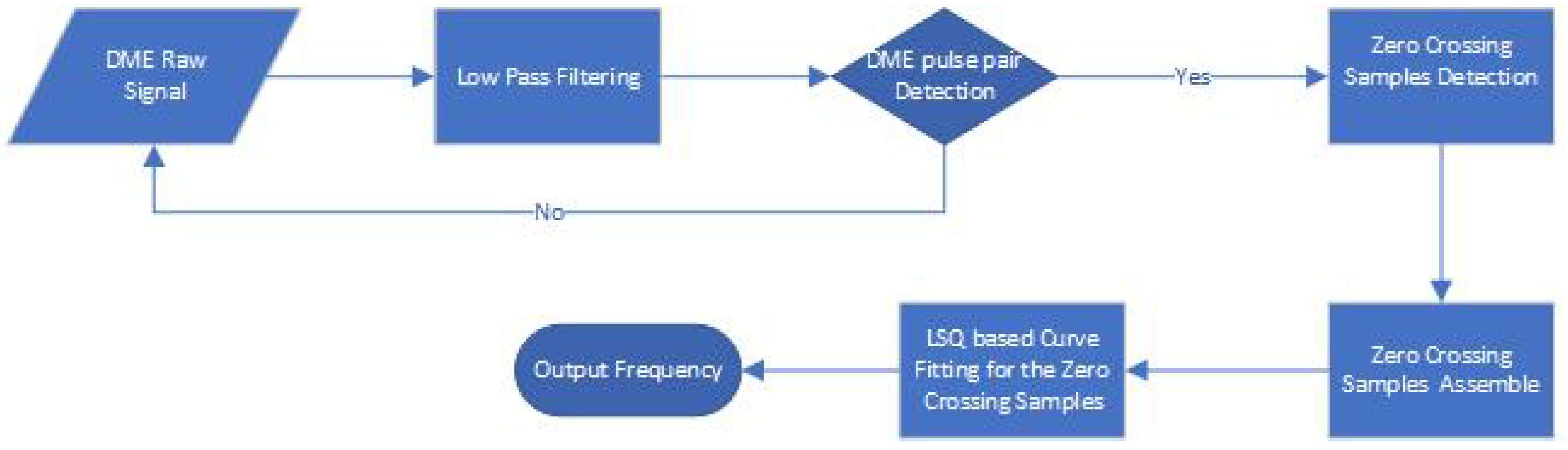
To achieve an accurate frequency estimation over a longer period, this work proposed to implement a zero-crossing average approach to estimate the DME carrier frequency, as shown in Figure 6. The zero-crossing approach can find the frequency given the interval between zero-crossing samples [10].
However, in this study, zero-crossing is not directly used to estimate the frequency but is instead employed to identify the zero-crossing samples for LSQ curve fitting. These characteristic samples are not only sufficient for estimating the overall frequency but also help mitigate the impact of noise in the LSQ curve fitting.
The low-pass filtering and DME detection procedures between the two approaches are identical. Instead of extracting samples around the DME pulse, the zero-crossing approach only selects the zero-crossing sample to minimise the impact of noise that contributes to the curve fitting approach. Figure 5 shows that the frequency estimation error is significantly reduced.

3.2. Kalman Filter-Based Phase Estimation

The main challenge of DME carrier tracking is the irregular phase measurement. Unlike a continuous signal, the carrier phase can be measured at a constant interval. Conventional carrier tracking loops, such as PLL or FLL, are designed to work with a continuous signal, relying on steady phase and frequency information to maintain a lock. DME carrier signal parameters can only be measured when the DME pulse is detected. Thus, a conventional carrier tracking loop is not feasible to track the DME signal. This work presents a Kalman filter-based method for DME carrier tacking, leveraging its predictive and estimation capability to handle the intermittent pulse modulated nature of DME signals.
The Kalman state vector x t is presented as Equation (4).
x t = ϕ t f t f ˙ t
where ϕ t , f, and f ˙ t are the carrier phase, Doppler rate, and Doppler changing rate at epoch t, respectively. The state transition model is expressed as
x t = F · x t 1 + w t 1
where F is equal
F = 1 T T 2 2 0 1 T 0 0 1 , w t 1 N ( 0 , Q )
Unlike the conventional Kalman filter, the prediction interval T in the transition vector F is inconsistent. The interval T in Equation (7) is decided by the moment when the DME pulse pair is detected. Thus, the transition vector F is adaptively updated based on the epoch corresponding to the detected DME pulse.
T = n · 1 F s
F s is the sampling rate, and n is the number of samples when DME pulse is detected.
Phase measurement and prediction in carrier tracking systems inherently suffer from phase ambiguity because both are typically confined to the range between [ π , π ] , due to the periodic nature of the trigonometric functions used to extract phase. This means the true difference between the predicted and measured phase can be different by an unknown integer multiple of 2 π , making it difficult to determine whether a phase jump is a small change or a full cycle shift. This ambiguity can lead to incorrect residual calculations and poor Kalman filter performance if not properly handled. Benefiting from measured frequency alongside the phase can help mitigate this issue. Frequency represents the time derivative of the phase and evolves smoothly without wrapping, providing unambiguous information about how the phase is changing between each epoch. By incorporating frequency into the measurement model, the Kalman filter gains a continuous, wrapping-free constraint that complements the wrapped phase measurement, allowing it to be more accurate over time. Thus, in the measurement model, the measurement z t includes both phase ϕ and frequency f z e r o c r o s s i n g and is presented as Equation (8)
z t = ϕ m e a s , t f z e r o c r o s s i n g , t = H · x t + v t
where
H = 1 0 0 0 1 0 0 0 0 , v t N ( 0 , R )
The remainder of the process follows the standard Kalman filter methodology and is therefore not elaborated upon in this study.

4. Experiment and Validation Results

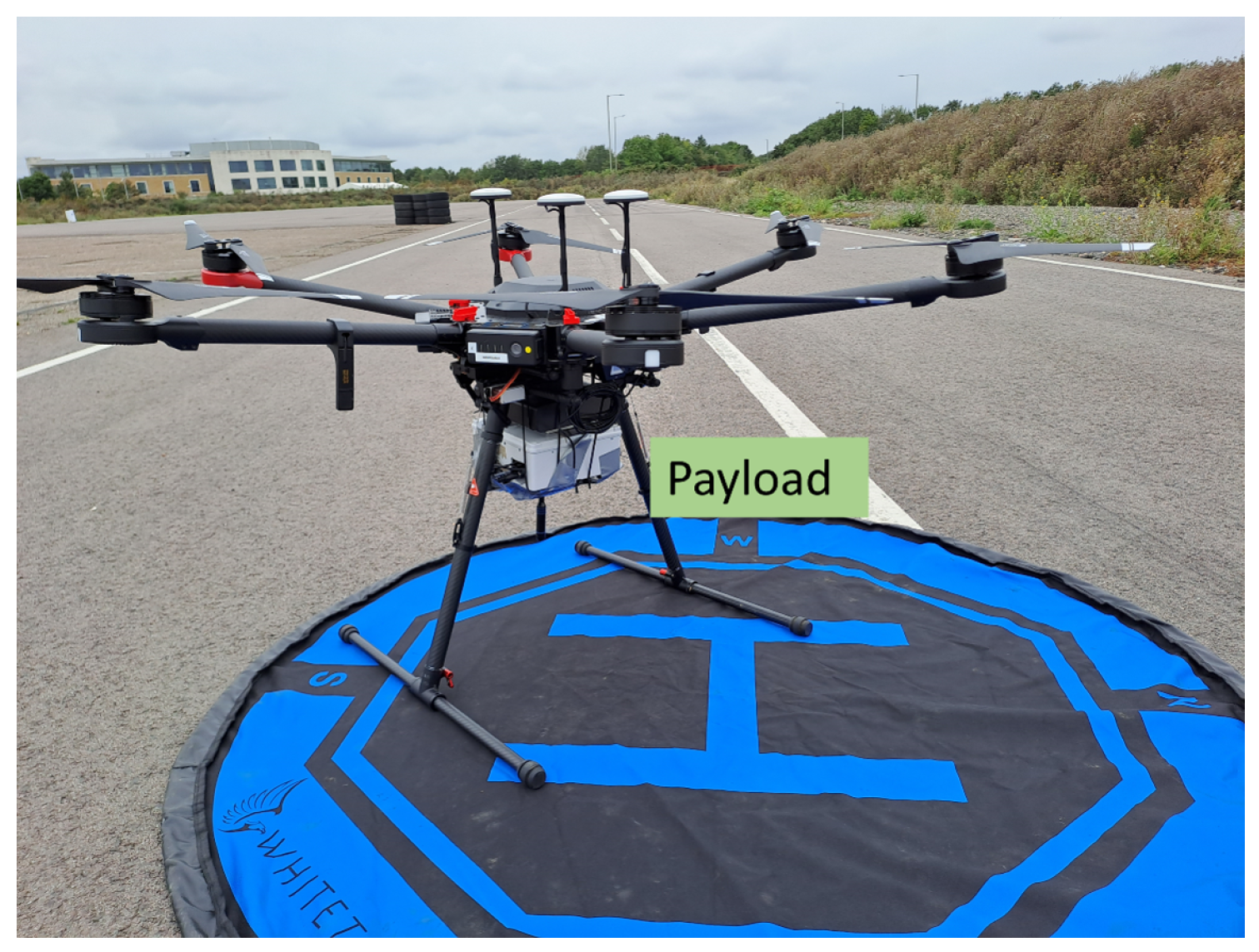
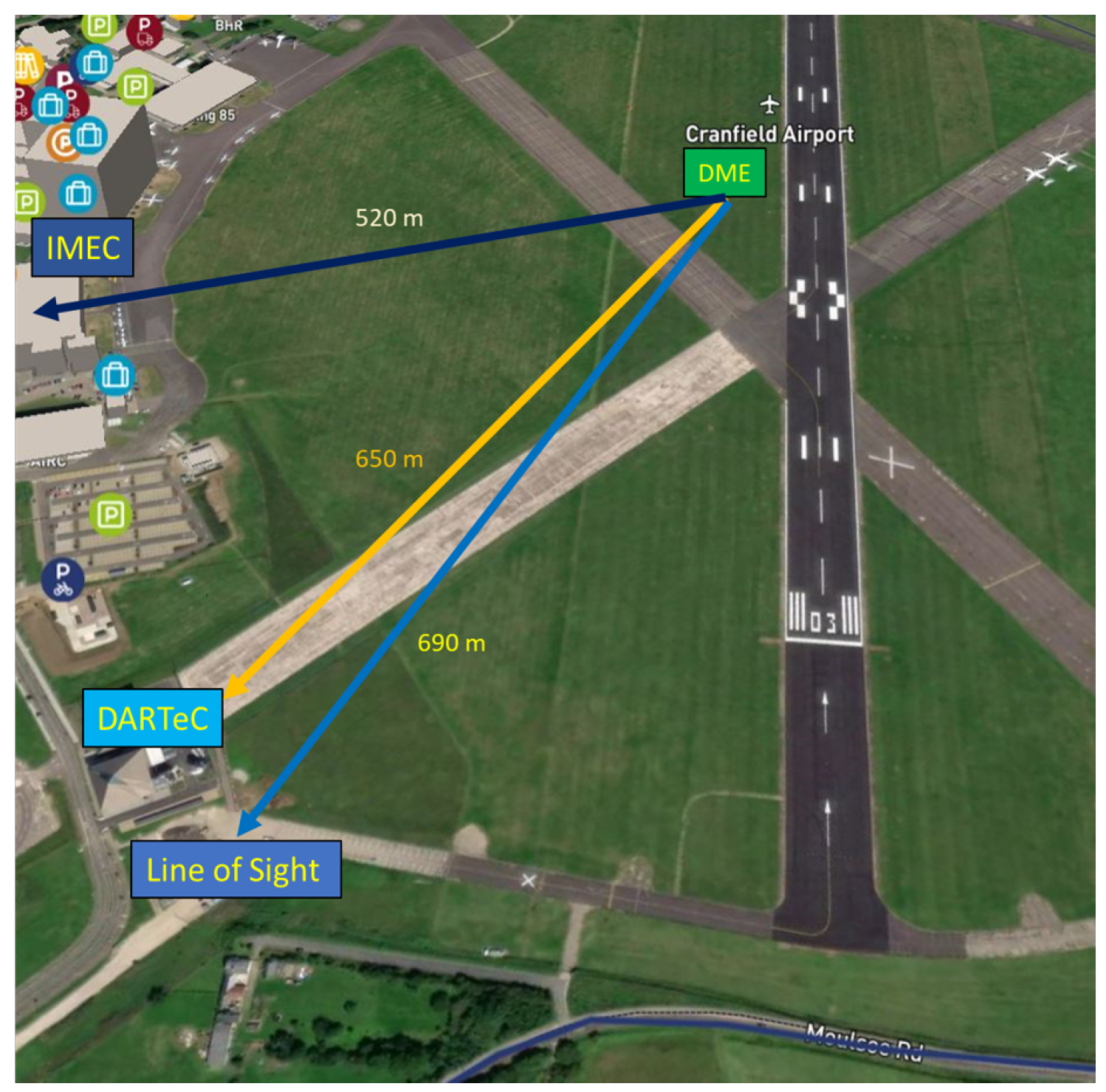
To evaluate the practical performance of the proposed Kalman filter-based DME carrier phase tracking method, a series of drone-based field tests were conducted at Cranfield University, UK. The data collection platform is presented in Figure 7. A quadrotor UAV was equipped with a bespoke Jetson-based DME data collection payload to collect the DME baseband signal. An open-sky environment was specifically selected to ensure an unobstructed line-of-sight to the DME ground station. As shown in Figure 8, the nearby buildings DARTeC and IMEC are located at a significant distance from the testing yard, thereby minimising signal blockage and reflection effects from surrounding structures. The collected DME baseband signal is then converted to a 1 MHz intermediate frequency signal for post-processing.
For initial analysis, only 10 s of data were processed to reduce computational complexity and focus on a representative segment of stable flight where signal quality was high. Additionally, within this short time window, the DME transmit frequency remains relatively stable, allowing the estimated frequency to be compared against the known transmitted frequency.
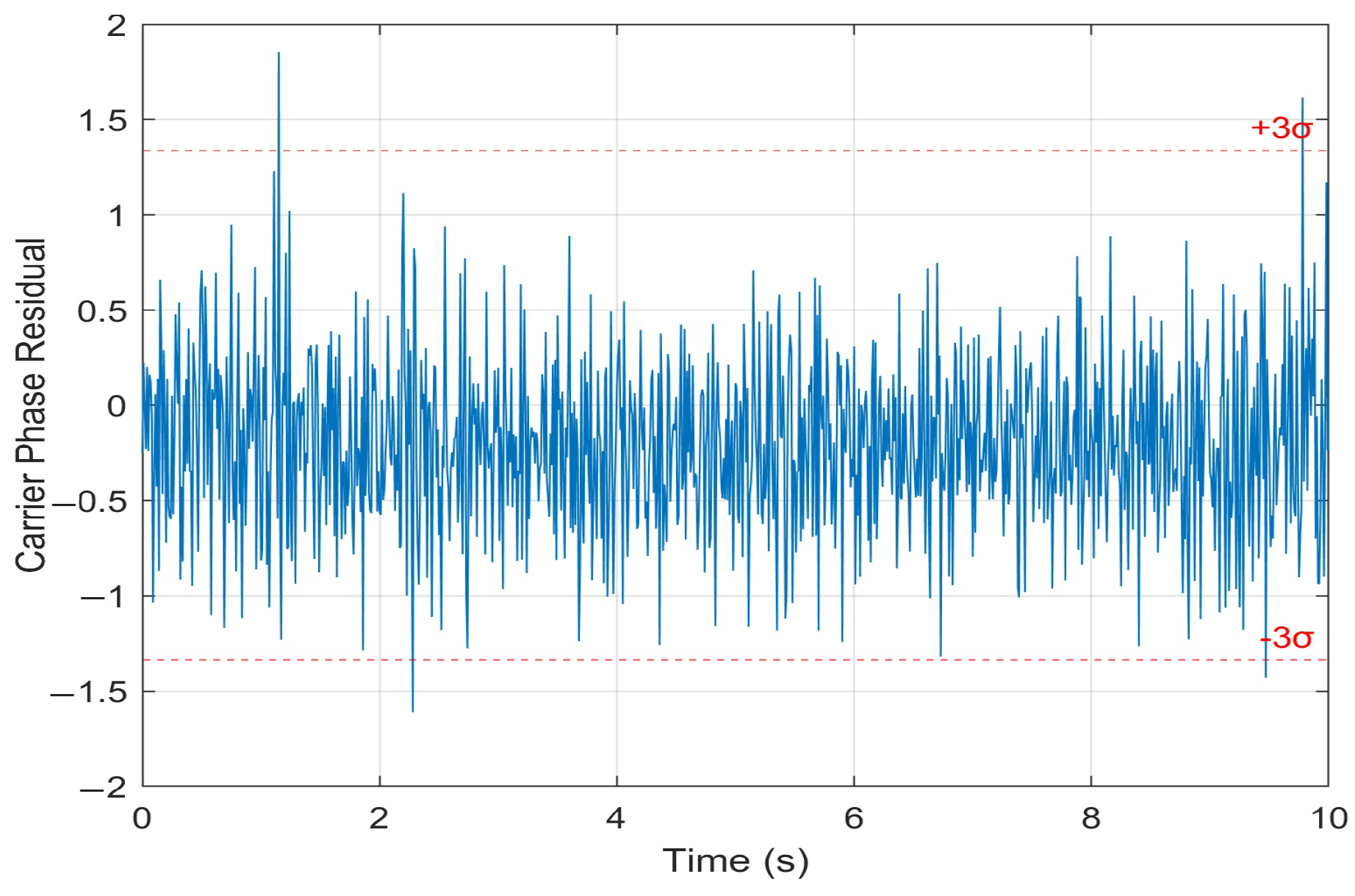
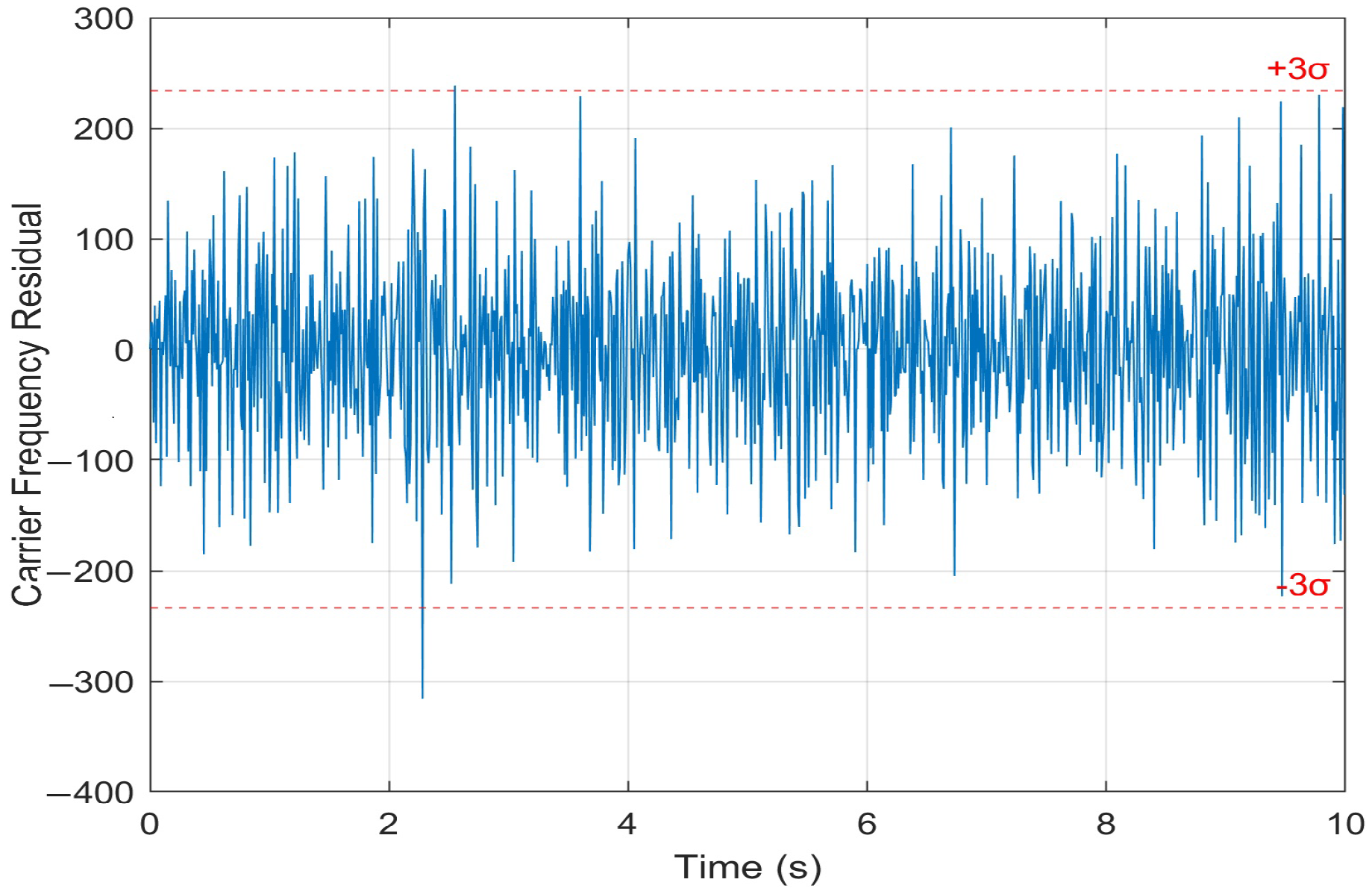
The carrier phase and frequency residual from the Kalman filter observed throughout the tracking process remain consistently within the ± 3 σ bounds, as Figure 9 and Figure 10 present, indicating that the Kalman filter is well-tuned and operating reliably. This suggests that the estimated measurement uncertainties accurately reflect the actual tracking errors, with no significant outliers or systematic bias present. The consistency within the 3 σ threshold supports the conclusion that the filter maintains good agreement between predicted and observed measurements, ensuring stable and accurate carrier phase tracking performance.
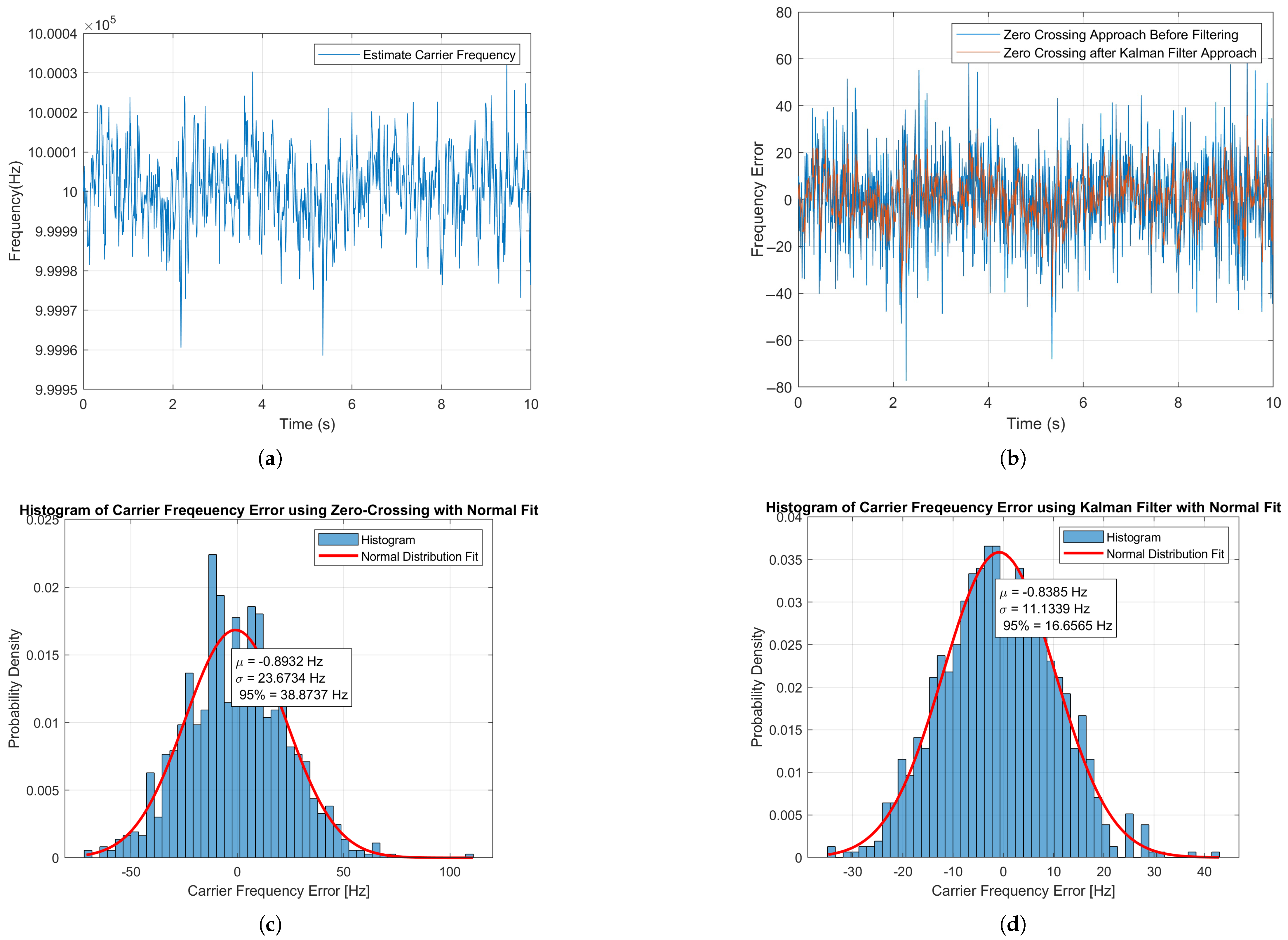
The Kalman filter frequency estimation results plot in Figure 11a shows a smooth and consistent estimate of the carrier frequency over time, with minimal fluctuations.
The Kalman filter output demonstrates lower noise and better stability, as shown in Figure 11b, when compared to the simple zero-crossing approach. A histogram comparison of these approaches is presented as Figure 11c,d; it shows that the proposed Kalman filter approach results in a more stable carrier frequency error, with 95 % of the carrier error being only 16 Hz, which is significantly lower than the 38 Hz observed with the zero-crossing approach. The comparison results clearly illustrate that the Kalman filter provides a more refined estimate. These results indicate that the Kalman filter achieves higher accuracy and robustness in frequency tracking, making it well-suited for precise carrier tracking applications.

5. Conclusions

This paper presented an enhanced DME carrier tracking approach using a Kalman filter. The Kalman filter, with its recursive estimation capabilities and arbitrary updating rate, has proven to be an effective tool for enhancing the precision and robustness of carrier phase tracking in DME systems. Benefiting from the accurate zero-crossing frequency estimation, the Kalman filter significantly improves tracking performance, especially under irregular intervals.
To validate the proposed approach, a series of field experiments is conducted using a drone platform equipped with a DME signal collection payload. The use of a drone allowed for controlled testing across varying altitudes, speeds, and manoeuvring profiles, simulating realistic scenarios in aviation and unmanned aerial systems. The results demonstrated that the proposed method meets the accuracy and stability requirements for DME carrier phase measurement in drone operations. The integration of drone-based testing not only confirmed the practical feasibility of the method but also highlighted its potential for use in emerging aerial navigation systems. Future work will focus on optimising the filter for long and real-time onboard processing and exploring its integration with other navigational aids to support autonomous flight and precise positioning in GNSS-challenged environments.

Author Contributions

J.Y. was responsible for the methodology, validation, conducted the primary research, and prepared the manuscript. T.P.A. and M.R. supported the field trial design. I.P. and A.T. contributed to supervision and critical review of the work. S.T., P.P., B.L. and M.B. contributed to reviewing and editing the manuscript. A.B. and F.S. provided funding acquisition. All authors have read and agreed to the published version of the manuscript.

Funding

This work is performed under the ESA-funded project NAVISP-EL1-052 RAASPAS.

Institutional Review Board Statement

Not applicable.

Informed Consent Statement

Not applicable.

Data Availability Statement

The data presented in this study are not publicly available due to ownership and confidentiality restrictions.

Conflicts of Interest

Authors Smita Tiwari, Pekka Peltola, Ben Lavin and Martin Bransby were employed by the company Telespazio. The remaining authors declare that the research was conducted in the absence of any commercial or financial relationships that could be construed as a potential conflict of interest.

References

  1. Kim, E. Investigation of APNT optimized DME/DME network using current state-of-the-art DMEs: Ground station network, accuracy, and capacity. In Proceedings of the 2012 IEEE/ION Position, Location and Navigation Symposium, Myrtle Beach, SC, USA, 23–26 April 2012. [Google Scholar]
  2. Kim, E. Analysis of dme/dme navigation performance and ground network using stretched-front-leg pulse-based dme. Sensors 2018, 18, 3275. [Google Scholar] [CrossRef] [Scilit] [PubMed]
  3. Lilley, R.W.; Erikson, R. DME/DME for Alternative Position, Navigation, and Timing (APNT); APNT White Paper; Department of Transportation: Washington, DC, USA, 2012. [Google Scholar]
  4. Jalloul, T.; Yeste, O.; Wessam, A.; Landry, R.; Thibeault, C. DME/DME navigation using a single low-cost SDR and sequential operation. In Proceedings of the 2014 IEEE/AIAA 33rd Digital Avionics Systems Conference (DASC), Colorado Springs, CO, USA, 5–9 October 2014. [Google Scholar]
  5. Li, K.; Pelgrum, W. Robust dme carrier phase tracking under flight dynamics. In Proceedings of the 2013 International Technical Meeting of The Institute of Navigation, San Diego, CA, USA, 29–27 January 2013; pp. 696–708. [Google Scholar]
  6. Li, K.; Pelgrum, W. Enhanced DME carrier phase: Concepts, implementation, and flight-test results. Navig. J. Inst. Navig. 2013, 60, 209–220. [Google Scholar] [CrossRef] [Scilit]
  7. Wang, X.; Luo, Y.; Zhai, Z.; Yang, L.; He, T. Algorithm for sine wave cure fit based on frequency precise estimation. In 2017 International Conference on Mechanical, System and Control Engineering (ICMSC), St. Petersburg, Russia, 19–21 May 2017; IEEE: New York, NY, USA, 2017; pp. 357–361. [Google Scholar]
  8. Giarnetti, S.; Leccese, F.; Caciotta, M. Non recursive multi-harmonic least squares fitting for grid frequency estimation. Measurement 2015, 66, 229–237. [Google Scholar] [CrossRef] [Scilit]
  9. Abdollahi, A.; Matinfar, F. Frequency estimation: A least-squares new approach. IEEE Trans. Power Deliv. 2010, 26, 790–798. [Google Scholar] [CrossRef] [Scilit]
  10. Friedman, V. A zero crossing algorithm for the estimation of the frequency of a single sinusoid in white noise. IEEE Trans. Signal Process. 1994, 42, 1565–1569. [Google Scholar] [CrossRef] [Scilit]
Figure 1. Generic Processing Diagram of Kalman Filter-Based DME Carrier Phase Tracking.
Engproc 126 00054 g001
Figure 2. Generic Processing Diagram of LSQ-based Curve Fitting Approach.
Engproc 126 00054 g002
Figure 3. LSQ Curve Fitting Approach Phase Comparison.
Engproc 126 00054 g003
Figure 4. LSQ-Curve Fitting Approach Carrier Phase Estimation Error.
Engproc 126 00054 g004
Figure 5. Carrier Frequency Estimation Error Comparison Between LSQ and Zero-Crossing LSQ-based Curve Fitting Approach.
Engproc 126 00054 g005
Figure 6. Generic Processing Diagram of Zero Crossing-based Curve Fitting Approach.
Engproc 126 00054 g006
Figure 7. DME Data Collection Drone and Payload.
Engproc 126 00054 g007
Figure 8. DME Transmitter in Cranfield University.
Engproc 126 00054 g008
Figure 9. Carrier Phase Residual in Kalman Filter.
Engproc 126 00054 g009
Figure 10. Carrier Frequency Residual in Kalman Filter.
Engproc 126 00054 g010
Figure 11. Estimated Carrier Frequency and Error Comparison: (a) Estimated Frequency from Proposed Kalman Filter Approach; (b) Estimated Frequency Error Comparison (c); Histogram of Zero-crossing aApproach; and (d) Histogram of Kalman Filter Approach.
Engproc 126 00054 g011
Disclaimer/Publisher’s Note: The statements, opinions and data contained in all publications are solely those of the individual author(s) and contributor(s) and not of MDPI and/or the editor(s). MDPI and/or the editor(s) disclaim responsibility for any injury to people or property resulting from any ideas, methods, instructions or products referred to in the content.