1. Introduction
In order to successfully deploy unmanned aerial vehicles (UAVs), certain levels of autonomous decision making have to be adopted. This also comprises the field of maintenance, repair and overhaul (MRO) of these systems. Advanced maintenance strategies, such as condition-based maintenance, rely heavily on diagnostic and prognostic methods, to detect, identify, and forecast changes in component and system health state [
1]. The corresponding processes which influence these health states can be heavily interrelated. Due to that complexity, identification of the causes for anomalies in sensor data can be challenging.
Causal models, representing causal relationships within a system, offer an option to express the relationships between system state parameters and determine the causal paths that govern health states [
2]. Furthermore, in the case of Bayesian networks (BNs), they allow us to quantify the probabilities of the root causes for anomalous observations from sensor measurements through the use of Bayesian inferencing, giving valuable input for fault isolation to decision making in condition monitoring and maintenance. BNs have been used in similar fields but also more specifically for real-time on-board health management of UAVs [
3,
4].
Potential faults and failure events are mapped within a BN, where nodes represent component states and edges capture the dependencies between states, events, causes and effects. This approach supports the fault isolation process by quantifying the probability of occurrence of specific faults or root causes based on observations made in sensor signals [
5].
This work intends to demonstrate how BNs can be used in an architecture to enhance fault and failure detection and isolation in complex engineering systems and support short- and long-term maintenance decisions.
The following sections provide a brief description of the general concept of BNs. This is followed by a summary of their application in diagnostics. Subsequently, the architecture within which the developed BN is embedded is detailed. Finally, the developed BN for a small UAV and examples of its usage are demonstrated and discussed.
2. Bayesian Networks in Diagnostics
The aim of diagnostic methods in complex engineering systems is to perform fault detection, identifying anomalies, and fault diagnosis, isolating the component which has a fault or is failing and estimating its degradation state as well as the root causes [
6].
Bayesian networks can support diagnostics and decision making also considering uncertainty.
This section offers an introductory overview of Bayesian networks (BNs) and their application in diagnostics. Additionally, the implementation of a diagnostic framework incorporating the developed BN for a small UAV is detailed.
2.1. Bayesian Networks
This section provides a concise overview of BNs, drawing from the explanations presented in [
2].
A Bayesian network is a probabilistic graphical model that represents a set of random variables
and their conditional dependencies through a directed acyclic graph. Each node corresponds to a variable
, and each directed edge
indicates that
is a direct parent of
.
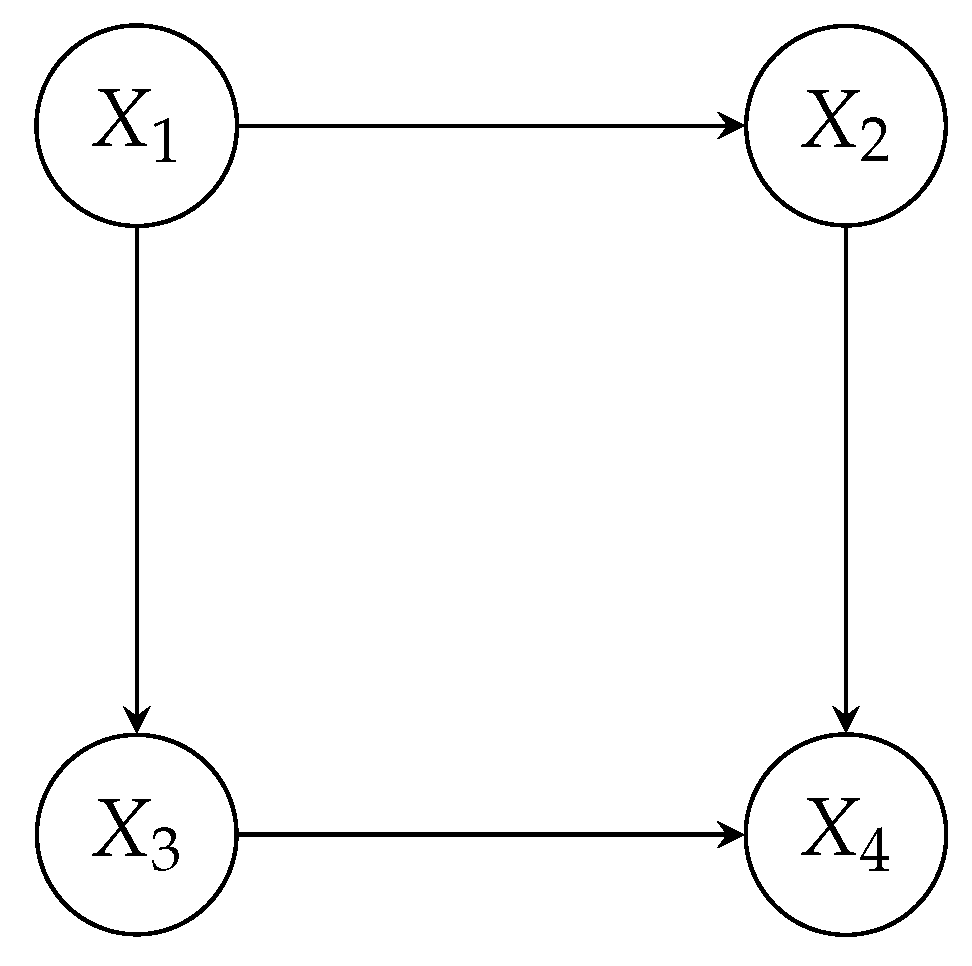
Figure 1 shows a BN with four variables.
The joint distribution over all variables factorises according to the graph:
where
denotes the set of parent variables of
.
The joint probability distribution for the network in
Figure 1 is given in Equation (
2).
Each node or variable in the network is associated with a conditional probability table (CPT) that specifies the probabilities of different states based on the values of its parent nodes. As an example, the CPT of
is shown in
Table 1.
Given specific assumptions about the variables within the network, interventions can be executed to derive the updated joint probability distribution. For instance, this can be achieved by setting
as illustrated in Equation (
3).
2.2. BN Model Structure for Diagnostics
Typically, BN-based fault diagnosis goes through different steps. The first step is to determine the graph structure of the BN model [
5]. This is normally done by analyzing the cause-and-effect relationships either through human experts or data-driven structure learning methods [
7].
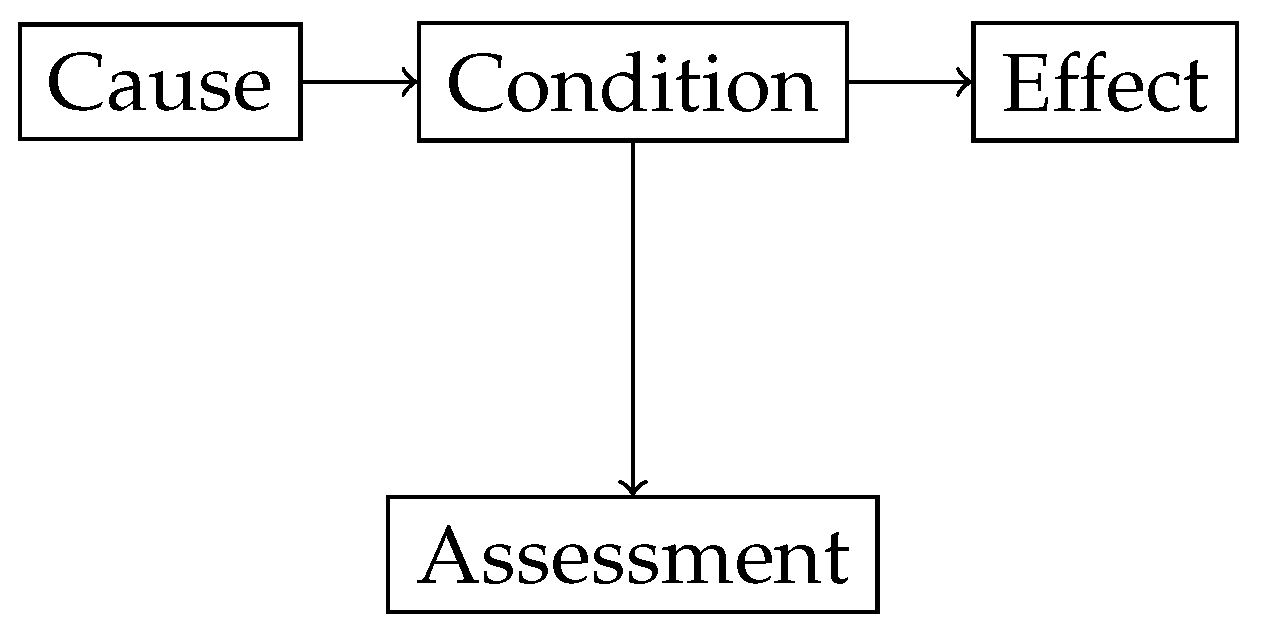
Figure 2 shows a simple static BN. The different node types are described in
Table 2. In this work, this scheme is adopted to create the more complex BN for UAV system diagnostics, which is further described later in
Section 2.3. The cause node can be used for influencing parameters from system inputs, ambient conditions or other fault and failure conditions. This can either be the current or the past value. The outgoing edge points to the condition node, which represent system state parameters such as battery power output, state of charge (SoC) or propeller crack length. These parameters are either observable or not. As the edge is directed to the effect node, system condition causes effects on other parameters, which can be observable, e.g., through sensor measurements or inspections.
Lastly, the assessment node provides an analysis of whether a condition is deemed normal or abnormal given different criteria such as other condition parameters, ambient condition and system inputs.
Temporal features related to cause, fault modes and effects can be expressed to some extent in static BNs. However, to incorporate temporal causes and effects, e.g., originating from deterioration processes of different components, dynamic Bayesian networks (DBNs) extend static BNs with time-dependent variables and reasoning, while increasing complexity and performance requirements.
The next step is the BN parameter modelling. This step includes obtaining the prior probabilities for independent nodes and conditional probability tables for dependent nodes. This information can either be derived from expert knowledge or statistical values of historical, experimental or simulation data [
5].
Uncertainty arising from sensor noise is addressed by modeling the relationship between observed measurements (sensor readings) and hidden states using conditional probability distributions. These distributions capture the likelihood of obtaining specific sensor readings including sensor noise given different possible system states [
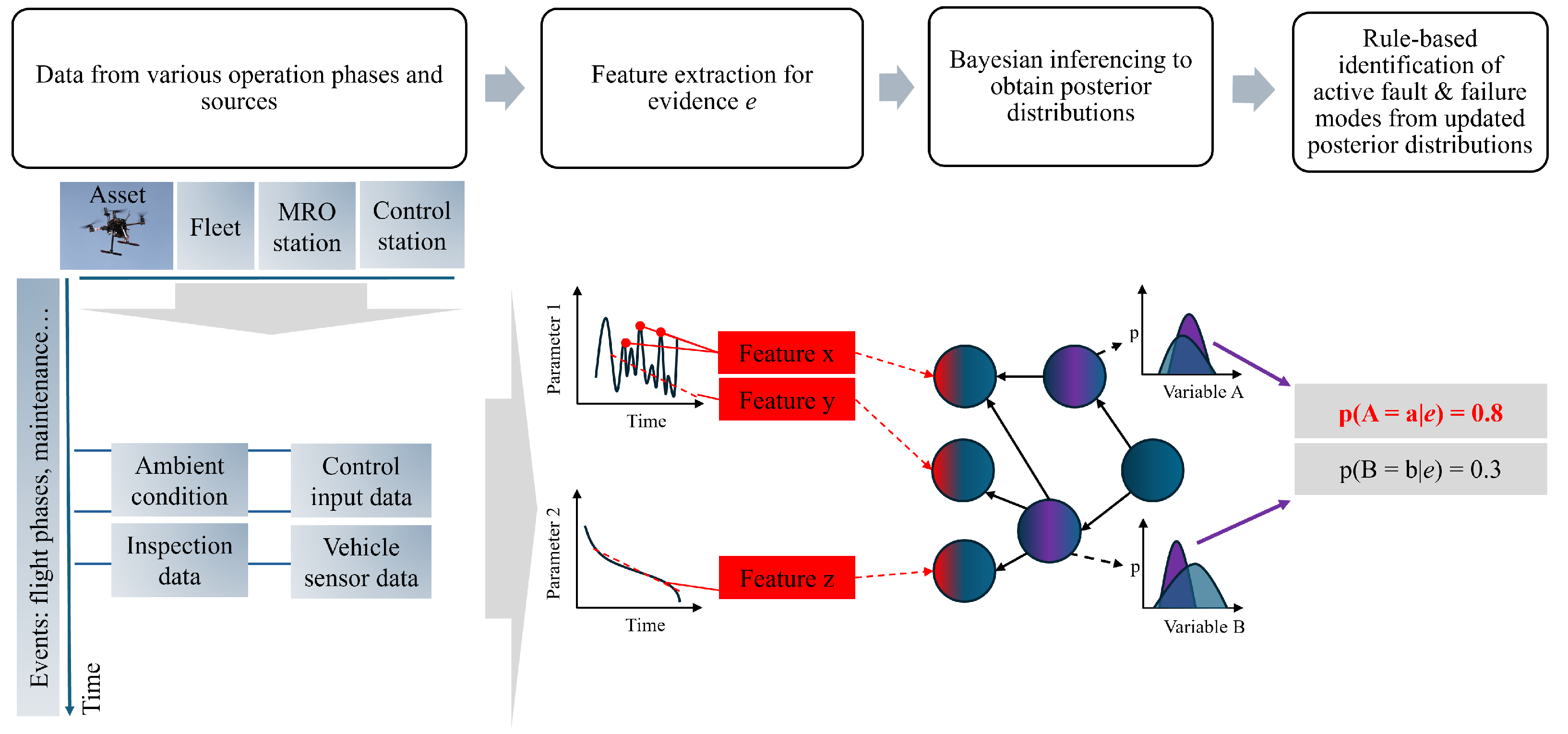
8]. Once the BN’s structure is defined and it is parameterized, it can be used adhering to the process shown in
Figure 3.
The fault identification consists of two steps: the Bayesian inferencing and, based on the resulting posterior distributions, the reasoning [
5].
As illustrated in
Figure 3, at each update interval, newly available data from current and past operational phases is utilized. This data comes from various sources including the monitored vehicle, control station, other fleet vehicles, or the MRO station. The data is used to extract necessary features for updating the BN model and computing the posterior distributions of unobservable nodes. Based on predefined rules, the obtained posterior probabilities are evaluated, and it is determined whether further actions for deeper investigation, mitigation or rectification are necessary.
2.3. BN Model for a Small UAV
In this section, a diagnostic BN for a small UAV is introduced. The subsystems considered in this work include the lithium-polymer battery, motor, and propeller. For demonstration purposes, only one power train and propeller unit are taken into account.
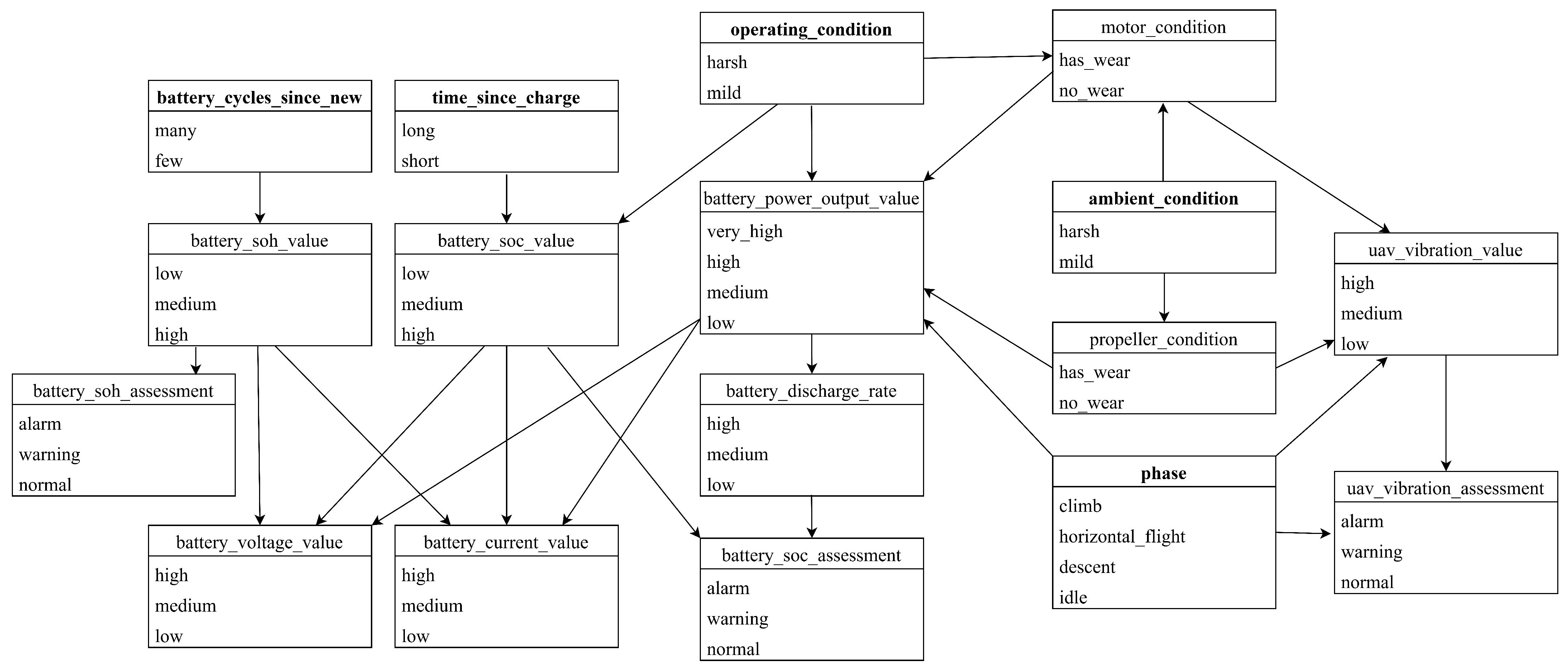
Based on a preliminary analysis of fault modes, failure effects, and their observability, the BN model is created as depicted in
Figure 4 and further described in this section. The two most important conditions of a battery to monitor are its state of charge (SoC), which represents the remaining discharge capacity expressed as a percentage of the battery’s total capacity, and its state of health (SoH), which is the ratio of the current maximum capacity to the initial maximum capacity at the beginning of the battery’s life.
Battery power output values for each flight phase of a small UAS are estimated using the rough aerodynamic models described in [
9]. The battery current and voltages, influenced by both the battery power output and its SoC and SoH, are estimated using the degradation models provided in NASA’s open-source Python package ProgPy [
10]. These obtained values are used to generate the CPTs for BN parametrization. For illustrative purposes, discrete categorical values instead of numerical continuous values are used in this work.
Among other impact factors, one important factor for SoH progression is the number of charge and discharge cycles a battery undergoes over its lifetime. The SoC is influenced by the duration under load since the last recharge and the operating conditions of the system, such as velocity or wind speed and direction. The evaluation of SoC involves assessing whether the SoC value resides within normal or alarming regions. This assessment is performed using estimated SoC values, which are derived from voltage and current sensor measurements as well as the battery discharge rate inferred from the estimated battery power output. This methodology is justified because high discharge rates are more detrimental to safe system operation when the SoC is low compared to a fully charged state.
In addition to the flight phases climb, horizontal flight, descent, and idling (on the ground), motor and propeller degradation also impact battery power demand due to changes in drag. The conditions of motors and propellers are influenced by ambient factors such as temperature, as well as the presence of erosive particles or larger impact-causing debris in the air. Motor condition is further affected by operating conditions, particularly through electro-thermal stresses. A degraded propeller or motor can induce vibrations that can be sensed by the on-board accelerometer of the UAS. This measurement is considered for vibration assessment in conjunction with the current flight phase. The mentioned relations are summarized in
Table 3.
Ref. [
11] provides a Python-based library pgmpy for creating and using BNs. Using this tool, a static BN is created. For Bayesian inferencing, the variable elimination method is used. This is an exact inference algorithm used in BNs for computing posterior probabilities of query variables given observed evidence [
8].
3. Demonstration and Discussion
The first synthetic scenario presented in
Table 4 illustrates the outcome of inference following a climb flight phase with a recently fully charged battery and medium vibration measurements. In this context, the battery current is observed to be high while the voltage remains low. Notably, no information regarding battery cycles is provided, which may realistically reflect patchy life cycle management practices for UAV batteries.
The indicators for a worn propeller and motor damage both show low values in this scenario. This can be attributed to the fact that increased vibration levels during climb phases are consistent with higher rotational speeds of the propellers. Consequently, medium-level vibrations are not considered anomalous under these conditions.
The network generates posterior distributions suggesting a low SoH value for the battery but does not provide an indication of the SoC. This observation can be explained by the combination of high current and low voltage, which is characteristic of batteries with increased internal resistance due to degradation. As the battery’s health decreases, its internal resistance rises, resulting in higher currents. The likelihood of encountering harsh operating conditions closely matches the prior probability distribution allocated to both normal and harsh operating conditions within the BN.
Table 5 presents an identical scenario as previously described, with the inclusion of additional information about the battery’s past cycles, suggesting it is relatively new. With this supplementary data, the fault identification shifts from indicating a low SoH to signaling a low SoC. Additionally, the analysis now suggests the presence of harsh operating conditions. This demonstrates the network’s capability to provide insights into the root cause of the identified fault mode.
The present study represents an ongoing endeavor, with several avenues for further development. The inclusion of probabilistic metrics such as the likelihood of misdetection and false alarms is under consideration.
To enhance the robustness and comprehensiveness of the analysis, additional fault modes and impact factors should be identified and incorporated into the framework.
Moreover, the modeling of interrelationships among components may pose challenges when utilizing directed acyclic graphs. Alternative methodologies or enhancements to existing approaches may be required to effectively capture these complex interactions.
4. Conclusions and Outlook
In this paper, the concept of integrating BNs into a diagnostic framework for UAVs has been successfully established. The setup and functionality of the BN model have been demonstrated, showcasing its ability to effectively identify the likelihood and impact of various faults. The results indicate that this approach can distinguish active fault modes and their evolution states within a system, enabling suitable prognostic methods to be applied.
The proposed methodology offers a transparent, modular, and scalable toolset for health management in UAS, which can also be extended to other domains requiring trustworthy diagnosis and prognostics of complex systems. Valuable insights into the application of BN models for diagnostic and prognostic purposes within various fields, including robotics, aerospace, and autonomous vehicles, have been contributed.
For future work, several directions are planned to be explored:
A comprehensive study of performance metrics regarding complexity and the trade-offs between exact vs. approximate inferencing.
Investigation into integrating the BN model on different platforms, such as on-edge, remote, and hybrid setups.
Development of automated structure and parameter learning methods for BNs to expedite the setup process.
Breakdown analysis of individual components within the power train, such as the electronic speed controller and power module.
Generalization of this approach to complete UAV quadcopter configurations with multiple motors and propellers and additional subsystems.
These future research directions aim to further enhance the applicability and efficiency of BN-based diagnostic frameworks in complex systems. It is believed that the findings will provide a strong foundation for advancing health management technologies across various domains, ultimately contributing to safer and more reliable operations in critical applications.
Author Contributions
Conceptualization, A.A.K.; methodology, A.A.K.; software, A.A.K.; validation, A.A.K.; formal analysis, A.A.K.; investigation, A.A.K.; resources, A.A.K.; data curation, A.A.K.; writing—original draft preparation, A.A.K.; writing—review and editing, A.A.K. and A.-K.K.; visualization, A.A.K.; supervision, A.-K.K. and F.R.; project administration, A.-K.K.; funding acquisition, G.W. All authors have read and agreed to the published version of the manuscript.
Funding
This research received no external funding.
Data Availability Statement
The raw data supporting the conclusions of this article will be made available by the authors on request.
Conflicts of Interest
The authors declare no conflicts of interest.
Abbreviations
The following abbreviations are used in this manuscript:
| BN | Bayesian Network |
| CPT | Conditional Probability Table |
| DBN | Dynamic Bayesian Network |
| MRO | Maintenance, Repair and Overhaul |
| SoC | State of Charge |
| SoH | State of Health |
| UAV | Unmanned Aerial Vehicle |
References
- Ahmad, R.; Kamaruddin, S. An overview of time-based and condition-based maintenance in industrial application. Comput. Ind. Eng. 2012, 63, 135–149. [Google Scholar] [CrossRef]
- Pearl, J. Probabilistic Reasoning in Intelligent Systems: Networks of Plausible Inference; Morgan Kaufmann Publishers Inc.: San Francisco, CA, USA, 1988. [Google Scholar]
- Schumann, J.; Rozier, K.Y.; Reinbacher, T.; J. Mengshoel, O.; Mbaya, T.; Ippolito, C. Towards Real-time, On-board, Hardware-supported Sensor and Software Health Management for Unmanned Aerial Systems. Int. J. Progn. Health Manag. 2015, 6. [Google Scholar] [CrossRef]
- Kulkarni, C.S.; Corbetta, M.; Robinson, E. Enhancing Fault Isolation for Health Monitoring of Electric Aircraft Propulsion by Embedding Failure Mode and Effect Analysis into Bayesian Networks. Annu. Conf. Phm Soc. 2020, 12, 12. [Google Scholar] [CrossRef]
- Cai, B.; Huang, L.; Xie, M. Bayesian Networks in Fault Diagnosis. IEEE Trans. Ind. Inform. 2017, 13, 2227–2240. [Google Scholar] [CrossRef]
- Zio, E. Prognostics and Health Management (PHM): Where are we and where do we (need to) go in theory and practice. Reliab. Eng. Syst. Saf. 2022, 218, 108119. [Google Scholar] [CrossRef]
- Kitson, N.K.; Constantinou, A.C.; Guo, Z.; Liu, Y.; Chobtham, K. A survey of Bayesian Network structure learning. Artif. Intell. Rev. 2023, 56, 8721–8814. [Google Scholar] [CrossRef]
- Koller, D.; Friedman, N. Probabilistic Graphical Models: Principles and Techniques—Adaptive Computation and Machine Learning; The MIT Press: Cambridge, MA, USA, 2009. [Google Scholar]
- Sierra, G.; Orchard, M.; Goebel, K.; Kulkarni, C. Battery health management for small-size rotary-wing electric unmanned aerial vehicles: An efficient approach for constrained computing platforms. Reliab. Eng. Syst. Saf. 2019, 182, 166–178. [Google Scholar] [CrossRef]
- Teubert, C.; Griffith, K.J.; Corbetta, M.; Kulkarni, C.; Banerjee, P.; Watkins, J.; Daigle, M. ProgPy, version 1.5. ProgPy Python Prognostics Packages. Zenodo: Geneva, Switzerland, 2025. [CrossRef]
- Ankan, A.; Textor, J. pgmpy: A Python toolkit for Bayesian networks. J. Mach. Learn. Res. 2024, 25, 1–8. [Google Scholar]
| Disclaimer/Publisher’s Note: The statements, opinions and data contained in all publications are solely those of the individual author(s) and contributor(s) and not of MDPI and/or the editor(s). MDPI and/or the editor(s) disclaim responsibility for any injury to people or property resulting from any ideas, methods, instructions or products referred to in the content. |