Proceeding Paper

Conceptualization and Numerical Optimization of an Energy-Efficient Electrothermal Ice Protection System for a Ducted Fan Propeller †
by
Cedric Obatolu
1,2,*,
Rainer Bartels
1 and
Sebastian Neveling
2,3
1
Institute of Flight Systems, German Aerospace Center (DLR), 38108 Braunschweig, Germany
2
Innovation Center for Small Aircraft Technologies, German Aerospace Center (DLR), 52146 Würselen, Germany
3
Institute of Lightweight Systems, German Aerospace Center (DLR), 38108 Braunschweig, Germany
*
Author to whom correspondence should be addressed.
Presented at the 15th EASN International Conference, Madrid, Spain, 14–17 October 2025.
Eng. Proc. 2026, 133(1), 127; https://doi.org/10.3390/engproc2026133127 (registering DOI)

Published: 13 May 2026

Abstract

In-flight icing poses a major risk to the flight safety and operational availability in aviation and particularly to small electric aircraft. One suitable ice protection system (IPS) concept is the electrothermal IPS; however, it often suffers from high power consumption if not properly optimized. Ducted fans are a promising propulsion technology for urban air mobility applications, but effective IPSs for ducted fan propellers have been rare thus far. This work thus presents a framework for the development of an energy-efficient electrothermal IPS for application in an off-the-shelf ducted fan propeller. Three-dimensional ice accretion simulations of the ducted fan’s assembly were performed under centrifugal loads using the commercial icing simulation code ANSYS® FENSAP-ICE-TURBO and the most critical areas for ice accretion on the ducted fan were identified. On the basis of the ice accretion simulations, the expected performance change of the ducted fan due to ice accretion on the rotor blades was evaluated. The placement and activation of the heating elements on the rotor blades were investigated and optimized using a one-dimensional electrothermal de-icing solver.

1. Introduction

In-flight icing is caused by the impingement of liquid supercooled water droplets at a temperature < 0 °C on an aircraft’s structure, freezing on the surface, which results in the build-up of an ice layer. It can cause a reduction in lift, an increase in drag, and a decrease in the stall angle of attack [1]. Thus, icing poses a major risk to aviation and has caused a number of accidents in the past [2]. Particularly vulnerable are small electric aircraft [3] and propellers [4]. This is mainly due to the current lack of suitable ice protection systems (IPSs). The conventional hot-air IPS requires engine bleed air, which is unavailable for electric aircraft and difficult to transfer into the rotating structure of propellers. Electrothermal IPSs, which use resistive heating, solve these limitations, but can suffer from high power consumption when not designed optimally. Consequently, the optimization of the layout and activation of electrothermal IPSs on propellers is a topic of current research. Müller et al. [5] designed a carbon fiber-based electrothermal anti-icing system for a propeller, using two spanwise heating zones. Targui and Habashi [6] employed fully 3D conjugate heat transfer simulations combined with reduced-order modelling to optimize the placement and power density of a rotor blade anti-icing system. Kozomara et al. [7] experimentally investigated multiple IPSs for a rotor of a 25kg drone, including icephobic coatings, a chemical IPS, and an electrothermal IPS, based on a screen printed carbon-filled ink. Kalow et al. [8] experimentally investigated the anti-icing and de-icing performance of both an electrothermal heater and a waste-heat system on a rotor in DLR’s whirl tower icing and de-icing test facility (EVA).
Apart from classical open propellers and rotors, other propulsion systems for electric aircraft have been developed. One promising technology for future urban air mobility aircraft is the ducted fan, mainly because it promises reduced noise emissions [9]. However, to the authors’ knowledge, there is currently no published research on the ice protection of ducted fan blades. Thus, a ducted fan [10] was acquired from the company Jetpel® GmbH for the testing of energy-efficient IPSs. The Jetpeller is a known reference from the DLR project S2TOL, where a silent gyrocopter was developed, employing the Jetpeller as a propulsor [11]. It has seven rotor blades with a diameter of approx. 85 cm and a tip chord length of approx. 18.5 cm , ten stator blades and a maximum static thrust of 1500 N at an electrical power of 60 kW . The Jetpeller has both rotating and stationary components, an advantage for the testing of several IPS technologies at EVA. This work focuses on the development of a numerical framework for the design and optimization of a structurally integrated electrothermal IPS for the Jetpeller’s rotor blades.
At first, an overview of the utilized software and setups is given, consisting of a 3D ice accretion simulation with CFD re-calculations and a 1D electrothermal de-icing solver. In the next section, the obtained results from the numerical simulations are presented. Finally, the results are critically discussed and an outlook on future research activities is given.

2. Materials and Methods

This section details the software and setups used for the 3D ice accretion simulations, the associated CFD re-calculations, and the 1D de-icing study.

2.1. 3D Ice Accretion Simulations

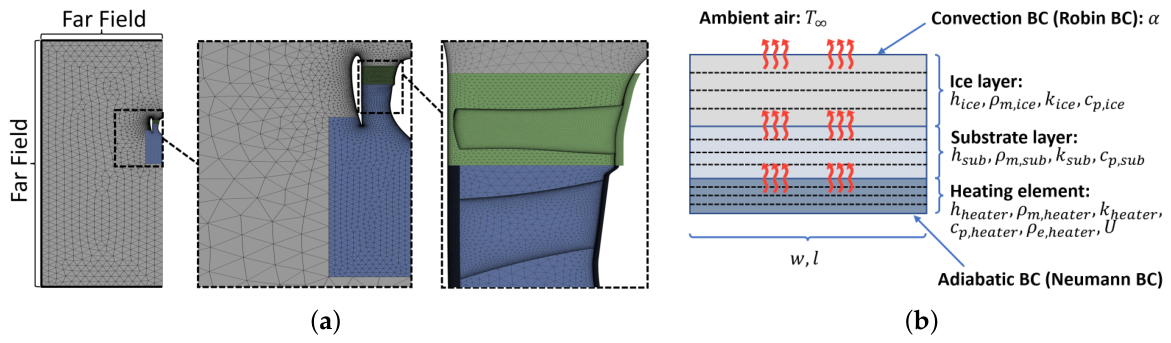
Time-dependent ice accretion simulations on the complete ducted fan’s assembly were done using ANSYS FENSAP-ICE-TURBO’s ICE3D module [12,13,14] (version 2023R1) to identify areas of ice accretion. ICE3D is based on the shallow water icing model [13], which calculates the local ice accretion based on an energy and mass balance, taking into account the effects of droplet impingement, crystallization, water runback, evaporation, radiation, convection, and surface conduction. The walls subject to ice accretion are set adiabatic, i.e., no heat exchange with the surface is permitted. ICE3D requires the results from a CFD simulation to calculate heat transfer coefficients, water film velocities, and other quantities. These results are obtained from the ANSYS CFX® solver. The setup is shown in Figure 1a and consists of three domains: 1. Far field and inlet; 2. Rotor; 3. Stator, outlet, and wake. The domains are connected via mixing plane interfaces (IF), and periodic boundary conditions (BC) are used to reduce computational effort. Based on the obtained rotor blade ice shapes, CFD re-calculations were conducted in order to gather information on the performance change.

2.2. 1D Electrothermal Solver

A one-dimensional heat conduction code, based on a Crank–Nicolson scheme [15], was conceived. The setup is shown in Figure 1b. It consists of three separate material layers, stacked on top of each other. The bottom layer represents the heating element. Its lower BC is set adiabatic for simplicity. The layup has a length l and a width w and the heater has a thickness h h e a t e r . A voltage is applied in the lengthwise direction to the heater. With the heater’s electrical resistivity ρ e , h e a t e r , the heating power is obtained from the following relation [16]:
P h e a t e r = U 2 R = U 2 · w · h h e a t e r l · ρ e , h e a t e r .
A substrate layer exists on top of the heater, which acts both as a thermal conductor between the heater and ice layers and as an electrical isolation of the heater. On top of the substrate, the ice layer to be removed is located. At the ice layer’s surface, a convective BC is imposed. The calculation starts with the entire layup at the environmental temperature T = 10 ° C and the heater is immediately activated. When the IF temperature between the substrate and ice layer reaches 0 °C, melting commences. The de-icing criterion is thus set at 0 °C, as the strong centrifugal forces expected on the rotating blades are assumed to remove any accreted ice as soon as a shallow water film is established. The required time and energy for de-icing is retrieved. All relevant baseline parameters of the setup are detailed in Table 1. Based on this setup and the baseline configuration, both sensitivity and parameter studies were performed to optimize the electrothermal IPS power consumption and de-icing time. It is noted that this does not constitute a formal global optimization, but rather a parametric variation around the baseline used to identify promising design directions.

3. Results

In this section, the obtained results from the numerical studies are presented. This includes the determined areas of ice accumulation, the resulting performance change, and the results of the 1D de-icing studies.

3.1. 3D Ice Accretion Simulations

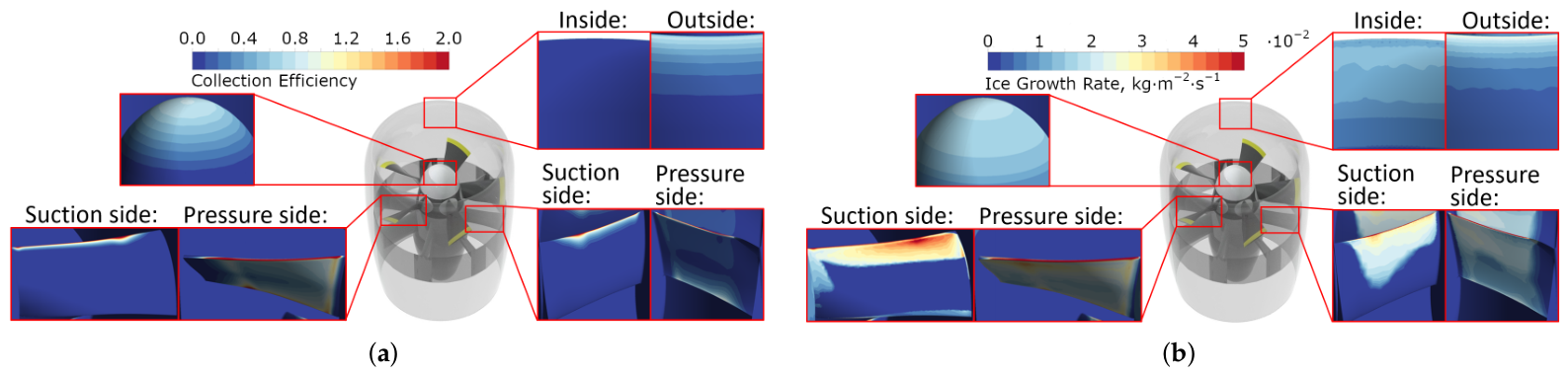
Ice accretion simulations were conducted on the ducted fan’s assembly. All simulations were performed at an ambient temperature T = 10 ° C , a median volume diameter M V D = 40 μ m , and a rotational speed n = 2000 rpm , resulting in a blade-tip Reynolds number of R e t i p = 1.3 · 10 6 . These values were selected to be consistent with the operating conditions planned for future icing experiments at EVA. A freestream velocity U = 15 m s ahead of the Jetpeller’s inlet was obtained from simplified CFD calculations of the Jetpeller installed inside EVA. The liquid water content L W C = 1.5 g m 3 was calculated assuming a uniform droplet distribution within the area of accelerated airflow (diameter approx. 1.7 m) ahead of the Jetpeller and the known spray nozzle water mass flow rate of 3 kg min . The results from FENSAP-ICE-TURBO’s DROP3D module, presented in Figure 2a, show that the main areas of droplet impingement are the rotor blades, especially on the leading edge and pressure side. To a smaller extent, ice accretion on the stator blades, the spinner cap, and the nacelle leading edge is observed. The ice growth rate on the assembly, calculated by ICE3D, is shown in Figure 2b. As expected, areas with high local droplet impingement generally show fast growth of the ice layer. Due to water runback, some areas with low droplet impingement also have a fast-growing ice layer, most notably the suction sides of the rotor and stator blades, the pressure side of the rotor near the blade tip, and the inner side of the inlet.
The ice shape after the run of the ICE3D module is shown in Figure 3 at three separate radial positions of the rotor blade at various time steps. Clearly, the entire pressure side of the rotor is affected by ice build-up. Despite low local impingement on the suction side, a significant ice layer is observed up to around 35% chord length due to water runback, with the affected area growing slightly with increasing radial position.
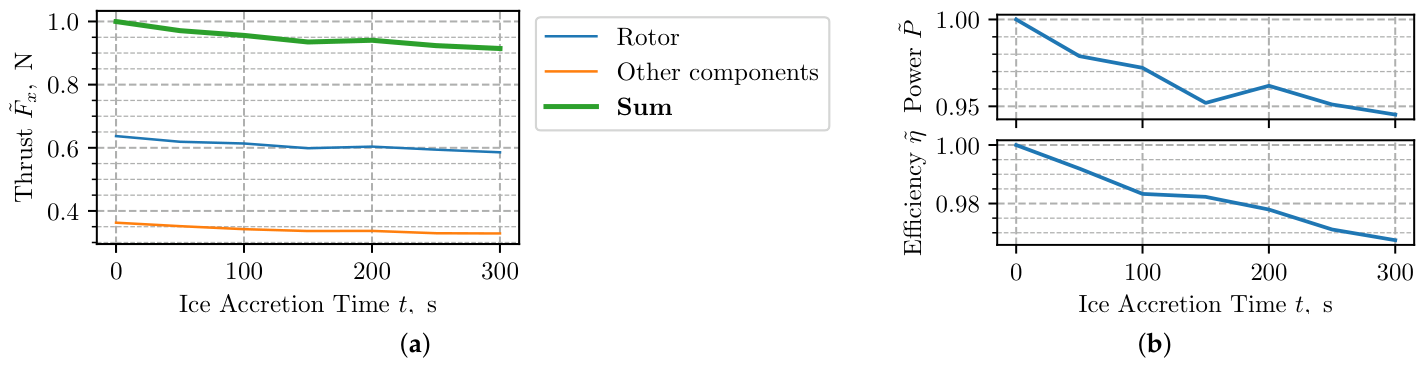
From here on, only the effect of the ice accretion on the rotor blades is considered, i.e., the remaining components are assumed to be free of ice. CFD re-calculations were performed based on the obtained rotor blade ice shapes at time intervals of Δ t = 50 s . Figure 4a shows the change of thrust F ˜ x , while Figure 4b depicts the resulting shaft power P ˜ and propeller efficiency η ˜ over the ice accretion time. All performance metrics were normalized with the ice-free reference case.
Thrust, power, and efficiency all generally decrease over time. This is expected for the thrust, as the ice shape leads to local flow separation on the suction side; however, the decrease in shaft power is surprising. A possible explanation is the reduction of induced drag through the lower thrust. An initial decrease in propeller thrust after the start of the icing process has been observed in some experiments, e.g., [5]. From t 350 s , no CFD re-calculations could be performed, since the ice shape at the blade tip begins to collide with the rotor shroud, which would lead to non-physical results.
A conservative allowable decrease in thrust of 5% is assumed, as n = 2000 rpm is already close to the maximum rotational speed allowed at EVA. Thus, the ice shape resulting at t = 100 s , with a maximum thickness of 5.3 mm and an average thickness of approx. 3.5 mm , is evaluated in the further de-icing studies. At this point, the overall thrust drops by 4.4% and the propeller efficiency is reduced by 1.7%.

3.2. 1D Electrothermal Solver

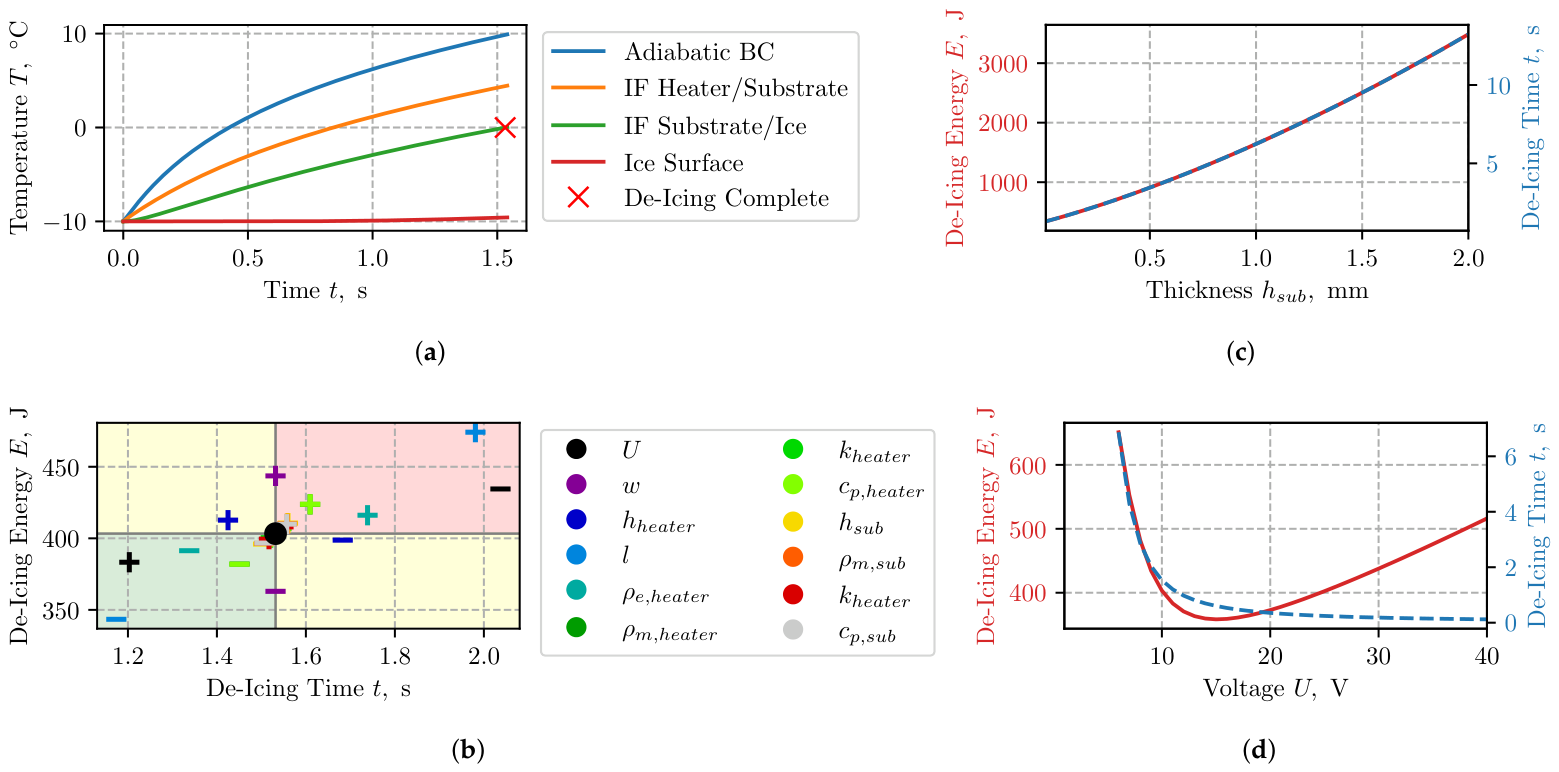
A baseline set of geometrical and material parameters was assumed based on the conditions and results of the 3D ice accretion simulations on the rotor blades (see Table 1). For the 1D de-icing studies, the IPS on the suction side of the blade is considered as a representative case, which was estimated to require the dimensions of w = 4.5 cm and l = 28 cm based on the calculated ice shape. The temperature distribution within the considered material layers during the de-icing process is shown in Figure 5a. In this case, de-icing is achieved in t = 1.53 s , with the heating element drawing P h e a t e r = 263 W at a voltage of U = 10 V , leading to a total de-icing energy requirement of E = P h e a t e r · t = 403 J . The maximum temperature at the adiabatic BC is evaluated to be T m a x = 9.92   ° C , which is unproblematic for the cured epoxy resin employed in the ducted fan’s rotor blades.
  • The parameters’ influence on the expected de-icing time and energy was investigated in a sensitivity study. The parameters X were varied individually around their baseline values:
    X = [ X , X r e f , X + ] = [ 0.9 X r e f , X r e f , 1.1 X r e f ] ,
    Meanwhile, the other parameters were kept at the baseline state. The results are depicted in Figure 5b. The central black dot marks the baseline state. The parameters decreased from their baseline X are marked with a “−” symbol, while the parameters increased from their baseline X + are marked with a “+” symbol. The lower left quadrant is marked in green, because it defines the desirable zone. For example, by decreasing c p , h e a t e r , both de-icing time and energy are reduced compared to the baseline. In contrast, the upper right quadrant is shown in red. For instance, an increase of ρ e , h e a t e r leads to both a larger de-icing time and energy. The remaining quadrants are marked yellow, as results in these zones mark a trade-off between de-icing time and energy. For example, an increase of h h e a t e r promises faster de-icing, but a slight increase in energy consumption.
Because the results of the sensitivity study in part depend on the choice of the baseline state, a parameter study was conducted, where one of the parameters was varied over a wider range, while the other parameters again remained at their baseline. The obtained de-icing time and energy for the variation of h s u b and U are shown in Figure 5c,d as exemplar results. An increase in the substrate layer thickness leads to both a longer de-icing time and higher energy requirement. Thus, the heating element should be placed as close as possible to the blade’s surface. For the input voltage, an increase leads to a shorter de-icing time; however, for U > 15 V , the required energy rises again, with U = 15 V leading to the global minimum required de-icing energy, E = 358 J in this case.

4. Discussion

As only the initial flow simulation was considered for the ice accretion study, the effects of the changing surface geometry due to ice accretion and shedding on the local droplet impingement were not considered, e.g., the fact that the ice layer forming on the blade’s suction side forms a ridge with strong local flow separation. To capture such effects, a significant increase in computational resources, due to the increasingly complex ice shapes, is required. Still, in order to obtain more realistic ice shapes and power/efficiency changes, these effects should be considered in future studies. Dynamic effects associated with asymmetric mass distributions are also outside the scope of the present framework.
The ballistic threat of ice shedding has not been assessed in this study. Although the acquired Jetpeller’s rotor shroud is fitted with aramid fiber reinforcements and protective tape, the IPS activation should first be tested at shorter de-icing intervals to rule out impact damage. The decrease in required power to keep the ducted fan’s propeller at 2000 rpm with increasing ice layer thickness is surprising. The reduction of driving torque because of the smaller induced drag has been identified as a possible cause. Although an initial decrease in power has been observed previously (e.g. [5]), the effect is long-lasting in the present study and it should be a focus of future tests employing the Jetpeller at EVA.
Although the 1D electrothermal solver in its present state is a helpful tool for determining the appropriate dimensions and material properties of an electrothermal IPS, more phenomena should be taken into account. For instance, the assumption of an adiabatic BC on the interior surface of the heating element is an idealization, because realistically, part of the heater’s power supply will be conducted into the structure. A water film model should be implemented to account for the crystallization heat and sensible heat of impacting droplets, and to allow adhesion loss to only take place at a more conservative temperature > 0 °C. The implementation of a 3D thermal simulation in ANSYS Mechanical for more accurate results for the 3D blade is currently in progress.
In future works, experiments will be conducted at EVA to validate the numerical tools used in this study. For this purpose, the Jetpeller will be mounted on EVA’s rotor rig. Ice accretion tests will be done to verify the areas vulnerable to icing and validate the effects on thrust, power, and efficiency. Multiple IPS concepts will be integrated into the structure of the ducted fan and their effectiveness and efficiency will be critically assessed.

5. Conclusions

A workflow for the conceptualization and optimization of an electrothermal IPS for a ducted fan propeller has been developed. Initial results were presented for a test case oriented around the expected icing conditions at EVA. Specifically, areas of ice accretion were identified using 3D icing simulations, and the rotor blade’s leading edge and pressure side were found to have the highest icing risk, with water runback leading to additional accretion on the suction side up to approx. 35% chord length.
The performance change due to ice accretion on the propeller blades was evaluated using CFD re-calculations. Thrust, efficiency, and power all reduced with an increased time of ice accretion. Based on the ducted fan’s thrust degradation, an IPS activation time of t = 100   s at a maximum ice thickness of 5.3   mm and a thrust loss of 4.4% was found to be suitable.
A 1D solver was implemented to optimize the parameters of an electrothermal IPS on the blade’s suction side. The baseline state showed de-icing in t = 1.53   s at an energy requirement of 403   J with a maximum material temperature of 9.92   ° C . With sensitivity and parameter studies, it was shown that de-icing energy and time can be improved; heater placement closer to the iced surface lowers both time and energy, while changing the heater thickness leads to a trade-off between an improvement in de-icing time or energy. For the applied voltage, an energy minimum of E = 358 J was observed at U = 15 V .

Author Contributions

Conceptualization, C.O. and R.B.; methodology, C.O. and S.N.; software, C.O.; validation, R.B. and S.N.; writing—original draft preparation, C.O.; writing—review and editing, R.B. and S.N.; visualization, C.O.; supervision, R.B.; project administration, R.B. All authors have read and agreed to the published version of the manuscript.

Funding

This research received no external funding.

Institutional Review Board Statement

Not applicable.

Informed Consent Statement

Not applicable.

Data Availability Statement

Data will be made available on request, provided it does not conflict with any non-disclosure agreements.

Acknowledgments

We thank Jetpel GmbH and Helix-Carbon GmbH for their productive cooperation. We thank Christoph Deiler for taking on the role of internal reviewer.

Conflicts of Interest

The authors declare no conflicts of interest.

Abbreviations

The following abbreviations are used in this manuscript:
IPSIce protection system
EVAIcing and de-icing test facility/Ver- und Enteisungsversuchsanlage
BCBoundary condition
IFInterface

References

  1. Bragg, M.B.; Broeren, A.P.; Blumenthal, L.A. Iced-airfoil aerodynamics. Prog. Aerosp. Sci. 2005, 41, 323–362. [Google Scholar] [CrossRef]
  2. Green, S. A Study of U.S. Inflight Icing Accidents and Incidents, 1978 to 2002. In Proceedings of the 44th AIAA Aerospace Sciences Meeting and Exhibit, Reno, NV, USA, 9–12 January 2006. [Google Scholar] [CrossRef]
  3. Zhou, L.; Yi, X.; Liu, Q. A Review of Icing Research and Development of Icing Mitigation Techniques for Fixed-Wing UAVs. Drones 2023, 7, 709. [Google Scholar] [CrossRef]
  4. Gent, R.W.; Dart, N.P.; Cansdale, J.T. Aircraft icing. Phil. Trans. R. Soc. A. 2000, 358, 2873–2911. [Google Scholar] [CrossRef]
  5. Müller, N.C.; Løw-Hansen, B.; Borup, K.T.; Hann, R. UAV icing: Development of an ice protection system for the propeller of a small UAV. Cold Reg. Sci. Technol. 2023, 213, 103938. [Google Scholar] [CrossRef]
  6. Targui, A.; Habashi, W. On a reduced-order model-based optimization of rotor electro-thermal anti-icing systems. Int. J. Numer. Methods Heat Fluid Flow 2022, 32, 2885–2913. [Google Scholar] [CrossRef]
  7. Kozomara, D.; Amon, J.; Puffing, R.; Neubauer, T.; Schweighart, S.; Diebald, S.; Rapf, A.; Moser, R.; Breitfuss, W. Experimental Investigation of UAS Rotors and Ice Protection Systems in Appendix C Icing Conditions; SAE Technical Paper 2023-01-1380; SAE International: Warrendale, PA, USA, 2023. [Google Scholar] [CrossRef]
  8. Kalow, S.; Bartels, R.; Schneider, O.; Sahyoun, D.; Keimer, R. Icing and De-Icing under Centrifugal Loads in DLR’s whirl tower facility. In Proceedings of the 49th European Rotorcraft Forum 2023, Buckeburg, Germany, 5–7 September 2023; pp. 1–12, ISBN 978-3-932182-92-1. Available online: https://publikationen.dglr.de/?id=620&tx_dglrpublications_pi1[document_id]=54801019 (accessed on 17 April 2026).
  9. Davis, D.G.M. Ducted Propulsors for General Aviation. Aircr. Eng. 1977, 49, 5–7. [Google Scholar] [CrossRef]
  10. Weintraub, D.; Koppelberg, J.; Köhler, J.; Jeschke, P. Ducted fans for hybrid electric propulsion of small aircraft. CEAS Aeronaut. J. 2022, 13, 471–485. [Google Scholar] [CrossRef]
  11. Weintraub, D.; Koppelberg, J.; Köhler, J.; Jeschke, P. Aufbau Einer Elektrisch Angetriebenen Tragschrauberkonfiguration für Den Urbanen Luftverkehr. Deutscher Luft-Und Raumfahrtkongress. Deutsche Gesellschaft Für Luft-Und Raumfahrt. 2023. Available online: https://elib.dlr.de/199324/ (accessed on 17 April 2026).
  12. ANSYS Inc. Ansys FENSAP-ICE User Manual. 2023R1. 2023. Available online: https://ansyshelp.ansys.com/Views/Secured/corp/v231/en/pdf/Ansys_FENSAP-ICE_User_Manual.pdf (accessed on 17 April 2026).
  13. Bourgault, Y.; Beaugendre, H.; Habashi, W.G. Development of a Shallow-Water Icing Model in FENSAP-ICE. J. Aircr. 2000, 37, 640–646. [Google Scholar] [CrossRef] [PubMed]
  14. Veillard, X.; Habashi, W.G.; Baruzzi, G.S. Icing Simulation in Multistage Jet Engines. J. Propul. Power 2011, 27, 1231–1237. [Google Scholar] [CrossRef]
  15. Crank, J.; Nicolson, P. A Practical Method for Numerical Evaluation of Solutions of Partial Differential Equations of the Heat-Conduction Type. Math. Proc. Camb. Philos. Soc. 1947, 43, 50–67. [Google Scholar] [CrossRef]
  16. Tipler, P.A.; Mosca, G. Physics for Scientists and Engineers, 6th ed.; W. H. Freeman and Company: New York, NY, USA, 2008; pp. 845–850. [Google Scholar]
  17. The Engineering ToolBox. Ice-Thermal Properties. Available online: https://www.engineeringtoolbox.com/ice-thermal-properties-d_576.html (accessed on 26 November 2025).
  18. Krauklis, A.E.; Starkova, O.; Gibhardt, D.; Kalinka, G.; Aouissi, H.A.; Burlakovs, J.; Sabalina, A.; Fiedler, B. Reversible and irreversible effects on the epoxy GFRP fiber-matrix interphase due to hydrothermal aging. Compos. Part Open Access 2023, 12, 100395. [Google Scholar] [CrossRef]
  19. Azar, K.; Graebner, J.E. Experimental Determination of Thermal Conductivity of Printed Wiring Boards. In Proceedings of the 12th IEEE Semi-Therm Symposium, Proceedings, Austin, TX, USA, 5–7 March 1996; pp. 169–182. [Google Scholar] [CrossRef]
  20. Engineers Edge. Thermal Properties of Non-Metals. Available online: https://www.engineersedge.com/heat_transfer/thermal_properties_of_nonmetals_13967.htm (accessed on 26 November 2025).
  21. Haufler Composites. Carbon UD 150g/m2 Epoxy Prepreg. Available online: https://www.compositeshop.de/xoshop/lng/en/\fibers/carbon-fiber/carbon-ud-150gm-epoxy-prepreg.html (accessed on 26 November 2025).
  22. Abry, J.C.; Bochard, S.; Chateauminois, A.; Salvia, M.; Giraud, G. In situ detection of damage in CFRP laminates by electrical resistance measurements. Compos. Sci. Technol. 1998, 59, 925–935. [Google Scholar] [CrossRef]
  23. Joven, R.; Das, R.; Ahmed, A.; Roozbehjavan, P.; Minaie, B. Thermal Properties of Fiber/Epoxy Composites with Different Fabric Weaves. 2012. Available online: https://www.academia.edu/3307464/Thermal_Properties_of_Carbon_Fiber_Epoxy_Composites_with_Different_Fabric_Weaves (accessed on 17 April 2026).
Figure 1. Numerical setups: (a) flow/icing simulation setup; (b) 1D electrothermal solver setup.
Engproc 133 00127 g001
Figure 2. Icing simulation results on the ducted fan: (a) local droplet impingement; (b) local instantaneous ice growth rate.
Engproc 133 00127 g002
Figure 3. Blade ice shape at three radial positions after ice accretion, and ice-free surface for reference.
Engproc 133 00127 g003
Figure 4. Ducted fan’s performance change due to rotor icing: (a) thrust over icing time; (b) power/efficiency over icing time.
Engproc 133 00127 g004
Figure 5. 1D electrothermal solver results. (a) Baseline case: Temperature over time. (b) Sensitivity study: Influence on de-icing time and de-icing energy. (c) Parameter study: Substrate thickness. (d) Parameter study: Applied voltage.
Engproc 133 00127 g005
Table 1. Parameters of the 1D electrothermal de-icing solver setup and their baseline values.
ParameterExplanationBaseline ValueUnit
α Surface heat transfer coefficient 1500 W / ( m 2 · K )
h i c e Average thickness of ice layer 1 3.5 mm
ρ m , i c e Mass density of ice layer 1917 kg / m 3
k i c e Isotropic thermal conductivity of ice layer [17] 2.3 W / ( m · K )
c p , i c e Heat capacity of substrate layer [17] 2.0 kJ / ( kg · K )
h s u b Thickness of substrate layer 2 0.072 mm
ρ m , s u b Mass density of substrate layer [18]1690 kg / m 3
k s u b Through-thickness thermal conductivity of substrate layer [19] 0.29 W / ( m · K )
c p , s u b Heat capacity of substrate layer [20] 1.15 kJ / ( kg · K )
h h e a t e r Thickness of heater layer 2 0.48 mm
ρ m , h e a t e r Mass density of heater layer [21]1570 kg / m 3
ρ e , h e a t e r Electrical resistivity of heater layer [22] 2.93 · 10 5 Ω · m
k h e a t e r Through-thickness thermal conductivity of heater layer [23] 0.8 W / ( m · K )
c p , h e a t e r Heat capacity of heater layer [23] 0.8 kJ / ( kg · K )
UVoltage applied to heater layer 310 V
wWidth of laminate layup 1 4.5 cm
lLength of laminate layup 128 cm
1 Ice accretion simulation; 2 unmodified blade material layup; 3 initial estimation.
Disclaimer/Publisher’s Note: The statements, opinions and data contained in all publications are solely those of the individual author(s) and contributor(s) and not of MDPI and/or the editor(s). MDPI and/or the editor(s) disclaim responsibility for any injury to people or property resulting from any ideas, methods, instructions or products referred to in the content.