1. Introduction
According to the Airbus 2025 Global Market Forecast [
1], the average annual traffic growth is projected to sustain a rate of 4.0% over the next twenty years, necessitating over 43,000 aircraft deliveries by 2040. This exponential growth of air transport poses a real problem to the sustainability of aviation. In this context, the European Commission has set ambitious goals in Flightpath 2050: Europe’s Vision for aviation [
2] to mitigate the aviation’s environmental footprint. Among these targets are a reduction of 75% in CO
2 emissions and a 90% reduction in NOx emissions per passenger-kilometer by 2050. These ambitious goals are unlikely to be achieved with existing technologies and aircraft concepts. Therefore, the development of alternative environmentally friendly energy sources, new aircraft concepts and technologies, and more sustainable flight mission profiles is necessary to significantly reduce aircraft emissions.
Among the proposed solutions, a promising contender is the adoption of a concept with high-aspect-ratio (HAR) wings. Quantitative research studies [
3,
4,
5] show that increasing wingspan can result in a substantial decrease in fuel consumption, mainly by reducing induced drag and therefore lowering emissions.
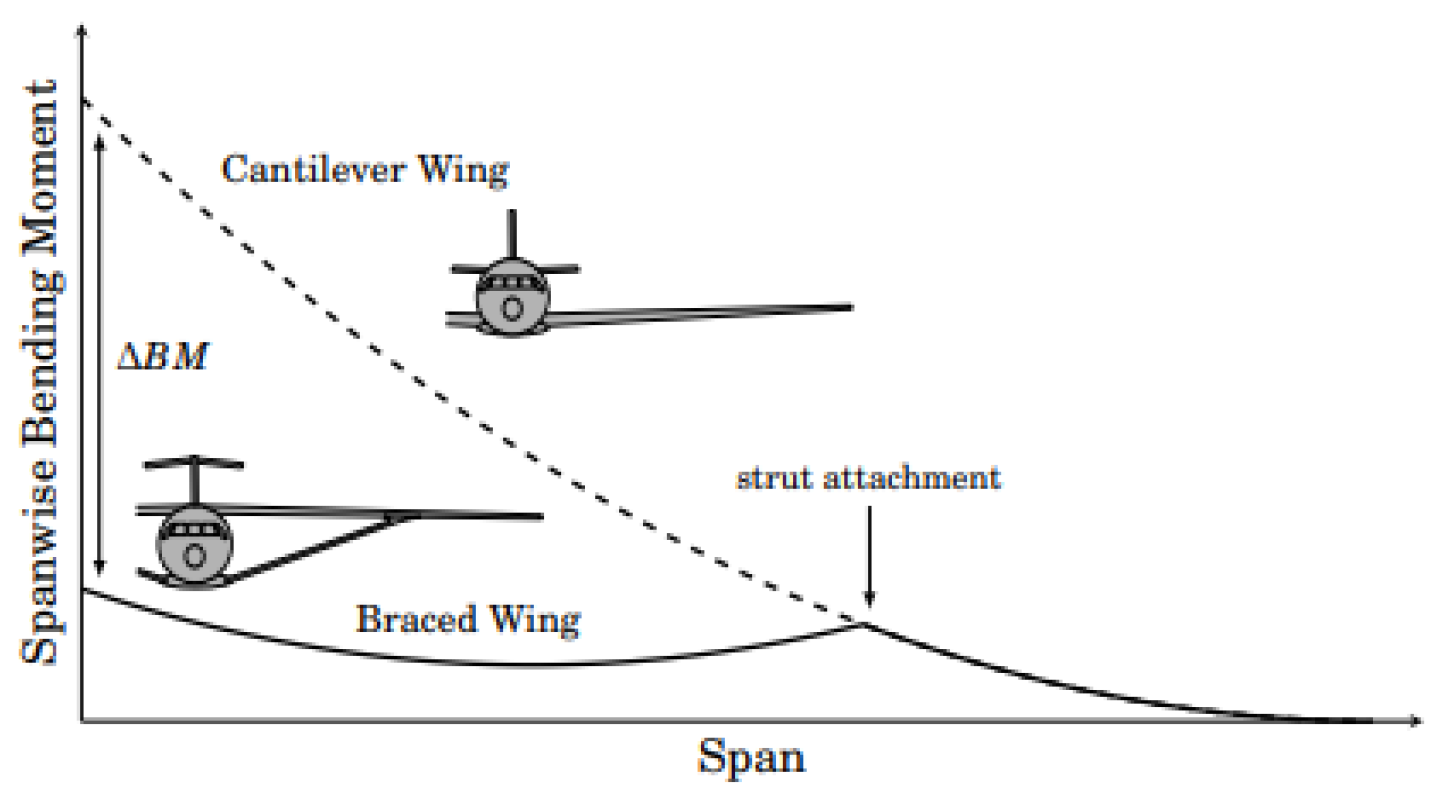
However, the high-aspect-ratio (HAR) wings present some drawbacks, making their design very tedious. These include the higher wing weight due to the increased bending moment at the wing root. One solution to address this challenge is the adoption of strut-braced wings, which aim to balance the aerodynamic efficiency provided by increased aspect ratio with the reduction in structural weight enabled by the additional strut that alleviates the root bending moment, as seen in
Figure 1 [
6].
Due to their inherent aerodynamic and structural complexities, traditional aircraft design methods and tools are inadequate for such wings. Therefore, new and suitable design approaches are needed to fully investigate their potential.
The objective of this work is to propose a low-fidelity approach that combines an OAD methodology with finite element structural analysis to allow the sizing, trade-off studies, optimization and structural assessment of regional strut-braced wing aircraft.
2. Materials and Methods
2.1. Overall Aircraft Design Approach
The overall aircraft design approach integrates all key disciplines—such as geometry, aerodynamics, weight, and others—early in the design process to size aircraft concepts and identify the most promising ones for further development.
FAST-OAD [
7], an open-source OAD framework developed by ISAE-SUPAERO and ONERA, will serve as the baseline tool in this work. Based on the OpenMDAO framework [
8] and relying on fast “Level-0” analytical models, it enables rapid sizing of conventional aircraft. Its modular and flexible architecture allows easy integration, removal, or extension of models, which makes it suitable for exploring new configurations of aircraft.
To enable sizing of strut-braced configurations, low-fidelity physics-based models [
9] suitable for such concepts are integrated into the FAST-OAD loop. The primary structure of the wing is computed by aerostructural analysis of the wing. Using the positive and negative maneuver load factors, the external and internal loads are evaluated, including aerodynamic loads (either from an elliptic distribution or computed using a VLM solver), fuel distribution, engine loads, structural weight relief, and the loads induced by the strut. The resulting component surface areas are subsequently used to compute the primary wing weight. The secondary wing structural masses are estimated using the same empirical models. For strut sizing, a beam-like model is implemented, and only the tension in the strut—assumed to represent a portion of the total aircraft lift—is considered.
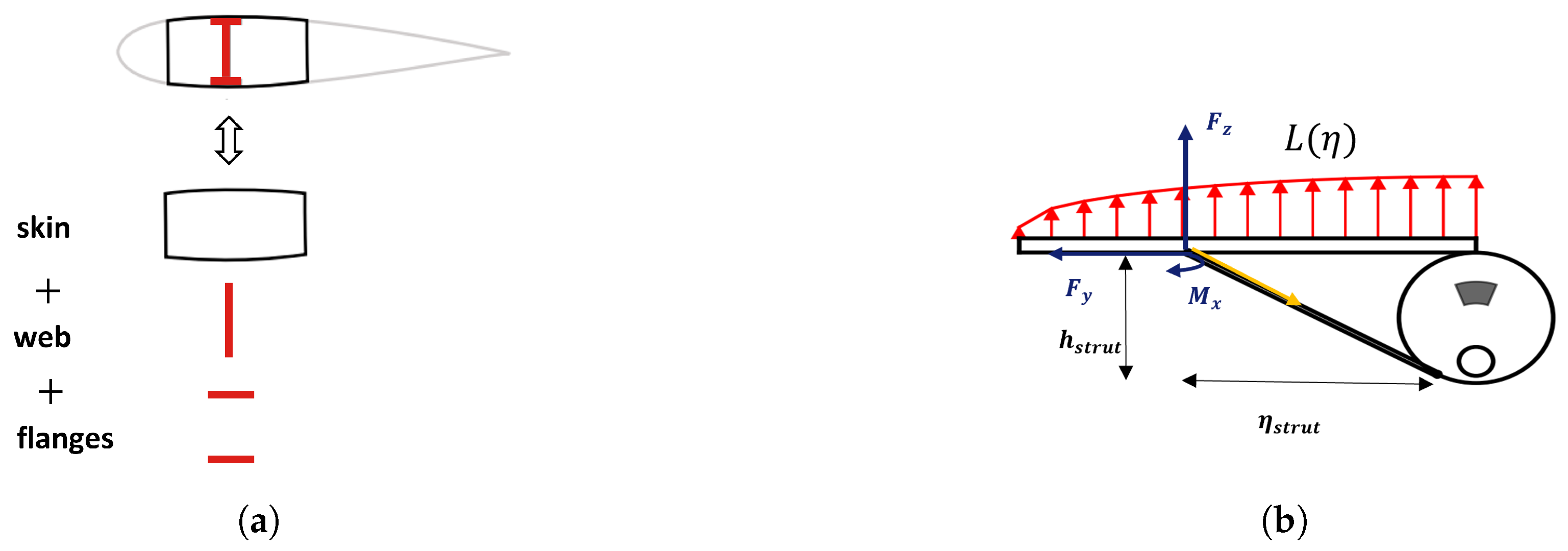
Figure 2 illustrates the implemented wingbox model and the strut-braced wing parametrization.
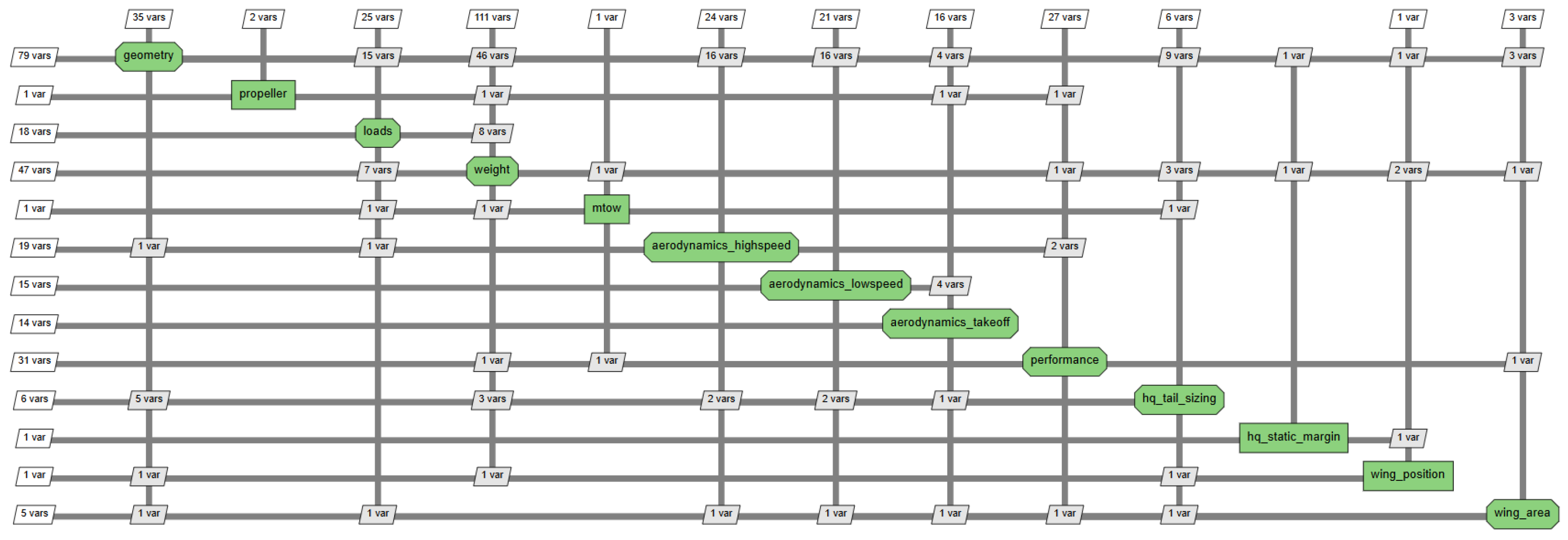
The resulting multidisciplinary design process of the strut-braced wing configuration is presented in
Figure 3.
2.2. Structural Analysis
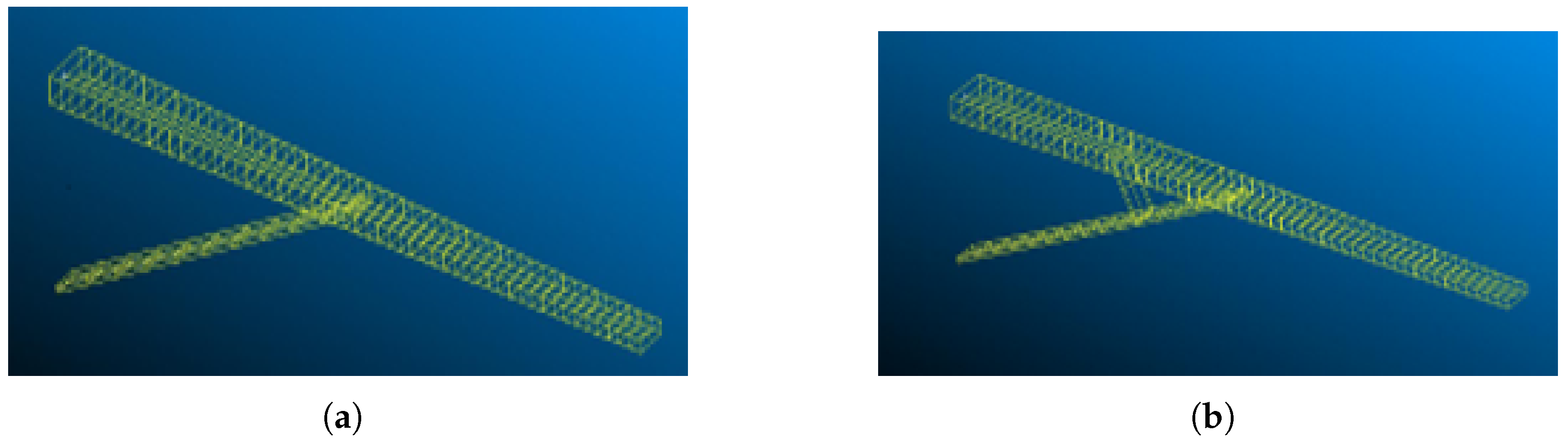
To investigate the effects of the additional jury and strut connections on the structural behavior of the wing, low-fidelity models of the optimal strut-braced wing obtained from the OAD sizing (illustrated in
Figure 4) were created and analyzed using PATRAN NASTRAN.
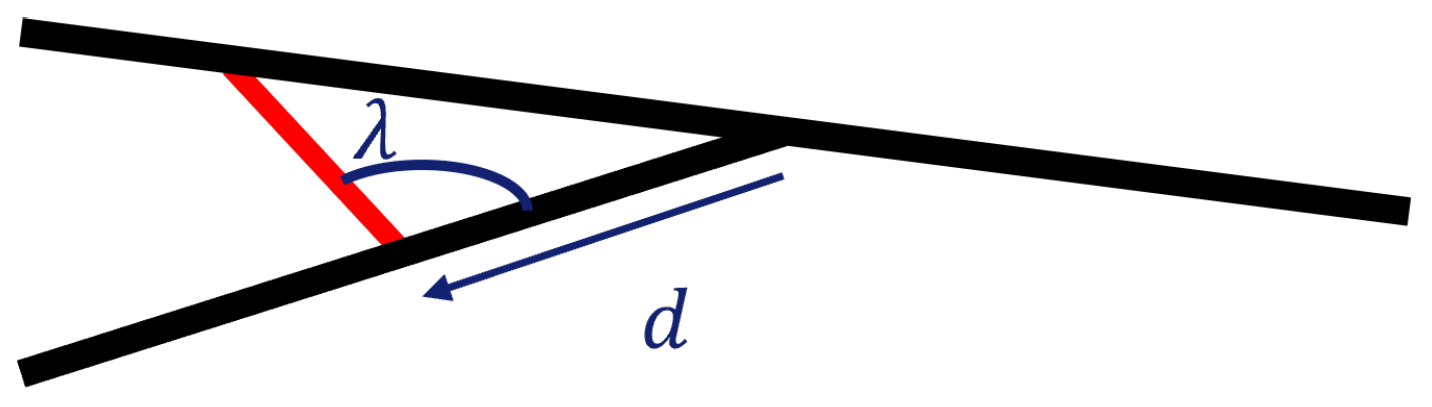
To assess the impact of the jury, a parametric study was first performed to determine the optimal position of the jury relative to the strut–wing junction and the optimal angle between the jury and the wing, as shown in
Figure 5. Then, a structural optimization was carried out–with and without the jury–to prevent buckling under −1 g maneuver load.
The strut–fuselage and strut–wing connections can be either rigid (‘clamped’) or free to rotate (‘pin’). To investigate their impact, we performed static and buckling analysis under +2.5 g and −1 g loads for four configurations: clamped–clamped, ‘clamped–pin’, ‘pin–clamped ‘, ‘pin–pin’ (‘CC’, ‘CP’, ‘PC’ and ‘PP’, respectively).
3. Results and Discussions
3.1. OAD Sizing
3.1.1. OAD Framework Validation
To validate the new physics-based structural model, the OAD results are compared with those obtained using a semi-empirical wing-weight model.
As a reference aircraft, we consider an ATR-72-like configuration with an aspect ratio of 12. The mission consists of a 750-nautical-mile standard flight at a cruise altitude of 20,000 ft, followed by a 100-nautical-mile diversion at 14,000 ft and a 30 min holding segment at 2000 ft.
The OAD results are presented in
Table 1. By considering the alleviation effects from the structural weight itself and the fuel, we have a difference of 11% in wing weight between with respect to the empirical wing weight model. However the relative errors in OWE, MTOW and the block fuel are less than 2%, which is acceptable.
3.1.2. Strut-Braced Wing Configuration Trade-Offs
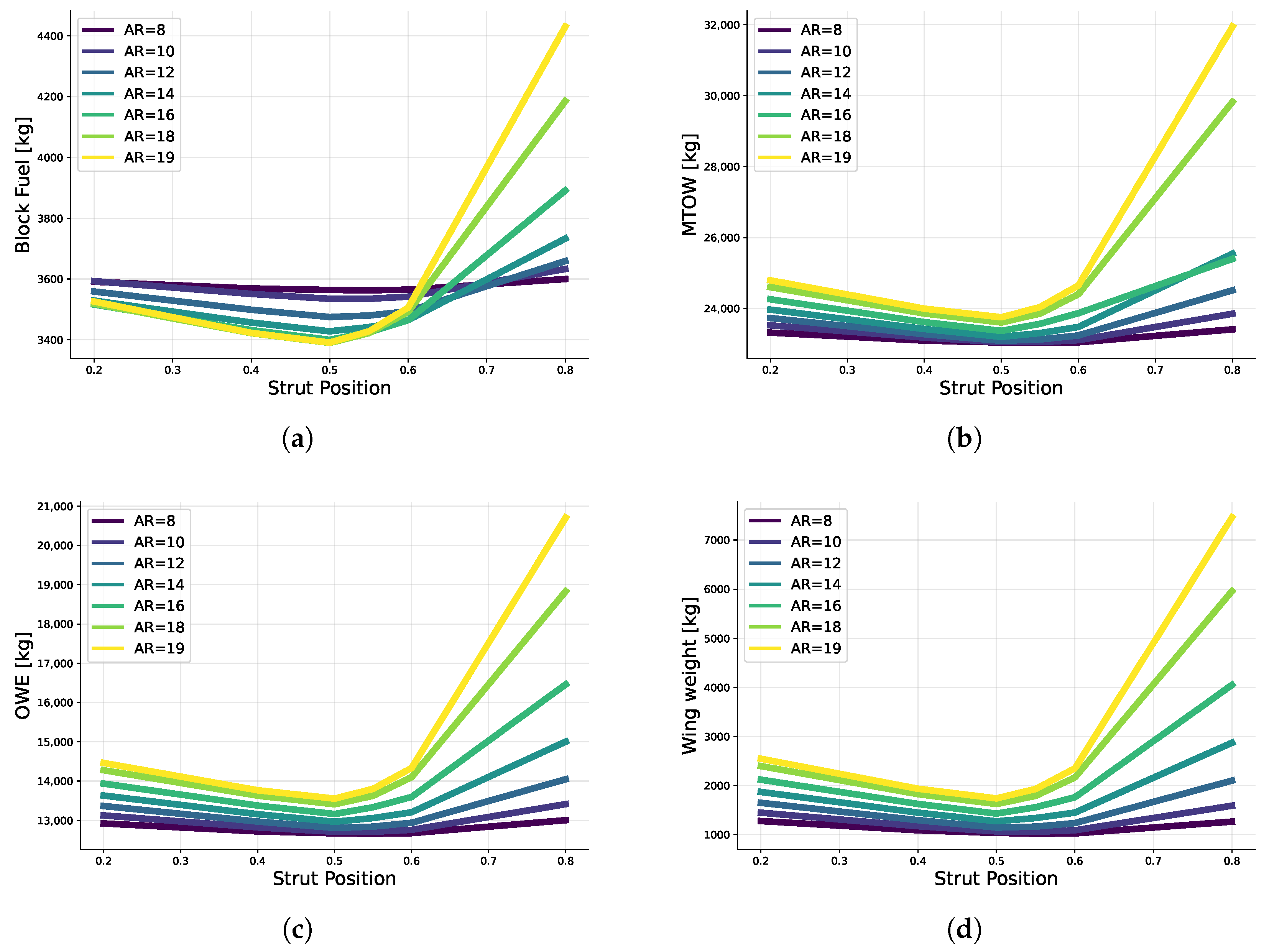
After validating the framework, a trade-off study is conducted to investigate the impact of the wing aspect ratio (AR) and the spanwise position of the strut on the overall performance of the strut-braced wing configuration. Starting from the reference aircraft, multiple OAD sizings are performed by varying the wing aspect ratio and the strut spanwise position, with the strut chord and thickness-to-chord ratio fixed at 30% of the wing mean aerodynamic chord (MAC) and 0.12, respectively. The trends of the OAD outputs are presented in
Figure 6. For a fixed aspect ratio, the optimal range of the strut positions lies between 0.45 and 0.60 of the wingspan, where minimum fuel burn, wing weight, OWE and MTOW are achieved. Beyond 0.60, the increasing strut weight pf counteracts the load-alleviation benefits. For aspect ratios below 16, the strut effects are negligible. Consequently, for the reference aircraft, optimal strut-braced wing configurations are obtained for aspect ratios between 16 and 18 and strut positions between 0.45 and 0.60 of the wingspan.
3.1.3. Optimization
Following the trade-off study assessing the influence of aspect ratio and strut spanwise position, an optimization is performed to determine, starting from the reference cantilever configuration, the optimal strut-braced wing configuration. The objective is to minimize fuel burn by optimizing both the aspect ratio and the strut spanwise position. The optimization is constrained by a maximum wingspan of 36 m, due to operational requirements, and by the avoidance of engine–strut interference. COBYLA (Constrained Optimization By Linear Approximation) is used as an optimizer. It is a gradient-free optimizer based on local linear approximations. Gradient-free algorithms explore the design space extensively, potentially leading to improved local minima and, in some cases, the global minimum. However, their main drawback is that the number of function evaluations increases rapidly with the number of design variables [
11]. Since only two design variables are considered in this study, a gradient-free optimization method is deemed appropriate.
The optimized strut-braced wing aircraft has an aspect ratio of 17.64, representing a relative increase of 47% compared to the reference aircraft, and a strut position of 0.543.
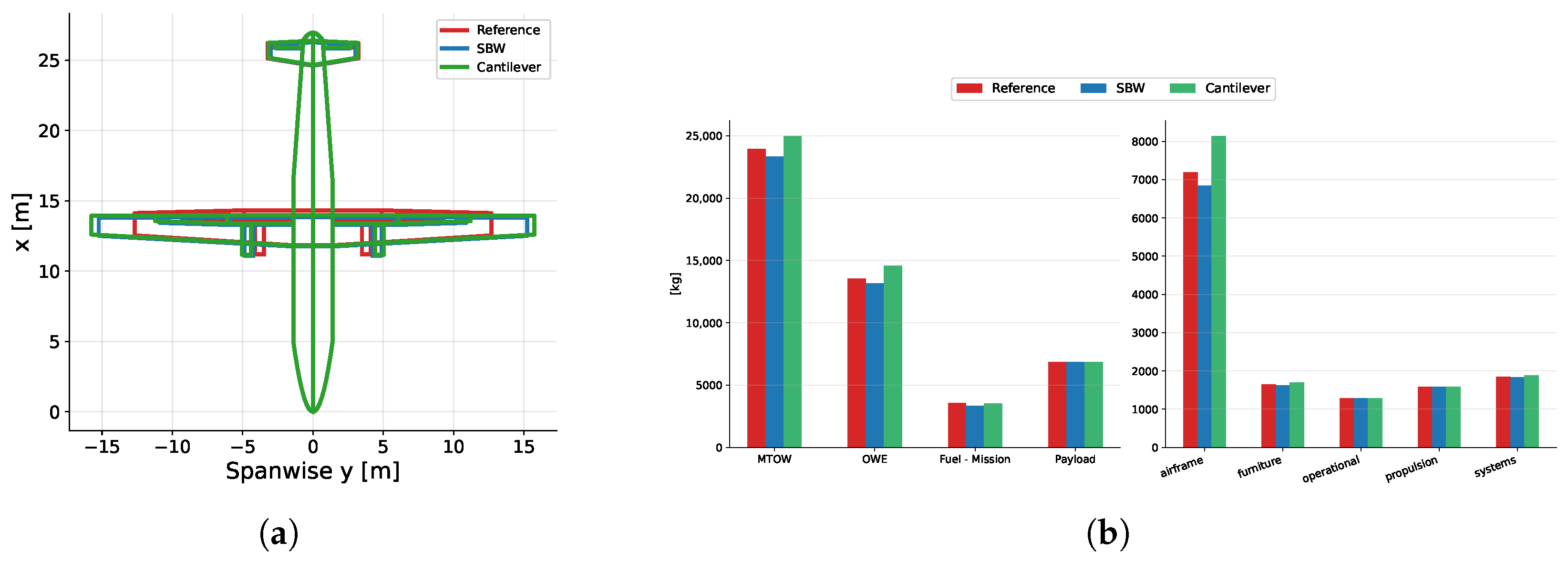
Figure 7 compares the planform and weight breakdown of the reference aircraft, the SBW configuration, and an equivalent cantilever configuration with the same aspect ratio as the SBW concept. Compared to the reference aircraft, the fuel burn is reduced by 6.35%, driven by a 15% increase in aerodynamic efficiency and a 24% reduction in wing weight, which together result in an overall MTOW reduction of about 3%. Relative to the cantilever configuration at the same aspect ratio, the structural benefit of the strut is evident, enabling a wing weight reduction of about 45% due to a 60% decrease in root bending moment.
3.2. Structural Analysis
A low-fidelity finite element model of the OAD optimized SBW is developed in PATRAN/NASTRAN to assess the effects of the strut connection and the addition of a jury strut on the wing’s structural behavior.
3.2.1. The Influence of the Jury Member
A parametric study is first conducted to determine the optimal jury strut position and orientation.
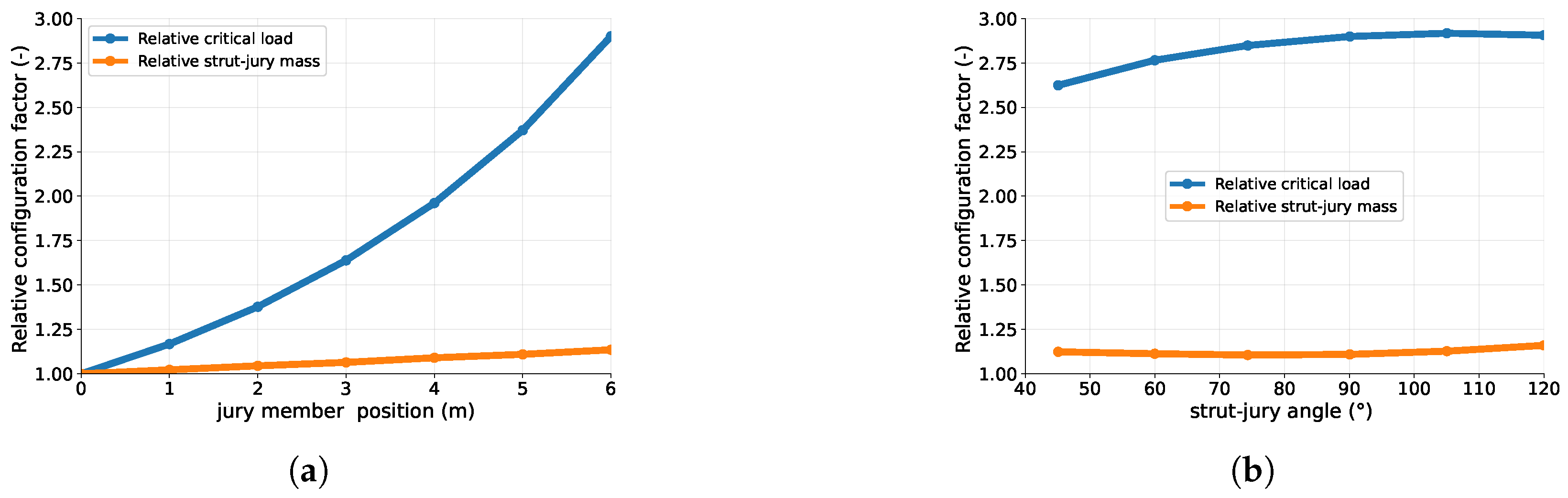
Figure 8 presents the variation in the critical buckling load and jury mass with jury position and strut–jury angle. Increasing the distance from the strut–wing junction enhances the jury’s effectiveness by reducing the strut’s effective length and improving its buckling behavior. An optimal strut–jury angle of 105° maximizes the critical buckling load while minimizing the jury mass.
Subsequently, a strut optimization was carried out to ensure buckling resistance under the −1g maneuver load, considering the configuration without a jury member and the configuration including one. The results show that incorporating a jury member reduces wing weight by 20% relative to the configuration without a jury, highlighting its beneficial effect on buckling performance.
3.2.2. Influence of the Connections
The results of the linear static and buckling analyses of the wing for the four strut-connection types (‘CC’, ‘CP’, ‘PC’, and ‘PP’) are reported in
Table 2. It can be observed that, under positive loads, the connection type has no influence on the loads, stresses, or wingtip deflection. The only difference appears in the moment at the strut base, which is zero in the case of a ‘pin’ connection, as expected. However, under negative loads, the type of connection has a significant impact on the critical buckling load. A 47% decrease in critical buckling load is observed when both the strut–fuselage and strut–wing connections are pin joints (free to rotate), due to the increase in effective length resulting from the boundary conditions.
These results clearly show that having joints that are free to rotate is extremely detrimental to the buckling failure mode. Consequently, it is recommended that all strut connections be made as rigid as possible in order to delay the onset of buckling in the wing structure.
4. Conclusions
To assess the potential of strut-braced wing configurations for reducing the environmental footprint of future regional aircraft, a low-fidelity design methodology is proposed, which combines an OAD framework with finite-element-based structural analysis.
The disciplinary models originally implemented in the FAST-OAD framework relied on empirical formulas developed for conventional tube-and-wing aircraft. To extend its capabilities to strut-braced wing configurations, a physics-based model has been introduced for structural sizing and weight estimation of the SBW.
The new OAD process developed for the SBW concept was used to carry out the sizing, trade-off, and optimization of strut-braced wing configurations. Studies based on an ATR-72 reference aircraft yielded an optimal SBW design with an aspect ratio of 17.64 and a strut position ratio of 0.543, resulting in approximately a 24% reduction in wing weight and a 6.78% decrease in fuel burn. For such a high-aspect-ratio wing, the strut alleviates the root bending moment, thereby reducing wing weight, OEW, and ultimately MTOW.
Structural analysis of the optimized SBW indicates that a clamped–clamped strut connection maximizes buckling performance, and adding a jury strut further improves stability while reducing wing weight by about 20%.
The approach must be further refined by including the jury-strut drag penalty, integrating buckling analysis into the OAD loop, assessing dynamic loads, and calibrating the model with high-fidelity data.
Author Contributions
Conceptualization, O.S. and S.S.; methodology, O.S.; software, O.S., S.S. and Y.L.L.; validation, O.S. and S.S.; formal analysis, O.S.; investigation, O.S. and S.S.; resources, O.S.; data curation, O.S. and S.S.; writing—original draft preparation, O.S.; writing—review and editing, E.B. and J.M.; visualization, O.S.; supervision, E.B. and J.M.; project administration, E.B. and J.M.; funding acquisition, E.B. All authors have read and agreed to the published version of the manuscript.
Funding
This research was funded by European HERA project (under Grant Agreement 101102007) and by ISAE-SUPAERO, within the framework of the research chair CEDAR (Chair for Eco-Design of AiRcraft).
Institutional Review Board Statement
Not applicable.
Informed Consent Statement
Not applicable.
Data Availability Statement
The data presented in this study are available on request from the corresponding author.
Conflicts of Interest
The authors declare no conflicts of interest.
Abbreviations
The following abbreviations are used in this manuscript:
| MDO | Multidisciplinary Design Optimization |
| OAD | Overall Aircraft Design |
| HAR | High Aspect Ratio |
| SBW | Strut-Braced Wing |
| MTOW | Maximum Takeoff Weight |
| OWE | Operating Empty Weight |
References
- Airbus. Global Market Forecast 2025–2044; Airbus: Toulouse, France, 2025; Available online: https://www.airbus.com/en/products-services/commercial-aircraft/global-market-forecast (accessed on 10 March 2025).
- European Commission; Directorate-General for Mobility and Transport; Directorate-General for Research and Innovation. Flightpath 2050–Europe’s Vision for Aviation: Maintaining Global Leadership and Serving Society’s Needs; Publications Office of the European Union: Luxembourg, 2011; Available online: https://op.europa.eu/fr/publication-detail/-/publication/296a9bd7-fef9-4ae8-82c4-a21ff48be673 (accessed on 10 March 2025).
- Marchetti, F.; Toffol, S.; Ricci, S.; Beretta, J.; Paletta, N. Aeroelastic Optimization of High Aspect Ratio Wings for Environmentally Friendly Aircraft. In Proceedings of the AIAA SCITECH 2022 Forum, San Diego, CA, USA, 3–7 January 2022. [Google Scholar] [CrossRef]
- Lamer, Y.L.; Morlier, J.; Benard, E.; He, P. Aeroelastic Analysis of High Aspect Ratio and Strut-Braced Wings. In Proceedings of the 33rd Congress of the International Council of the Aeronautical Sciences, Stockholm, Sweden, 4–9 September 2022. [Google Scholar]
- Sy, O.; Morlier, J.; Bénard, E. Aerostructural Optimization of High-Aspect-Ratio Wings: Navigating Complex Trade-Offs. In Proceedings of the AeroBest 2025–III ECCOMAS Thematic Conference on Multidisciplinary Design Optimization of Aerospace Systems, Lisbon, Portugal, 22–24 April 2025. [Google Scholar]
- Pfenninger, W. Passive Aeroelastic Control in Truss-Braced Wings Using Vibration Suppression; University of Bristol: Bristol, UK, 2019. [Google Scholar]
- David, C.; Delbecq, S.; Defoort, S.; Schmollgruber, P.; Benard, E.; Pommier-Budinger, V. From FAST to FAST-OAD: An Open-Source Framework for Rapid Overall Aircraft Design. IOP Conf. Ser. Mater. Sci. Eng. 2021, 1024, 012062. [Google Scholar] [CrossRef]
- Gray, J.S.; Hwang, J.T.; Martins, J.R.R.A.; Moore, K.T.; Naylor, B.A. OpenMDAO: An Open-Source Framework for Multidisciplinary Design, Analysis, and Optimization. Struct. Multidiscip. Optim. 2019, 59, 1075–1104. [Google Scholar] [CrossRef]
- Carrier, G.; Arnoult, G.; Fabbiane, N.; Schotté, J.-S.; David, C.; Defoort, S.; Delavenne, M. Multidisciplinary Analysis and Design of a Strut-Braced Wing Concept for Medium-Range Aircraft. In Proceedings of the AIAA SciTech 2022 Forum, San Diego, CA, USA, 3–7 January 2022. [Google Scholar]
- Lafage, R.; Defoort, S.; Lefebvre, T. WhatsOpt: A Web Application for Multidisciplinary Design Analysis and Optimization. In Proceedings of the AIAA Aviation 2019 Forum, San Diego, CA, USA, 3–7 January 2019. [Google Scholar]
- Martins, J.R.R.A.; Hwang, J.T. Multidisciplinary Design Optimization of Aircraft Configurations—Part 1: A Modular Coupled Adjoint Approach; Lecture Series; Von Karman Institute for Fluid Dynamics: Sint-Genesius-Rode, Belgium, 2016; ISSN 0377-8312. [Google Scholar]
| Disclaimer/Publisher’s Note: The statements, opinions and data contained in all publications are solely those of the individual author(s) and contributor(s) and not of MDPI and/or the editor(s). MDPI and/or the editor(s) disclaim responsibility for any injury to people or property resulting from any ideas, methods, instructions or products referred to in the content. |