Proceeding Paper

Degradation-Aware Preliminary Sizing and Control Framework for Regional Aircraft Hybrid Fuel Cell–Battery Systems †
1
Department of Industrial Engineering, University of Salerno, Via Giovanni Paolo II 132, 84084 Fisciano, SA, Italy
2
AIT Austrian Institute of Technology GmbH, Giefinggasse 2, 1210 Vienna, Austria
*
Author to whom correspondence should be addressed.
Presented at the 15th EASN International Conference, Madrid, Spain, 14–17 October 2025.
Eng. Proc. 2026, 133(1), 119; https://doi.org/10.3390/engproc2026133119
Published: 11 May 2026

Abstract

The aviation sector is under increasing pressure to cut emissions, prompting strong interest in alternative propulsion systems. This study examines the potential of hybrid-electric aircraft relying on electrochemical energy storage and conversion units (EC-ESC), consisting of proton exchange membrane fuel cell systems coupled with batteries. A design space exploration framework is proposed to size and control these systems for regional aircraft, treating fuel cell system nominal power and battery C-rate as key design variables, while also accounting for in-flight degradation. A flexible degradation-aware control strategy manages power sharing within the co-design strategy, which seeks a configuration minimizing the total EC-ESC equivalent mass. The entire procedure is designed versatilely enough to be applicable for the model-based design and energy management of EC-ESC units destined for several end uses, e.g., short/medium-haul, and long-haul aircraft or automotive.

1. Introduction

Aviation is among the fastest-growing sources of greenhouse gas emissions, accounting for roughly 2–3% of global CO2 and even more when non-CO2 effects are included. Despite advances in aerodynamics, lightweight structures, and engine efficiency, rising air traffic has offset efficiency gains [1]. Current mitigation pathways focus on sustainable aviation fuels (SAFs) and electrification. Although SAFs are central to near-term decarbonization, they face scalability limits, high production costs, and feedstock-related sustainability constraints [2]. Fully battery-electric aircraft remain restricted to small, short-range applications due to the low specific energy of lithium-ion batteries (~200–300 Wh/kg) [3]. Hydrogen propulsion, particularly fuel cell-based systems, offers higher specific energy and is therefore a promising medium-long-term solution [4]. Hybrid fuel cell/battery architectures are actively investigated to balance energy and power demands, with batteries managing transients and fuel cells operating near steady state. However, significant challenges persist, including mass penalties, component lifetimes, and the need for advanced energy management. Prior studies have explored suitable control strategies [5] and alternative hybrid architectures [6], but altitude-induced fuel cell power losses are often neglected. Other works address degradation-aware design or control but treat components independently [7,8]. Consequently, a comprehensive design space exploration framework that jointly optimizes hybridization level and in-flight power split remains lacking. Within this context, and in the framework of the HECATE project [9], the present study proposes a co-optimization strategy for electrochemical energy storage and conversion units (EC-ESCs) supplying regional aircraft electrical propulsion loads. The EC-ESC consists of a multi-stack PEM fuel cell system (PEMFCS) and a lithium-ion battery. Device degradation is modeled using semi-empirical methods and incorporated into a co-design environment to determine the equivalent hybrid-unit mass. A flexible rule-based energy management strategy governs in-flight power sharing between the hybrid components, while the efficiency-driven model is used as the fuel cell stack’s electrical variables estimator. Additionally, the battery’s electrical–thermal model is implemented as a Functional Mock-up Unit (FMU), enabling an efficient co-simulation framework consistent with digital-twin and aviation-sector computational requirements.
The paper is structured as follows: Section 2 details the EC-ESC sizing and control methodology, including PEMFCS modeling, battery-sizing criteria, and the hybrid energy-management strategy. Section 3 discusses the results, while Section 4 presents the conclusions and future research directions.

2. Methodology

This section delineates the modeling framework employed herein. The hybrid unit fulfills the electrical load demand, including taxi, take-off, cruising and landing phases. The design space exploration is performed using the net PEMFCS nominal power at beginning of life (BoL) and the maximum battery-cell C-rate as key design variables.

2.1. Mathematical Models

The EC-ESC individual components modeling approach is presented herein.

2.1.1. PEM Fuel Cell System Model

The efficiency-driven model described by the authors in [10] is used to estimate the PEM fuel cell stack’s electrical variables, i.e., current ( I P E M F C ) and voltage ( V P E M F C ). Such a choice is due to the flexibility of the approach in leveraging the efficiency curves to profile I P E M F C and V P E M F C , thus permitting the simulation of stacks from different manufacturers. This feature is exploited here to replicate data in [11] (see Figure 1).
To implement the efficiency-driven model, the number of cells in series ( n c e l l s , s ) results from the ratio between the DC link voltage and the maximum cell voltage, while the number of parallel arrays ( n a r r a y s , p ) is calculated to match the nominal system power at BoL ( P n e t , s y s t e m , B o L ). Then, Equations (1) and (2) constitute the core of the efficiency-driven model:
V P E M F C = V T N · η P E M F C · n c e l l s , s
I P E M F C = P P E M F C S / ( η P E M F C S · V T N · n c e l l s , s · n a r r a y s , p )
In Equation (1), V T N and η P E M F C stand for the thermoneutral voltage and stack efficiency, respectively. Moreover, in Equation (2), P P E M F C S is the actual PEMFCS power supply, and η P E M F C S is the efficiency at system level. Subsequently, V P E M F C and I P E M F C are used to calculate the stack power ( P P E M F C ).

2.1.2. Balance-of-Plant

At constant current density, which in turn corresponds to constant air mass flow in case the excess of air with respect to stoichiometry is kept constant by suitably managing PEMFC cathode manifold dynamics [12], the gross PEMFC power output is altitude-invariant, whereas the net power declines with increasing altitude, due to the higher demand of auxiliary systems. The compressor is sized here according to the maximum absorbed power ( P c m p , m a x ), according to Equation (3):
P c m p , m a x = m ˙ a i r , m a x · c p , a i r · T a i r , i n · ( β γ a i r 1 γ a i r 1 ) · 1 η c m p · η e m
where m ˙ a i r , m a x is the maximum air flow rate entering the compressor, and T a i r , i n , η c m p , and η e m are the inlet air temperature, compressor and electric motor efficiencies, respectively. Moreover, the compressor pressure ratio, β , is determined using the control law presented in [13], while the altitude-dependent variations of T a i r , i n air specific heat ( c p , a i r ) and adiabatic exponent ( γ a i r ) are retrieved from [14]. Then, the total auxiliaries’ parasitic consumption results from Equation (4), where P P E M F C , m a x is the maximum stack power at sea level, while the second addendum considers other parasitic contributions.
P A u x = P c m p , m a x + 0.01 · P P E M F C , m a x ( h = 0 )

2.1.3. Battery Model

The battery electrical–thermal model considers charge and discharge internal resistances as functions of state of charge (SOC) and battery temperature ( T Batt ), while the open-circuit voltage (OCV) is mapped against SOC. Key outputs include T Batt , SOC, battery voltage ( V Batt ), and C-rate. Within the sizing framework, the number of series-connected cells ( n cells , Batt , s ) is selected to satisfy the DC-link voltage requirement, whereas the battery nominal power ( P Batt , nom ) is computed according to Equation (5).
P B a t t , n o m = m a x ( P L o a d ) i d l · P n e t , s y s t e m , E o L
where i d l is the PEMFCS idling percentage to avoid start-up/shut-down phases of the hydrogen-based device, while P n e t , s y s t e m , E o L is the power available at end of life (EoL). Furthermore, the power deliverable at cell level accounts for the C-rate as follows:
P B a t t , c e l l = C a p a c i t y · V c e l l ,   n o m i n a l · C r a t e
The number of cells in parallel ( n c e l l s , B a t t , p ) is subsequently calculated to cope with P B a t t , n o m , thus enabling the assessment of the total energy content at pack level ( C a p B a t t ). It must be noted that, according to Equation (5), the battery pack is slightly oversized to compensate for the PEMFCS power drop between BoL and EoL conditions. Particularly, P n e t , s y s t e m , E o L is calculated by exploiting Equations (1)–(3), under the simplifying assumption of non-degrading auxiliaries, and considering a degradation coefficient ( D ) set to 0.1:
P n e t , s y s t e m , E o L = I P E M F C · V P E M F C P n e t , s y s t e m , B o L , a d i m = 1 · 1 D P A u x

2.2. EC-ESC Energy Management

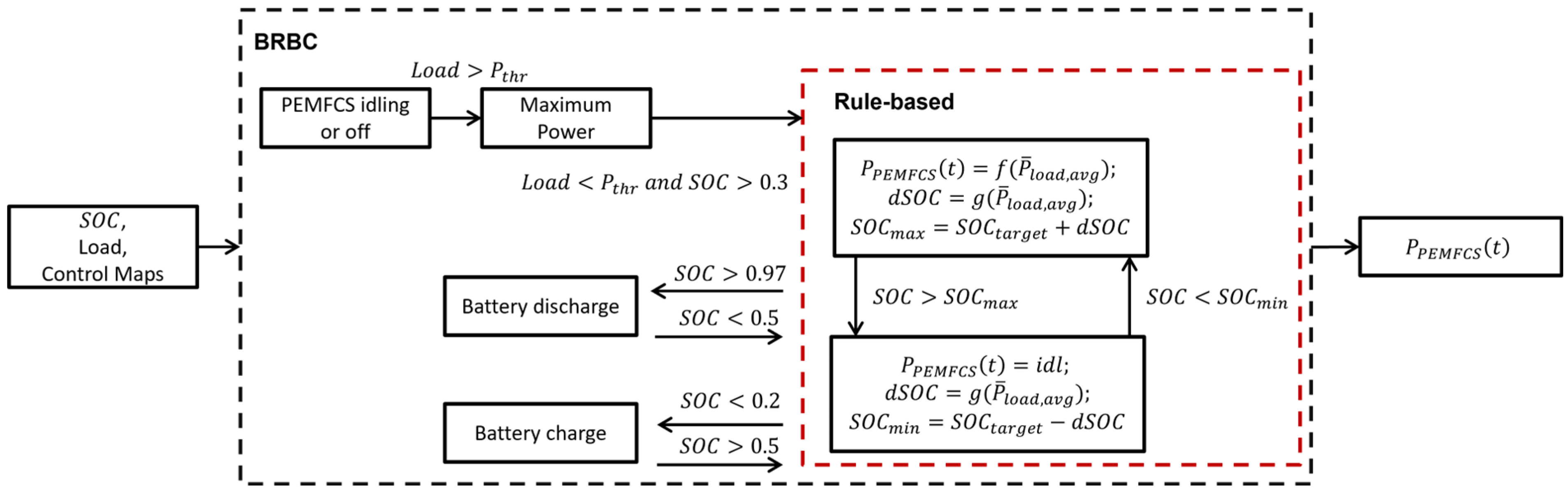
A blended rule-based controller (BRBC), implemented as a finite state machine, governs the power distribution between the EC–ESC hybrid components. The strategy relies on an intelligent thermostatic controller, supplemented with high-power operational states to meet mission demands (see Figure 2). During the initial stage of the mission, the PEMFCS remains idling or off, depending on its nominal rating. When the load exceeds a predefined threshold ( P t h r ) , the system shifts to maximum power. During cruise, the “Rule-based” superstate allocates power using the flexible control laws in [15], maintaining PEMFCS idling when S O C > S O C m a x until S O C approaches S O C m i n . Additional “Battery charge” and “Battery discharge” states ensure safe SOC operation. The BRBC output feeds the efficiency-driven model, which computes P PEMFC while subtracting altitude-dependent auxiliary loads. With regard to the control maps embedded within the rule-based block, two key control variables are considered: the admissible variation in the battery state of charge ( d S O C ) and the PEMFCS output power ( P P E M F C S ) . Both variables are mapped as functions of the average mission power demand ( P ¯ l o a d , a v g ) , which is obtained through a priori estimating the load profile over a specified time horizon (TH) [15]. Finally, it is worth remarking that the BRBC includes some degradation-aware adjustments, as the idling level softens the degradation due to start-up/shut-down cycles, while a rate limiter on the PEMFCS power delivery avoids aggressive load variations impacting on the occurrence of thermomechanical stresses potentially damaging the membrane.

Component In-Flight Degradation

Given the control-oriented focus of this work, the semi-empirical model in [16], based on the “severity factor ( σ )” concept, is adopted. σ is defined as:
σ ( I ,   T B a t t ,   S O C ) = Г (   I n o m ,   T B a t t , n o m ,     S O C n o m ) γ ( I ,   T B a t t ,   S O C )
where Γ denotes battery aging under nominal conditions assuming a 20% capacity fade, and γ represents aging under arbitrary load cycles. Nominal conditions ( n o m ) SOC = 0.35, T = 298   K , C-rate = 2.5   h 1 follow [16]. When the battery undergoes more severe operating conditions, σ > 1 , indicating accelerated lifetime depletion. The severity factor enables computation of the effective Ah-throughput ( A h e f f ) relative to the nominal battery life Γ . The corresponding fraction of life consumed is then converted into an equivalent hydrogen penalty ( m H 2 , B a t t , D ) by considering the cost of hydrogen and that of the battery. Then, the PEMFCS degradation during flight ( Δ ϕ P E M F C S ) is estimated by leveraging the empirical model proposed by [17], wherein the loss of stack performance accounts for specific operating conditions, namely: low-power, rapid transients, high-power phases and the number of start/stop cycles occurring during the flight mission. Moreover, as the PEMFCS degradation could be considered linear when considering 10% voltage decay as the EoL criteria [17], the device’s lifetime in operating hours ( t P E M F C S ) is also estimated. Finally, similarly to battery life depletion, Δ ϕ P E M F C S is converted into equivalent hydrogen consumption ( m H 2 , P E M F C S , D ) considering the PEMFCS cost.

2.3. Design Space Exploration Set-Up

A full-factorial parametric analysis is implemented in the hybridized aircraft EC-ESC unit co-design framework. As mentioned in Section 2, the PEMFCS power rating at BoL and battery C-rate are considered as degrees of freedom and varied in the two-dimensional domain shown in Table 1. Such a design domain leverages the flexibility of the co-design strategy to explore different degrees of aircraft hybridization. The final aim is to minimize an objective function ( J ) represented by the total equivalent mass of the EC-ESC.
In Equation (9), M B a t t and M P E M F C S are the battery and PEMFCS masses (including the BoP), m H 2 is the hydrogen consumption, m H 2 , e q is the equivalent hydrogen consumption associated with the battery, and m H 2 , t a n k is the mass of the liquid hydrogen storage tank. These terms are evaluated using the parameters listed in Table 2. Moreover, S O C e n d is the SOC achieved at the end of the mission, and S O C t and C r a t e ( t ) are the SOC and C r a t e levels attained during the simulation. Further clarification is mandatory with respect to the degradation topic as treated in this work. Indeed, the simulation framework is conceived to simulate the EC-ESC behavior at BoL but the calculation of the in-flight degradation helps in seeking combined design and control actions offering a suitable trade-off between overall mass and device lifetime.
J = M B a t t + M P E M F C S + m H 2 + m H 2 , e q + m H 2 , P E M F C S , D + m H 2 , B a t t , D + m H 2 , t a n k s . t . S O C e n d > 0.35 S O C t > 0.2 C r a t e ( t ) < 7

3. Results

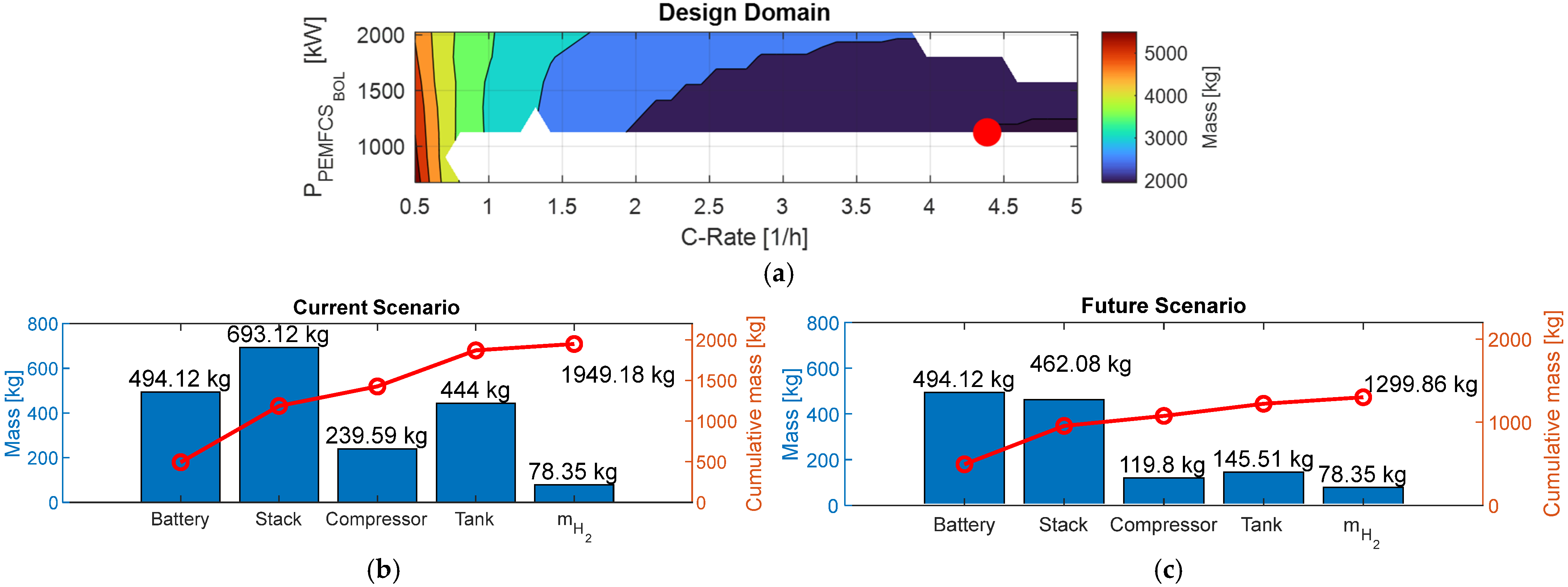
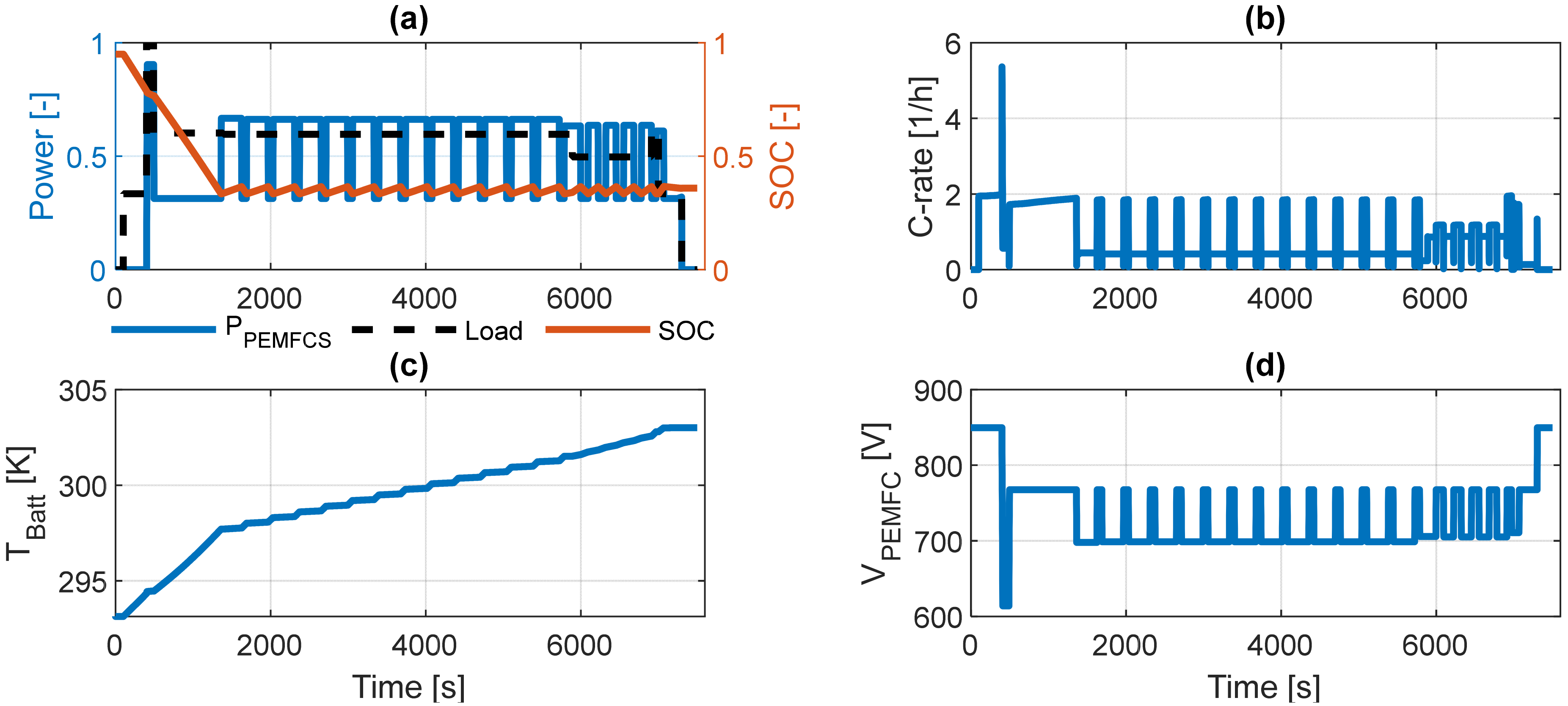
This section reports the outcomes of the co-design framework. Figure 3a shows the bi-dimensional design space, illustrating the EC–ESC mass as a function of the two design variables. A clear advantage emerges for higher admissible C-rate values, reducing the required battery capacity. Particularly, it must be noted that the total mass increases when considering higher battery capacity and low PEMFCS power installed, as a consequence of the relatively low-energy density of a battery compared to hydrogen-based devices. Moreover, in such regions, the PEMFCS is forced to operate for a longer time near to the maximum power, which implies increased hydrogen consumption and liquid hydrogen tank gravimetric impact. At C-rates from ≈ 0.8 1/h to 5 1/h and relatively low PEMFCS power installed (i.e., lower than ≈1100 kW), an infeasible region appears; in these conditions, the target SOC of 0.35 cannot be upheld. Additional infeasibility zones arise when both high C-rates (near the technological limit) and large PEMFCS power ratings are selected, as the simulated C-rate during charging exceeds the maximum allowable value of 7. The optimal solution is identified for P n e t , s y s t e m , B o L   of 1124.7 kW and a C-rate of 4.36, implying a total system mass of approximately 1950 kg. The mass breakdown is illustrated in Figure 3b, where it is evident that the fuel cell stack accounts for the largest contribution (≈35.6%), followed by the battery pack (≈25.35%), hydrogen tank (≈22.78%), and the compressor (≈12.3%). On the other hand, Figure 3c outlines the mass contributions when considering optimistic assumptions for the PEMFCS components (see Table 2). In this scenario, the total mass would be reduced from 1950 kg to approximately 1300 kg. Moreover, Figure 4a presents the results of the BRBC in normalized form. At the beginning of the mission, the EC–ESC does not deliver power, as indicated by the constant SOC and the null PEMFCS output. With the increase in load demand, the controller directs the battery to supply the required power. This choice arises from the fact that, if the PEMFCS were operated at idle, its output would exceed the load demand, leading to battery overcharging. Conversely, during take-off, the PEMFCS is activated at its maximum power. During take-off, the simulated C-rate reaches its peak value of 5.36, constrained by the PEMFCS power ramp limit (10% of the nominal installed power per second). Subsequently, the rule-based controller is engaged.
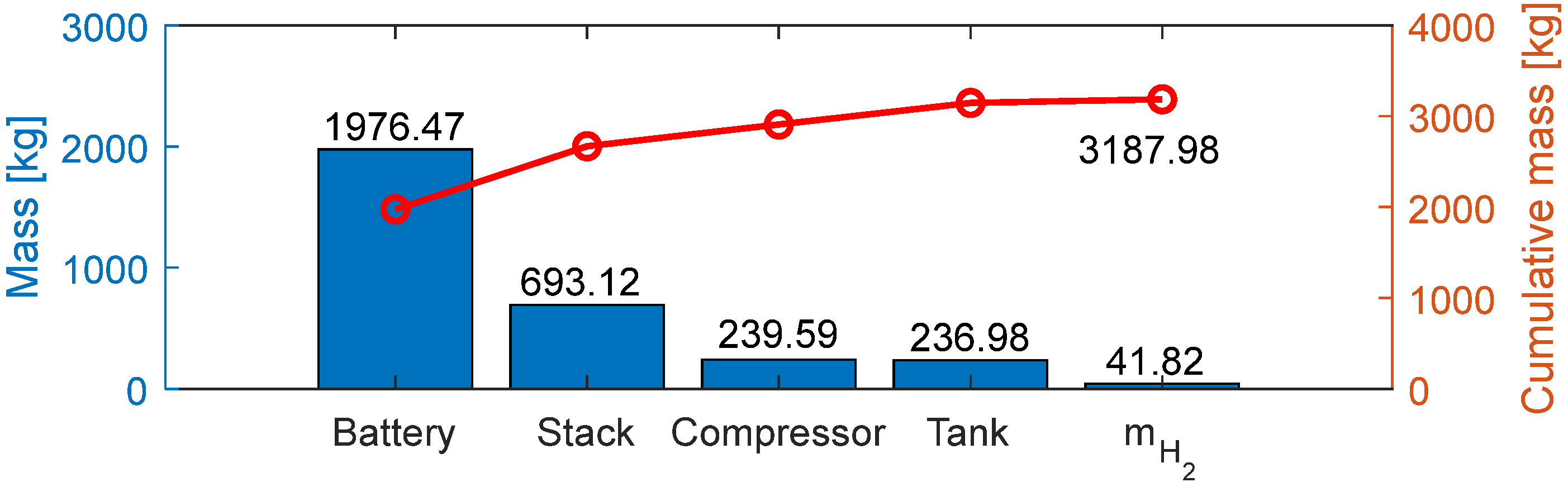
During the cruise phase, the PEMFCS operates both to satisfy the load and to maintain the battery SOC oscillating around the target value of 0.35. Additional insights come from the in-flight degradation of both the battery and the PEMFCS. Some remarks are necessary concerning Δ ϕ P E M F C S . Owing to the BRBC strategy, the PEMFCS power slope is constrained, continuous start-up/shut-down cycles are avoided, and an idling condition at 30% of the installed net power is introduced. As a result, the primary driver of PEMFCS aging is attributed exclusively to the high-power operating stages and the start-up/shut-down cycle. This leads to a preliminary lifetime estimate of approximately 7000 operating hours, with a Δ ϕ P E M F C S of 0.0032%. It is worth noting here that, although calculated in a preliminary way by relying on a linear approach, the result is well aligned with other studies. For example, the work [18] foresees an 8000 operating hour durability for an aeronautical fuel cell system, which would result in 7–9 device replacements throughout an aircraft’s lifetime. Furthermore, battery in-flight degradation is estimated to be 0.0021%, which mainly depends on the C-rate attained during the simulation and battery operating temperature. These quantities are plotted in Figure 4b and Figure 4c, respectively. Moreover, Figure 4d illustrates the evolution of the stack voltage throughout the mission. It is observed that, in the maximum power mode, the voltage decreases to approximately 670 V. Although this condition lasts only 80 s, the DC/DC converter may face limitations in handling the voltage excursion between zero-power and maximum-power operation. In this study, the latter issue is mitigated by identifying an alternative configuration through the co-design framework. Indeed, the PEMFCS sizing power obtained from the previous design space exploration is preserved but the efficiency-driven model is used to identify the non-dimensional power level ensuring a maximum voltage swing of approximately 100 V; however, to maintain the minimum battery SOC requirement, the battery C-rate is reduced from 4.36 to 1 in the redesign, thereby shifting toward a more highly hybridized architecture. This new design entails EC-ESC mass increase from 1950 kg to approximately 3200 kg, with the breakdown distribution in Figure 5. Furthermore, following the cooling load estimation approach presented by the authors in [10], the first configuration presented produces a maximum cooling load ( Q ˙ c o o l , m a x ) of 1768 kW.
However, when the PEMFCS operating point is modified in the second case study, Q ˙ c o o l , m a x decreases significantly, reaching 500 kW. This could have a significant impact on the overall system mass estimation when including the thermal management system within the loop, as well as stimulating the deepening of alternative fuel cell technologies featuring higher operating temperatures [19].

4. Conclusions

This work has presented a degradation-aware co-design framework for the preliminary sizing and control of fuel cell–battery hybrid systems for regional aircraft. By combining design space exploration, a blended rule-based controller, and semi-empirical degradation models, the methodology enables a consistent evaluation of trade-offs among system mass, efficiency, and component lifetime. The optimal configuration, featuring a PEMFCS net beginning-of-life power of ~1125 kW and a battery C-rate of 4.36, results in an equivalent mass of about 1950 kg, with the fuel cell stack as the dominant contributor. Moreover, a preliminary fuel cell durability of roughly 7000 operating hours is also estimated. However, voltage excursions during maximum-power operation challenge DC/DC converter capabilities, motivating a revised design that limits the stack voltage swing to ~100 V. This requires reducing the battery C-rate and increases total EC–ESC mass to approximately 3200 kg. Overall, the study underscores the value of integrated design and control in developing hybrid fuel cell–battery architectures, offering a flexible and computationally efficient tool for assessing hybridization strategies across device life stages. Future studies will analyze the impact of additional hydrogen consumption on the overall hybrid unit mass in the last flight scenario.

Author Contributions

Conceptualization, P.A. and M.S.; methodology, M.S., E.H. and P.A.; software, E.H. and P.A.; validation, E.H. and P.A.; writing—original draft, P.A.; writing—review and editing, M.S., E.H. and P.A.; visualization, M.S. and P.A.; supervision, M.S. and H.K. All authors have read and agreed to the published version of the manuscript.

Funding

This research is funded by the European Union under GA no 101101961—HECATE.

Data Availability Statement

Data supporting presented results are not sharable for confidentiality reasons.

Acknowledgments

Funded by the European Union under GA no 101101961—HECATE. Views and opinions expressed are, however, those of the author(s) only and do not necessarily reflect those of the European Union or Clean Aviation Joint Undertaking. Neither the European Union nor the granting authority can be held responsible for them. The project is supported by the Clean Aviation Joint Undertaking and its Members.

Conflicts of Interest

Authors Emina Hadžialić and Helmut Kühnelt are employed by the company AIT Austrian Institute of Technology GmbH. The remaining authors declare that the research was conducted in the absence of any commercial or financial relationships that could be construed as a potential conflict of interest.

References

  1. International Civil Aviation Organization (ICAO). Aviation Vision 2050: The Potential for Climate-Neutral Growth. Available online: https://theicct.org/wp-content/uploads/2025/09/ID-445-%E2%80%93-Aviation-Vision-2050_report_final-2.pdf (accessed on 10 September 2025).
  2. Grimme, W. The introduction of sustainable aviation fuels—A discussion of challenges, options and alternatives. Aerospace 2023, 10, 218. [Google Scholar] [CrossRef]
  3. Pattanayak, T.; Mavris, D. Battery technology for sustainable aviation: A review of current trends and future prospects. Appl. Energy 2025, 397, 126356. [Google Scholar] [CrossRef]
  4. Soleymani, M.; Mostafavi, V.; Hebert, M.; Kelouwani, S.; Boulon, L. Hydrogen propulsion systems for aircraft: A review on recent advances and ongoing challenges. Int. J. Hydrogen Energy 2024, 91, 137–171. [Google Scholar] [CrossRef]
  5. Penta, M.; Fedele, E.; Manrique, C.; Iannuzzi, D.; Accardo, G. Analysis of an Equivalent Consumption Minimization Strategy for a Fuel Cell Electric Aircraft. In 2024 IEEE International Conference on Electrical Systems for Aircraft, Railway, Ship Propulsion and Road Vehicles & International Transportation Electrification Conference (ESARS-ITEC); IEEE: Piscataway, NJ, USA, 2024; pp. 1–8. [Google Scholar]
  6. Li, S.; Zhao, P.; Gu, C.; Bu, S.; Pei, X.; Zeng, X.; Cheng, S. Hybrid power system topology and energy management scheme for hydrogen-powered aircraft. IEEE Trans. Smart Grid 2023, 15, 1201–1212. [Google Scholar] [CrossRef]
  7. Misley, A.; Sergent, A.; D’Arpino, M.; Ramesh, P.; Canova, M. Design space exploration of lithium-ion battery packs for hybrid-electric regional aircraft applications. J. Propuls. Power 2023, 39, 390–403. [Google Scholar] [CrossRef]
  8. Grazioso, G.; Di Stasio, M.; Nicolosi, F.; Trepiccione, S. A mathematical model for hybrid-electric propulsion systems for regional propeller-driven aircraft. Energy Convers. Manag. X 2025, 26, 100957. [Google Scholar] [CrossRef]
  9. Clean Aviation, HECATE. Available online: https://hecate-project.eu/ (accessed on 10 September 2025).
  10. Aliberti, P.; Minneci, M.; Sorrentino, M.; Cuomo, F.; Musto, C. Efficiency-Based Modeling of Aeronautical Proton Exchange Membrane Fuel Cell Systems for Integrated Simulation Framework Applications. Energies 2025, 18, 999. [Google Scholar] [CrossRef]
  11. Lohse-Busch, H.; Duoba, M.; Stutenberg, K.; Iliev, S.; Kern, M. Technology Assessment of a Fuel Cell Vehicle: 2017 Toyota Mirai; Technical Report ANL/ESD-18/12; Energy Systems Division, Argonne National Laboratory: Lemont, IL, USA, 2018. Available online: https://publications.anl.gov/anlpubs/2018/06/144774.pdf (accessed on 10 September 2025).
  12. Arsie, I.; Di Domenico, A.; Pianese, C.; Sorrentino, M. Modeling and analysis of transient behavior of polymer electrolyte membrane fuel cell hybrid vehicles. J. Fuel Cell Sci. Technol. 2007, 4, 261–271. [Google Scholar] [CrossRef]
  13. Lopez-Juarez, M.; Rockstroh, T.; Novella, R.; Vijayagopal, R. A methodology to develop multi-physics dynamic fuel cell system models validated with realistic drive cycle data. Appl. Energy 2024, 358, 122568. [Google Scholar] [CrossRef]
  14. Massaro, M.C.; Pramotton, S.; Marocco, P.; Monteverde, A.H.A.; Santarelli, M. Optimal design of a hydrogen-powered fuel cell system for aircraft applications. Energy Convers. Manag. 2024, 306, 118266. [Google Scholar] [CrossRef]
  15. Sparano, M.; Sorrentino, M.; Troiano, G.; Cerino, G.; Piscopo, G.; Basaglia, M.; Pianese, C. Future technological potential of hydrogen fuel cell systems for aviation and preliminary co-design of a hybrid regional aircraft powertrain. Energy Convers. Manag. 2023, 281, 116822. [Google Scholar] [CrossRef]
  16. Serrao, L.; Onori, S.; Sciarretta, A.; Guezennec, Y.; Rizzoni, G. Optimal energy management of hybrid electric vehicles including battery aging. In Proceedings of the 2011 American Control Conference; IEEE: Piscataway, NJ, USA, 2011; pp. 2125–2130. [Google Scholar]
  17. Pei, P.; Chang, Q.; Tang, T. A quick evaluating method for automotive fuel cell lifetime. Int. J. Hydrogen Energy 2008, 33, 3829–3836. [Google Scholar] [CrossRef]
  18. Mukhopadhaya, J. Performance analysis of fuel cell retrofit aircraft. In ICCT White Paper; ICCT: Washington, DC, USA, 2023. [Google Scholar]
  19. Gallo, M.; Marra, D.; Sorrentino, M.; Pianese, C.; Au, S.F. A versatile computational tool for model-based design, control and diagnosis of a generic solid oxide fuel cell module. Energy Convers. Manag. 2018, 171, 1514–1528. [Google Scholar] [CrossRef]
Figure 1. PEM fuel cell system and stack efficiency curves, evaluated on HHV basis from [11].
Engproc 133 00119 g001
Figure 2. Blended rule-based controller used to assess PEMFCS power supply.
Engproc 133 00119 g002
Figure 3. (a) Distribution of the EC–ESC mass within the considered design domain. The red dot represents the design point minimizing the objective function; EC-ESC mass breakdown according to current (b) and future (c) assumptions, respectively.
Engproc 133 00119 g003
Figure 4. Results of the EC-ESC co-design framework: (a) outputs of the BRBC; (b) battery C-rate, (c) temperature, and (d) stack voltage achieved during the flight simulation.
Engproc 133 00119 g004
Figure 5. Mass distribution of the EC–ESC architecture limiting the in-flight fuel cell stack voltage excursion to ≈100 V.
Engproc 133 00119 g005
Table 1. Design space exploration search domain.
DoFsDescriptionValue (Unit)
P n e t , s y s t e m , B o L Lower Limit-Upper limit600 (kW)–2000 (kW)
C r a t e Lower Limit-Upper limit0.5 (1/h)–5 (1/h)
Table 2. Parameters used to calculate the objective function [14,15].
ParametersDescriptionValue (Unit)
σ S t a c k / σ c m p PEMFC/Compressor unit massCurrent: 2/1 (kW/kg); Future 3/2 (kW/kg)
σ t a n k LH2 tank gravimetric efficiencyCurrent: 15 (%/weight); Future: 35 (%/weight)
Disclaimer/Publisher’s Note: The statements, opinions and data contained in all publications are solely those of the individual author(s) and contributor(s) and not of MDPI and/or the editor(s). MDPI and/or the editor(s) disclaim responsibility for any injury to people or property resulting from any ideas, methods, instructions or products referred to in the content.