1. Introduction
Improving the survivability of aerial vehicles against modern air defense systems is a critical objective in military operations and autonomous guidance research [
1,
2,
3,
4]. To complete missions while avoiding interception by anti-air threats, various evasive maneuver strategies have been proposed [
5,
6,
7,
8,
9,
10]. When key threat information—such as maneuverability limits and guidance time constants—is known, an optimized evasive trajectory resembling a vertical-S maneuver can significantly reduce the likelihood of interception [
6,
7].
However, in most real-world scenarios, such precise knowledge is uncertain or unavailable. Under such constraints, simpler sinusoidal motion profiles, including vertical-S and barrel-roll maneuvers, have demonstrated improved miss distances compared to straight-line trajectories without explicit threat modeling [
5,
8,
9,
10,
11,
12]. Nevertheless, these single-plane maneuvers suffer from directional predictability; their evasive effect diminishes when the threat approaches from angles orthogonal to the maneuver plane.
In the maritime domain, anti-ship cruise missiles must penetrate close-in weapon systems (CIWSs) to strike naval targets. Introducing a bias into 3D proportional navigation (PN) enables trajectory shaping without relying on real-time threat awareness [
9,
10,
13]. While biased PN increases the likelihood of reaching the target, it does not enforce terminal constraints such as a desired impact angle [
14]. To address these limitations, recent differential game approaches using Modified Differential Riccati Equations (MDREs) enable the attacker missile to avoid interceptors while reaching the target with a prescribed terminal angle [
15]. While most previous studies do not explicitly consider terminal impact angle, this study aims to guide a UAV—modeled here as a missile-like attacker vehicle—to reach a stationary surface target with a prescribed terminal approach angle while passively evading hostile air defense systems. Since evading highly agile interceptors is inherently difficult, the objective is to reduce predictability against low-to-medium-tier threats while minimizing range loss. To achieve this, a sinusoidal evasive acceleration is applied as a bias to the GENEX guidance law [
16], which inherently accounts for the terminal angle constraint.
2. Materials and Methods
This section describes the three-dimensional (3D) engagement model, the guidance laws, the evasive maneuver generation, and the fifth-order guidance realization used in the simulations. The overall acceleration command applied by the attacker missile is
while the realized acceleration is produced through a fifth-order dynamic chain and is subject to saturation, as detailed in
Section 2.6.
2.1. Engagement Geometry, Frames, and State Definitions
A 3D inertial frame
is used with position vectors expressed in
. The stationary surface target is located at
. The attacker missile (UAV) and the anti-air missile (AAM, defender) positions and velocities are
and
, respectively. The relative vectors are defined as
with corresponding ranges
Unit vectors are denoted by
for any non-zero vector
.
2.2. 3-DOF Point-Mass Translational Dynamics
Both vehicles are modeled as point masses in 3D translation (3-DOF), with
where
is the realized (achievable) acceleration after the guidance/autopilot dynamics and saturation. In this study, the commanded accelerations are applied as lateral accelerations (normal to the current velocity direction), consistent with proportional navigation practice. Thus, any raw command
is projected onto the normal plane as
where
. This avoids unrealistically injecting axial acceleration when only lateral maneuver limits are specified.
2.3. GENEX Guidance for Terminal Angle Constraint
The attacker missile employs the Generalized Vector Explicit Guidance (GENEX) law [
16] to satisfy a terminal approach-direction constraint while driving the miss distance to zero. The commanded GENEX acceleration is written as
where
is the attacker missile speed and
is the current velocity direction. The desired terminal velocity direction
encodes the required terminal impact angle. In 3D,
can be constructed from a desired terminal elevation angle
and azimuth angle
(defined in the inertial frame) as
The dimensionless gains
and
are explicit functions of the GENEX design parameter
n and the time to go
, as defined in [
16]. In this work,
is estimated using
which is appropriate for stationary targets under near-constant speed and lateral-maneuver assumptions.
2.4. AAM Proportional Navigation Guidance
The defender (AAM) employs classical proportional navigation (PNG), as defined in [
7], to intercept the attacker missile. Let
and
denote the relative position and relative velocity. The line-of-sight (LOS) angular-rate vector can be expressed as
The PNG lateral acceleration command is then written in vector form as
where
N is the navigation constant and
is the closing speed
The command in (
10) is inherently orthogonal to
and thus consistent with a lateral acceleration limit.
2.5. Barrel-Roll Evasive Maneuver with Range-Dependent Scheduling
To reduce predictability and enlarge the AAM miss distance without explicit threat state knowledge, a barrel-roll-like maneuver is generated by a rotating lateral acceleration in the plane normal to the attacker missile velocity. An orthonormal basis
, and
is constructed at each instant as
where
is a fixed reference vector (e.g.,
), chosen such that
.
The evasive command is defined as
where
f is the maneuver frequency and
is the initial phase. To mitigate range loss and to avoid saturating the terminal guidance effort, the maneuver amplitude is scheduled by time-to-go:
where
is the attacker missile lateral acceleration limit and
is the predefined terminal-phase duration. This schedule gradually reduces the evasive effort as the engagement approaches the target position, leaving acceleration budget for GENEX to enforce the terminal angle constraint and decrease the energy cost.
2.6. Fifth-Order Guidance Realization and Saturation (Zarchan Binomial Model)
Following Zarchan’s treatment of acceleration saturation for a fifth-order binomial guidance system [
5], the attacker missile’s guidance realization is modeled as a 5th-order dynamics split into (i) a 2nd-order seeker/noise-filter/guidance block and (ii) a 3rd-order flight-control system (autopilot) block. Crucially, the acceleration limiter is placed
between these two blocks, i.e., it limits the guidance-produced acceleration command before it is shaped by the flight-control dynamics. In this study, “3-DOF” refers only to translational point-mass kinematics, whereas the “fifth-order” model represents the acceleration-command realization dynamics and is not an additional degree of freedom.
Let
denote the instantaneous acceleration command generated by the guidance law in (
1). The intermediate (pre-saturated) acceleration signal is obtained by the 2nd-order binomial block
where
T is the overall guidance time constant, consistent with the binomial approximation in [
5]. The saturated acceleration command is
and the flight-control system is represented by a 3rd-order binomial block
Equations (
15)–(
17) yield an overall 5th-order realization with transfer function
, while the nonlinearity is explicitly captured by the limiter placement in (
16).
In 3D engagements, the acceleration limit is applied to the
lateral component. Thus, each vector signal is projected onto the plane normal to the current velocity direction before limiting:
and a norm-based saturation is used
This structure matches the interpretation in [
5]: if the missile lacks adequate acceleration capability, the guidance command saturates, producing additional miss distance and potentially degrading terminal-angle satisfaction if not managed by the proposed time-to-go amplitude scheduling in (
14). The same fifth-order binomial realization and lateral saturation structure is applied to the AAM acceleration command, using its own time constant
and limit
.
2.7. Simulation Setup and Mission Success Criteria
All simulations integrate (
4) forward in time with a fixed-step numerical integrator. The engagement parameters (speeds, guidance time constants, and acceleration limits) are summarized in
Table 1.
Mission success is evaluated using three conditions:
- 1.
Target hit (miss distance): at final time .
- 2.
Terminal angle constraint: the terminal direction error
satisfies
.
- 3.
Survivability: the minimum AAM-to-attacker-missile separation
satisfies
, where
is a specified kill radius.
3. Results and Discussion
In this section, the numerical simulation results are presented to validate the performance of the proposed GENEX (Generalized Vector Explicit Guidance) law integrated with the evasive acceleration bias structure. The primary objective is to demonstrate the munition’s ability to simultaneously evade an incoming anti-air missile (AAM) threat and satisfy the terminal impact constraints against a stationary surface target.
The simulations were conducted using the 3-DOF engagement model described in
Section 2.2, and the evasion parameters were swept to assess feasibility and sensitivity.
3.1. Engagement Scenarios and Validation
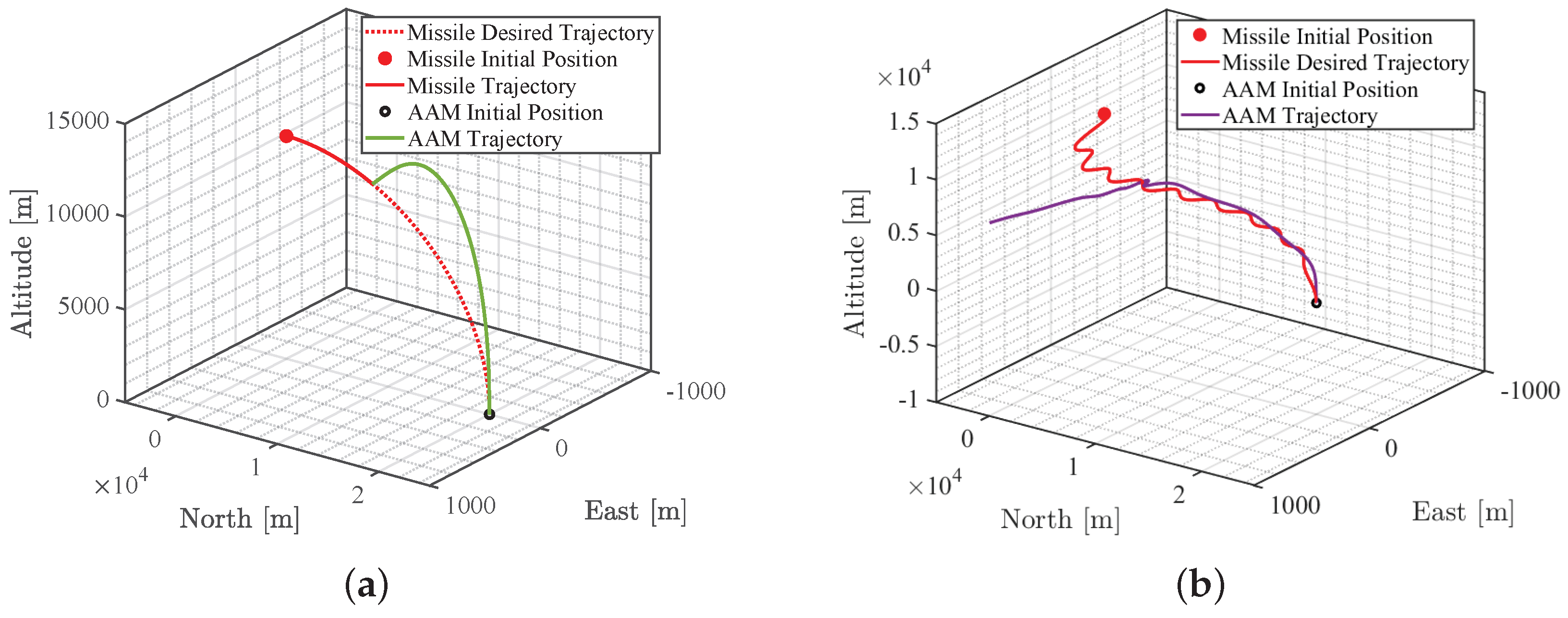
To establish a baseline for performance comparison, a reference engagement scenario was first simulated without the activation of any evasive maneuvers. This scenario serves to highlight the vulnerability of a standard guidance approach against an active air defense system.
As illustrated in
Figure 1a, in the absence of evasive maneuvers, the attacker missile follows a predictable trajectory dictated solely by the guidance law. Consequently, the enemy AAM successfully intercepts the attacker missile mid-flight, resulting in mission failure. This baseline case underscores the necessity of an active evasion strategy for survivability in contested environments.As shown in
Figure 1b, the implementation of the barrel-roll maneuver significantly alters the engagement outcome. The attacker missile generates a spiraling trajectory that effectively deceives the tracking estimation of the threat missile, causing it to miss. Crucially, despite the energy expenditure required for these high-G maneuvers, the GENEX guidance law compensates for the trajectory deviations. It ensures that the attacker missile converges onto the target with the required terminal angle, confirming the compatibility of the evasive bias with the generalized explicit guidance framework.
3.2. Design Space Exploration and Sensitivity Analysis
To determine the optimal operating parameters and assess the system’s robustness, a comprehensive parametric study was performed.
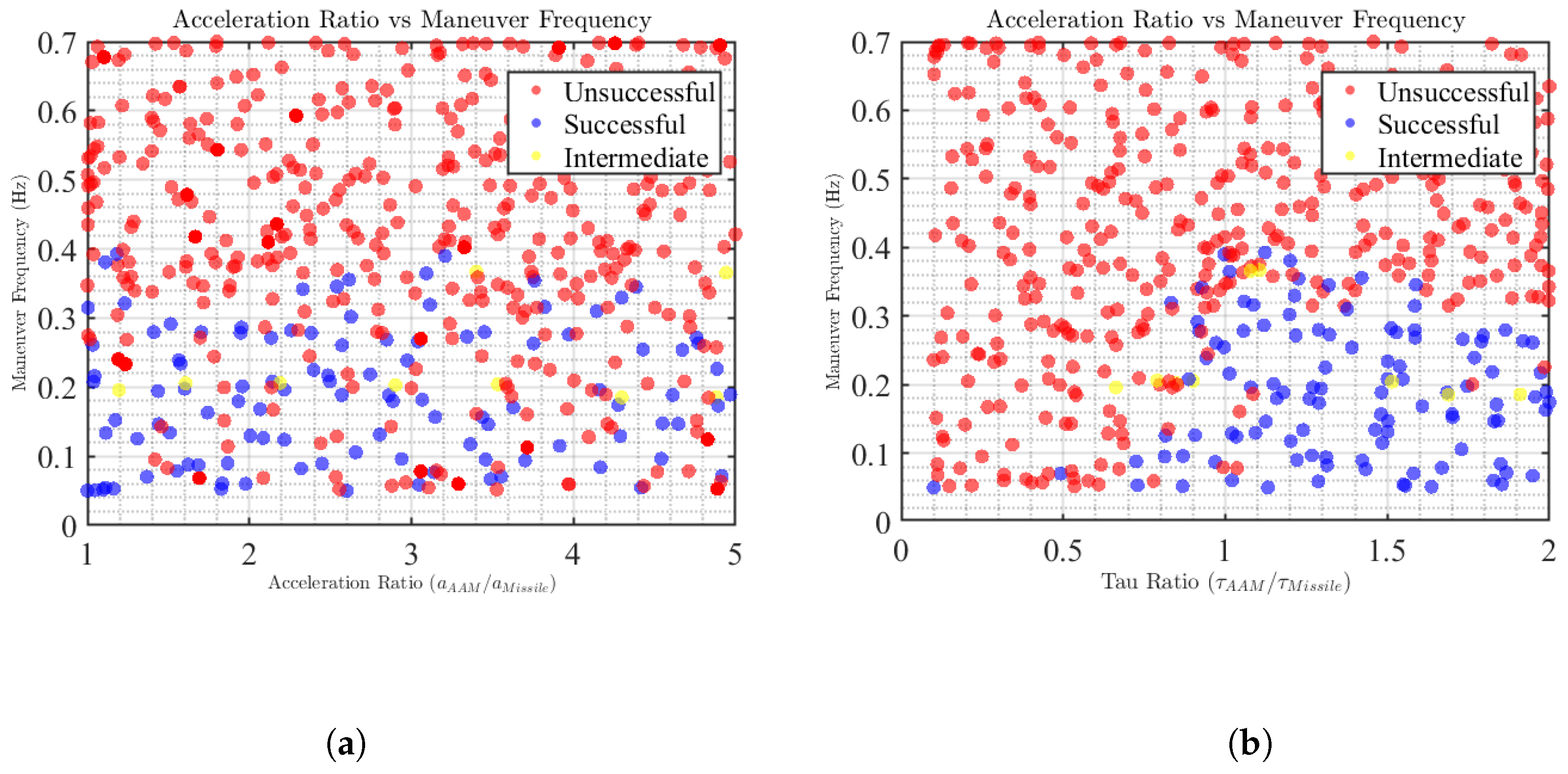
Figure 2 presents the feasibility maps regarding both the internal design variables and the external threat characteristics.
Figure 2 summarizes feasibility boundaries imposed by the limited lateral-acceleration budget and finite guidance dynamics. In
Figure 2a, increasing maneuver frequency or amplitude eventually becomes infeasible because the combined GENEX and evasive demand exceeds
and the fifth-order response bandwidth, leading to sustained saturation and loss of terminal accuracy.
Figure 2b shows that more agile threats (smaller
) reduce the survivable region, as PNG can react faster to the induced LOS variations. The proposed method is therefore most effective against basic-to-intermediate threats with moderate guidance time constants, where survivability gains are obtained without sacrificing terminal-direction constraints.
4. Conclusions
This study has presented a robust guidance and control strategy designed to enhance the survivability of air-to-surface munitions against active air defense systems while ensuring precise terminal impact conditions. By integrating the Generalized Vector Explicit Guidance (GENEX) law with a barrel-roll evasive maneuver, the research addressed the dual challenge of threat evasion and terminal angle constraint satisfaction.
The core contribution of this work lies in enabling the attacker missile to execute evasive maneuvers for survivability while preserving the desired terminal approach angle. To support this objective under limited acceleration capability, a range-dependent acceleration bias structure is implemented. Recognizing that the attacker missile’s acceleration capacity is a finite resource, this structure manages the trade-off between GENEX terminal-angle control and evasion effort. The simulation results demonstrated that reducing the magnitude of the evasive acceleration as the attacker missile approaches the target mitigates range loss and prevents actuator saturation during the critical terminal phase, thereby avoiding degradation of the terminal-angle requirement without compromising mid-course survivability.
The comprehensive parametric analysis revealed the operational boundaries of the proposed method. It was observed that the system’s success is fundamentally constrained by the attacker missile’s dynamic bandwidth and structural acceleration limits; excessive evasion frequencies or magnitudes lead to unfeasible trajectories. Furthermore, the sensitivity analysis regarding the threat’s response time confirmed that the proposed strategy is highly effective against basic-to-intermediate air defense threats characterized by moderate guidance time constants. While the effectiveness naturally diminishes against highly agile, high-end interceptors, the method proves to be a cost-effective solution for reducing vulnerability in typical operational environments.
In conclusion, this research validates that a carefully tuned evasive maneuver, when coupled with an optimal guidance law like GENEX, increases the mission success probability of munitions. The proposed methodology offers a practical and implementable framework for next-generation autonomous munitions operating in contested airspaces.
Author Contributions
Conceptualization, E.B.B. and I.M.K.; methodology, E.B.B.; software, E.B.B.; validation, I.M.K. and E.B.B.; formal analysis, E.B.B.; resources, E.B.B. All authors have read and agreed to the published version of the manuscript.
Funding
This research received no external funding.
Institutional Review Board Statement
Not applicable.
Informed Consent Statement
Not applicable.
Data Availability Statement
The original contributions presented in this study are included in the article. Further inquiries can be directed to the corresponding author.
Conflicts of Interest
Author Ekrem Berkcan Bavbek was employed by the company ASELSAN. The remaining authors declare that the research was conducted in the absence of any commercial or financial relationships that could be construed as a potential conflict of interest.
Abbreviations
The following abbreviations are used in this manuscript:
| AAM | Anti-Air Missile |
| PNG | Proportional Navigation |
| UAV | Unmanned Air Vehicle |
| GENEX | Generalized Vector Explicit Guidance |
References
- Patsko, V.S.; Kumkov, S.S.; Turova, V.S. Pursuit–evasion games. In Handbook of Dynamic Game Theory; Başar, T., Zaccour, G., Eds.; Springer: Cham, Switzerland, 2018. [Google Scholar]
- Kang, S.; Kim, H.J. Differential game missile guidance with impact angle and time constraints. IFAC Proc. Vol. 2011, 44, 3920–3925. [Google Scholar] [CrossRef] [Scilit]
- Johnson, P.A. Numerical Solution Methods for Differential Game Problems. Master’s Thesis, Massachusetts Institute of Technology, Cambridge, MA, USA, 2009. [Google Scholar]
- Faruqi, F.A. Differential Game Theory with Applications to Missiles and Autonomous Systems Guidance; Wiley: Chichester, UK, 2017. [Google Scholar]
- Zarchan, P. Tactical and Strategic Missile Guidance, 6th ed.; American Institute of Aeronautics and Astronautics: Reston, VA, USA, 2012; pp. 120–122. [Google Scholar]
- Shinar, J.; Rotsztein, Y.; Bezner, E. Analysis of three-dimensional optimal evasion with linearized kinematics. J. Guid. Control 1979, 2, 353–360. [Google Scholar] [CrossRef] [Scilit]
- Zarchan, P. Proportional navigation and weaving targets. J. Guid. Control Dyn. 1995, 18, 969–974. [Google Scholar] [CrossRef] [Scilit]
- Imado, F.; Miwa, S. Missile guidance algorithm against high-g barrel roll maneuver. J. Guid. Control Dyn. 1994, 17, 123–128. [Google Scholar] [CrossRef] [Scilit]
- Ryoo, C.-K.; Whang, I.-H.; Tahk, M.-J. 3-D evasive maneuver policy for anti-ship missiles against close-in weapon systems. In Proceedings of the AIAA Guidance, Navigation, and Control Conference, AIAA 2003-5653, Austin, TX, USA, 11–14 August 2003. [Google Scholar]
- Kim, Y.-H.; Ryoo, C.-K.; Tahk, M.-J. Guidance synthesis for evasive maneuver of anti-ship missiles against close-in weapon systems. IEEE Trans. Aerosp. Electron. Syst. 2010, 46, 1376–1388. [Google Scholar] [CrossRef] [Scilit]
- Lee, J.-I.; Ryoo, C.-K. Impact angle control law with sinusoidal evasive maneuver for survivability enhancement. Int. J. Aeronaut. Space Sci. 2018, 19, 433–442. [Google Scholar] [CrossRef] [Scilit]
- Yogaswara, Y.H.; Hong, S.-M.; Tahk, M.-J.; Shin, H.-S. Impact angle control guidance synthesis for evasive maneuver against intercept missile. Int. J. Aeronaut. Space Sci. 2017, 18, 719–728. [Google Scholar] [CrossRef] [Scilit]
- Kim, T.-H.; Park, B.-G.; Tahk, M.-J. Bias-shaping method for biased proportional navigation with terminal-angle constraint. J. Guid. Control Dyn. 2013, 36, 1810–1816. [Google Scholar]
- Erer, K.S. Biased Proportional Navigation Guidance for Impact Angle Control with Extension to Three-Dimensional Engagements. Ph.D. Thesis, Middle East Technical University, Ankara, Turkey, 2015. [Google Scholar]
- Pan, J.; Ma, J.; Huang, J.; Sun, C. A novel attack missile guidance method considering the terminal angle constraint of the attack missile-target-defense missile game. In Lecture Notes in Electrical Engineering; Springer: Singapore, 2025; pp. 235–246. [Google Scholar]
- Ohlmeyer, E.J.; Phillips, C.A. Generalized vector explicit guidance. J. Guid. Control Dyn. 2006, 29, 261–268. [Google Scholar] [CrossRef] [Scilit]
| Disclaimer/Publisher’s Note: The statements, opinions and data contained in all publications are solely those of the individual author(s) and contributor(s) and not of MDPI and/or the editor(s). MDPI and/or the editor(s) disclaim responsibility for any injury to people or property resulting from any ideas, methods, instructions or products referred to in the content. |