


Abstract
Studying the effect of gusts on aircraft is an essential task in aerodynamic and structural design and analysis, as well as in airworthiness certification. The singular design and operational characteristics of Remotely Piloted Aircraft (RPA) demand a specific study of gust effects on these vehicles. This investigation uses the discrete gust criterion prescribed in current fixed-wing RPA codes to analyse the gust behaviour of RPA from a conceptual design viewpoint. The results obtained from the flight envelope analysis allow us to assess the influence of stall, manoeuvring, and gust effects on the overall envelope, with these aspects showing significant differences with respect to conventionally piloted aircraft.
1. Introduction
The study of the effects caused by atmospheric gusts and turbulence on aircraft has been the subject of a substantial amount of research since the early years of aviation [1]. An aircraft encountering moderate-to-severe gusts and turbulence may undergo significant aerodynamic load variations and accelerations, resulting in a potentially hazardous scenario, with manned aircraft gust encounters representing a relevant proportion of incidents and accidents [2,3]. Thereby, the sizing of aircraft attending to gust considerations represents a crucial set of requirements both in historical and current aviation certification regulations [2]. The way in which gust certification requirements have evolved and the assessment of the results from different gust criteria when applied to aircraft modelling are both areas that have attracted a noteworthy amount of interest [2,3,4,5,6].
Aircraft response to atmospheric turbulence and gusts depends on many factors, including the characteristics of the turbulence structures, as well as the operational and design features of the aircraft itself [3,7,8]. Considering this, changes that have taken place over time in aeroplane speed, flight altitude, and wing loading, among other aspects, have demanded updated assessments on their behaviour when encountering these phenomena, even leading to regulation amendments at times, as seen in [3,4]. Therefore, aircraft presenting singular design or operational characteristics when compared to the norm demand a particular evaluation of their gust behaviour and an assessment on how gust regulatory requirements might impact their design.
The latest decades have seen an unprecedented growth in the research, development, and deployment of Remotely Piloted Aircraft (RPA) within the field of aviation. These aircraft have demonstrated a noteworthy versatility to carry out missions of very diverse types, with their multi-mission flexibility being among their main advantages [9,10,11]. Many operations that leverage the potential of RPA show substantial differences to those that are usual in manned aircraft, with the design of the air vehicles themselves also displaying remarkably contrasting features compared to those of manned aircraft [10,12]. Thus, in recent years there has been a surge in research efforts studying the peculiarities and challenges of gust behaviour of RPA. Their low wing loading makes them particularly sensitive to gusts, resulting in higher accelerations and load factors [5]. This does not only affect structural sizing attending to regulations, but also flight controllability [13,14], as well as sensor pointing and data resolution [9,14]. Thereby, it is required both to research the peculiarities of the behaviour of RPA when bearing gusts, as well as to analyse how their design may be influenced by gust-related regulatory requirements.
In this context, this work conducts an investigation on the way in which fixed-wing RPA design and operational characteristics influence their flight envelope, which is the set of both gust and manoeuvre loading conditions prescribed by the regulations that must be complied within aircraft sizing. This envelope can capture the gust behaviour of the aircraft when considering variations in airspeed, height, and weight, thus serving to study gust effects in multiple potential flight conditions, allowing us to capture variations among diverse feasible missions of the same RPA. In the case of CS/Part-25 regulations for manned aircraft, both the discrete gust criterion (which models gusts as pre-defined deterministic profiles of vertical air velocity) and the continuous turbulence criterion (which models gusts from a stochastic perspective) must be employed. A comparison of the foundations of both approaches is expounded in [3,8]. However, other regulations exclusively include the discrete gust criterion, as is the case of manned aircraft regulations such as CS/Part-23 and CS-VLA, as well as current RPA certification codes, including the CS-LUAS by the Joint Authorities for Rulemaking on Unmanned Systems (JARUS) and the AEP-4671 and AEP-83 codes by the North Atlantic Treaty Organization (NATO). Therefore, this criterion shall be the one used in this manuscript when estimating the flight envelope. One of its main advantages is its compatibility with rapid calculation methods, such as those used in aircraft conceptual design during the first phases of the project [15,16]. The particularities of the flight envelope of RPA when compared to those of conventionally piloted aircraft shall be analysed and discussed, as well as the issues arising from the gust susceptibility of RPA when they withstand gusts while flying at low speeds.
2. Methodology
This section covers the approach used for gust modelling and analysis in this research, which is based on the flight envelope prescribed by current RPA regulations.
2.1. Regulatory Requirements and Gust Modelling
As commented in the Introduction, the current research is based on the discrete gust modelling criterion, which is demanded by present RPA regulations. Among current RPA airworthiness codes, JARUS CS-LUAS and NATO AEP-4671 are the two that provide a higher level of detail in the exposition of their requirements [17]. Thus, they shall be the ones used as the basis for the methodology of this research. The underlying gust model of both the above-mentioned codes follows the classic approach of CS/Part-23 regulations for manned aircraft. This model is based on the work by Pratt [1], which assumes a vertical gust velocity profile with the shape of a 1-cosine function, whose horizontal extent and amplitude are regulated, respectively, by its gradient, H, and its intensity, U. The former parameter is half the wavelength of the gust, whereas the latter corresponds to the maximum vertical air velocity. In Pratt’s model, and as adopted in RPA regulations, a standard gradient of 12.5 times the Mean Geometric Chord (MGC) is used. The mathematical expression of the gust shape is provided in Equation (1), where u represents the gust vertical velocity at each horizontal position (s) along the gust wave. The gust intensity is a function of altitude, as prescribed by the airworthiness codes.
Under some modelling assumptions regarding the nature of the motion of the aircraft and the aerodynamics involved, Pratt found that the maximum vertical acceleration (and, subsequently, the load factor) experienced by the aircraft for a given gust could be related to that of an equivalent quasi-stationary instantaneous gust through a multiplicative constant that he named the gust alleviation factor, Kg. This factor, for which Pratt found a convenient numerical approximation that simplifies analytical calculations, is a function of the aircraft’s mass ratio (also known as mass parameter, μ), which integrates the aircraft’s mass, geometry, and flight condition. More details may be found in [1]. The hypotheses of this model are adopted by current RPA codes and are also employed here.
2.2. Flight Envelope Build-Up Process
Following the prescriptions found in the aforementioned RPA codes, the flight envelope is drawn from the combination of the manoeuvring and gust envelopes. Such a combination is to be understood as the set union of the points that belong to either of the two envelopes. These envelopes are sets of points in the two-dimensional space, representing the loading conditions that the aircraft structure must be able to withstand when performing a manoeuvre or encountering a regulation-prescribed gust. The vertical axis represents the load factor, n, which is the ratio of the normal aerodynamic force component divided by the weight of the RPA [15], while the horizontal axis is the equivalent airspeed (EAS), VEAS. The construction of the envelopes is mainly based on two characteristic speeds: the design cruising speed, VC, which is selected attending to RPA operating requirements as a representative mission equivalent airspeed, and the design dive speed, VD, which is the maximum equivalent airspeed of the envelope, where VC < VD. The envelope build-up process followed here is based on the aforementioned RPA codes and on references [9,15,16].
The manoeuvring envelope imposes limit load factors for both positive (nlim+) and negative (nlim−) manoeuvres, which represent the most demanding manoeuvring load conditions expected in service. As prescribed in the codes, for positive manoeuvres, the limit load factor is constant up to VD, whereas for negative manoeuvres, it is constant up to VC and transitions linearly towards 0 at VD. The values of both nlim+ and nlim− are prescribed in the regulations as a function of the Maximum Take-Off Weight (MTOW), but need not be higher than 3.8 for nlim+, nor lower than 0.4 times the former value with a negative sign for nlim−.
The generation of the gust envelope is based on Equation (2) which merges Pratt’s theoretical results with a starting condition of level flight, yielding a convenient expression that relates load factor with flight velocity, through VEAS. Its derivation is fully expounded in [1].
Here, is the air density at sea level, and is the air density at the operating altitude for which the envelope is being drawn. UEAS is the maximum gust intensity, as described in Section 2.1. This magnitude has different regulation-prescribed values depending on flight altitude. MGC is defined as the quotient of the wing surface area, Sw, and the wingspan, bw [16]. W/Sw is the wing loading, which is the quotient of RPA weight and wing surface, and is a key design parameter affecting numerous performance characteristics of the aircraft, from take-off and landing to stall and gust behaviour, as fully expounded in [15,16]. is the lift-curve slope [16], and g is the gravity acceleration. Equation (2) is linear in VEAS, explaining the diamond-shaped form of the gust envelopes that will be seen in subsequent figures.
A subset of points needs to be excluded from the envelopes to take stall into account. In the absence of more complex aerodynamic considerations, stall can be modelled by Equation (3), which in the envelope space corresponds to two parabolas.
Here, is the maximum lift coefficient of the CL curve for the RPA configuration, and is the stall speed expressed in EAS corresponding to each load factor.
The constructive process presented above allows us to perform some reasoning regarding the relationships of different parameters of the problem with the envelope and its shape. The relevant parameters and their meaning have been previously defined, and a summary of their sources of variation and some typical values are presented in Table 1.
Table 1.
Summary of relevant design and operational parameters in the flight envelope.
This paper will predominantly focus on the impact of the wing loading (W/Sw) in the shape of the envelope. As it appears in the denominator of both Equations (2) and (3), any decrease in the wing loading will result in an increment of the corresponding value. For expression (2), this implies a greater slope of the gust curves, which exacerbates the importance of gust in the sizing of the structure. For Equation (3), it entails increasing the load factor at which stall occurs. Therefore, a reduction in the wing loading is simultaneously beneficial for stall behaviour and detrimental for gust structural sizing.
3. Analysis and Results
The purpose of this section is to show a number of envelopes corresponding to real RPA, and to analyse them from the perspective of the impact of design and operational variables in their shape. Data have been mainly gathered from the Jane’s Web database on RPA. The results obtained here will be subsequently discussed in Section 4.
3.1. Tactical RPA: RQ-2 Pioneer
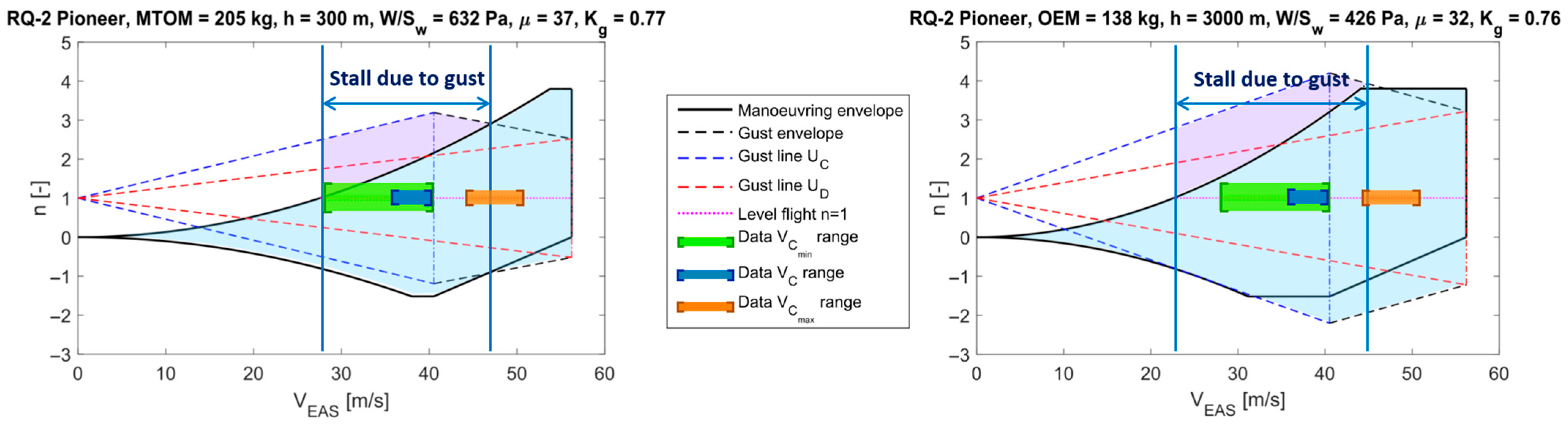
Two flight envelopes are presented in Figure 1 for different operating conditions of the RQ-2 Pioneer: one with maximum mass, corresponding to Maximum Take-Off Mass (MTOM) and low altitude, h, and another with minimum mass, corresponding to Operating Empty Mass (OEM) and higher altitude. This choice is intended to showcase the most contrasting shapes that the flight envelope can take for a given aircraft.
Figure 1.
RQ-2 Pioneer flight envelopes at two different conditions. The blue region corresponds to the set of points of the envelope, and the purple region to those falling in the stall region for the prescribed maximum gust intensity at each speed, corresponding to the “stall due to gust” interval.
The shapes of the envelopes are quite distinct to those typically found in manned aeroplanes, with some examples of manned aeroplane envelopes being found in [15,16]. The different highlighted regions on the n = 1 line represent various possible horizontal flight speeds that the Pioneer can take depending on the mission and flight condition. Since this aircraft is mainly intended for Intelligence, Surveillance and Reconnaissance (ISR) operations, these speeds are generally low, and, consequently, quite close to stall in many cases. In the first envelope, the segments corresponding to nlim are very short, and stall dominates most of the diagram in spite of the comparatively low wing loading. This is due to the cruise and maximum flight speed of the aircraft also being low, resulting in a reduced value of VD, and thus giving as a result a compact envelope. At the bottom right corner is an area where the gust load factor is the most demanding. It is noted that there is a significant range of operational flight speeds where the gust load factors fall above the stall parabola. This means that those load conditions are not attainable, since at those speeds, encountering a gust as prescribed by the regulations would result in the aircraft stalling according to the model used in this research. This could compromise the operation and the integrity of the aircraft.
The second envelope is notably different, which showcases the impact of the mission and load condition on gust and stall behaviour. The stall moves to the left, leaving more room for manoeuvres. This is due to the reduction in the wing loading, which on the other hand increases the gust load factors, leading to a larger area in the bottom right corner of the envelope. This increase in gust load factors balances the reduced stall speed, leading to a similar length of the gust-induced stall interval, albeit shifted to the left.
3.2. Medium Altitude Long Endurance (MALE) RPA: Predator A
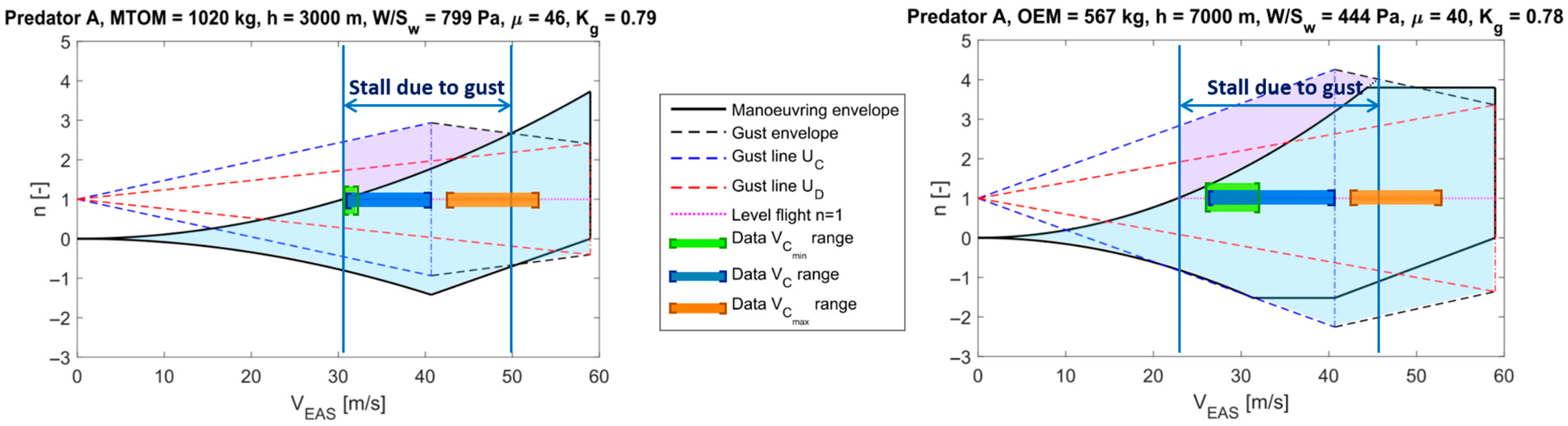
Figure 2 presents the flight envelopes of the Predator A. The left and right parts of the figure correspond, respectively, to the maximum and minimum wing loadings, with accompanying changes in flight altitude for the same reasons alluded to in Section 3.1. The differences between both envelopes are even more remarkable in this case. In the first one, the nlim values are not reached for any velocity due to the large impact of stall. This is due to the combination of the higher maximum W/Sw of this aircraft in comparison with the RQ-2 Pioneer, but with similar maximum values of VEAS in both RPA due to the effect of the different mission altitudes. The envelope changes substantially in the second condition due to the high fuel mass of the Predator, resulting in a larger absolute variation in W/Sw between both envelopes. Here, the nlim values are no longer overpowered by stall and the load factors for gusts of negative intensity take a remarkable share of the bottom right side of the envelope. Both envelopes also present a significant gust-induced region, which is similar in magnitude in both cases, since the mitigating effect of a less prominent stall region is compensated by the exacerbating effect of higher gust load factors.
Figure 2.
Predator A flight envelopes at two different conditions. The blue region corresponds to the set of points of the envelope, and the purple region to those falling in the stall region for the prescribed maximum gust intensity at each speed, corresponding to the “stall due to gust” interval.
4. Discussion
One of the main particularities of the envelopes obtained for both RPA when compared to those of conventional manned aircraft is that they are noticeably more compact in the horizontal axis (VEAS) dimension, corresponding to a lower interval of feasible flight speeds for RPA. This is consistent with the fact that many RPA missions are conducted at low speeds, such as ISR tasks, which are very common for these aircraft [9,10]. Low flight speeds typically result in flight conditions of higher endurance [18], and also enhance the data capture quality of many ISR sensors [14]. These advantages substantiate the interest of flying at low speeds for these kinds of operations, even if these are often close to stall. Thus, unless there is an additional design requirement for high-speed flight for the particular RPA concept, the cruise and maximum level speed values of these aircraft tend to be relatively low, which avoids oversizing the powerplant, and results in lower values of VD when compared to those usually seen in manned aircraft. The above-mentioned considerations lead to a lower interval of possible flight speeds, resulting in a large portion of the manoeuvring envelope in this space being limited in terms of the load factor by stall instead of reaching the prescribed values of nlim, which, depending on the flight conditions, may not even be achievable for any VEAS values, as seen, for example, in Figure 2.
As a consequence of the above, the gusts prescribed by the regulation, particularly those of intensity UC, could potentially cause the vehicle to stall over a large portion of the feasible level flight speed interval, since the gust lines fall above the stall parabola in most of the envelopes, as seen in the case studies. Only at large values of VEAS do the gust lines fall below stall or nlim, but the VEAS values where this happens are significantly higher than those corresponding to typical mission speeds. This is in contrast to conventional manned aircraft, where the proportion of the gust-induced stall interval is much lower with respect to the whole range of feasible flight speeds [16]. Furthermore, gust-induced stall does not occur as much for the expected mission speeds in these aircraft, with their operating speeds tending to be higher in value than those of RPA [16]. The fact that RPA are very susceptible to gust-induced stall at typical mission speeds represents a significant drawback, as it results in a hazardous loss-of-control scenario even if the flight height and RPA characteristics would allow it to recover from stall before impact. A more involved study of this phenomenon would require analysing the time variation in angle of attack, which has not been conducted in this model and is an area of future research.
In terms of RPA design, and particularly analysing the effects of gusts on structural sizing, it can be seen that gust load factors tend to be remarkably high for both case studies, especially when compared to typical values of various categories of manned aircraft [15,16]. Although these high gust load factors are not reached for positive gusts in many cases due to stall occurring beforehand, there is a large area at the bottom-right of the flight envelope, corresponding to downward gusts, where gust loads are significantly more demanding than manoeuvring ones. Large load factors result in a heavier structure, following typical semi-empirical weight estimation models, in which Wwing ∝ nx [10,16], with x being a constant, the value of which depends on the model. Thus, it can be expected that gust effects will have a larger role in the structural design of RPA.
Nowadays, many RPA that are in operation have not been designed attending to current codes, such as those used in this study. Therefore, if it is sought to certify these already existing designs according to these regulations to enhance their integration in non-segregated airspace and achieve larger operation flexibility, it is possible that the structure might have to be reinforced to withstand these gust loads, resulting in a potentially costly redesign. This was already suggested in previous research when studying the required structural weight for gust loads at the cruise speed of various RPA [5], and is further supported with the results obtained in this investigation for the whole flight envelope with present regulations. New RPA projects can choose to implement these structural sizing criteria from the initial phases of the design process through rapid methodologies such as the one used in this research, laying the groundwork for a code-compliant structure.
5. Conclusions
Aeroplane gust analysis has been and continues to be the focus of much research that seeks to further understand the behaviour of these aircraft when subjected to these atmospheric phenomena. This research has analysed the gust behaviour of two representative RPA through the flight envelope approach prescribed by current RPA-specific regulations. In spite of the requirements of the codes in terms of gust loads being very similar to those found in the manned aircraft CS/Part-23 and CS-VLA codes, their application to RPA gives significantly different gust envelopes in terms of shape and gust/manoeuvre load predominance. Since the structure must withstand all load conditions included in the envelope, this significantly affects the structural sizing of these aircraft, which may give rise to original structure design strategies and criteria, with this being a potential area of future work that might follow from the present analyses. Furthermore, a significant hazardous aspect has been identified, which is that RPA are more susceptible to gust-induced stall precisely at their typical operating speeds. The study of the operational and design measures that could be taken to mitigate the risks associated with this behaviour opens up another possible avenue of subsequent research.
A key aspect that makes the flight envelope a remarkable tool to study RPA gust behaviour is its capability to capture these effects for the whole range of potential airspeeds at different weights and altitudes, fitting the multi-mission nature of these aircraft. This has enabled its use in this study to capture the main particularities behind the gust response of these aircraft in different flight conditions from a conceptual design standpoint. As commented by previous authors, there are still many questions to answer with respect to manned aircraft and RPA turbulence and gust behaviour, with this field constituting a significant area of research towards better understanding and modelling of the gust behaviour of these aircraft so as to improve their safety under the effect of these phenomena.
Author Contributions
Conceptualization, C.C.-R.; methodology, C.-J.V.-C. and Á.G.-R.; software, C.-J.V.-C. and Á.G.-R.; validation, C.-J.V.-C., Á.G.-R. and C.C.-R.; formal analysis, C.-J.V.-C. and Á.G.-R.; investigation, C.-J.V.-C. and Á.G.-R.; resources, C.C.-R.; data curation, Á.G.-R.; writing—original draft preparation, C.-J.V.-C. and Á.G.-R.; writing—review and editing, C.C.-R.; visualisation, C.-J.V.-C.; supervision, C.C.-R. All authors have read and agreed to the published version of the manuscript.
Funding
This research received no external funding.
Institutional Review Board Statement
Not applicable.
Informed Consent Statement
Not applicable.
Data Availability Statement
The original contributions presented in this study are included in the article material. Any further inquiries can be directed to the corresponding author.
Conflicts of Interest
The authors declare no conflicts of interest.
References
- Pratt, K.G.; Walker, W.G. A Revised Gust-Load Formula and a Re-Evaluation of V-g Data Taken on Civil Transport Airplanes from 1933 to 1950; NACA-TR-1206; NASA: Pasadena, CA, USA, 1954. Available online: https://ntrs.nasa.gov/citations/19930090988 (accessed on 26 November 2025).
- Saucray, J.M.; Atigues, C.; Squeglia, G.; Guillot, J. International standardisation of regulations for gust loading calculations. Aeronaut. J. 1991, 95, 370–378. [Google Scholar] [CrossRef] [Scilit]
- Fuller, J.R. Evolution and Future Development of Airplane Gust Loads Design Requirements. SAE Trans. 1997, 106, 1679–1698. Available online: https://www.jstor.org/stable/44650556 (accessed on 7 May 2026).
- Flomenhoft, H.I. Brief History of Gust Models for Aircraft Design. J. Aircr. 1994, 31, 1225–1227. [Google Scholar] [CrossRef] [Scilit]
- Cuerno-Rejado, C.; Martínez-Val, R. Unmanned Aircraft Systems in the Civil Airworthiness Regulatory Frame: A case study. J. Aircr. 2011, 48, 1351–1359. [Google Scholar] [CrossRef] [Scilit]
- Wu, Z.; Cao, Y.; Ismail, M. Gust loads on aircraft. Aeronaut. J. 2019, 123, 1216–1274. [Google Scholar] [CrossRef] [Scilit]
- Coupry, G. Problèmes du vol d’un avion en turbulence. Prog. Aerosp. Sci. 1970, 11, 111–181. [Google Scholar] [CrossRef] [Scilit]
- Noback, R. Comparison of Discrete and Continuous Gust Methods for Airplane Design Loads Determination. J. Aircr. 1986, 23, 226–231. [Google Scholar] [CrossRef] [Scilit] [PubMed]
- Austin, R. Unmanned Aircraft Systems: UAVS Design, Development and Deployment, 1st ed.; John Wiley & Sons: Chichester, West Sussex, UK, 2010. [Google Scholar]
- Gundlach, J. Designing Unmanned Aircraft Systems: A Comprehensive Approach, 1st ed.; AIAA: Reston, VA, USA, 2012. [Google Scholar]
- Palmer, J.L. Assembly and Initial Analysis of a Database of the Characteristics of Fixed-Wing Unmanned Aircraft Systems; Australian Government: Canberra, Australian, 2014. Available online: https://apps.dtic.mil/sti/tr/pdf/ADA623605.pdf (accessed on 29 November 2025).
- Clothier, R.A.; Palmer, J.L.; Walker, R.A.; Fulton, N.L. Definition of an airworthiness certification framework for civil unmanned aircraft systems. Saf. Sci. 2011, 6, 871–885. [Google Scholar] [CrossRef] [Scilit]
- Watkins, S.; Milbank, J.; Loxton, B.J.; Melbourne, W.H. Atmospheric Winds and Their Implications for Microair Vehicles. AIAA J. 2006, 44, 2591–2600. [Google Scholar] [CrossRef] [Scilit]
- Mohamed, A.; Massey, K.; Watkins, S.; Clothier, R. The attitude control of fixed-wing MAVS in turbulent environments. Prog. Aerosp. Sci. 2014, 66, 37–48. [Google Scholar] [CrossRef] [Scilit]
- Roskam, J.; Lan, C.-T.E. Airplane Aerodynamics and Performance, 1st ed.; DARcorporation: Lawrence, KS, USA, 1997. [Google Scholar]
- Gudmundsson, S. General Aviation Aircraft Design, 1st ed.; Butterworth-Heinemann: Oxford, UK, 2014. [Google Scholar]
- Gómez-Rodríguez, Á.; Turkoglu, C.; Cuerno-Rejado, C. A Systematic Approach towards the Integration of Initial Airworthiness Regulatory Requirements in Remotely Piloted Aircraft System Conceptual Design Methodologies. Aerospace 2024, 11, 735. [Google Scholar] [CrossRef] [Scilit]
- Gómez-Tierno, M.Á.; Pérez-Cortés, M.; Puentes-Márquez, C. Mecánica del Vuelo, 2nd ed.; Garceta Grupo Editorial: Madrid, Spain, 2012. [Google Scholar]

Disclaimer/Publisher’s Note: The statements, opinions and data contained in all publications are solely those of the individual author(s) and contributor(s) and not of MDPI and/or the editor(s). MDPI and/or the editor(s) disclaim responsibility for any injury to people or property resulting from any ideas, methods, instructions or products referred to in the content. |
© 2026 by the authors. Licensee MDPI, Basel, Switzerland. This article is an open access article distributed under the terms and conditions of the Creative Commons Attribution (CC BY) license.