


Abstract
Ultrasonic Guided Wave (UGW)-based Structural Health Monitoring (SHM) is a promising strategy for detecting damage to aeronautical structures, although its application is complicated by signal complexity and experimental uncertainty. This work seeks to identify damage-sensitive signal features for integration into Machine Learning (ML) frameworks, offering physics-informed indicators. The study combined experimental monitoring of damage to Carbon Fibre Reinforced Polymer (CFRP) plates and finite element models. To overcome the numerical–experimental mismatch, an ML algorithm predicted experimental characteristics from numerical data. The robustness of the model was validated by extrapolation (prediction of future damage) and generalization (prediction on unseen plates) strategies, confirming that ML can robustly correct for uncertainty. These results validate hybrid strategies that feed Digital Twin approaches to structural diagnosis and real-time forecasting.
1. Introduction
The increasing adoption of composite materials in the aerospace industry is driven by their exceptional stiffness-to-weight ratio [1]. However, their vulnerability to failure modes that are difficult to detect visually, such as delamination, demands advanced predictive maintenance strategies. Structural Health Monitoring (SHM) systems have been explored to identify these failures, enhancing safety and reducing aircraft maintenance costs. Among them, Ultrasonic Guided Waves (UGWs) [2], stand out as elastic waves that propagate along thin structures and are highly suitable for non-destructive inspection due to their sensitivity to small-scale damage and their capability to cover large structural areas.
This work addresses the challenge of achieving robust numerical–experimental validation, hindered by the mismatch between the simplifications of analytical models and the uncertainties inherent in manufacturing and testing. Machine Learning (ML) emerges as a suitable solution to mitigate these discrepancies in the UGW field [3], thanks to its ability to capture the nonlinear and complex relationship between physical parameters and signal behaviour. Its robustness to noise, capacity to reduce overfitting and usefulness in quantifying variable importance further support its application.
This research, framed on the Horizon Europe GENEX project, aims to develop an ML-based framework for predicting delamination propagation in composite plates. The methodology focuses on comparing trends of key signal features obtained from UGW inspection simulations and experiments, enabling the characterization of composite laminate behaviour under static loading. This approach is expected to improve predictive maintenance practices and enhance aircraft system reliability.
2. Materials and Methods
The monitoring campaign presented in this research aims to study how to compensate for the numerical–experimental uncertainties of the propagation of Ultrasonic Guided Waves on composite plates damaged by delamination.
Four Carbon Fibre Reinforced Polymer (CFRP) plates (P1 to P4) 500 mm × 250 mm × 3.93 mm were manufactured at AIMEN, Vigo, Spain, by Automatic Fibre Placement (AFP) and instrumented and tested at ITA. The stacking sequence of the 21 plies that conformed the laminate of the plates was (45/−45/0/−45/45/90/−45/45/45/−45/90/T/−45/45/45/−45/90/45/−45/0/−45/45) and the resulting homogeneous material properties are described in Table 1.
Table 1.
CFRP plates homogeneous material properties.
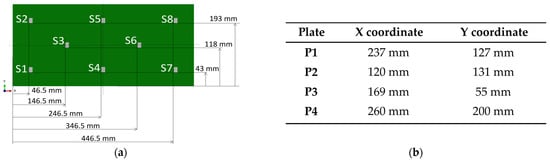
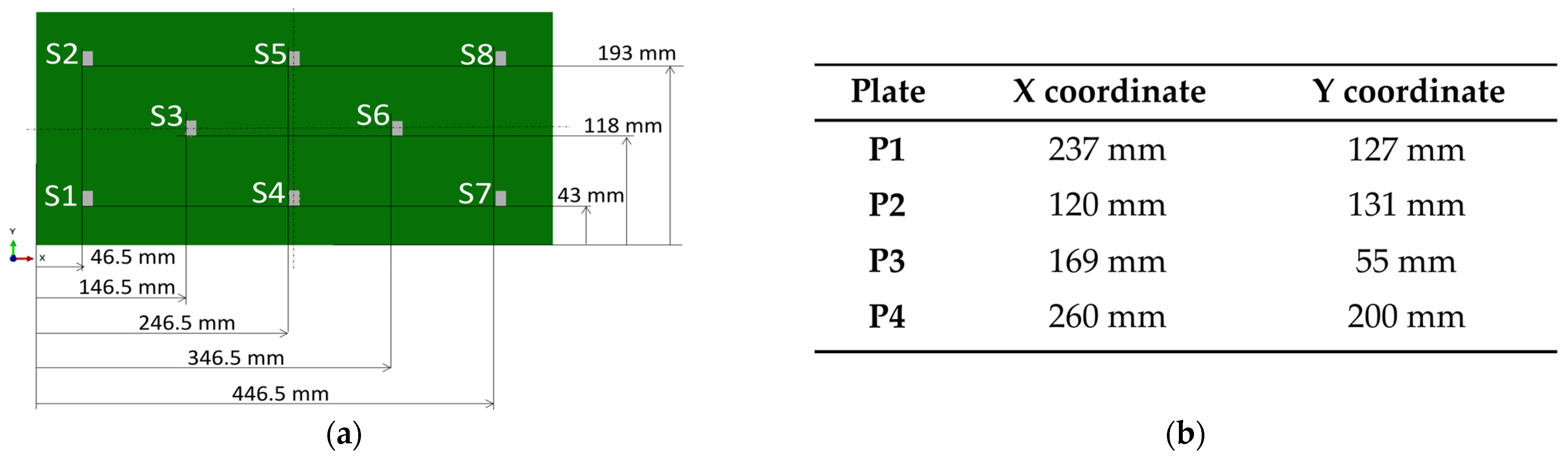
Eight commercial Macro Fibre Composite (MFC) sensors (M-0714-P2) provided by Smart Material GmbH, Dresden, Germany, were bonded to the top surface of each plate with cyanoacrylate and placed as shown in Figure 1a. Although geometry and instrumentation were identical, the plates presented different in-plane damage locations, which maximizes the variability of the data. Damage-centre coordinates, referenced to the bottom-left origin, are presented in Figure 1b.
Figure 1.
Plates instrumentation: (a) sensor positioning; (b) location of damage.
2.1. Experimental Campaign
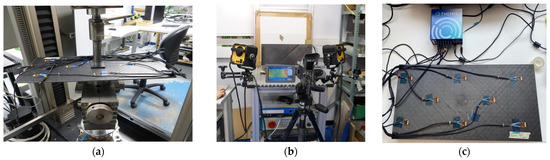
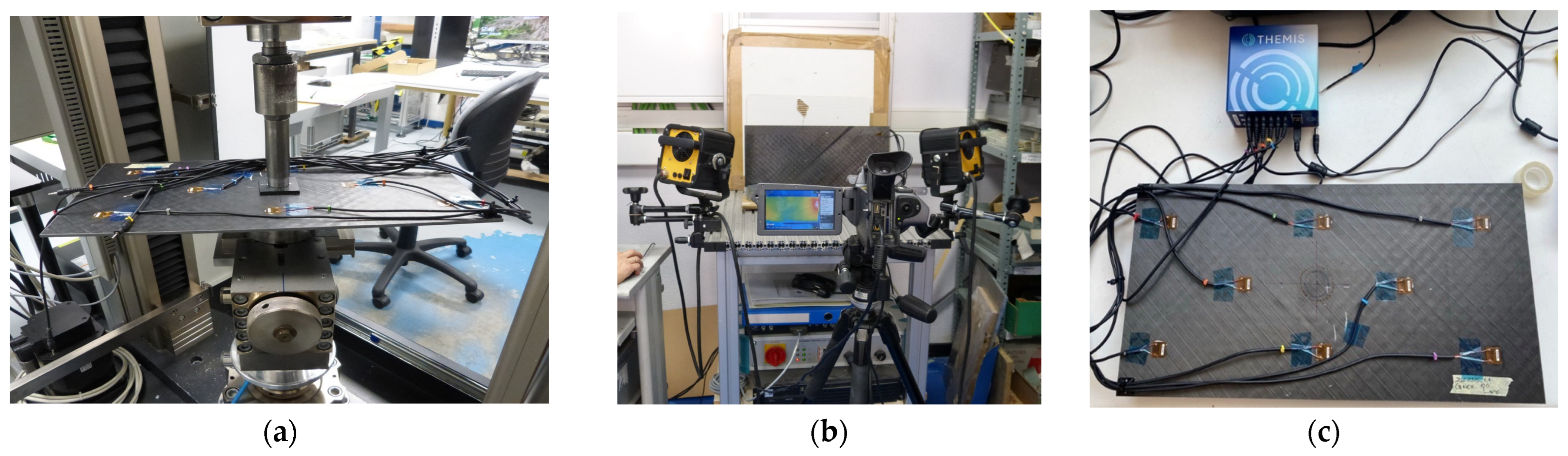
The experimental campaign comprised three main steps. First, a stepwise circular flexion load test was conducted using a servo-hydraulic UTM INSTRON8872 provided by INSTRON, Barcelona, Spain, (max 25 kN, 50 mm displacement) to propagate a central delamination. This delamination was pre-introduced during manufacturing via a 4 cm Teflon film in the plate mid-plane. Delamination progression was controlled using infrared thermography, a non-destructive technique (NDT), based on thermal imaging [4], that accurately determined the geometry and size of the damaged zone after each loading stage. Finally, SHM was performed using Ultrasonic Guided Wave (UGW) inspection. Piezoelectric MFC sensors attached to the plate surface actively emitted and received ultrasonic waves, allowing on-demand structural interrogation crucial for in-service monitoring [1]. The Phased Array Monitoring for Enhanced Life Assessment (SHMUS) system developed by Aranguren [5] generated the waves, using a 3.5-cycle, 150 kHz signal with a Hanning windowing. Figure 2 illustrates the experimental set-up of the three steps during P1 testing.
Figure 2.
Experimental set-up: (a) stepwise circular flexion loading test set-up; (b) thermography set-up; (c) Ultrasonic Guided Wave (UGW) set-up.
2.2. Numerical Model
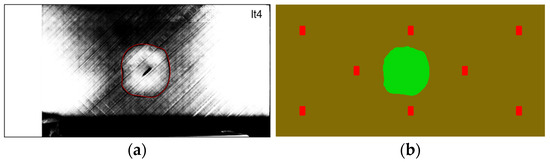
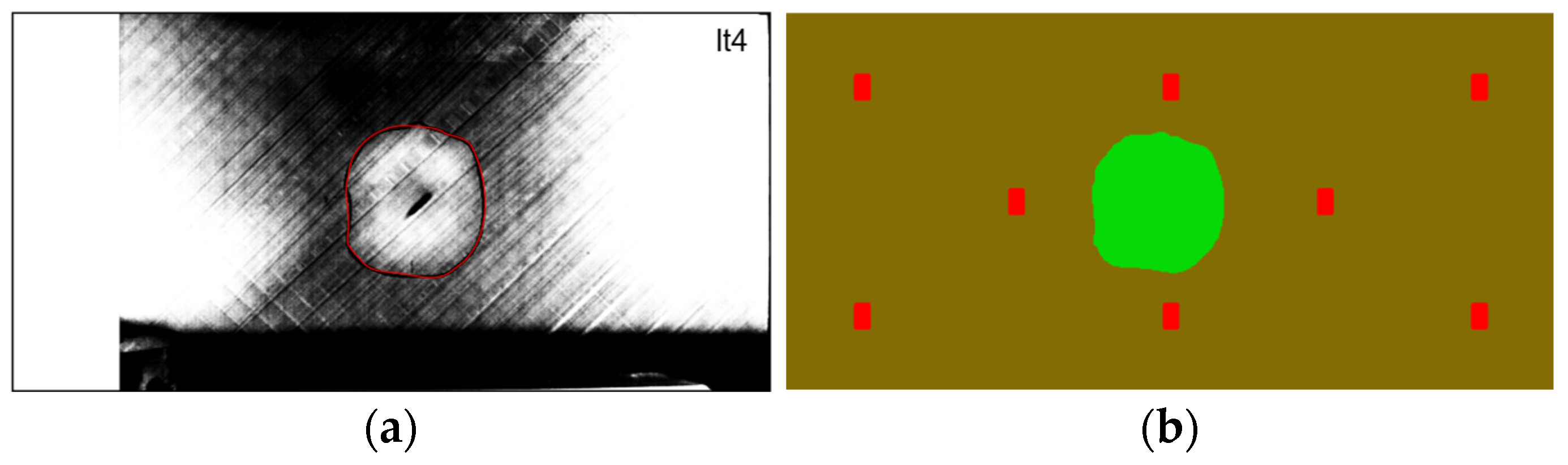
A large dataset is crucial for accurate damage prediction. Finite element (FE) simulations in Abaqus 2024 generated the synthetic datasets of the plates. considering material properties, excitation signals, sensor positions, and damage location via thermography and penetrating liquids. Dispersion curves ensured a 1 mm element size and identified key wave modes. The models in Abaqus represent the condition of the plate after each application of force, as if they were a series of photos, shown in Figure 3.
Figure 3.
P1 condition after the fourth force application (It4): (a) thermograph, with delamination perimeter marked in red; (b) Abaqus model, with sensors in red, delaminated area in green and the rest of the plate in brown.
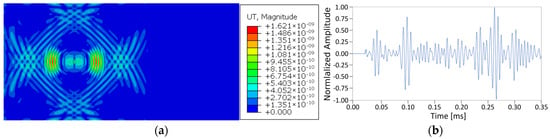
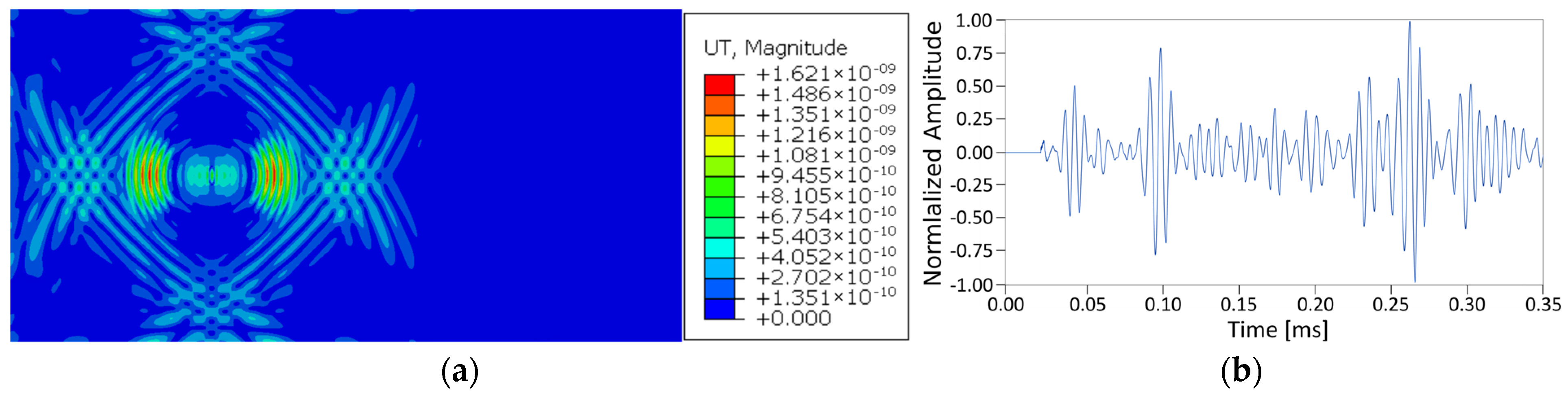
To reduce computational cost, simulations used simplified models: homogeneous material, smooth surfaces, and perfect contact between sensors and plates. Delaminated areas were modelled by splitting the plate into two parts joined with compatible displacements, creating a stress-free contact surface that effectively represents the delamination. Finally, a co-simulation analysis was chosen to improve the efficiency of the simulation. An explicit integration scheme (Abaqus Explicit) was used to simulate the propagation of the elastic waves in the plates (Figure 4a), while implicit integration (Abaqus Standard) was used to simulate the piezoelectric behaviour of the sensors, obtaining the received electrical potential as output (Figure 4b).
Figure 4.
Abaqus co-simulation for P1 emitting with sensor S3 at baseline state (It0): (a) total displacement, UT, at a propagation time of 0.039 ms; (b) received signal by sensor S6.
For real structures with curvature or reinforcements, local scattering or mode conversion may arise [3], but this simulation methodology can be extended to higher-fidelity models, still capturing the key wave–damage interactions.
Validation is challenging due to real-world uncertainties preventing exact simulation–experiment waveform matching. The method compares trends of key signal features during damage, enabling robust and practical numerical–experimental validation.
2.3. Feature Extraction Method
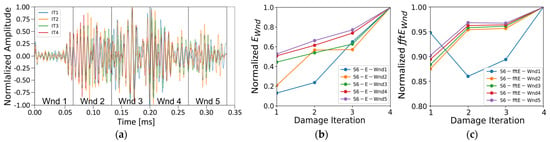
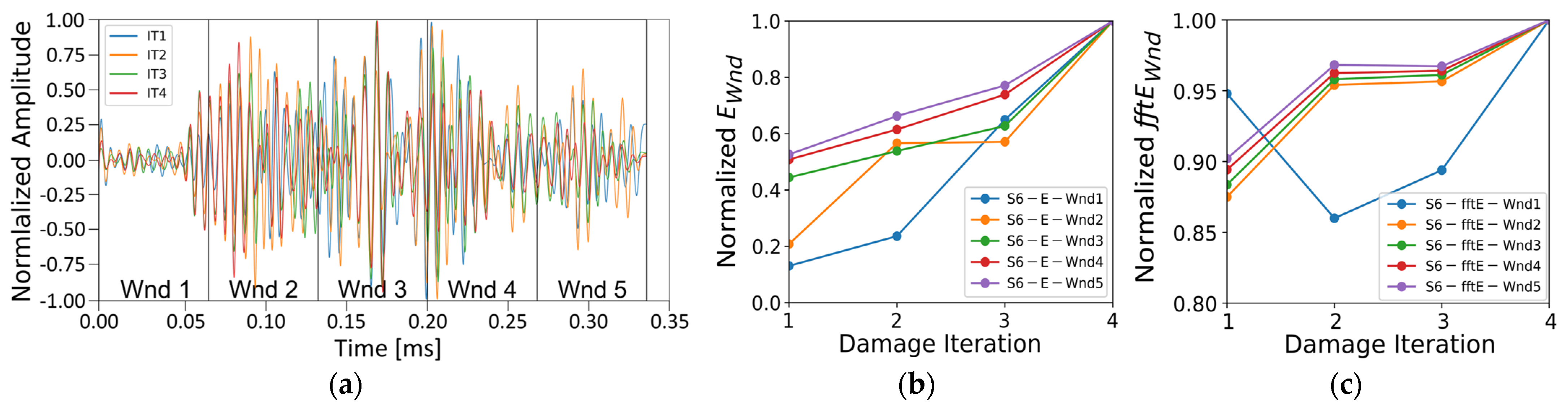
Since there is a need to extract useful quantitative information from raw signals for validation, the Features Extraction Method is detailed here. The methodology begins with the preprocessing of the experimental data, eliminating the acquisition system response time and filtering the signals with an order five Butterworth band-pass filter to isolate the frequency range of interest, which was [125, 175] kHz. The core of the method is twofold, based on the data processing and feature engineering developed by Kolozis [6]: first, the baseline signal is subtracted from all signals, isolating the pure effect from damage progression, then the resulting signals are divided into five equally spaced windows, in order to capture the variations in signal intensity across different time intervals (Figure 5a).
Figure 5.
P1 signal feature extraction emitting with sensor S3 and receiving with sensor S6: (a) resulting signals after preprocessing and baseline subtraction; (b) time-domain window energy trends with damage iteration; (c) frequency-domain window energy trends with damage iteration.
Finally, two key features are quantified in each of these windows: Energy in the Time Domain (), calculated as the sum of squares of the amplitude of the discrete signal, and Energy in the Frequency Domain (), obtained following Equation (1) by the sum of squares of the normalized Fast Fourier Transform (FFT) of the discrete signal:
where i is the window number, is the FFT of the discrete signal at instant n, and N is the total number of samples in each window.
The result of this process is the normalized energy trends versus the progression of damage (damage iteration) illustrated in Figure 5, which is precisely the metric that will be compared and adjusted between the numerical model and the experiment.
2.4. Machine Learning Algorithm
Despite a robust Feature Extraction Method, numerical–experimental validation is not always achieved, as Abaqus simulation signals often fail to replicate experimental trends. The goal of Machine Learning (ML) in this research is to correct these discrepancies by predicting experimental features from numerical ones. ML is ideal for UGW due to its ability to capture highly complex, nonlinear relationships between physical parameters and signal characteristics [7]. Its robustness against noise, achieved by averaging hundreds of predictions, minimizes overfitting and measurement errors, while its interpretative capacity quantifies variable importance, revealing the influence of numerical features or damage characteristics. When labelled data are unavailable, ML strategies rely on unsupervised novelty detection on baseline signals [8], complemented by physics-based data augmentation and transfer learning to generalize across unseen damage scenarios.
Each plate dataset contained experimental and numerical signal features ( and ), damage characteristics (coordinates and size), and sensor positions (angles and distances). The four datasets trained the ML model, whose accuracy was evaluated with Mean Absolute Error (MAE) and R2 after Max-Normalization (MN) [9]. Hyperparameters of robust algorithms—Random Forest (RF), Gradient Boosting (GB), and Extreme Gradient Boosting (XGBoost)—were optimized.
Two validation strategies tested generalization: Strategy 1 assesses extrapolation, predicting future damage states from initial damage levels; Strategy 2 assesses generalization, predicting the physical behaviour of never seen samples from full progression of damage in a single plate. An additional metric considered a 10% error band respected to the real values, defined to quantify predictions within tolerance. The result was a Signal Feature Prediction, where the model generated the predicted experimental values.
3. Results
3.1. Random Forest Evaluation in P1 from 75% to 5% Train Data
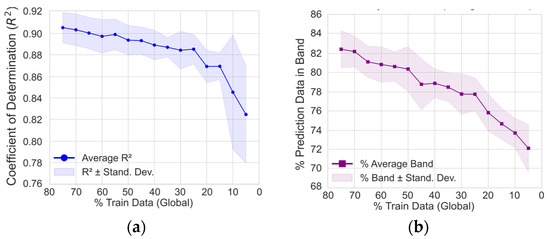
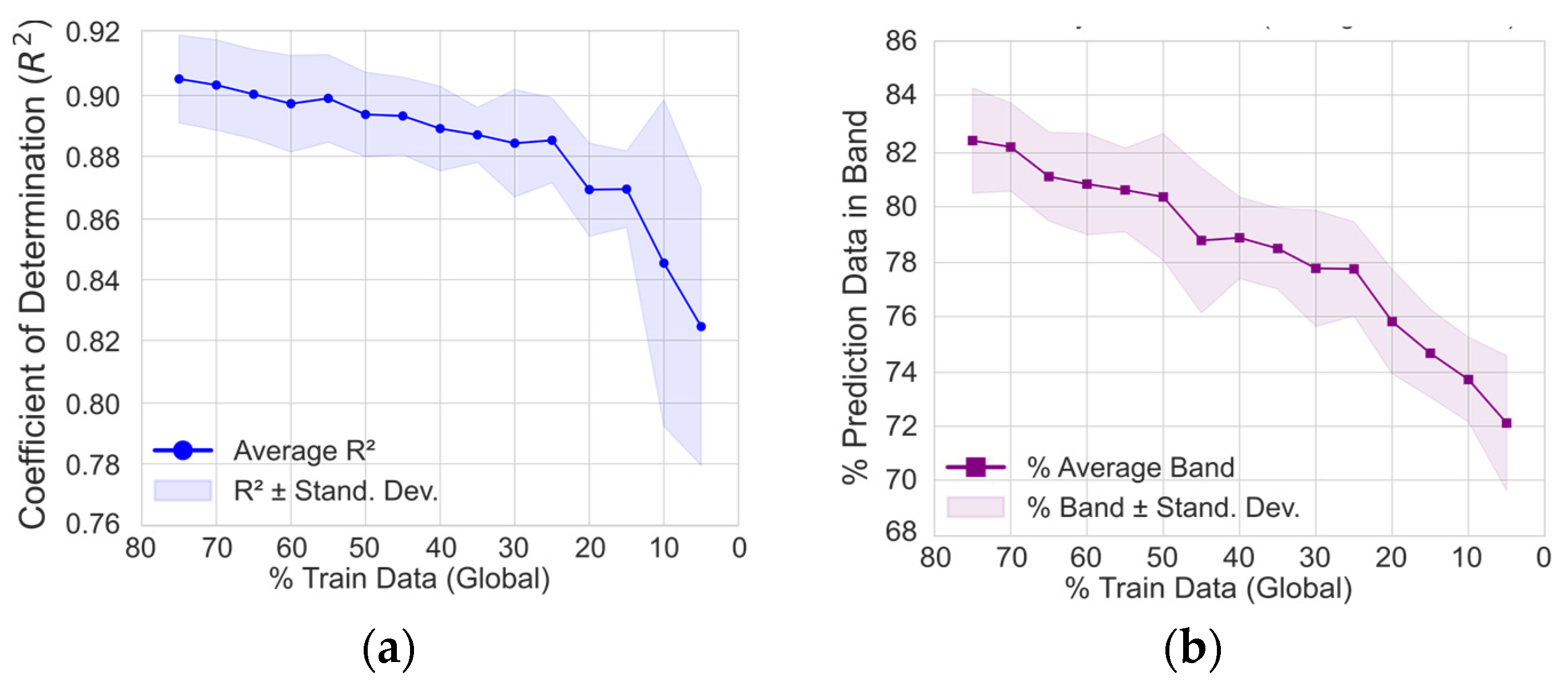
Before testing the full model, an initial robustness test was performed on a single plate to confirm the feasibility of the ML method for predicting experimental features. To this end, a dataset of 2560 samples combining the signal features with coordinates, and the size of the damage was used. The training set ranged from 75% to 5% of the total data, with 20% reserved for testing. The process was repeated ten times (runs) and evaluated with R2 and the percentage of predicted data within the 10% error band. Results in Figure 6 show the model retains high predictive capacity and success rate even with minimal training data. This validation enabled testing the full model, allocating roughly 25% of the data for training and 75% for testing.
Figure 6.
Random Forest Evaluation in P1 from 75% to 5% train data: (a) evaluation of the average of ten runs of R2 depending on the percentage of training data; (b) evaluation of the average of ten runs of the data within the 10% error band depending on the percentage of training data.
3.2. Strategy 1: ML Algorithm to Extrapolate Damage Progression
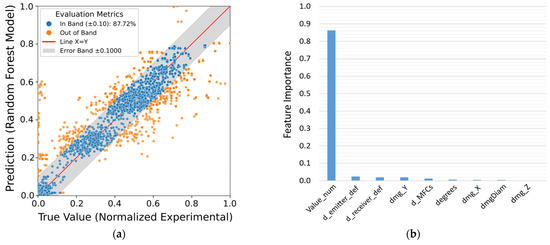
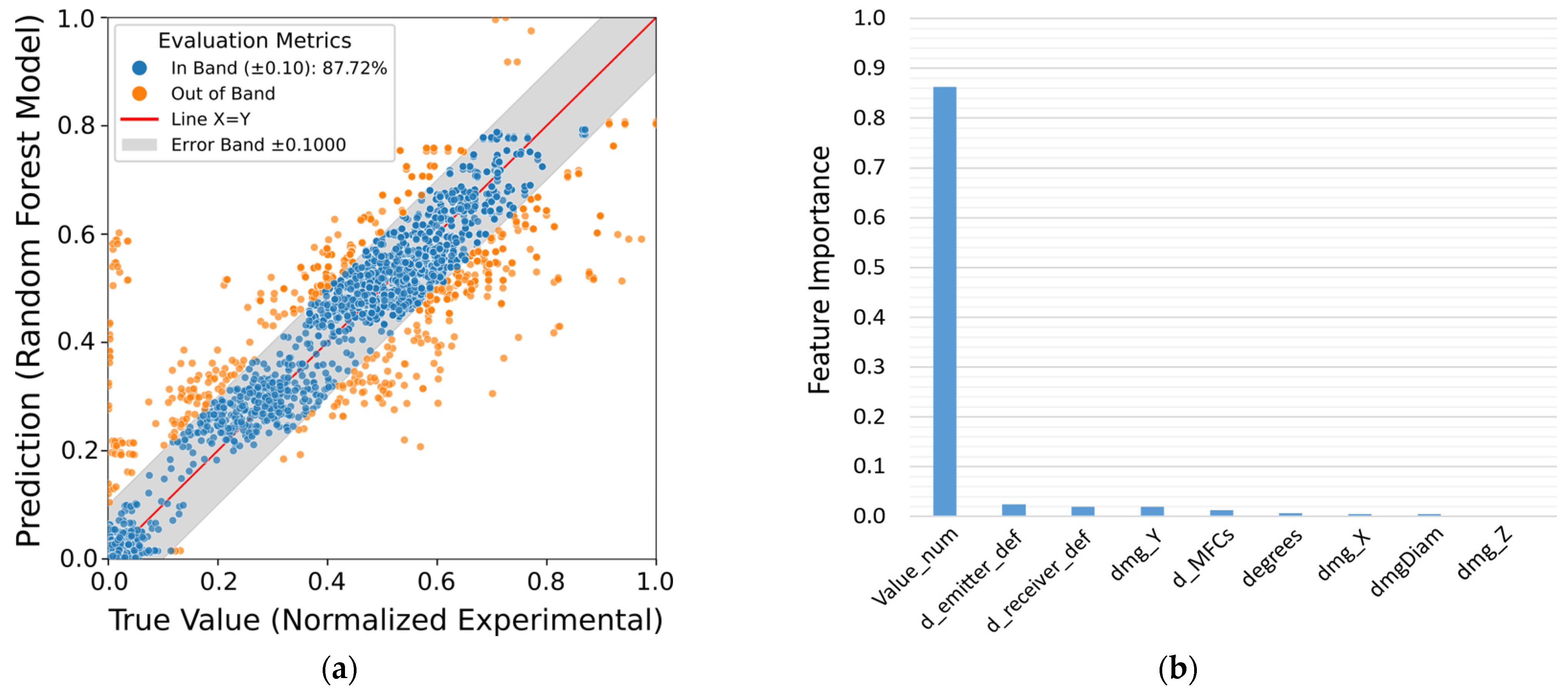
The main objective of Strategy 1 was to test the ML algorithm’s ability to extrapolate damage progression. Results for the three ML models are shown in Table 2, with 2560 training and 6400 testing samples. Random Forest performed slightly better, achieving the highest R2, lowest MAE, and greatest percentage of predictions within the 10% error band, as confirmed in Figure 7. Hyperparameters used were max_depth = 12, min_samples_split = 4, and n_estimators = 100.
Table 2.
Strategy 1 metrics: Random Forest, Gradient Boost and Extreme Gradient Boost.
Figure 7.
Random Forest prediction for damage extrapolation in Strategy 1: (a) true value vs. predicted value; (b) feature importances.
RF excels at predicting future damage states, as its independent prediction averaging (bagging) reduces the high variance of extrapolation, providing greater stability and robustness than boosting methods. Variable importance in RF reflects each feature’s contribution to impurity reduction. In this study, the numerical value of each signal feature (Value_num) dominates over 86% importance, acting as the main predictor and validating its role as a translator between numerical and experimental domains. Geometry variables show minimal relevance, indicating their influence is encoded in the simulated signal. Thus, the model corrects simulation–experiment bias and predicts future damage states.
3.3. Strategy 2: ML Algorithm to Predict the Physical Behaviour of New Samples
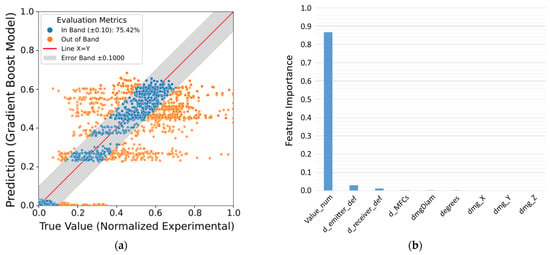
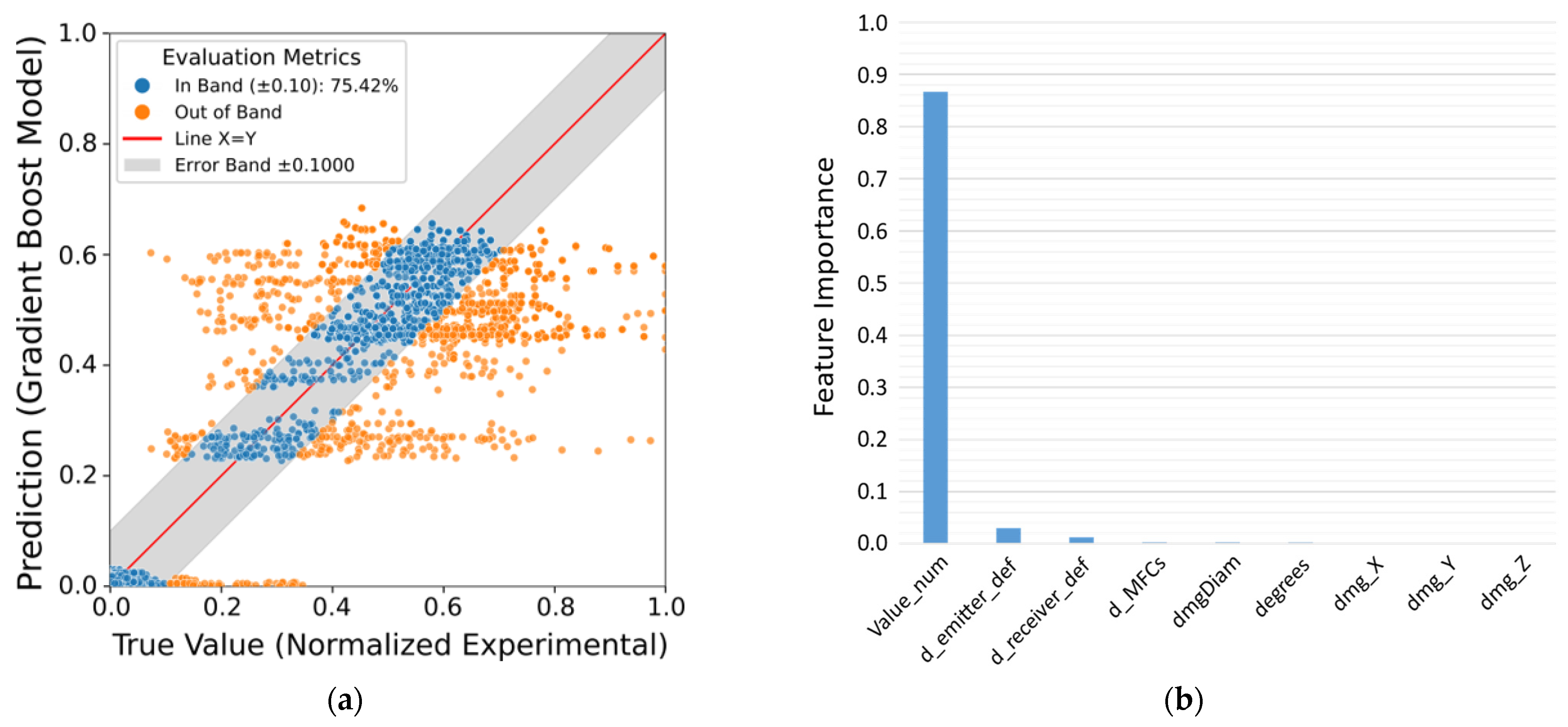
Strategy 2 is the most rigorous generalization test, designed to evaluate whether the ML model can predict the physical behaviour of an entirely new plate. A 4-fold cross-validation was implemented, training the model on a single plate and testing it on the remaining three. Average results for the three ML models are reported in Table 3, demonstrating strong predictive capacity. Gradient Boost achieved the best R2 and MAE, with the highest percentage of predictions within the 10% error band. Figure 8 illustrates GB predictions trained with P1 (2560 samples) and tested on P2–P4 (6400 samples), using hyperparameters: learning_rate = 0.05, max_depth = 3, and n_estimators = 450.
Table 3.
Strategy 2 metrics: Random Forest, Gradient Boost and Extreme Gradient Boost.
Figure 8.
Gradient Boost prediction for damage generalization in Strategy 2 training with P1 and testing with P2, P3 and P4: (a) true value vs. predicted value; (b) feature importances.
GB outperforms RF and slightly surpasses XGBoost in generalizing to unseen plates, as its sequential boosting reduces systematic bias more efficiently than variance-reduction methods. Variable importance reflects each feature’s information gain. Value_num dominates as the base predictive value, while relative geometry—distances from emitter and receiver to damage—captures the key physical mechanism guiding wave interaction. Absolute damage coordinates are irrelevant, confirming predictions depend only on relative geometry. This demonstrates that the model generalizes underlying physics rather than memorizing data.
4. Discussion
The findings confirm that delamination monitoring in composite plates successfully overcomes experimental uncertainties and model simplifications by focusing on signal feature extraction rather than full waveforms. Machine Learning enables predicting experimental features from numerical ones, bridging the gap between simulations and experiments. Strategy 1, predicting future damage states, achieved the best performance, with Random Forest reaching R2 above 0.93. Strategy 2, predicting entirely new plates, also confirmed model generalizability, with Gradient Boost averaging R2 above 0.82. In both strategies, the numerical value of each signal feature dominated (>86% importance), while geometric variables played a secondary role. This comparison identifies the most robust and optimized algorithm for testing real GENEX project demonstrators.
Future work will integrate this ML model into a Deep Neural Network (DNN) for damage localization, and quantification using numerical and experimental inspections.
Author Contributions
Conceptualization, J.H.-O., P.K., E.P.K., A.C.-E. and J.M.R.; methodology, J.H.-O., P.K., A.C.-E. and J.M.R.; software, J.H.-O., P.K. and A.C.-E.; validation, J.H.-O., A.C.-E. and J.M.R.; formal analysis, J.H.-O., A.C.-E. and J.M.R.; investigation, J.H.-O., A.C.-E. and J.M.R.; resources, J.H.-O., A.C.-E. and J.M.R.; data curation, J.H.-O. and A.C.-E.; writing—original draft preparation, J.H.-O.; writing—review and editing, J.M.R., P.K., E.P.K. and S.C.; visualization, J.H.-O., J.M.R. and S.C.; supervision, A.C.-E., J.M.R. and S.C.; project administration, A.C.-E.; funding acquisition, S.C. All authors have read and agreed to the published version of the manuscript.
Funding
“New end-to-end digital framework for optimized manufacturing and maintenance of next generation aircraft composite structures (GENEX)” was funded by the European Union under Grant Agreement No. 101056822. The views and opinions expressed are, however, those of the authors only and do not necessarily reflect those of the European Union or CINEA. Neither the European Union nor CINEA can be held responsible for them.
Institutional Review Board Statement
Not applicable.
Informed Consent Statement
Not applicable.
Data Availability Statement
Data are contained within the article.
Conflicts of Interest
The authors declare no conflicts of interest.
References
- Sause, M.G.R.; Jasiūnienė, E. Structural Health Monitoring Damage Detection Systems for Aerospace; Springer Aerospace Technology: Cham, Switzerland, 2021; pp. 36–53. [Google Scholar] [CrossRef] [Scilit]
- Mitra, M.; Gopalakrishnan, S. Guided wave based structural health monitoring: A review. Smart Mater. Struct. 2016, 25, 053001. [Google Scholar] [CrossRef] [Scilit]
- Ricci, F.; Monaco, E.; Boffa, N.D.; Maio, L.; Memmolo, V. Guided waves for structural health monitoring in composites: A review and implementation strategies. Prog. Aerosp. Sci. 2022, 129, 100790. [Google Scholar] [CrossRef] [Scilit]
- Avdelidis, N.P.; Hawtin, B.C.; Almond, D.P. Transient thermography in the assessment of defects of aircraft composites. NDT E Int. 2003, 36, 433–439. [Google Scholar] [CrossRef] [Scilit]
- Aranguren, G.; Etxaniz, J.; Barrera, E.; Ruiz, M.; Martin De La Escalera, F.; Essa, Y. SHM ultrasound system for damage detection in composite material. In Proceedings of the 9th European Workshop on Structural Health Monitoring (EWSHM 2018), Manchester, UK, 10–13 July 2018. [Google Scholar]
- Kolozis, P.; Karasavvas, D.; Royo, J.M.; Hernandez-Olivan, J.; Thalassinou-Lislevand, V.; Calvo-Echenique, A.; Koumoulos, E. AI-Powered Structural Health Monitoring: Predicting Fatigue Damage in Aircraft Composites with Ultrasonic Guided Wave Inspections. Eng. Proc. 2025, 90, 86. [Google Scholar] [CrossRef] [Scilit]
- Yuan, F.-G.; Zargar, S.A.; Chen, Q.; Wang, S. Machine learning for structural health monitoring: Challenges and opportunities. SPIE 2020, 11379, 1137903. [Google Scholar] [CrossRef] [Scilit]
- Malekloo, A.; Ozer, E.; AlHamaydeh, M.; Girolami, M. Machine learning and structural health monitoring overview with emerging technology and high-dimensional data source highlights. Struct. Health Monit. 2022, 21, 1906–1955. [Google Scholar] [CrossRef] [Scilit]
- Singh, D.; Singh, B. Investigating the impact of data normalization on classification performance. Appl. Soft Comput. 2020, 97, 105524. [Google Scholar] [CrossRef] [Scilit]

Disclaimer/Publisher’s Note: The statements, opinions and data contained in all publications are solely those of the individual author(s) and contributor(s) and not of MDPI and/or the editor(s). MDPI and/or the editor(s) disclaim responsibility for any injury to people or property resulting from any ideas, methods, instructions or products referred to in the content. |
© 2026 by the authors. Licensee MDPI, Basel, Switzerland. This article is an open access article distributed under the terms and conditions of the Creative Commons Attribution (CC BY) license.