Proceeding Paper

A Hybrid Chitosan–Parylene C Composite Based Piezoelectric Pressure Sensor for Biomedical Applications †
1
Centre for Medical and Industrial Ultrasonics (C-MIU), University of Glasgow, Glasgow G12 8QQ, UK
2
Microelectronics Lab (meLAB) Group, University of Glasgow, Glasgow G12 8QQ, UK
*
Author to whom correspondence should be addressed.
Presented at the International Conference on Responsible Electronics and Circular Technologies (REACT 2025), Glasgow, UK, 11–12 November 2025.
Eng. Proc. 2026, 127(1), 17; https://doi.org/10.3390/engproc2026127017
Published: 24 March 2026

Abstract

Flexible and biocompatible sensors are vital for a wide range of biomedical applications, including real-time health monitoring, intracranial pressure monitoring, knee replacement surgeries, wearables, and smart prosthetics. While various highly sensitive and stable pressure sensors have been demonstrated, they often lack the conformability and biocompatibility crucial for their wider application in various bio-integrated electronic systems. Herein, a piezoelectric pressure sensor is proposed using a hybrid polymer composite by leveraging the unique properties of Chitosan and Parylene C. Various material characterisations, such as XRD and FTIR, were performed to reveal structural and chemical characteristics of the novel composite material. Next, electromechanical characterisations of the pressure sensor were performed to reveal its dynamic sensing properties. The pressure sensor exhibits excellent sensitivity for both pressure and frequency, as well as cyclic stability (103 cycles), wide pressure range (20–70 kPa), and biocompatibility.

1. Introduction

Piezoelectric-based pressure sensors have received significant attention in recent years due to their self-powering ability and mechanical flexibility for various wearable and implantable biomedical applications, including precise monitoring of physiological signals like knee movements, hand gestures, blood flow rate, pressure, respiration and other tissue mechanical detections [1,2]. Piezoelectric materials typically offer high sensitivity and superior mechanical flexibility, but are still lacking in terms of biocompatibility, crucial for the integration of the devices towards wearable and implantable devices [3]. Recently, various composite materials have been developed by combining nature-derived, inexpensive and abundant biopolymers with synthetic materials, which have been explored for the fabrication of a new generation of piezoelectric pressure sensors [4,5].

2. Materials and Methods

2.1. Materials

Chitosan (CS) (low molecular weight; CAS 9012-76-4; MFCD00161512) and acetic acid (ReagentPlus®, ≥99% from Runcorn, UK; CAS 64-19-7; MFCD00036152) were acquired from Merck Life Science (Dorset, UK). Parylene-C (PAC) dimer (SCS) was obtained from Specialty Coating Systems (SCS), Indiana, USA. High-conductivity copper tape (100 µm) and polyimide tape (25 µm) were purchased from RS Components, UK. All materials were used as received.

2.2. Fabrication of Chitosan–Parylene C Pressure Sensor

The CS-PAC pressure sensor was fabricated in a sandwich structure, with the CS-PAC composite film serving as the intermediate piezoelectric layer and copper used as both the top and bottom electrodes to ensure a suitable electrical contact and mechanical stability. The outer layer was encapsulated with polyimide (PI) tape to provide insulation and protection while maintaining flexibility. The core of the pressure sensor is the fabrication of the CS-PAC film, which possesses piezoelectric properties.
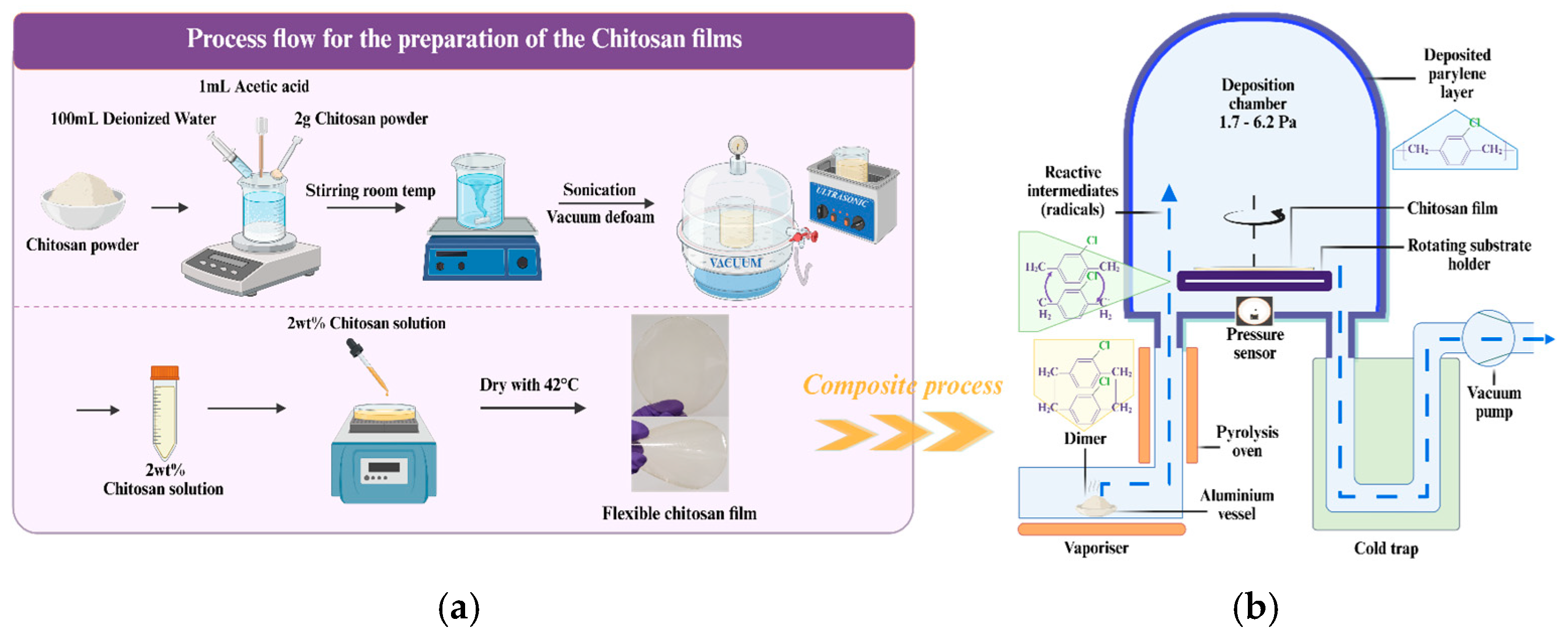
To obtain uniform CS-PAC composite films, a 2 wt.% chitosan (CS) solution was first prepared as illustrated in Figure 1a, and 2 g CS powder was thoroughly dissolved in 100 mL ultra-pure deionised (DI) water containing 1 mL acetic acid. The mixed solution was then subjected to magnetic stirring at 60–70 °C whilst undergoing 37 kHz ultrasonic treatment for 30 min, then placed in a vacuum desiccator for 1–2 h to remove residual bubbles, followed by rotation in a polystyrene Petri dish at 1000 rpm for 30 s (spin-coating) to form a film with uniform thickness before heating to 40–42 °C for 5–6 h, yielding a thin, transparent, and flexible chitosan film. Furthermore, a homogeneous composite film was prepared by chemical vapour deposition (CVD) of PAC onto the CS film, as shown in Figure 1b. The PAC dimer was loaded inside the chamber (vaporiser) under a vacuum of 10−5–10−6 bar, where it experienced the standard three-stage process, comprising vaporisation (~200 °C), pyrolysis to the monomer (680–700 °C), and deposition via adsorption on the cooled rotating substrate (~10 °C) on which a CS film was secured, thereby forming the CS-PAC composite film.

2.3. Characterisation of Chitosan–Parylene C Pressure Sensor

To analyse the structural and chemical characteristics of the composite films, X-ray diffraction (XRD, Rigaku MiniFlex 600, Osaka, Japan) and Fourier transform infrared spectroscopy (FTIR, Bruker Platinum A225, Coventry, UK) were employed to evaluate the crystalline structure and functional groups of pristine CS films, PAC films and CS-PAC composite films. The electromechanical performance of the fabricated pressure sensors was examined using a TIRA vibration system (TV 50018, TIRA GmbH, Schalkau, Germany) via periodic compressive loading. Corresponding output voltages were recorded using a digital storage oscilloscope (DSOX3014T). Long-term cyclic loading tests were used to assess stability and durability of the sensors.

3. Results and Discussion

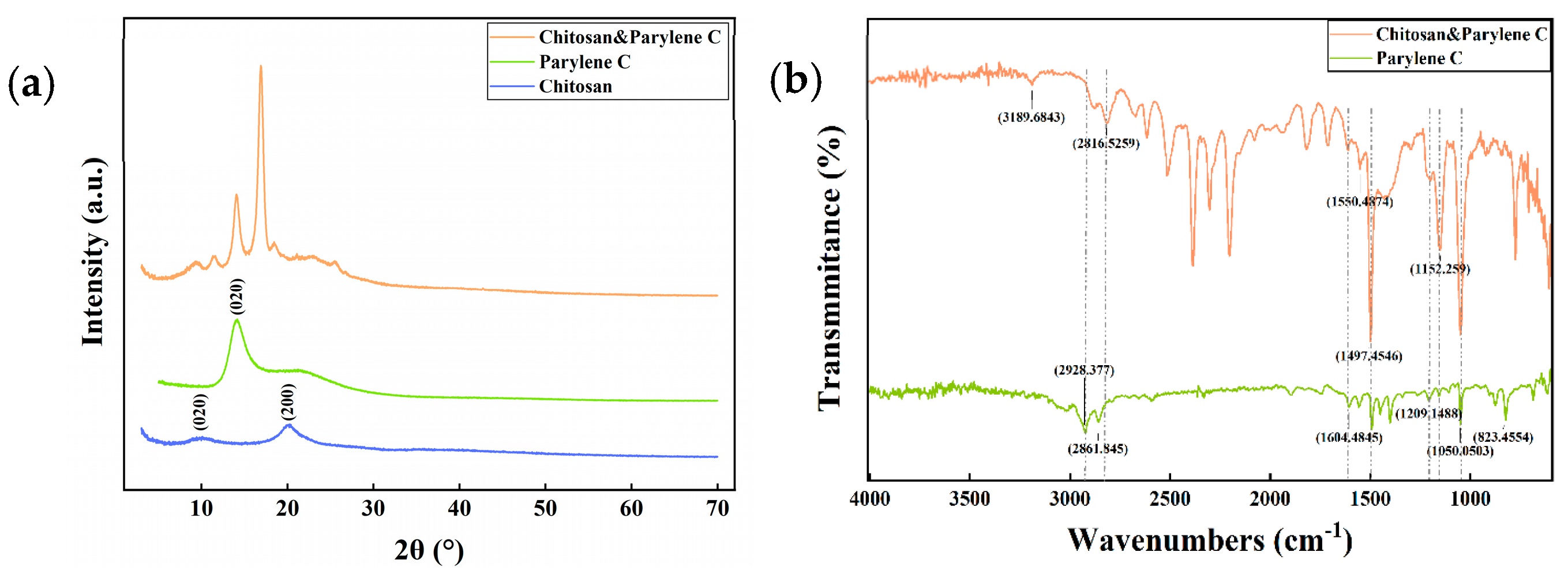
To understand the structural and chemical properties of the material, XRD and FTIR characterizations were performed on both pristine and hybrid composite materials, as shown in Figure 2. The results from XRD reveal that the CS-PAC composite retains the characteristic reflections of both chitosan (≈2θ 10° and 20°) and parylene-C (≈2θ 14°, (020)), indicating successful composite formation as presented in Figure 2a [6,7]. The average crystallite size estimated by the Scherrer equation is 4.62 nm, and the overall degree of crystallinity obtained from crystalline–amorphous deconvolution is 43%, consistent with a semicrystalline composite.
Next, to verify functional group changes before and after composite formation, FTIR analysis was performed on pristine Parylene C (PAC) and the CS-PAC film. As depicted in Figure 2b, the composite exhibits chitosan bands at ~3189 cm−1 (O–H/N–H, broad) and ~1152 cm−1 (C–O–C) while retaining PAC signatures (aromatic C=C at 1500–1600 cm−1 and C–Cl within 1150–1260 cm−1); the amide region (~1650–1590 cm−1) is strengthened and broadened [7,8]. Therefore, the spectra confirm phase coexistence and hydrogen bond-mediated interfacial interactions, indicating successful integration of CS and PAC.
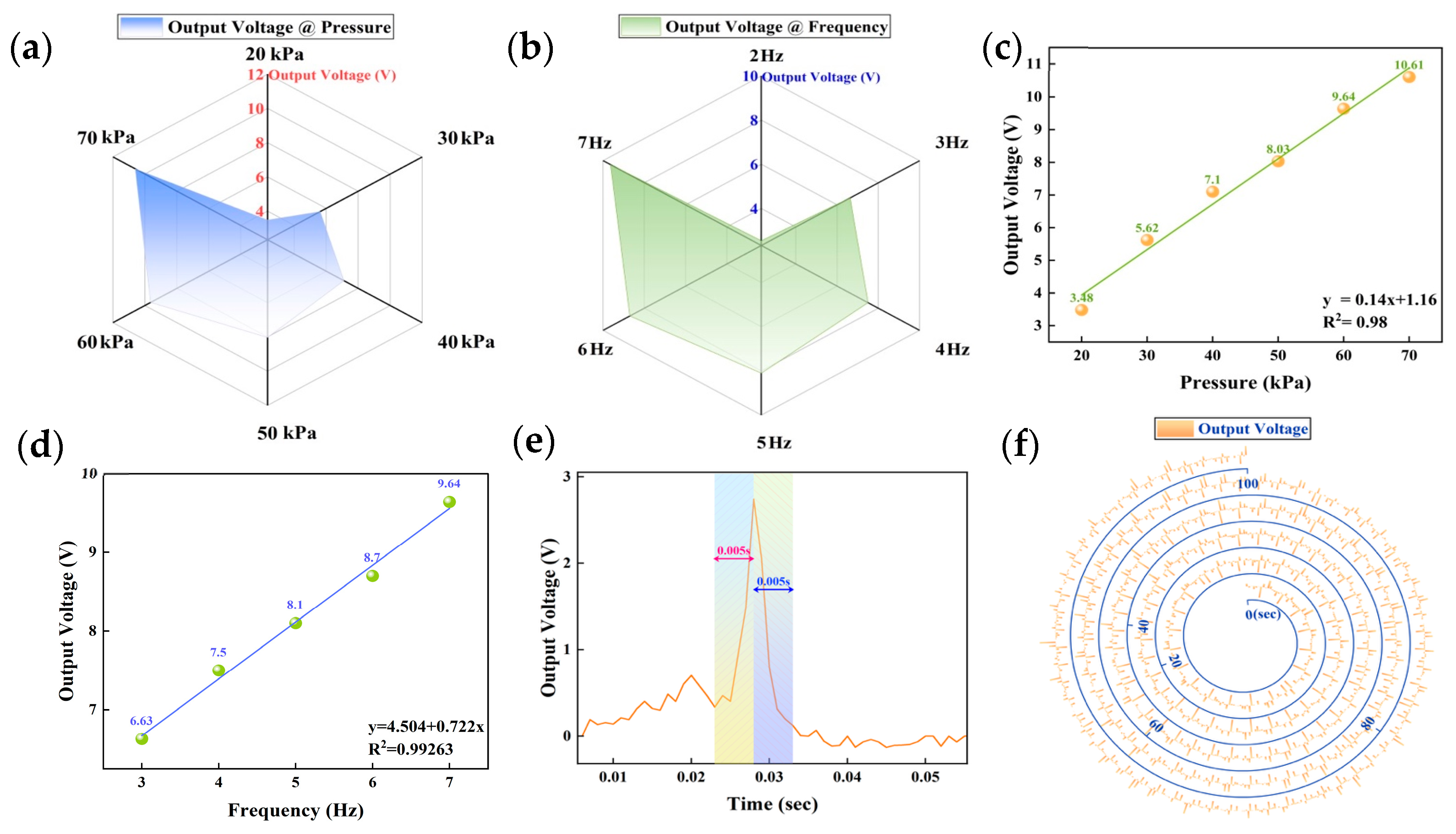
Electromechanical measurements were investigated via the TIRA system. The results presented in Figure 3a,b summarise the output characteristics responding to pressure increasing from 20 kPa (2.54 V) to 70 kPa (9.64 V) in 10 kPa increments and frequency increasing from 2 Hz (3.48 V) to 7 Hz (10.61 V) in 1 Hz steps, respectively. Pressure and frequency sensitivity were evaluated based on the slope of the linear curve fitted using OriginLab software, 2018b, as shown in Figure 3c,d, where the slope represents sensitivity and the variance indicates the linearity of the fitted curve. The CS-PAC sensor demonstrates excellent pressure sensitivity of 140 mV/kPa and frequency sensitivity of 722 mV/Hz, both exhibiting linearity exceeding 98%. As illustrated in Figure 3e, the sensor exhibits relatively fast response and recovery times of 5 ms, indicating that it can accurately detect dynamic pressure changes. In practical applications, maintaining long-term stability of the sensor is also crucial. Figure 3f demonstrates that the voltage output remains stable after exceeding 103 load cycles, further demonstrating its suitability for high-performance wearable and biomedical applications and promoting the use of sustainable, bio-based materials in a new generation of wearable health technologies [6].

4. Conclusions

A novel hybrid polymer composite that demonstrates excellent piezoelectric properties, biocompatibility, superior mechanical flexibility and conformability was explored for dynamic pressure sensors. The fabricated sensor showed outstanding sensitivity, cyclic stability, and biocompatibility, further indicating its suitability for a wide range of biomedical applications.

Author Contributions

Z.W.: Conceptualization, Investigation, Methodology, Validation, Measurements, Visualization, Writing—original draft; B.P.Y.: Conceptualization, Investigation, Methodology, Validation, Measurements, Writing—original draft; H.H.: Supervision, Project administration, Funding acquisition; A.F.: Writing—review and editing, Supervision, Project administration, Funding acquisition. All authors have read and agreed to the published version of the manuscript.

Funding

This research was funded by the Engineering and Physical Sciences Research Council (EPSRC) Grant No. EP/V049658/1.

Institutional Review Board Statement

Not Applicable.

Informed Consent Statement

Not Applicable.

Data Availability Statement

All the material will be upon request to authors.

Conflicts of Interest

The authors declare no conflicts of interest.

References

  1. Kim, D.-H.; Lu, N.; Ma, R.; Kim, Y.-S.; Kim, R.-H.; Wang, S.; Wu, J.; Won, S.M.; Tao, H.; Islam, A.; et al. Epidermal Electronics. Science 2011, 333, 838–843. [Google Scholar] [CrossRef] [PubMed]
  2. Liu, R.; Wang, Z.L.; Fukuda, K.; Someya, T. Flexible Self-Charging Power Sources. Nat. Rev. Mater. 2022, 7, 870–886. [Google Scholar] [CrossRef]
  3. Amjadi, M.; Kyung, K.-U.; Park, I.; Sitti, M. Stretchable, Skin-Mountable, and Wearable Strain Sensors and Their Potential Applications. Adv. Funct. Mater. 2016, 26, 1678–1698. [Google Scholar] [CrossRef]
  4. Lee, J.-Y.; Connor, S.T.; Cui, Y.; Peumans, P. Solution-Processed Metal Nanowire Mesh Transparent Electrodes. Nano Lett. 2008, 8, 689–692. [Google Scholar] [CrossRef] [PubMed]
  5. Park, J.; Lee, Y.; Hong, J.; Ha, M.; Jung, Y.; Lim, H.; Kim, S.Y.; Ko, H. Tactile-Direction-Sensitive and Stretchable Electronic Skins Based on Human-Skin-Inspired Interlocked Microstructures. ACS Nano 2014, 8, 12020–12029. [Google Scholar] [CrossRef] [PubMed]
  6. Wang, Z.; Yalagala, B.P.; Heidari, H.; Feeney, A. Highly Sensitive Parylene C-Based Flexible Pressure Sensors for Wearable Systems. Small Sci. 2025, 5, 2500081. [Google Scholar] [CrossRef] [PubMed]
  7. Kim, J.Y.-H. Parylene-C as a New Piezoelectric Material. Ph.D. Thesis, California Institute of Technology, Pasadena, CA, USA, 2013. [Google Scholar]
  8. Wang, Z.; Yalagala, B.P.; Zhang, J.; Hafezi, M.; Heidari, H.; Feeney, A. Wireless and Self-Powered Wearable Pressure Sensors Based on Chitosan for Artificial Mechanoreceptors. Adv. Mater. Technol. 2025, 10, 2401858. [Google Scholar] [CrossRef]
Figure 1. (a) Schematic illustration of the process flow for chitosan film preparation; (b) deposition of a 5 µm-thick Parylene C layer onto the thin, transparent, and flexible chitosan film.
Engproc 127 00017 g001
Figure 2. (a) XRD and (b) FTIR characterisation on pristine chitosan, Parylene C and their hybrid stacked structures.
Engproc 127 00017 g002
Figure 3. Electromechanical performance characteristics of the CS-PAC piezoelectric pressure sensor. Here, (a,b) respectively represent the pressure and frequency sensitivities of the fabricated pressure sensors; (c,d) display the variations in the output voltages with increases in the pressure and frequency magnitudes, respectively; (e) shows the response (left) and recovery time (right) of the sensor as 5 ms, and (f) shows the cyclic stability of the pressure sensor, indicating relatively high stability for more than 103 cycles.
Engproc 127 00017 g003
Disclaimer/Publisher’s Note: The statements, opinions and data contained in all publications are solely those of the individual author(s) and contributor(s) and not of MDPI and/or the editor(s). MDPI and/or the editor(s) disclaim responsibility for any injury to people or property resulting from any ideas, methods, instructions or products referred to in the content.