Proceeding Paper

High-Energy Ball Milling Strategies for the Synthesis of Cu/TiO2 Catalysts †

Facultad de Química, Bioquímica y Farmacia, Instituto de Investigación en Tecnología Química (INTE-QUI-CONICET), Universidad Nacional de San Luis (UNSL), Almirante Brown 1455, San Luis 5700, Argentina
*
Author to whom correspondence should be addressed.
Presented at the 6th International Electronic Conference on Applied Sciences, 9–11 December 2025; Available online: https://sciforum.net/event/ASEC2025.
Eng. Proc. 2026, 124(1), 5; https://doi.org/10.3390/engproc2026124005
Published: 21 January 2026
(This article belongs to the Proceedings of The 6th International Electronic Conference on Applied Sciences)

Abstract

In this work, Cu/TiO2 catalysts were prepared by several high-energy ball milling strategies (dry and semi-wet milling) using different copper reagents and compared with a sample synthesized by a conventional impregnation method. Crystal structures were identified by means of X-ray Diffraction (XRD), including anatase, rutile, high-pressure TiO2 (II) and W species due to mill vial erosion at some conditions, highlighting the effect of a copper precursor on the rate of titania polymorphic transformation. Specific Surface Area (SBET) values were calculated from N2 physisorption, showing a correlation between the energy supplied to the powder and the milling conditions. Moreover, Scanning Electron Microscopy (SEM) was able to display the morphologies while a semi-quantification of present elements could be performed by Electron Dispersive X-ray Spectroscopy (EDS). Catalysts obtained through this green and one-pot process could be suitable for a variety of reactions, including CO2 hydrogenation and glycerol valorization.

1. Introduction

Mechanochemical activation stands out as an eco-friendly and cost-effective solid-state technique for the synthesis of a variety of materials [1,2,3,4]. Due to its simplicity and robustness, high-energy ball milling has become an efficient and greener alternative to improve the physicochemical properties of solids, including the increase in Specific Surface Area (SBET) due to particle fragmentation, oxygen vacancies and even the creation of new polymorphic structures, as in the case of titania [5,6,7,8]. Furthermore, surface and structural defects accumulation and high temperature being locally achieved facilitates metal dispersion and the formation of metal–support interfacial structures [1,2,3,5]. Therefore, mechanochemistry has become a promising substitute to produce highly active heterogeneous catalysts with features that cannot be achieved by conventional methods of synthesis [9,10,11,12]. Moreover, most studies use a dry milling method for powder precursors and thus the effect of water during preparation (even in small amounts) remains as an object of analysis. Herein, we present a preliminary study of the synthesis of Cu/TiO2 catalysts by means of high-energy ball milling, in both dry and semi-wet conditions, in order to elucidate the interaction of precursors, physicochemical properties, and titania polymorphic transformations that takes place in the creation of the final materials.

2. Materials and Methods

2.1. Synthesis of Catalysts

Dry and semi-wet milling was performed according to the milling conditions published in a previous work [1]. Briefly, titanium oxide (IV) of 99% purity (Biopack, Buenos Aires, Argentina) and CuO (Sigma Aldrich, Buenos Aires, Argentina) or Cu(NO3)2 (Sigma Aldrich, Buenos Aires, Argentina) were added to the vial in particular amounts to achieve 1 wt% of Cu in the final catalysts. The process involved effective milling at 350 rpm for 45 min according to the following repeated sequence: 15 min of milling was followed by a 15 min break to prevent the overheating of vial and balls. Semi-wet milling was carried out under the same parameters, adding 1 mL (a) or 0.4 mL (b) of milliQ water into the vial and powder before milling. Samples were finally calcined in a muffle furnace (Indef, Córdoba, Argentina) at 500 °C for 4 h. Obtained catalysts were labeled CuTidmn (nitrate precursor) and CuTidmo (oxide precursor) for the dry-milling conditions and CuTisna and CuTisnb for the semi-wet conditions (nitrate). The reference catalyst prepared by wet impregnation was denoted CuTiwi.

2.2. Characterization

X-ray Diffraction (XRD) was performed in a Rigaku Ultima IV diffractometer (Rigaku, Tokyo, Japan) operated at 20 mA and 30 kV with a Cu Kα radiation lamp using a scanning rate of 3° per minute in the range 10–80° and a counting time of 2 s. Present species were identified and compared with the International Center for Diffraction Data Standard (JCPDS) patterns. The Brunauer–Emmet–Teller (BET) method was applied by nitrogen adsorption at 77 K in a Micromeritics Gemini V equipment (Micromeritics, Norcross, GA, USA). Scanning Electron Microscopy (SEM) was carried out using an LEO 1450 VP SEM (Carl Zeiss AG, Oberkochen, Germany) coupled with an Electron Dispersive X-ray Spectroscopy (EDS) system.

3. Results and Discussion

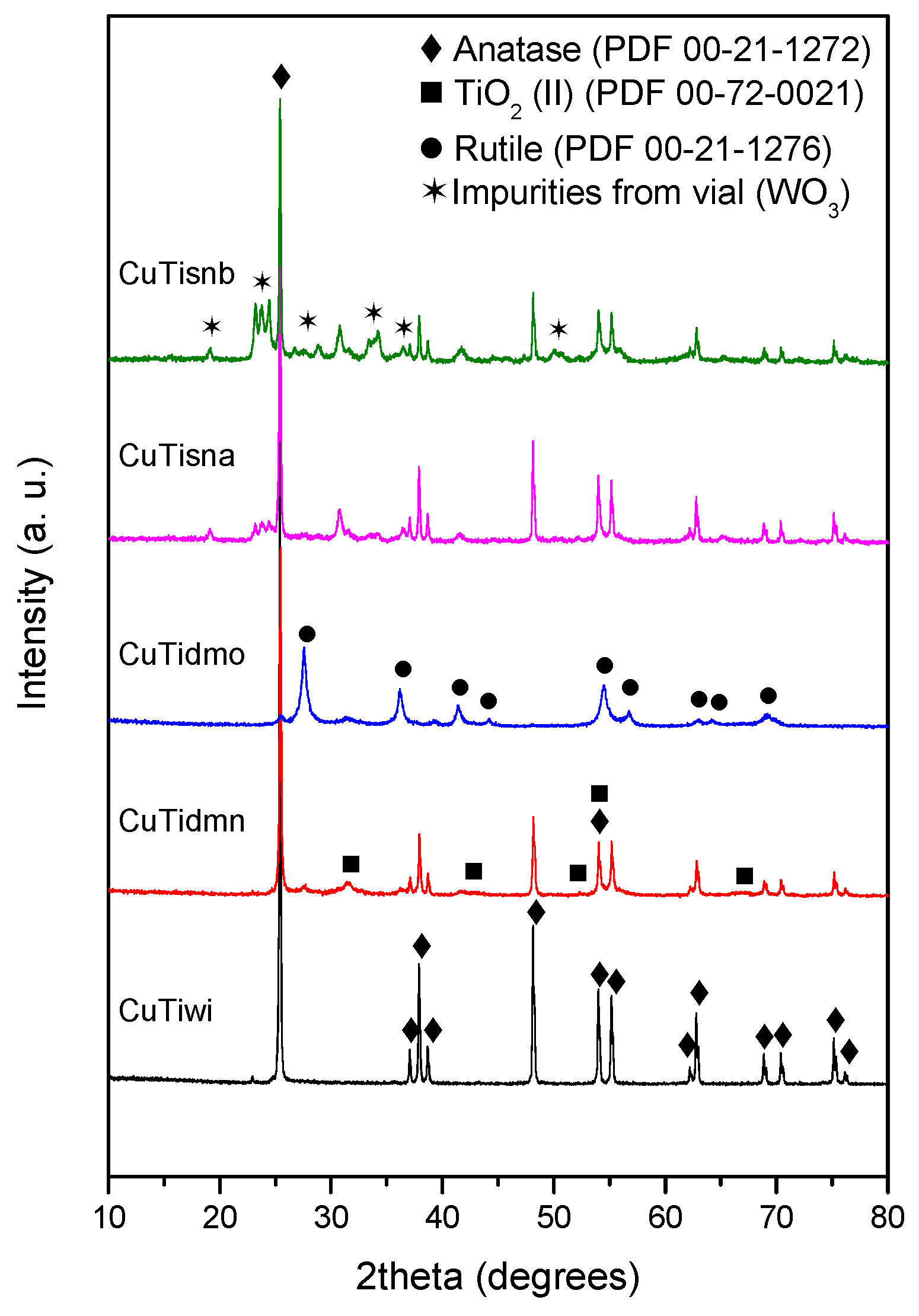
XRD showcased the crystal structures achieved in each catalyst (Figure 1). CuTiwi was used as a reference and displayed the typical signals corresponding to the anatase phase (PDF 00-21-1272) as the only titania polymorph present, which was in line with the commercial reagent used [1,4]. On the other hand, CuTidmn showed anatase reflections but also several broad and low-intensity signals associated with the high-pressure TiO2 (II) polymorph (PDF 00-72-0021), while CuTidmno showed intense reflections of the rutile phase (PDF 00-21-1276), the most stable structure, and several low-intensity reflections of both anatase and TiO2 (II) structures [4]. These results indicated the crucial role of the Cu precursor under dry-milling in modifying the polymorphic transformation of titania, since under the same milling conditions pure TiO2 was found to be mostly composed of anatase and a small amount of high-pressure polymorph, as confirmed in a previous study [1]. Moreover, catalysts prepared by semi-wet milling (CuTisna and CuTisnb) showed a mixture of phases (mostly anatase) with the addition of several impurities coming from the vial (mainly WO3). Thus, in this case, the addition of water along with the attrition produced during milling could erode the vial surface, contaminating the final samples. Broader and lower intensities were also observed in milled catalysts due to particle fragmentation in comparison to CuTiwi [1,4]. In all cases, diffraction lines attributed to copper species were not detected, which could be associated with the low concentration of copper and/or a high dispersion/incorporation of Cu into the TiO2 lattice [3].
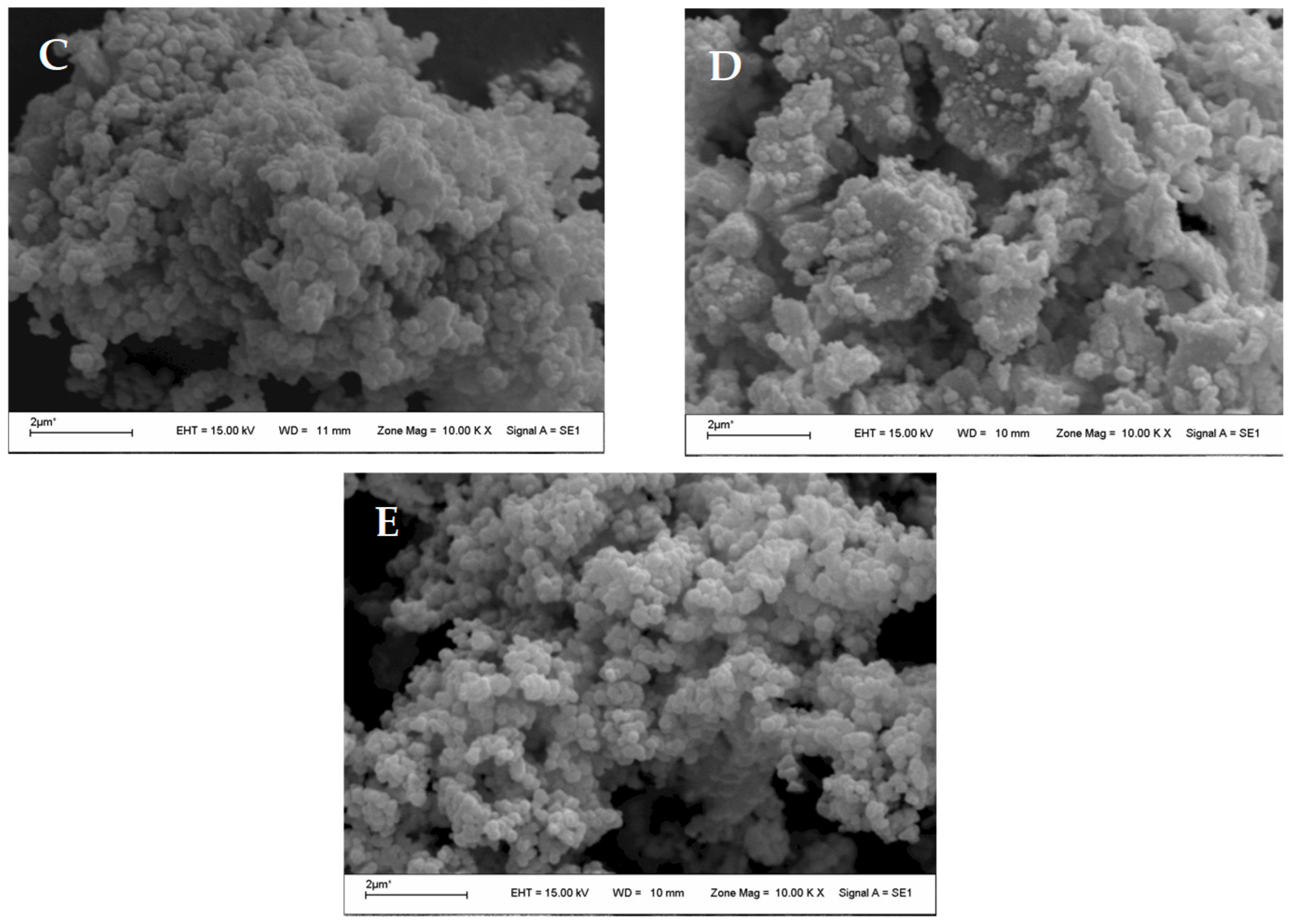
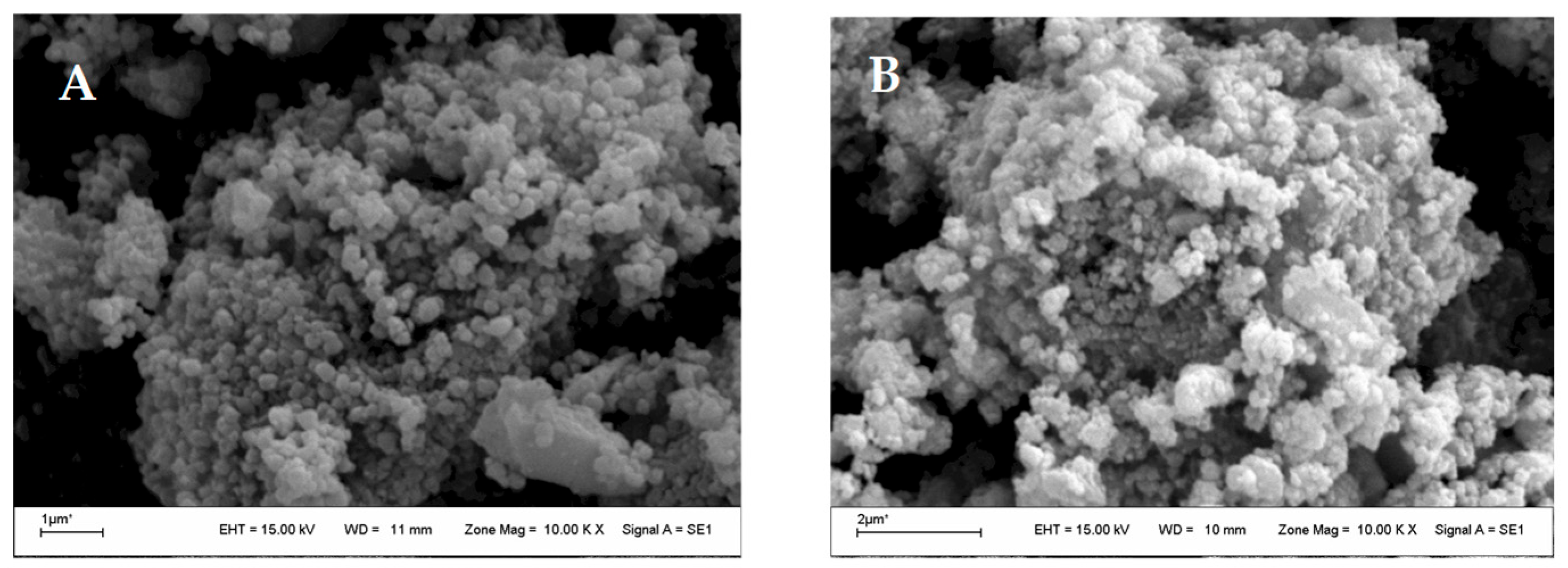
In addition, the SBET values ranged between 11 and 13 m2 g−1, indicating that the nature of the copper precursor nor the addition of water affected the Specific Surface Area during the particle refinement. CuTiwi showed a value of 9 m2 g−1, which was in agreement with the low porosity of titania, while pure anatase milled under the same conditions showed a value of 16 m2 g−1 [1]. The lower values obtained could thus be attributed to the different hardness of precursors compared to pure titania. The morphology of all catalysts (Figure 2) showed particles that were spherical in shape, with diameters around 150 nm, as observed previously in milled titania [1]. Some grape-like agglomerates were also observed in the case of semi-wet milling, as expected due to water addition. Finally, EDS semi-quantitative analysis showed Cu values between 0.94 and 1.97 wt%, where higher values may be attributed to Cu(NO3)2 hydration, resulting in errors in the quantities weighted.

4. Conclusions

The materials obtained by the mechanochemical approaches presented herein could be useful for a diversity of applications, such as heterogeneous catalysts for different chemical reactions, where a high dispersion of Cu species and the presence of several titania polymorphs could play a crucial role as active supports during catalytic tests. The catalysts obtained in this preliminary study should be thoroughly characterized to investigate metal–support interactions and the attained redox properties in order to finally be tested for CO2 valorization.

Author Contributions

Conceptualization, M.G.R., M.R.M. and L.E.C.; investigation, M.G.R.; visualization, M.G.R.; writing—original draft, M.G.R.; writing—review, M.G.R., L.E.C. and M.R.M.; writing—editing, M.G.R.; validation, M.G.R., L.E.C. and M.R.M.; supervision, L.E.C. and M.R.M.; resources, M.R.M. All authors have read and agreed to the published version of the manuscript.

Funding

The authors acknowledge the Universidad Nacional de San Luis (UNSL), Agencia Nacional de Promoción Científica y Tecnológica (ANPCyT) and Consejo Nacional de Investigaciones Científicas y Técnicas (CONICET) for their financial support.

Institutional Review Board Statement

Not applicable.

Informed Consent Statement

Not applicable.

Data Availability Statement

No new data were created or analyzed in this study. Data sharing is not applicable to this article.

Conflicts of Interest

The authors declare no conflicts of interest.

References

  1. Rinaudo, M.G.; Beltrán, A.M.; Fernández, M.A.; Cadús, L.E.; Morales, M.R. Tailoring materials by high-energy ball milling: TiO2 mixtures for catalyst support application. Mater. Today Chem. 2020, 17, 100340. [Google Scholar] [CrossRef]
  2. Rinaudo, M.G.; Pecchi, G.; Cadús, L.E.; Morales, M.R. Is mechanochemical activation always an asset? The case of Pd/CeO2 catalysts for glycerol selective oxidation. Ceram. Int. 2023, 49, 18614–18623. [Google Scholar] [CrossRef]
  3. Rinaudo, M.G.; González, M.K.L.; Cadús, L.E.; Morales, M.R. On the scope of mechanochemical activation: The case of Cu/ZnO catalytic systems. J. Phys. Chem. Solids 2023, 183, 111661. [Google Scholar] [CrossRef]
  4. Rinaudo, M.G.; Beltrán, A.M.; Fernández, A.; Cadús, L.E.; Morales, M.R. Pd supported on defective TiO2 polymorphic mixtures: Effect of metal–support interactions upon glycerol selective oxidation. Results Eng. 2022, 16, 100737. [Google Scholar] [CrossRef]
  5. Lu, X.; Yu, J.; Li, J.; Serrano, I.; Arbiol, J.; Cabot, A.; Llorca, J. Mechanochemical synthesis of highly dispersed Cu on CeO2 for the reverse water-gas shift reaction. Chem. Eng. J. 2025, 519, 165039. [Google Scholar] [CrossRef]
  6. Marín, E.; Vendrell, X.; Llorca, J. Pd Supported on CeO2 Nanostructures Prepared by Planetary Ball Milling under a Modified Atmosphere for Catalytic Oxidation of CO. ACS Appl. Nano Mater. 2025, 8, 12151–12163. [Google Scholar] [CrossRef] [PubMed]
  7. Danielis, M.; Colussi, S.; de Leitenburg, C.; Soler, L.; Llorca, J.; Trovarelli, A. Outstanding Methane Oxidation Performance of Palladium-Embedded Ceria Catalysts Prepared by a One-Step Dry Ball-Milling Method. Angew. Chem. Int. Ed. 2018, 57, 10212–10216. [Google Scholar] [CrossRef] [PubMed]
  8. Ziat, Y.; Hammi, M.; Belkhanchi, H.; Ifguis, O.; Rzaoudi, S.; Laghlimi, C.; Moutcine, A.; Lazrak, C. CNTs modified ZnO and TiO2 thin films: The effect of loading rate on band offset at metal/semiconductor interfaces. In Proceedings of the International Conference on Climate Nexus Perspectives: Toward Innovative, Resilient and Sustainable Solutions for Natural Resources and Biodiversity Management (I2CNP 2021), Online, 6 June 2021; EDP Sciences: Les Ulis, France, 2022. [Google Scholar] [CrossRef]
  9. Ge, S.; Chen, Y.; Guo, Y.; Llorca, J.; Soler, L. Mechanochemically activated Au/CeO2 for enhanced CO oxidation and COPrOx reaction. Appl. Mater. Today 2023, 33, 101857. [Google Scholar] [CrossRef]
  10. Braga, A.; Danielis, M.; Colussi, S.; Trovarelli, A. Rational screening of milling parameters for Ru–Na/Al2O3 dual-function materials for integrated CO2 capture and methanation. RSC Mechanochem. 2025, 2, 516–528. [Google Scholar] [CrossRef]
  11. Danielis, M.; Colussi, S.; Llorca, J.; Dolan, R.H.; Cavataio, G.; Trovarelli, A. Pd/CeO2 Catalysts Prepared by Solvent-free Mechanochemical Route for Methane Abatement in Natural Gas Fueled Vehicles. Ind. Eng. Chem. Res. 2021, 60, 6435–6445. [Google Scholar] [CrossRef]
  12. Deng, H.; Yu, Y.; He, H. Water Effect on Preparation of Ag/Al2O3 Catalyst for Reduction of NOx by Ethanol. J. Phys. Chem. C 2016, 120, 24294–24301. [Google Scholar] [CrossRef]
Figure 1. XRD spectra of samples.
Engproc 124 00005 g001
Figure 2. SEM micrographs of the samples: CuTidmn (A); CuTidmo (B); CuTisna (C); CuTisnb (D); CuTiwi (E).
Engproc 124 00005 g002aEngproc 124 00005 g002b
Disclaimer/Publisher’s Note: The statements, opinions and data contained in all publications are solely those of the individual author(s) and contributor(s) and not of MDPI and/or the editor(s). MDPI and/or the editor(s) disclaim responsibility for any injury to people or property resulting from any ideas, methods, instructions or products referred to in the content.