1. Introduction
Photovoltaic (PV) systems are a leading sustainable energy technology due to their scalability and decreasing costs [
1]. Accurate PV modeling is vital for performance prediction and fault diagnosis [
2]. This process requires extracting unknown parameters from equivalent electrical circuits, such as the single-, double-, or triple-diode models. These parameters include photocurrent, saturation current, ideality factors, and resistances. However, reliable estimation is challenging. The associated optimization problem is highly nonlinear, multimodal, and extremely sensitive to measurement noise [
3].
Traditional methods for deterministic optimization usually suffer from inaccuracy and instability because they are prone to local minima and require a good initial guess from the user. Due to this, there is an increasing interest in the use of metaheuristic and nature-inspired optimization algorithms in solving PV parameter extraction problems. These algorithms possess the ability for global search, they do not require information on the gradient, and they have also been proven to be robust under varying PV models and operation conditions [
4].
The most used optimization algorithms are Particle Swarm Optimization (PSO) [
5], Genetic Algorithm (GA) [
6], Differential Evolution (DE) [
7], Artificial Bee Colony (ABC) [
8], and Simulated Annealing (SA) [
9]. Besides those metaheuristics, the traditional numerical methods, of which the most well-known is the Nelder–Mead Simplex (NM) approach [
10], are still appealing due to their simplicity and relatively low computational cost, though they usually converge toward local optima.
In recent years, many advances have been proposed for PV parameter extraction using hybrid metaheuristics, adaptive versions of PSO and DE, and multi-objective optimization methods [
11,
12,
13,
14,
15]. Although these papers have shown significant speedup or accuracy gains for PV parameters, current comparisons always have one of the following disadvantages:
- (i)
Comparisons based on one type of single-diode structure (generally, SDMs) without evaluating scalability to DDMs or TDMs;
- (ii)
Experimental conditions being inconsistent across experiments in terms of, for example, different data, stopping times, or error measures;
- (iii)
Limited statistical validation, with insufficient analysis of robustness, variability, and confidence intervals;
- (iv)
Dependency on traditional PSO algorithms without remedying well-known problems such as premature convergence and loss of diversity for search spaces with a large number of dimensions.
Therefore, despite the existence of numerous optimization methods documented in the literature, the problem of systematic comparative studies based on appropriate statistics to clearly describe the algorithmic behavior with an increasing complexity of the considered PV models still arises. Also, the benefits of enhanced or adaptive PSO algorithms have not been sufficiently studied based on the uniformly conducted comparative analysis concerning SDMs, DDMs, and TDMs. In order to solve these problems, this paper offers a thorough, integrated comparison of various common optimization algorithms, including SA, PSO, GA, DE, ABC, and NM, for extracting solar cell parameters based on various complicated models. In addition, this paper innovates an improved version of the popular Particle Swarm Optimization algorithm, known as IPSO, in an attempt to improve the exploration–exploitation balance, especially in a complex scenario where the dimensionality is usually much higher in practical applications regarding multi-diode solar cell models. There are also several Modified PSO versions reported in the literature such as, for instance, Chaotic PSO and Hybrid PSO-GA, but they tend to concentrate on general optimization problems of benchmarking functions and not on particular PV constraints. The IPSO proposed in this paper differs from existing versions since it incorporates a Constriction Factor that handles velocity explosion for models of high dimensionality, and a hybrid fitness function that gives emphasis to both current and power errors (
Section 2.2). Differing from the usual modifications that concentrate on inertia adjustment for optimization, this particular strategy ensures that the goal is not only achieved but also ensures that the resulting MPP area stays within its physical constraints, since the original PSO tends to compromise on accuracy for its TDM due to its high sensitivities.
The main contributions of this work can be summarized as follows:
A new proposal for a novel improved Particle Swarm Optimization (IPSO) approach for extracting PV parameters, with adaptive strategies to overcome premature convergence, especially for DDM and TDM commercial PV systems.
An integrated and impartial assessment platform for carrying out a comparison of the six algorithms on the same test setting.
Performance assessment in terms of various measures of accuracy as well as robustness, which include RMSE, MAE, MAPE, RMSE mean, RMSE standard deviation, and confidence intervals.
Nonparametric significance tests to assess the differences in algorithms rigorously.
Guidelines for choosing suitable optimization techniques according to the level of complexity of the PV model.
2. Materials and Methods
2.1. Photovoltaic Model and Problem Formulation
Accurately extracted PV model parameters are essential for reliable I–V and P–V curve simulation with changing operating conditions. The parameters of the SDM, DDM, and TDM describe cell behavior in terms of photocurrent generation, diode recombination effects, and resistive losses, respectively. Thus, they directly affect the accuracy of the simulated characteristics and should be estimated employing robust optimization techniques. The SDM includes five parameters:
,
,
,
, and
. The DDM adds a second diode with its own saturation current and ideality factor in order to better model the recombination losses, and the TDM introduces a third diode to capture additional non-ideal effects [
16]. All parameters for the three models are summarized in
Table 1.
In this work, the SDM, DDM, and TDM are utilized for estimating the unknown PV parameters using experimental I–V data. The extraction process depends on finding the minimum RMSE between measured and simulated characteristics by using advanced optimization techniques. These models are represented using well-known I–V equations, where the SDM is given as follows:
The DDM extends the formulation by introducing a second diode:
The TDM includes a third diode to further capture non-ideal effects:
These models are crucial in effective PV module performance simulation and provide a basis for optimization-based parameter extraction, as carried out in this work.
The parameter extraction task is formulated as an optimization problem that minimizes the difference between measured and simulated I–V curves using the RMSE as the error function. RMSE effectively captures overall deviations across the entire curve. To ensure realistic solutions, constraints are imposed on parameter ranges, such as non-negative currents, valid diode ideality factors, and physically meaningful resistance values. The optimization landscape is inherently non-convex and multimodal, with many local minima caused by strong nonlinear interactions among parameters. These characteristics make advanced stochastic optimization methods more suitable than deterministic techniques for achieving accurate PV parameter estimates. The experimental data used in this study were obtained from a commercial 57 mm diameter silicon solar cell (R.T.C France) and a Photowatt PWP-201 (Bourgoin-Jallieu, France) photovoltaic module consisting of 36 series-connected polycrystalline silicon cells [
17].
Along with the RMSE, several complementary metrics are also used to measure the accuracy of parameter extraction in a comprehensive manner. These metrics include the coefficient of determination, R
2, the mean bias error, MBE, and the mean absolute error, MAE, each considering the goodness of fit from a different perspective between the modeled and experimental I–V data. R
2 computes how well the model describes the variance in the measured data, the MBE shows whether overestimation or underestimation is systematic, and MAE considers the average size of errors. In addition, confidence interval analysis is incorporated to assess the robustness and reliability of the estimated parameters, while the Wilcoxon signed-rank test is employed to statistically evaluate the significance of performance differences between the proposed IPSO and the comparative algorithms.
Table 2 summarizes these metrics and their definitions in detail.
2.2. Improved Particle Swarm Optimization for PV Parameter Extraction
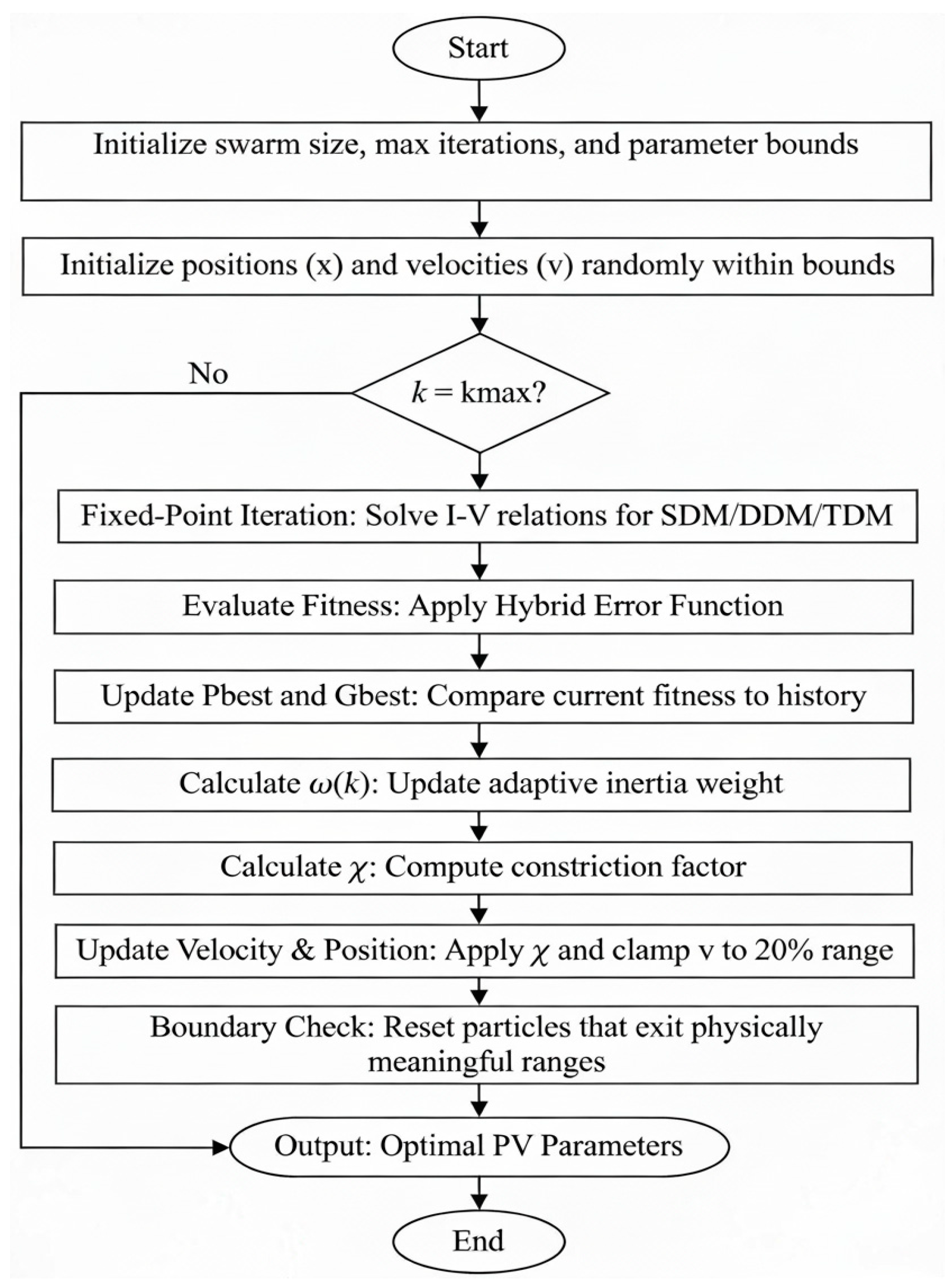
Parameter extraction for photovoltaic (PV) models, especially double- and triple-diode models, is a multimodal, nonlinear optimization issue. Premature convergence, loss of swarm diversity, turbid oscillatory, and slow convergence are the common flaws that standard PSO is criticized for in high-dimensional problems. To tackle these problems, we propose an Improved PSO (IPSO) that enhances convergence stability and robustness. The flowchart of IPSO is indicated in
Figure 1. The dimensionality increase from SDMs to TDMs raises the search space from 5 dimensions to 9. In such high-dimensional search spaces, particles in traditional PSO tend to have a high probability of passing through or ‘overshooting’ the global minimum, which results from uncontrolled acceleration. The application of Clerc’s Constriction Factor is particularly effective in TDMs, which offers a mathematical proof of ensuring convergence by restraining the acceleration/velocity from excessive fluctuations. Additionally, the Adaptive Inertia Weight enables the PSO to perform a global search during the initial stages, transitioning to a refined local search during the later stages, which is essential for exploring the ‘valley’ of the global minimum function in the complex expression of the triple-diode model.
Key Enhancements in IPSO
The proposed IPSO introduces four improvements:
- 1.
Adaptive Inertia Weight: Linearly decreasing inertia weight balances global exploration and local exploitation:
k is the current iteration number;
is the maximum allowed iterations;
and are the maximum and minimum inertia weights (set to 0.9 and 0.4, respectively).
- 2.
Constriction Factor (Clerc’s method): Velocity updates are scaled by to prevent explosions and oscillations:
χ is the Constriction Factor;
Φ represents the sum of the acceleration coefficients;
and are the cognitive and social coefficients.
- 3.
Velocity Clamping: Maximum velocity is limited to 20% of the search range:
- 4.
Boundary Handling: Particle positions are strictly confined within physically meaningful bounds to avoid negative resistances, unrealistic diode currents, or invalid ideality factors.
- 5.
Objective Function: IPSO minimizes a hybrid error function combining current and power mismatches:
is the updated velocity of particle at iteration ;
is the maximum velocity threshold;
and are the experimental and simulated current values;
and are the experimental and simulated power values ().
2.3. Optimization Process
In this study, the performance of the proposed Improved Particle Swarm Optimization (IPSO) algorithm is evaluated through a comparative analysis with several well-known population-based and stochastic optimization techniques for estimating the parameters of photovoltaic models, namely SDMs, DDMs, and TDMs. The comparison includes Simulated Annealing (SA), conventional Particle Swarm Optimization (PSO), Genetic Algorithm (GA), Differential Evolution (DE), Artificial Bee Colony (ABC), and the Nelder–Mead (NM) simplex method. Each algorithm was run 10 times independently with different initializations (randomly generated) to ensure robustness and to avoid local minima. For each model, the final selected parameters correspond to the best solution (minimum hybrid fitness function) obtained among the 10 runs. Each optimized parameter set’s performance was evaluated by using RMSE, MAE, MBE, and R
2.
Table 3 presents the lower and upper bounds applied to the diode-model parameters, and
Table 4 summarizes the main hyperparameters of each optimization algorithm, including IPSO.
For maintaining numerical stability and physical integrity throughout the parameter extraction algorithm, each photovoltaic model equation (the SDM, DDM, and TDM) ensures protected exponential computations, where the exponential expression is limited between fixed boundaries (−50, +50) to avoid overflow and divergence. Moreover, for each single-, double-, and triple-diode photovoltaic cell model, the Implicit Nonlinear Current–Voltage Relations are solved by applying fixed-point iteration algorithms with fixed iteration numbers based on each PV model: 60 iterations for SDM, 80 iterations for DDM, and 100 iterations for TDM. The above aspects directly relate to the algorithmic strategy employed by the IPSO framework.
3. Results
The efficiency of the different optimization algorithms in extracting the SDM, DDM, and TDM photovoltaic model parameters is demonstrated through the best parameter sets identified by each algorithm, as shown in
Table 5. The values show the optimal combination of photocurrent, diode saturation currents, ideality factors, and resistances obtained during the optimization process.
Table 6 compares the performance of the algorithms in terms of RMSE, MAE, MBE, R
2, 95% confidence interval (CI
95)
, and computation time. This analysis points out the differences in solution quality and computational efficiency among the various optimizers tested. Population-based algorithms like PSO, DE, and ABC tend to have low errors, while deterministic approaches like NM are competitive in terms of accuracy but require much longer computation times.
As presented in
Table 5, all optimization algorithms are able to calculate physically viable model parameters for SDMs, DDMs, and TDMs. The photocurrent
is highly consistent for all models and optimization algorithms and ranges from approximately 0.75 to 0.77 A. This validates successful irradiance-driven current extraction. Greater variation is noted for
I0,
I01,
I02,
I03, which are saturation currents of the diodes, especially for DDMs and TDMs. This indicates that greater flexibility in models translates to further current recombination processes for which the algorithms can extract leakage currents as low as
10−12 A. The series and shunt resistance have noticeable variations for the algorithms. Both GA and ABC provide relatively higher values for the shunt resistance, indicating less leakage current paths, and PSO/IPSO and DE provide relatively lower series resistance values, indicating better reproduction of the ohmic loss phenomena. In the TDM system, a relatively equal trade-off for the
and
values are offered by DE and NM, while the ABC and GA have relatively higher variations, especially in
. Likewise, the obtained values of the ideality factors (
) point out the algorithmic characteristics, for which PSO/IPSO and DE provide relatively moderate values, whereas for GA, ABC, and NM, convergence might occur for greater values, especially in the case of the higher-order junctions in the TDM, as a result of the higher nonlinear effects in complex solar cell models.
Based on the observations made in the graphs, the quantitative performance comparison shown in
Table 6 further justifies these trends in the differences in accuracy, robustness, and computation cost of the algorithms. IPSO provides the lowest values of RMSE, specifically on the more complex models, registering the lowest RMSE of 0.00177 on the SDM, 0.00117 on the DDM, and 0.00064 on the TDM, accompanied by the highest
R2 values overall (≥0.99995), meaning an almost perfect fit to the experimental I–V data. The traditional PSO algorithm shows competitive results in terms of accuracy on all models, though with somewhat higher RMSE values and larger variability, particularly on the TDM. DE clearly shows a strong convergence behavior, as confirmed by a lower mean and standard deviation, as well as a smaller range of the 95% confidence interval for RMSE, although it has a slightly higher best value for RMSE than IPSO. In comparison, GA and ABC reach a reasonable fitting accuracy with higher RMSE and MAE values, especially for the DDM and TDM, indicating greater difficulties in optimizing multiple diode parameters simultaneously. Notably, NM has very high sensitivity to initialization and showed very excellent best-case performance for the DDM and TDM, but it had extremely large RMSE mean, standard deviation, and confidence interval values, which reveal severe instability and poor robustness. In terms of computational cost, SA remains the fastest for the SDM, but its performance degrades significantly as model complexity increases, while for the TDM, IPSO, PSO, and DE require longer execution times due to the expanded search space. In general, the results showed that IPSO offers the best trade-off between accuracy and fitting quality, while DE provided the most robust convergence, hence both being particularly well-suited for complex multi-diode PV models.
4. Discussion
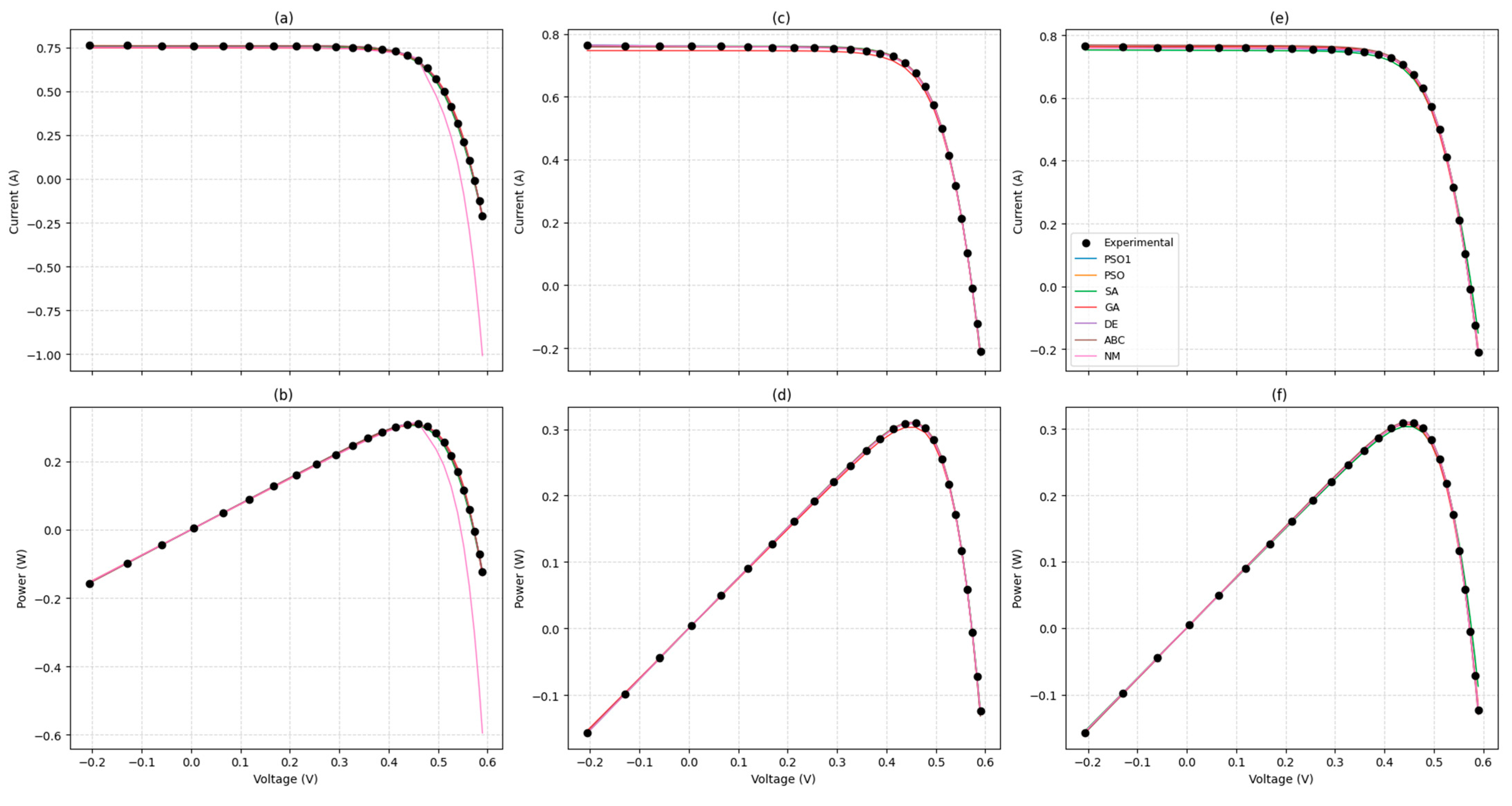
To better assess and interpret the results of the tested optimization algorithms, a detailed analysis of the accuracy of the PV models to replicate the I–V and P–V curves is carried out. While a simple assessment of numerical error metrics is made, this assessment attempts to associate the goodness of fit with the search process for all algorithms, specifically for simpler to more complicated models, such as the single-, double-, and triple-diode models. A better understanding of algorithm performance is made possible by considering both graphical and statistical aspects. The experimental results derived from
Figure 1,
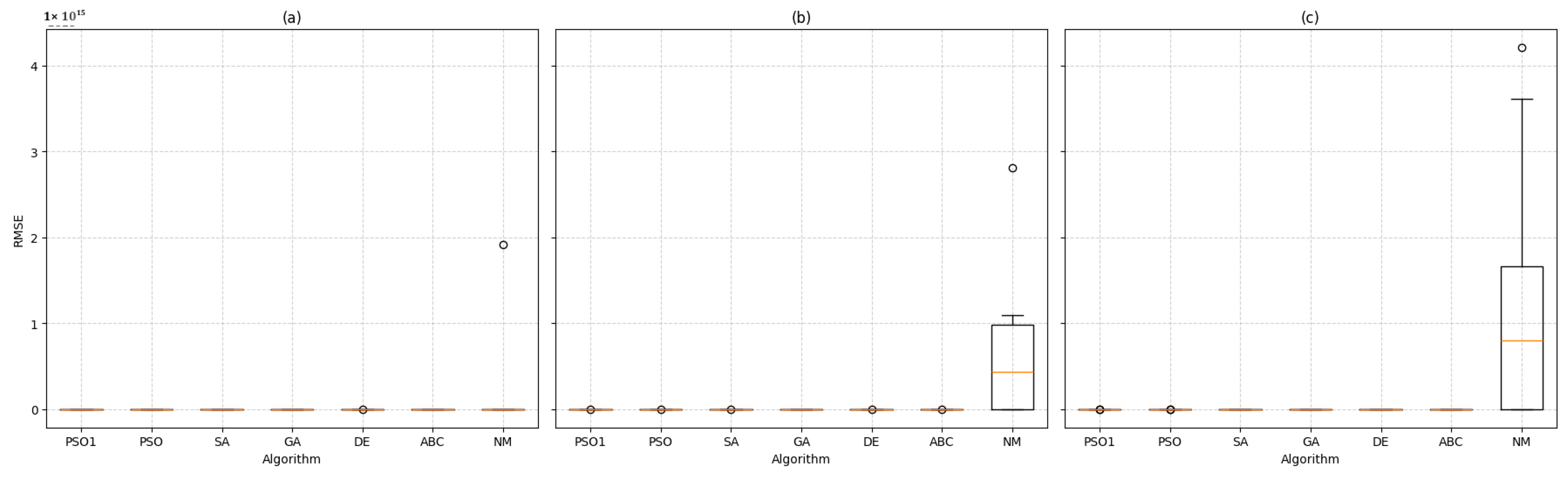
Figure 2 and
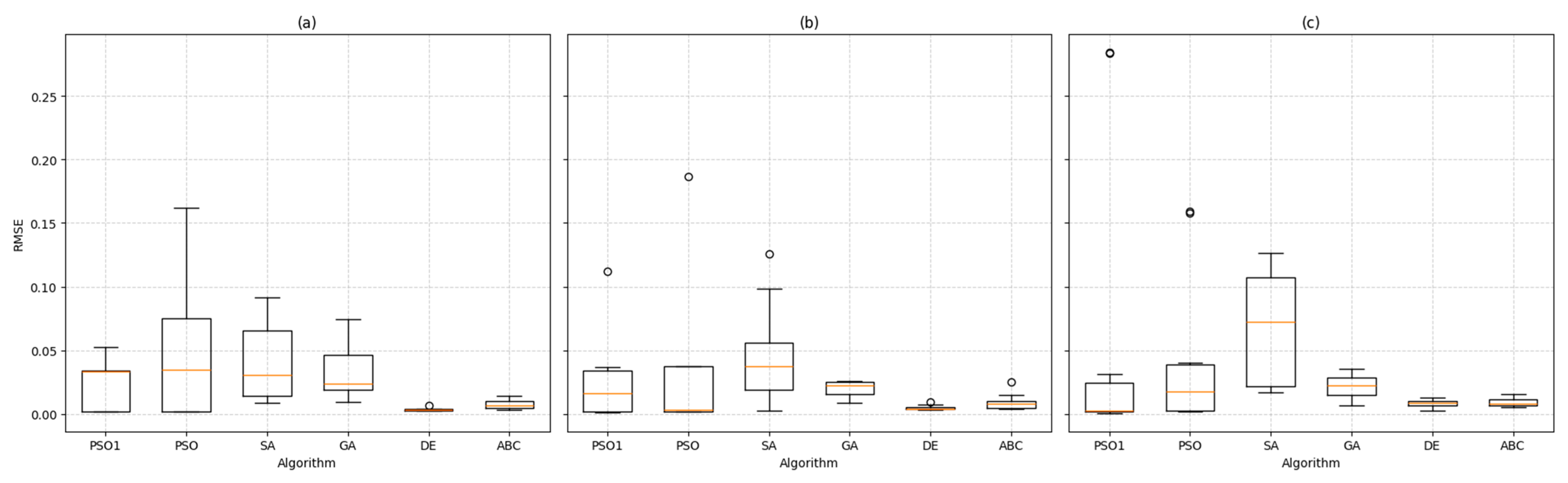
Figure 3 and
Table 6 and
Table 7 in the preceding subsections conclude the comprehensive analysis of the numerical resolution, robustness, and optimization process of the tested algorithms for the photovoltaic models of increasingly complex structures, including the single-diode model (SDM), double-diode model (DDM), and triple-diode model (TDM), respectively. It should be noted that, throughout
Figure 2,
Figure 3 and
Figure 4, the label PSO1 refers to the proposed improved Particle Swarm Optimization (IPSO) algorithm.
The I–V and P–V characteristics in
Figure 2 show that most algorithms successfully replicate SDM experimental data. This success is due to the low-dimensional parameter space and a less multimodal convergence landscape. However, as complexity increases for the DDM and TDM, noticeable differences arise. Significant deviations appear near the knee region and open-circuit voltage. These areas are highly sensitive to saturation currents, ideality factors, and resistances. Swarm-based algorithms—specifically PSO, DE, and IPSO—consistently provide the best fit in these nonlinear regions. In contrast, GA and SA show small but systematic discrepancies, especially in the high-voltage region, which is evidence of their lower effectiveness in dealing with the strong coupling of parameters. These differences are further emphasized by the P-V curves, since inaccuracies in the estimation of parameters result in shifts in the MPP. IPSO consistently yields the most accurate localization of MPP for the TDM, reflecting its enhanced capability to balance global exploration and local exploitation in high-dimensional optimization problems.
The RMSE distributions in
Figure 3 indicate a great variability in the robustness of the algorithms. The results for the NM algorithm show a great variability and lack of stability, especially in the SDM and TDM scenarios. These properties are typical for local search heuristics that have a lack of population diversity and are highly dependent on the initial solution, and the considered objective function is rather highly nonlinear and multimodal. The distributions for population-based methods are much tighter. Among these population-based methods, IPSO and DE have the lowest interquartile ranges. This shows how stable both methods are. The effectiveness of IPSO can be attributed to improved swarm behavior that avoids premature convergence. This is a major drawback of traditional PSO.
In order to conduct the comparison among the competitive algorithms more easily,
Figure 4 will not include NM, which has much higher RMSE values. According to the new results of the analysis, IPSO always shows the smallest median RMSE value on the TDM problem, with the superiority of IPSO being more remarkable on the higher-dimensional and more nonlinear problem of the PV model. One interesting observation arises in the TDM analysis: although IPSO produced the absolute best-case RMSE (0.00064), it had a higher mean and standard deviation compared with DE and ABC. This illustrates a performance trade-off: the constriction-driven local search mechanism within IPSO enables it to “tunnel” highly effectively into the deepest global minima; however, it remains sensitive towards initial stochastic conditions at high dimensions. In contrast, DE’s mutation and crossover provide a more uniform “averaging” effect across the population for superior robustness, or lower variance, but slightly less precision in the final best-case fit. For commercial applications where the highest possible accuracy is essential, one would prefer IPSO; however, where consistency (that is, the same general result) in various initializations of the algorithm is crucial, then DE remains an important candidate. GA and SA have a wider range of RMSE values in the DDM and TDM, which indicates that there might exist convergence stability issues in the GA and SA approaches when the multiple-diode branches are considered. While ABC algorithm has a moderate level of robustness but a slower convergence process.
The results of the Wilcoxon signed-rank test, shown in
Table 7, confirm the significance of the results. IPSO is significantly better than NM for all three PV systems with a
p-value < 0.01. This proves that the results are not due to chance. Contrast analysis between IPSO and the rest of the population-based methods such as PSO, DE, GA, SA, and ABC does not show any statistically significant differences at a confidence level of 5%. However, IPSO outperforms the rest with respect to the lowest RMSE (best) and highest R
2 scores, especially for the TDM.
From an algorithmic point of view, the superior behavior of IPSO is due to its enhanced swarm coordination mechanism, promoting information exchange among particles without compromises in diversity. Therefore, it will enable a more effective way of navigating the highly nonlinear error surfaces induced by exponential diode terms and resistive losses. Considering the growing complexity of the PV model, robustness and adaptive search behavior become more crucial than convergence speed. In all, the evidence from curve fitting accuracy and RMSE distribution analysis combines well with the results of statistical testing to establish that IPSO indeed offers a robust and resilient optimization framework for PV parameter extraction. In fact, its advantage in performance becomes all the more evident for higher-order diode models, where traditional methods of optimization either suffer from instability or become excessively sensitive to initial conditions.
5. Conclusions
This research provides a comprehensive and systematic analysis of the single-diode (SDM), double-diode (DDM), and triple-diode (TDM) PV current–voltage and power–voltage models with respect to their capacity to efficiently reproduce the experimental current–voltage and power–voltage curves. In addition to a descriptive analysis between models mainly based on their capacity to correctly reproduce experimental results, there is a description of how a more complex approach fundamentally improves the simulation results based on their physical mechanism. Although the single-diode model captures the overall current–voltage curve correctly, it fails when it comes to incorporating recombination and leakage current due to their simplicity. The double-diode approach overcomes the above-mentioned problem by considering the recombination current efficiently enough. The triple-diode current–voltage analysis incorporates more components that result in a better fit within the whole operational voltage.
Among the other findings, from the point of view of optimization, algorithmic behavior becomes much more critical when increasing model complexity. The proposed IPSO method provided robust convergence stability and achieved reasonable robustness in performance for all models under investigation, in particular for the TDM, where the search space of parameters is highly nonlinear and multimodal. The results of the RMSE distribution analysis and confidence intervals, and the analysis of standard deviation of the RMSE, confirm that IPSO provides not only competitive estimation accuracy but also bounded variability, which is a sign of reliability of the estimation. Although statistical tests did not show significant differences in performance between IPSO and a number of advanced metaheuristics, namely PSO, DE, GA, and ABC, in estimations of complex models, IPSO demonstrated an evident and statistically significant advantage over the method of Nelder–Mead, whose performance degraded strongly with the increase in dimensionality. The Wilcoxon signed-rank test further supports that for highly complex diode models, differences in the performance of population-based algorithms are not pronounced and are mostly dependent on the exploration/exploitation trade-off. Therefore, the adaptation introduced in the IPSO algorithm allows it to maintain efficiency in converging, with fewer possibilities for stagnation, making it suitable for the estimation of multi-diode parameters.
In general, the results offer a clear direction on how to make decisions on modeling and optimization in PV systems. The use of higher-order models of the diode, especially the TDM, is recommended when there is a need for accurate performance prediction, for instance, in maximum power point tracking and PV system design and diagnostics. Simultaneously, efficient population-based optimizers, especially enhanced versions of them, for instance, IPSO, would serve as a trustworthy and computationally efficient tool for dealing with the complexity introduced by higher-order models of PV cells. Future studies should concentrate on developing the technique in situations where operating conditions are dynamic, for instance, in terms of partial shading and temperature effects. It should be noted, however, that the present study relies on a single experimental dataset, which constitutes a limitation and may restrict the generalization of the conclusions. Future work should therefore validate the proposed approach using multiple datasets, different PV technologies, and a wider range of operating conditions, including partial shading and temperature variations.
Author Contributions
Conceptualization, O.K.; methodology, O.K. and F.W.; software, O.K.; validation, O.K., M.H. and M.L.; formal analysis, M.H. and M.; investigation, O.K., M.H. and M.L.; resources, M.H. and M.L.; data curation O.K. and F.W.; writing—original draft preparation, O.K.; writing—review and editing, O.K., M.H. and M.L.; visualization, O.K. and F.W.; supervision, M.H. and M.L.; project administration, M.H. and M.L.; funding acquisition, O.K. All authors have read and agreed to the published version of the manuscript.
Funding
This research received no external funding.
Institutional Review Board Statement
Not applicable.
Informed Consent Statement
Not applicable.
Data Availability Statement
The raw data supporting the conclusions of this article will be made available by the authors on request.
Conflicts of Interest
The authors declare no conflicts of interest.
References
- Oussama, K.; Mohamed, H.; Mohamed, L. Revolutionizing Renewable Energy Through Artificial Intelligence: An Overview. In International Conference on Digital Age & Technological Advances for Sustainable Development; Springer Nature: Cham, Switzerland, 2024; pp. 56–65. [Google Scholar]
- Quiles-Cucarella, E.; Sánchez-Roca, P.; Agustí-Mercader, I. Performance Optimization of Machine-Learning Algorithms for Fault Detection and Diagnosis in PV Systems. Electronics 2025, 14, 1709. [Google Scholar] [CrossRef]
- Velilla, E.; Cano, J.B.; Jimenez, K.; Valencia, J.; Ramirez, D.; Jaramillo, F. Numerical analysis to determine reliable one-diode model parameters for perovskite solar cells. Energies 2018, 11, 1963. [Google Scholar] [CrossRef]
- Md Ashikur, R.; Sokkalingam, R.; Othman, M.; Biswas, K.; Abdullah, L.; Kadir, E.A. Nature-inspired metaheuristic techniques for combinatorial optimization problems: Overview and recent advances. Mathematics 2021, 9, 2633. [Google Scholar] [CrossRef]
- Marini, F.; Walczak, B. Particle swarm optimization (PSO). A tutorial. Chemom. Intell. Lab. Syst. 2015, 149, 153–165. [Google Scholar] [CrossRef]
- Lambora, A.; Gupta, K.; Chopra, K. Genetic algorithm-A literature review. In Proceedings of the 2019 International Conference on Machine Learning, Big Data, Cloud and Parallel Computing (COMITCon), Faridabad, India, 14–16 February 2019; IEEE: Piscataway, NJ, USA, 2019; pp. 380–384. [Google Scholar]
- Price, K.V. Differential evolution. In Handbook of Optimization: From Classical to Modern Approach; Springer: Berlin/Heidelberg, Germany, 2013; pp. 187–214. [Google Scholar]
- Karaboga, D.; Basturk, B. On the performance of artificial bee colony (ABC) algorithm. Appl. Soft Comput. 2008, 8, 687–697. [Google Scholar] [CrossRef]
- Delahaye, D.; Chaimatanan, S.; Mongeau, M. Simulated annealing: From basics to applications. In Handbook of Metaheuristics; Springer International Publishing: Cham, Switzerland, 2018; pp. 1–35. [Google Scholar]
- Chang, K.-H. Stochastic Nelder–Mead simplex method—A new globally convergent direct search method for simulation optimization. Eur. J. Oper. Res. 2012, 220, 684–694. [Google Scholar] [CrossRef]
- Alruwaili, M. A Multi-Objective Optimization Framework for Robust and Accurate Photovoltaic Model Parameter Identification Using a Novel Parameterless Algorithm. Processes 2025, 13, 2111. [Google Scholar] [CrossRef]
- Singh, A.; Sharma, A.; Rajput, S.; Bose, A.; Hu, X. An investigation on hybrid particle swarm optimization algorithms for parameter optimization of PV cells. Electronics 2022, 11, 909. [Google Scholar] [CrossRef]
- Águila-León, J.; Vargas-Salgado, C.; Díaz-Bello, D.; Montagud-Montalvá, C. Optimizing photovoltaic systems: A meta-optimization approach with GWO-Enhanced PSO algorithm for improving MPPT controllers. Renew. Energy 2024, 230, 120892. [Google Scholar] [CrossRef]
- Güven, A.F.; Yörükeren, N.; Tag-Eldin, E.; Samy, M.M. Multi-objective optimization of an islanded green energy system utilizing sophisticated hybrid metaheuristic approach. IEEE Access 2023, 11, 103044–103068. [Google Scholar] [CrossRef]
- Kumari, P.A.; Geethanjali, P. Adaptive genetic algorithm based multi-objective optimization for photovoltaic cell design parameter extraction. Energy Procedia 2017, 117, 432–441. [Google Scholar] [CrossRef]
- Rawa, M.; Calasan, M.; Abusorrah, A.; Alhussainy, A.A.; Al-Turki, Y.; Ali, Z.M.; Sindi, H.; Mekhilef, S.; Abdel Aleem, S.H.E.; Bassi, H. Single diode solar cells—Improved model and exact current–voltage analytical solution based on Lambert’s W function. Sensors 2022, 22, 4173. [Google Scholar] [CrossRef]
- Easwarakhanthan, T.; Bottin, J.; Bouhouch, I.; Boutrit, C. Nonlinear minimization algorithm for determining the solar cell parameters with microcomputers. Int. J. Sol. Energy 1986, 4, 1–12. [Google Scholar] [CrossRef]
Figure 1.
Flowchart of the adaptive Particle Swarm Optimization (IPSO) algorithm for extracting optimal photovoltaic (PV) module parameters.
Figure 1.
Flowchart of the adaptive Particle Swarm Optimization (IPSO) algorithm for extracting optimal photovoltaic (PV) module parameters.
Figure 2.
I–V and P–V characteristics for the SDM (a,b), DDM (c,d), and TDM (e,f) using different optimization algorithms.
Figure 2.
I–V and P–V characteristics for the SDM (a,b), DDM (c,d), and TDM (e,f) using different optimization algorithms.
Figure 3.
RMSE distribution across optimization algorithms for the SDM (a), DDM (b), and TDM (c). In each boxplot, the box represents the interquartile range (25th–75th percentiles), the orange line denotes the median RMSE, whiskers extend to the most extreme values within 1.5 × IQR, and circular markers indicate outliers.
Figure 3.
RMSE distribution across optimization algorithms for the SDM (a), DDM (b), and TDM (c). In each boxplot, the box represents the interquartile range (25th–75th percentiles), the orange line denotes the median RMSE, whiskers extend to the most extreme values within 1.5 × IQR, and circular markers indicate outliers.
Figure 4.
RMSE distribution across optimization algorithms for SDM (a), DDM (b), and TDM (c) configurations, excluding the Nelder–Mead (NM) algorithm due to its significantly higher error values. In each boxplot, the box represents the interquartile range (25th–75th percentiles), the orange line denotes the median RMSE, whiskers extend to the most extreme values within 1.5 × IQR, and circular markers indicate outliers.
Figure 4.
RMSE distribution across optimization algorithms for SDM (a), DDM (b), and TDM (c) configurations, excluding the Nelder–Mead (NM) algorithm due to its significantly higher error values. In each boxplot, the box represents the interquartile range (25th–75th percentiles), the orange line denotes the median RMSE, whiskers extend to the most extreme values within 1.5 × IQR, and circular markers indicate outliers.
Table 1.
PV parameters to be estimated for the SDM, DDM, and TDM.
Table 1.
PV parameters to be estimated for the SDM, DDM, and TDM.
| Parameter | Symbol | Description | SDM | DDM | TDM |
|---|
| Photocurrent | | Current generated by solar irradiance | ✔ * | ✔ | ✔ |
| Diode 1 saturation current | | Reverse saturation current of the first diode | ✔ | ✔ | ✔ |
| Diode 1 ideality factor | | Ideality factor of the first diode | ✔ | ✔ | ✔ |
| Diode 2 saturation current | | Reverse saturation current of the second diode | — | ✔ | ✔ |
| Diode 2 ideality factor | | Ideality factor of the second diode | — | ✔ | ✔ |
| Diode 3 saturation current | | Reverse saturation current of the third diode | — | — | ✔ |
| Diode 3 ideality factor | | Ideality factor of the third diode | — | — | ✔ |
| Series resistance | | Wiring and contact losses | ✔ | ✔ | ✔ |
| Shunt resistance | | Model leakage currents across the junction | ✔ | ✔ | ✔ |
Table 2.
Description of evaluation metrics used.
Table 2.
Description of evaluation metrics used.
| Metric | Formula | Description |
|---|
| MSE | | Measures the average bias in predictions. A positive value indicates overestimation, while a negative value indicates underestimation. |
| RMSE | | Represents overall prediction error magnitude and penalizes large deviations. |
| R2 | | Indicates how well the model explains the variance in the experimental data. |
| MAE | | Measures the average magnitude of errors between predicted and actual values; lower values indicate higher prediction accuracy. |
Table 3.
Parameter bounds for SDMs, DDMs, and TDMs.
Table 3.
Parameter bounds for SDMs, DDMs, and TDMs.
| Model | Parameter Bounds |
|---|
| SDM | Iph ∈ [0.5, 1.5]; I0 ∈ [1 × 10⁻¹², 1 × 10⁻⁶]; Rs ∈ [0, 1]; Rsh ∈ [1, 2000]; n ∈ [1, 2] |
| DDM | Same as SDM + I01 ∈ [1 × 10⁻¹², 1 × 10⁻⁶]; n1 ∈ [1, 2] |
| TDM | Same as DDM + I02 ∈ [1 × 10⁻¹², 1 × 10⁻⁶]; n2 ∈ [1, 2] |
Table 4.
Optimization algorithms and main parameters.
Table 4.
Optimization algorithms and main parameters.
| Algorithm | Main Parameters |
|---|
| IPSO | Swarm size = 35; max iterations = 50; inertia weight w linearly decreasing from 0.9 to 0.4; cognitive and social coefficients c1 = c2 = 2.05; constriction factor χ applied; velocity limit = 20% of parameter range |
| PSO | Swarm size = 30; inertia weight w = 0.7; cognitive coefficient c1 = 1.5; social coefficient c2 = 1.5; max iterations = 200 |
| SA | Initial temperature = 1.0; cooling rate α = 0.99; max iterations = 2000 |
| GA | Population = 30; generations = 200; mutation rate = 0.1; elitism = 20% |
| DE | Population = 40; generations = 200; mutation factor f = 0.6; crossover rate CR = 0.9 |
| ABC | Food sources = 20; limit = 50; max iterations = 200 |
| NM | Max iterations = 3000; simplex-based local search |
Table 5.
Best SDM, DDM, and TDM parameter estimates for all algorithms.
Table 5.
Best SDM, DDM, and TDM parameter estimates for all algorithms.
| Algorithm | Model | Iph (A) | I0/I01 (A) | I02 (A) | I03 (A) | Rs (Ω) | Rsh (Ω) | n/n1 | n2 | n3 |
|---|
| SA | SDM | 0.7556 | 1.000 × 10⁻⁶ | — | — | 0.0343 | 604.83 | 1.634 | — | — |
| | DDM | 0.7606 | 1.000 × 10⁻¹² | 1.000 × 10⁻⁶ | — | 0.0319 | 842.12 | 1.314 | 1.638 | — |
| | TDM | 0.7518 | 1.000 × 10⁻¹² | 1.000 × 10⁻¹² | 1.000 × 10⁻⁶ | 0.0396 | 185.59 | 1.168 | 1.506 | 1.649 |
| PSO | SDM | 0.7582 | 7.021 × 10⁻⁷ | — | — | 0.0336 | 840.91 | 1.595 | — | — |
| | DDM | 0.7614 | 5.761 × 10⁻⁷ | 1.000 × 10⁻¹² | — | 0.0337 | 56.83 | 1.574 | 1.439 | — |
| | TDM | 0.7608 | 2.341 × 10⁻⁷ | 4.127 × 10⁻⁸ | 1.438 × 10⁻⁷ | 0.0370 | 52.60 | 1.709 | 1.503 | 1.463 |
| IPSO | SDM | 0.7582 | 7.021 × 10⁻⁷ | — | — | 0.0336 | 840.91 | 1.595 | — | — |
| | DDM | 0.7614 | 5.761 × 10⁻⁷ | 1.000 × 10⁻¹² | — | 0.0337 | 56.83 | 1.574 | 1.439 | — |
| | TDM | 0.7608 | 2.341 × 10⁻⁷ | 4.127 × 10⁻⁸ | 1.438 × 10⁻⁷ | 0.0370 | 52.60 | 1.709 | 1.503 | 1.463 |
| GA | SDM | 0.7469 | 1.000 × 10⁻⁶ | — | — | 0.0243 | 553.90 | 1.640 | — | — |
| | DDM | 0.7465 | 1.000 × 10⁻⁶ | 1.000 × 10⁻⁶ | — | 0.0263 | 1102.92 | 1.739 | 1.717 | — |
| | TDM | 0.7637 | 1.000 × 10⁻⁶ | 1.000 × 10⁻¹² | 1.000 × 10⁻⁶ | 0.0356 | 665.29 | 1.653 | 1.773 | 1.934 |
| DE | SDM | 0.7589 | 9.141 × 10⁻⁷ | — | — | 0.0319 | 1589.83 | 1.626 | — | — |
| | DDM | 0.7598 | 7.875 × 10⁻⁷ | 8.749 × 10⁻⁷ | — | 0.0284 | 836.15 | 1.759 | 1.666 | — |
| | TDM | 0.7588 | 1.000 × 10⁻¹² | 4.540 × 10⁻⁷ | 8.311 × 10⁻⁷ | 0.0311 | 1523.01 | 1.905 | 1.765 | 1.638 |
| ABC | SDM | 0.7597 | 9.655 × 10⁻⁷ | — | — | 0.0339 | 2000.00 | 1.633 | — | — |
| | DDM | 0.7586 | 5.008 × 10⁻⁸ | 8.316 × 10⁻⁷ | — | 0.0295 | 1174.14 | 1.610 | 1.622 | — |
| | TDM | 0.7675 | 1.293 × 10⁻⁷ | 3.986 × 10⁻⁷ | 1.000 × 10⁻⁶ | 0.0292 | 176.95 | 2.000 | 1.650 | 1.691 |
| NM | SDM | 0.7502 | 9.662 × 10⁻¹² | — | — | 1.0000 | 2000.00 | 2.000 | — | — |
| | DDM | 0.7609 | 5.463 × 10⁻⁷ | 3.396 × 10⁻⁷ | — | 0.0349 | 60.50 | 1.949 | 1.524 | — |
| | TDM | 0.7582 | 4.399 × 10⁻⁷ | 5.638 × 10⁻⁷ | 7.205 × 10⁻⁸ | 0.0343 | 786.25 | 1.553 | 1.900 | 2.000 |
Table 6.
Performance comparison of all algorithms under SDM, DDM, and TDM configurations.
Table 6.
Performance comparison of all algorithms under SDM, DDM, and TDM configurations.
| Algorithm | Model | RMSE (Best) | RMSE (Mean) | RMSE (Std) | CI_95 | MAE (Best) | MBE (Best) | R2 (Best) | Time (s) |
|---|
| SA | SDM | 0.00861 | 0.03940 | 0.02822 | 0.02128 | 0.00817 | 0.00815 | 0.99888 | 90.49 |
| | DDM | 0.00295 | 0.04718 | 0.03651 | 0.02753 | 0.00298 | −0.00238 | 0.99986 | 301.87 |
| | TDM | 0.01732 | 0.06687 | 0.04155 | 0.03133 | 0.01433 | −0.00062 | 0.99559 | 681.11 |
| PSO | SDM | 0.00179 | 0.04784 | 0.05002 | 0.03772 | 0.00189 | 0.00031 | 0.99995 | 132.43 |
| | DDM | 0.00187 | 0.03145 | 0.05397 | 0.04070 | 0.00197 | −0.00001 | 0.99994 | 492.93 |
| | TDM | 0.00226 | 0.04376 | 0.05899 | 0.04449 | 0.00243 | −0.00006 | 0.99992 | 1162.99 |
| IPSO | SDM | 0.00177 | 0.02280 | 0.01794 | 0.01353 | 0.00178 | 0.00008 | 0.99995 | 130.50 |
| | DDM | 0.00117 | 0.02543 | 0.03253 | 0.02453 | 0.00111 | 0.00011 | 0.99998 | 459.41 |
| | TDM | 0.00064 | 0.06118 | 0.11164 | 0.08418 | 0.00068 | 0.00001 | 0.99999 | 1110.67 |
| GA | SDM | 0.00937 | 0.03305 | 0.02116 | 0.01595 | 0.01047 | 0.00426 | 0.99856 | 132.45 |
| | DDM | 0.00895 | 0.02017 | 0.00585 | 0.00441 | 0.01000 | 0.00979 | 0.99862 | 492.14 |
| | TDM | 0.00677 | 0.02179 | 0.00961 | 0.00724 | 0.00678 | 0.00008 | 0.99929 | 1143.67 |
| DE | SDM | 0.00247 | 0.00352 | 0.00111 | 0.00083 | 0.00204 | −0.00002 | 0.99993 | 135.03 |
| | DDM | 0.00303 | 0.00503 | 0.00203 | 0.00153 | 0.00267 | −0.00044 | 0.99990 | 489.74 |
| | TDM | 0.00281 | 0.00829 | 0.00272 | 0.00205 | 0.00247 | −0.00022 | 0.99991 | 1146.16 |
| ABC | SDM | 0.00341 | 0.00782 | 0.00387 | 0.00292 | 0.00285 | 0.00003 | 0.99987 | 268.53 |
| | DDM | 0.00397 | 0.00950 | 0.00606 | 0.00457 | 0.00358 | −0.00049 | 0.99976 | 990.68 |
| | TDM | 0.00530 | 0.00959 | 0.00352 | 0.00266 | 0.00561 | −0.00383 | 0.99952 | 2316.28 |
| NM | SDM | 0.22379 | 1.92 × 10¹⁴ | 5.74 × 10¹⁴ | 1.92 × 10¹⁴ | 0.13533 | 0.13427 | 0.27746 | 107.47 |
| | DDM | 0.00087 | 6.75 × 10¹⁴ | 8.43 × 10¹⁴ | 6.35 × 10¹⁴ | 0.00084 | −0.00000 | 0.99999 | 369.43 |
| | TDM | 0.00196 | 1.26 × 10¹⁵ | 1.47 × 10¹⁵ | 1.11 × 10¹⁵ | 0.00208 | 0.00079 | 0.99994 | 1022.84 |
Table 7.
Wilcoxon signed-rank test results comparing IPSO with other optimization algorithms across SDMs, DDMs, and TDMs (α = 0.05).
Table 7.
Wilcoxon signed-rank test results comparing IPSO with other optimization algorithms across SDMs, DDMs, and TDMs (α = 0.05).
| Model | Comparison | Wilcoxon Statistic | p-Value | Significant |
|---|
| SDM | IPSO vs. NM | 0.0 | 0.000977 | YES |
| IPSO vs. PSO | 15.0 | 0.116211 | NO |
| IPSO vs. SA | 16.0 | 0.137695 | NO |
| IPSO vs. GA | 16.0 | 0.137695 | NO |
| IPSO vs. DE | 45.0 | 0.967773 | NO |
| IPSO vs. ABC | 45.0 | 0.967773 | NO |
| DDM | IPSO vs. NM | 1.0 | 0.001953 | YES |
| IPSO vs. SA | 12.0 | 0.065430 | NO |
| IPSO vs. PSO | 20.0 | 0.246094 | NO |
| IPSO vs. GA | 25.0 | 0.422852 | NO |
| IPSO vs. ABC | 37.0 | 0.838867 | NO |
| IPSO vs. DE | 40.0 | 0.903320 | NO |
| TDM | IPSO vs. NM | 2.0 | 0.002930 | YES |
| IPSO vs. PSO | 22.0 | 0.312500 | NO |
| IPSO vs. SA | 20.0 | 0.246094 | NO |
| IPSO vs. GA | 20.0 | 0.246094 | NO |
| IPSO vs. DE | 27.0 | 0.500000 | NO |
| IPSO vs. ABC | 27.0 | 0.500000 | NO |
| Disclaimer/Publisher’s Note: The statements, opinions and data contained in all publications are solely those of the individual author(s) and contributor(s) and not of MDPI and/or the editor(s). MDPI and/or the editor(s) disclaim responsibility for any injury to people or property resulting from any ideas, methods, instructions or products referred to in the content. |