Proceeding Paper

Effect of Artificial Ageing on Mechanical Properties of Recycled Polypropylene Hollow Chamber Sheets †
by
Stamatina Theochari
1,*,
Agathi Anthoula Kaminari
2,3,
Angelos Kaldellis
3,4,
Athanasios Karabotsos
3,
Isidoros Iakovidis
5,
Stavros Chionopoulos
5,
Theano Vlachou
1 and
Athina Georgia Alexopoulou
2,3
1
Department of Graphic and Visual Communication, University of West Attica, Alsos University Campus, Agios Spyridonos, 12243 Aigaleo, Greece
2
Department of Conservation of Antiquities and Works of Art, University of West Attica, Alsos University Campus, Agios Spyridonos, 12243 Aigaleo, Greece
3
ARTICON Lab, Faculty of Applied Arts and Culture, University of West Attica, Alsos University Campus, Agios Spyridonos, 12243 Aigaleo, Greece
4
Lab of Soft Energy Applications & Environmental Protection, University of West Attica, Ancient Olive Grove Campus, 12241 Aigaleo, Greece
5
Department of Naval Architecture, School of Engineering, University of West Attica, Alsos University Campus, Agios Spyridonos, 12243 Aigaleo, Greece
*
Author to whom correspondence should be addressed.
Presented at the 8th International Conference of Engineering Against Failure (ICEAF VIII), Kalamata, Greece, 22–25 June 2025.
Eng. Proc. 2025, 119(1), 12; https://doi.org/10.3390/engproc2025119012
Published: 11 December 2025
(This article belongs to the Proceedings of The 8th International Conference of Engineering Against Failure)

Abstract

Packaging materials made from polypropylene (PP) can be used to protect cultural heritage objects from damage ensuring their long-life preservation. This research work concerns the assessment of recycled polypropylene hollow chamber sheets as potential packaging materials for archival collections and cultural heritage objects. It was carried out through a multidisciplinary diagnostic methodology combining mechanical methods, non-destructive imaging techniques in visible light (VIS), and ultraviolet-induced visible luminescence (UVL), as well as handheld digital microscopy, colorimetry, glossimetry, and SEM microanalysis. The results showed that the condition and mechanical performance of the specimens are affected by the ageing process.

1. Introduction

The development of green and sustainable materials for ecological, accessible, sustainable and inclusive processes concerning the protection and conservation-restoration of the cultural heritage is of great concern. Since our planet is experiencing an accelerating climate and ecological breakdown, green methods and materials have been proposed recently by researchers from all over the world [1]. The European research programme HORIZON-CL2-2021-HERITAGE-01: GREENART (GREen ENdeavor in Art ResToration) [2] focuses on the development of sustainable green materials from renewable resources to replace existing conventional packaging materials; this project highlights the applicability of the proposed materials before they reach the market of conservation–restoration of the cultural heritage, in accordance with the requirements of the Green Deal Agenda [3,4,5,6]. In addition, packaging materials should be effective, safe, and affordable, while also exhibiting enhanced properties, such as strong mechanical stability and long lifespan. These qualities are essential to ensure the protection and preservation of museum objects, valuable documents, and artworks, which are highly vulnerable during storage or transportation, especially in cases of international loans or relocation within storage facilities [7,8,9]. The use of recycled heterophasic copolymers having a morphology known to provide enhanced toughness and resistance to ageing have also been under investigation in this context [8,10]. To date, only a limited number of research publications have addressed the properties of green polymer materials and other sustainable alternatives for the conservation and storage of heritage objects [10,11].
This work presents the diagnostic methodology designed and performed by the research team of University of West Attica (UNIWA team), for the assessment of packaging materials that were proposed by GREENART research project. Two different types of hollow chamber sheets made from recycled PP (rPPhcs1 and rPPhcs2) are evaluated after artificial ageing in comparison with a conventional one (cPPhcs) derived from petroleum refining. The assessment is based on a multidisciplinary approach combining destructive, non-destructive, and analytical techniques. The outcomes could be useful for academics, professionals, and related industries for the evaluation of new materials before using for packaging, storage and transportation of cultural heritage objects and archive collections.

2. Materials and Methods

2.1. Materials

Specimens of materials supplied by partners of GREENART were cut in dimensions of 2 × 5 cm and actual thickness or as required by each specific testing method. As shown in Table 1, the three types of specimens differ in origin and structure: cPPhcs are conventional PP sheets from fossil resources, rPPhcs1 and rPPhcs2, which are made of recycled PP, are based on recycled heterophasic copolymers, with different density. Different manufacturing processes were used, resulting in anisotropic geometry for rPPhcs1 and isotropic with bubble-like geometry for rPPhcs2.

2.2. Methods

2.2.1. Artificial Ageing

All specimens were subjected to ageing using an accelerated weathering tester (Atlas SC340 MHG Solar Simulator, Votcsch Industrietechnik GmbH, Balingen Deutschland) according to ISO 4892-3:2016. In total, a 1000 h ageing process was conducted under 0.76 W/m2 UV light irradiance at 340 nm wavelength, with cycles ranging from 60 °C, 8 h dry UV light exposure period to 50 °C, and 4 h in the water spray phase (80% RH) [12].

2.2.2. Mechanical Tests and Measurements

The specimens were kept in room conditions of 23 °C and 50% RH for 24 h before mechanical tests.
Tensile strength tests were conducted in accordance with ISO 527, using standard specimen dimensions and testing conditions as specified by standard [13]. Mechanical testing was carried out using a universal testing machine Testometric M500 (Testometric Co. Ltd., Rochdale, UK) with a maximum load capacity of 50 kN. Creep tests for the PP specimens were performed using an Edibon EEFCR creep testing machine (Madrid, Spain) under a constant load of 6.5 kg or 15.0 kg. Temperature was set to 20 ± 2 °C. Three independent specimens were used for each test to ensure reproducibility and calculate the average values as described in [14].

2.2.3. Non-Destructive Testing

Non-destructive testing refers to a set of techniques for inspecting, examining and evaluating materials, components or assemblies for discontinuities, alterations and variations in their characteristics, without destroying their integrity or functionality [15,16].
  • Colorimetry and glossimetry: Reference measurements of colorimetry on the specimens were used to determine the colour uniformity before and after ageing. The instrumentation used for colour measurements was a PCE-CSM 10 Spectrophotometer (Manchester, UK). The measurements were carried out using the colorimeter PCE-CSM 10 for quality control of the specimens in different colour spaces (CIE L*a*b*, XYZ, Yxy, LCh, CIE LUV, Hunter Lab) [17]. Surface gloss of specimens was measured using a TG 60/268 Lovibond gloss metre (Dortmund, Germany) and GQC6 Quality Control Software, which is included for free, according to EN ISO 7668 standard. The gloss metre determined the intensity of light reflected from the surface of the specimens at three measurement angles of 20°, 60°, and 85°, giving information on the status of their surface [18].
  • Imaging techniques: The morphology of the specimens was examined through non-destructive spectral imaging in visible light (VIS, raking and symmetrical) and ultraviolet-induced visible luminescence (UVL), as well as microscopy techniques, such as Dino Lite handheld digital microscopy (Almere, The Netherlands) to capture close-up views of selected areas in the visible [14]. Visible reflectance imaging was carried out using a Nikon D800 digital single-lens reflex camera (DSLR) (Nikon Corp., Tokyo, Japan) equipped with an AF-S Nikkor 24–70 mm 1:2.8G ED lens (Nikon Corp., Japan). A copy stand was employed to support the paper samples. Two J78 halogen lamps (Viagrande, Italy) were used for symmetrical illumination. UVL was carried out by a Nikon D800 digital single-lens reflex camera (DSLR) equipped with an AF-S Nikkor 24–70 mm 1:2.8G ED lens and a copy stand was employed to support the samples. One UV LED lamp (Viagrande, Italy) with 14,250 mW radiation power and Max spectral emission 365 nm was used for excitation radiation. Barrier filter KODAK 2E (Rochester, NY, USA) was used to balance excess blue radiation from the light source. The procedure was carried out in a light-isolated room, in complete darkness.
  • Study of the structure and morphology by SEM-EDS: A JSM-6510 LV Scanning Electron Microscope (SEM) (JEOL Ltd., Tokyo, Japan) equipped with an EDAX Energy Dispersive Spectroscopy (EDS) (Oxford Instruments, Oxford, UK) was employed for observation and analysis of the surface of the specimens [19].

3. Results and Discussion

3.1. Tensile Strength

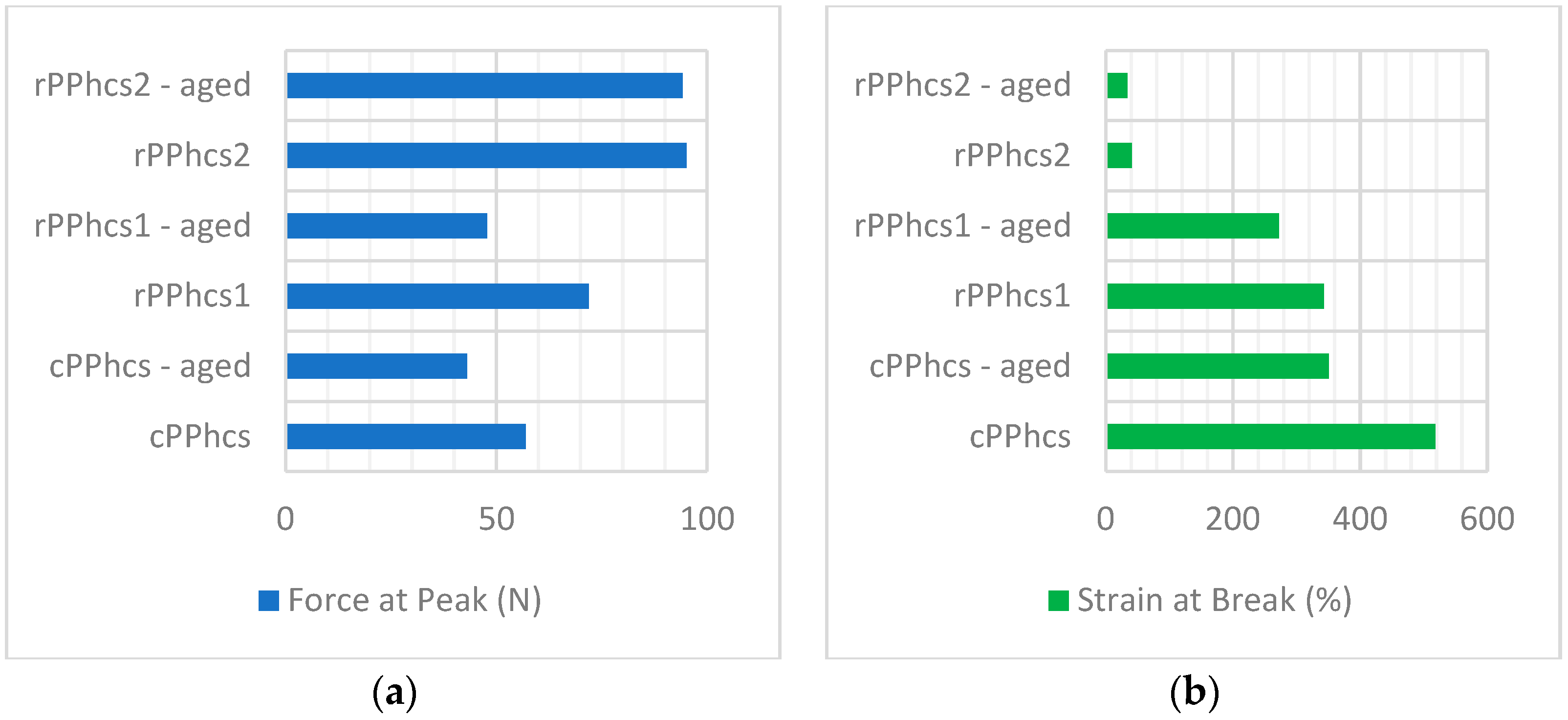
The tensile test results, presented in Figure 1, demonstrate the influence of artificial ageing on the mechanical performance of the polypropylene hollow chamber sheets. A noticeable reduction in maximum force at break was observed for both cPPhcs and rPPhcs1 specimens following ageing, with relative decreases of 24.4% and 33.5%, respectively. In contrast, the rPPhcs2 specimens exhibited only a marginal decrease of 0.9%, indicating a higher resistance to degradation under the applied ageing conditions. Similarly, the strain at break was significantly affected by ageing for cPPhcs and rPPhcs1, showing reductions of 32.4% and 20.7%, respectively. The rPPhcs2 material also showed a reduction in elongation at break, though to a lesser extent (17.7%). These findings suggest that the mechanical integrity of rPPhcs2 remains more stable compared to the other materials tested, thereby demonstrating greater potential for use in applications requiring prolonged durability.

3.2. Creep Test

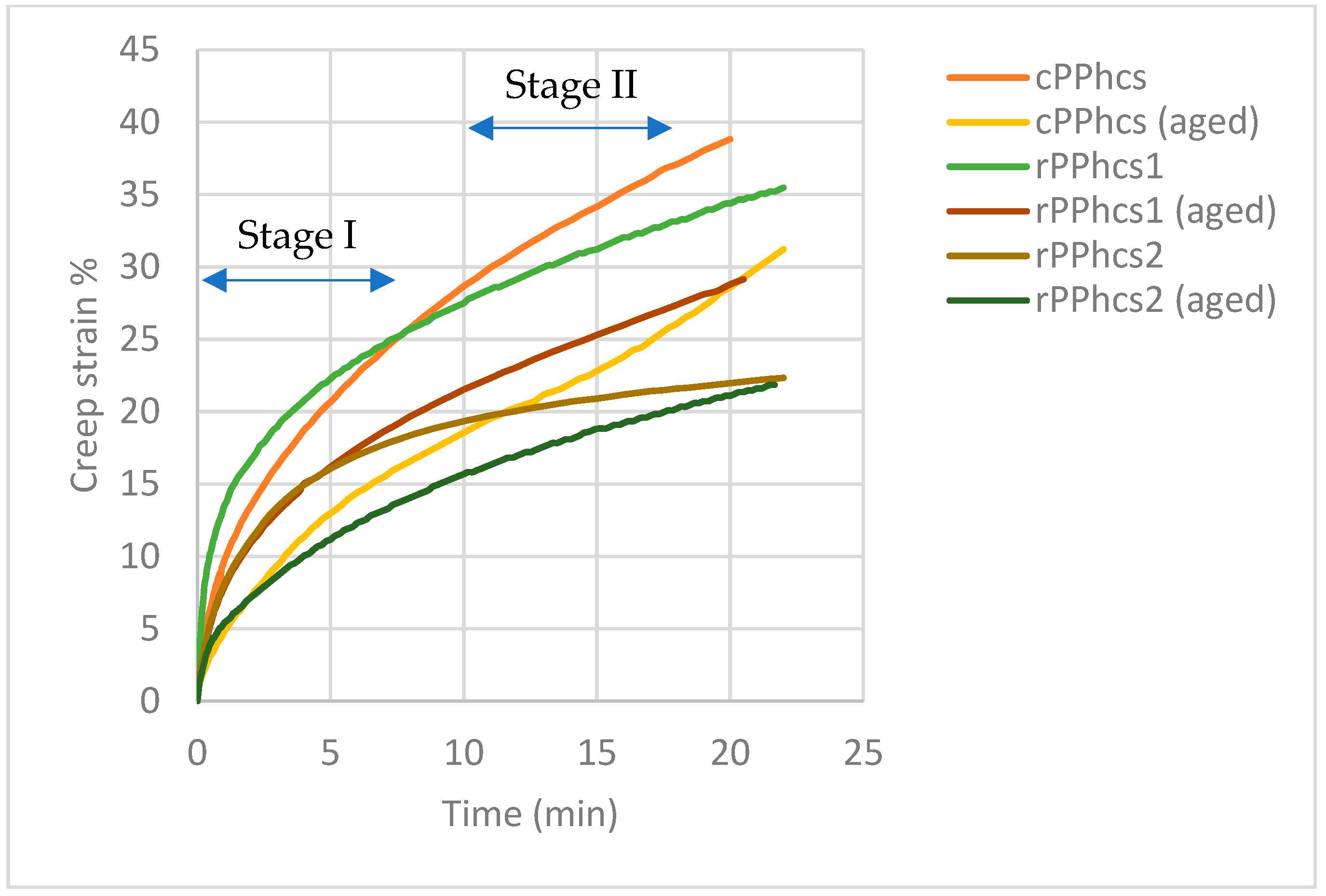
Strain versus time curves obtained from creep tests of the cPPhcs, rPPhcs1 and rPPhcs2 specimens, both before and after their ageing, are depicted in Figure 2. Two specimens were tested for each material. The creep response of each specimen varies depending on the material type, as their creep strains change following artificial ageing. It was observed that, under a load of 6.5 kg, the creep strain of the aged specimens decreases in the case of cPPhcs and rPPhcs1. A similar trend was observed for rPPhcs2 under a load of 15.0 kg at the same temperature. The stage II creep rate for each specimen was determined from the curves of Figure 2, corresponding to the slope of their linear part [14]. It was found that the creep rate for the cPPhcs increased by a factor of 3.3 after ageing (i.e., 0.028 mm/min to 0.092 mm/min under 6.5 kg at 20 ± 2 °C), by a factor of 1.4 for rPPhcs1 (i.e., 0.044 mm/min to 0.060 mm/min under 6.5 kg at 20 ± 2 °C), and for rPPhcs2 by a factor of 2.0 (i.e., 0.019 mm/min to 0.038 mm/min under 15.0 kg at 20 ± 2 °C).

3.3. Imaging Techniques

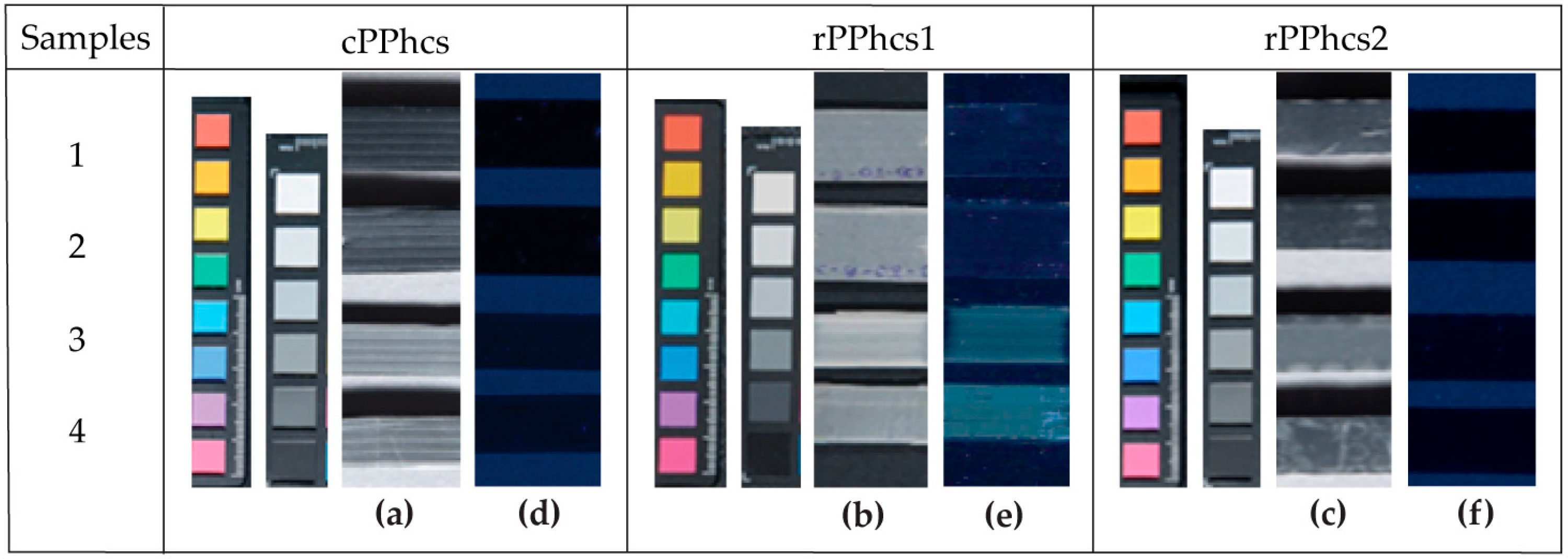
Thermal, humid, and UV radiation conditions of ageing resulted in the fading (whitening) of the specimens, especially of the black ones (cPPhcs and rPPhcs2). Distinct variations between the aged and unaged specimens are obvious (Figure 3a–c). The colour of the cPPhcs specimens changed from black to grey, showing that they are affected by ageing (Figure 3a). The specimens of rPPhcs1 are the weakest in comparison to rPPhcs2 and cPPhcs and showed significant failure (Figure 3b). The original colour of rPPhcs1 specimens was dark grey, but after ageing it faded to light grey. A change in the behaviour under UV light was also observed on this material, as it presents fluorescence, indicating changes in its chemistry (Figure 3e). The oxidation of polymers like polyethylene and polypropylene caused by ageing leads to the introduction of new chromophoric groups, and thus to increased fluorescence [20]. It should be noted that, although the aged specimens were supported using a tape to bear the creep test, their response was eliminated. The specimens made from rPPhcs2 were stronger and their response was better than rPPhcs1, as presented in Figure 3c. Their colour changed slightly, they did not present luminescence (Figure 3f), and they were not affected after ageing and creep testing, which is probably attributed to the material and its structure.

3.4. Colour and Gloss Measurements

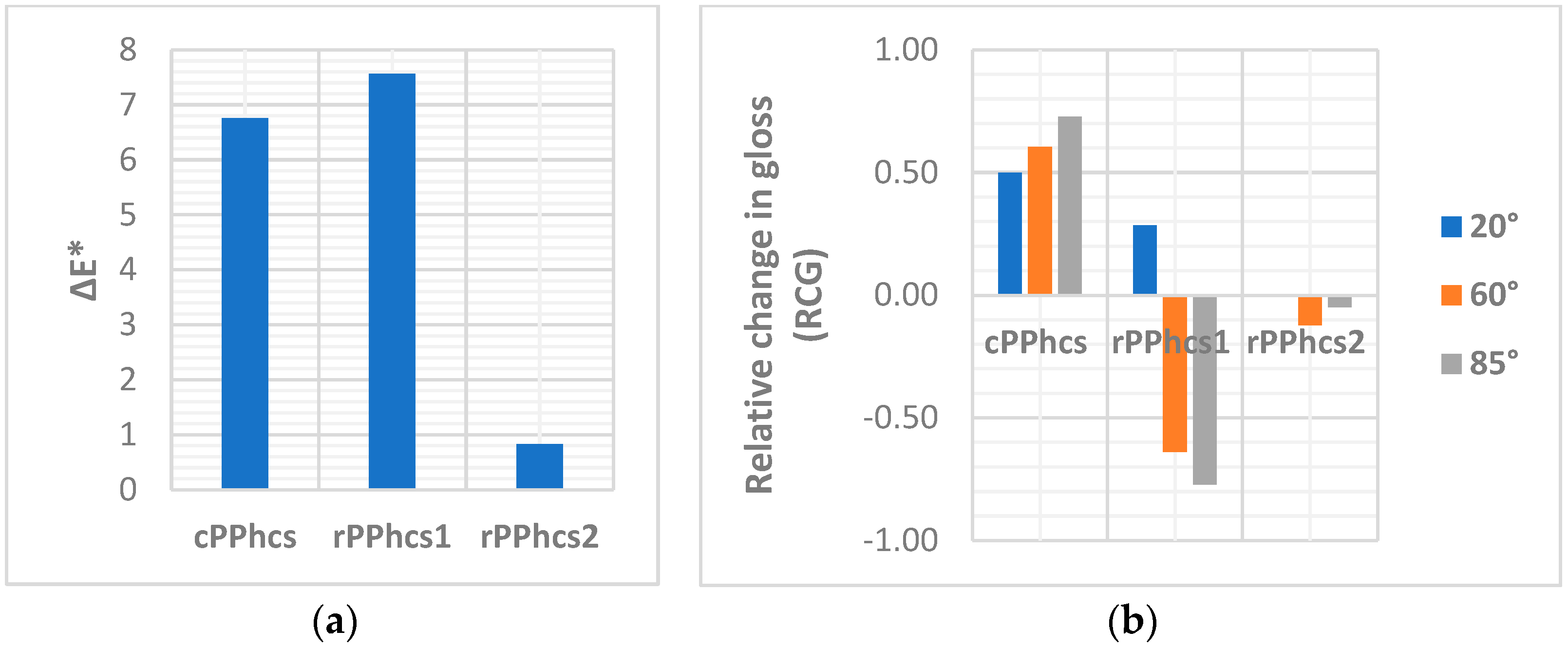
The gradual whitening of the specimens after ageing, and notable variations, which were observed across different material types, were verified by colorimetric analysis. These differences suggest significant changes in the surface properties, as confirmed by the variations in Delta E* (ΔE*) (Figure 4a). Specimen rPPhcs2 did not present any notable changes (i.e., ΔΕ* = 0.8), while the specimen rPPhcs1 showed a significant colour change (i.e., ΔΕ* = 7.6), as did cPPhcs (i.e., ΔΕ* = 6.7).
The relative changes In gloss (RCG) before and after ageing for all specimens are presented in Figure 4b. Although all specimens exhibited low gloss levels prior to ageing, noticeable differences emerged in the cases of cPPhcs and rPPhcs1 after exposure. In contrast, rPPhcs2 showed only minor changes, suggesting superior stability. This finding is further corroborated by the colorimetric analysis shown in Figure 4a.

3.5. SEM/EDS Measurements and Digital Microscopy

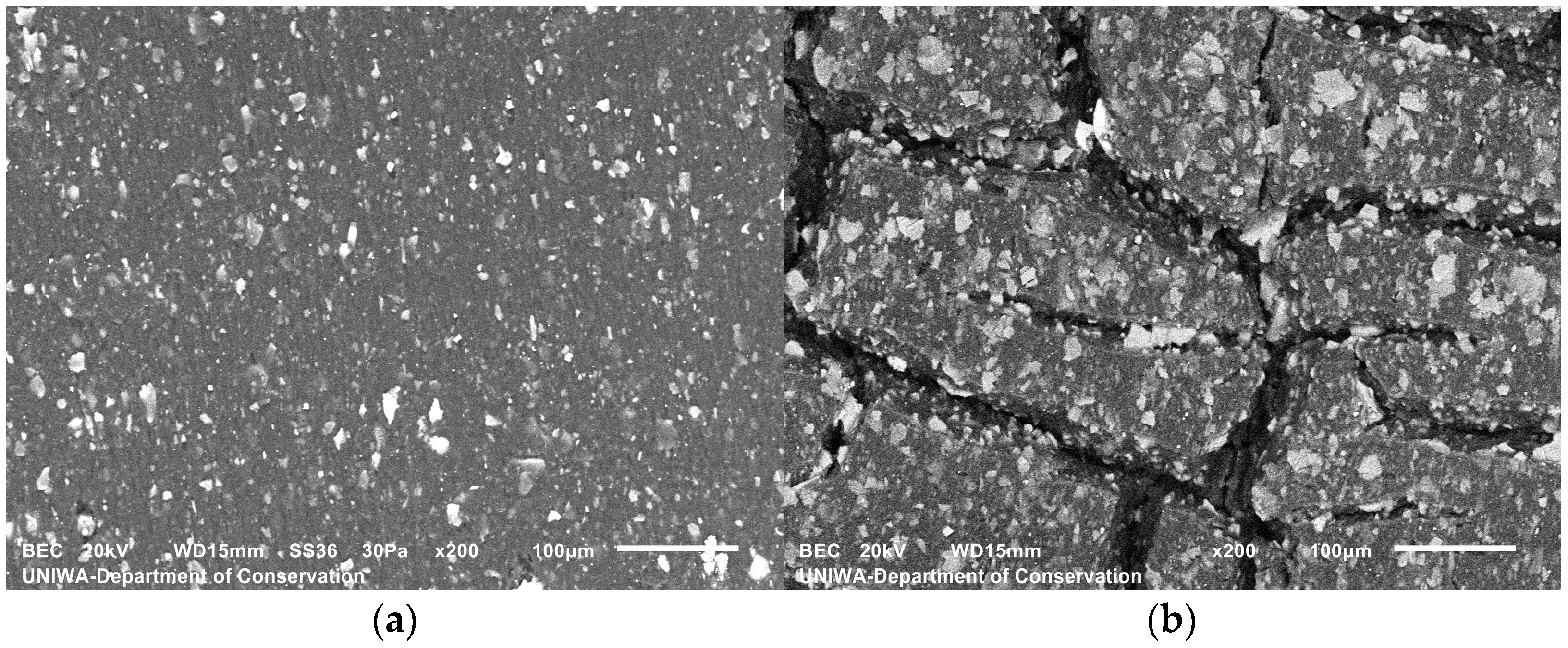
SEM analysis recorded the condition of the surfaces before (BA) and after the ageing (AA) of the specimens and displayed that the unaged specimens show a homogeneous texture with grains of additives, such as Si and Ca determined by EDS analysis. After ageing, all the specimens presented some defects on their surface, which were more evident in the rPPchs1 specimen (Figure 5). It was observed that the material rPPchs1 became brittle, displaying a surface like a “snakeskin”, with discolorations and some cracks. Thereafter, EDS analysis determined the oxygen content on all specimens and revealed a sharp increase after ageing. The oxygen content increased by a factor of 2.5 on cPPhcs and 4.5 on rPPhcs2, respectively, while on rPPhcs1 by a factor of 10, showing the extent of the degradation and failure of the examined materials.
The recycled materials (rPPhcs1, rPPhcs2) demonstrate comparable performance to the conventional cPPhcs made of virgin PP. The superior durability of rPPhcs2 compared to rPPhcs1 and cPPhcs is deduced from its minimal response to oxidation, degradation, and cracking (Figure 3f), its minimal colour and gloss changes (Figure 4) against ageing conditions (UV, thermal, humidity). This behaviour could be linked to its geometric characteristics and its higher surface density. The effect of the chemical composition and microstructure on the characteristics under study could be further investigated as a future prospect.

4. Conclusions

The paper presented the preliminary results of the research within the GREENART programme, concerning the assessment of the materials rPPhcs1 and rPPhcs2 after artificial ageing using mechanical testing and non-destructive imaging techniques in visible (VIS) and ultraviolet-induced visible luminescence (UVL), SEM/EDS analysis, and digital microscopy. These materials made of recycled polypropylene can be proposed as green ones to replace conventional materials made from petroleum refining for the packaging of cultural heritage objects, taking into consideration the following remarks:
  • The rPPhcs2 samples exhibited an irrelevant decrease in tensile strength after ageing compared to rPPhcs1 and cPPhcs, indicating a higher resistance to degradation. However, the creep rate increased in all samples after ageing.
  • The variations in the mechanical properties of the materials due to artificial ageing reflected in colour and gloss changes, offering insights into their stability and integrity.
  • The rPPhcs2 sample is more rigid than rPPhcs1, offering enhanced durability for applications requiring shock and vibration absorption. It is well-suited for folders, archive boxes, and storage containers for heritage objects, as it retains both mechanical strength and optical properties even after ageing. In contrast, rPPhcs1 is more flexible, balancing stiffness and toughness, but requires protection from sunlight, heat, humidity, and UV exposure to preserve performance.
  • The findings highlight key factors behind the failure of new, sustainable material alternatives. Further research is needed on how chemical composition, structure, and environmental conditions—such as temperature and humidity—affect their performance during mechanical testing.

Author Contributions

Conceptualization, S.T. and A.G.A.; methodology, S.T., A.A.K., A.K. (Angelos Kaldellis), A.K. (Athanasios Karabotsos), I.I., S.C. and T.V.; investigation, S.T.; resources, S.T., I.I. and A.K. (Angelos Kaldellis); writing—original draft preparation, S.T., A.A.K. and A.G.A.; writing—review and editing, S.T., A.A.K. and A.G.A.; supervision, S.T. and A.G.A.; project administration, A.A.K.; funding acquisition, A.G.A. and S.T. All authors have read and agreed to the published version of the manuscript.

Funding

This research work was carried out within the framework of the 101060941-HORIZON-CL2-2021-HERITAGE-01 GREen ENdeavor in Art ResToration (GREENART) research project funded by the EU. The registration fees for the presentation in the 8th International Conference of Engineering Against Failure (ICEAF) were totally funded by the University of West Attica, Greece.

Institutional Review Board Statement

Not applicable.

Informed Consent Statement

Not applicable.

Data Availability Statement

Data are contained within the article.

Acknowledgments

The authors acknowledge M. Anders and K. Schuhmann of ZFB Zentrum für Bucherhaltung GmbH, Leipzig, Germany, for providing the packaging materials and PPC Inspectra S.A., Pallini, 153 51, Greece, for performing the tensile testing and for their valuable technical support.

Conflicts of Interest

The authors declare no conflicts of interest. The funders had no role in the design of the study, in the collection, analyses, or interpretation of data, in the writing of the manuscript, or in the decision to publish the results.

References

  1. Baglioni, M.; Poggi, G.; Chelazzi, D.; Baglioni, P. Advanced Materials in Cultural Heritage. Conserv. Mol. 2021, 26, 3967. [Google Scholar] [CrossRef]
  2. GREen ENdeavor in Art ResToration. Available online: https://www.greenart-project.eu/ (accessed on 28 April 2025).
  3. Potts, A. European Cultural Heritage Green Paper. Available online: https://openarchive.icomos.org/id/eprint/2552/1/2021_European%20Heritage%20Green%20Paper_full%20paper.pdf (accessed on 28 May 2025).
  4. European Green Deal. European Green Deal: Commission Proposes Transformation of EU Economy and Society to Meet Climate Ambitions. Available online: https://ec.europa.eu/commission/presscorner/detail/en/ip_21_3541 (accessed on 28 April 2025).
  5. European Chemicals Agency. EU-ECHA Database. 2024. Available online: https://echa.europa.eu/ (accessed on 28 April 2025).
  6. EPA United States Environmental Protection Agency. Available online: https://www.epa.gov/comptox-tools (accessed on 28 April 2025).
  7. Mirabile, A. Sustainable Development or Degrowth. Available online: https://www.greenart-project.eu/wp-content/uploads/2023/09/ama-350-greenart-en_low.pdf (accessed on 28 April 2025).
  8. Maddah, H.A. Polypropylene as a Promising Plastic: A Review. Am. J. Polym. Sci. 2016, 6, 1–11. [Google Scholar]
  9. Chelazzi, D.; Poggi, G.; Baglioni, P. The GREENART Project: Environmentally Friendly and Low Impact Materials for the Conservation of Cultural Heritage. Stud. Conserv. 2024, 69, 25–34. [Google Scholar] [CrossRef]
  10. Barbosa, L.G.; Piaia, M.; Ceni, G.H. Analysis of impact and tensile properties of recycled polypropylene. Int. J. Mater. Eng. 2017, 7, 117–120. [Google Scholar] [CrossRef]
  11. Stuart, B.; Wong, S.; Goodall, R.; Beale, A.; Chu, C.; Nel, P.; Amin-Jones, H.; Thomas, P. Safe Storage? An Assessment of Polyethylene for the Storage of Heritage Objects. Stud. Conserv. 2022, 68, 669–678. [Google Scholar] [CrossRef]
  12. Jakubowska, P.; Borkowski, G.; Brzakalski, D.; Sztorch, B.; Klozinski, A.; Przekop, R.E. The Accelerated Ageing Impact on Mechanical and Thermal Properties of Polypropylene Composites with Sedimentary Rock Opoka-Hybrid Natural Filler. Materials 2022, 15, 338. [Google Scholar] [CrossRef] [PubMed]
  13. Zisopol, D.G.; Minescu, M.; Iacob, D.V. A Study on the Influence of aging of the Butt-welded PE100 SDRPPHCS11 on Shore A Hardness and Tensile Strength. Eng. Technol. Appl. Sci. Res. 2024, 13, 12722–12727. [Google Scholar] [CrossRef]
  14. Dimitrellou, S.; Iakovidis, I.; Psarianos, D.R. Mechanical Characterization of Polylactic Acid, Polycarbonate, and Carbon Fiber-Reinforced Polyamide Specimens Fabricated by Fused Deposition Modeling. J. Mater. Eng. Perform. 2024, 33, 3613–3626. [Google Scholar] [CrossRef]
  15. Alexopoulou, A.; Kaminari, A.A.; Moutsatsou, A. Multispectral and Hyperspectral Studies on Greek Monuments, Archaeological Objects and Paintings on Different Substrates. Achievements and Limitations. In Transdisciplinary Multispectral Modeling and Cooperation for the Preservation of Cultural Heritage, TMM_CH 2018, Communications in Computer and Information Science, 1st ed.; Moropoulou, A., Korres, M., Georgopoulos, A., Spyrakos, C., Mouzakis, C., Eds.; Springer: Cham, Switzerland, 2019; Volume 962, pp. 443–461. [Google Scholar] [CrossRef]
  16. Alexopoulou, A.; Kaminari, A.; Moutsatsou, A.; Banou, P. Imaging Techniques in the Study of Cultural Heritage; Kallipos, Open Academic Editions: Zografou, Athens, Greece, 2024; pp. 93–186, (In Greek). [Google Scholar] [CrossRef]
  17. Becker, D. Color Trends and Selection for Product Design; Elsevier: Amsterdam, The Netherlands, 2016; pp. 105–190. [Google Scholar] [CrossRef]
  18. Arney, J.S.; Ye, L.; Banach, S. Interpretation of Gloss Meter Measurements. J. Imaging Sci. Technol. 2006, 50, 567–571. [Google Scholar] [CrossRef]
  19. Zhou, W.; Apkarian, R.; Wang, Z.L.; Joy, D. Fundamentals of Scanning Electron Microscopy (SEM). In Scanning Microscopy for Nanotechnology, 1st ed.; Zhou, W., Wang, Z.L., Eds.; Springer: New York, NY, USA, 2006; pp. 1–40. [Google Scholar] [CrossRef]
  20. Zhang, Z.; Tian, R.; Lu, C.; Duan, X. Three-Dimensional Visualization for Early-Stage Evolution of Polymer Aging. ACS Cent. Sci. 2020, 6, 771–778. [Google Scholar] [CrossRef] [PubMed]
Figure 1. Variation in maximum applied force (a) and % strain at break (b) for unaged and aged specimens tested in tension.
Engproc 119 00012 g001
Figure 2. Creep behaviour of cPPhcs, rPPhcs1 and rPPhcs2 specimens before (ΒA) and after (AA) ageing.
Engproc 119 00012 g002
Figure 3. The three sets of unaged (1,2) and aged (3,4) specimens cPPhcs, rPPhcs1 and rPPhcs2 before (1,3) and after (2,4) creep testing, as recorded with imaging techniques (VIS: (ac) and UVL: (df)). While cPPhcs and rPPhcs2 do not fluoresce, it is evident that rPPhcs1 presents fluroescence after ageing.
Engproc 119 00012 g003
Figure 4. Changes in colour ΔΕ* (a) and relative change in gloss RCG (b) between values obtained before (BA) and after (AA) ageing of all specimens.
Engproc 119 00012 g004
Figure 5. Images of rPPchs1 specimen before (a) and after ageing (b) at 200× magnification (SEM).
Engproc 119 00012 g005
Table 1. Characteristics of the PP packaging materials that were examined in the present work.
SamplescPPhcsrPPhcs1rPPhcs2
raw materialconventional PPrecycled PP
m (g/m2)478.9655.5997.0
t (mm)2.53.53.4
Disclaimer/Publisher’s Note: The statements, opinions and data contained in all publications are solely those of the individual author(s) and contributor(s) and not of MDPI and/or the editor(s). MDPI and/or the editor(s) disclaim responsibility for any injury to people or property resulting from any ideas, methods, instructions or products referred to in the content.