


Printable Chemoresistive Sensor Based on PrFeTiO5 Solid Solution for Acetone Detection †

 ,
,  , , ,
, , , 
Abstract
1. Introduction
2. Materials and Methods
3. Results and Discussion
4. Conclusions
Author Contributions
Funding

Institutional Review Board Statement
Informed Consent Statement
Data Availability Statement
Conflicts of Interest
Abbreviations
| VOCs | Volatile organic compounds |
| MOXs | Metal oxides |
| SEM | Scanning electron microscopy |
| HRTEM | High-resolution transmission electron microscopy |
| XRPD | X-ray powder diffraction |
| RH% | Relative humidity |
References
- Epping, R.; Koch, M. On-site detection of volatile organic compounds (VOCs). Molecules 2023, 28, 1598. [Google Scholar] [CrossRef] [PubMed]
- Rodríguez-Torres, M.; Altuzar, V.; Mendoza-Barrera, C.; Beltrán-Pérez, G.; Castillo-Mixcóatl, J.; Muñoz-Aguirre, S. Acetone detection and classification as biomarker of diabetes mellitus using a quartz crystal microbalance gas sensor array. Sensors 2023, 23, 9823. [Google Scholar] [CrossRef]
- Lin, T.; Lv, X.; Hu, Z.; Xu, A.; Feng, C. Semiconductor metal oxides as chemoresistive sensors for detecting volatile organic compounds. Sensors 2019, 19, 233. [Google Scholar] [CrossRef]
- Spagnoli, E.; Fabbri, B.; Gaiardo, A.; Valt, M.; Ardit, M.; Krik, S.; Cruciani, G.; Della Ciana, M.; Vanzetti, L.; Vola, G. Design of a metal-oxide solid solution for selective detection of ethanol with marginal influence by humidity. Sens. Actuators B Chem. 2022, 370, 132426. [Google Scholar] [CrossRef]
- Spagnoli, E.; Gaiardo, A.; Fabbri, B.; Valt, M.; Krik, S.; Ardit, M.; Cruciani, G.; Della Ciana, M.; Vanzetti, L.; Vola, G. Design of a metal-oxide solid solution for sub-ppm H2 detection. ACS Sens. 2022, 7, 573–583. [Google Scholar] [CrossRef]
- de Lacy Costello, B.; Ewen, R.J.; Ratcliffe, N.M.; Sivanand, P. Thick film organic vapour sensors based on binary mixtures of metal oxides. Sens. Actuators B Chem. 2003, 92, 159–166. [Google Scholar] [CrossRef]
- Jamnani, S.R.; Moghaddam, H.M.; Leonardi, S.G.; Neri, G.; Ferlazzo, A. VOCs sensing properties of samarium oxide nanorods. Ceram. Int. 2024, 50, 403–411. [Google Scholar] [CrossRef]
- Kumar, K.L.A.; Durgajanani, S.; Jeyaprakash, B.G.; Rayappan, J.B.B. Nanostructured ceria thin film for ethanol and trimethylamine sensing. Sens. Actuators B Chem. 2013, 177, 19–26. [Google Scholar] [CrossRef]
- Tsang, S.C.; Bulpitt, C. Rare earth oxide sensors for ethanol analysis. Sens. Actuators B Chem. 1998, 52, 226–235. [Google Scholar] [CrossRef]
- Ma, L.; Ma, S.; Shen, X.; Wang, T.; Jiang, X.; Chen, Q.; Qiang, Z.; Yang, H.; Chen, H. PrFeO3 hollow nanofibers as a highly efficient gas sensor for acetone detection. Sens. Actuators B Chem. 2018, 255, 2546–2554. [Google Scholar] [CrossRef]
- Tricoli, A.; Righettoni, M.; Pratsinis, S.E. Minimal cross-sensitivity to humidity during ethanol detection by SnO2-TiO2 solid solutions. Nanotechnology 2009, 20, 315502. [Google Scholar] [CrossRef] [PubMed]
- Spagnoli, E.; Valt, M.; Gaiardo, A.; Fabbri, B.; Guidi, V. Insights into the sensing mechanism of a metal-oxide solid solution via operando diffuse reflectance infrared fourier transform spectroscopy. Nanomaterials 2023, 13, 2708. [Google Scholar] [CrossRef]
- Ahmed, D.; Spagnoli, E.; Chakir, A.; Mancinelli, M.; Ferroni, M.; Mehdaoui, B.; Bouari, A.E.; Fabbri, B. PrFeTiO5-Based Chemoresistive Gas Sensors for VOCs Detection. Chemosensors 2025, 13, 222. [Google Scholar] [CrossRef]
- Rossi, A.; Spagnoli, E.; Tralli, F.; Marzocchi, M.; Guidi, V.; Fabbri, B. New Approach for the Detection of Sub-Ppm Limonene: An Investigation through Chemoresistive Metal-Oxide Semiconductors. Sensors 2023, 23, 6291. [Google Scholar] [CrossRef] [PubMed]
- Rossi, A.; Spagnoli, E.; Visonà, A.; Ahmed, D.; Marzocchi, M.; Guidi, V.; Fabbri, B. SO2 Detection over a Wide Range of Concentrations: An Exploration on MOX-Based Gas Sensors. Chemosensors 2024, 12, 111. [Google Scholar] [CrossRef]
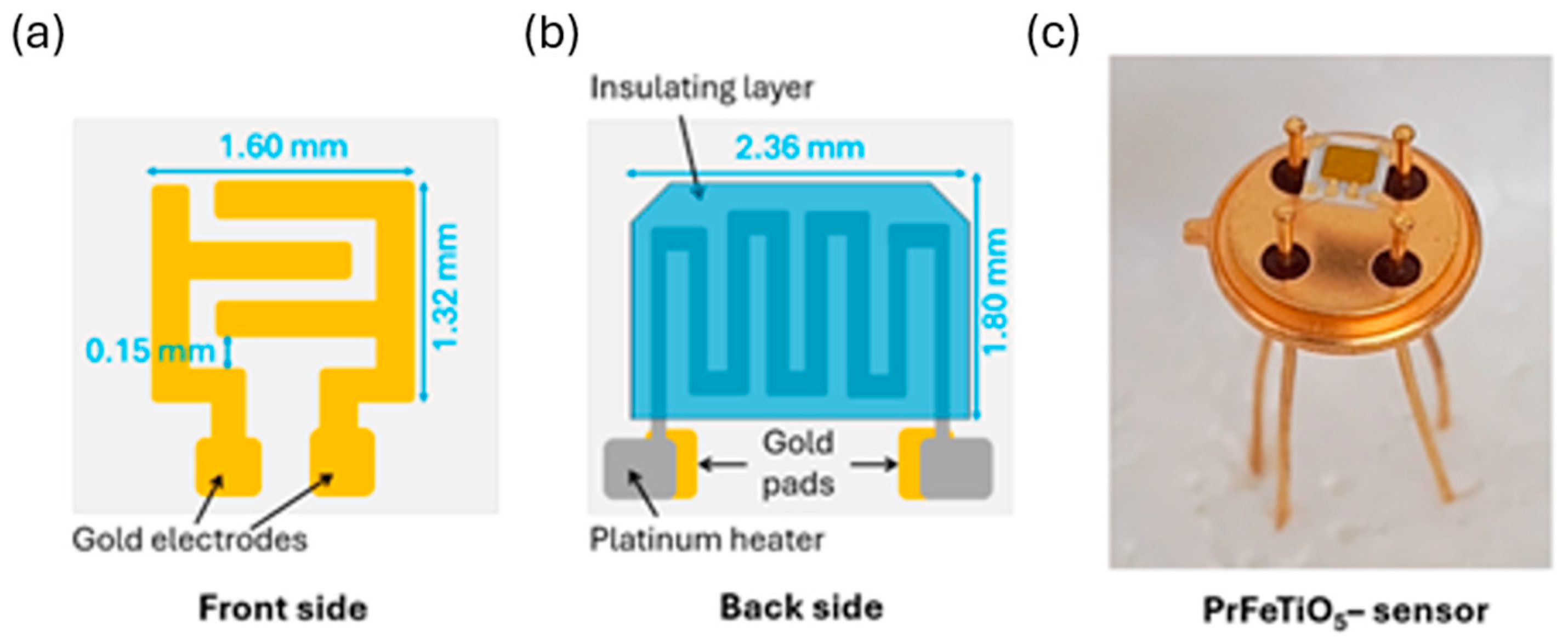
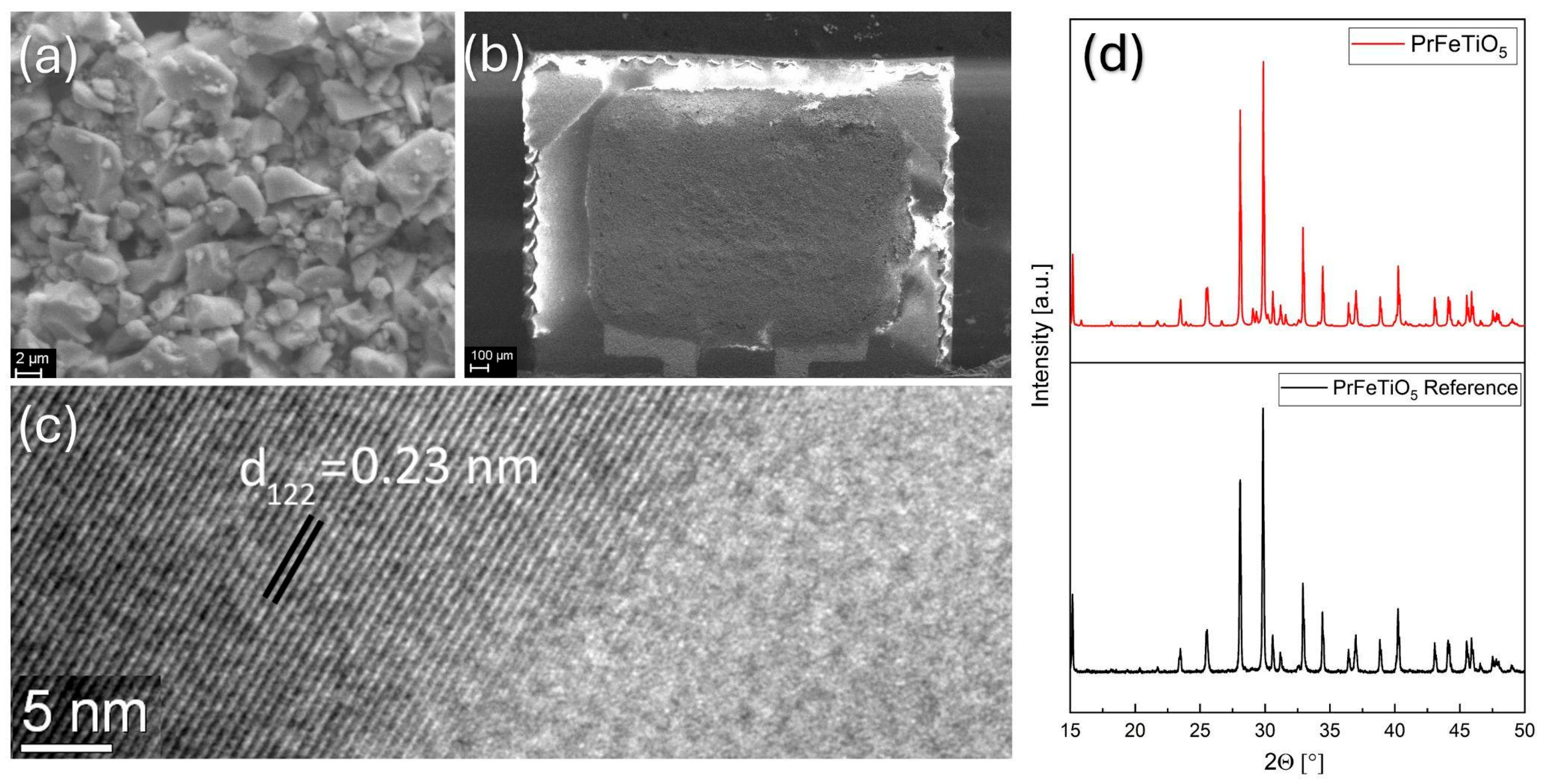
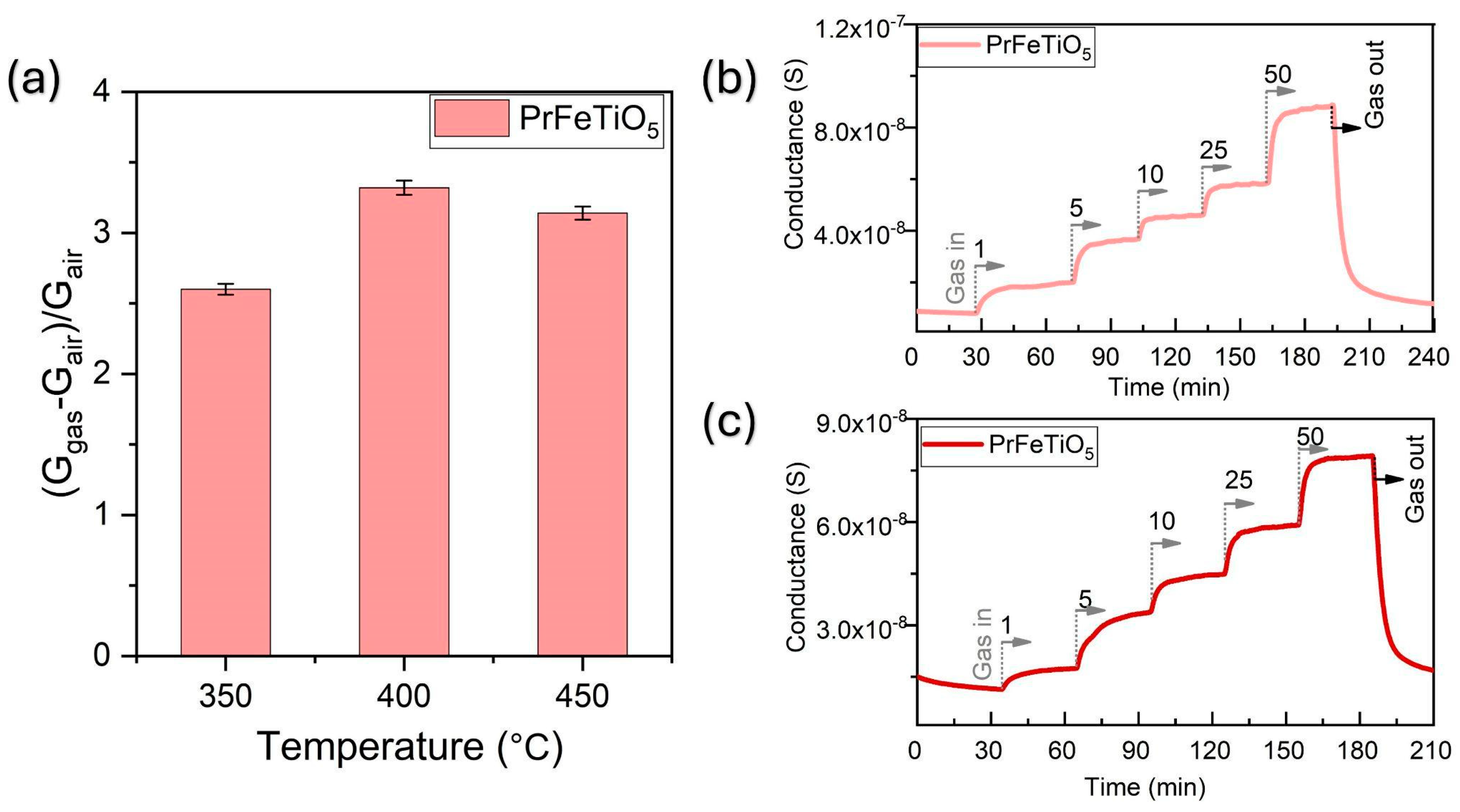
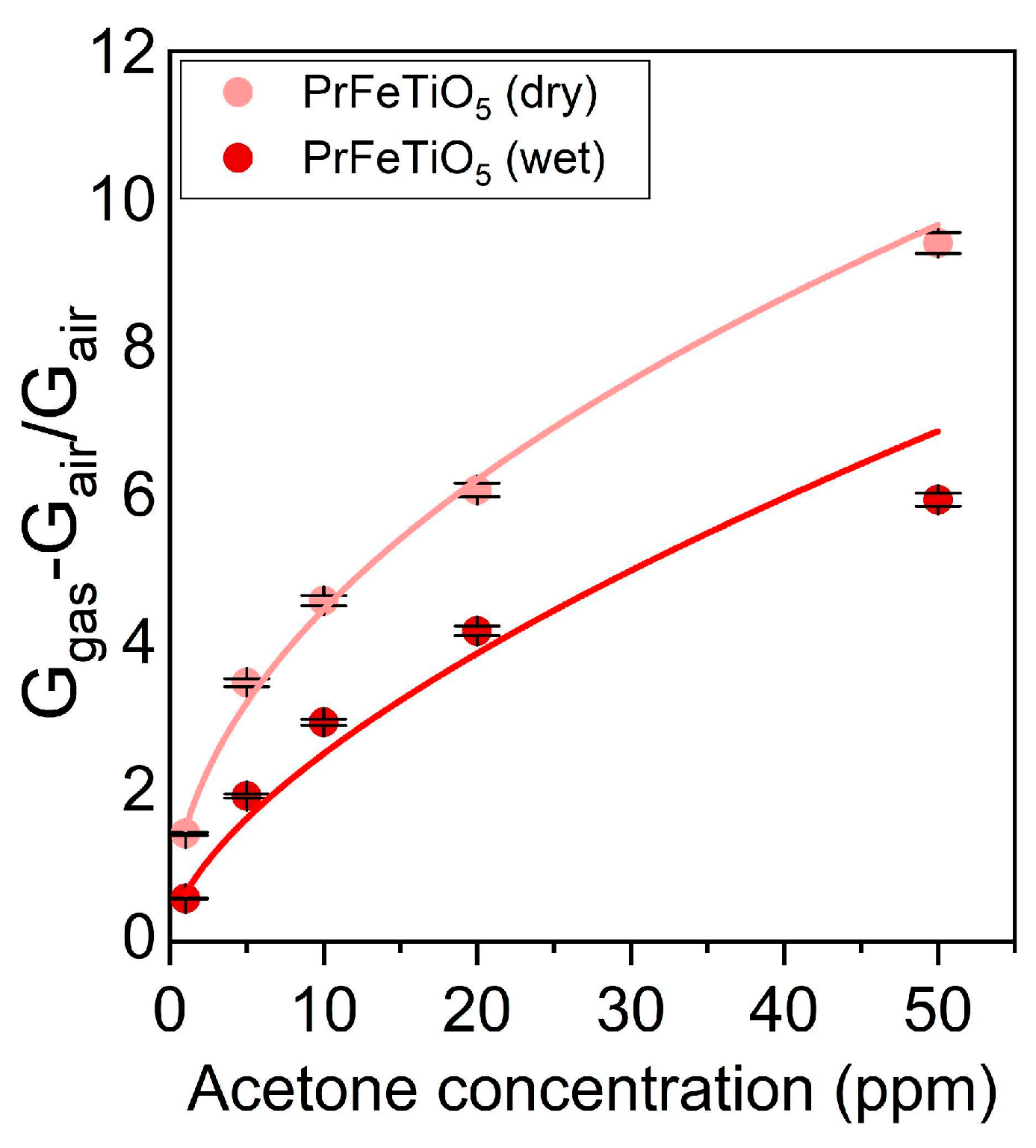
Disclaimer/Publisher’s Note: The statements, opinions and data contained in all publications are solely those of the individual author(s) and contributor(s) and not of MDPI and/or the editor(s). MDPI and/or the editor(s) disclaim responsibility for any injury to people or property resulting from any ideas, methods, instructions or products referred to in the content. |
© 2025 by the authors. Licensee MDPI, Basel, Switzerland. This article is an open access article distributed under the terms and conditions of the Creative Commons Attribution (CC BY) license (https://creativecommons.org/licenses/by/4.0/).
Share and Cite
Ahmed, D.; Spagnoli, E.; Chakir, A.; Mancinelli, M.; Ferroni, M.; Mehdaoui, B.; El Bouari, A.; Fabbri, B. Printable Chemoresistive Sensor Based on PrFeTiO5 Solid Solution for Acetone Detection. Eng. Proc. 2025, 118, 48. https://doi.org/10.3390/ECSA-12-26592
Ahmed D, Spagnoli E, Chakir A, Mancinelli M, Ferroni M, Mehdaoui B, El Bouari A, Fabbri B. Printable Chemoresistive Sensor Based on PrFeTiO5 Solid Solution for Acetone Detection. Engineering Proceedings. 2025; 118(1):48. https://doi.org/10.3390/ECSA-12-26592
Chicago/Turabian StyleAhmed, Danial, Elena Spagnoli, Adil Chakir, Maura Mancinelli, Matteo Ferroni, Boubker Mehdaoui, Abdeslam El Bouari, and Barbara Fabbri. 2025. "Printable Chemoresistive Sensor Based on PrFeTiO5 Solid Solution for Acetone Detection" Engineering Proceedings 118, no. 1: 48. https://doi.org/10.3390/ECSA-12-26592
APA StyleAhmed, D., Spagnoli, E., Chakir, A., Mancinelli, M., Ferroni, M., Mehdaoui, B., El Bouari, A., & Fabbri, B. (2025). Printable Chemoresistive Sensor Based on PrFeTiO5 Solid Solution for Acetone Detection. Engineering Proceedings, 118(1), 48. https://doi.org/10.3390/ECSA-12-26592

