Proceeding Paper

Advanced Oxidation Process for Decontamination of Tetracycline from Wastewater Using Immobilized Magnetite †
by
Padinchare Veettil Gayathri
1,*,
Vincy Antoney
2,
Divya Nair
3,
Telsa Tenson
4,
Sreelakshmi Manalody Goguldas
4,
Sneha Vadassery
4 and
Thara Surendran
4
1
Department of Science and Humanities, Sree Narayana Gurukulam College of Engineering, Kadayiruppu, Kolenchery 682311, Kerala, India
2
Department of Chimicia Industriale, Alma Mater Studiorium-Università di Bologna, Viale Risorgimento 2, 40126 Bologna, Italy
3
Department of Climate Variability and Aquatic Ecosystems, Kerala University of Fisheries and Ocean Studies (KUFOS), Puthuvyppu, Kochi 682508, Kerala, India
4
Department of Chemistry, St. Alberts College, Ernakulam, Banerjee Road, Kochi 682018, Kerala, India
*
Author to whom correspondence should be addressed.
Presented at the 4th International Electronic Conference on Processes, 20–22 October 2025; Available online: https://sciforum.net/event/ECP2025.
Eng. Proc. 2025, 117(1), 76; https://doi.org/10.3390/engproc2025117076
Published: 20 April 2026
(This article belongs to the Proceedings of The 4th International Electronic Conference on Processes)

Abstract

This study examines the solar-driven photocatalytic degradation of tetracycline hydrochloride in aqueous media using immobilized magnetite. The synthesized catalyst was characterized by X-ray diffraction (XRD), scanning electron microscopy (SEM), and Fourier transform infrared spectroscopy (FT-IR). Photocatalytic experiments revealed that tetracycline degradation followed pseudo-first-order kinetics, achieving 48% removal within 30 min and nearly complete degradation (99%) after 120 min of solar irradiation. The addition of Fenton reagent significantly enhanced degradation efficiency by promoting the generation of reactive oxygen species. The formation of multiple degradation intermediates, along with a substantial reduction in chemical oxygen demand (COD) was observed. The immobilized magnetite catalyst exhibited good stability and reusability with minimal loss of activity over repeated cycles. Overall, the results demonstrate that magnetite-based solar photocatalysis is a cost-effective, efficient, and environmentally sustainable approach for treating TCT-contaminated wastewater.

1. Introduction

Antibiotics are extensively used in human and veterinary medicine, with global consumption increasing by ~16.3%, from 29.5 to 34.3 billion defined daily doses in recent years [1,2,3]. Although not initially regarded as environmental contaminants, their widespread occurrence in aquatic systems has raised concerns about ecological toxicity, human health risks, and the development of antibiotic resistance. Tetracyclines are the second most widely used antibiotic class worldwide and are applied in clinical therapy and livestock production [4]. Tetracycline hydrochloride (TCT) is produced on a large scale, with China manufacturing over 10,000 tons annually, nearly 70% for veterinary use. Due to incomplete metabolism, 40–90% of administered TCT is excreted unchanged, leading to its accumulation in soil and water. Its high chemical stability and low adsorption further enhance environmental persistence, posing long-term risks to ecosystems and public health [5].
Recent studies have demonstrated that Fe3O4-based photocatalysts are highly effective for antibiotic oxidation due to their visible-light activity, magnetic recoverability, and efficient Fe2+/Fe3+ redox cycling. Another study [6] reported that single-metal-atom oxide anchored Fe3O4-ED-rGO with enhanced charge separation for visible-light degradation of antibiotic residues. A violet phosphorus–Fe3O4 photocatalysis-self-Fenton system that achieved rapid norfloxacin removal through intensified reactive oxygen species generation was developed [7]. More recently, [8] demonstrated efficient TCT degradation using an Fe3O4@starch-derived carbon photo-Fenton catalyst under visible light. These studies highlight the strong potential of Fe3O4-based systems for solar-driven antibiotic remediation, supporting the approach of the use of synthesized magnetite adopted in this work.
While TCT degradation via UV/TiO2 and photo-Fenton systems has been reported, solar-driven approaches remain underexplored. This study evaluates the solar-assisted photocatalytic degradation of TCT using magnetite (Fe3O4), highlighting their low cost, environmental compatibility, and magnetic recoverability through batch and real-water experiments. Since conventional wastewater treatments are ineffective in removing trace pharmaceuticals [9], advanced oxidation and reduction processes (AO/RPs), which generate reactive species such as OH radicals, are therefore promising for antibiotic removal [10], as proved using this study.

2. Materials and Methods

2.1. Materials Used

Tetracycline hydrochloride (98.5–100.0% purity) was purchased from Sigma-Aldrich (Darmstadt, Germany). Iron sulfate heptahydrate (FeSO4·7H2O), hydrogen peroxide (H2O2), sodium hydroxide (NaOH), and sulfuric acid (H2SO4) were obtained from NICE Chemicals Pvt. Ltd. (Kochi, India) and other chemicals used in this study were of analytical reagent (AnalaR) grade or equivalent and were used without further purification. The data analysis and graphical plotting were carried out using OriginPro 2021 (Version 9.8).

2.2. Methodology

2.2.1. Photocatalytic Experimental Setup

Photocatalytic experiments were carried out in a 250 mL open Pyrex reactor containing TCT solution and magnetite catalyst, with continuous agitation using a KEMI VDRL shaker (Kadavil Electro Mechanical Industries, Kochi, India). Solar irradiation experiments were conducted outdoors in Kochi, Kerala, India (9°59′28.29″ N, 76°13′57.08″ E), between 11:00 a.m. and 2:00 p.m. from December 2023 to April 2024, under an average irradiance of ~780 W m−2, measured using a Metravi 207 (Metravi Instruments Pvt Ltd., Kolkata, India) solar meter maintaining a temperature of 34 ± 2 °C. Samples were then periodically withdrawn, centrifuged, and analyzed spectrophotometrically. Experiments under varying conditions, including sunlight alone, TCT–Fenton reagent (FR), TCT–FR–catalyst, and TCT alone, were performed to assess individual and synergistic effects, the samples being analyzed using spectrophotometer.

2.2.2. Dark Control Experiments

Dark control experiments were conducted to evaluate the contribution of adsorption and non-photolytic degradation. During the study, no significant degradation of TCT was observed in either case. The slight decrease in concentration over time was attributed solely to adsorption onto the catalyst surface rather than chemical degradation, confirming that light irradiation is essential for effective TCT removal.

2.2.3. Synthesis of Catalyst

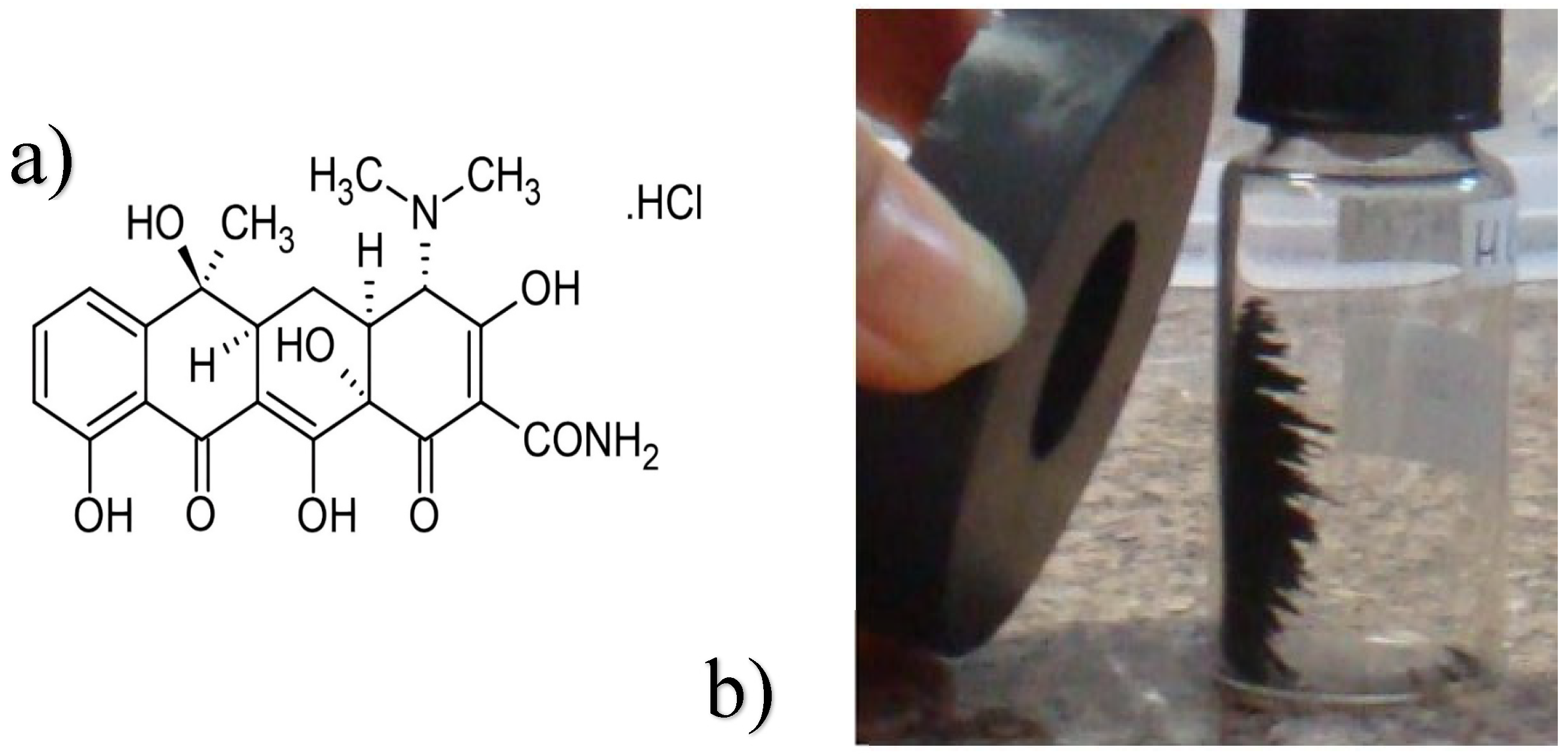
Magnetite nanoparticles were synthesized using the precipitation method [11]. Briefly, 1.81 g of FeSO4·7H2O was dissolved in 100 mL of distilled water and homogenized at 6000–10,000 rpm. A 2 mol L−1 NaOH solution was slowly added until the pH reached 11, resulting in the formation of iron oxide and oxyhydroxide precipitates. The suspension was aged for 24 h, after which magnetic separation was performed for 2 min and the supernatant was discarded. The precipitate was washed several times with distilled water and dried at room temperature (25 °C). The chemical structure of TCT and a photograph of the synthesized magnetite catalyst are shown in Figure 1a,b, respectively.

2.2.4. Analytical Methods

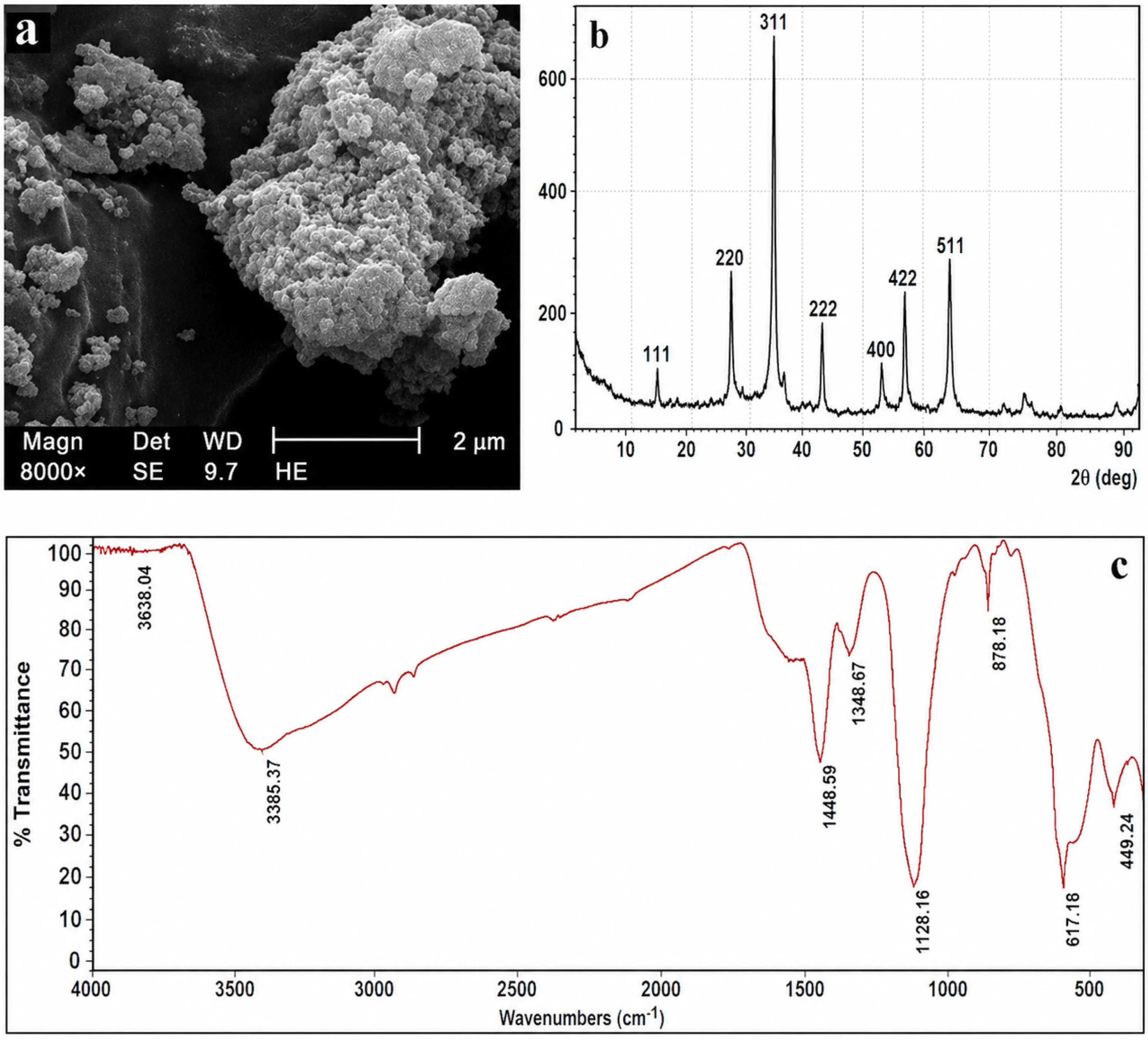
The morphology and surface characteristics of the synthesized magnetite particles were examined using scanning electron microscopy (SEM) Helios MX1 PFIB-SEM, Thermo Fisher Scientific, Waltham, MA, USA (Figure 2a). The crystalline structure and phase composition were analyzed by X-ray diffraction (XRD) using a Bruker D8 Advance diffractometer, Thermo Fisher Scientific, United States (Figure 2b). Fourier transform infrared spectroscopy (FT-IR, Nicolet Avatar 370, Thermo Fisher Scientific, United States) was employed to identify functional groups present in the catalyst by measuring infrared absorption over a range of wavelengths (Figure 2c). TCT concentrations were determined using a UV–Vis spectrophotometer (ELICO Double Beam SL 210 UV-Visible Spectrophotometer, ELICO Ltd. Hyderabad, India), and the corresponding results are provided in the results and discussion section.

3. Results and Discussions

3.1. Dark Experiments

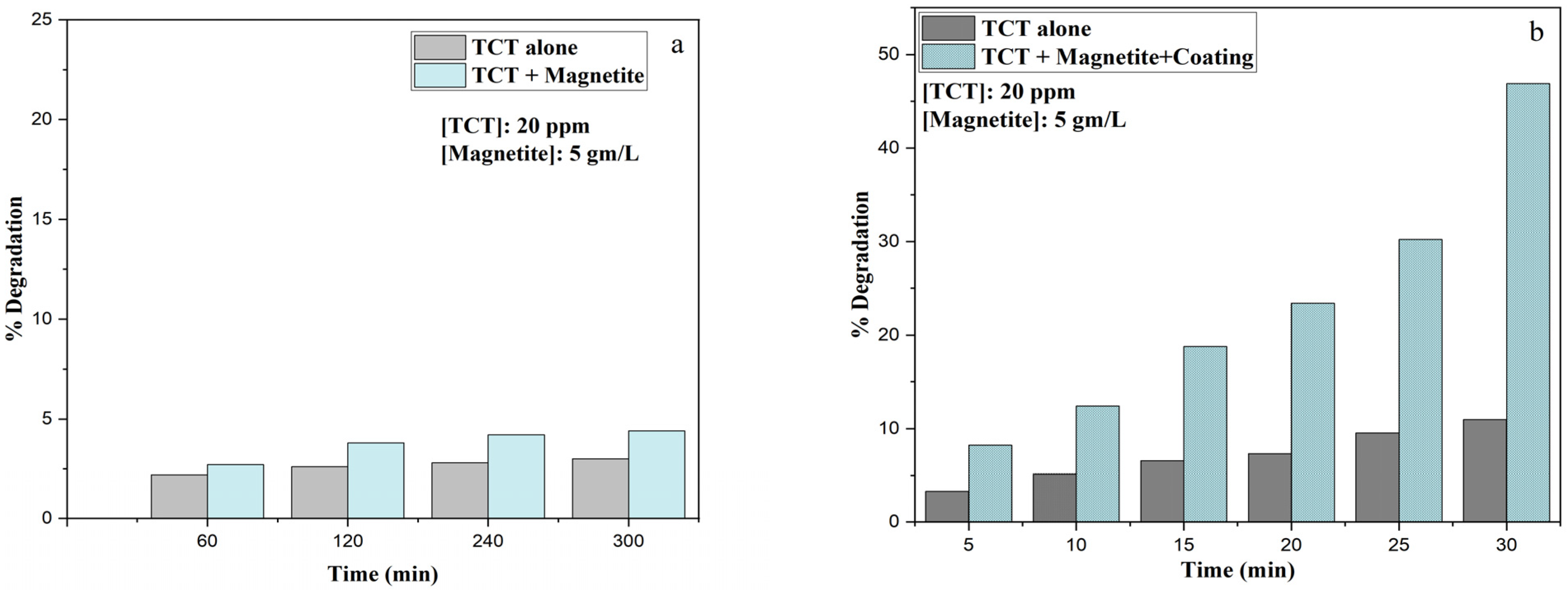
The degradation of 20 mg L−1 (ppm) TCT under dark conditions was investigated in the presence and absence of 5 g/L of magnetite catalyst for a duration of up to 300 min. The volume of the sample solution used in each experiment was 25 mL. The results indicated that no significant degradation of TCT occurred either in the presence or absence of the magnetite catalyst at room temperature under dark conditions. The slight decrease in TCT concentration observed over time was attributed to adsorption onto the catalyst surface rather than to chemical degradation [12], as illustrated in Figure 3a.

3.2. Solar Experiments

3.2.1. Effect of Light and Magnetite on the Degradation of TCT

The influence of solar irradiation on TCT degradation was evaluated under various conditions (Figure 3b). Solar photolysis alone resulted in limited TCT removal, indicating that sunlight acts primarily as an energy source rather than a direct degradation agent. In the presence of magnetite, a moderate enhancement in degradation was observed. Notably, when the magnetite catalyst was immobilized through surface coating, the degradation efficiency increased significantly, reaching 48% within 30 min. This improvement is attributed to enhanced light absorption, increased availability of active surface sites, and more efficient generation of hydroxyl (OH) radicals [13,14,15].

3.2.2. Effect of Fenton Reagent on Immobilized Catalyst

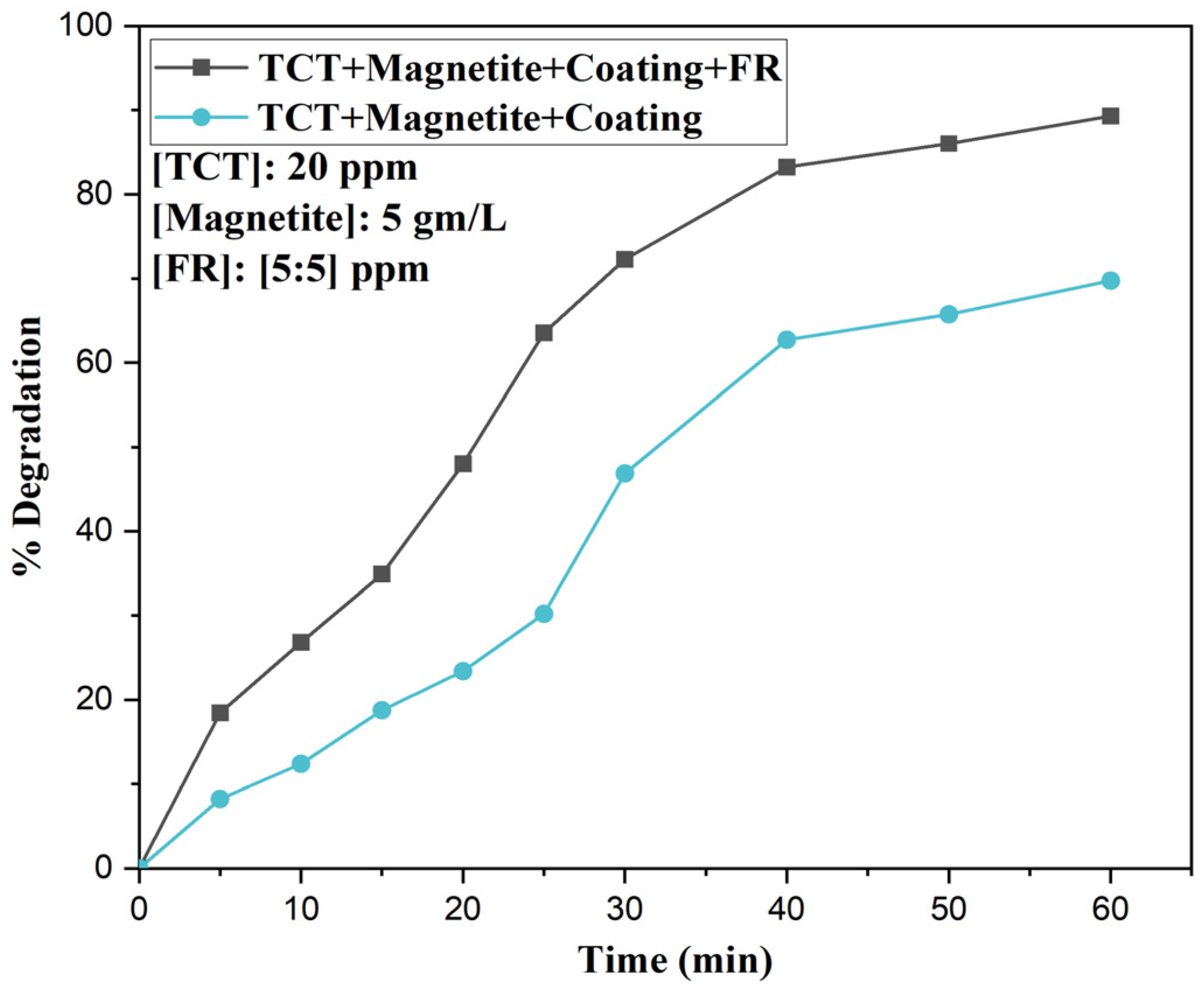
The photo-Fenton process is strongly influenced by H2O2 and iron concentrations and solution pH, as hydroxyl radical (OH) generation controls the reaction rate. H2O2 serves as the main OH source, while Fe3+ catalyzes its formation [16]. Degradation studies using an immobilized magnetite catalyst showed that adding Fenton reagent (FR) significantly enhanced TCT removal. For a 20 mg L−1 TCT solution with 5 g L−1 magnetite at an Fe2+:H2O2 ratio of 5:5 (ppm), the FR system (pH 3–4) achieved 89% and 100% degradation after 60 and 120 min, respectively, compared to 70% and 88% at natural pH (6.5) without FR. The improved performance is attributed to increased generation of reactive radicals (OH, HO2) via Fe2+/Fe3+–H2O2 reactions.
The enhanced degradation efficiency can be attributed to the increased availability of active catalytic sites, which facilitates more effective interactions between the photocatalyst and TCT molecules [14]. In the Fenton-assisted system, the Fe2+/Fe3+ redox cycle in the presence of H2O2 generates highly reactive hydroxyl (OH) and hydroperoxyl (HO2) radicals [16,17] with OH exhibiting a strong oxidation potential of approximately 2.0–2.8 V (E°). These reactive species effectively attack the aromatic rings of TCT, resulting in ring opening, formation of intermediate compounds, and subsequent mineralization into CO2 and H2O. Consequently, the Fenton-assisted system achieved complete (100%) TCT degradation, whereas only 88% degradation was observed in the absence of the Fenton reagent. The results are summarized in Figure 4.

3.2.3. UV–Visible Analysis and Reaction Kinetics of TCT

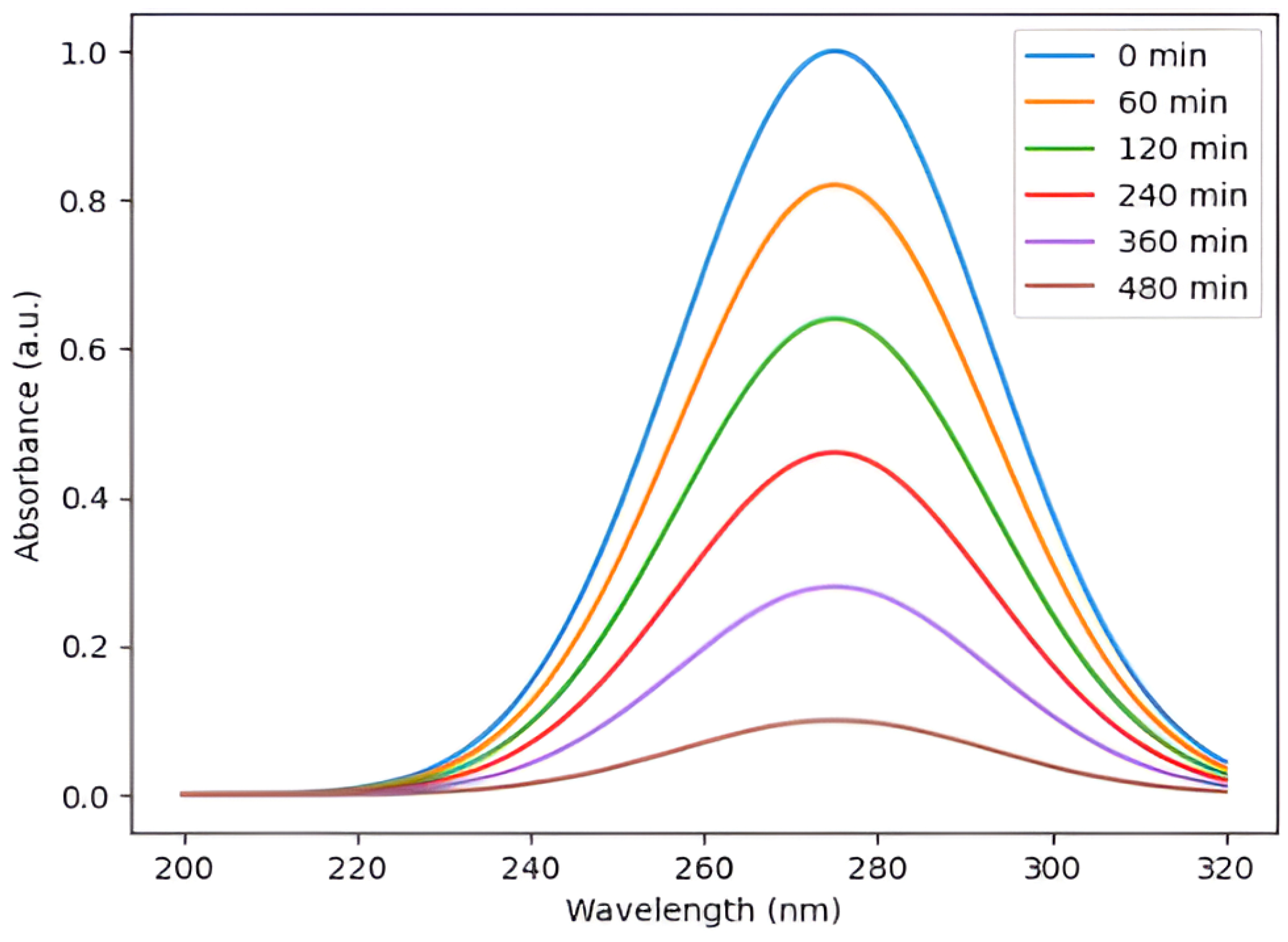
The UV–Vis absorption spectra of TCT recorded at different irradiation times during solar photocatalytic degradation is given in Figure 5. The characteristic absorption bands of TCT gradually decreased with increasing irradiation time, indicating the destruction of the conjugated chromophoric structure of the antibiotic. The continuous reduction in absorbance intensity confirms effective photocatalytic degradation rather than mere adsorption of TCT onto the catalyst surface.
The kinetic analysis and degradation pathway interpretation were conducted. In accordance with recent reports [18], the degradation data were fitted to a pseudo-first-order kinetic model, indicating that the reaction rate is governed by the availability of reactive oxygen species generated on the catalyst surface. The observed kinetic behavior supports a radical-mediated oxidation mechanism, in which hydroxyl radicals (OH) play a dominant role in the breakdown of the conjugated antibiotic structure, leading to progressive degradation and mineralization. The kinetics of degradation can also be explained in terms of the modified Langmuir–Hinshelwood model [19].
To place the kinetics of the photocatalytic performance of the present immobilized Fe3O4 system in context, a comparative evaluation with previously reported photocatalysts for antibiotic degradation was conducted. Table 1 summarizes representative Fe3O4-based and related photocatalytic systems reported in the literature, highlighting degradation efficiency, reaction time, light source, and key catalyst characteristics.

3.2.4. Effect of Cod on the Degradation of TCT

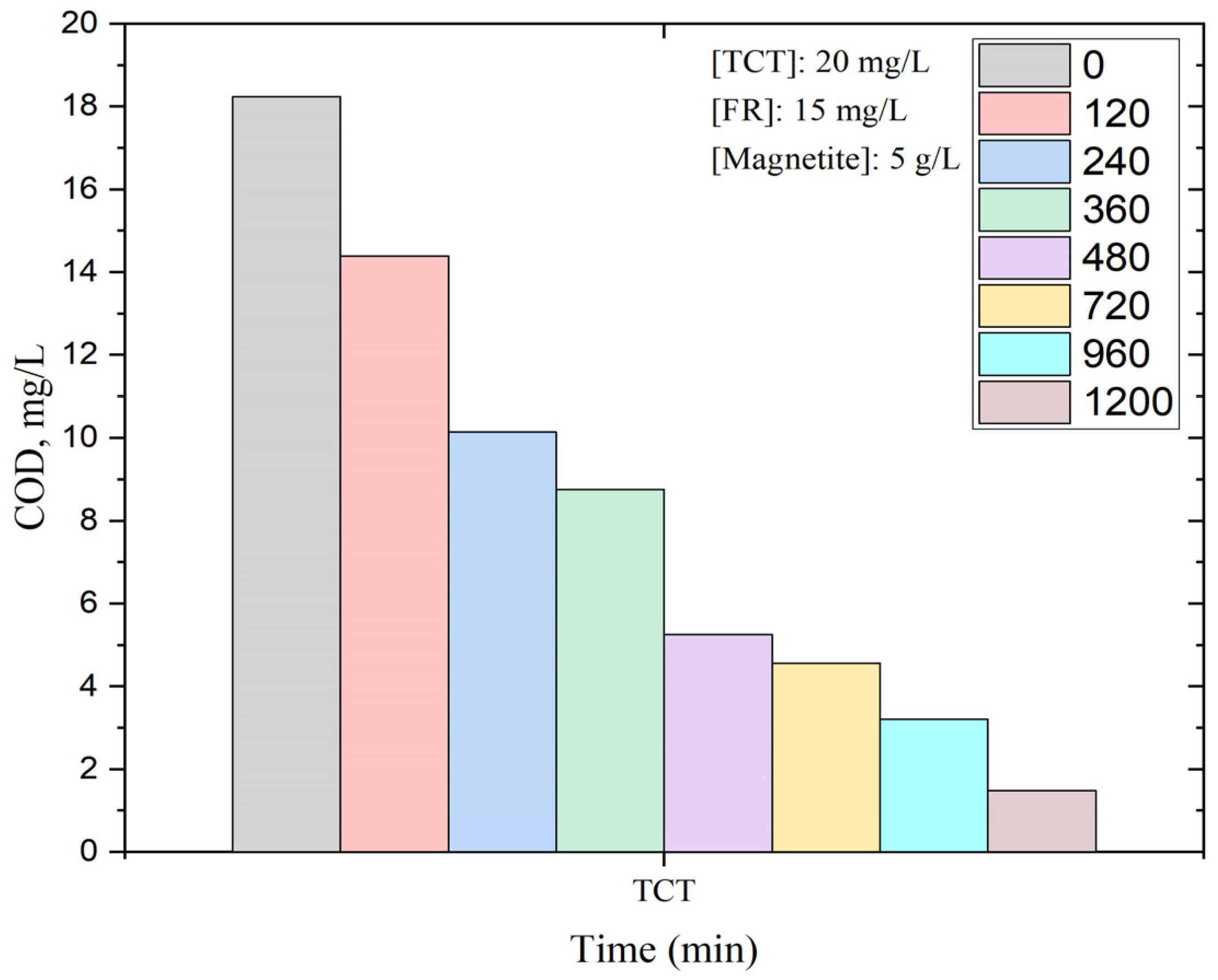
COD was used to evaluate the mineralization efficiency of the process, indicating the conversion of pollutants into benign end products such as CO2, H2O, and inorganic salts [16,19]. The COD was monitored at different time intervals during solar photocatalytic treatment which resulted in the formation of intermediates: the results are shown in Figure 6. Complete mineralization of the pollutant mixture was achieved after 1200 min in the presence of catalyst under solar irradiation.

3.2.5. Recycling of Used Catalyst

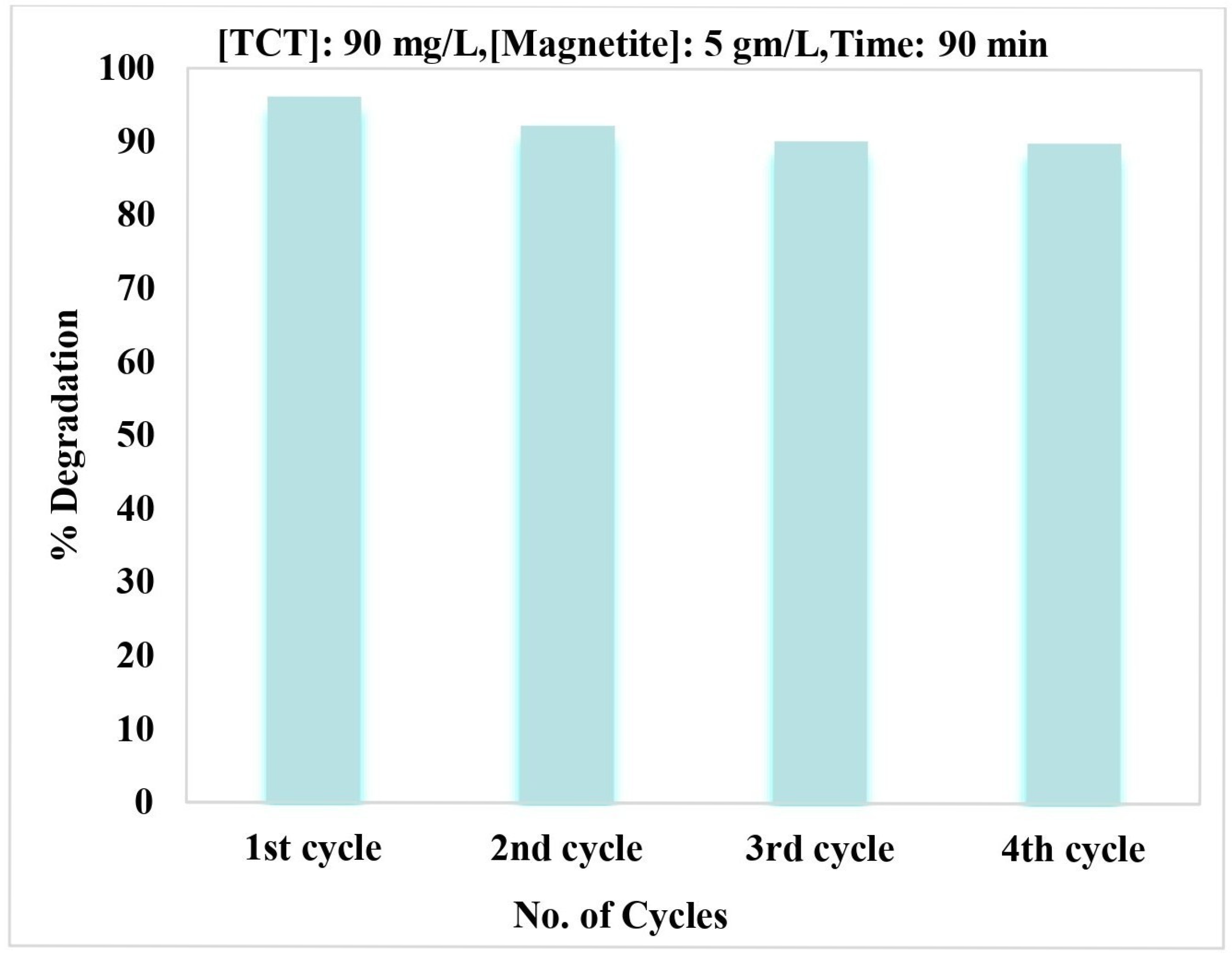
Catalyst reusability is a key factor for both economic and environmental sustainability [21,22]. After each reaction cycle, the used magnetite catalyst was magnetically separated, washed thoroughly with deionized water, and dried at 200 °C for 2 h prior to reuse. Recycling experiments conducted under identical optimal conditions demonstrated TCT degradation efficiencies of 96%, 92%, 90%, and 90% over four successive cycles under solar irradiation (Figure 7). The slight decline in degradation efficiency observed after repeated use indicates the good stability and reusability of the magnetite catalyst.

3.2.6. Photocatalytic Reaction Mechanism

Under solar irradiation, immobilized Fe3O4 absorbs visible light and generates electron–hole pairs. Fe3O4 absorbs visible components of solar light due to its narrow band gap, leading to the excitation of electrons from the valence band (VB) to the conduction band (CB, as indicated by Equation (1):
Fe3O4 + hν → eCB + hVB+
The photogenerated charge carriers initiate redox reactions at the catalyst surface.
The photogenerated electrons reduce dissolved oxygen to superoxide radicals (O2), while holes oxidize water or hydroxide ions to form hydroxyl radicals (OH) (Equations (2) and (3)). In the presence of Fenton reagent, Fe2+/Fe3+ redox cycling on the Fe3O4 surface accelerates H2O2 decomposition, producing additional OH radicals and significantly enhancing oxidative activity.
eCB + O2O2
hVB+ + H2O/OHOH
In the Fenton-assisted system, Fe2+/Fe3+ species present in magnetite catalyze hydrogen peroxide decomposition (Equation (4)):
Fe2+ + H2O2 → Fe3++ OH +OH
Solar irradiation further promotes the photoreduction of Fe3+ back to Fe2+, sustaining the catalytic cycle (Equation (5)):
Fe3+ + hν → Fe2+
This continuous Fe2/Fe3 redox cycling significantly enhances OH generation, explaining the higher degradation efficiency observed in the photo-Fenton system. TCT molecules adsorb onto the catalyst surface and are subsequently attacked by OH and O2 radicals, leading to hydroxylation, demethylation, and ring-opening reactions.
The intermediate compounds undergo further oxidation by ROS (Equation (6)), ultimately producing CO2, H2O, and inorganic ions, which is supported by the observed reduction in COD.
Intermediates + OH → CO2 + H2O + Inorganic products

4. Conclusions

This study demonstrates that solar-assisted photocatalysis using synthesized magnetite is an effective and sustainable approach for the degradation of TCT in aqueous systems. The immobilized magnetite catalyst exhibited favorable structural and morphological properties and efficiently generated reactive hydroxyl radicals responsible for pollutant degradation. Catalyst immobilization improved stability, reusability, and magnetic recoverability, while the incorporation of Fenton reagent significantly enhanced degradation efficiency. Overall, the magnetite-based solar photocatalytic system offers a cost-effective and environmentally friendly strategy for treating antibiotic-contaminated wastewater and shows strong potential for further optimization and scale-up applications.

Author Contributions

Conceptualization, P.V.G.; methodology, P.V.G.; validation, D.N.; formal analysis, S.M.G.; investigation, V.A., T.T., S.M.G., S.V. and T.S.; data curation, T.T.; writing—original draft preparation, V.A.; writing—review and editing, P.V.G. and D.N.; supervision, P.V.G. All authors have read and agreed to the published version of the manuscript.

Funding

This research received no external funding.

Institutional Review Board Statement

Not applicable.

Informed Consent Statement

Not applicable.

Data Availability Statement

The data presented in this study are available on request from the corresponding author.

Acknowledgments

All the authors gratefully acknowledge the technical and administrative support provided by SNGCE, Kadayiruppu, St Alberts College, Ernakulam and KUFOS, Puthuvype. The assistance received during experimental work and data analysis is sincerely appreciated.

Conflicts of Interest

All the authors declare no conflicts of interest.

References

  1. Mutua, F.; Sharma, G.; Grace, D.; Bandyopadhyay, S.; Shome, B.; Lindahl, J. A review of animal health and drug use practices in India, and their possible link to antimicrobial resistance. Antimicrob. Resist. Infect. Control 2020, 9, 103. [Google Scholar] [CrossRef]
  2. Halawa, E.M.; Fadel, M.; Al-Rabia, M.W.; Behairy, A.; Nouh, N.A.; Abdo, M.; Olga, R.; Fericean, L.; Atwa, A.M.; El-Nablaway, M.; et al. Antibiotic action and resistance: Updated review of mechanisms, spread, influencing factors, and alternative approaches for combating resistance. Front. Pharmacol. 2024, 14, 1305294. [Google Scholar] [CrossRef] [PubMed]
  3. Klein, E.Y.; Impalli, I.; Poleon, S.; Denoel, P.; Cipriano, M.; Van Boeckel, T.P.; Pecetta, S.; Bloom, D.E.; Nandi, A. Global trends in antibiotic consumption during 2016–2023 and future projections through 2030. Proc. Natl. Acad. Sci. USA 2024, 121, e2411919121. [Google Scholar] [CrossRef]
  4. Semenova, Y.; Makalkina, L.; Glushkova, N.; Gaipov, A. Tetracyclines in the Modern Era: Global Consumption, Antimicrobial Resistance, Environmental Occurrence, and Degradation Techniques. Antibiotics 2025, 14, 1183. [Google Scholar] [CrossRef]
  5. Chang, D.; Mao, Y.; Qiu, W.; Wu, Y.; Cai, B. The source and distribution of tetracycline antibiotics in China: A review. Toxics 2023, 11, 214. [Google Scholar] [CrossRef]
  6. Selvakumar, K.; Wang, Y.; Lu, Y.; Tian, B.; Zhang, Z.; Hu, J.; Raja, A.; Arunpandian, M.; Swaminathan, M.; Dai, H.; et al. Single metal atom oxide anchored Fe3O4-ED-rGO for highly efficient photodecomposition of antibiotic residues under visible light illumination. Appl. Catal. B Environ. 2022, 300, 120740. [Google Scholar] [CrossRef]
  7. Wang, S.; Zhao, X.; Liu, Z.; Yang, X.; Pang, B.; Gao, Y.; Zhou, R.; Xu, D.; Zhang, J.; Zhang, T.; et al. Violet phosphorus-Fe3O4 as a novel photocatalysis-self-Fenton system coupled with underwater bubble plasma to efficiently remove norfloxacin in water. Chem. Eng. J. 2023, 452, 139481. [Google Scholar] [CrossRef]
  8. Wu, C.; Guo, T.; Chen, Y.; Tian, Q.; Zhang, Y.; Huang, Z.; Hu, H.; Gan, T. Facile synthesis of excellent Fe3O4@ starch-derived carbon Photo-Fenton catalyst for tetracycline degradation: Rapid Fe3+/Fe2+ circulation under visible light condition. Sep. Purif. Technol. 2024, 329, 125174. [Google Scholar] [CrossRef]
  9. Matesun, J.; Petrik, L.; Musvoto, E.; Ayinde, W.; Ikumi, D. Limitations of wastewater treatment plants in removing trace anthropogenic biomarkers and future directions: A review. Ecotoxicol. Environ. Saf. 2024, 281, 116610. [Google Scholar] [CrossRef]
  10. Cuerda-Correa, E.M.; Alexandre-Franco, M.F.; Fernández-González, C. Advanced oxidation processes for the removal of antibiotics from water. An overview. Water 2019, 12, 102. [Google Scholar] [CrossRef]
  11. Qu, S.; Yang, H.; Ren, D.; Kan, S.; Zou, G.; Li, D.; Li, M. Magnetite nanoparticles prepared by precipitation from partially reduced ferric chloride aqueous solutions. J. Colloid Interface Sci. 1999, 215, 190–192. [Google Scholar] [CrossRef] [PubMed]
  12. Gayathri, P.V.; Nair, D.; Gopinath, G.; Pilla, D.; Joseph, S. Solar photocatalysis for the decontamination of water from emerging pharmaceutical pollutant chloroquine using nano ZnO as the catalyst. Water Air Soil Pollut. 2023, 234, 146. [Google Scholar] [CrossRef]
  13. Stella, R.J.; Sreevani, I.; Gurugubelli, T.R.; Ravikumar, R.V.S.S.N.; Koutavarapu, R. Enhanced solar light-driven photocatalytic degradation of tetracycline using Fe3+-doped CdO/ZnS nanocomposite: Mechanistic insights and performance evaluation. Catalysts 2023, 13, 1312. [Google Scholar] [CrossRef]
  14. Doosti, M.; Jahanshahi, R.; Laleh, S.; Sobhani, S.; Sansano, J.M. Solar light induced photocatalytic degradation of tetracycline in the presence of ZnO/NiFe2O4/Co3O4 as a new and highly efficient magnetically separable photocatalyst. Front. Chem. 2022, 10, 1013349. [Google Scholar] [CrossRef]
  15. Nasiri, A.; Tamaddon, F.; Mosslemin, M.H.; Amiri Gharaghani, M.; Asadipour, A. Magnetic nano-biocomposite CuFe2O4@ methylcellulose (MC) prepared as a new nano-photocatalyst for degradation of ciprofloxacin from aqueous solution. Environ. Health Eng. Manag. J. 2019, 6, 41–51. [Google Scholar] [CrossRef]
  16. Gayathri, P.V.; Joseph, S.; Yesodharan, S.; Yesodharan, E.P. Fenton and solar Fenton processes: Inexpensive green technologies for the decontamination of wastewater from toxic Rhodamine B dye pollutant. Water Pract. Technol. 2023, 18, 1938–1958. [Google Scholar] [CrossRef]
  17. Scaria, J.; Nidheesh, P.V. Magnetite–reduced graphene oxide nanocomposite as an efficient heterogeneous Fenton catalyst for the degradation of tetracycline antibiotics. Environ. Sci. Water Res. Technol. 2022, 8, 1261–1276. [Google Scholar] [CrossRef]
  18. Zhou, Z.; Zhao, S.; Li, Z.; Wang, P.; Zhan, S.; Wang, M. Activating Oxygen via the 3-Electron Pathway to Hydroxyl Radical by La−O4 Single-atom on WO3 for Water Purification. Angew. Chem. Int. Ed. 2025, 64, e202418122. [Google Scholar] [CrossRef] [PubMed]
  19. Gayathri, P.V.; Rayaroth, M.P.; Aravindakumar, C.T.; Pillai, D.; Joseph, S. SUNLIGHT-INDUCED decontamination of water from emerging pharmaceutical pollutants using ZnO nanoparticles. Chemosphere 2023, 343, 140265. [Google Scholar] [CrossRef]
  20. Kutuzova, A.; Dontsova, T.; Kwapinski, W. Application of TiO2-based photocatalysts to antibiotics degradation: Cases of sulfamethoxazole, trimethoprim and ciprofloxacin. Catalysts 2021, 11, 728. [Google Scholar] [CrossRef]
  21. Ariza Gonzalez, M.; Hoijang, S.; Tran, D.B.; Tran, Q.M.; Atik, R.; Islam, R.; Maparathne, S.; Wongthep, S.; Yarinia, R.; Amarasekara, R.; et al. Surface-Modified Magnetic Nanoparticles for Photocatalytic Degradation of Antibiotics in Wastewater: A Review. Appl. Sci. 2026, 16, 844. [Google Scholar] [CrossRef]
  22. Nair, D.; Gayathri, P.V.; Vandhana, T.V.; Praved, P.H.; Rayaroth, M.P.; Abdulaziz, A.; Gopinath, G. Occurrence and degradation of emerging antibiotic-resistant bacteria in riverine environment with sono, photo, and sonophotocatalytic oxidation under low-frequency ultrasound and sunlight. Photochem. Photobiol. Sci. 2025, 24, 1513–1532. [Google Scholar] [CrossRef]
Figure 1. (a) Magnetite powder obtained from the reaction of Fe2+ ions and OH ions. (b) Magnetite catalyst exposed to the magnet field of a magnet.
Engproc 117 00076 g001
Figure 2. (a) SEM image of the magnetite sample. (b) XRD spectra of the magnetite sample. (c) FTIR absorption spectra from the magnetite nanoparticle samples.
Engproc 117 00076 g002
Figure 3. (a) Effect of dark on the degradation of TCT. (b) Effect of sunlight and catalyst on the degradation of TCT.
Engproc 117 00076 g003
Figure 4. Effect of Fenton reagent on the degradation of TCT for 60 min in the presence of sunlight.
Engproc 117 00076 g004
Figure 5. UV–Vis absorption spectra of TCT (20 mg L−1) at different irradiation times during solar photocatalytic degradation in the presence of immobilized magnetite catalyst.
Engproc 117 00076 g005
Figure 6. COD reduction in TCT in presence of FR and magnetite under sunlight.
Engproc 117 00076 g006
Figure 7. Recycling of used magnetite under sunlight.
Engproc 117 00076 g007
Table 1. Comparing the photocatalytic degradation performance of the synthesized magnetite with previously published systems.
Catalyst SystemTarget
Antibiotic
Light SourceDegradation
Efficiency
Time (min)Key FeaturesReference
Immobilized Fe3O4Tetracycline HClSolar light~99%120Simple synthesis, solar-driven, magnetic recovery, reusableThis work
Fe3O4–ED–rGO (single-metal-atom oxide anchored)Antibiotic residuesVisible light>90%120Enhanced charge separation, visible-light activity[6]
Violet phosphorus–Fe3O4 (photocatalysis–self-Fenton)NorfloxacinVisible light + plasma~100%60Strong ROS generation, synergistic photo-Fenton effect[7]
Fe3O4@starch-derived carbon (photo-Fenton)TetracyclineVisible light>95%90Rapid Fe3+/Fe2+ cycling, high stability[8]
ZnO/NiFe2O4/Co3O4TetracyclineSolar light~92%120Magnetically separable composite[14]
TiO2-based photocatalystVarious antibioticsUV/solar~80–90%150–180Widely used benchmark photocatalyst[20]
Disclaimer/Publisher’s Note: The statements, opinions and data contained in all publications are solely those of the individual author(s) and contributor(s) and not of MDPI and/or the editor(s). MDPI and/or the editor(s) disclaim responsibility for any injury to people or property resulting from any ideas, methods, instructions or products referred to in the content.