1. Introduction
Increasing greenhouse gas emissions, particularly carbon dioxide (CO
2), remain one of the most pressing environmental challenges of modern industrial development [
1]. In parallel, the removal of acid gases such as hydrogen sulfide (H
2S) from natural gas streams is essential to meet product gas specifications and to ensure safe transportation, processing, and utilization [
2,
3]. The oil and gas sector, therefore, plays a central role in both emission mitigation and the advancement of cleaner processing pathways. Among the available gas treatment technologies, chemical solvent absorption has emerged as a robust and industry-proven method capable of selectively capturing CO
2 and H
2S, especially in cases where the feed gas contains relatively low concentrations of contaminants or when high-purity CO
2 recovery is required [
4,
5,
6].
Uzbekistan’s natural gas industry contributes significantly to national energy security and chemical production capacity. The Shurtan Gas Chemical Complex (SGCC) is one of the country’s largest facilities processing natural gas into pipeline-grade streams and feedstock for polymer and fertilizer production [
7]. Despite existing sour gas treatment infrastructure, a substantial fraction of separated CO
2 remains unused and is often vented into the atmosphere [
8]. At the same time, the Dehkanabad Potash Plant requires a continuous supply of high-purity CO
2 for sodium carbonate (Na
2CO
3) synthesis, where CO
2 acts as a critical reagent in the carbonation stage. Establishing an integrated separation and utilization pathway between these two facilities represents an opportunity to reduce atmospheric emissions while supporting domestic soda ash production, strengthening industrial self-sufficiency, and contributing to Uzbekistan’s broader circular economy and decarbonization ambitions.
Solvent-based absorption systems, particularly those employing amines and blended solvents, remain the most mature industrial solution for CO
2 and H
2S separation from natural gas streams [
9]. However, their performance is strongly dependent on thermodynamic behavior, reaction kinetics, temperature, regeneration conditions, and solvent circulation rate [
10,
11]. Traditional equilibrium-based modeling approaches often fail to accurately predict mass transfer behavior in packed absorption columns, especially when simultaneous removal of CO
2 and H
2S occurs [
12]. Rate-based modeling offers a more realistic representation of transport phenomena, making it particularly valuable for industrial-scale design, optimization, and energy evaluation.
Although chemical absorption technologies have been widely studied internationally, very limited research exists on CO
2 and H
2S separation tailored to the specific gas composition and operational realities of Uzbekistan’s industrial facilities [
1]. Current literature provides general performance and economic metrics for amine-based systems, yet regional studies rarely consider the full integration of gas purification with downstream chemical conversion processes such as the production of soda ash. Likewise, few analyses quantify regeneration energy demand and solvent performance using process simulation under realistic flow rates and purity requirements for large-scale application.
The novelty of the present study does not lie in the rate-based separation methodology itself, which is well established in the literature, but in its application to real industrial gas streams from the SGCC and the explicit integration of CO2 capture with downstream sodium carbonate production at the Dehkanabad Potash Plant. This regional, application-oriented integration represents a practical contribution toward industrial-scale carbon capture and utilization in Uzbekistan. The model does not simply evaluate separation efficiency but considers practical operational constraints, absorber and regenerator column behavior, solvent circulation optimization, and regeneration energy demand. By connecting gas purification with a defined industrial utilization pathway, this work moves beyond conventional separation studies and demonstrates a realistic blueprint for a carbon capture and utilization (CCU) chain within the Uzbek chemical sector.
In essence, this study aims to address the existing research gap by providing a scientifically grounded and industrially relevant framework for CO2 and H2S separation, purification, and reuse under local conditions. The findings contribute not only to the advancement of process modeling for sour gas treatment but also to the strategic implementation of CCU systems capable of reducing emissions while enhancing national industrial productivity. Through this approach, the work supports the long-term development of sustainable gas processing and value-added carbon utilization within Uzbekistan’s industrial ecosystem. The proposed CO2 capture and utilization pathway directly supports Uzbekistan’s national strategies on industrial modernization, emission reduction, and the development of a circular economy in the gas and chemical sectors.
2. Methodology
The separation process of CO2 and H2S from natural gas was modeled using Aspen Plus V12.0 with a chemical absorption–regeneration configuration. The simulation framework was constructed to reflect realistic industrial operating conditions at the SGCC, including feed composition, temperature, pressure, and targeted CO2 purity for downstream utilization. To evaluate model credibility, the predicted CO2 removal efficiencies and specific regeneration energy values were benchmarked against reported industrial and literature data for MEA-based sour gas treatment systems. The obtained results fall within commonly reported industrial ranges, supporting the validity of the simulated trends and confirming that the model provides a realistic representation of large-scale industrial behavior, despite the absence of site-specific operational data for full calibration. A rate-based column calculation approach was adopted to capture mass transfer behavior, interfacial phenomena, and reaction kinetics occurring between the gas and solvent phases.
The process simulation consisted of two main operational stages: absorption of CO2 and H2S from the feed stream into the solvent, followed by solvent regeneration in a desorber column. The raw feed gas contained 3.42% CO2 and 0.09% H2S, while a partially treated stream used in a second simulation case contained 2.1% CO2. In both scenarios, the pressure and flow rates were set according to industrially representative data reported for SGCC operations. The absorber was modeled at a controlled temperature range of 40–45 °C to maintain favorable absorption kinetics, whereas the regenerator operated at elevated temperature to release absorbed gases and restore solvent capacity. Packed column geometry, tray efficiency, and contact area parameters were selected based on commonly applied industrial packing specifications and adjusted according to Aspen packing database properties.
The thermodynamic behavior of the system was represented using the Electrolyte Non-Random Two-Liquid (ELECNRTL) model, which is widely accepted for amine-based solvent systems due to its ability to account for ion formation, electrolyte equilibria, and non-ideal phase interactions. Reaction kinetics for CO2 and H2S absorption were incorporated using Aspen Plus built-in rate-based reaction libraries. The model includes the dominant chemical reactions governing amine-based sour gas treatment systems, such as CO2 hydration, bicarbonate formation, carbamate formation, and protonation reactions, as well as the corresponding acid–base reactions for H2S absorption. The kinetic parameters were adopted directly from the Aspen Plus database, which is based on extensively validated experimental literature. The model was not calibrated using site-specific industrial operational data due to limited data availability; instead, model credibility was assessed by benchmarking predicted removal efficiencies and regeneration energy values against widely reported industrial and literature ranges. These parameters were applied without modification and within their recommended operating ranges, ensuring consistency with established industrial modeling practice. Sensitivity analysis was performed to evaluate the influence of solvent flow rate, absorber temperature, packing height, and regenerator duty on overall separation efficiency.
Solvent selection was guided by industrial applicability, chemical stability, regeneration potential, and corrosion characteristics. Preliminary simulations were conducted using several amine-based solvent systems (monoethanolamine (MEA), diethanolamine (DEA), methyldiethanolamine (MDEA), and blended solvents) commonly applied in industrial sour gas treatment. Based on comparative performance in terms of CO
2 and H
2S removal efficiency, regeneration energy demand, and technological maturity, an aqueous MEA solution was selected for detailed rate-based modeling. MEA was chosen due to its well-documented reaction kinetics, availability of validated thermodynamic and kinetic parameters, and widespread industrial use, which enables meaningful comparison with reported literature and operational benchmarks (
Table 1). The solvent concentration was selected within a typical industrial range to balance absorption capacity and regeneration energy consumption. A steady-state simulation mode was used to reflect continuous industrial processing conditions, and convergence settings were refined to maintain numerical stability during rate-based mass transfer calculations.
The purified CO2 stream generated from the regenerator overhead was analyzed in terms of purity, flow rate, and suitability for use in sodium carbonate production at the Dehkanabad Potash Plant. The regeneration energy requirement was evaluated as a key metric reflecting feasibility and economic performance. Benchmark values from industrial literature were used as reference to determine alignment with energy-efficient operation.
Process performance was assessed using three primary indicators: CO2 and H2S removal efficiency at the absorber outlet, regenerated CO2 purity after stripping, and specific energy demand per ton of recovered CO2. Additional secondary indicators, including solvent recirculation rate, column temperature gradient, and solvent loading capacity, were reviewed to support a comprehensive operational evaluation.
3. Results and Discussion
In this section, the main separation performance results, energy requirements, and sensitivity analyses are presented and interpreted in the context of industrial operation and CCU integration.
The rate-based Aspen Plus simulations showed that the proposed absorption–regeneration system can reliably remove both CO2 and H2S from the sour gas streams originating from the SGCC, while simultaneously delivering a high-purity CO2 product suitable for downstream utilization at the Dehkanabad Potash Plant.
3.1. Absorber Performance and Removal Efficiencies
Under the baseline operating conditions, with absorber temperature maintained in the range of 40–45 °C and optimized solvent circulation rate, the model predicted a CO2 removal efficiency of approximately 98.6% and an H2S removal efficiency close to 99.9%. These values were obtained for the raw gas case with an inlet composition of 3.42% CO2 and 0.09% H2S, and they remained within a similar range when the partially treated gas stream containing 2.1% CO2 was simulated. The high H2S removal at the lower section of the absorber reflects the strong chemical affinity and faster reaction kinetics of H2S with the solvent compared to CO2, which is consistent with typical amine-based sour gas treatment behavior.
The internal column profiles illustrate the coupled thermal and concentration effects associated with chemical absorption. As the sour gas enters the bottom section of the packed absorber and contacts the lean solvent, exothermic reactions between CO2/H2S and the active solvent components generate a local temperature rise in the lower and mid sections of the column. This temperature bulge is accompanied by a rapid drop in H2S molar fraction and a more gradual decrease in CO2 along the packing height. Toward the top of the column, the temperature approaches the inlet solvent temperature and the remaining gas-phase CO2 approaches its treated specification.
A quantitative summary of the main separation indicators is given in
Table 2.
The results show that the absorber delivers a treated gas that comfortably satisfies typical pipeline and downstream process specifications, and produces a rich solvent stream with sufficiently high acid gas loading to make regeneration energetically meaningful.
3.2. Regeneration Behavior and Energy Demand
The regenerator column performance is crucial for both the energy efficiency and the economic feasibility of the separation process. The specific energy requirement for solvent regeneration was estimated at approximately 2.3 GJ per ton of CO2. This value represents the reboiler duty required to release absorbed acid gases and regenerate the solvent and implicitly includes sensible and latent heat contributions associated with solvent heating and vaporization. Auxiliary energy demands such as pumping power and compression were not explicitly considered in the present analysis. This specific energy requirement falls within the lower range of values reported for industrial chemical absorption systems and is significantly lower than conventional benchmark values often cited for MEA systems, which can approach 3.5–4.0 GJ per ton of CO2.
Inside the regenerator, the temperature profile exhibits the characteristic behavior of a stripping column. The bottom section, where the reboiler supplies heat, maintains the highest temperature, providing the driving force for solvent desorption. As vapor rises through the packing and contacts the rich solvent descending from the absorber, CO2 and residual H2S are transferred to the vapor phase, while the solvent gradually becomes leaner. The CO2 mole fraction in the vapor phase increases toward the top of the column, where the product stream is withdrawn, while the temperature decreases due to heat loss and vapor–liquid equilibrium effects.
The purified CO2 stream leaving the regenerator achieved a modeled purity of at least 99.5%. During regeneration, H2S is co-stripped with CO2 and remains in the acid gas overhead stream; therefore, additional downstream treatment such as sulfur recovery or neutralization would be required to meet environmental and safety standards. This high purity is essential for its application in sodium carbonate production, where impurities such as H2S and heavy hydrocarbons can negatively affect product quality and equipment integrity.
The main regeneration and product quality parameters are summarized in
Table 3.
The slightly lower energy demand in the 20 t/h case reflects reduced solvent circulation and lower overall acid gas load, while maintaining essentially identical product quality. This behavior indicates that the system can be flexibly adjusted to match different CO2 supply requirements without incurring significant performance penalties.
3.3. Sensitivity Analysis and Process Optimization
To understand how operational decisions influence performance and to identify realistic optimization levers, a sensitivity analysis was conducted on solvent circulation rate, absorber temperature, packing height, and reboiler duty. The results show that solvent circulation rate is the dominant parameter affecting CO2 removal efficiency and, indirectly, energy demand.
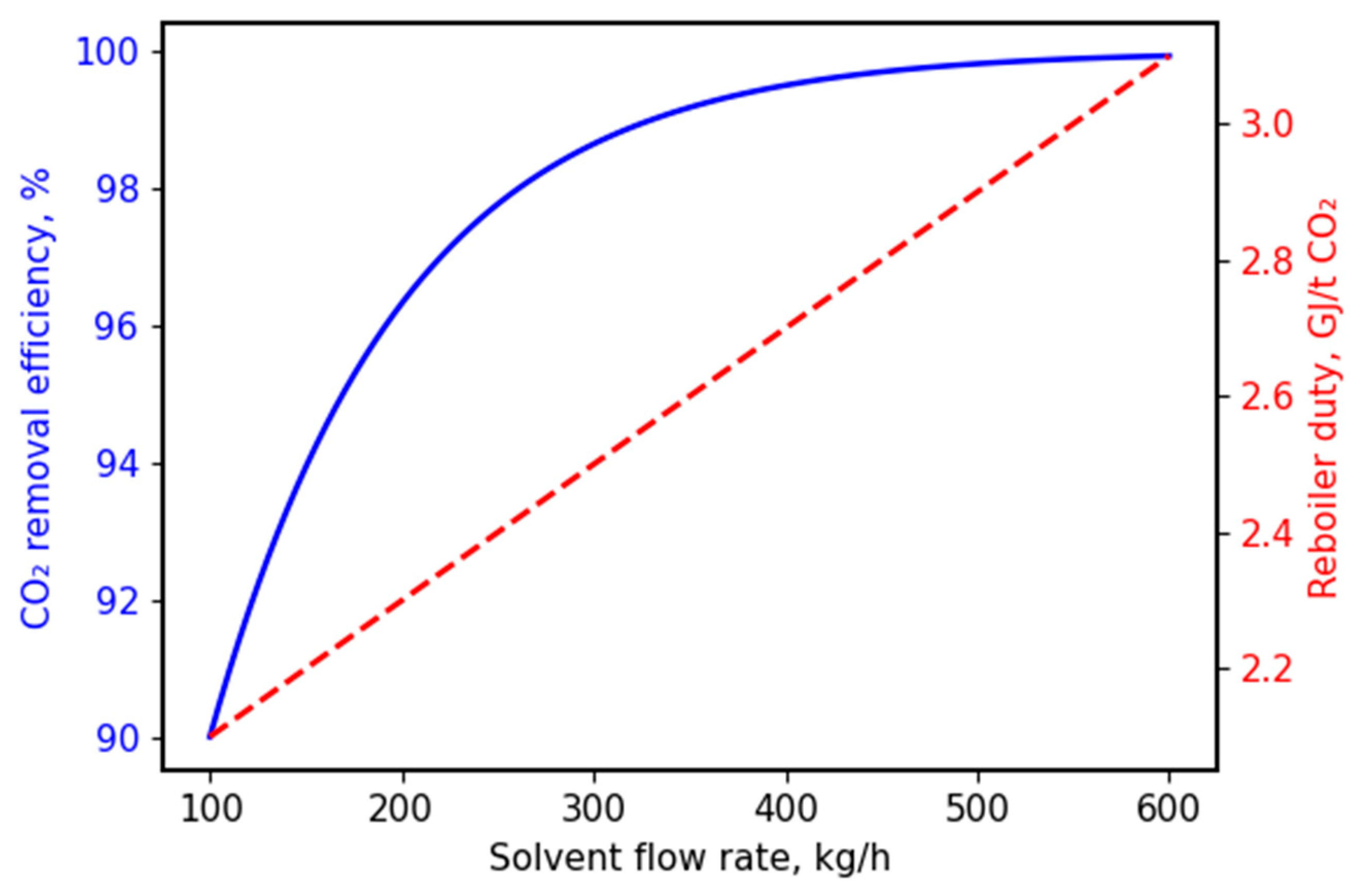
At low solvent flow rates, the gas–liquid contact is insufficient to achieve the targeted CO2 removal, leading to higher residual CO2 in the treated gas. As the solvent flow increases, removal efficiency improves sharply because more reactive capacity is available and the driving force for mass transfer is enhanced. However, beyond a certain point, further increases in solvent flow yield only marginal gains in CO2 removal, while the reboiler duty rises almost proportionally due to the increased solvent mass that must be heated and stripped. This trade-off defines an economically optimal window for solvent circulation.
Figure 1 demonstrates an asymptotic increase in CO
2 removal efficiency with increasing solvent circulation rate, while the specific reboiler duty increases almost linearly. At low solvent flow rates, mass transfer limitations dominate and removal efficiency rises sharply. However, beyond a certain circulation rate, the absorber approaches its effective mass transfer limit and further increases in solvent flow result in only marginal gains in CO
2 removal, accompanied by a disproportionate increase in regeneration energy demand. This behavior clearly identifies an optimal operating region in which high separation efficiency can be achieved without excessive energy penalties.
Absorber temperature had a measurable but secondary effect within the studied range. Lower temperatures favor CO2 absorption by increasing solubility and shifting equilibrium toward the loaded solvent, but excessively low temperatures can increase solvent viscosity and pumping demand. Higher temperatures improve reaction kinetics but reduce solubility. The simulations confirmed that operating around 40–45 °C achieves a reasonable compromise between kinetics and equilibrium for the modeled system.
Packing height also influences performance. Increasing the packing height expands the contact surface area and residence time, enhancing mass transfer and allowing the system to approach equilibrium more closely. In the present study, raising the packing height above approximately 12 m produced only minor gains in CO2 removal, indicating that the column was already close to its effective design limit. This result suggests that, for the given gas composition and flow rates, further increasing column height would not be justified from a cost–benefit perspective. The analysis demonstrates that the process offers sufficient operational flexibility to adapt to varying feed and product requirements, provided that solvent flow and energy input are carefully managed. These insights are valuable for future scale-up, control strategy development, and integration with plant utility systems.
3.4. Integration with Sodium Carbonate Production and CCU Implications
A central objective of this study was to evaluate whether the captured CO
2 stream can realistically supply the Dehkanabad Potash Plant for sodium carbonate production. The simulation results show that CO
2 purities above 99.5% and flow rates of 20–30 t/h can be achieved with energy demands consistent with modern industrial benchmarks. According to the process data used in this work, a CO
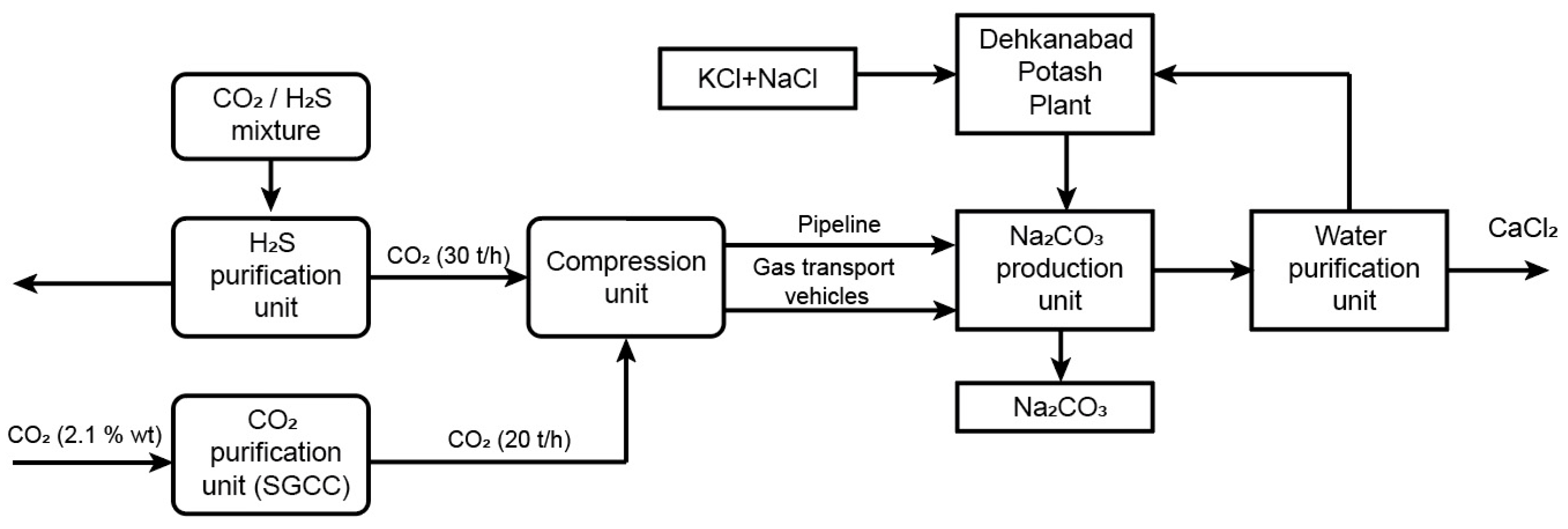
2 supply of around 20 t/h enables the production of approximately 296,000 t/y of calcined soda at an overall process efficiency of about 77%. The modeled separation system thus provides a technically viable upstream CO
2 source that is well aligned with the downstream plant’s consumption needs (
Figure 2).
This integration transforms CO2 from an unwanted by-product of gas processing into a valuable feedstock for chemical production, reducing direct CO2 emissions from the gas complex while displacing alternative CO2 sources or imported soda ash. In a broader perspective, such coupling of gas treatment and chemical manufacturing contributes to the formation of an industrial symbiosis network and supports the development of a circular carbon economy in Uzbekistan. The relatively low regeneration energy demand is particularly important in this context, since it helps to ensure that the climate benefits of CO2 capture and utilization are not offset by excessive energy consumption.
3.5. Practical Application Challenges
Despite the promising simulation results, several challenges must be addressed prior to industrial implementation. These include long-term solvent degradation due to thermal and oxidative effects, corrosion risks associated with acid gas loading, and potential foaming or scaling under variable feed compositions. In addition, solvent losses and impurity accumulation may affect operational stability. These factors highlight the need for pilot-scale testing, solvent management strategies, and appropriate material selection before full-scale deployment.
The simulation framework developed in this study can also serve as a decision-support tool for future CCU planning. By adjusting feed composition, target flow rate, and energy prices, operators and policymakers can evaluate different integration scenarios, estimate operational costs, and compare the proposed configuration with alternative capture technologies such as physical solvents or hybrid systems.
4. Conclusions
This study developed a rate-based Aspen Plus simulation to evaluate the separation of CO2 and H2S from sour gas streams originating from the SGCC and assessed the feasibility of supplying high-purity CO2 to the Dehkanabad Potash Plant for sodium carbonate production. The results demonstrated that under optimized solvent flow and absorber operating conditions, the process can achieve 98.6% CO2 removal and more than 99.9% H2S elimination. The regenerator delivered a CO2 product purity exceeding 99.5%, suitable for chemical conversion applications. The estimated regeneration energy (2.3 GJ per ton of CO2) falls within competitive industrial ranges, indicating that solvent-based chemical absorption remains a viable solution for large-scale deployment in Uzbekistan’s gas and chemical sectors. The integration of this separation system with soda ash production provides a meaningful pathway to reduce emissions while generating value-added products, supporting national efforts toward circular carbon utilization.
Although the simulation confirmed the technical potential of the proposed system, further investigation is required to transition from modeling to industrial implementation. Future work should include dynamic simulation and process control development to evaluate operational stability under fluctuating feed conditions. Pilot-scale testing will be necessary to assess solvent degradation, corrosion behavior, foaming, and long-term operational reliability. A comprehensive techno-economic analysis, including capital cost estimation and lifecycle assessment, is outside the scope of this proceedings paper and will be addressed in future extended studies. Additional research could explore alternative solvent blends, hybrid absorption–membrane systems, or partial-regeneration strategies to further reduce energy consumption. These next steps will support the advancement of a scalable, efficient, and economically competitive CO2 capture and utilization framework for Uzbekistan’s industrial ecosystem.
The proposed separation and utilization scheme aligns with Uzbekistan’s national strategies on emission reduction, industrial modernization, and efficient utilization of domestic resources, supporting the transition toward a circular carbon economy in the chemical and gas processing sectors.




 ,
,