Proceeding Paper

Hydrophobic-to-Hydrophilic Transition of Polyethylene Surface via Salicylic Acid Grafting †

by
Ana Luisa Grafia
* and
Silvia Elena Barbosa
Planta Piloto de Ingeniería Química (PLAPIQUI), CONICET, Universidad Nacional del Sur (UNS), Bahía Blanca 8000, Argentina
*
Author to whom correspondence should be addressed.
Presented at the 4th International Electronic Conference on Processes, 20–22 October 2025; Available online: https://sciforum.net/event/ECP2025.
Eng. Proc. 2025, 117(1), 40; https://doi.org/10.3390/engproc2025117040
Published: 30 January 2026
(This article belongs to the Proceedings of The 4th International Electronic Conference on Processes)

Abstract

Polyethylene is widely used in flexible packaging, but its hydrophobic and inert surface limits its compatibility with environmentally friendly water-based inks and paints. Conventional methods improve wettability only temporarily and with limited control. Here, we introduce a surface functionalization method in which salicylic acid is grafted onto polyethylene films through an aluminum-mediated alkylation process compatible with continuous film processing. Infrared-softened polyethylene films were sequentially sprayed with AlCl3 and salicylic acid. Reaction occurrence was confirmed by chemical and morphological analyses, revealing the in situ formation of aluminum salicylate complexes anchored to the polyethylene surface. Wettability tests demonstrated enhanced compatibility with water-based paints.

Graphical Abstract

1. Introduction

Polyethylene (PE) has an excellent balance of cost, performance, and sustainability; hence, it is one of the most widely used thermoplastics worldwide. However, its hydrophobic surface limits its suitability for applications requiring adhesion, such as printing, painting, and lamination—particularly important in flexible packaging [1,2]. This limitation has become increasingly critical as sustainability pressures drive the packaging industry to adopt environmentally friendly, water-based inks and paints. [3].
Surface modification provides a means of improving PE wettability while preserving its bulk properties by restricting chemical change to a thin outer layer. However, many commonly used treatments, such as corona and plasma discharge, remain difficult to control, lack molecular specificity, and often produce effects that are temporary or poorly tailored to the desired chemistry [1,2,4,5].
An emerging alternative approach is through UV-based photochemical surface modification. In this method, ultraviolet radiation activates the polymer surface or promotes photooxidation, enabling the introduction of polar functional groups or the grafting of selected molecules with a high degree of chemical control. Such techniques have been applied in areas requiring precise surface functionalization, including biomedical devices, microelectronics, and advanced coatings. However, their industrial implementation remains selective due to several inherent limitations, such as extremely shallow modification depths, line-of-sight constraints that hinder uniform treatment of complex geometries, limited processing speeds, and the potential for polymer degradation under high UV doses [6,7,8]
A controlled, robustand effective alternative involves the surface chemical grafting of selected functional molecules, enabling well-defined modifications and the introduction of chemical groups capable of improving surface polarity or serving as anchoring sites for additional species [1,2]. Particularly valuable are modification strategies that can be integrated into continuous polymer-processing operations, such as blown-film or cast-film extrusion.
Within this context, salicylic acid (SA) is an especially attractive grafting agent for PE surfaces. Compared to benzoic acid—which we successfully grafted onto PE films in prior work [9]—SA exhibits higher polarity and greater chemical reactivity due to the simultaneous presence of phenolic and carboxylic functional groups. These features not only enhance its ability to increase surface hydrophilicity but also promote stronger coordination with Lewis-acid catalysts. In parallel, Friedel–Crafts alkylation, mediated by aluminum chloride (AlCl3), is a well-established route for grafting aromatic compounds onto hydrocarbon chains [10], and multiple studies have demonstrated the feasibility of chemically bonding polyethylene segments to aromatic rings via electrophilic substitution [11,12,13,14].
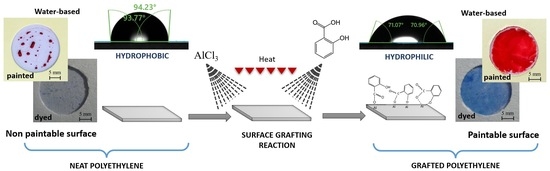
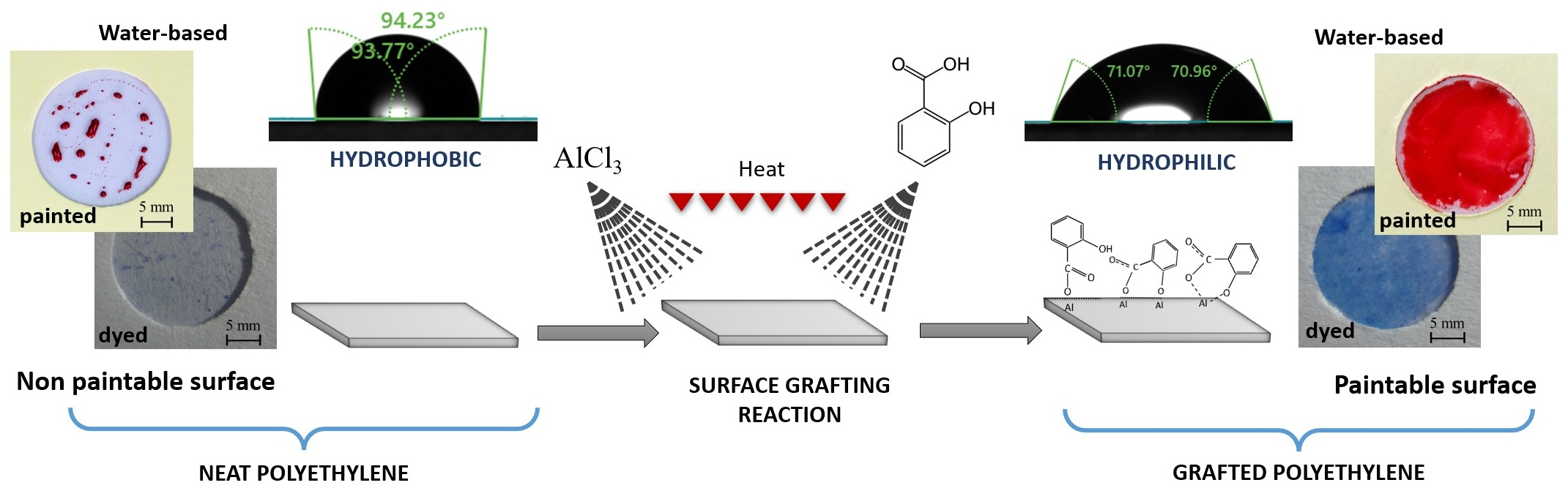
Building on these insights, this work aims to transform the PE surface from hydrophobic to hydrophilic by grafting SA onto PE films through an aluminum-mediated reaction applied by spray deposition onto infrared-softened surfaces. This strategy has the potential to be implemented in continuous processing lines and, critically, enables the effective use of eco-friendly, water-based inks and paints on PE substrates.

2. Materials and Methods

2.1. Materials

Blown PE films (80 µm thick) produced from LDPE 203 were supplied by Dow Polisur (Mw = 229,300 g/mol; Mn = 22,500 g/mol). Salicylic acid (SA, ACS grade) and anhydrous aluminum chloride (AlCl3, ≥98% purity) were obtained from Merck, Saint Louis, MO, USA and used as received. N-heptane and absolute ethanol (≥99.5% purity), supplied by Cicarelli from Buenos Aires, Argentina served as solvents. Distilled water was employed for contact angle measurements. A commercial red watercolor from Giotto, Irvine, Italy, (prepared at 0.37 g of dry paint per mL of water) and a methylene blue solution (40 g/L) from Biopack, Buenos Aires, Argentina, were used for wettability and dyeing tests.

2.2. Reaction Experiment

Squares of PE film (15 × 15 cm) were softened at approximately 95 °C using an infrared heating system, a temperature previously shown to soften the polymer surface without reaching a bulk melting [6]. This softened surface was modified using an artistic airbrush, operated at a working distance of 15 cm, using dry compressed air at 3 bar and a flow rate of 6 mL/min. First, a suspension containing 155 mg of AlCl3 in 25 mL of n-heptane was applied, followed by a solution of 500 mg of SA in 25 mL of absolute ethanol, whose pH had been adjusted to 3 with HCl. To remove unreacted species and non-grafted residues, 5 × 5 cm portions of the treated films were subjected to extraction in 200 mL of absolute ethanol under ultrasonic agitation for 2 h. At the end of the extraction process, the temperature of the ethanol bath reached approximately 40 °C. Salicylic acid exhibits very high solubility in ethanol, about 276 g·L−1 at 25 °C, which further increases with temperature to approximately 527 g·L−1 at 40 °C [15]. Accordingly, in 200 mL of ethanol, the solubilization capacity for salicylic acid ranges between 55.2 and 105.4 g, which is more than 1000 and 2000 times the amount of salicylic acid applied during the reaction step for the film portion subjected to extraction. The treated samples were subsequently dried under an extractor hood for 48 h. The resulting materials are referred to as PE-SA. For reproducibility purposes, the reaction experiment was independently repeated at least five times under identical experimental conditions.

2.3. Characterization

The characterization was performed on all samples obtained from the repeated reaction experiments. For each sample, measurements and analyses were conducted on at least three different areas to account for surface heterogeneity and to ensure reproducibility.
Reaction occurrence and reaction products were studied by Fourier Transform Infrared Spectroscopy (FTIR) using a Nicolet 520 instrument (Thermo Fisher, Madison, WI, USA) equipped with an Attenuated Total Reflection (ATR) accessory and operated at a resolution of 4 cm−1. Spectra were recorded directly on the films, averaging 100 scans per measurement.
The elemental composition of the film surfaces was examined by Energy-Dispersive X-ray Spectroscopy (EDX) using a JEOL-35CF scanning electron microscope (JEOL Ltd., Akishima, Japan) coupled to an EDAX DX4 detector (EDAX, Mahwah, NJ, USA), capable of identifying elements from B to U with an approximate interaction depth of 1 μm.
Surface morphology was evaluated through optical microscopy (OM) employing a Zeiss Phomi III POL microscope (Jena, Germany) in transmission mode, and through scanning electron microscopy (SEM) using a LEO EVO-40XVP system. Prior to SEM imaging, the samples were sputter-coated with gold using a PELCO 91000 (Ted Pella, Redding, CA, USA) coater.
Compatibility with water-based systems was assessed through a combination of wettability and paintability tests. Static contact angle measurements were obtained via the sessile drop method using an OCA-15 goniometer (DataPhysics, Filderstadt, Germany). More than ten droplets of 4 µL of distilled water were deposited on different regions of PE and PE-SA films under controlled conditions (25 °C, 50% RH). A qualitative evaluation of paintability was performed by immersing both pristine PE and PE-SA samples in a methylene blue solution and by applying watercolors with a soft brush. After painting, watercolor-coated films were blotted with absorbent paper to assess paint adhesion once dried. Paint coverage was analyzed through direct visual inspection and documented by photography.
To evaluate long-term stability, surface properties related to compatibility with water-based systems—including water contact angle, dyeability, and paintability—were remeasured on samples stored for ten years in a closed office cabinet under ambient conditions.

3. Results and Discussion

3.1. Evaluation of Reaction Occurrence

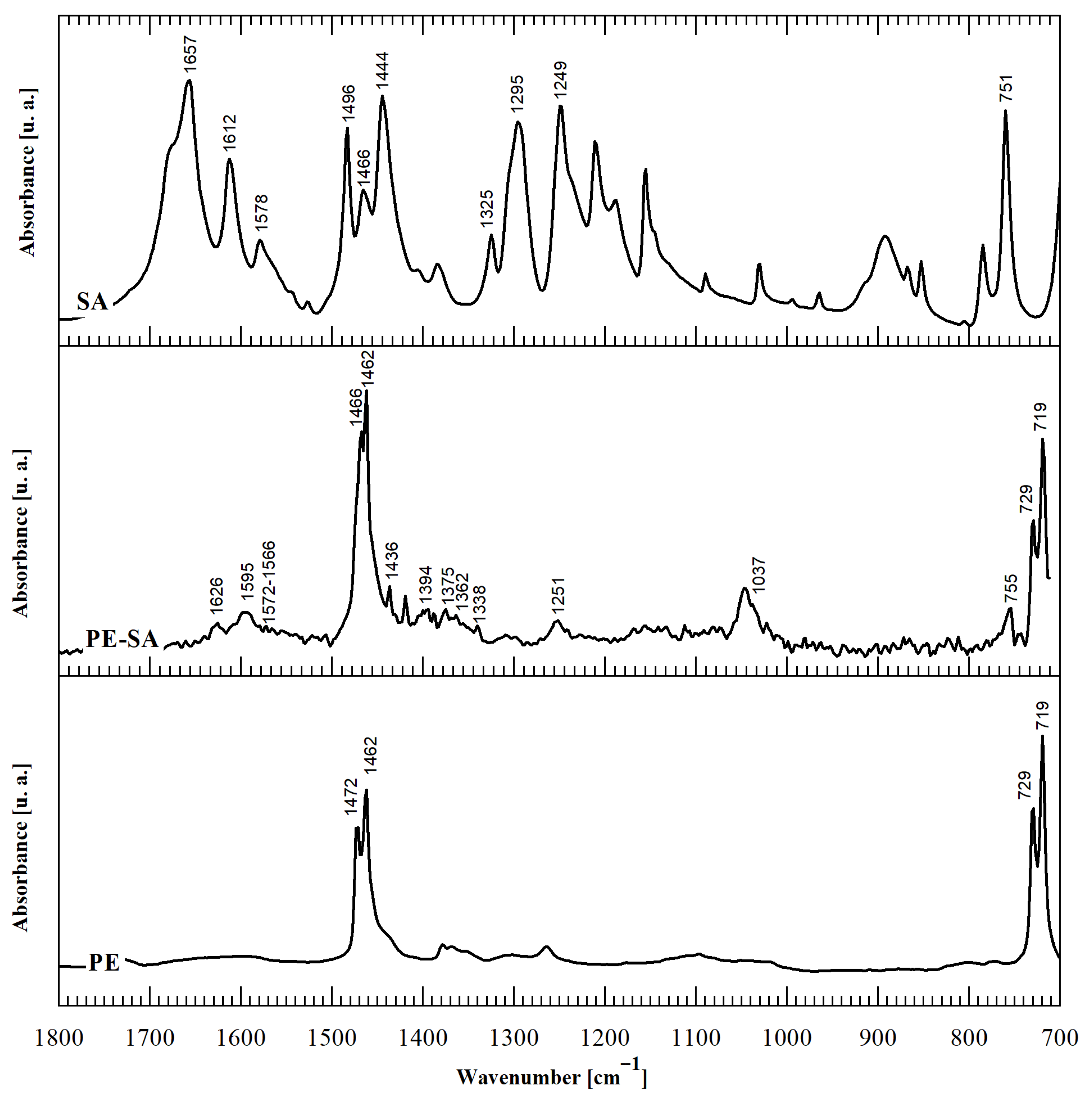
To investigate the chemical nature of the reaction products, FTIR-ATR measurements were conducted. Figure 1 compares the spectra of PE-SA with those of pristine PE and pure SA, while the principal band assignments are compiled in Table 1. Alongside the characteristic absorption bands of polyethylene [16], the modified PE-SA films display additional signals associated with the newly formed species, most notably within the 1700–700 cm−1 region.
The aromatic character of the grafted species is evidenced by the absorption band at 1466 cm−1, which corresponds to the in-plane C=C stretching vibration of an aromatic ring [17]. Several characteristic SA bands exhibit shifts after grafting. For example, the band at 1251 cm−1 in PE-SA, compared with 1249 cm−1 in SA, is attributed to the aromatic O–H stretching vibration [18,19]. Likewise, the band at 755 cm−1 in PE-SA, relative to 751 cm−1 in SA, corresponds to the C–H out-of-plane deformation typical of monosubstituted aromatic rings [20,21]. A more notable change is the disappearance of the salicylic acid bands associated with the carboxyl group—located at 1657, 1325, and 1295 cm−1 [22,23]—which suggests that grafting proceeded through the acid functional group.
A closer examination of the additional FTIR bands in the PE-SA spectrum indicates that the aluminum introduced via AlCl3 becomes incorporated into the reaction product. Several signals characteristic of aluminum-associated carboxylate ions (COO) were detected. Olafsson et al. [24] and Olafsson & Hildingsson [25], who investigated the migration of organic acids in PE/aluminum laminate packaging and its influence on interlayer adhesion, reported comparable FTIR signatures. In line with their findings, the band observed at 1394 cm−1 in PE-SA can be assigned to a carboxylate group interacting with aluminum surfaces. Additionally, the pair of absorptions at 1626 and 1572 cm−1 is consistent with aluminum–carboxylate complexes and has been previously associated with benzoate ions coordinated to Al [26,27,28]. Another relevant feature in the PE-SA spectrum is the band at 1037 cm−1, which has been attributed to Al–O–C linkages [29].
On the other hand, the PE-SA spectrum exhibits additional absorptions at 1595, 1566, and 1436 cm−1, which can be attributed to C–O stretching in bridging or bidentate complexes [21,30,31,32].
Collectively, these spectral features confirm that grafting proceeds through the acidic and hydroxyl functional groups of salicylic acid. They also demonstrate that AlCl3 not only serves as a catalyst but also becomes incorporated into the grafted structure, contributing directly to the anchoring of the SA onto the PE surface.
Table 1. FTIR assignment of the main absorption bands for PE-SA, PE, and SA.
Frequency [cm−1]AssignmentReferences
PE-SAPESA
1657C=O free carboxylic acid stretching mode[22,23]
1626
1572
Vibrations related to monodentate aluminum benzoate complexes.[26,27,28]
1595
1566
1436
C-O in bridge or bidentate complexes[21,29,31,32]
1496CC of aromatic ring[20,22,23]
1466 1466C–H bending and C–C skeletal vibrations of the aromatic ring[17]
14621462 CH bending deformation[16]
1394 -COO carboxylate ion on aluminum surface[24,25]
13751378 CH3 symmetric deformation[16]
1325
1295
C-O of COOH coupled stretching vibrations[23]
1251 1249Aromatic O–H stretching vibration[18,19]
1037 Al-O-C[29]
755 751C–H out-of-plane vibrations of a monosubstituted aromatic ring (770–685 cm−1)[20,21]
721
719
721
719
CH2 rocking deformation[16]
The bands assigned to the grafting product are highlighted in bold.
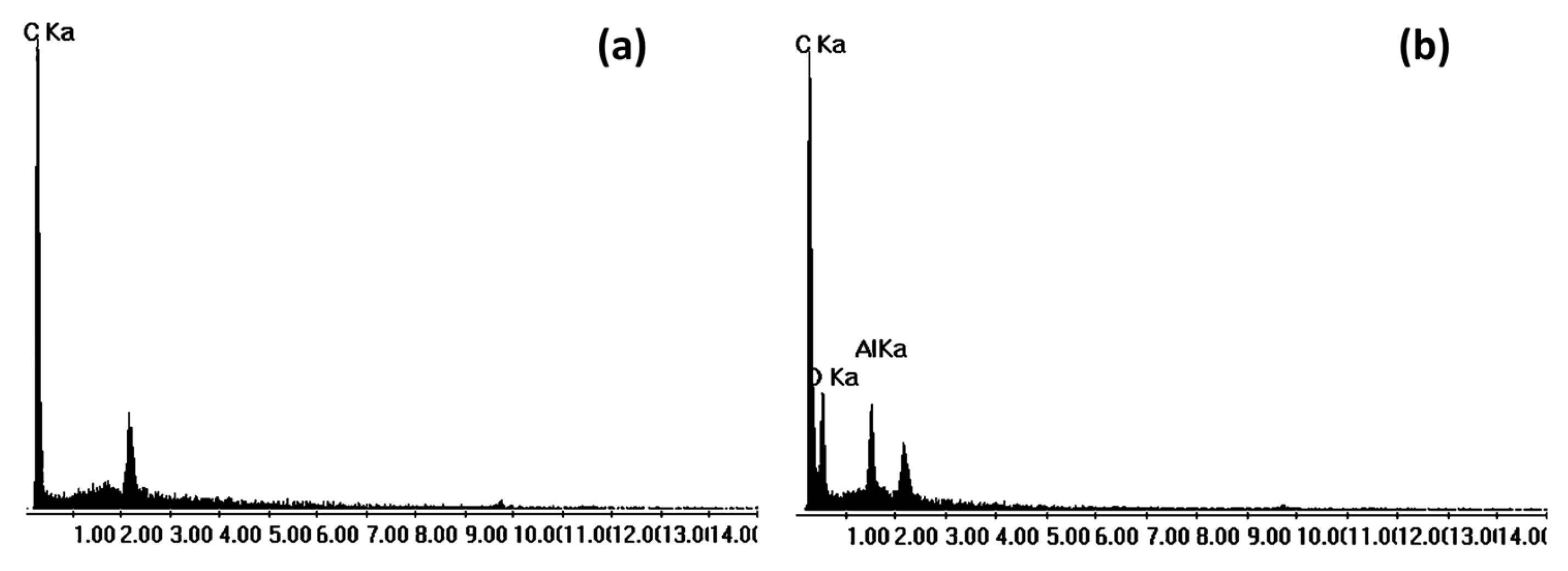
Elemental surface composition was examined by EDX analysis. Figure 2 displays the EDX spectra of PE (a) and PE-SA (b). As expected, the spectrum of pristine PE shows only carbon, whereas the modified films exhibit clear signals of aluminum and oxygen. These findings are consistent with the presence of aluminum carboxylate complexes formed on the polyethylene surface as a reaction product.

3.2. Surface Morphology of the Films

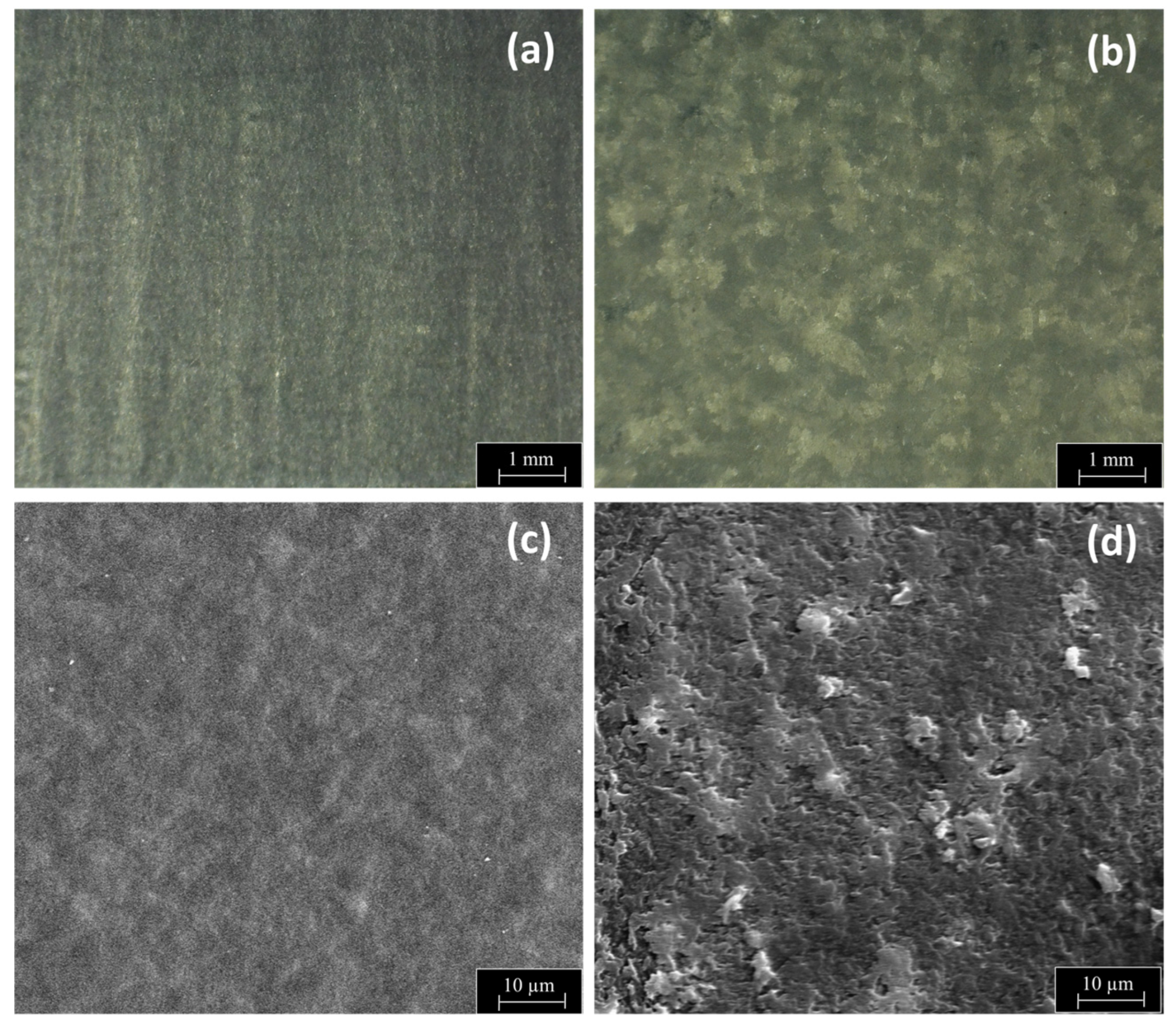
Regarding the morphological analysis, optical and electron microscopy of the pristine PE films (Figure 3a,c) show the characteristic smooth and featureless surface typical of a non-modified PE film surface. In contrast, the PE-SA samples (Figure 3b,d) exhibit a uniformly altered surface morphology, characterized by a wrinkled, irregular, and textured appearance. This topographical change is consistent with the formation of a continuous reaction layer over the polymer surface.
The homogeneous distribution of these morphological features across the observed areas indicates that the grafting process occurred extensively and uniformly, confirming that the chemical modification was not localized but rather widespread over the entire exposed surface.

3.3. Evaluation of Surface Polarity and Paintability

In order to demonstrate that grafting reaction change surface polarity of PE films, the wettability was evaluated by water contact angle measurements. The water contact angle measured for pristine PE is 93.5 ± 0.8°, slightly above 90°, confirming its strongly hydrophobic character, in agreement with reported values for polyethylene films, typically ranging from 90 to 100° [33,34,35]. In contrast, the PE-SA samples exhibit a contact angle of 70.6 ± 0.9°, indicating a markedly hydrophilic surface. This reduction of more than 20° relative to unmodified PE provides clear evidence of a substantial increase in surface polarity induced by the grafting treatment. This contact angle value is approximately 10 degrees lower than that reported in our previous work on polyethylene films grafted with benzoic acid [9]. This also highlights the greater contribution of salicylic acid to surface hydrophilicity compared with benzoic acid, due to its higher number of hydroxyl groups, which provide increased polarity.
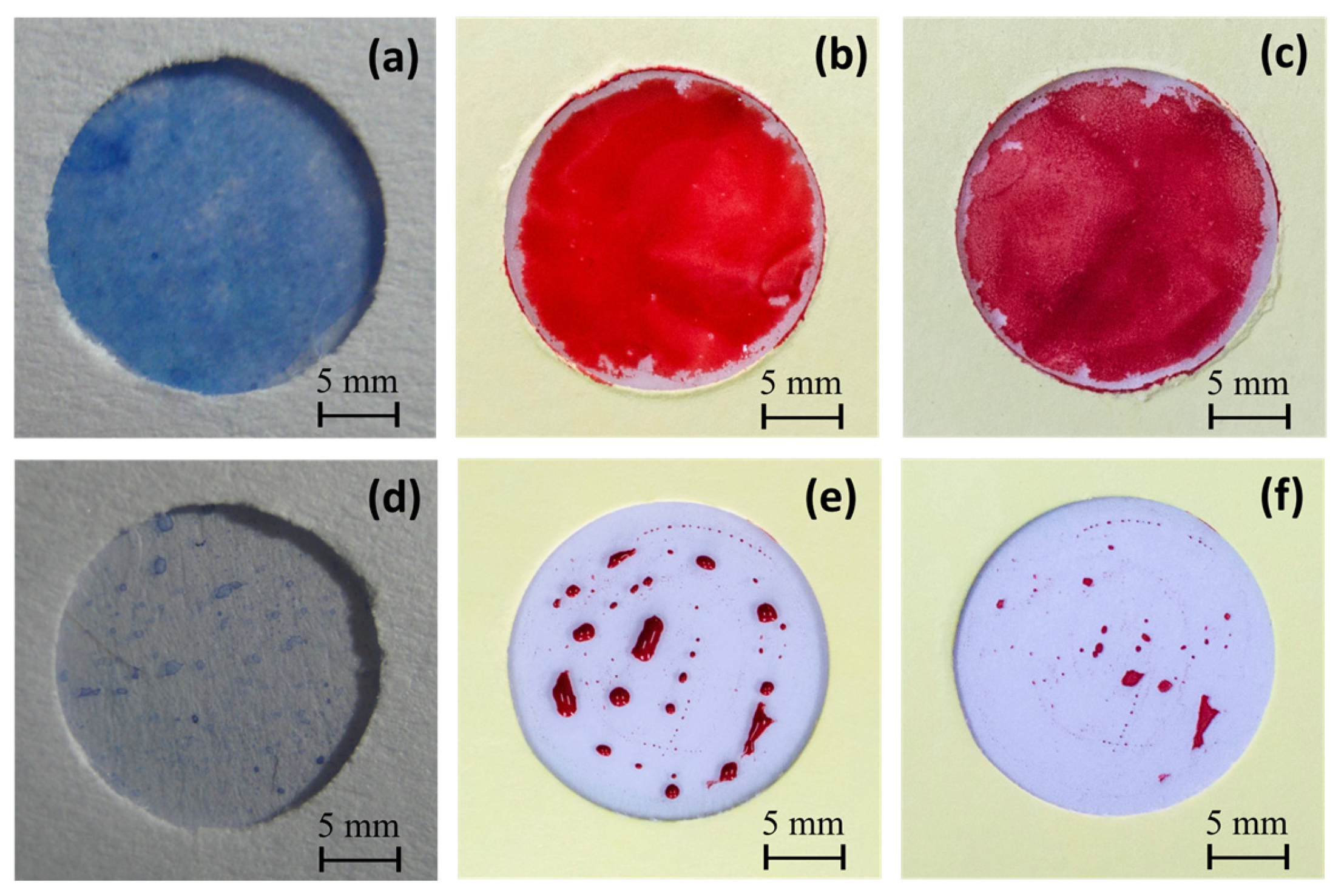
Figure 4 presents the results of the qualitative tests performed with water-based dyes and paints. Both methylene blue and red watercolor spread uniformly across the PE-SA surface (Figure 5a,b), whereas pristine PE displays strong repellency, with the liquids forming isolated droplets rather than continuous coverage (Figure 4d,e). This stark contrast further confirms the increased hydrophilicity of the modified films.
Notably, this behavior persists after the watercolor is allowed to dry and the surface is gently blotted (Figure 4c,f). The PE-SA films retain a continuous, adherent paint layer, indicating not only improved wettability but also enhanced adhesion of water-based colorants. This suggests a stronger affinity not only for aqueous systems but also for dyes and pigments containing aromatic components.
Overall, the dyeing and painting tests clearly demonstrate that the grafted films exhibit markedly improved compatibility with water-based coatings, while unmodified PE remains essentially non-wettable. These findings confirm that the proposed modification strategy effectively converts the PE surface from hydrophobic to hydrophilic, thereby enabling the use of more environmentally friendly inks and paints.
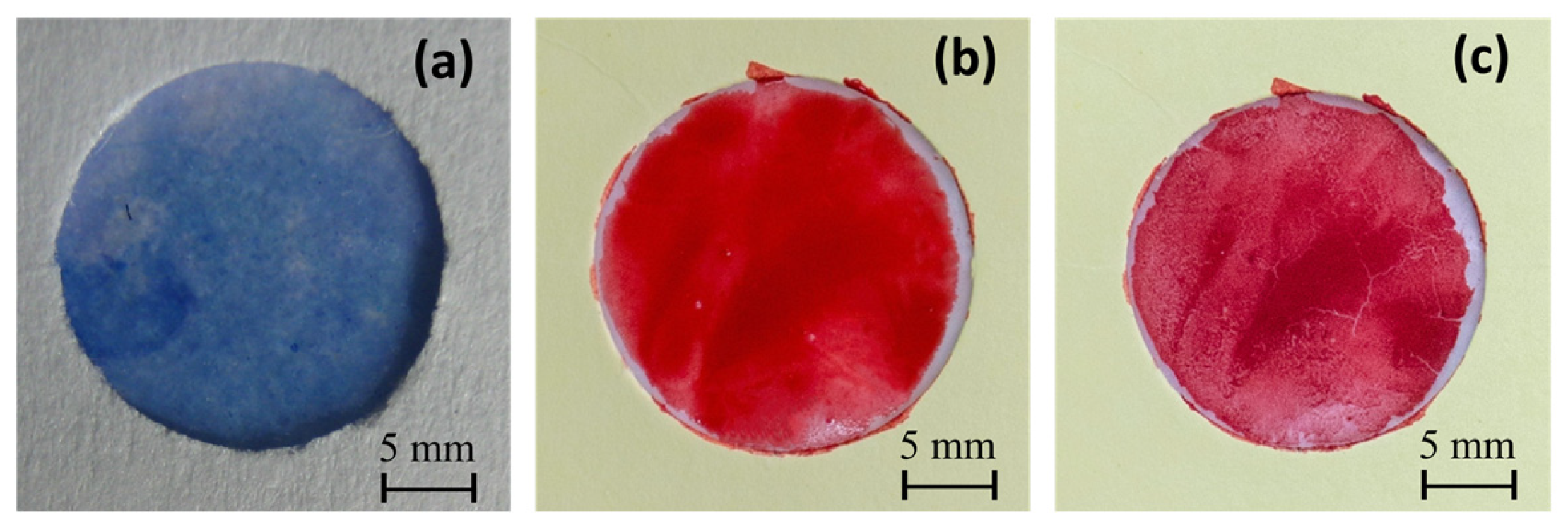
The long-term durability of the surface functionalization was further examined through natural aging under ambient storage conditions. After ten years of storage, the water contact angle measured on PE-SA films was 71.4 ± 0.8°, showing no statistically significant variation compared to the values obtained for freshly modified samples. This result confirms that the hydrophilic character induced by the grafting process is preserved over extended periods. Consistent behavior was observed in qualitative compatibility tests with water-based systems (Figure 5), including dyeing with methylene blue and painting with water-based watercolor, where aged samples exhibited uniform coverage and adhesion comparable to those of newly modified films. Across all wettability and paintability evaluations, no evidence of loss of adhesion, surface deactivation, or recovery of hydrophobic behavior was detected.

4. Conclusions

This study demonstrates that the aluminum-mediated grafting of salicylic acid onto polyethylene films is an effective strategy for surface functionalization. FTIR-ATR analysis confirmed the formation of aluminum–salicylate coordination complexes covalently anchored to the PE surface, while EDX verified the incorporation of aluminum and oxygen consistent with these species. Optical and electron microscopy further revealed a continuous and homogeneous modification layer.
The impact of this chemical functionalization was evident in wettability and paintability tests. The water contact angle decreased by more than 20°, shifting the material from strongly hydrophobic to clearly hydrophilic. Qualitative paintability assays showed complete and uniform coverage of PE-SA films, in contrast to the droplet formation and poor adhesion observed for pristine PE. The retention of paint after drying further confirmed the enhanced compatibility of the modified surface with water-based colorants.
Overall, the combined spectroscopic, morphological, and wetting evidence demonstrates that this spraying-based grafting approach produces a chemically tailored PE surface with strong, robust, and long-term stable affinity toward polar and aqueous formulations. The method could be compatible with continuous processing and enables the use of environmentally friendly inks and paints. Owing to the sequential spraying strategy employed, the proposed surface functionalization method is inherently compatible with continuous manufacturing schemes, including roll-to-roll processing and polymer film extrusion lines. In particular, it presents clear potential for direct integration into blown-film and calendering processes, where the modification could be applied during or immediately after film formation by exploiting the residual thermal energy of the freshly extruded polymer. For blown-film operations, the treatment could be implemented above the freeze line using two successive annular spraying systems, a region where the polymer surface remains in a softened or molten state, enabling effective reagent deposition and reaction at industrial processing rates. Moreover, the methodology is not limited to polyethylene and could be extended to other thermoplastic substrates, such as polypropylene, as well as to alternative grafting molecules (e.g., acetylsalicylic acid), allowing the surface chemistry of polymer films to be tailored to the specific requirements of diverse applications.

Author Contributions

Conceptualization, A.L.G. and S.E.B.; methodology, A.L.G. and S.E.B.; formal analysis, A.L.G. and S.E.B.; investigation, A.L.G.; resources, A.L.G. and S.E.B.; data curation, A.L.G.; writing—original draft preparation, A.L.G.; writing—review and editing, S.E.B.; supervision, S.E.B.; project administration, S.E.B.; funding acquisition, S.E.B. All authors have read and agreed to the published version of the manuscript.

Funding

This research was funded by CONICET, UNS and MINCyT. PGI UNS 24/M174. SGCyT-UNS and PICT-2018-04606.

Institutional Review Board Statement

Not applicable.

Informed Consent Statement

Not applicable.

Data Availability Statement

The original contributions presented in this study are included in the article. Further inquiries can be directed to the corresponding author.

Acknowledgments

The authors gratefully acknowledge Carlos Renaudo, a colleague from the same institute, for his assistance with the contact angle measurements.

Conflicts of Interest

The authors declare no conflicts of interest.

References

  1. Narimisa, M.; Ghobeira, R.; Onyshchenko, Y.; De Geyter, N.; Egghe, T.; Morent, R. Different Techniques Used for Plasma Modification of Polyolefin Surfaces. In Plasma Modification of Polyolefins; Springer International Publishing: Cham, Switzerland, 2022; pp. 15–56. [Google Scholar] [CrossRef]
  2. Nemani, S.K.; Annavarapu, R.K.; Mohammadian, B.; Raiyan, A.; Heil, J.; Haque, M.A.; Abdelaal, A.; Sojoudi, H. Surface modification of polymers: Methods and applications. Adv. Mater. Interfaces 2018, 5, 1801247. [Google Scholar] [CrossRef]
  3. Ramirez Jar Carlo, C.; Tumolva Terence, P. Analysis and optimization of water-based printing ink formulations for polyethylene films. Appl. Adhes. Sci. 2018, 6, 1. [Google Scholar] [CrossRef]
  4. Fabbri, P.; Messori, M. Surface modification of polymers: Chemical, physical, and biological routes. In Modification of Polymer properties; William Andrew Publishing: Norwich, NY, USA, 2017; pp. 109–130. [Google Scholar] [CrossRef]
  5. Plummer, C.M.; Li, L.; Chen, Y. The post-modification of polyolefins with emerging synthetic methods. Polym. Chem. 2020, 11, 6862–6872. [Google Scholar] [CrossRef]
  6. Panda, P.; Mohapatra, R. Transforming Polymers: Innovative Physical and Chemical Modification Techniques for Advanced Functional Applications. Mini-Rev. Org. Chem. 2025, 22, 706–717. [Google Scholar] [CrossRef]
  7. Pattanateeradetch, A.; Sakulthaew, C.; Lin, Y.-T.; Watcharenwong, A.; Gotvajn, A.Ž.; Chen, Y.-C.; Xu, Q.; Chokejaroenrat, C. Efficient activation of UV-driven ozonation using ultrasonics for LDPE decomposition. J. Water Process. Eng. 2025, 69, 106800. [Google Scholar] [CrossRef]
  8. Bahners, T.; Gutmann, J.S.; Müssig, J. Application-Related Optimization of Adhesion of Polymers Using Photochemical Surface Modification. In Polymer Surface Modification to Enhance Adhesion: Techniques and Applications; John Wiley & Sons: Hoboken, NJ, USA, 2024; pp. 155–198. [Google Scholar]
  9. Grafia, A.L.; Barbosa, S.E. Polyethylene Film Surface Modification via Benzoic Acid Grafting. Polymers 2024, 16, 1291. [Google Scholar] [CrossRef]
  10. Kennedy, J.P. New Syntheses of Functional and Sequential Polymers by Exploiting Knowledge of the Mechanism of Initiation; ACS Publications: Washington, DC, USA, 1982; pp. 3–12. [Google Scholar]
  11. Grafia, A.L.; Martini, R.E.; Barbosa, S.E. Spray process to styrene grafting onto polyethylene film surface for paintability enhancement. Prog. Org. Coat. 2018, 117, 91–101. [Google Scholar] [CrossRef]
  12. Martini, R.E.; Brignole, E.A.; Barbosa, S.E. Grafting of styrene onto polyethylene in near critical media. J. Appl. Polym. Sci. 2012, 123, 2787–2799. [Google Scholar] [CrossRef]
  13. Díaz, M.F.; Barbosa, S.E.; Capiati, N.J. Reactive compatibilization of PE/PS blends. Effect of copolymer chain length on interfacial adhesion and mechanical behavior. Polymer 2007, 48, 1058–1065. [Google Scholar] [CrossRef]
  14. Carrick, W.L. Reactions of polyolefins with strong lewis acids. J. Polym. Sci. Part A-1 Polym. Chem. 1970, 8, 215–223. [Google Scholar] [CrossRef]
  15. Lim, J.; Jang, S.; Cho, H.K.; Shin, M.S.; Kim, H. Solubility of salicylic acid in pure alcohols at different temperatures. J. Chem. Thermodyn. 2013, 57, 295–300. [Google Scholar] [CrossRef]
  16. Gulmine, J.V.; Janissek, P.R.; Heise, H.M.; Akcelrud, L. Polyethylene characterization by FTIR. Polym. Test. 2002, 21, 557–563. [Google Scholar] [CrossRef]
  17. Yang, L.; Xu, Y.; Su, Y.; Wu, J.; Zhao, K.; Chen, J.; Wang, M. FT-IR spectroscopic study on the variations of molecular structures of some carboxyl acids induced by free electron laser. Spectrochim. Acta Part A Mol. Biomol. Spectrosc. 2005, 62, 1209–1215. [Google Scholar] [CrossRef]
  18. Yost, E.C.; Tejedor-Tejedor, M.I.; Anderson, M.A. In situ CIR-FTIR characterization of salicylate complexes at the goethite/aqueous solution interface. Environ. Sci. Technol. 1990, 24, 822–828. [Google Scholar] [CrossRef]
  19. Phambu, N. Adsorption of carboxylic acids on submicrocrystalline aluminum hydroxides in aqueous solution. Part I: Qualitative study by infrared and Raman spectroscopy. Appl. Spectrosc. 2002, 56, 756–761. [Google Scholar] [CrossRef]
  20. Indrayanto, G.; Syahrani, A.; Mugihardjo; Rahman, A.; Soeharjono; Tanudjojo, W.; Susanti, S.; Yuwono, M.; Ebel, S. Benzoic acid. Anal. Profiles Drug Subst. Excip. 1999, 26, 1–46. [Google Scholar]
  21. Guan, X.; Chen, G.; Shang, C. ATR-FTIR and XPS study on the structure of complexes formed upon the adsorption of simple organic acids on aluminum hydroxide. J. Environ. Sci. 2007, 19, 438–443. [Google Scholar] [CrossRef]
  22. Abounassif, M.A.; Mian, M.S.; Mian, N.A. Salicylic acid. In Analytical Profiles of Drug Substances and Excipients; Academic Press: London, UK, 1994; Volume 23, pp. 421–470. [Google Scholar]
  23. Hayashi, S.; Kimura, N. Infrared Spectra and Molecular Configuration of Benzoic acid. Bull. Inst. Chem. Res. 1966, 44, 335–340. [Google Scholar]
  24. Olafsson, G.; Hildingsson, I.; Bergnstahl, B. Transport of Oleic and Acetic Acids from Emulsions into Low Density Polyethylene; Effects on Adhesion with Aluminum Foil in Laminated Packaging. J. Food Sci. 1995, 60, 420–425. [Google Scholar] [CrossRef]
  25. Olafsson, G.; Hildingsson, I. Sorption of Fatty Acids into Low-Density Polyethylene and Its Effect on Adhesion with Aluminum Foil in Laminated Packaging Material. J. Agric. Food Chem. 1995, 43, 306–312. [Google Scholar] [CrossRef]
  26. Kubicki, J.D.; Schroeter, L.M.; Itoh, M.J.; Nguyen, B.N.; Apitz, S.E. Attenuated total reflectance Fourier-transform infrared spectroscopy of carboxylic acids ad-sorbed onto mineral surfaces. Geochem. Cosmochim. Acta 1999, 63, 2709–2725. [Google Scholar] [CrossRef]
  27. Biber, M.V.; Stumm, W. An In-Situ ATR-FTIR Study: The surface Coordination of Salicylic Acid on Aluminum and Iron (III) Oxides. Environ. Sci. Technol. 1994, 28, 763–768. [Google Scholar] [CrossRef] [PubMed]
  28. Schultz, J.; Carré, A.; Mazeau, C. Formation and rupture of grafted polyethylene/aluminium interfaces. Int. J. Adhes. Adhes. 1984, 4, 163–168. [Google Scholar] [CrossRef]
  29. Guertin, D.L.; Wiberley, S.E.; Bauer, W.H.; Goldenson, J. The infrared spectra of three Aluminum Alkoxides. J. Phys. Chem. 1956, 60, 1018–1019. [Google Scholar] [CrossRef]
  30. Guan, X.; Shang, C.; Chen, G.H. ATR-FTIR investigation of the role of phenolic groups in the interaction of some NOM model compounds with aluminum hydroxide. Chemosphere 2006, 65, 2074–2081. [Google Scholar] [CrossRef] [PubMed]
  31. Lewandowski, W.; Baranska, H. The influence of Selected Metals on the Aromatic System of Salicylic Acid. Appl. Spectrosc. 1987, 41, 976–980. [Google Scholar] [CrossRef]
  32. Kuiper, A.E.T.; Medema, J.; Van Bokhoven, J.J.G.M. Infrared and Raman spectra of benzaldehyde adsorbed on alumina. J. Catal. 1973, 29, 40–48. [Google Scholar] [CrossRef]
  33. Seyhan, A.; Gunaydin, B.N.; Polat, Y.; Kilic, A.; Demir, A.; Avci, H. Improvement of polyethylene fiber wettability and mechanical properties through an environmentally sustainable spinning process. Int. J. Adhes. Adhes. 2022, 119, 103250. [Google Scholar] [CrossRef]
  34. Subedi, D.P. Contact angle measurement for the surface characterization of solids. Himal. Phys. 2011, 2, 1–4. [Google Scholar] [CrossRef]
  35. De Geyter, N.; Morent, R.; Leys, C. Surface characterization of plasma-modified polyethylene by contact angle experiments and ATR-FTIR spectroscopy. Surf. Interface Anal. 2008, 40, 608–611. [Google Scholar] [CrossRef]
Figure 1. FTIR-ATR spectra of SA, PE-SA and PE.
Engproc 117 00040 g001
Figure 2. EDX spectrum of (a) PE and (b) PE-SA.
Engproc 117 00040 g002
Figure 3. Optical micrographs of the film surfaces for PE (a) and PE-SA (b), and SEM micrographs of PE (c) and PE-SA (d).
Engproc 117 00040 g003
Figure 4. Photographs of qualitative paintability tests: methylene blue dyeing on PE-SA (a) and PE (d); red watercolor applied on PE-SA (b) and PE (e); and watercolor after drying and blotting on PE-SA (c) and PE (f).
Engproc 117 00040 g004
Figure 5. Photographs of qualitative paintability tests after 10 years of natural aging: methylene blue dyeing on PE-SA (a), red watercolor applied on PE-SA (b), and watercolor after drying and blotting on PE-SA (c).
Engproc 117 00040 g005
Disclaimer/Publisher’s Note: The statements, opinions and data contained in all publications are solely those of the individual author(s) and contributor(s) and not of MDPI and/or the editor(s). MDPI and/or the editor(s) disclaim responsibility for any injury to people or property resulting from any ideas, methods, instructions or products referred to in the content.