
Proceeding Paper

Synthesis, Antioxidant Evaluation, and Docking Simulation of New Mannich-Type β-Amino Ketone †
by
Amira Ait Belkacem
* and
Hichem Sadrik Kettouche
Laboratory of Synthesis of Molecules with Biological Interest, Department of Chemistry, Faculty of Exact Sciences, University of Frères Mentouri Constantine 1, Compus Chaabet Ersas, Constantine 25000, Algeria
*
Author to whom correspondence should be addressed.
Presented at the 29th International Electronic Conference on Synthetic Organic Chemistry, 14–28 November 2025; Available online: https://sciforum.net/event/ecsoc-29.
Chem. Proc. 2025, 18(1), 134; https://doi.org/10.3390/ecsoc-29-26703
Published: 11 November 2025

Abstract

New β-amino ketone Mannich derivatives were synthesized in good yields. Molecular docking studies were conducted to evaluate their potential as inhibitors of acetylcholinesterase and tubulin, while their antioxidant activity was assessed using the DPPH (2,2-diphenyl-1-picrylhydrazyl) assay. ADMET study (pharmacokinetic properties) predictions further indicated that these compounds can cross the blood–brain barrier and display high gastrointestinal absorption. Collectively, these findings highlight the derivatives as promising candidates for drug development, with favorable oral bioavailability and potential applications in the treatment of neurodegenerative diseases and cancer.

1. Introduction

The Mannich compounds of the β-amino ketone type have important applications across a wide range of biological activities, including antidiabetic [1], antimicrobial [2], anticancer [3], anti-Alzheimer [4], and antioxidant [5] effects. Their stereochemical properties make these compounds particularly valuable in the design and development of therapeutic agents for diverse diseases.
The stereochemistry of β-amino ketone Mannich derivatives strongly influences their structural stability and biological reactivity with target molecules. Electronic distribution and conformational flexibility, which are essential for regulating interactions with structural proteins like tubulin or enzymes like acetylcholinesterase, can be greatly impacted by even minor modifications in stereochemical configuration. Their pharmacological profiles may eventually diverge significantly as a result of these variations.
New β-amino ketone Mannich derivatives were synthesized through a simple condensation reaction. These compounds demonstrated strong antioxidant activity as well as significant inhibitory effects on acetylcholinesterase and tubulin. Furthermore, ADMET analysis confirmed that they comply with Lipinski’s Rule of Five and are capable of crossing both the blood–brain barrier and the gastrointestinal tract, without exhibiting any ADMET-related toxicity.

2. Materials and Methods

2.1. Material Used

The Avogadro 2.0 (GPLv2) program was used to prepare the ligand, and Chimera program version 1.16 was used to prepare the target. Swiss-PdbViewer (SPDBV) version 4.1 was used for energy minimization, and BIOVIA Discovery Studio 2021 was used for visualization and analysis. ANOVA SPSS software 2.0 was used for DPPH analysis.

2.2. Statistical Analysis

The results presented are mean ± standard deviation (SD), which is the average of three measurements. Each sample’s IC50 value—the concentration needed for 50% inhibition—was calculated by using linear regression to plot the percentage of inhibition and the resulting curve. Using SPSS software 1.0, a one-way analysis of variance (ANOVA) was carried out to find statistically significant differences (p < 0.05) between the samples.

2.3. Methods

2.3.1. Ligand Preparation

The Avogadro program was used to construct the small molecules, then geometry optimization and energy minimization were performed to prepare the derivative compounds for docking studies. For additional computer analysis, the optimized structures were then saved in .pdb format.

2.3.2. Targets Preparation

The acetylcholinesterase (AChE) protein (PDB ID: 4M0E) [6] and the tubulin protein (PDB ID: 1SA0) [7] were retrieved in .pdb format from the Protein Data Bank. The target proteins were prepared by removing water molecules, eliminating non-essential chains, and adding polar hydrogens. Subsequent energy minimization was performed using Swiss-PdbViewer (SPDBV) version 4.0. The processed structures were then visualized and analyzed for further docking studies.

3. Results and Discussion

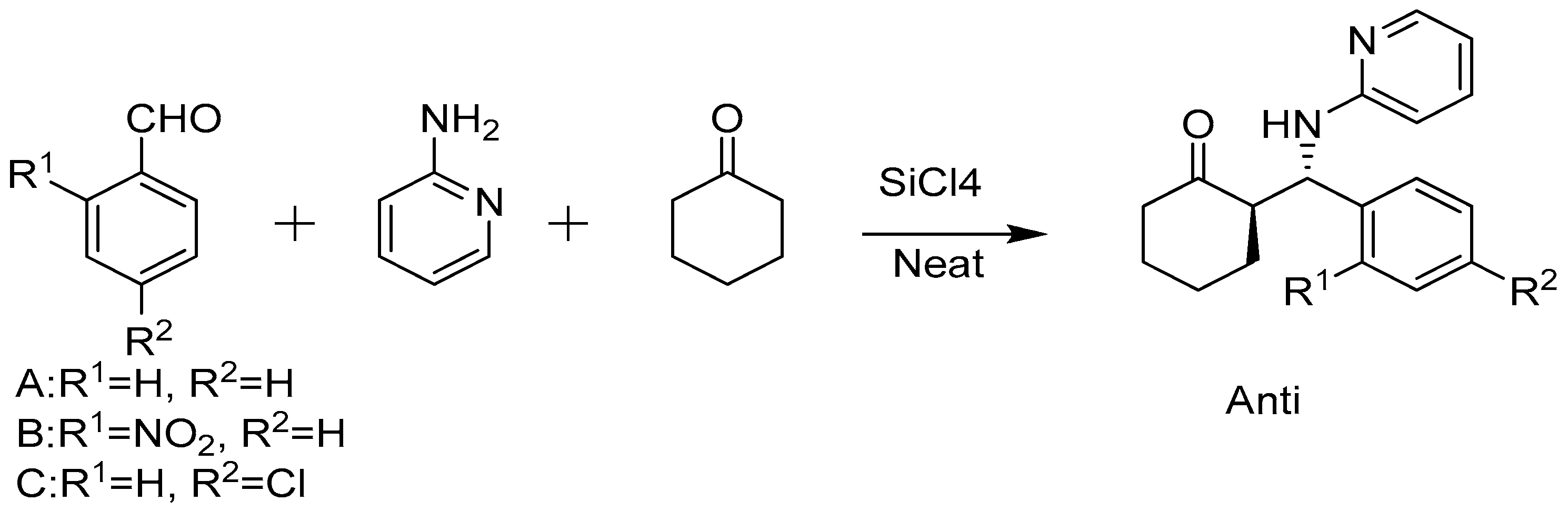
β-amino ketones were easily synthesized through a simple Mannich reaction using SiCl4 as a catalyst (Scheme 1). The reaction afforded exclusively the anti isomer, with yields ranging from 42% to 77%. After synthesis, these compounds were subjected to theoretical studies. The selective formation of the anti isomer can be attributed to the catalytic effect of SiCl4, which influences the orientation of the intermediates during the reaction. This accounts for the observed stereoselectivity, making the method a straightforward and efficient approach for the synthesis of anti-β-amino ketone Mannich derivatives.

3.1. Docking Study

Docking studies of these compounds were performed using Chimera to evaluate their potential as effective inhibitors. The results showed that, in acetylcholinesterase, the compounds exhibited strong binding affinity at both the catalytic active site (CAS) and the peripheral anionic site (PAS), suggesting potential anti-Alzheimer’s activity. Moreover, they demonstrated strong binding interactions within the active sites of tubulin, indicating possible anticancer activity. These findings highlight the compounds as promising lead candidates with dual therapeutic potential against Alzheimer’s disease and cancer.

3.1.1. With Acetylcholinesterase

Docking analysis with acetylcholinesterase revealed that the best binding pose of the compounds exhibited a binding affinity with an RMSD value of 0.000 Å, indicating a highly stable and reliable conformation within the two binding pockets of acetylcholinesterase.
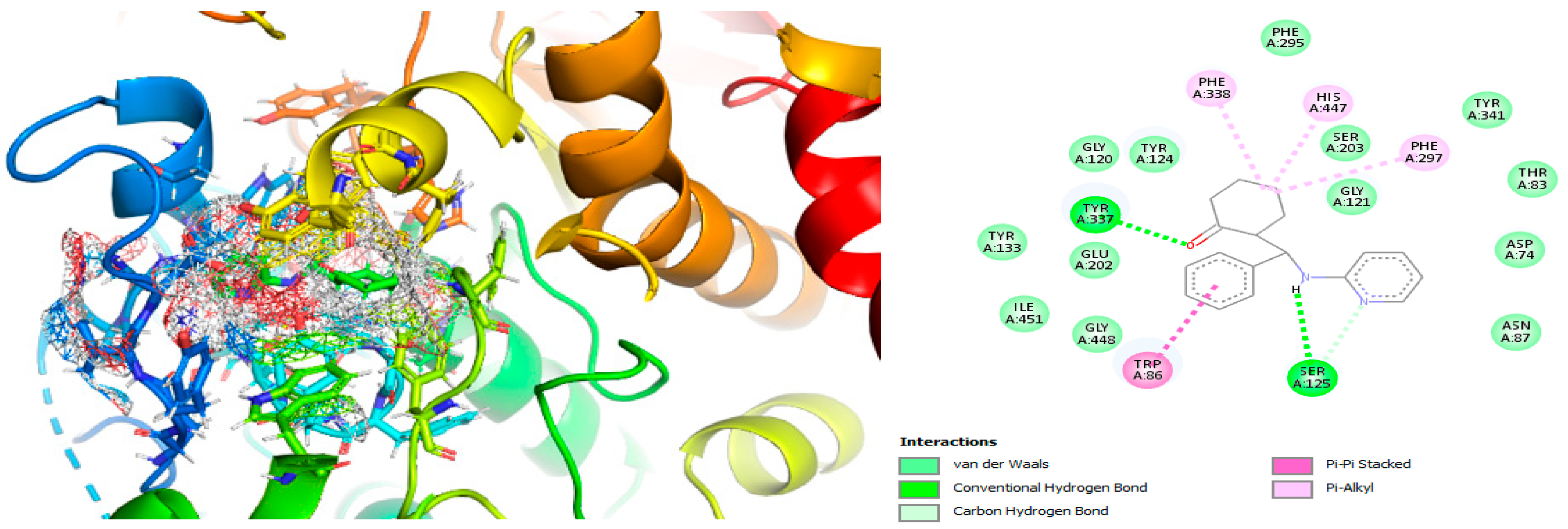
Compound A Figure 1 demonstrated a strong binding affinity in the catalytic active site (CAS) of acetylcholinesterase (AChE), with a docking score of −9.4 kcal/mol. This stability is attributed to several interactions: a π–π stacking interaction with TRP86, a conventional hydrogen bond with TYR337, π–alkyl interactions involving PHE297, PHE338, and HIS447, as well as van der Waals forces with SER203, GLY448, ILE451, Glu202, TYR133, GLY120, PHE295, and GLY121. Additionally, in the peripheral anionic site (PAS), compound A formed a conventional hydrogen bond, and carbon hydrogen bond with SER125 van der Waals interactions with TYR124, TYR341, and ASP74. The coexistence of these interactions within both CAS and PAS pockets suggests that compound A could effectively block substrate access while simultaneously interfering with peripheral binding, thereby enhancing its potential inhibitory activity against AChE.
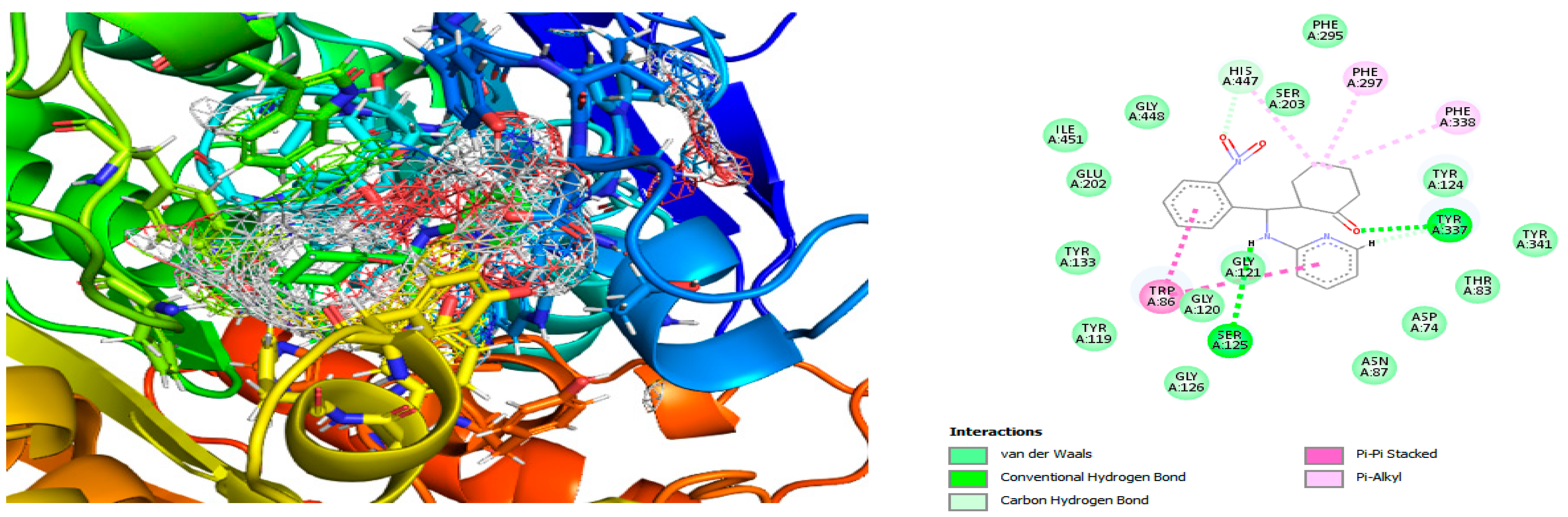
Compound B Figure 2 demonstrated a strong binding affinity in the catalytic active site (CAS) of acetylcholinesterase (AchE), with a docking score of −8.8 kcal/mol. This stability is attributed to multiple interactions: a π–π stacking interaction with TRP86, a carbon–hydrogen bond with HIS447, and TYR337, also a conventional hydrogen bond with TYR337, π–alkyl interactions involving PHE297 and PHE338, and van der Waals forces with SER203, TYR133, GLU202, ILE451, and GLY448. Additionally, in the peripheral anionic site (PAS), compound B formed a conventional hydrogen bond with SER125, along with van der Waals interactions involving TYR124, TYR341, and ASP74. The coexistence of these interactions within both CAS and PAS pockets suggests that compound B could effectively block substrate access while simultaneously interfering with peripheral binding, thereby enhancing its potential inhibitory activity against AChE.
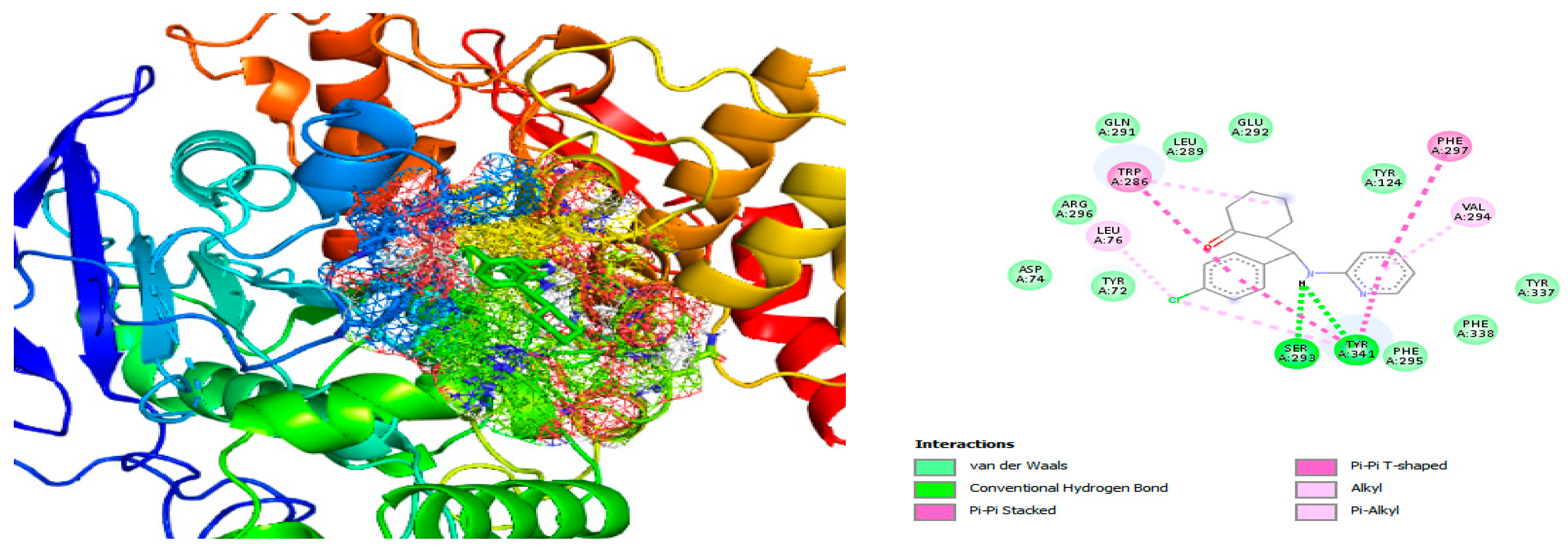
Compound C Figure 3 demonstrated a strong binding affinity in the (PAS) of acetylcholinesterase (AchE), with a docking score of −8.9 kcal/mol. This stability is attributed to multiple interactions: a π–π stacking interaction with TRP286 and PHE 297, a convention hydrogen bond with TYR341, van der Waals forces with TYR72, ASP74, ARG296, LUE289, GLU292, TYR124, and π–alkyl interactions involving TRP286VAL294, alkyl interaction with LEU76. Additionally, in the CAS, compound C formed a convention hydrogen bonding interaction with Ser293 van der Waals forces with TYR337 PHE338 PHE295. The coexistence of these interactions within both CAS and PAS pockets suggests that compound A could effectively block substrate access and simultaneously interfere with peripheral binding, thereby enhancing its potential inhibitory activity against AchE.

3.1.2. With Tubulin

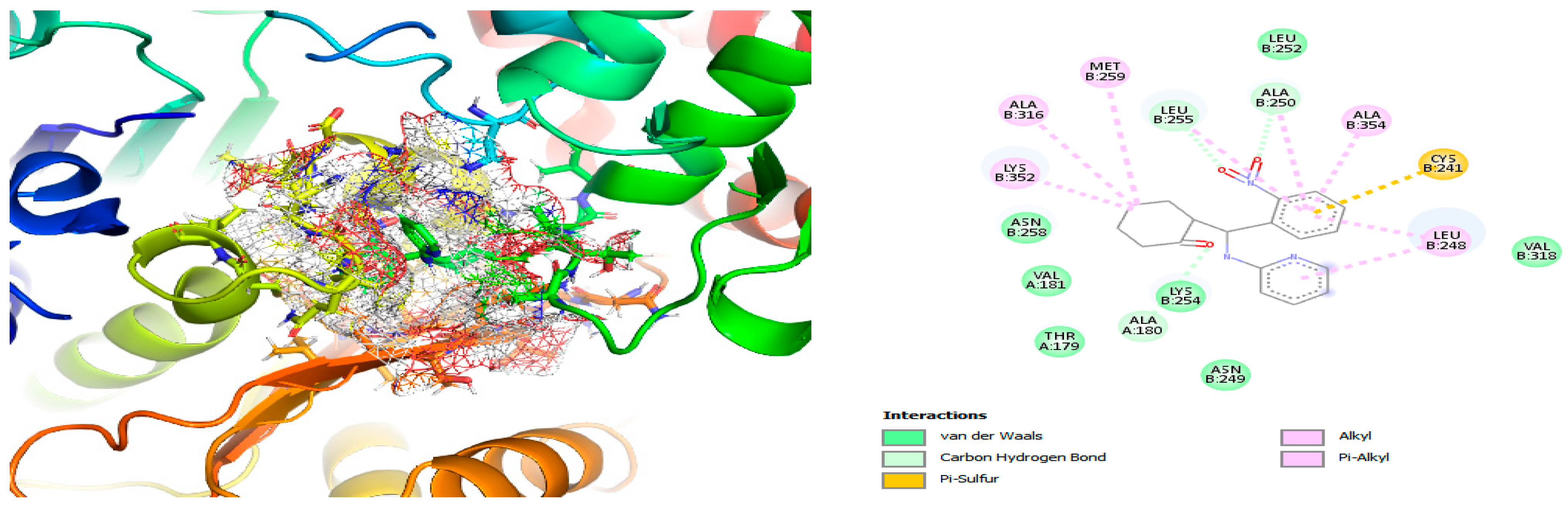
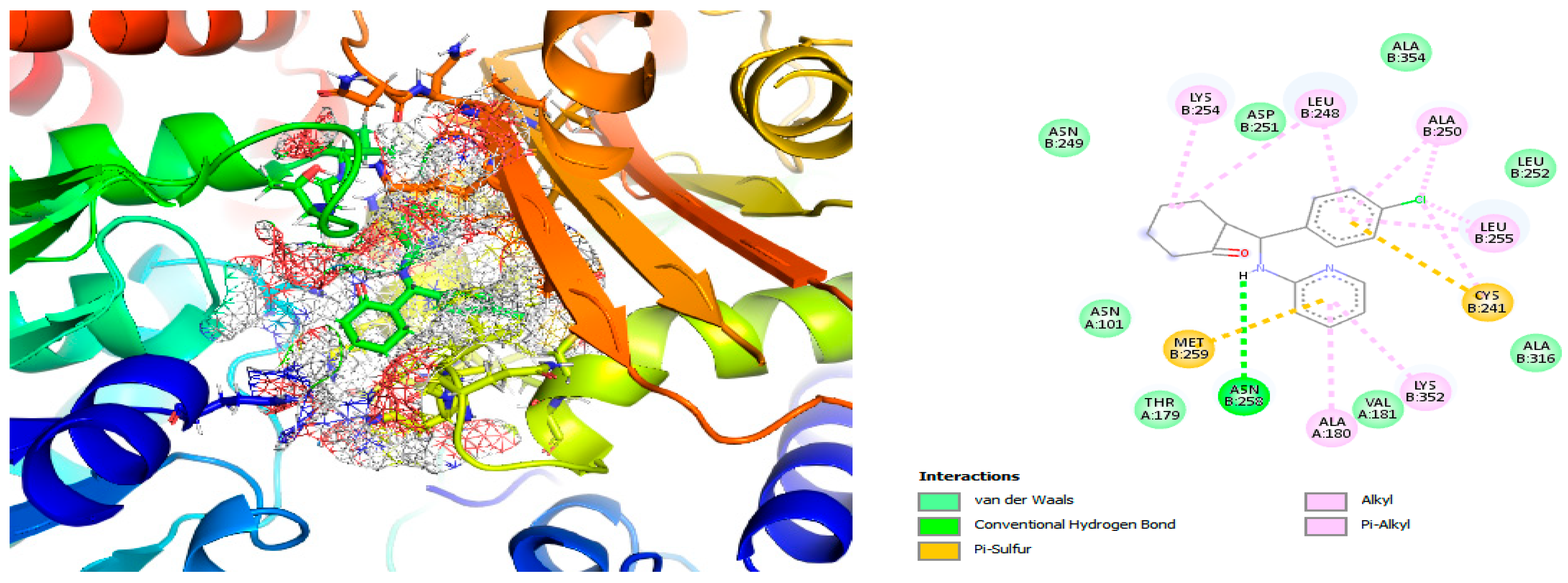
The molecular docking of the compounds with tubulin revealed that the best binding pose exhibited an RMSD of 0.000 Å, confirming a stable conformation. The 2D interaction diagram showed a key interactions with Cys B:241, which is characteristic of ligands occupying the colchicine-binding site, thereby indicating strong stabilization within the colchicine-binding site of tubulin.
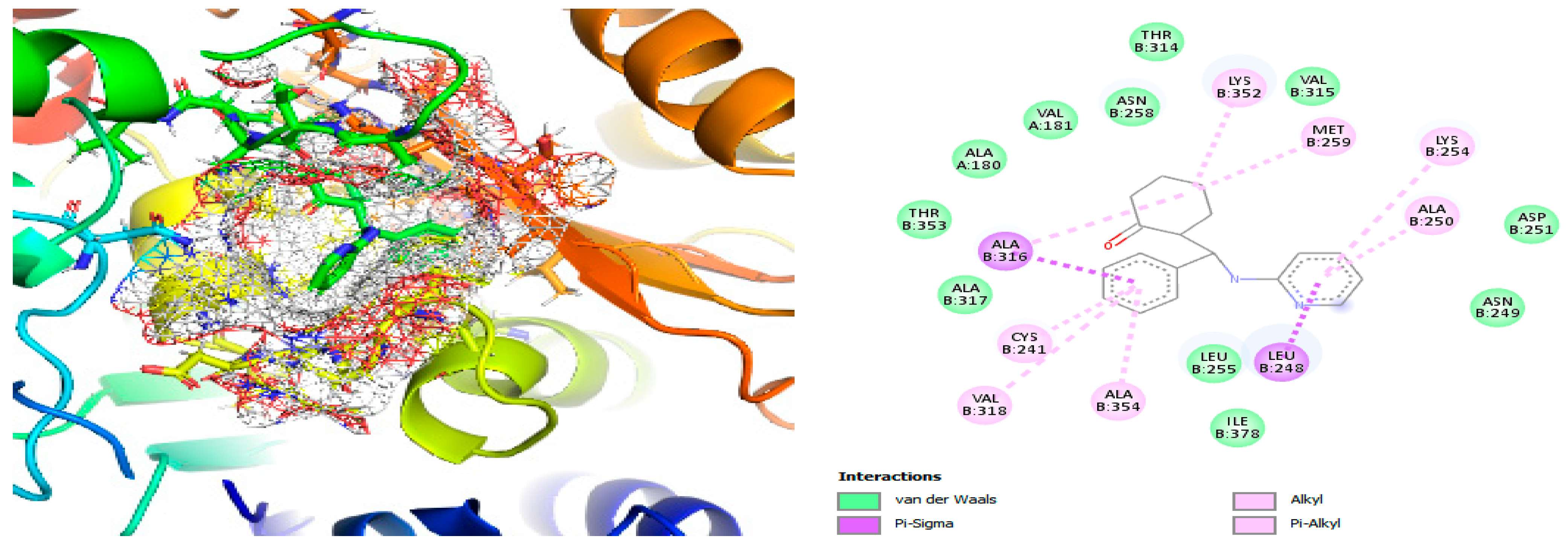
Compound A Figure 4 showed a strong binding affinity with a docking score of −8.1 kcal/mol. This stability is driven by π–sigma interactions with ALA317 and LEU248, π–alkyl interactions with CYS241, VAL318, and ALA354; alkyl interactions with LYS352, MET259, LYS254, and ALA250; and van der Waals forces involving ALA317, THR353, ALA180, VAL181, ASN258, THR314, VAL315, ASP251, ASN249, LEU255, and ILE378.
Compound B Figure 5 showed a strong binding affinity with a docking score of −8.3 kcal/mol. This stability is driven by π–sulfur interactions with CYS241, π–alkyl interactions with LYS352, ALA316, and MET259, as well as alkyl contacts with ALA354 and LEU248. Additional stabilization arises from carbon–hydrogen bonds with LEU255, ALA250, and LYS254, along with van der Waals interactions involving LEU252, VAL318, ASN249, ALA180, THR179, VAL181, and ASN258.
Compound C Figure 6 showed a strong binding affinity with a docking score of −7.8 kcal/mol. This stability is driven by π–sulfur interactions with CYS241 and MET259, π–alkyl contacts with ALA180 and LYS352, and alkyl interactions with LYS254, LEU248, ALA250, and LEU255. Additionally, a conventional hydrogen bond was observed with ASN258. And van der Waals interactions involving ASN249, ASP251, ALA354, LEU252, ALA316, VAL181, ASN101, and THR179.

3.2. Pharmacokinetic Study

According to the ADMET analysis performed using SwissADME (http://www.swissadme.ch/index.php, accessed on 23 July 2025), all the synthesized compounds comply with Lipinski’s and Veber’s rules. In combination with admetSAR predictions (https://lmmd.ecust.edu.cn/admetsar2/, accessed on 26 December 2025), The findings show that all of the compounds can pass through the gastrointestinal tract and the blood–brain barrier, indicating that they may successfully enter the central nervous system and function as possible anti-cancer and anti-Alzheimer’s medications with encouraging oral bioavailability. Additionally, the compounds’ non-AMES toxicity and non-carcinogenicity were confirmed by admetSAR predictions, as shown in Table 1.

3.3. Antioxidant Evaluation

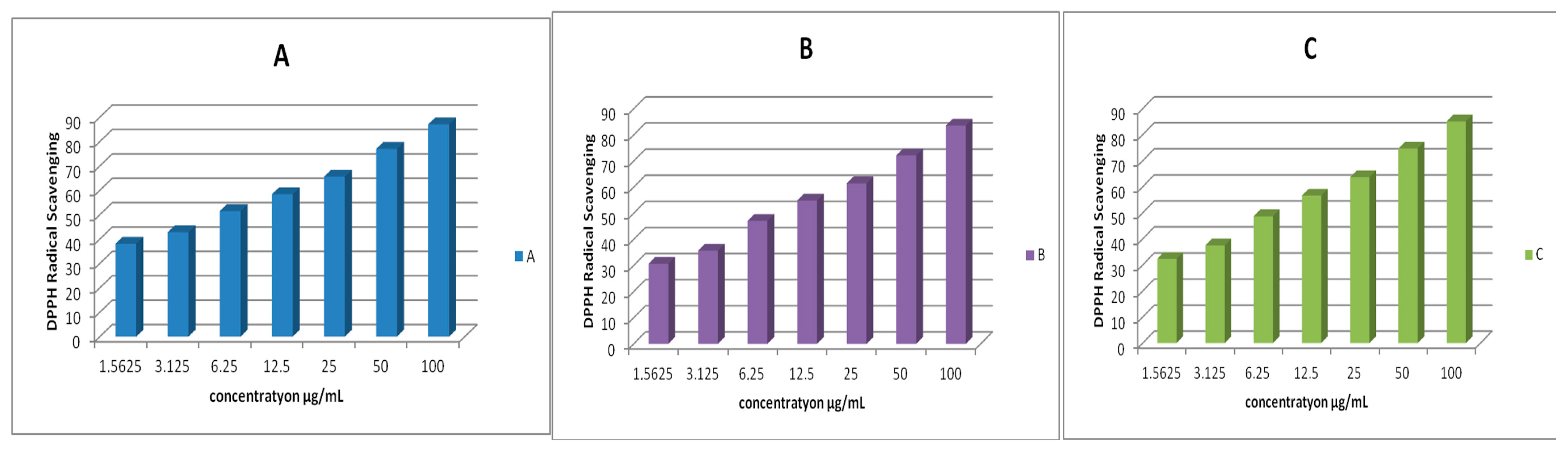
A modified DPPH assay was used to assess the synthetic compounds’ antioxidant activity [8]. Table 2 displayed the activity as IC50 values (μg/mL), and Figure 7 computed the percentage of radical inhibition as follows:
% Inhibition = [(A control – A sample)/A control] × 100
The β-amino ketone Mannich derivatives showed moderate to good antioxidant activity in the DPPH assay. The IC50 values ranged between 43.6 and 47.2 µg/mL, which is in line with previously reported values for similar structures. Although less potent than BHT (IC50 = 6.9 µg/mL), the results highlight the ability of β-amino ketones to scavenge free radicals effectively, possibly due to the presence of nitrogen and carbonyl groups enhancing electron donation.

4. Experimental Section

General Procedure for the Preparation of β-Amino Ketonse Derivatives

To a mixture of cyclohexanone (3 mmol), an aromatic aldehyde (1 mmol), and 2amino pyridine (1 mmol) in a test tube, SiCl4 (2 mol%) was added. The reaction mixture was stirred at room temperature and monitored by TLC. After completion, dichloromethane (10 mL) was added to the crude product, and the solution was washed successively with saturated aqueous sodium chloride (5 mL) and water (5 mL). The organic layer was dried over anhydrous MgSO4, and the solvent was evaporated. The solid obtained was purified by column chromatography on silica gel using ethyl acetate/hexane (2:8) as the eluent.
(R)-2-((S)-phenyl(pyridin-2-ylamino)methyl)cyclohexanone (A): yellow solid (48%); 1H NMR (250 MHz, CDCl3, ppm), 8.84 (s, 1H), 7.6–7.33 (m, 8H), 3.2–2.68 (m, 4H), 2–1.7 (m, 6H).
(R)-2-((S)-(2-nitrophenyl)(pyridin-2-ylamino)methyl)cyclohexanone(B): yellow solid (42%); 1H NMR (250 MHz, CDCl3, ppm), 8.15 (d, J = 7.1 Hz, 1H), 7.88 (s, 1H), 7.88–7.67 (t, J = 7.3 Hz, 2H), 7.6–7.56 (t, J = 7 Hz, 2H), 7.47–7.38 (d, J = 7.5 Hz, 2H), 3.1 (m, 3H), 2.7 (m, 5H), 1.8 (m, 2H).
(R)-2-((S)-(4-chlorophenyl)(pyridin-2-ylamino)methyl)cyclohexanone (C): yellow solid (77%); 1H NMR (250 MHz, CDCl3, ppm), 8.07 (s, 1H) (m, 2H), 7.86–7.77 (m, 3H), 7.7–7.62 (m, 2H), 3.46 (m, 3H), 2.6 (m, 4H), 1.72 (m, 3H).

5. Conclusions

In this study, we synthesized new β-amino ketone derivatives through a simple Mannich reaction. These compounds were subjected to molecular docking analysis to evaluate their potential as inhibitors of acetylcholinesterase and tubulin, while their antioxidant activity was assessed using the DPPH assay. ADMET predictions were performed to assess the ability to cross the blood–brain barrier and their gastrointestinal absorption. The combined results confirm that these derivatives are promising candidates for drug development, with favorable oral bioavailability and potential applications in the treatment of neurodegenerative diseases and cancer.

Author Contributions

Conceptualization, A.A.B. and H.S.K.; methodology, A.A.B.; software, A.A.B.; validation, H.S.K.; formal analysis, A.A.B.; investigation, H.S.K.; resources, A.A.B.; data curation, A.A.B.; writing—original draft preparation, A.A.B.; writing—review and editing, A.A.B.; visualization, A.A.B.; supervision, H.S.K.; project administration, H.S.K. All authors have read and agreed to the published version of the manuscript.

Funding

This research received no external funding.

Institutional Review Board Statement

Not applicable.

Informed Consent Statement

Not applicable.

Data Availability Statement

All the data are available in this manuscript.

Conflicts of Interest

The authors declare no conflicts of interest.

References

  1. Tang, G.; Yan, J.; Fan, L.; Xu, J.; Song, X.; Jiang, L.; Luo, L.; Yang, D. Synthesis of novel β-amino ketones containing ap-aminobenzoic acid moiety and evaluation of their antidiabetic activities. Sci. China Chem. 2013, 56, 490–504. [Google Scholar] [CrossRef]
  2. Dawood, N.; Saeed, B.; Saeed, Z. Synthesis of Some New Amino Carbonyl Compounds by Mannich Reaction. Molekul 2024, 19, 26–35. [Google Scholar] [CrossRef]
  3. Venkatesan, S.; Karthikeyan, N.S.; Rathore, R.S.; Giridharan, P.; Sathiyanarayanan, K.I. A mild and efficient one-pot three-component synthesis of anti-β-amino-carbonyl compounds catalyzed by NH4OAc and their anticancer activities. Med. Chem. Res. 2014, 23, 5086–5101. [Google Scholar] [CrossRef]
  4. Yamali, C.; Gul, M.; Gul, H.I. Current pharmaceutical research on the significant pharmacophore mannich bases in drug design. Curr. Top. Med. Chem. 2023, 23, 2590–2608. [Google Scholar] [CrossRef]
  5. Yaşa, H.; Hasdemir, B.; Erken, Ö. β-Amino carbonyl compounds from iodine-catalyzed three component Mannich reactions and evaluation of their antioxidant activity. Org. Prep. Proced. Int. 2019, 51, 537–546. [Google Scholar] [CrossRef]
  6. Jiang, C.S.; Ge, Y.X.; Cheng, Z.Q.; Song, J.L.; Wang, Y.Y.; Zhu, K.; Zhang, H. Discovery of new multifunctional selective acetylcholinesterase inhibitors: Structure-based virtual screening and biological evaluation. J. Comput. Aided Mol. Des. 2019, 33, 521–530. [Google Scholar] [CrossRef] [PubMed]
  7. Sana, S.; Reddy, V.G.; Reddy, T.S.; Tokala, R.; Kumar, R.; Bhargava, S.K.; Shankaraiah, N. Cinnamide derived pyrimidine-benzimidazole hybrids as tubulin inhibitors: Synthesis, in silico and cell growth inhibition studies. Bioorg. Chem. 2021, 110, 104765. [Google Scholar] [PubMed]
  8. Blois, M.S. Antioxidant determinations by the use of a stable Free Radical. Nature 1958, 4617, 1119–1200. [Google Scholar]
Scheme 1. General procedure for synthesis.
Chemproc 18 00134 sch001
Figure 1. Simulation of A in the active site of AchE.
Chemproc 18 00134 g001
Figure 2. Simulation of B in the active site of AchE.
Chemproc 18 00134 g002
Figure 3. Simulation of C in the active site of AchE.
Chemproc 18 00134 g003
Figure 4. Simulation of A in the active site of Tubulin.
Chemproc 18 00134 g004
Figure 5. Simulation of B in the active site of Tubulin.
Chemproc 18 00134 g005
Figure 6. Simulation of C in the active site of Tubulin.
Chemproc 18 00134 g006
Figure 7. The percentage of DPPH radical inhibition of samples (A) Antioxidant evaluation of compound A (B) Antioxidant evaluation of compound B (C) Antioxidant evaluation of compound C.
Chemproc 18 00134 g007
Table 1. Table of ADMET study results.
EntriesLipinski’s RulesVeber’s RulesBBBAMES ToxicCarcinogenicGastrointestinal
A++++
B++++
C++++
Significance: Yes (+); No (−).
Table 2. Table of Antioxidant Evaluation.
Concentration (µg/mL)1.56253.1256.2512.52550100IC50 (µg/mL)
BHT (% Inhib.)18.9 ± 0.332.5 ± 0.447.8 ± 0.366.3 ± 0.282.7 ± 0.389.5 ± 0.292.3 ± 0.26.9 ± 0.1
Compound A (% Inhib.)7.2 ± 0.213.9 ± 0.324.6 ± 0.338.7 ± 0.454.3 ± 0.368.9 ± 0.280.4 ± 0.243.6 ± 0.3
Compound B (% Inhib.)5.8 ± 0.311.6 ± 0.322.5 ± 0.236.4 ± 0.350.9 ± 0.364.6 ± 0.277.2 ± 0.247.2 ± 0.4
Compound C (% Inhib.)6.1 ± 0.212.2 ± 0.323.3 ± 0.437.5 ± 0.352.7 ± 0.266.8 ± 0.378.5 ± 0.245.8 ± 0.3
Disclaimer/Publisher’s Note: The statements, opinions and data contained in all publications are solely those of the individual author(s) and contributor(s) and not of MDPI and/or the editor(s). MDPI and/or the editor(s) disclaim responsibility for any injury to people or property resulting from any ideas, methods, instructions or products referred to in the content.