
Proceeding Paper

Tetrakis (Hydroxymethyl)Phosphonium Chloride for Crosslinking Polyethylenimine (PEI) to Improve Metal Ion Extraction †
1
CARMeN Institute, UMR 6064 CNRS (ex LCMT), ENSICAEN, Univ. Caen Normandy, Univ. Rouen Normandy, INSA Rouen Normandy, F-14050 Caen, France
2
Laboratory of Separation and Purification Technology, Department of Chemistry, Faculty of Sciences, University of Tlemcen, PB 119, Tlemcen 13000, Algeria
*
Author to whom correspondence should be addressed.
Presented at the 29th International Electronic Conference on Synthetic Organic Chemistry, 14–28 November 2025; Available online: https://sciforum.net/event/ecsoc-29.
Deceased author.
Chem. Proc. 2025, 18(1), 127; https://doi.org/10.3390/ecsoc-29-26926
Published: 13 November 2025

Abstract

Tetrakis (Hydroxymethyl) Phosphonium chloride (THPC) in aqueous solution reacts with amines to form aminomethylenephosphines. The reaction was studied with piperidine, and THPC was used with PEI. The reaction with PEI leads to new polymers with phosphine groups (PEI-P) and phosphine oxide (PEI-PO) after oxidation by hydrogen peroxide. These polymers coordinate cations of transition metals, lanthanides and actinides.

1. Introduction

Tetrakis (Hydroxymethyl) Phosphonium chloride (THPC) in aqueous solution was obtained by Alfred Hoffman (1921) by reacting phosphine with hydrochloric formaldehyde solution [1]. according to the Scheme 1.
THPC exists as an equilibrium in water with tris (hydroxymethyl) phosphine (THP), and this equilibrium can easily shift in the presence of a basis to THP. (see Scheme 2).
THPC is commercially available as a textile flame retardant agent [2]. THPC is a precursor of THP, a precursor of aminomethylphosphines used in organometallic chemistry, such as 1,3,5-triaza-7-phosphaadamantane (PTA), a water-soluble ligand of transition metal [3].
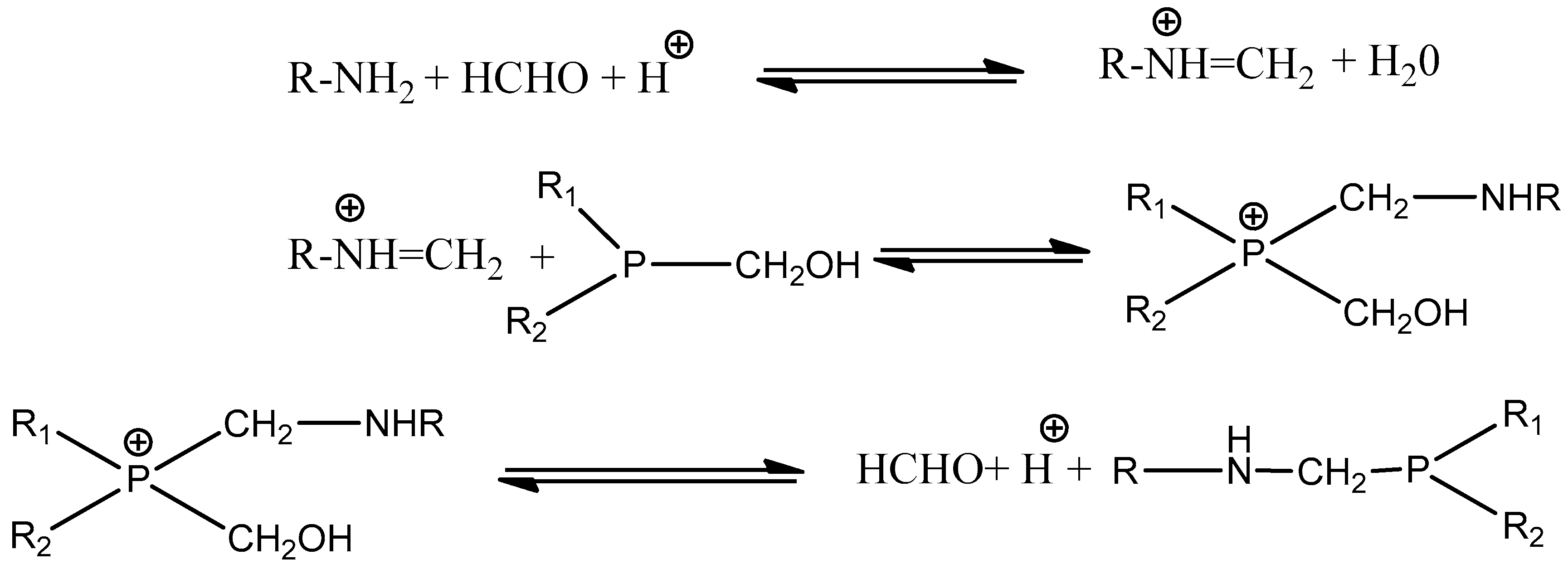
The synthesis of aminomethylphosphines is through a Mannich reaction catalyzed by a Bronsted acid, so THPC can be used as a source of THP and HCl according to the Scheme 3.

2. Results and Discussion

During our work on new Suzuki reactions [4], we have studied the formation of new ligand aminomethylphosphine formed by the reaction of THPC with amines.
A model of this reaction was the reaction of piperidine with THPC in the formation of tris (methylenpiperidine) phosphine. This air-sensitive phosphine has been characterized by its air-stable palladium complex and by oxidation in air-stable tris (methylenpiperidine) phosphine oxide.
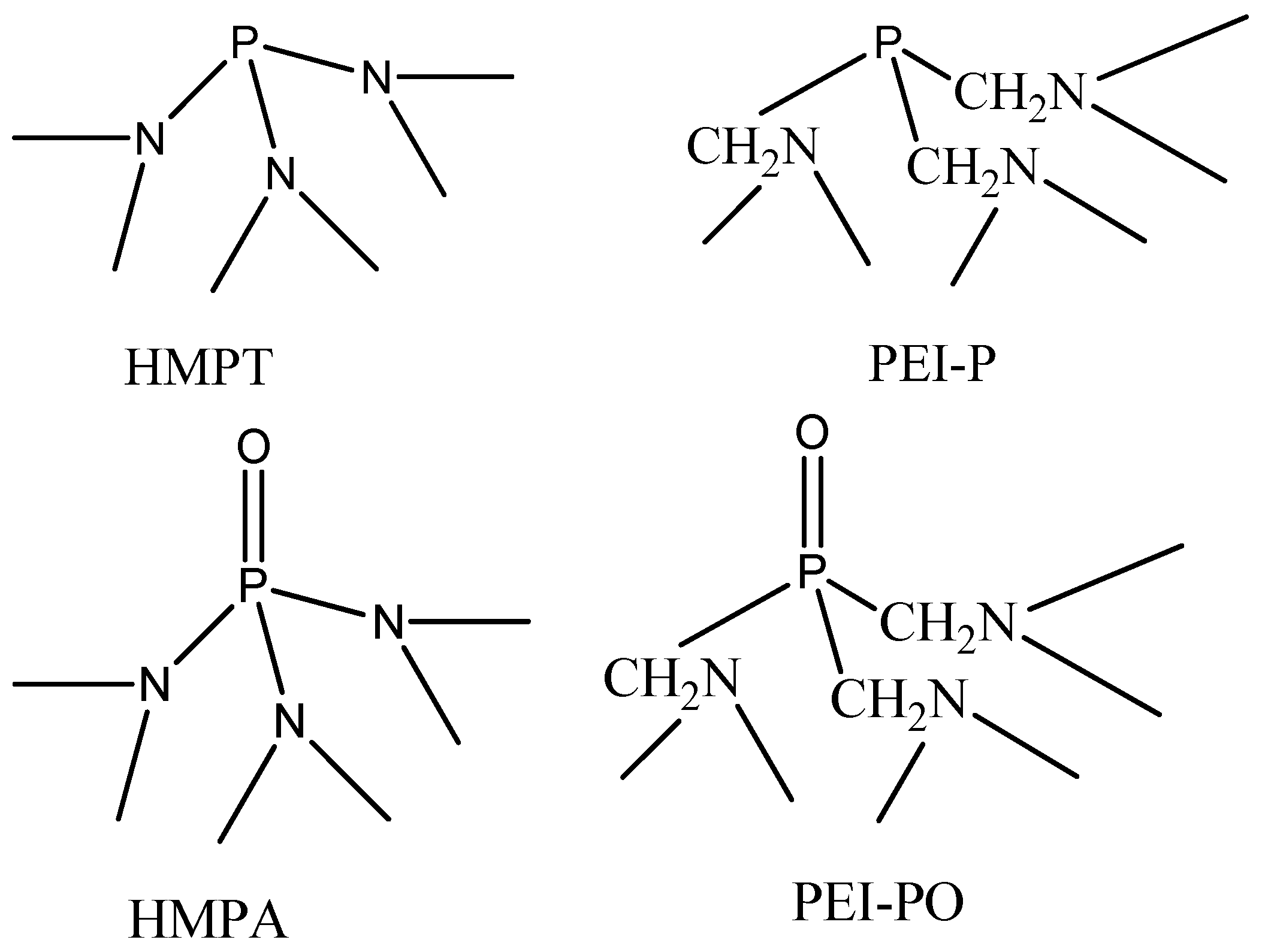
In general, tris (methyleneamine) phosphines are close to HMPT [5], and its oxide is close to HMPA [6], according the Scheme 4, known for its abilities to coordinate metal ions, with phosphine as the soft ligand and phosphine oxide as the hard ligand.
We previously showed that phosphonic PEIs obtained by the Modrizer–Irani reaction (a Mannich-type reaction) are metal-ion-coordinating agents [7]. So, we have explored the use of THPC for cross-linking PEI with phosphine and phosphine oxide bridges.
The reaction of THPC with PEI takes place easily in an aqueous ethanolic solution of PEI under argon in order to obtain phosphine bridges (PEI-P). The reaction was performed with a large amount of PEI generously gifted by BASF (M = 8, 25, 1000, 2000 kD).
During the reaction of THPC with PEI, the NH2 groups (ν = 3147 cm−1) disappeared; also, new OH groups (ν OH = 3147 cm−1) appeared under infrared spectroscopy.
The 31P NMR shows new signals (signals δ = −23.4; −29.4; −33.0 ppm). These are attributed to NHCH2P (CH2OH)2, [NHCH2]2 P CH2OH (bridge), [NHCH2]3 P.
The surface measured by BET also diminishes (10.2 m2g−1 from to 2.6 m2g−1).
All these observations show an incomplete reaction of THPC cross-linking with PEI and the formation of different phosphine groups (PCH2OH and NHCH2 P) on the surface of PEI.
The phosphine groups were oxidized with an aqueous solution of hydrogen peroxide by the phosphine oxide group (PEI-PO) and is characterized by P=O (ν = 1180 cm−1) vibration in infrared and disappearing phosphine signal, and new signals in 31P NMR (signals δ = +24 to +40 ppm) appeared.
The PEI-P rapidly discolored an aqueous solution of colored metallic cations (Cu+2, Co+2, Fe+3, Ru+3,VO2+, Pd+2) and the PEI -PO discolored a Ce+4, UO2 +2, solution.
Quantitative extraction (followed by visible spectrometry in the presence of Arsenazo III lanthanides (Sm+3, La+3, Nd+3) and actinides (UO22, Th+3) was studied at the LSPT (Tlemcen, Algeria) with PEI-PO prepared at LCMT (Caen, France)).

3. Perspectives

The reaction of THPC with PEI allows for numerous applications based on increased metal ion coordination, with cross-linking PEI increasing the strength of PEI polymers. Potential applications include metal extraction using PEI resins [7] or as a selective membrane [8]. The modification of nanoparticles-PEI [9] as a catalyst or extraction agent is also possible, as is modification of PEI for biological applications [10].

4. Experimental

Equipment:
31P NMR spectra were recorded at 100.6 MHz with 1H decoupling on a Bruker DRX 400 instrument. Chemical shifts are expressed in ppm relative to H3PO4. Infrared reflection spectra were recorded on a Perkin-Elmer Spectrum One spectrometer.

4.1. Reaction Model: THPC with Piperidine

4.1.1. Tri (N-Piperidylmethylene) Phosphine

1.36 g (16 mmol, 4 equ) of piperidine was placed in a two-necked flask under argon. The flask was cooled in an ice bath. 952 mg of an aqueous solution of tetrakis (hydroxymethyl) phosphonium chloride (THPC) (4 mmol, 80% aqueous solution) was then slowly added using a syringe. The reaction was highly exothermic and was accompanied by the release of hydrochloric acid. A slightly sticky white solid which was insoluble in water was obtained. Any attempt at purification was impossible since the product oxidizes in air and becomes deliquescent. It should, therefore, be analyzed as soon as it is formed.
[(CH2)5NCH2]3P: RN = 135053-54-2
NMR31P (CDCl3): −62.6 ppm

4.1.2. Tri (N-Piperidylmethylene) Phosphine Oxide

Tri (N-piperidylmethylene) phosphine is dissolved in 10 mL of dichloromethane. 10 mL of 30% hydrogen peroxide was added. The mixture was stirred for a few minutes. The organic phase is collected, dried over magnesium sulfate, filtered, and evaporated. A colorless oil was obtained.
[(CH2)5NCH2]3PO: RN = 2328-96-3
NMR 31P (CDCl3): +50 ppm

4.1.3. Bis (Tri(N-Piperidylmethylene) Phosphine)-Palladium (II) Chloride

355 mg of palladium (II) chloride (2 mmol, 1 equ), dissolved in a minimum of DMF, was added by syringe to tri (N-piperidylmethylene) phosphine (4 mmol, 2 eq) under argon flow. The mixture turned yellow, then, a paste which agglomerated was formed. After stirring overnight at room temperature, a dark precipitate appeared. The precipitate was filtered through a Büchner funnel and washed with ether. 876 mg of a black solid was thus obtained (yield = 53%).
[[(CH2)5NCH2]3P]2 PdCl2
NMR 31P (THF-d8): −2.6 pppm

4.2. THPC with PEI

4.2.1. PEI-Phosphine (PEI-P)

Under argon, THPC (14.3 mL or 19.6 g; 0.08 M 9.928 P) in ethanol (20 mL) was added to a solution of water (100 mL) with ethanol (5.4 L) and PEI 25 kD (29 g) (0.045 eqmol). The mixture formed white foam and was refluxed for 2 h, turning the solution yellow. The solution was evaporated under vacuum at 70 °C, leaving a yellow resin. The pale yellow polymer was washed with water (20 mL) and recovered by centrifugation six times under argon.
  • Analysis: 1.7% of P
  • IR (ATR powder): 3470 cm−1 (OH), 3362 cm−1 (large NH); 710–700 cm−1 (C-P)
  • 31P NMR (H2O, HCl): δ = −23.4; −29.4; −33.0 ppm

4.2.2. PEI-Phosphine Oxide (TEI-PO)

  • IR (ATR powder) 3470 cm−1 (OH), 3362 cm−1 (large NH); 1180 cm−1 (P=O)
  • 31P NMR (H2O, HCl): δ = +24 to +40 ppm

4.3. Preliminary Qualitative Metal Coordination Tests

Aqueous solutions of NiCl2, CoCl2, FeCl3, RuCl3, Na2PdCl4, VOSO4, CeCl4, and UO(C2H3O2)2 were stirred in the presence of PEI-P or PEI-PO until discoloration, demonstrating the ability of these resins to coordinate metal cations.

5. Conclusions

The reaction of THPC with PEI allows increased metal ion coordination; PEI-P is particularly good for coordinating transition metal ions and PEI-PO is very good for the coordination of lanthanides and actinides.

Author Contributions

Conceptualization, D.V.; investigation, A.J., M.A.D. and D.V.; review and editing, D.V. and N.B. Author M.A.D. passed away prior to the publication of this manuscript. All authors have read and agreed to the published version of the manuscript.

Funding

This research received no external funding.

Institutional Review Board Statement

Not applicable.

Informed Consent Statement

Not applicable.

Data Availability Statement

Data sharing does not apply to this paper.

Acknowledgments

The authors thank BASF for their generous gift of PEI.

Conflicts of Interest

The authors declare no conflicts of interest.

References

  1. Hoffman, A. The Action of Hydrogen Phosphide on Formaldehyde. J. Am. Chem. Soc. 1921, 43, 1684–1688, Erratum in J. Am. Chem. Soc. 1930, 52, 2995–2998. https://doi.org/10.1021/ja01370a065.. [Google Scholar] [CrossRef]
  2. Weil, E.D.; Levchik, S.V. Flame retardants in commercial use or development for textiles. J. Fire Sci. 2008, 26, 243–281. [Google Scholar] [CrossRef]
  3. Caporali, M.; Gonsalvi, L.; Zanobini, F.; Peruzzini, M. Synthesis of the Water-Soluble Bidentate (P,N) Ligand PTN(Me). Inorg. Synth. 2011, 35, 92–108. [Google Scholar] [CrossRef]
  4. Jullien, A. Extension du Couplage Aryle-Aryle de Suzuki: Nouvelles Conditions et Synthèse Parallèle. Ph.D. Thesis, University of Caen, Caen, France, 16 December 2004. [Google Scholar]
  5. King, R.B. Complexes of Trivalent Phosphorus Derivatives. II. Metal Carbonyl Complexes of Tris (dimethylamino)-phosphine. Inorg. Chem. 1963, 2, 936–944. [Google Scholar] [CrossRef]
  6. Dykstra, R.R. “Hexamethylphosphoric Triamide” Encyclopedia of Reagents for Organic Synthesis; John Wiley & Sons, Ltd.: Hoboken, NJ, USA, 2001. [Google Scholar] [CrossRef]
  7. Villemin, D.; Monteil, C.; Bar, N.; Didi, M.A. Phosphonated polyethyleneimines (PEIP) as multi-use polymers. Phosphorus Sulfur Silicon Relat. Elem. 2015, 190, 879–890. [Google Scholar] [CrossRef]
  8. Zhang, X.; Zheng, J.; Jin, P.; Xu, D.; Yuan, S.; Zhao, R.; Depuydt, S.; Gao, Y.; Xu, Z.L.; Van Der Bruggen, B. A PEI/TMC membrane modified with an ionic liquid with enhanced permeability and antibacterial properties for the removal of heavy metal ions. J. Hazard. Mater. 2022, 435, 129010. [Google Scholar] [CrossRef] [PubMed]
  9. Monteil, C.; Bar, N.; Moreau, B.; Retoux, R.; Bee, A.; Talbot, D.; Villemin, D. Phosphonated polyethylenimine coated nanoparticles: Elaboration of size and zeta potential adjustable nanomaterials. Part. Part. Syst. Char. 2014, 32, 219–227. [Google Scholar] [CrossRef]
  10. Chen, Z.; Lv, Z.; Sun, Y.; Chi, Z.; Qing, G. Recent advancements in polyethyleneimine-based materials and their biomedical, biotechnology, and biomaterial applications. J. Mater. Chem. B 2020, 8, 2951–2973. [Google Scholar] [CrossRef] [PubMed]
Scheme 1. Formation of THPC chloride.
Chemproc 18 00127 sch001
Scheme 2. THPC in water (equilibrium).
Chemproc 18 00127 sch002
Scheme 3. Mannich condensation of THP with amine.
Chemproc 18 00127 sch003
Scheme 4. Substructure comparison between PEI-P and HMPT; PEI-PO and HPMPA.
Chemproc 18 00127 sch004
Disclaimer/Publisher’s Note: The statements, opinions and data contained in all publications are solely those of the individual author(s) and contributor(s) and not of MDPI and/or the editor(s). MDPI and/or the editor(s) disclaim responsibility for any injury to people or property resulting from any ideas, methods, instructions or products referred to in the content.