
Proceeding Paper

Valorization of Olive Oil Residues: Phytochemical Analysis and Potential Bioactivity †
by
Carlos Alvarez
1,2,*,
Mauricio Bedoya
3,4 and
Margarita Gutiérrez
2
1
Facultad de Ciencias Agrarias y Forestales, Escuela de Ingeniería en Biotecnología, Universidad Católica del Maule, Talca 3460000, Chile
2
Laboratorio de Síntesis Orgánica y Actividad Biológica (LSO-Act-Bio), Instituto de Química de Recursos Naturales, Universidad de Talca, Casilla 747, Talca 3460000, Chile
3
Centro de Investigación de Estudios Avanzados del Maule (CIEAM), Vicerrectoría de Investigación y Postgrado, Universidad Católica del Maule, Talca 3480112, Chile
4
Laboratorio de Bioinformática y Química Computacional (LBQC), Departamento de Medicina Traslacional, Facultad de Medicina, Universidad Católica del Maule, Talca 3480112, Chile
*
Author to whom correspondence should be addressed.
Presented at the 29th International Electronic Conference on Synthetic Organic Chemistry, 14–28 November 2025; Available online: https://sciforum.net/event/ecsoc-29.
Chem. Proc. 2025, 18(1), 122; https://doi.org/10.3390/ecsoc-29-26727
Published: 11 November 2025

Abstract

The valorization of olive oil production residues represents an innovative and sustainable strategy aligned with circular economy principles and the United Nations Sustainable Development Goals. In this study, we aimed to explore the phytochemical composition and neuroprotective potential of organic extracts obtained from olive pomace of the Arbequina and Arbosana cultivars. Extracts were prepared through solid–liquid extraction and analyzed by high-performance liquid chromatography coupled with mass spectrometry (HPLC-MS), enabling the comprehensive identification of bioactive metabolites. The analysis revealed a diverse profile of phenolic compounds, including hydroxytyrosol, tyrosol, and multiple oleuropein derivatives, as well as triterpenic acids such as oleanolic and maslinic acids. These compounds are widely recognized for their antioxidant, anti-inflammatory, and neuroprotective activities. The antioxidant potential of the extracts was evaluated in vitro using DPPH and ABTS radical scavenging assays, showing significant activity comparable to that of standard antioxidants. Moreover, cholinesterase inhibitory assays demonstrated moderate to strong inhibition of acetylcholinesterase, an enzyme implicated in neurodegenerative diseases such as Alzheimer’s disease. To further elucidate the molecular basis of these effects, in silico molecular docking studies were performed on the most abundant compounds, revealing favorable binding affinities and interactions with key active site residues of acetylcholinesterase. Overall, these findings highlight olive pomace as a promising, underutilized source of bioactive compounds with potential applications in the development of functional foods, nutraceuticals, and neuroprotective therapeutic agents. The integration of in vitro and in silico approaches strengthens the evidence supporting the use of these extracts in future biomedical and industrial applications.

1. Introduction

Alzheimer’s disease (AD) is the most common cause of dementia and is strongly linked to cholinergic deficits, particularly reduced acetylcholine in cortical and hippocampal regions [1,2]. Current treatments rely on cholinesterase inhibitors such as donepezil and rivastigmine, which provide only symptomatic relief and often cause adverse effects [3,4], highlighting the need for safer alternatives [5]. Natural products offer structural diversity and multitarget properties [6], with several studies reporting antioxidant, anti-inflammatory, and enzyme-modulating activities [7,8]. Olive-derived matrices are of particular interest due to their richness in polyphenols and triterpenoids [9,10], yet alperujo—the byproduct of olive oil extraction—remains largely unexplored pharmacologically [11].
In Chile, the olive oil industry has expanded significantly, with Arbequina and Arbosana cultivars widely adopted [12,13], leading to increased alperujo generation [14]. Currently treated as waste [15], this residue contrasts with its chemical richness and potential as a source of bioactives [16]. Characterizing alperujo could thus contribute to both sustainability and health innovation [17]. This study aimed to profile the phytochemical composition of Chilean alperujo and evaluate its major metabolites as acetylcholinesterase (AChE) inhibitors using HPLC-MS and molecular docking [18,19], positioning this material as a biotechnological resource rather than a discarded residue [20].

2. Materials and Methods

2.1. Preparation of Extracts

Alperujo from Arbequina and Arbosana varieties was obtained immediately after oil extraction in the Maule region, Chile. The material was air-dried at room temperature, stored under dark and cool conditions, and later processed by two extraction methods. For sonication-assisted extraction, 200 g of dried pomace were suspended in 800 mL of ethanol and treated with a probe sonicator (Model VCX 400, Sonics & Materials, Inc., Newtown, CT, USA) (400 W, 20 kHz) for 30 min [21]. For reflux extraction, 200 g of pomace were mixed with 800 mL of ethanol:water (7:3 v/v) and heated at 70 °C for 1 h [22]. In both cases, extracts were filtered, concentrated under reduced pressure, and lyophilized to yield dry material for subsequent assays.

2.2. Enzymatic Inhibition Assay

The inhibitory activity of olive alperujo extracts against AChE was determined following Ellman’s colorimetric method [23]. Briefly, reactions were performed using acetylthiocholine iodide as substrate and 5,5′-dithiobis-(2-nitrobenzoic acid) (DTNB) as chromogenic reagent [24]. The reaction mixture was incubated with different concentrations of alperujo extracts, and the formation of the yellow 5-thio-2-nitrobenzoate anion was monitored at 405 nm. Galantamine was used as a positive control, showing an IC50 value of 0.101 ± 0.01 µg/mL for AChE inhibition [25]. All assays were performed in triplicate under the same experimental conditions.

IC50 Determination

The half-maximal inhibitory concentration (IC50) values were derived from the enzymatic inhibition data obtained using Ellman’s method [23]. Extracts were evaluated at three concentrations (125, 250, and 500 µg·mL−1). For each concentration (C) and its corresponding percentage inhibition (%I), IC50 values were estimated by fitting the data to the Hill–Langmuir equation:
y   =   V m a x   ×   x ^ n / ( k ^ n   +   x ^ n )
Three IC50 estimates were obtained per sample, one at each tested concentration, and the final IC50 was expressed as the arithmetic mean ± standard deviation of these values. The fitting followed the Hill–Langmuir equation, where y represents the response expressed as percentage inhibition, x is the concentration, Vmax is the maximum response, k corresponds to the IC50 value, and n is the Hill coefficient describing the steepness of the curve.

2.3. Sample Preparation for HPLC-MS

Alperujo extracts from Arbequina and Arbosana cultivars were solubilized with 200 µL of ice-cold 80% acetonitrile. Samples were vortexed and sonicated for 5 min, followed by centrifugation at 10,000× g for 10 min. The supernatant was transferred to HPLC vials and maintained at 8 °C until injection [26].

2.4. HPLC-MS Analysis

Chromatographic separation was carried out on a Luna NH2 column (2.1 × 100 mm, 3 µm; Phenomenex) using hydrophilic interaction chromatography (HILIC) [26]. The mobile phases consisted of:
Solvent A: water + 0.1% acetic acid + 10 mM ammonium acetate.
Solvent B: 99% acetonitrile + 0.1% acetic acid + 10 mM ammonium acetate.
The flow rate was set to 250 µL·min−1, with a column temperature of 40 °C. The injection volume was 3 µL.

2.5. Mass Spectrometry

Data acquisition was performed in both positive and negative ionization modes, across three acquisition segments: (i) system equilibration, (ii) calibrant injection for post-acquisition recalibration, and (iii) MS/MS acquisition of the sample [27].

2.6. Compound Selection and Molecular Modeling

The ten most abundant compounds identified by HPLC from Arbequina and Arbosana alperujo extracts were selected for in silico evaluation [28]. Molecular structures were drawn and optimized in three dimensions using the protein preparation wizard module of the Schrödinger suite 2023-4 (Schrödinger, LLC, New York, NY, 2023). The ligands were prepared through the LigPrep module, ensuring proper protonation states at pH 7.0 and energy minimization using the OPLS_2005 force field [29].

2.7. Protein Preparation

The crystallographic structure of human AChE was retrieved from the RCSB Protein Data Bank (PDB ID: 4BDT). The protein was pre-processed in the protein preparation wizard module, including the assignment of bond orders, addition of missing hydrogen atoms, and optimization of hydrogen bonding networks [30]. Protonation states were assigned at pH 7.0 with PROPKA 3 software [31]. The crystallographic ligand (Huprine W), and water molecules within 5 Å of the co-crystallized ligand were retained. Energy minimization of the hydrogen atoms was performed using the OPLS_2005 force field to relieve structural strain. Prior to molecular docking calculations, the reference ligand was removed from the binding site.

2.8. Docking Protocol

Molecular docking calculations were conducted using the Induced Fit Docking (IFD) protocol [32]. The binding site was defined as the residues located within 5 Å of the co-crystallized ligand Huprine W in the AChE crystal structure. These residues included chain A positions: Asp74, Gly80, Gly82, Thr83, Trp86, Gly120, Gly121, Gly122, Tyr124, Ser125, Leu126, Tyr133, Glu202, Ser203, Ala204, Phe295, Arg297, Tyr337, Phe338, Tyr341, Trp439, Met443, Pro446, His447, Gly448, Tyr449, Ile451. Each ligand was subsequently docked into the catalytic active site (CAS) of AChE, and the resulting complexes were scored based on predicted binding free energy and interaction profiles.

2.9. MM-GBSA Free Energy Calculations

To refine docking results, the binding free energy of each ligand–protein complex was estimated using the Prime MM-GBSA method implemented in Schrödinger [33]. Calculations were performed under the VSGB 2.1 solvation model, and outputs included ΔGbind values, docking scores, and the number of ligand–residue interactions (INT). These results were compared against the docking profile of the reference inhibitor Huprine W to assess relative inhibitory potential.

3. Results and Discussion

3.1. Inhibitory Activity of Alperujo Extracts on AChE

The alperujo extracts from Arbequina and Arbosana displayed concentration-dependent inhibition of AChE across all extraction methods tested (sonication, maceration, reflux). The inhibitory activity at 125, 250, and 500 µg·mL−1 was used to estimate IC50 values. Across samples, IC50 estimates fell in the range of 120–150 µg·mL−1, indicating consistent potency between varieties and extraction modes.
Table 1 summarizes the percentage inhibition at the three tested concentrations and the corresponding IC50 estimates for each extract. Galantamine was included as a positive control.

Effect of Extraction Method

Comparison between extraction procedures revealed distinct extraction efficiencies for bioactive constituents. Reflux produced extracts with lower IC50 values, consistent with the enhanced solubilization of aglycone flavonoids and semi-polar metabolites at elevated temperature [34]. Sonication also yielded potent extracts, likely by disrupting plant tissue and releasing bound compounds [35]. Importantly, Arbequina and Arbosana showed comparable inhibitory capacities, suggesting that varietal differences are secondary to extraction technique in determining inhibitory potency.

3.2. HPLC–MS Metabolite Profiling

High-resolution HILIC–MS analysis revealed a diverse and complex phytochemical profile in both Arbequina and Arbosana alperujo extracts. This analysis enabled the identification of a broad spectrum of metabolites and also provided insights into their relative abundances, which are critical for correlating chemical composition with biological activity. The ten most abundant compounds, ranked by relative intensity, are presented in Table 2.
The compounds identified belong to different chemical families, including flavonoids, phenolic acids, sugars, amines, nucleobases, and iridoid glycosides. Among these, flavonoids such as luteolin and apigenin stand out due to their well-documented capacity to inhibit cholinesterases and their recognized neuroprotective roles in Alzheimer’s disease models [36,37]. Phenolic acids like 3,4-dihydroxyphenylacetic acid and 3-hydroxyphenylacetic acid, although generally weaker inhibitors, may act additively to enhance overall inhibitory activity in complex mixtures. The presence of iridoid glycosides such as loganin further enriches the phytochemical profile, suggesting that the extracts may exert biological effects beyond cholinesterase inhibition, including antioxidant and anti-inflammatory actions.

Linking Phytochemistry and Inhibitory Activity

Among the top metabolites, luteolin (rank 2) and apigenin (rank 6) are particularly notable, as both flavonoids have been consistently associated with AChE inhibition in previous in vitro and in silico studies [38,39]. Their relative abundance in the extracts provides a plausible mechanistic explanation for the observed inhibitory activity. Phenolic acids such as 3,4-dihydroxyphenylacetic acid may further contribute Via weaker, additive effects. Sugars and sugar alcohols (dulcitol, D-tagatose) likely play no direct inhibitory role but indicate the polar nature of the extracts. The presence of loganin (an iridoid glycoside) suggests possible contributions to neuroprotective effects beyond AChE inhibition, although its direct activity against the enzyme is expected to be limited.
Taken together, these results support a model where flavonoid content, particularly luteolin and apigenin, underpins the inhibitory potency of alperujo extracts. Differences in extraction method are therefore expected to reflect the relative enrichment or depletion of these flavonoids, explaining the observed IC50 variations.

3.3. Molecular Docking and MM-GBSA Analysis

To further explore the inhibitory potential of alperujo-derived metabolites, the ten most intense compounds identified by HPLC–MS were individually subjected to molecular docking analysis against AChE [26]. This selection allowed us to assess whether the most intense signals in the chromatographic profile correspond to bioactive molecules or if less abundant compounds are the primary contributors to the inhibitory effect. The docking results, including binding free energy (ΔGbind), number of ligand–protein interactions (INT), and overall ranking, are summarized in Table 3.
Among them, loganin displayed the most favorable interaction profile (ΔGbind = −43.81 kcal·mol−1, 33 interactions), ranking sixth overall in the docking dataset. This result is particularly relevant given its relatively high abundance in alperujo and its structural similarity to other iridoids previously reported as cholinesterase inhibitors.
Flavonoids such as luteolin and apigenin showed intermediate binding affinities (−50.25 and −43.59 kcal·mol−1, respectively), with normalized scores between 0.61 and 0.65. These values, although lower than those of the reference inhibitor huprine (−115.67 kcal·mol−1) are consistent with literature reports where flavonoids contribute significantly to the inhibitory potential of polyphenol-rich extracts.
Sugars and sugar alcohols, including dulcitol and D-tagatose, exhibited weaker affinities (ΔGbind between −18.4 and −19.6 kcal·mol−1) and lower rankings, suggesting they are unlikely to contribute directly to cholinesterase inhibition. Similarly, small nitrogen-containing metabolites such as adenine and N-phenyl diethanolamine displayed modest binding energies (−18.5 and −26.5 kcal·mol−1, respectively), reinforcing the notion that their biological role may be indirect or negligible in this context.
Triethylamine and 3-hydroxyphenylacetic acid also ranked low (ΔGbind = −24.71 and −5.64 kcal·mol−1, respectively), confirming their limited contribution to the overall inhibitory activity. Finally, 34-dihydroxyphenylacetic acid (34_DPA) showed very weak interactions (ΔGbind = −15.68 kcal·mol−1, Rank 83), highlighting its minimal relevance compared to more active phenolics.
This convergence between computational and enzymatic data reinforces the hypothesis that the bioactivity of alperujo arises from the synergistic action of phenolic and iridoid constituents rather than from the dominant sugar fraction.
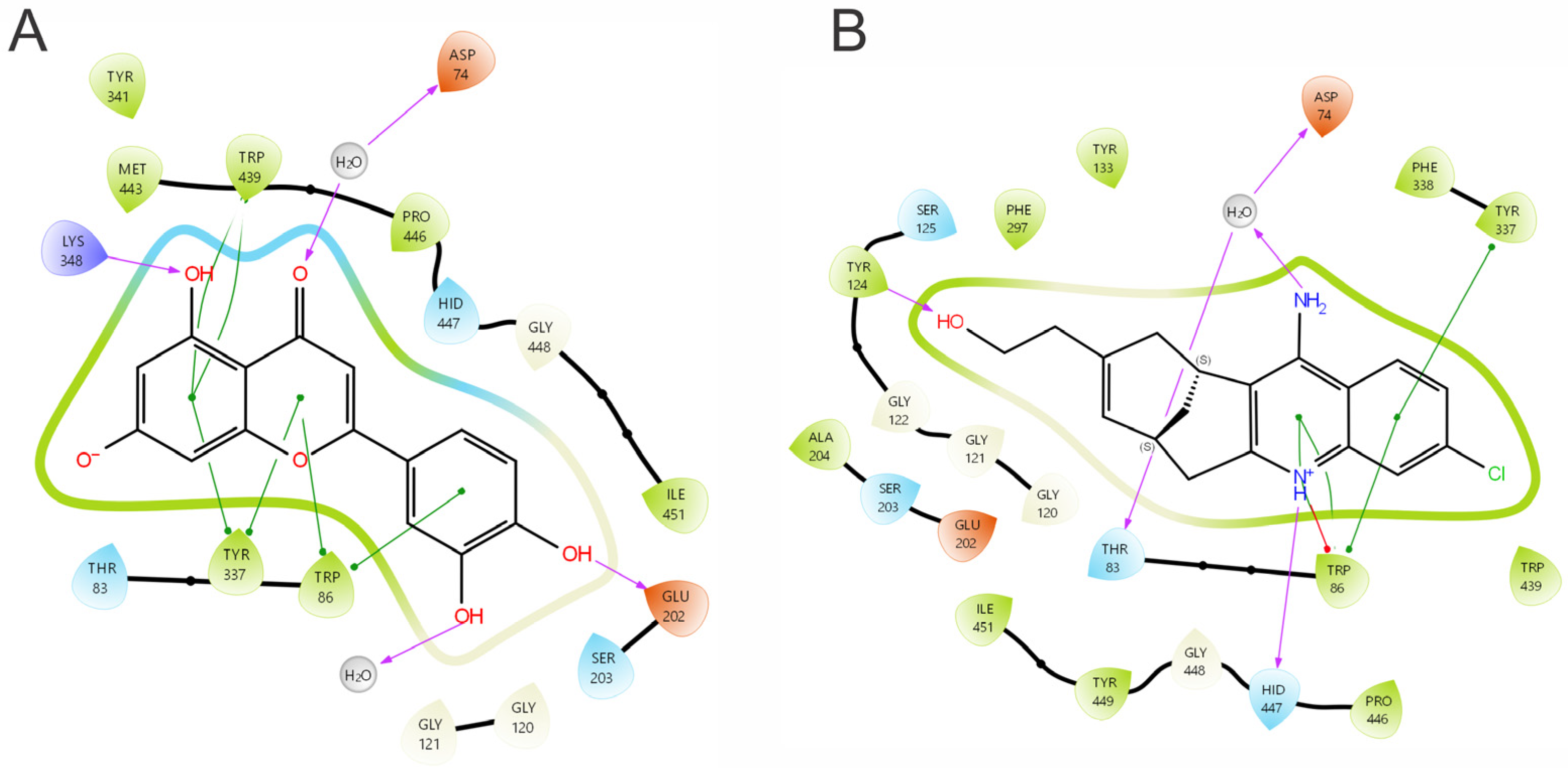
Among the evaluated metabolites, luteolin emerged as one of the most promising ligands in terms of predicted binding affinity and interaction profile. To better understand πits binding mode, a two-dimensional ligand interaction diagram was generated (Figure 1).
The analysis revealed that luteolin engages in a dense interaction network within the enzyme gorge, forming hydrogen bonds with Glu202, Ser203, and Tyr337, and establishing π–π stacking interactions with Trp86 and Tyr341. These residues are of pharmacological relevance because they define both the catalytic anionic site (CAS) and the peripheral anionic site (PAS), two domains that are fundamental for substrate recognition and catalytic turnover. Luteolin’s ability to simultaneously contact residues in both the CAS and PAS suggests that it may function as a dual-site ligand, a mechanism associated with enhanced inhibitory potency. Moreover, interactions with Trp439 and Met443 further stabilize the compound within the gorge, reducing the likelihood of displacement by the natural substrate acetylcholine. When compared to crystallographic data of Huprine W, a reference inhibitor with nanomolar potency, remarkable parallels can be observed. Huprine W is known to anchor through π–π stacking with Trp86 and Tyr337, while establishing hydrogen bonding with Glu202, thereby occupying both the CAS and PAS. The fact that luteolin reproduces these key interactions, despite its lower molecular complexity and natural origin, highlights its potential as a pharmacologically relevant cholinesterase inhibitor. The overlap in binding determinants between luteolin and Huprine W strengthens the mechanistic plausibility of luteolin as a contributor to the inhibitory activity of alperujo extracts, bridging the gap between computational predictions and experimental enzymatic data.

4. Conclusions

The integration of enzymatic inhibition assays, metabolite profiling, and molecular docking provided a coherent view of the cholinesterase inhibitory potential of alperujo extracts. The HPLC–MS results revealed a chemical matrix dominated by sugars, yet docking analyses demonstrated that these abundant metabolites contribute little to the observed activity. Instead, phenolic and iridoid compounds such as luteolin, apigenin, and loganin emerged as the most relevant contributors, showing strong predicted affinities for AChE. Luteolin reproduced several of the critical interactions described for the reference inhibitor Huprine W, including contacts with Trp86, Tyr337, and Glu202, suggesting a dual-site binding mode. This mechanistic alignment between computational predictions and IC50 values measured in vitro underscores the pharmacological relevance of specific secondary metabolites within the extracts, highlighting the potential of alperujo-derived molecules as promising natural scaffolds for the development of cholinesterase inhibitors, and illustrates how agro-industrial byproducts can serve as valuable resources for biomedical research.

Author Contributions

Conceptualization, C.A. and M.B.; methodology, C.A.; software, M.B.; validation, C.A., M.B. and M.G.; formal analysis, C.A.; investigation, C.A.; resources, M.B. and M.G.; data curation, C.A.; writing—original draft preparation, C.A.; writing—review and editing, C.A.; visualization, C.A.; supervision, M.B. and M.G.; project administration, C.A.; funding acquisition, M.B. and M.G. All authors have read and agreed to the published version of the manuscript.

Funding

This research was financially supported by the Chilean National Agency of Research and Development (ANID) through the project ANILLO ACT210025.

Institutional Review Board Statement

Not applicable.

Informed Consent Statement

Not applicable.

Data Availability Statement

The data presented in this study are available upon request from the corresponding author.

Acknowledgments

The authors thank the software access and computer time granted on the high-performance computing cluster at the Laboratorio de Bioinformática y Química Computacional (LBQC) at Universidad Católica del Maule, Chile.

Conflicts of Interest

The authors declare no conflict of interest.

References

  1. Zhang, J.; Zhang, Y.; Wang, J.; Xia, Y.; Zhang, J.; Chen, L. Recent Advances in Alzheimer’s Disease: Mechanisms, Clinical Trials and New Drug Development Strategies. Signal Transduct. Target. Ther. 2024, 9, 211. [Google Scholar] [CrossRef] [PubMed]
  2. Cummings, J.; Osse, A.M.L.; Cammann, D.; Powell, J.; Chen, J. Anti-amyloid monoclonal antibodies for the treatment of Alzheimer’s disease. BioDrugs 2024, 38, 5–22. [Google Scholar] [CrossRef] [PubMed]
  3. Sharma, K. Cholinesterase inhibitors as Alzheimer’s therapeutics. Mol. Med. Rep. 2022, 20, 1479–1487. [Google Scholar] [CrossRef] [PubMed]
  4. Knopman, D.S.; Amieva, H.; Petersen, R.C.; Chételat, G.; Holtzman, D.M.; Hyman, B.T.; Nixon, R.A.; Jones, D.T. Alzheimer disease. Nat. Rev. Dis. Primers 2021, 7, 33. [Google Scholar] [CrossRef]
  5. Liu, P.P.; Xie, Y.; Meng, X.Y.; Kang, J.S. History and progress of hypotheses and clinical trials for Alzheimer’s disease. Signal Transduct. Target. Ther. 2019, 4, 29. [Google Scholar] [CrossRef]
  6. Anighoro, A.; Bajorath, J.; Rastelli, G. Polypharmacology: Challenges and opportunities in drug discovery. J. Med. Chem. 2024, 57, 7874–7887. [Google Scholar] [CrossRef]
  7. Dos Santos, T.C.; Gomes, T.M.; Pinto, B.A.S.; Camara, A.L.; Paes, A.M.A. Naturally occurring acetylcholinesterase inhibitors and their potential use for Alzheimer’s disease therapy. Front. Pharmacol. 2018, 9, 1192. [Google Scholar] [CrossRef]
  8. Smyrska-Wieleba, N.; Mroczek, T. Natural Inhibitors of Cholinesterases: Chemistry, Structure-Activity and Methods of Their Analysis. Int. J. Mol. Sci. 2023, 24, 2722. [Google Scholar] [CrossRef]
  9. Boss, A.; Bishop, K.S.; Marlow, G.; Barnett, M.P.G.; Ferguson, L.R. Evidence to support the anti-cancer effect of olive leaf extract and future directions. Nutrients 2016, 8, 513. [Google Scholar] [CrossRef]
  10. Sahebkar, A.; Soranna, D.; Liu, X.; Thomopoulos, C.; Simental-Mendía, L.E.; Derosa, G.; Maffioli, P.; Parati, G. A systematic review and meta-analysis of randomized controlled trials investigating the effects of supplementation with Nigella sativa (black seed) on blood pressure. J. Hypertens. 2019, 34, 2127–2135. [Google Scholar] [CrossRef]
  11. Brenes, M.; García, A.; García, P.; Rios, J.J.; Garrido, A. Phenolic Compounds in Spanish Olive Oils. J. Agric. Food Chem. 1999, 47, 3535–3540. [Google Scholar] [CrossRef] [PubMed]
  12. Montero, I.; Miranda, M.; Sepúlveda, F.; Arranz, J.; Rojas, C.; Nogales, S. Solar Dryer Application for Olive Oil Mill Wastes. Energies 2015, 8, 14049–14063. [Google Scholar] [CrossRef]
  13. Romero, N.; Saavedra, J.; Tapia, F.; Sepúlveda, B.; Aparicio, R. Influence of agroclimatic parameters on phenolic and volatile compounds of Chilean virgin olive oils and characterization based on geographical origin, cultivar and ripening stage. J. Sci. Food Agric. 2016, 96, 583–592. [Google Scholar] [CrossRef] [PubMed]
  14. ElMekawy, A.; Diels, L.; Bertin, L.; De Wever, H.; Pant, D. Potential Biovalorization Techniques for Olive Mill Biorefinery Wastewater. Biofuel. Bioprod. Biorefin. 2014, 8, 283–293. [Google Scholar] [CrossRef]
  15. Doula, M.K.; Moreno-Ortego, J.L.; Tinivella, F.; Inglezakis, V.J.; Sarris, A.; Komnitsas, K. Olive mill waste: Recent advances for the sustainable development of olive oil industry. Olive Mill Waste 2017, 29–56. [Google Scholar]
  16. Fernández-Lobato, L.; Ruiz-Carrasco, B.; Tostado-Véliz, M.; Jurado, F.; Vera, D. Environmental Impact of the Most Representative Spanish Olive Oil Farming Systems: A Life Cycle Assessment Study. J. Clean. Prod. 2024, 442, 141169. [Google Scholar] [CrossRef]
  17. Quintero-Flórez, A.; Pereira-Caro, G.; Sánchez-Quezada, C.; Moreno-Rojas, J.M.; Gaforio, J.J.; Jimenez, A.; Beltrán, G. Effect of Olive Cultivar on Bioaccessibility and Antioxidant Activity of Phenolic Fraction of Virgin Olive Oil. Eur. J. Nutr. 2018, 57, 1925–1946. [Google Scholar] [CrossRef]
  18. Cheng, G.; Xu, P.; Zhang, M.; Chen, J.; Sheng, R.; Ma, Y. Resveratrol-Maltol Hybrids as Multi-Target-Directed Agents for Alzheimer’s Disease. Bioorg. Med. Chem. 2018, 26, 5759–5765. [Google Scholar] [CrossRef]
  19. Leuci, R.; Brunetti, L.; Poliseno, V.; Laghezza, A.; Loiodice, F.; Tortorella, P.; Piemontese, L. Natural Compounds for the Prevention and Treatment of Cardiovascular and Neurodegenerative Diseases. Foods 2020, 10, 29. [Google Scholar] [CrossRef]
  20. Şahin, S.; Samli, R.; Tan, A.S.B.; Barba, F.J.; Chemat, F.; Cravotto, G.; Lorenzo, J.M. Solvent-free microwave-assisted extraction of polyphenols from olive tree leaves: Antioxidant and antimicrobial properties. Molecules 2017, 22, 1056. [Google Scholar] [CrossRef]
  21. Ellman, G.L.; Courtney, K.D.; Andres, V., Jr.; Featherstone, R.M. A new and rapid colorimetric determination of acetylcholinesterase activity. Biochem. Pharmacol. 1961, 7, 88–95. [Google Scholar] [CrossRef] [PubMed]
  22. Worek, F.; Mast, U.; Kiderlen, D.; Diepold, C.; Eyer, P. Improved determination of acetylcholinesterase activity in human whole blood. Clin. Chim. Acta 1999, 288, 73–90. [Google Scholar] [CrossRef] [PubMed]
  23. Ferreira, D.; Moreira-Silva, D.; Neto, T.; Machado, M.; Sousa, T.; Ribeiro, C.; Sarmento-Ribeiro, A.B.; Castelo-Branco, M.; Domingues, M.R.M. In vitro screening for acetylcholinesterase inhibition and antioxidant activity of Quercus suber cork and corkback extracts. Evid.-Based Complement. Altern. Med. 2020, 2020, 3825629. [Google Scholar] [CrossRef] [PubMed]
  24. Badawy, S.A.; Hassan, A.R.; Abu Bakr, M.S.; Mohammed, A.E.-S.I. UPLC-qTOF-MS/MS Profiling of Phenolic Compounds in Fagonia Arabica L. and Evaluation of Their Cholinesterase Inhibition Potential through in-Vitro and in-Silico Approaches. Sci. Rep. 2025, 15, 5244. [Google Scholar] [CrossRef]
  25. Zhang, Q.W.; Lin, L.G.; Ye, W.C. Techniques for extraction and isolation of natural products: A comprehensive review. Chin. Med. 2018, 13, 20. [Google Scholar] [CrossRef]
  26. Banks, J.L.; Beard, H.S.; Cao, Y.; Cho, A.E.; Damm, W.; Farid, R.; Felts, A.K.; Halgren, T.A.; Mainz, D.T.; Maple, J.R.; et al. Integrated Modeling Program, Applied Chemical Theory (IMPACT). J. Comp. Chem. 2005, 26, 1752. [Google Scholar] [CrossRef]
  27. Madhavi Sastry, G.; Adzhigirey, M.; Day, T.; Annabhimoju, R.; Sherman, W. Protein and ligand preparation: Parameters, protocols, and influence on virtual screening enrichments. J. Comput.-Aided Mol. Des. 2013, 27, 221–234. [Google Scholar] [CrossRef]
  28. Olsson, M.H.M.; Søndergaard, C.R.; Rostkowski, M.; Jensen, J.H. PROPKA3: Consistent Treatment of Internal and Surface Residues in Empirical PKa Predictions. J. Chem. Theory Comput. 2011, 7, 525–537. [Google Scholar] [CrossRef]
  29. Sherman, W.; Day, T.; Jacobson, M.P.; Friesner, R.A.; Farid, R. Novel Procedure for Modeling Ligand/Receptor Induced Fit Effects. J. Med. Chem. 2006, 49, 534–553. [Google Scholar] [CrossRef]
  30. Colovic, M.B.; Krstic, D.Z.; Lazarevic-Pasti, T.D.; Bondzic, A.M.; Vasic, V.M. Acetylcholinesterase inhibitors: Pharmacology and toxicology. Curr. Neuropharmacol. 2013, 11, 315–335. [Google Scholar] [CrossRef]
  31. Milinčić, D.D.; Popović, D.A.; Lević, S.M.; Kostić, A.Ž; Tešić, Ž.L.; Nedović, V.A.; Pešić, M.B. Application of polyphenol-loaded nanoparticles in food industry. Nanomaterials 2019, 9, 1629. [Google Scholar] [CrossRef] [PubMed]
  32. Khemakhem, I.; Ahmad-Qasem, M.H.; Catalán, E.B.; Micol, V.; García-Pérez, J.V.; Ayadi, M.A.; Bouaziz, M. Kinetic Improvement of Olive Leaves’ Bioactive Compounds Extraction by Using Power Ultrasound in a Wide Temperature Range. Ultrason. Sonochem. 2017, 34, 466–473. [Google Scholar] [CrossRef]
  33. Goldsmith, C.D.; Vuong, Q.V.; Stathopoulos, C.E.; Roach, P.D.; Scarlett, C.J. Optimization of the aqueous extraction of phenolic compounds from olive pomace. Antioxidants 2018, 7, 191. [Google Scholar]
  34. López-Lázaro, M. Distribution and biological activities of the flavonoid luteolin. Mini Rev. Med. Chem. 2009, 9, 31–59. [Google Scholar] [CrossRef] [PubMed]
  35. Salehi, B.; Venditti, A.; Sharifi-Rad, M.; Kręgiel, D.; Sharifi-Rad, J.; Durazzo, A.; Lucarini, M.; Santini, A.; Souto, E.B.; Novellino, E.; et al. The therapeutic potential of apigenin. Int. J. Mol. Sci. 2019, 20, 1305. [Google Scholar] [CrossRef]
  36. Yao, Z.-H.; Yao, X.-L.; Zhang, Y.; Zhang, S.-F.; Hu, J.-C. Luteolin Could Improve Cognitive Dysfunction by Inhibiting Neuroinflammation. Neurochem. Res. 2018, 43, 806–820. [Google Scholar] [CrossRef]
  37. Kwon, S.H.; Ma, S.X.; Hong, S.I.; Kim, S.Y.; Lee, S.Y.; Jang, C.G. Loganin improves learning and memory impairments induced by scopolamine in mice. Eur. J. Pharmacol. 2009, 619, 44–49. [Google Scholar] [CrossRef]
  38. Uriarte-Pueyo, I.; Calvo, M.I. Flavonoids as acetylcholinesterase inhibitors. Curr. Med. Chem. 2011, 18, 5289–5302. [Google Scholar] [CrossRef]
  39. Cheung, J.; Rudolph, M.J.; Burshteyn, F.; Cassidy, M.S.; Gary, E.N.; Love, J.; Franklin, M.C.; Height, J.J. Structures of human acetylcholinesterase in complex with pharmacologically important ligands. J. Med. Chem. 2012, 55, 10282–10286. [Google Scholar] [CrossRef]
Figure 1. Comparative 2D ligand interaction diagrams of Luteolin (A) and Huprine W (B) bound to AChE, the hydrogen bonds are shown in thin purple arrows, the π-π stacking interactions are shown in thin dark green lines with dots, the hydrophobic and polar interactions are shown in thick green and blue lines respectively.
Chemproc 18 00122 g001
Table 1. Inhibition of AChE by Arbequina and Arbosana alperujo extracts obtained through different extraction methods. IC50 values were estimated from inhibition at 125, 250, and 500 µg·mL−1.
Sample%Inhibition 500 µg·mL−1%Inhibition 250 µg·mL−1%Inhibition 125 µg·mL−1Estimated IC 50 (µg·mL−1)
Sonicated Arbequina80.9863.0347.50161.2 ± 0.30
Sonicated Arbosana80.8165.6447.85146.7 ± 1.08
Reflux
Arbequina
80.7563.8153.13372.3 ± 0.44
Reflux
Arbosana
83.2163.9749.19233.8 ± 0.46
Galantamine---0.101 ± 0.01
Table 2. Top Ten most intense compounds identified in Arbequina/Arbosana alperujo extracts by HPLC–MS. RT refers to retention time (minutes); m/z meas. corresponds to the measured mass-to-charge ratio of the precursor ion; M meas. indicates the measured molecular mass; Formula represents the molecular formula of the putatively identified compound.
RankRT (min)m/z meas.M meas.CompoundFormulaIntensity 1
14.59181.072182.079DulcitolC6H14O6640,879/286,162
27.79285.041286.048LuteolinC15H10O6212,976/203,961
34.38167.035168.0423,4-Dihydroxyphenylacetic acidC8H8O4118,219/123,467
45.75179.056180.065D-TagatoseC6H12O638,916/68,465
50.98102.127101.120TriethylamineC6H15N41,477/46,029
64.53269.046270.054ApigeninC15H10O527,190/45,961
70.91182.118181.110N-PhenyldiethanolamineC10H15NO219,824/14,083
82.23136.061135.054AdenineC5H5N511,019/12,190
91.39153.055152.0473-Hydroxyphenylacetic acidC8H8O34471/6054
101.32391.158390.151LoganinC17H26O103925/5062
1 Values are expressed as intensity in Arbequina/Arbosana order.
Table 3. Docking results of the ten most intense alperujo-derived compounds identified by HPLC–MS against AChE, including Huprine W as reference inhibitor. ΔGbind: calculated binding free energy; INT: number of protein–ligand interactions with residues of the binding site.
CompoundΔGbind 1INT
Loganin−43.8133
Luteolin−50.2527
Apigenin−43.5926
Dulcitol−18.4028
D-tagatose−19.5826
3-Hydroxyphenylacetic acid−5.6422
Adenine−18.4925
N-Phenyldiethanolamine−26.4921
Triethylamine−24.7123
3,4-Dihydroxyphenylacetic acid−15.6815
Huprine W−115.6734
1 Binding free energy (ΔGbind) values are expressed in kcal·mol−1.
Disclaimer/Publisher’s Note: The statements, opinions and data contained in all publications are solely those of the individual author(s) and contributor(s) and not of MDPI and/or the editor(s). MDPI and/or the editor(s) disclaim responsibility for any injury to people or property resulting from any ideas, methods, instructions or products referred to in the content.