
Proceeding Paper

Computational Insights into the Antimalarial Potential of Phytochemicals from Centella asiatica: A Molecular Docking Approach †
Department of Pharmaceutical Sciences and Technology, Birla Institute of Technology, Mesra 835215, Jharkhand, India
*
Author to whom correspondence should be addressed.
Presented at the 29th International Electronic Conference on Synthetic Organic Chemistry, 14–28 November 2025; Available online: https://sciforum.net/event/ecsoc-29.
Chem. Proc. 2025, 18(1), 123; https://doi.org/10.3390/ecsoc-29-26912
Published: 13 November 2025

Abstract

Parasitic diseases are some of the most lethal and pervasive infections globally, causing millions of cases of morbidity and mortality annually. Plasmodium falciparum is the predominant vector-borne pathogen, resulting in 0.5 million fatalities annually. Malaria, caused by Plasmodium falciparum, continues to be a significant worldwide health issue, requiring the development of novel treatment medicines to address increasing medication resistance. This study undertakes a focused in silico screening of phytochemicals derived from Centella asiatica against dihydrofolate reductase-thymidylate synthase (PfDHFR-TS), represented by PDB ID: 3BWK. This work investigated molecular modelling to clarify the probable mechanism of its anti-malarial activity through the suppression of falciparum proteins. Campesterol exhibits a maximal binding affinity (docking score: −8.6 Kcal/mol) for FP-2 from Plasmodium falciparum, as determined by our molecular docking investigation of 15 bioactive compounds from Centella asiatica. However, Ursolic acid and rutin also showed potential activity with significant docking scores (−8.5 and 8.4 Kcal/mol). Campesterol, recognized as a possible inhibitor of falciparum, offers a viable pathway for the treatment of malaria, necessitating additional investigation into its therapeutic use. This research provides significant insights into the molecular interactions between phytochemicals, facilitating innovative and successful strategies for malaria treatment. Our research indicates that polyphenols derived from Centella asiatica exhibit significant pharmacological potential against several biological targets.

1. Introduction

Plasmodium falciparum is the most lethal vector-borne infectious agent, responsible for approximately half a million deaths annually. This single-celled eukaryotic parasite has a complex life cycle and is an obligate intracellular pathogen that infects both liver cells (hepatocytes) and red blood cells (erythrocytes). Its rapid replication within erythrocytes—occurring every 48 h—leads to swift disease progression and exponential parasite growth [1]. The infection can result in severe complications such as cerebral malaria and profound anemia, often culminating in death. Among all pathogens, P. falciparum has exerted the greatest evolutionary pressure on the human genome, particularly in regions where malaria is endemic. Despite the availability of curative treatments, there is currently no universally effective vaccine. The World Health Organization reported an estimated 212 million malaria cases and 429,000 related deaths in 2020, underscoring the persistent global burden of this disease [1,2].
The urgent need for new antimalarial therapies has led researchers to explore traditional medicinal practices as potential sources of novel compounds [3,4]. One promising avenue involves targeting parasite-specific enzymes such as falcipain-2 (FP-2) and falcipain-3 (FP-3), which belong to the papain family of cysteine proteases. These enzymes play a critical role in the parasite’s digestion of host hemoglobin within its food vacuole, a process essential for nutrient acquisition and red blood cell rupture. FP-2, in particular, is the primary hemoglobin-degrading enzyme and has emerged as a key therapeutic target. Its inhibition disrupts hemoglobin breakdown, impairs parasite development, and prevents host cell invasion [5,6].
Because hemoglobin is vital for oxygen transport in the human body, its degradation contributes significantly to the pathology of malaria. Monitoring FP-2 activity can also serve as a biomarker for parasite proliferation. Hb, a protein found in red blood cells, transports oxygen throughout our organs and tissues and returns carbon dioxide to the lungs: host cell invasion, Hb degradation, and protein trafficking. Consequently, interfering with the crucial indicator protein FP2, which is used to monitor the spread of malaria parasites, leads to the creation of antimalarial medications [7]. The bulk of this complex is composed of the haem-purifying protein, which includes the cysteine proteases FP2 and the aspartic proteases plasmepsins (Plms) II and IV. Additionally, Plms IV is present in the Pf digestive vacuole [8,9].
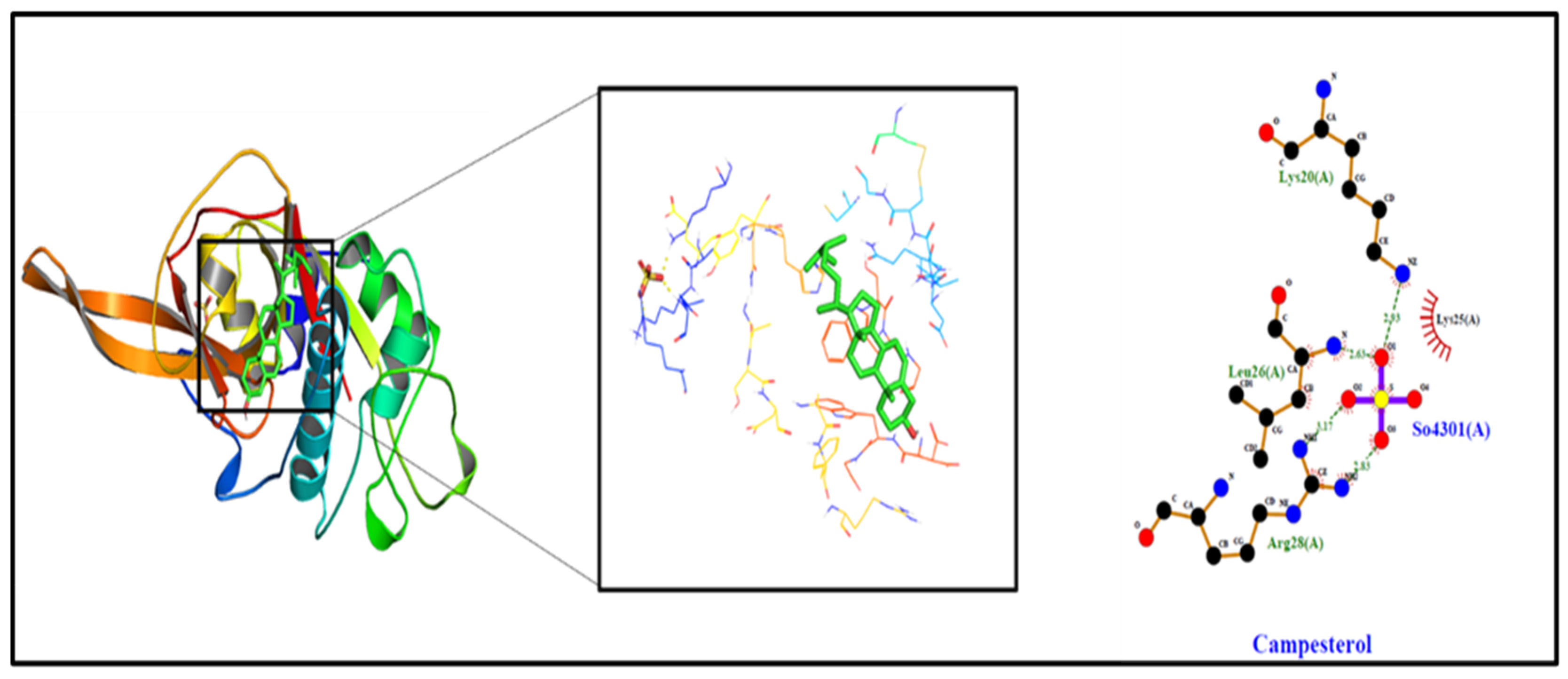
In this study, falcipain-2 (FP2), represented by the crystal structure 3BWK, was computationally docked with a set of 15 anti-malarial polyphenols to evaluate their binding efficiency and therapeutic potential. The analysis revealed that compounds such as Campesterol, Ursolic acid, Rutin, and β-sitosterol exhibited the strongest interactions, with binding energies ranging from −8.4 to −8.6 kcal/mol, as illustrated in Figure 1. These findings suggest that these polyphenols may serve as promising candidates for inhibiting FP2 activity. Notably, Campesterol, derived from Centella asiatica, demonstrated significant binding affinity, and to the best of current knowledge, its antimalarial properties have not been previously documented. This highlights its potential as a novel lead compound for future drug development efforts targeting malaria.

2. Materials and Methods

2.1. Molecular Docking

Centella asiatica is a well-known set for this research. Protein preparation, ligand preparation, receptor grid construction, ligand docking procedure, and docking results viewing are the five main steps in molecular docking. Each and every structure that was required was drawn using “ChemDraw ultra latest version software 9.0.” The Protein Data Bank (PDB database, https://www.rcsb.org, accessed on 16 September 2025) provided the Plasmodium falciparum (3D) crystal structures. The docking was then performed with the software ‘Autodock’ Vina 1.2.0. Finally, the visualization was performed with the PyMOL LigPlot + 2.2.4 [10,11,12].

2.2. In Silico Drug-likeness and ADMET Analysis

The top hits were further analyzed for in silico pharmacokinetics using ‘SwissADME’ (http://www.swissadme.ch, accessed on 20 September 2025). The toxicity parameters were then assessed using toxicity assessments, conducted using ‘admetSAR’ (https://lmmd.ecust.edu.cn/admetsar3/predict.php, accessed on 20 September 2025).

2.3. Boiled Egg Model Analysis

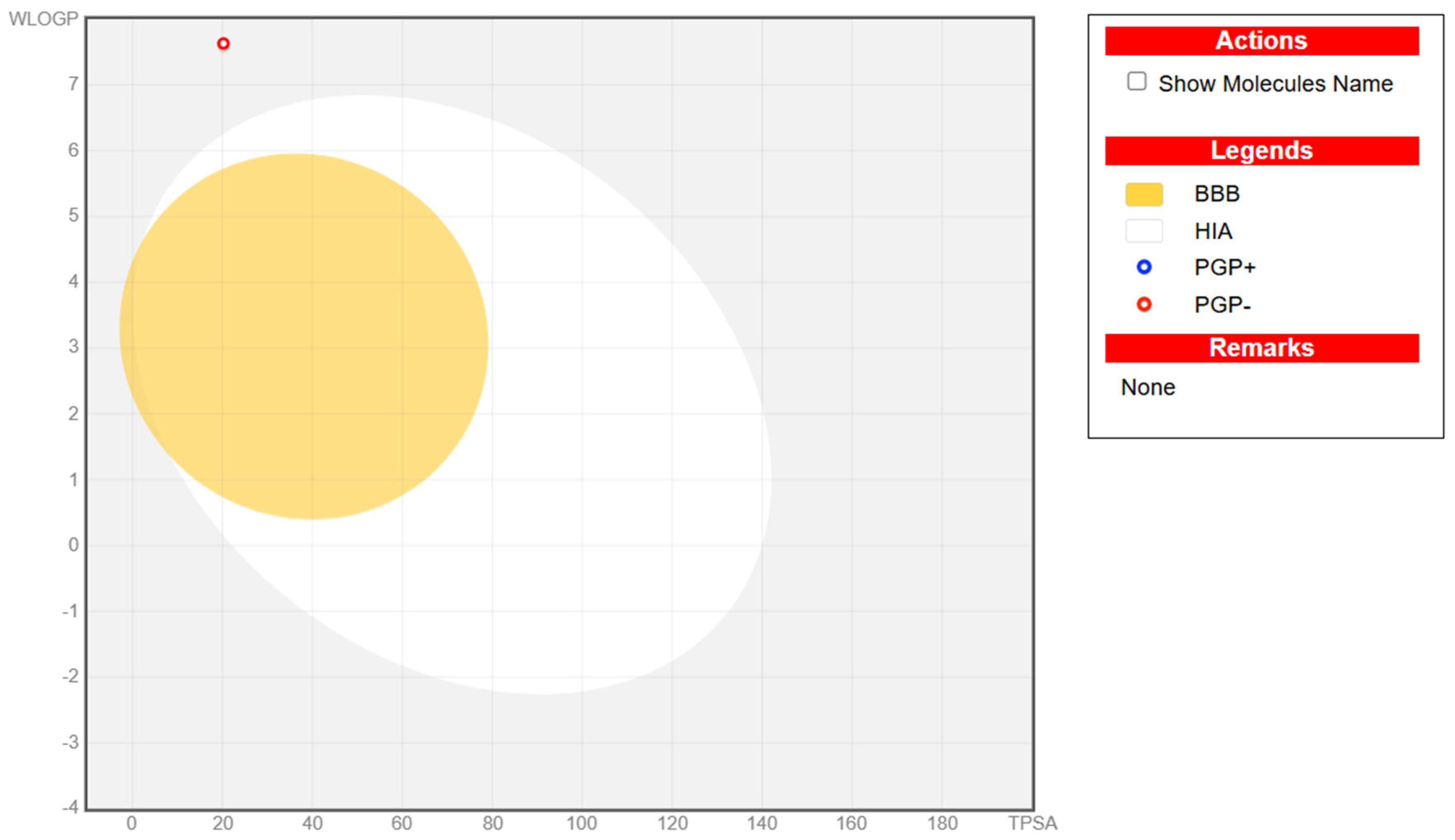
Brain access and gastrointestinal absorption are two pharmacokinetic behaviours that must be estimated at various stages of the drug development process. This led to the development of the Brain or Intestinal Estimated Permeation technique (BOILED-Egg), an accurate predictive model. It calculates the polarity and lipophilicity of small molecules. Because of the model’s speed, accuracy, conceptual simplicity, and simply comprehensible graphical output, the same two physicochemical properties produce contemporaneous predictions for intestinal and brain penetration that can be readily translated into the molecular design. Filtering chemical libraries in the early phases of drug discovery or assessing drug candidates for development are just two examples of the various applications for the BOILED-Egg paradigm.

3. Results and Discussion

3.1. Molecular Docking Simulations

The dataset of 15 molecules was analyzed against Falcipain-3 with its inhibitor (3BWK). Out of 15 phytomolecules, the docking analysis showed that Campesterol interacts predominantly with the amino acid residues Lys20, Leu26, and Arg28, forming a network of hydrogen bonds, van der Waals forces, and π–π interactions. The ligand–protein complex also involved electrostatic stabilization, contributing to the overall binding affinity as mentioned in Table 1. The standard Chloroquine (docking score: −5.5 kcal/mol) had lesser affinity as compared with Campesterol (docking score: −8.6 kcal/mol) against the falcipain-3. Additionally, Ursolic acid, Rutin, and β-β-sitosterol also showed high binding affinity. Interestingly, Falcipain-3 is a critical cysteine protease in Plasmodium falciparum involved in hemoglobin degradation within the parasite’s food vacuole. Its inhibition disrupts the parasite’s metabolic pathways, making it an attractive target for drug development. The co-crystal structure (3BWK) with its known inhibitor indicates that Falcipain-3 possesses both an active site and an allosteric site, where ligand binding induces conformational flexibility that enhances substrate accessibility. The hydrogen bonding observed between Campesterol and Arg28 (distance ~2.83 Å), Leu26 (distance ~2.63 Å), and Lys20 (distance ~2.93 Å) indicates strong stabilizing interactions within the binding pocket. The docking results are consistent with earlier reports highlighting the pharmacological importance of phytosterols like Campesterol, which have demonstrated anti-inflammatory, immunomodulatory, and antiparasitic activities. The ability of Campesterol to bind to both the active and allosteric sites of Falcipain-3 may provide a synergistic inhibitory pattern, offering a promising approach to overcome resistance mechanisms often seen with single-site inhibitors.

3.2. In Silico ADMET Profile

Cytochrome P450 (CYP) enzymes play a key role in the metabolism of xenobiotics, including drugs and phytochemicals. Predicting the inhibitory potential of candidate compounds against major CYP isoforms is essential for evaluating possible drug–drug interactions and metabolic liabilities in Table 2 and Figure 2. In this study, the CYP inhibition profiles of selected phytoconstituents of Centella asiatica were predicted using the SwissADME platform, focusing on five key isoforms: CYP1A2, CYP2C19, CYP2C9, CYP2D6, and CYP3A4. In silico ADMET profiling of Campesterol, Ursolic acid, and Rutin revealed low gastrointestinal absorption and lack of blood–brain barrier permeation for all three compounds, suggesting limited oral bioavailability but low central nervous system liability. Rutin was identified as a P-glycoprotein (P-gp) substrate, which may further reduce absorption, whereas none of the compounds showed inhibitory activity against the major CYP isoforms, indicating a low risk of CYP-mediated drug–drug interactions. Drug-likeness evaluation demonstrated that Campesterol and Ursolic acid complied with Lipinski’s rule of five, while Rutin failed most drug-likeness filters due to its high polarity. Predicted oral toxicity classified campesterol (LD50: 890 mg/kg) and ursolic acid (LD50: 2000 mg/kg) as toxicity class 4, and rutin (LD50: 5000 mg/kg) as class 5, suggesting that rutin is the least toxic. Overall, the results indicate that these phytoconstituents are relatively safe, although formulation strategies may be required to improve their bioavailability.

4. Conclusions

The in silico evaluation of Centella asiatica phytochemicals against Falcipain-3 (3BWK) revealed promising binding interactions, supporting their potential as antimalarial agents. ADMET predictions indicated low gastrointestinal absorption and no blood–brain barrier permeation, suggesting limited oral bioavailability but reduced CNS liability. All three compounds were non-inhibitors of major CYP isoforms and showed no AMES toxicity, no carcinogenicity, and minimal hERG inhibition risk. Together, the docking and ADMET results highlight these phytochemicals as safe candidates with potential for further development as antimalarial agents.

Author Contributions

Conceptualization, S.Y., S.D., and A.P.; methodology, S.Y., S.D., and A.P.; writing—original draft preparation, S.Y., S.D., and A.P.; writing—review and editing, S.Y., S.D., and A.P. All authors have read and agreed to the published version of the manuscript.

Funding

This research received no external funding.

Institutional Review Board Statement

Not applicable.

Informed Consent Statement

Not applicable.

Data Availability Statement

The original contributions presented in this study are included in the article. Further inquiries can be directed to the corresponding author.

Conflicts of Interest

The authors declare no conflicts of interest.

References

  1. World Health Organization. WHO technical brief for countries preparing malaria funding requests for the Global Fund (2020–2022). In WHO Technical Brief for Countries Preparing Malaria Funding Requests for the Global Fund (2020–2022); World Health Organization: Geneva, Switzerland, 2020. [Google Scholar]
  2. Obonti, A.T.; Alam, S.; Kamal, T.B.; Zaman, A.; Hasnat, H.; Saha, T.; Islam, M.A. Prospective plants with corroborated antimalarial actions: A review. Bangladesh Pharm. J. 2021, 24, 180–193. [Google Scholar] [CrossRef]
  3. Melo, P.M.; Maluf, S.E.C.; Azevedo, M.F.; Paschoalin, T.; Budu, A.; Bagnaresi, P.; Henrique-Silva, F.; Soares-Costa, A.; Gazarini, M.L.; Carmona, A.K. Inhibition of Plasmodium falciparum cysteine proteases by the sugarcane cystatin CaneCPI-4. Parasitol. Int. 2018, 67, 233–236. [Google Scholar] [CrossRef] [PubMed]
  4. Venditti, A. What is and what should never be: Artifacts, improbable phytochemicals, contaminants and natural products. Nat. Prod. Res. 2020, 34, 1014–1031. [Google Scholar] [CrossRef]
  5. Chen, D.; Oezguen, N.; Urvil, P.; Ferguson, C.; Dann, S.M.; Savidge, T.C. Regulation of protein-ligand binding affinity by hydrogen bond pairing. Sci. Adv. 2016, 2, e1501240. [Google Scholar] [CrossRef]
  6. Bouchut, A.; Rotili, D.; Pierrot, C.; Valente, S.; Lafitte, S.; Schultz, J.; Hoglund, U.; Mazzone, R.; Lucidi, A.; Fabrizi, G.; et al. Identification of novel quinazoline derivatives as potent antiplasmodial agents. Eur. J. Med. Chem. 2019, 161, 277–291. [Google Scholar] [CrossRef] [PubMed]
  7. Rajguru, T.; Bora, D.; Modi, M.K. Identification of promising inhibitors for Plasmodium haemoglobinase Falcipain-2, using virtual screening, molecular docking, and MD Simulation. J. Mol. Struct. 2022, 1248, 131427. [Google Scholar] [CrossRef]
  8. Lehmann, C.; Heitmann, A.; Mishra, S.; Burda, P.C.; Singer, M.; Prado, M.; Niklaus, L.; Lacroix, C.; Menard, R.; Frischknecht, F.; et al. A cysteine protease inhibitor of plasmodium berghei is essential for exo-erythrocytic development. PLoS Pathog. 2014, 10, e1004336. [Google Scholar] [CrossRef]
  9. Fagnidi, Y.K.H.; Toi, B.; Megnassan, E.; Frecer, V.; Miertuš, S. In silico design of Plasmodium falciparum cysteine protease falcipain 2 inhibitors with favorable pharmacokinetic profile. J. Anal. Pharm. Res. 2018, 7, 298–309. [Google Scholar] [CrossRef][Green Version]
  10. Mishra, V.R.; Ghanavatkar, C.W.; Mali, S.N.; Qureshi, S.I.; Chaudhari, H.K.; Sekar, N. Design, synthesis, antimicrobial activity and computational studies of novel azo linked substituted benzimidazole, benzoxazole and benzothiazole derivatives. Comput. Biol. Chem. 2019, 78, 330–337. [Google Scholar] [CrossRef]
  11. Anuse, D.G.; Mali, S.N.; Thorat, B.R.; Yamgar, R.S.; Chaudhari, H.K. Synthesis, SAR, in silico appraisal and anti-microbial study of substituted 2-aminobenzothiazoles derivatives. Curr. Comput.-Aided Drug Des. 2020, 16, 802–813. [Google Scholar] [CrossRef]
  12. Desale, V.J.; Mali, S.N.; Thorat, B.R.; Yamgar, R.S. Synthesis, admetSAR predictions, DPPH radical scavenging activity, and potent anti-mycobacterial studies of hydrazones of substituted 4-(anilino methyl) benzohydrazides (Part 2). Curr. Comput.-Aided Drug Des. 2021, 17, 493–503. [Google Scholar] [CrossRef] [PubMed]
Figure 1. The 2D and 3D interaction profiles for the best docked compound, Campesterol.
Chemproc 18 00123 g001
Figure 2. BOILEDEgg model analysis for the phytochemical Campesterol.
Chemproc 18 00123 g002
Table 1. Docking score analysis of selected phytochemicals and standard drugs for antimalarial potential.
PhytochemicalsTitle 2
Campesterol−8.6
Ursolic acid−8.5
Rutin−8.4
β-Sitosterol−8.3
Castillicetin−8.2
Quercetin−8.1
Asiaticoside−8.1
Madecassoside−8
Asiatic acid−7.9
Madecassic acid−7.9
Castilliferol−7.7
Kampeferol−7.6
Stigmasterol−7.6
Ferulic acid−5.8
Chloroquine (Standard)−5.5
Table 2. In silico ADMET profiling for the top best docked score against 3BWK.
PropertiesCampesterolUrsolic AcidRutin
GI absorptionLowLowLow
BBB permeantNoNoNo
P-gp substrateNoNoYes
CYP1A2 inhibitorNoNoNo
CYP2C19 inhibitorNoNoNo
CYP2C9 inhibitorNoNoNo
CYP2D6 inhibitorNoNoNo
CYP3A4 inhibitorNoNoNo
LipinskiYesYesNo
GhoseYesNoNo
VeberNoYesNo
EganNoNoNo
Blood–Brain Barrier---
Toxicity Class445
LD50890 mg/kg2000 mg/kg5000 mg/kg
Note: Class 1: fatal if swallowed (LD50 ≤ 5), Class 2: fatal if swallowed (5 < LD50 ≤ 50), Class 3: toxic if swallowed (50 < LD50 ≤ 300), Class 4: harmful if swallowed (300 < LD50 ≤ 2000), Class 5: may be harmful if swallowed (2000 < LD50 ≤ 5000), Class 6: non-toxic (LD50 > 5000).
Disclaimer/Publisher’s Note: The statements, opinions and data contained in all publications are solely those of the individual author(s) and contributor(s) and not of MDPI and/or the editor(s). MDPI and/or the editor(s) disclaim responsibility for any injury to people or property resulting from any ideas, methods, instructions or products referred to in the content.